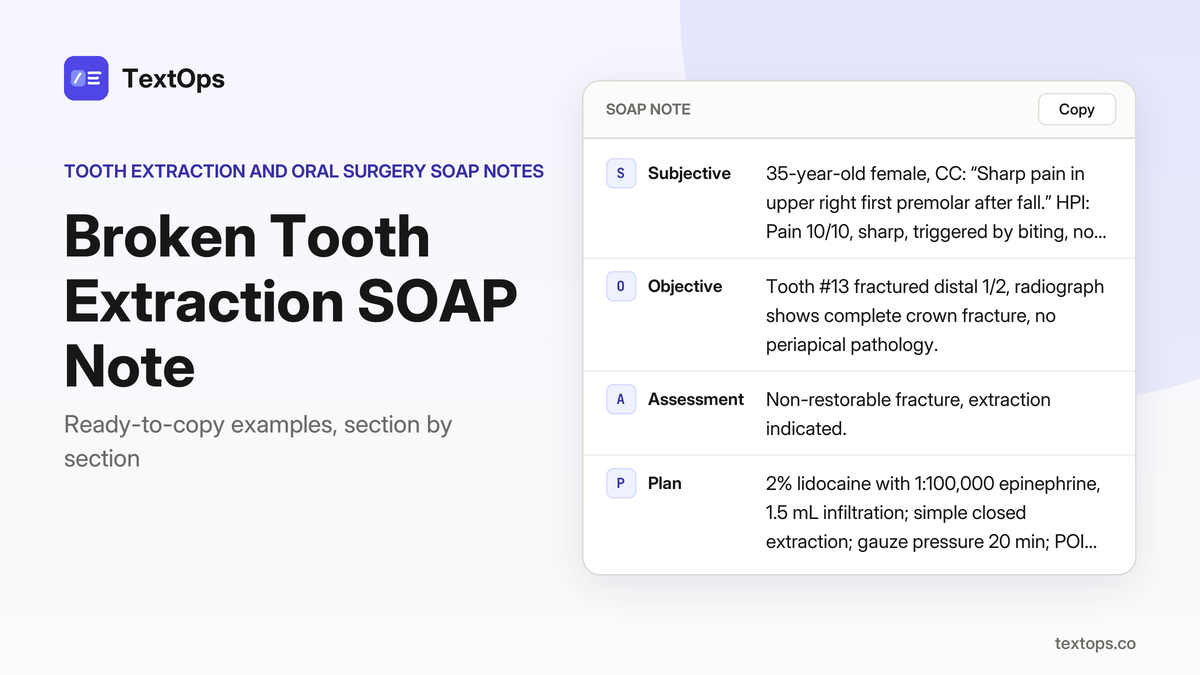
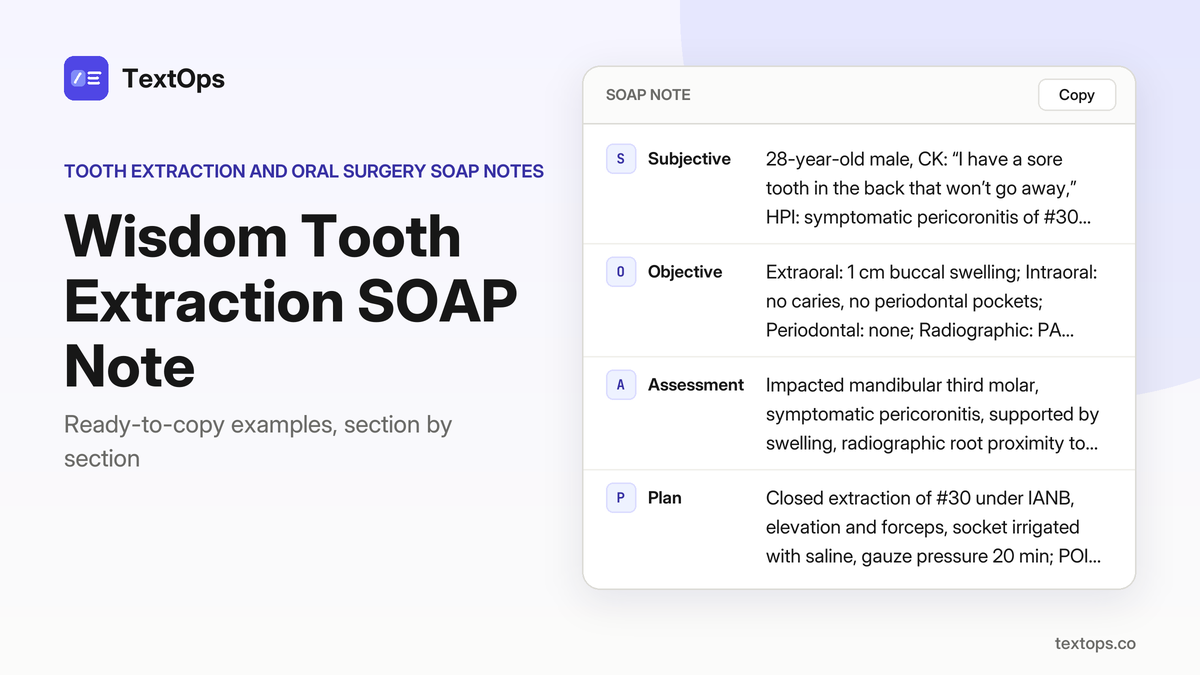
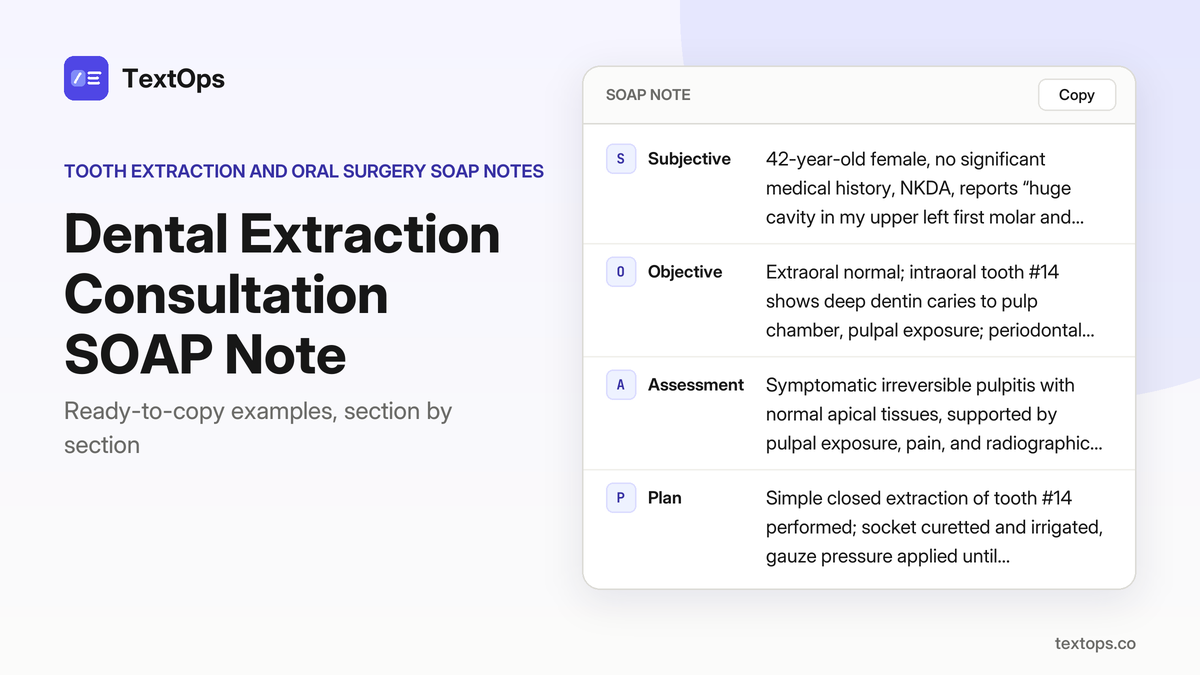
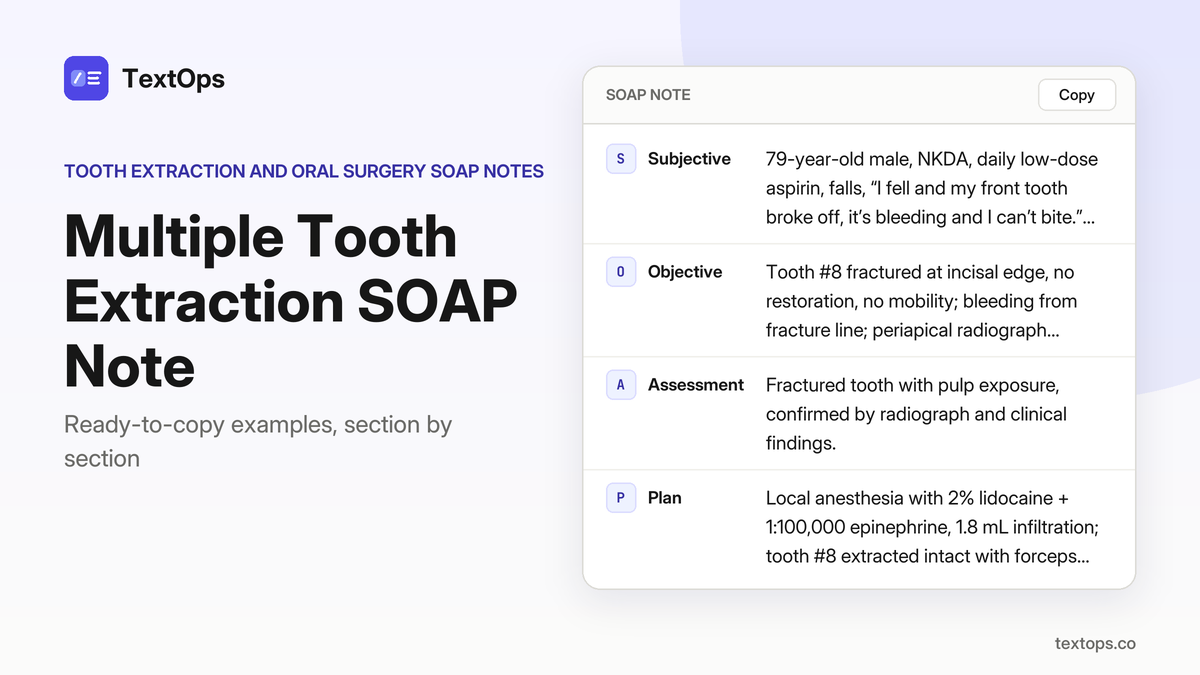
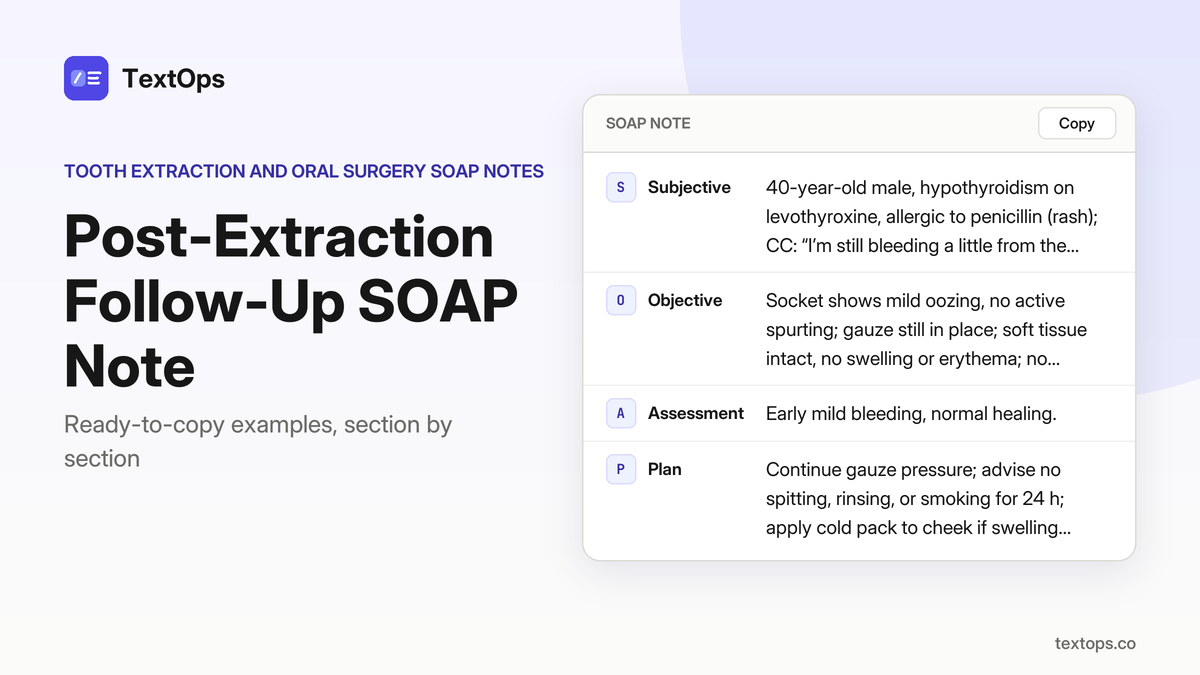
Fully populated SOAP note templates for impacted wisdom tooth extractions are available. Each note is copy-ready and includes every required section: S, O, A, P. Patient demographics, medical history, anesthesia details, surgical steps, post-operative instructions and complication management are pre-filled, ready for immediate use.
Initial Wisdom-Tooth Extractions
Adult Male, 28, First Visit – Impacted 38
SOAP note
SSubjective
28-year-old male, CK: “I have a sore tooth in the back that won’t go away,” HPI: symptomatic pericoronitis of #30, PMH: controlled hypertension on lisinopril, NKDA.
OObjective
Extraoral: 1 cm buccal swelling; Intraoral: no caries, no periodontal pockets; Periodontal: none; Radiographic: PA shows #30 mesioangular, Pell class II, depth B, root darkening adjacent to the inferior alveolar canal; Tests: IANB anesthesia 2% lidocaine 1:100,000, 1.8 mL, aspiration negative; Vital signs: BP 128/78.
AAssessment
Impacted mandibular third molar, symptomatic pericoronitis, supported by swelling, radiographic root proximity to the IAC, and pericoronitis symptoms.
PPlan
Closed extraction of #30 under IANB, elevation and forceps, socket irrigated with saline, gauze pressure 20 min; POI: no spitting, soft diet, cold packs, analgesic NSAID as needed; next visit: RTC in 7 days.
Young Adult, 19, Orthodontic Referral – Impacted 38
SOAP note
SSubjective
19-year-old female, orthodontic referral, “My orthodontist wants me to have this tooth removed before the braces finish”; no pain reported; PMH: low-dose aspirin daily, NKDA; no systemic signs.
OObjective
Extraoral: BP 122/76, no swelling; Intraoral: tooth #30 vertical, Pell class I, depth A, no caries or periodontal disease; Radiographic: panoramic shows no proximity to the inferior alveolar canal; Soft tissue healthy; Anesthesia: 2% lidocaine with 1:100,000 epinephrine, 1.8 mL, IANB, aspiration negative.
AAssessment
Impacted mandibular third molar, orthodontic indication – supported by vertical position, Pell class I, depth A, clear radiograph, and absence of pathology.
PPlan
Simple extraction of tooth #30 performed under IANB; bone removal not required; socket irrigated, gauze pressure applied; patient instructed to avoid aspirin for 24 h, follow POI, and return for post-op check in 7 days.
Female, 25, Non-smoker – Impacted 38
SOAP note
SSubjective
25-year-old female, chief complaint: “I have a bad tooth that hurts when I bite.” She reports smoking 5 cigarettes daily. PMH: NKDA, BP 130/80, no fever.
OObjective
Tooth #30 is distoangular, Pell class III, depth C. PAN shows root close to the inferior alveolar canal with root darkening; periapical radiograph confirms symptomatic pericoronitis. Soft-tissue swelling 1.5 cm buccally, no caries.
AAssessment
Impacted mandibular third molar with symptomatic pericoronitis, supported by radiographic root proximity to the canal and clinical swelling.
PPlan
Surgical extraction performed under 2% lidocaine with 1:100,000 epinephrine, 1.8 mL (1 cartridge), IANB, aspiration negative. Flap raised, bone removed, root sectioned, socket curetted; hemostasis achieved with gauze and oxidized cellulose. POI: bite on gauze 30-60 min, no spitting, rinsing, or smoking for 24 h, soft diet, cold packs. Advised to quit smoking. Next visit: 7-day suture check and healing assessment.
Pregnant, 28, First Trimester – Impacted 38
SOAP note
SSubjective
28-year-old female, 12 weeks pregnant, NKDA, reports “I have a tooth that hurts and I need it removed”; history of pericoronitis with 1 cm buccal swelling, no systemic signs, BP 118/70.
OObjective
Extraoral: mild buccal swelling; Intraoral: tooth #30 mesioangular, Pell class II, depth B; periodontal: no caries, no BOP; Radiographic: panoramic shows root close to inferior alveolar canal with root darkening; Tests: IANB with 2% lidocaine 1:100,000, 1.8 mL, aspiration negative.
AAssessment
Impacted mandibular third molar, symptomatic pericoronitis, supported by swelling, pain, and radiographic root-canal proximity.
PPlan
Closed extraction of tooth #30 under IANB; socket irrigated with sterile saline; gauze pressure applied; POI: avoid NSAIDs, soft diet, ice packs, no spitting for 24 h; schedule follow-up in 7 days for healing assessment.
Female, 30, Allergy to NSAIDs – Impacted 38
SOAP note
SSubjective
30-year-old female, former smoker, allergic to NSAIDs with rash; chief complaint: “My tooth hurts and I think it needs to be removed”; medical history: no systemic disease; allergy to NSAIDs; BP 125/78.
OObjective
Extraoral: no swelling, extraoral symmetry WNL. Intraoral: tooth #30 vertical, Pell class I, depth A; soft tissues healthy; no caries; periapical radiograph shows no proximity to the mandibular canal. Periodontal: BOP negative, PD <4 mm. Radiographic: PA confirms vertical impaction, no root-canal contact.
AAssessment
Impacted mandibular third molar, orthodontic indication, supported by vertical position, Pell I, depth A, and absence of caries or canal proximity.
PPlan
Simple surgical extraction of tooth #30 performed under 2% lidocaine with 1:100,000 epinephrine, 1.8 mL IANB, aspiration negative. Socket irrigated, gauze pressure applied; patient instructed to avoid NSAIDs, use acetaminophen 500 mg q6–8 h PRN, maintain soft diet, apply cold packs, and avoid smoking. Follow-up in 7 days for healing assessment.
16-year-old male, hypothyroidism on levothyroxine, penicillin allergy (rash). Chief complaint: “My orthodontist says this tooth must be removed before the braces finish.” No systemic signs, BP 120/70, no swelling.
OObjective
Extraoral: normal. Intraoral: tooth #30 mesioangular, Pell class II, depth B, no caries, soft tissue healthy. Radiograph: panoramic, no proximity to inferior alveolar canal.
AAssessment
Impacted mandibular third molar, orthodontic indication, supported by mesioangular position, Pell class II, depth B and clear radiographic space.
PPlan
2% lidocaine with 1:100,000 epinephrine, 1.8 mL (1 cartridge), IANB, aspiration negative. Simple extraction of tooth #30 performed; socket irrigated, gauze pressure applied. POI: avoid chewing hard foods, use cold packs, maintain soft diet. Next visit: review healing in 7 days.
Male, 23, First Visit – Impacted 38
SOAP note
SSubjective
23-year-old male, no significant medical history, allergic to penicillin (rash); chief complaint: “I have a tooth that hurts when I bite”; history of present illness: pain on biting, no fever, BP 118/72; PMH none; medications none; allergy: penicillin rash.
OObjective
extraoral: soft tissue swelling 1.2 cm buccal; intraoral: tooth #30 distoangular, Pell class III, depth C; periodontal: no caries; radiographic: periapical radiograph shows root close to canal with root darkening; tests: none; vital signs: BP 118/72, pulse WNL.
AAssessment
Impacted mandibular third molar with symptomatic pericoronitis, supported by pain on biting, buccal swelling, distoangular position, Pell class III, depth C, and root proximity to the inferior alveolar canal on radiograph.
PPlan
Surgical extraction performed with IANB (2% lidocaine 1:100,000, 1.8 mL, aspiration negative); flap raised, bone removed, tooth sectioned, socket curetted; hemostasis achieved with gauze and oxidized cellulose; POI: avoid penicillin, soft diet, ice packs, no spitting or rinsing for 24 h; next visit: review healing in 7 days.
Female, 22, First Visit – Impacted 48
SOAP note
SSubjective
22-year-old female, seasonal allergies, NKDA, says “I have a tooth in the back that hurts and I think it needs to be removed.” No prior dental visits, no swelling, BP 122/76.
OObjective
Extraoral: normal. Intraoral: tooth #30 vertical, Pell class I, depth A, no caries, soft tissue healthy. Panoramic radiograph: no proximity to the mandibular canal. Vital signs: BP 122/76, no systemic signs.
AAssessment
Impacted mandibular third molar, orthodontic indication – confirmed by vertical position, Pell I, depth A, and radiographic absence of canal involvement.
PPlan
2% lidocaine with 1:100,000 epinephrine, 1.8 mL (1 cartridge), IANB, aspiration negative. Simple extraction of tooth #30 performed; socket irrigated, gauze pressure applied. POI: bite on gauze 30–60 min, avoid spitting, rinsing, smoking, soft diet, cold packs. Follow-up in 7 days for healing assessment.
Urgent Extraction for Acute Infection
Diabetic, 60, Emergency – Impacted 48
SOAP note
SSubjective
60-year-old female, type 2 diabetes on metformin, NKDA; CC: “I have a fever and a swollen face around my lower right back tooth”; HPI: acute pericoronitis with spreading swelling, fever 38.9 °C, malaise; PMH: diabetes; no trismus, no lymphadenopathy.
OObjective
PAN shows impacted #30 with pericoronitis, root apex abutting IAC, root darkening and canal interruption; intraoral: erythema, 2 cm buccal swelling, crown partially erupted, tender; temperature 38.9 °C; IANB 2% lidocaine + 1:100,000 epinephrine, 1.8 mL, aspiration negative.
AAssessment
Acute apical abscess of #30 with systemic infection, confirmed by radiographic root-canal proximity to IAC and clinical swelling.
PPlan
Surgically extracted #30 with flap, bone removal, sectioning; socket curetted, irrigated with saline; hemostasis with gauze pressure and oxidized cellulose; sutured 4-0 chromic gut; prescribed amoxicillin 500 mg TID × 7 days, ibuprofen 400 mg Q6H PRN up to 3 days; POI: avoid hard foods, use ice packs, maintain oral hygiene; next visit: 7-day review for healing and infection resolution.
Female, 34, Emergency – Impacted 48
SOAP note
SSubjective
34-year-old female, asthma, NKDA, reports “My lower right back tooth hurts and I have a bad taste in my mouth”; history of pericoronitis with swelling; no trismus, no lymphadenopathy, temperature 37.8 °C.
OObjective
PAN shows impacted #30 with pericoronitis, root apex close to inferior alveolar canal, slight root darkening, no canal interruption; intraoral swelling 1.5 cm, buccal mucosa erythematous, #30 tender to percussion; IANB 2% lidocaine 1:100,000, 1.8 mL, aspiration negative; temperature 37.8 °C.
AAssessment
Acute apical abscess of tooth #30, without systemic infection, supported by tender percussion, localized swelling, radiographic pericoronitis and absence of systemic signs.
PPlan
Surgically extracted #30 with flap, bone removal, sectioning; socket curetted, irrigated with saline; hemostasis with gauze pressure and oxidized cellulose; sutured with 4-0 chromic gut; prescribed Ibuprofen 400 mg q6h PRN up to 3 days; instructed to avoid hard foods, apply cold packs, maintain oral hygiene, and return if pain worsens or swelling increases.
Follow-Up, Re-extraction and Dry Socket Management
Smoker, 45, Re-evaluation – Impacted 38
SOAP note
SSubjective
45-year-old female, smoker 5 cigarettes/day, controlled hypertension on lisinopril, NKDA; CC: “I still have a sore spot in the back of my mouth and a bit of swelling”; HPI: mild discomfort, pain 3/10, no trismus, no fever; PMH: hypertension, smoking; meds: lisinopril; allergies: NKDA.
OObjective
Extraoral: no facial swelling; Intraoral: tooth #30 partially erupted, mesioangular impaction, Pell and Gregory class II, depth B; periodontal: mild erythema, no exposed bone; Radiograph: root close to inferior alveolar canal, no root fracture; test: pain 3/10, no trismus, no fever.
AAssessment
Impacted mandibular third molar, symptomatic pericoronitis – supported by partial eruption, mesioangular impaction, erythema, pain 3/10, radiographic proximity to IAC.
PPlan
Re-extraction scheduled for next visit; no local anesthesia used today; patient instructed to avoid smoking for 48 h, use ice packs, take ibuprofen 400 mg PRN for pain; advised to return if swelling increases or pain exceeds 5/10.
Male, 35, Re-extraction – Impacted 48
SOAP note
SSubjective
35-year-old male, daily low-dose aspirin, NKDA, reports “My tooth was removed last week but the pain is still bad”; pain 8/10, radiating to ear, no fever, no trismus.
OObjective
Tooth #30 extracted intact, root tip preserved; socket shows exposed bone, dry socket suspected, no bleeding or swelling.
AAssessment
Alveolar osteitis (dry socket) of tooth #30, supported by exposed bone, severe pain, radiating to ear, and absence of systemic signs.
PPlan
2% lidocaine with 1:100,000 epinephrine, 1.8 mL (1 cartridge), IANB used; gentle saline irrigation, chlorhexidine gel dressing placed; instructed to avoid smoking, use ice packs, take ibuprofen 400 mg PRN; next visit in 3 days for dressing check.
50-year-old male, smoker 5 cigarettes/day, NKDA, reports “I still feel a sharp pain in the back of my mouth” 3 days after extraction of tooth #30; pain 7/10, worse with heat, no fever, no trismus.
OObjective
Tooth #30 extracted 3 days ago; socket shows exposed bone, dry socket confirmed; mild swelling, no bleeding.
AAssessment
Alveolar osteitis (dry socket) of tooth #30, supported by exposed bone, pain severity, and lack of bleeding or infection signs.
PPlan
Medicated dressing with chlorhexidine gel placed in socket; instructed to avoid smoking, use ice packs, take ibuprofen 400 mg PRN for pain; advised to return if pain worsens or fever develops.
Male, 40, Anticoagulant Therapy – Impacted 48
SOAP note
SSubjective
40-year-old male, no significant medical history, NKDA, reports “I’m worried about bleeding after my tooth was removed”; tooth #30 was surgically extracted; pain 2/10, no fever, no trismus.
OObjective
Extraoral: normal; Intraoral: socket of #30 shows minimal bleeding, controlled with gauze pressure; no exposed bone, no swelling. Periodontal: N/A. Radiographic: N/A. Tests: N/A.
AAssessment
Impacted mandibular third molar, surgical extraction, no complications; diagnosis supported by extraction site with controlled bleeding and absence of infection signs.
PPlan
2% lidocaine with 1:100,000 epinephrine, 1.8 mL (1 cartridge), IANB used; hemostasis achieved with gauze and local pressure; patient instructed to continue anticoagulant therapy, apply ice packs, take ibuprofen 400 mg PRN for pain; next visit in 7 days for suture removal and healing assessment.
Female, 55, Re-extraction – Impacted 48
SOAP note
SSubjective
55-year-old female, former smoker, NKDA, chief complaint: “The pain from the extraction site is still intense”; pain 7/10, radiating to ear, no fever, no trismus.
OObjective
Tooth #30 removed; root tip partially retained; socket shows exposed bone; mild swelling; no bleeding; pain 7/10; radiating to ear.
AAssessment
Alveolar osteitis (dry socket) of tooth #30, evidenced by exposed bone, persistent pain, and absence of bleeding.
PPlan
Re-extraction under 2% lidocaine with 1:100,000 epinephrine, 1.8 mL IANB; medicated dressing with chlorhexidine gel placed; patient advised to avoid smoking, use ice packs, take ibuprofen 400 mg PRN; next visit scheduled in 3–5 days for healing assessment.
Male, 48, Smoking, Re-evaluation – Impacted 38
SOAP note
SSubjective
48-year-old male, smoker 5 cigarettes/day, hypothyroidism on levothyroxine. Chief complaint: “I still have a sore spot and some swelling.” History: partially erupted #30, mesioangular impaction, Pell-Gregory II-B, pain 4/10, no trismus, no fever. O: Extraoral: mild facial swelling; Intraoral: mild erythema over socket, no exposed bone; Periodontal: no BOP; Radiograph: #30 partially erupted, root close to inferior alveolar canal, no fracture. A: Impacted mandibular third molar with symptomatic pericoronitis, evidenced by partial eruption, erythema, pain, and radiographic proximity to the canal. P: Re-extraction scheduled for next visit; patient advised to avoid smoking for 48 h, use ice packs, take ibuprofen 400 mg PRN for pain; no anesthesia administered today.
Male, 42, Follow-up – Impacted 38
SOAP note
SSubjective
42-year-old male, no significant medical history; allergic to penicillin (rash); CC: “I’m still having a bit of pain after the extraction”; HPI: pain 6/10, worse with heat, mild swelling, no fever, no trismus; PMH: none.
OObjective
Tooth #30 removed 5 days ago; socket shows exposed bone, dry socket confirmed; no bleeding; mild swelling; pain 6/10, worse with heat; no systemic signs.
AAssessment
Alveolar osteitis (dry socket) of tooth #30, supported by exposed bone, pain pattern, and lack of bleeding or infection.
PPlan
Medicated dressing with chlorhexidine gel placed; patient instructed to avoid smoking, use ice packs, take ibuprofen 400 mg PRN for pain; advised to return if pain worsens or new symptoms develop.
Female, 45, Re-evaluation – Impacted 48
SOAP note
SSubjective
45-year-old female, seasonal allergies, NKDA; CC: "I still feel pain and some swelling in the back of my mouth"; HPI: 7 days post-extraction of lower right molar #30, reports 5/10 pain radiating to ear, mild swelling, no fever or trismus; PMH: seasonal allergies, no other systemic disease; medications: none; allergies: NKDA.
OObjective
Extraoral: mild posterior lower maxillary swelling; Intraoral: socket of #30 shows exposed bone, dry socket confirmed; Periodontal: none; Radiographic: no new findings; Tests: none.
AAssessment
Alveolar osteitis (dry socket) of tooth #30 confirmed by exposed bone and pain pattern.
PPlan
Medicated dressing with chlorhexidine gel placed in socket; patient instructed to avoid smoking, apply ice packs to the area, take ibuprofen 400 mg PRN for pain; advised to return if pain worsens, swelling increases, or fever develops.
Female, 58, Follow-up – Impacted 48
SOAP note
SSubjective
58-year-old female with type 2 diabetes on metformin, NKDA, reports “I still have pain and a bit of swelling after my extraction.” She had tooth #30 removed 10 days ago; pain 6/10, worse with heat, mild swelling, no fever or trismus.
OObjective
Extraoral: mild swelling, no erythema. Intraoral: socket of #30 shows exposed bone, dry socket confirmed, no bleeding. Pain 6/10, worse with heat.
AAssessment
Alveolar osteitis (dry socket) of tooth #30, supported by exposed bone, pain pattern, and lack of bleeding.
PPlan
Applied medicated dressing with chlorhexidine gel. Advised ice packs, avoid smoking, take ibuprofen 400 mg PRN for pain. No anesthesia or systemic antibiotics prescribed. Follow-up in 3 days to reassess healing and pain control.
Medication and Medical Condition Considerations
Pregnant Female, 32, Second Trimester – Impacted 48
SOAP note
SSubjective
32-year-old pregnant female, second trimester, reports “pain behind my lower right molars and swelling”; pain 7/10 when chewing; history of asthma, uses albuterol PRN; NKDA; no systemic infection signs.
OObjective
Extraoral: no facial asymmetry; Intraoral: erythematous flap with purulent drainage over #30; Periodontal: deep pocket at #30; Radiographic: panoramic shows impacted #30, class II, depth B, mesioangular, close to inferior alveolar canal; No periapical radiolucency; Test: IANB aspiration negative.
AAssessment
Impacted mandibular third molar with symptomatic pericoronitis, confirmed by clinical and radiographic findings.
PPlan
Surgical extraction performed: flap reflection, bone removal, tooth sectioning, socket curettage; hemostasis achieved with gauze and oxidized cellulose, sutured with 4-0 chromic gut; 4% articaine with 1:100,000 epinephrine, 1.8 mL IANB used; patient advised to avoid strenuous activity, maintain oral hygiene, use cold packs; next visit scheduled for suture removal and healing assessment.
Female, 34, Antiplatelet Therapy – Impacted 48
SOAP note
SSubjective
34-year-old female, controlled hypertension on lisinopril, NKDA; chief complaint: “My lower right molar is throbbing and I have a fever”; pain 9/10, worsens with heat; acute apical abscess of tooth #30, swelling 2 cm buccal vestibule, fever 38.2 °C, malaise, no trismus; medical history: hypertension, antiplatelet therapy not listed but relevant for hemostasis considerations.
OObjective
Extraoral: mild facial edema, 2 cm buccal vestibule swelling; Intraoral: tenderness on palpation of tooth #30, purulent drainage; Periodontal: no BOP; Radiographic: periapical radiolucency at apex of #30; Tests: temperature 38.2 °C, pain 9/10; Anesthesia: 2% lidocaine with 1:100,000 epinephrine, 1.8 mL IANB, aspiration negative.
AAssessment
Acute apical abscess of tooth #30, evidenced by periapical radiolucency, purulent swelling, fever, and severe pain.
PPlan
Surgical extraction of #30, abscess drainage, socket curettage, hemostasis with gauze and collagen sponge, suturing with 4-0 chromic gut; prescribed amoxicillin 500 mg PO q8h for 7 days, ibuprofen 400 mg PO q6h PRN up to 3 days; instructed to apply cold packs, maintain soft diet, avoid smoking, rinse after 24 h, report bleeding or severe pain; next visit in 7 days for suture removal and healing assessment.
Female, 38, Anticoagulant Therapy – Impacted 48
SOAP note
SSubjective
38-year-old female, takes low-dose aspirin daily, NKDA; CC: “I have a sore spot behind my lower right molars and it hurts when I bite”; HPI: 6/10 pain, intermittent swelling, pericoronitis; PMH: aspirin therapy; no systemic signs.
OObjective
Extraoral: 1.5 cm localized swelling; Intraoral: impacted #30, class III, depth C, horizontal; Periodontal: BOP present; Radiographic: PAN shows root close to inferior alveolar canal; Tests: IANB with 4% articaine 1:200 000, 1.8 mL, aspiration negative.
AAssessment
Impacted mandibular third molar with symptomatic pericoronitis, supported by swelling, pain, radiographic proximity to IAC.
PPlan
Surgical extraction performed: flap reflection, bone removal, tooth sectioning, socket curettage; hemostasis with gauze and oxidized cellulose; sutured with 4-0 chromic gut; patient advised to maintain low-dose aspirin, avoid hard foods for 48 h, apply ice packs, and return in 7 days for suture removal and healing assessment.
MRONJ Risk Management
Elderly, 70, MRONJ Risk – Impacted 48
SOAP note
SSubjective
70-year-old female, smoker 5 cigarettes/day, NKDA, reports “I have a sore spot behind my lower right molars and it’s been getting worse.” History: no acute infection, no swelling. PMH: none relevant to surgery.
OObjective
Extraoral: no facial swelling or lymphadenopathy. Intraoral: impacted #30, mesioangular, Pell and Gregory class II, depth B. Periodontal: no BOP, PD 3 mm. Radiographic: PAN shows root tip 2 mm from IAC, root darkening, canal diversion; CBCT confirms close proximity, no sinus communication. Tests: IANB 2% lidocaine with 1:100,000 epinephrine, 1.8 mL, aspiration negative.
AAssessment
Impacted mandibular third molar #30 with high MRONJ risk due to smoking and proximity to the inferior alveolar canal.
PPlan
Surgical extraction performed with flap, bone removal, tooth sectioning; root tip removed intact. Socket curetted, irrigated; hemostasis with gauze pressure and oxidized cellulose; sutured with 4-0 chromic gut. POI: bite on gauze 30 min, no spitting, rinsing, or smoking for 24 h, soft diet, ice packs, NSAID-free analgesia. Follow-up in 7 days for healing assessment.
Male, 65, MRONJ Risk – Impacted 38
SOAP note
SSubjective
65-year-old male, no significant medical history, NKDA, reports “My lower left molar has been painful and I can’t chew properly”; history of progressive pain, no swelling or infection; no antiresorptive therapy, age alone increases MRONJ risk.
OObjective
Extraoral: normal; Intraoral: impacted #19, distoangular, Pell and Gregory III-C; Periodontal: healthy mucosa; Radiographic: PAN shows root tip 1.5 mm from IAC, root darkening, canal diversion; CBCT confirms close proximity, no sinus communication; Tests: none.
AAssessment
Impacted mandibular third molar #19 with high MRONJ risk, supported by radiographic proximity to the inferior alveolar canal and patient age.
PPlan
Surgical extraction performed under 2% lidocaine with 1:100,000 epinephrine, 1.8 mL IANB; flap, bone removal, tooth sectioning, intact root tip removal; socket curetted, irrigated; hemostasis with gauze pressure and oxidized cellulose; 4-0 chromic gut sutures placed; POI: bite on gauze 30-60 min, no spitting, rinsing, or smoking for 24 h, soft diet, cold packs as needed, follow-up in 7 days for suture removal and healing assessment.
Patient Demographics, Consent and Medical History
Patient name, DOB, and sex appear first, followed by ASA physical status to indicate systemic health. A concise medical history summary lists relevant conditions—e.g., hypertension, diabetes, pregnancy, or anticoagulant therapy—alongside current medications, with a separate line for allergies and reactions. The consent discussion must be documented: the diagnosis, procedure, risks, benefits, and alternatives were explained; the patient (or legal guardian) verbally or in writing consented. Record the type of consent (verbal or written) and the person who provided it, ensuring the note reflects that informed consent was obtained before surgery.
Tooth Identification, Impaction Status and Diagnosis
Record the tooth number in Universal notation, e.g., 38 or 48, and immediately note the Pell-Gregory class (I-III) and depth (A-C) and the Winter angulation (mesioangular, distoangular, vertical, horizontal). State the type of impaction—soft-tissue, bony, mesioangular, etc.—and include any radiographic findings that justify extraction, such as root proximity to the inferior alveolar canal or sinus communication. The diagnosis line should read “impacted third molar, indication: orthodontic space closure, pericoronitis, or non-restorable caries,” ensuring the note reflects the clinical rationale for removal.
Surgical Procedure, Anesthesia and Intra-operative Details
Incision is noted as “flap” or “simple” with type (horizontal, vertical) and size. Record elevation technique: “full-thickness flap” or “partial thickness” and whether the flap was reflected. If bone removal was required, document “bone removal: 1 mm coronally, 2 mm apically” and the instrument used (piezo, burs). Note tooth sectioning: “sectioned into 2/3 roots” with method (chisel, fissure bur). Record forceps removal, socket curettage, irrigation volume and solution (saline, chlorhexidine 0.12 %). Hemostasis details: gauze pressure, hemostatic agent (oxidized cellulose, gelatin sponge) and time to bleeding cessation. Anesthesia: agent, concentration, vasoconstrictor, total volume, technique (IANB, infiltration), aspiration result, and patient response. State whether the extraction was closed or open and list any special equipment (e.g., piezoelectric device, laser).
Post-Operative Instructions, Follow-Up and Complication Management
Gauze is applied for 30–60 minutes, firm pressure maintained until bleeding stops. No spitting, rinsing, straws or smoking is advised for 24 hours. The patient receives a soft-diet plan, cold packs to the cheek every 15 minutes for the first 24 hours, and an analgesic regimen of ibuprofen 400 mg PO every 6–8 hours as needed, with acetaminophen 500 mg PO every 6 hours if NSAID intolerance. The patient is instructed to call if pain exceeds 7/10, bleeding persists beyond 30 minutes, swelling enlarges, or numbness of the lower lip/mandible occurs. The next visit is scheduled for day 7 to assess socket healing, remove sutures if placed, and discuss any dry socket signs. Risk of dry socket, nerve injury, and other complications is documented, and intra-operative measures such as gauze pressure, hemostatic agents, and careful flap reflection are recorded.
These examples show structure and wording only. Record what you actually found and did, and follow your practice’s documentation requirements.
Dr. Rahul Joshi is a Specialist Orthodontist with extensive clinical experience in orthodontics, dentofacial orthopaedics, and dental aesthetics. Holding a Master of Dental Surgery (MDS) in Orthodontics and Dentofacial Orthopaedics and a Bachelor of Dental Surgery (BDS) from Manipal Academy of Higher Education, he brings expertise in orthodontic treatment planning, teeth alignment, and Invisalign treatment. With professional experience across India and the Netherlands, Dr. Joshi combines clinical knowledge with practical experience in orthodontic care, dental aesthetics, and improving patients' oral health.
Master of Dental Surgery (MDS) in Orthodontics and Dentofacial Orthopaedics — Manipal Academy of Higher Education
Bachelor of Dental Surgery (BDS) — Manipal Academy of Higher Education
Stop retyping your templates
Save any template to TextOps once, then insert it anywhere on the web without retyping. Share it with your team so everyone uses the same wording.