Fully formatted, copy-ready SOAP notes for tobacco cessation in dental hygiene are organized by visit type—initial assessment, post-procedure follow-up, emergency, pharmacotherapy, behavioral support, maintenance, and screening. Each note is mobile-friendly, ready to paste into the chart. Guidance on tailoring the templates to pregnant, elderly, adolescent, and comorbid patients accompanies the examples.
Initial Tobacco Assessment Visits
Smoker, First Recall Visit
SOAP note
SSubjective
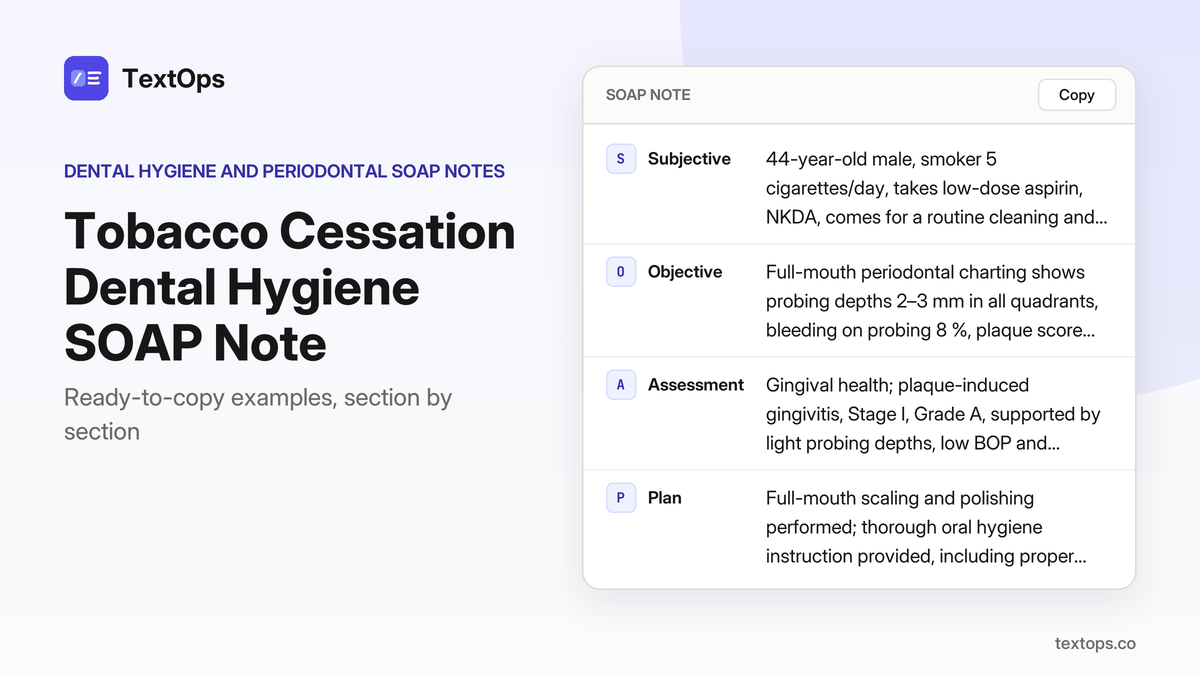
44-year-old male, smoker 5 cigarettes/day, takes low-dose aspirin, NKDA, comes for a routine cleaning and to discuss quitting smoking; he reports no pain or other complaints.
OObjective
Full-mouth periodontal charting shows probing depths 2–3 mm in all quadrants, bleeding on probing 8 %, plaque score 15 %; no pockets >4 mm, no caries, no mobility, no systemic signs; extraoral and intraoral exams are within normal limits; no anesthesia used.
AAssessment
Gingival health; plaque-induced gingivitis, Stage I, Grade A, supported by light probing depths, low BOP and plaque, absence of pockets >4 mm, and no clinical attachment loss.
PPlan
Full-mouth scaling and polishing performed; thorough oral hygiene instruction provided, including proper brushing, flossing, and use of interdental brushes; brief 5-A tobacco cessation counseling delivered, patient motivated to quit, referral to quitline made; no medication prescribed; patient advised to avoid smoking around the mouth and to return in 3 months for maintenance and reassessment.
Smoker, New Patient with Periodontal Disease
SOAP note
SSubjective
70-year-old female, smokes 5 cigarettes/day, controlled hypertension on lisinopril, NKDA; CC: “I have bleeding gums and bad breath; I want to know why.” HPI: reports intermittent bleeding, halitosis, no pain, no systemic symptoms.
OObjective
Extraoral: normal; Intraoral: plaque score 35 %; periodontal: probing depths 4–6 mm on #30-#32, BOP 25 %; CAL 4–6 mm; mobility Miller I on #30; no caries; no systemic signs.
AAssessment
Periodontitis, Stage II, Grade B (moderate progression, smoking), localized to lower molars, supported by PD 4–6 mm, BOP 25 %, CAL 4–6 mm.
PPlan
Scaling and root planing of #30-#32 with 2% lidocaine 1:100,000, 1.8 mL (IANB); oral hygiene instruction; brief tobacco cessation counseling; referral to quitline; next visit in 3 months for re-evaluation.
Smoker, Pregnant Patient
SOAP note
SSubjective
54-year-old female, smoker 5 cigarettes/day, pregnant, seasonal allergies, NKDA; CC: “I’m pregnant and still smoke; I want help quitting.” HPI: wishes to quit before 20 weeks.
OObjective
Probing depths 2–3 mm all quadrants, BOP 10 %, plaque score 20 %; no pockets >4 mm, no caries, no mobility.
AAssessment
Gingival health; plaque-induced gingivitis, Stage I, Grade A, supported by PD ≤3 mm, BOP 10 %, plaque 20 %.
PPlan
Prophylaxis performed; oral hygiene instruction given; brief tobacco cessation counseling delivered, referral to pregnancy-friendly quitline; advised cessation before 20 weeks; no drugs; next visit in 4 weeks for reassessment.
Smoker, Elderly Patient with COPD
SOAP note
SSubjective
75-year-old female, smoker 5 cigarettes/day, chief complaint: “My lungs are bad and I still smoke; I need help quitting.” PMH: COPD, allergic to penicillin (rash).
OObjective
Extraoral normal. Intraoral: plaque score 25 %; BOP 15 %; probing depths 3–4 mm in all quadrants; no pockets > 4 mm, no caries, no mobility.
AAssessment
Gingival health; plaque-induced gingivitis, Stage I, Grade A—supported by uniform 3–4 mm PD, 15 % BOP, and 25 % plaque score.
PPlan
Prophylaxis performed; oral hygiene instruction given; brief 5-A tobacco cessation counseling delivered, referral to quitline discussed, impact on COPD emphasized. No anesthesia or drugs used. Next visit in 3 months for periodontal maintenance and tobacco cessation follow-up.
Smoker, Adolescent with E-Cigarette Use
SOAP note
SSubjective
81-year-old female, chief complaint: “I use e-cigarettes and still have bad breath.” She is a former smoker, reports no current systemic disease, NKDA, and denies pain or swelling. HPI: she has been vaping daily for the past 6 months, experiences halitosis, and is concerned about oral health.
OObjective
Extraoral exam unremarkable. Intraoral probing depths 2–3 mm in all quadrants, BOP 12 %, plaque score 18 %. No pockets >4 mm, no carious lesions, no tooth mobility. Periodontal charting shows uniform shallow depths, consistent with gingival health; no recession or attachment loss noted.
AAssessment
Gingival health; plaque-induced gingivitis, Stage I, Grade A—diagnosis supported by PD 2–3 mm, BOP 12 %, plaque 18 %, and absence of deeper pockets or attachment loss.
PPlan
Prophylaxis performed with scaling of supragingival calculus and polishing. Comprehensive oral hygiene instruction delivered, emphasizing interdental cleaning and proper brushing technique. Brief tobacco cessation counseling (5-A) conducted; patient advised to discontinue e-cigarette use, provided a quitline referral, and scheduled a follow-up in 4 weeks to reassess periodontal status and cessation progress. No anesthesia or medication was administered.
Smoker, New Patient with Diabetes
SOAP note
SSubjective
43-year-old male, type 2 diabetes on metformin, smokes 5 cigarettes/day, asthma (albuterol PRN), NKDA; CC: “I have gum bleeding and I want to quit smoking”; HPI: bleeding from lower incisors, no pain, no systemic symptoms; PMH: diabetes, asthma; medications: metformin; allergies: NKDA.
OObjective
Extraoral: normal. Intraoral: gingival inflammation, bleeding on probing 20 %; periodontal chart: PD 4–5 mm on #17-#19, CAL 4–5 mm, mobility Miller I on #18; plaque score 30 %; no caries; radiographs: mild bone loss around lower incisors.
AAssessment
Periodontitis, Stage II, Grade C, localized to lower incisors, supported by PD 4–5 mm, CAL 4–5 mm, BOP 20 %, smoking, HbA1c > 7 %.
PPlan
Scaling and root planing of #17-#19 performed with 2% lidocaine 1:100,000, 1.8 mL (1 cartridge), IANB; oral hygiene instruction given; brief tobacco cessation counseling with quitline referral; advised tighter glucose control; next visit in 4 weeks for re-evaluation.
Post-Procedure Follow-Up Visits
Smoker, Post-Extraction Day 3
SOAP note
SSubjective
37-year-old male, smokes ~5 cigarettes/day, NKDA, reports “My mouth hurts and there's a little swelling” after extraction of tooth #16.
OObjective
Socket shows mild erythema, no suppuration; PD 0 mm, BOP none. Extraoral exam WNL.
AAssessment
Post-extraction healing with mild inflammation, consistent with the socket findings.
PPlan
2% lidocaine with 1:100,000 epinephrine, 1.8 mL buccal infiltration, aspiration negative. Oral hygiene instruction given; chlorhexidine 0.12% rinse 15 mL for 30 sec twice daily. Patient advised to avoid smoking to promote healing. No medications prescribed. Follow-up in 7 days to assess healing and reinforce cessation tips.
Smoker, Post-Orthodontic Retainer Placement
SOAP note
SSubjective
65-year-old female, smoker 5 cigarettes/day, hypothyroidism on levothyroxine, allergic to penicillin (rash); chief complaint: “My retainer feels tight and my gums are sore.” HPI: soreness began 2 days post-placement of a fixed retainer on #21-#24. PMH: hypothyroidism; no systemic signs.
OObjective
Gingival edema around #21-#24, mild BOP, no suppuration; extraoral normal; intraoral soft tissues intact; periodontal charting shows PD 3 mm at #21-#24 with 10 % BOP; radiographs not taken.
AAssessment
Gingival inflammation due to retainer, Stage I localized periodontitis, Grade A.
PPlan
Adjusted retainer to relieve pressure; instructed meticulous brushing and flossing around the appliance; advised smoking cessation, offered quitline referral; no medication prescribed; next visit in 4 weeks for re-evaluation.
Smoker, Post-Root Canal Therapy
SOAP note
SSubjective
73-year-old male, smokes 5 cigarettes daily, NKDA, reports “It still hurts when I bite.” HPI: pain localized to tooth #30, onset after recent root-canal therapy, no fever or systemic symptoms.
OObjective
Periapical radiograph shows 3 mm radiolucency at apex of #30; probing depth 4 mm, bleeding on probing present, mild swelling noted; extraoral exam otherwise normal.
AAssessment
Symptomatic apical periodontitis, pulpal necrosis with apical abscess, supported by radiolucency, deep pocket and BOP.
PPlan
Administered 4% articaine with 1:100,000 epinephrine, 1.8 mL infiltration, aspiration negative; prescribed ibuprofen 400 mg PRN for pain; advised smoking cessation and provided quitline referral; instructed to avoid hard foods and maintain oral hygiene; next visit in 2 weeks for clinical and radiographic reassessment.
Smoker, Post-Dental Implant Placement
SOAP note
SSubjective
55-year-old female, smokes 5 cigarettes daily, type 2 diabetes on metformin, NKDA, reports implant site feels sore.
OObjective
Implant site healing, mild erythema, PD 1 mm, BOP none; periapical radiograph shows implant in place, no peri-implant bone loss; IANB with 2% lidocaine 1:100,000, 1.8 mL, aspiration negative.
AAssessment
Implant placement healing with mild inflammation, supported by erythema, 1 mm PD, no BOP, and radiographic stability.
PPlan
Chlorhexidine 0.12% rinse 15 mL for 30 s twice daily, oral hygiene instruction, advise smoking cessation; no medications prescribed; next visit in 4 weeks for healing assessment.
Smoker, Post-Dental Surgery Day 7
SOAP note
SSubjective
62-year-old male, smoker 5 cigarettes/day, on low-dose aspirin, NKDA, CC “My jaw is still sore and I have some swelling,” HPI: postoperative day 7 after extractions of #17 and #19, no systemic symptoms.
OObjective
Extraction sockets #17, #19 healing, mild swelling, BOP around sockets, PD 0 mm, no suppuration, IANB 2% lidocaine with 1:100,000 epinephrine, 1.8 mL, aspiration negative.
AAssessment
Post-surgical healing with mild inflammation, supported by BOP and mild swelling but no suppuration or systemic signs.
PPlan
Prescribed ibuprofen 400 mg PRN for pain, chlorhexidine 0.12% rinse 15 mL 30 sec twice daily, advised smoking cessation, instructed to monitor swelling and report any increase, next visit in 14 days for reassessment.
Smoker, Follow-Up After Implant Failure
SOAP note
SSubjective
59-year-old male, smokes 5 cigarettes/day, controlled hypertension on lisinopril, NKDA; CC: “The implant didn’t stay, and my gums are swollen.” HPI: implant failure noted at #31, swelling and BOP; PMH: hypertension; no systemic signs.
OObjective
Extraoral: mild facial swelling; Intraoral: implant site with 3 mm bone loss, BOP present, mild edema; Periodontal: peri-implantitis signs; Radiographic: implant failure, bone loss evident on periapical film; Tests: none.
AAssessment
Peri-implantitis with implant failure confirmed by 3 mm bone loss, BOP, swelling, and radiographic evidence of implant failure.
PPlan
Planned implant removal and surgical debridement; prescribed amoxicillin 500 mg TID for 7 days and ibuprofen 400 mg PRN for pain; instructed oral hygiene and avoid smoking; next visit in 2 weeks for debridement assessment.
Smoker, Post-Root Canal Therapy with Persistent Pain
SOAP note
SSubjective
49-year-old female, smoker 5 cigarettes/day, seasonal allergies, NKDA; CC: “It still hurts a lot when I bite.” HPI: pain persists after root canal on tooth #25, no systemic symptoms.
OObjective
PA shows 4 mm radiolucency at apex of #25; PD 5 mm, BOP present, mild swelling noted.
AAssessment
Persistent symptomatic apical periodontitis with pulpal necrosis and chronic abscess, supported by radiolucency, deep pocket, BOP and swelling.
PPlan
Administered 4% articaine with 1:100,000 epinephrine, 1.8 mL infiltration, aspiration negative. Prescribed ibuprofen 400 mg PRN for pain; advised smoking cessation and scheduled follow-up in 7 days to reassess pain and healing.
Emergency Dental Visits
Smoker, Emergency Visit for Oral Cavity Pain
SOAP note
SSubjective
39-year-old female, smokes 5 cigarettes/day, allergic to penicillin (rash); CC: “I have a sharp pain in my lower right molar that started this morning and is getting worse”; HPI: pain worsening since morning; PMH: smoking, penicillin allergy; no other drug allergies.
OObjective
Tooth #30 shows deep enamel-dentin caries extending to the pulp chamber; PD 6 mm, BOP present; palatal swelling 1 cm; temperature 37.2 °C; no trismus, no lymphadenopathy; IANB with 2% lidocaine + 1:100,000 epinephrine, 1.8 mL administered.
AAssessment
Pulp necrosis with acute apical abscess, supported by deep caries, 6 mm pocket, BOP, palatal swelling, and lack of systemic signs.
PPlan
Pulpectomy performed, temporary glass ionomer restoration placed; ibuprofen 400 mg q6h PRN up to 3 days, acetaminophen 500 mg q6h PRN up to 3 days; oral hygiene instructions given; next visit scheduled for definitive restoration in 2 weeks.
Smoker, Emergency Visit for Oral Trauma
SOAP note
SSubjective
32-year-old female, former smoker, NKDA, presents with “I fell and broke my front tooth”; reports no pain or swelling, no mobility, BOP negative, palatal mucosa intact, and no systemic symptoms.
OObjective
Clinical exam shows tooth #7 with an uncomplicated crown fracture, no pulpal exposure, no mobility, and intact surrounding tissues; extraoral and intraoral findings are otherwise within normal limits; no evidence of infection or systemic involvement.
AAssessment
Diagnosis is uncomplicated crown fracture of tooth #7, supported by the absence of pulpal exposure, mobility, BOP, and systemic signs.
PPlan
Administered 2% lidocaine with 1:100,000 epinephrine, 1.8 mL infiltration; performed composite resin restoration of #7; provided detailed post-op instructions on oral hygiene, diet, and avoiding trauma; brief tobacco cessation counseling was offered, and a follow-up appointment was scheduled in one week to assess restoration integrity and oral health.
Smoker, Emergency Visit for Oral Ulcer
SOAP note
SSubjective
82-year-old female, smoker 5 cigarettes/day, asthma (albuterol PRN), NKDA; CC: “I have a big sore in my mouth that hurts when I eat”; HPI: ulcer pain worsens with chewing, no fever.
OObjective
Large traumatic ulcer on buccal mucosa, 1.5 cm diameter, painful on palpation, no discharge, no lymphadenopathy, T 37.0 °C, no systemic signs.
AAssessment
Traumatic oral ulcer confirmed by size, location, and symptomatology.
PPlan
Applied 20% benzocaine spray topically; prescribed chlorhexidine 0.12% rinse 15 mL for 30 s twice daily; advised avoidance of spicy foods; no drugs; patient to return if pain persists or ulcer enlarges.
Smoker, Emergency Visit for Oral Infection
SOAP note
SSubjective
78-year-old male, smoker 5 cigarettes/day, NKDA, reports “I have a severe ache in my lower left front tooth and a swelling.” History: acute pain, fever, malaise.
OObjective
Tooth #23 shows deep caries with pulpal exposure; PD 8 mm, BOP positive; palatal swelling 2 cm, trismus present; temperature 38.2 °C; submandibular lymphadenopathy.
AAssessment
Acute apical abscess of tooth #23, supported by deep caries, pulpal exposure, 8 mm pocket, swelling, fever, and lymphadenopathy.
PPlan
Incision and drainage performed under 2% lidocaine with 1:100,000 epinephrine, 1.8 mL, IANB; temporary restoration placed; amoxicillin 500 mg q6h PRN for 3 days, acetaminophen 500 mg q6h PRN for 3 days; oral hygiene instructions given; return in 7 days for review.
Smoker, Emergency Visit for Oral Trauma in Child
SOAP note
SSubjective
8-year-old female patient, smokes ~5 cigarettes/day, hypothyroidism on levothyroxine, NKDA; CC: “I fell and broke my front tooth”; HPI: fall 2 days ago, pain localized to upper central incisor, no swelling or bleeding.
OObjective
Tooth #7 shows an uncomplicated crown fracture, no pulpal exposure, no mobility, BOP negative, palatal mucosa intact; extraoral normal, intraoral soft tissues intact; no systemic signs.
AAssessment
Uncomplicated crown fracture of tooth #7, confirmed by clinical findings.
PPlan
Administered 2% lidocaine with 1:100,000 epinephrine, 1.8 mL infiltration; performed composite resin restoration of #7; gave POI: avoid hard foods for 24 h, maintain oral hygiene, report any pain or discoloration; next visit in 1 week for restoration check.
Smoker, Emergency Visit for Acute Pericoronitis
SOAP note
SSubjective
23-year-old female, smoker 5 cigarettes/day, NKDA; CC: “My lower right molar hurts and feels swollen”; HPI: acute pain and swelling of the lower right molar, no fever or systemic symptoms.
OObjective
Tooth #32 partially erupted with an inflamed follicle; PD 6 mm, BOP positive; palatal swelling 1 cm; temperature 37.1 °C; no lymphadenopathy.
AAssessment
Acute pericoronitis, evidenced by an inflamed follicle, deep probing depth, BOP, and localized swelling.
PPlan
Oral hygiene instruction; chlorhexidine 0.12% rinse 15 mL for 30 s twice daily; ibuprofen 400 mg every 6 h PRN up to 3 days; brief smoking cessation counseling and referral to quitline; next visit in 7 days for reassessment.
Smoker, Emergency Visit for Oral Lichen Planus Exacerbation
SOAP note
SSubjective
74-year-old female, smokes ~5 cigarettes/day, type 2 diabetes on metformin, NKDA; CC: “I have painful white patches in my mouth”; HPI: painful reticular white lesions on buccal mucosa with erythematous borders, tender on palpation, no ulceration or swelling, 37.0 °C, no lymphadenopathy.
OObjective
Reticular white lesions on buccal mucosa with erythematous borders; painful on palpation; no ulceration, swelling, or lymphadenopathy; temperature 37.0 °C; no systemic signs.
AAssessment
Oral lichen planus exacerbation, supported by reticular white lesions with erythematous borders and pain on palpation.
PPlan
Provided oral hygiene instruction; advised avoidance of spicy foods; no anesthesia or medication administered; patient encouraged to follow up in 2 weeks for reassessment and to discuss cessation support.
Pharmacotherapy Follow-Ups
Smoker, Follow-Up After Nicotine Patch Trial
SOAP note
SSubjective
79-year-old male, smokes ~5 cigarettes/day, takes low-dose aspirin, NKDA, chief complaint: “I’m still coughing a lot, but I feel better after the patch”; medical history: smoking, aspirin; no other meds; no allergies.
OObjective
Vital signs WNL; oral cavity shows no swelling or erythema; mild throat irritation reported; no BOP or pocket changes; no oral lesions; overall gingival health.
AAssessment
Gingival health; plaque-induced gingivitis, Stage I, Grade A, supported by absence of BOP, pocket depth ≤3 mm and normal attachment.
PPlan
Reviewed nicotine patch usage, advised to continue 7-day course, monitor for mucosal irritation; no drugs prescribed; next visit scheduled in 4 weeks for patch efficacy review.
Smoker, Follow-Up After Nicotine Gum Trial
SOAP note
SSubjective
76-year-old male, smoker 5 cigarettes/day, controlled hypertension on lisinopril, NKDA, reports “The gum is fine, but I’m still craving a cigarette.”
OObjective
BP 138/84 mmHg, pulse 72 bpm; mild oral dryness noted, no lesions, no swelling or erythema; periodontal chart shows no BOP or pocket changes, gingival health with plaque-induced gingivitis, Stage I, Grade A.
AAssessment
Plaque-induced gingivitis, Stage I, Grade A, with persistent nicotine craving despite gum use.
PPlan
Reviewed nicotine gum dosing (4–6 pieces per hour), instructed use of sugar-free gum, advised adequate hydration, offered quitline referral for additional support; no medication prescribed; next visit in 4 weeks for adherence and craving assessment.
Smoker, Follow-Up After Quitline Enrollment
SOAP note
SSubjective
40-year-old male, smoker 5 cigarettes/day, seasonal allergies, NKDA; CC: “I called the quitline and got a plan, but I’m still smoking a few times a day”; HPI: reports continued smoking despite quitline plan; PMH: no systemic disease; no medications; no oral lesions; mild nasal congestion; no swelling or erythema; BOP and pocket depths unchanged.
OObjective
Extraoral: nasal congestion mild; intraoral: no lesions, no BOP, pocket depths <4 mm, gingival health; periodontal chart shows Stage I, Grade A gingivitis; no radiographs taken; all tests normal.
AAssessment
Gingival health; plaque-induced gingivitis, Stage I, Grade A, supported by absence of BOP, pocket depths ≤3 mm, and healthy periodontal tissues.
PPlan
Reviewed quitline counseling steps, reinforced motivation, discussed coping strategies; no drugs prescribed; scheduled a 2-week follow-up to assess progress and adherence to quitline plan.
Smoker, Follow-Up After Varenicline Trial
SOAP note
SSubjective
34-year-old female, smokes 5 cigarettes/day; CC: “I feel a bit dizzy and my throat is sore after taking the pill”; HPI: mild dizziness, sore throat, no oral lesions; PMH: smoker; no medications listed.
OObjective
Vital signs WNL; extraoral and intraoral exam shows no swelling, erythema, BOP or pocket changes; no oral lesions; no systemic signs.
AAssessment
Gingival health; plaque-induced gingivitis, Stage I, Grade A, supported by normal probing depths and absence of BOP or attachment loss.
PPlan
Advised varenicline with food, monitor for dizziness, report any rash; no local anesthesia or drugs administered; instructed to maintain oral hygiene; scheduled next visit in 3 weeks to evaluate cessation progress and side-effect tolerance.
Smoker, Follow-Up After Nicotine Inhaler Trial
SOAP note
SSubjective
19-year-old male, former smoker, NKDA, reports “The inhaler works, but I still feel the urge to smoke”; no oral lesions, mild throat irritation, vital signs WNL, no swelling, erythema, BOP or pocket changes.
OObjective
Extraoral and intraoral examination reveals healthy gingiva, plaque-induced gingivitis with no BOP, probing depths 1-2 mm, no recession, no mobility; periodontal charting consistent with Stage I, Grade A; no systemic signs noted.
AAssessment
Gingival health; plaque-induced gingivitis, Stage I, Grade A, supported by probing depths ≤2 mm, absence of BOP, and normal periodontal parameters.
PPlan
Reviewed nicotine inhaler technique, reinforced consistent use, discussed behavioral strategies (cognitive coping, scheduled breaks, alternative stimuli), advised to continue inhaler as prescribed, no anesthesia used, no medications prescribed; next visit scheduled in 4 weeks.
Smoker, Follow-Up After Quit Attempt with Pharmacotherapy
SOAP note
SSubjective
22-year-old female, smoker 5 cigarettes/day, asthma on albuterol PRN, NKDA; CC: “I stopped smoking last week, but I’m having a hard time staying away”; HPI: quit attempt last week, experiencing cravings, mild cough, no oral lesions; PMH: asthma, no other meds; allergies: NKDA.
OObjective
Vital signs WNL; extraoral: no swelling or erythema; intraoral: no BOP, pocket depths unchanged, plaque-induced gingivitis Stage I Grade A; no oral lesions; mild cough noted; no systemic signs.
AAssessment
Gingival health; plaque-induced gingivitis, Stage I, Grade A, with nicotine withdrawal symptoms noted; no periodontal progression.
PPlan
Reinforced quit plan, discussed coping strategies and triggers, offered additional counseling session, scheduled 1-week follow-up to monitor abstinence; no medication prescribed; patient advised to continue albuterol PRN for asthma and to maintain oral hygiene; next visit in 7 days.
Smoker, Follow-Up After Varenicline Discontinuation
SOAP note
SSubjective
53-year-old female, smokes ~5 cigarettes/day, NKDA, reports stopping varenicline after two weeks because of nausea; chief complaint: “I stopped the pill after two weeks because of nausea.” O: extraoral: no swelling, erythema, or lymphadenopathy; intraoral: no lesions, mild oral mucosa normal; periodontal: no BOP, pocket depths unchanged, plaque-induced gingivitis, Stage I, Grade A; vital signs WNL. A: Gingival health; plaque-induced gingivitis, Stage I, Grade A, supported by absence of BOP and normal pocket depths. P: Discussed alternative cessation aids; advised nicotine patch for 4 weeks; no medications prescribed; instructed to monitor for nausea or oral irritation; scheduled next visit in 2 weeks.
Smoker, Follow-Up After Nicotine Inhaler Discontinuation
SOAP note
SSubjective
50-year-old female, smokes ~5 cigarettes/day, hypothyroidism on levothyroxine; CC: “I stopped the inhaler because it made my throat feel raw”; HPI: reports mild throat irritation, no oral lesions, no swelling or erythema; PMH: hypothyroidism, smoking; Meds: levothyroxine; vitals WNL.
OObjective
Extraoral: no swelling, erythema, or BOP; intraoral: no lesions, mild throat irritation noted; periodontal chart: BOP 0%, PD ≤3 mm, CAL normal; radiographs: none taken; tests: none.
AAssessment
Gingival health; plaque-induced gingivitis, Stage I, Grade A—supported by BOP 0%, PD ≤3 mm, no attachment loss.
PPlan
Advised nicotine patch or gum as alternatives, reinforced quitline referral, discussed side-effect management; no medications prescribed; instructed to monitor throat irritation, maintain oral hygiene, avoid smoking; scheduled 3-week follow-up.
Behavioral Support Follow-Ups
Smoker, Follow-Up After Quit Attempt
SOAP note
SSubjective
56-year-old female, smokes ~5 cigarettes/day, NKDA, says “I’m here to check in after my quit attempt.” PMH: none, no systemic signs.
OObjective
Extraoral: normal. Intraoral: gingival health; plaque-induced gingivitis, Stage I, Grade A; BOP 10% of sites, PD ≤3 mm, no CAL loss. Periodontal charting within normal limits. No radiographs taken.
AAssessment
Gingival health; plaque-induced gingivitis, Stage I, Grade A – supported by BOP 10%, PD ≤3 mm, no attachment loss.
PPlan
No anesthesia or drugs. Reinforced counseling, discussed cessation benefits, reviewed motivational interviewing techniques, set goal of 1-week abstinence, scheduled next visit in 4 weeks.
Smoker, Follow-Up After Quit Attempt with CBT
SOAP note
SSubjective
29-year-old female, smokes ~5 cigarettes/day, type 2 diabetes on metformin, NKDA; CC: “I tried CBT after quitting, but I’m still smoking.” HPI: continues daily smoking despite CBT, reports cravings, no systemic symptoms.
OObjective
Extraoral: WNL; Intraoral: gingival health, plaque-induced gingivitis, Stage I, Grade A; Periodontal charting: PD ≤ 3 mm, BOP 10 %, CAL 0 mm; Radiographs: none taken; Tests: none.
AAssessment
Gingival health; plaque-induced gingivitis, Stage I, Grade A, supported by PD ≤ 3 mm, BOP 10 %, no attachment loss.
PPlan
Continued CBT sessions; referred to smoking-cessation program; no medication prescribed; next visit in 4 weeks for CBT progress and periodontal reassessment.
Smoker, Follow-Up After Quit Attempt with Counseling
SOAP note
SSubjective
58-year-old male, smokes ~5 cigarettes/day, on low-dose aspirin, NKDA; CC: “I’ve been counseling but still smoke.”; PMH: aspirin, no other meds; HPI: ongoing smoking despite counseling.
Gingival health; plaque-induced gingivitis, Stage I, Grade A supported by BOP <10% and PD ≤3 mm.
PPlan
No anesthesia used; scheduled next counseling session, reviewed quit-plan, reinforced motivational interviewing, discussed coping strategies; patient advised to continue oral hygiene; next visit in 4 weeks.
Smoker, Follow-Up After Quit Attempt with Behavioral Support
SOAP note
SSubjective
21-year-old male, smoker 5 cigarettes/day, controlled hypertension on lisinopril, NKDA, chief complaint: “I’m getting behavioral support but still smoking.”
OObjective
Extraoral normal; intraoral shows plaque-induced gingivitis, Stage I, Grade A; periodontal charting: PD ≤3 mm, BOP 10% of sites, CAL none; radiographs not taken; all tests WNL.
AAssessment
Gingival health; plaque-induced gingivitis, Stage I, Grade A, supported by PD ≤3 mm, BOP 10%, no attachment loss.
PPlan
Discussed motivational interviewing techniques, reviewed coping strategies, reinforced quit plan, referred to local support group, no medication prescribed; instructed to maintain oral hygiene, avoid tobacco, return in 4 weeks for reassessment.
Smoker, Follow-Up After Quit Attempt with CBT and Meds
SOAP note
SSubjective
71-year-old male, smokes ~5 cigarettes/day, seasonal allergies, NKDA, reports “I used CBT and meds but still smoke”; no dental symptoms, no pain, no swelling, no tooth issues.
OObjective
Full periodontal chart shows gingival health; plaque-induced gingivitis, Stage I, Grade A: probing depths ≤3 mm, BOP <10 %, no attachment loss, no suppuration, no systemic signs, no anesthesia administered, no radiographs taken, no teeth noted.
AAssessment
Gingival health; plaque-induced gingivitis, Stage I, Grade A, confirmed by probing depths, BOP percentage, and absence of attachment loss.
PPlan
Reinforced CBT techniques, reviewed coping strategies, encouraged cessation aids, no new medication prescribed; patient advised to maintain oral hygiene, monitor cravings, and record daily smoking logs; scheduled follow-up in 2 weeks to reassess quit progress and adjust support.
Maintenance and Re-evaluation Visits
Smoker, Re-evaluation After Periodontal Maintenance
SOAP note
SSubjective
68-year-old female, smokes 5 cigarettes/day, chief complaint: “Here for my routine check-up and cleaning.” Medical history: allergic to penicillin (rash); no other systemic signs. O: Probing depths 4–5 mm on #30 and #31, BOP 30 % of sites, CAL 5 mm on #30 and #31, plaque score 25 %; radiograph shows no new bone loss; no suppuration or swelling; anesthesia: none. A: Periodontitis, Stage II, Grade B (moderate progression, smoking) supported by PD 4–5 mm, CAL 5 mm, BOP 30 %. P: Reviewed maintenance schedule; performed scaling and root planing on pockets >4 mm; re-taught oral hygiene; applied 5 % sodium fluoride varnish to #30 and #31; no drugs prescribed; next maintenance visit scheduled in 3 months.
Smoker, Re-evaluation After Periodontal Surgery
SOAP note
SSubjective
63-year-old male, former smoker, NKDA, reports “I’m here for my post-surgery check-up.” HPI: No pain, no swelling, routine follow-up after periodontal surgery on #17-#18.
OObjective
Extraoral normal. Intraoral: healing tissues, no erythema, no suppuration. Periodontal chart: PD 3 mm on #17 and #18, BOP 10 % of sites, CAL 3 mm on both teeth. Radiograph: stable bone levels, no new radiolucency.
AAssessment
Periodontitis, Stage I, Grade A – probing depths and attachment loss consistent with mild, slow-progressing disease; healing status good.
PPlan
Continue periodontal maintenance; reinforce oral hygiene instructions; no additional surgical intervention. No medication prescribed. Schedule next review in 4 weeks.
Screening and Diagnostic Visits
Smoker, Emergency Visit for Oral Cancer Screening
SOAP note
SSubjective
52-year-old female, smoker 5 cigarettes/day, asthma on albuterol PRN, NKDA, CC: “I have a sore spot in my mouth that won’t go away.” HPI: ulcerated buccal mucosa adjacent to tooth #12, 1.2 cm, erythematous base, indurated borders, no pain except discomfort when eating, no swelling or lymphadenopathy. O: Panoramic radiograph shows no bone loss; extraoral exam normal; intraoral exam reveals the ulcerated lesion described; no other mucosal abnormalities. A: Oral mucosal lesion suspicious for oral cancer, based on size, induration, and persistent ulceration. P: Referred to oral surgeon for incisional biopsy; instructed to avoid irritants, maintain oral hygiene, and return if symptoms worsen.
Smoker, New Patient with Oral Lichen Planus
SOAP note
SSubjective
69-year-old male, NKDA, smoker 5 cigarettes/day, CC: “I have white patches on my tongue that have been there for a few weeks.” HPI: patches have persisted for several weeks, no pain, no swelling.
OObjective
Reticular white lines on dorsal tongue extending from midline to lateral borders; no ulceration, erythema, or lymphadenopathy; panoramic radiograph shows no pathology.
AAssessment
Oral lichen planus, reticular type, supported by characteristic white reticular lines on the tongue without ulceration or erythema.
PPlan
Prescribed topical triamcinolone acetonide 0.1% mouthwash, rinse 4 × daily for 4 weeks; instructed to brush gently and avoid spicy foods; no anesthesia used. Scheduled follow-up in 6 weeks to reassess lesion resolution and adjust therapy.
Smoker, New Patient with Oral Cancer Screening
SOAP note
SSubjective
36-year-old male, smoker 5 cigarettes/day, hypothyroidism on levothyroxine; CC: “I feel a lump in my cheek that keeps growing.” HPI: recent onset, no trauma, no pain, no swelling, no lymphadenopathy.
OObjective
Extraoral: no facial asymmetry, no lymph nodes palpable. Intraoral: exophytic, 1.5 cm ulcerated mass on buccal mucosa near #15, indurated base, no pain. Periodontal: surrounding teeth healthy, no pocketing. Radiographic: panoramic shows no bone involvement.
AAssessment
Suspicious for squamous cell carcinoma, based on ulcerated exophytic mass, indurated base, recent growth, and smoking history.
PPlan
Referred to oral surgeon for incisional biopsy; advised to cease tobacco and limit alcohol; instructed on brushing, interdental cleaning, and regular follow-up. No medications prescribed.
Smoker, New Patient with Oral Mucosal Lesion
SOAP note
SSubjective
30-year-old female, NKDA, smokes 5 cigarettes/day; CC: “There’s a sore spot on my gum that won’t heal.” HPI: erythematous ulcer on lower buccal mucosa near #30, 0.8 cm, indurated borders, mild discomfort when chewing, no pain, no swelling, no lymphadenopathy.
OObjective
panoramic radiograph shows no bone loss; ulcer noted 0.8 cm, indurated borders, erythematous mucosa, no suppuration or exudate; extraoral exam WNL.
AAssessment
Traumatic ulcer supported by location, size, indurated borders, absence of systemic signs and bone loss.
Smoker, New Patient with Oral Mucosal Hyperkeratosis
SOAP note
SSubjective
33-year-old female, smokes 5 cigarettes/day, type 2 diabetes on metformin, NKDA; CC: “I have a thick patch on my tongue that looks like a scar”; HPI: lesion on ventral tongue, 3 months, no change, no pain or bleeding.
OObjective
panoramic radiograph WNL; oral exam shows a 2 cm hyperkeratotic white patch on the ventral tongue, smooth, non-ulcerated, no swelling.
AAssessment
Oral leukoplakia, based on a persistent, non-ulcerated white patch >1 cm on the tongue with no radiographic pathology.
PPlan
Referred for incisional biopsy to exclude dysplasia; advised strict tobacco cessation, good oral hygiene, and avoidance of irritants; no medication prescribed; next visit scheduled in 4 weeks for biopsy results and further counseling.
Assessment of Tobacco Use
The assessment records the patient’s tobacco type, frequency, and quantity—e.g., “cigarettes, 20/day” or “e-cigarette, 5 puffs/day.” Add a dependence score such as the Fagerström Test for Nicotine Dependence (score 0–10) in the S: section. Note prior quit attempts, including dates and methods, and any comorbidities that influence cessation (e.g., COPD, diabetes, pregnancy). In the O: section, document observable withdrawal signs—tremor, irritability, craving—if present, and relate them back to the dependence score. Reference the assessment in the A: by summarizing the patient’s readiness to quit and the level of dependence, which directly informs the 5-A counseling steps and the plan for pharmacotherapy or behavioral support. This assessment framework directs both immediate intervention and long-term follow-up.
Counseling (5-A’s and Motivational Interviewing)
Ask
Document the tobacco type, quantity, and frequency: “cigarettes, 20/day” or “e-cigarette, 5 puffs/day.” Capture last quit attempt date and method. Include a brief readiness question: “How ready are you to quit on a scale of 0-10?” Record the response verbatim.
Advise
State the health risk in one sentence: “Smoking increases your risk of periodontal disease and oral cancer.” Note that the patient was informed of risks, alternatives, and benefits. Record any refusal or agreement.
Assess
Score dependence with the Fagerström Test (0–10). Document withdrawal signs observed: tremor, irritability, craving. Summarise readiness: “Patient reports a readiness score of 7/10 and is motivated to quit.”
Assist
Offer a specific cessation aid: “We will provide a nicotine patch trial for 8 weeks.” Note counseling resources: quitline number, referral to a behavioral program. Record any agreed follow-up date.
Arrange
Schedule next counseling session: “RTC in 2 weeks to review patch use.” Document any additional support: “Patient will receive a written quit plan and a follow-up call.”
Motivational Interviewing Techniques
Use open-ended questions: “What concerns you most about quitting?” and reflective listening: “It sounds like you’re worried about withdrawal symptoms.” Record the patient’s expressed ambivalence and the clinician’s affirmation. Note the stage of change: “Patient is in the preparation stage, ready to set a quit date.”
Pharmacotherapy Options and Documentation
Nicotine Replacement Therapy (NRT)
Document the product, dose, and schedule in the P: section. For a patch, write “Nicotine patch 21 mg/day, 1 patch per day, 8 weeks.” For gum, write “Nicotine gum 4 mg, chew 2 gums every 1–2 hours, up to 24 g/day, 8 weeks.” Include a brief instruction: “Apply patch to clean, dry skin; replace at bedtime; avoid high-fat meals with gum.”
Prescription Medications (Varenicline, Bupropion)
Record the drug, dose, frequency, and duration. Example: “Varenicline 0.5 mg PO BID, titrate to 1 mg BID after 3 days, continue 12 weeks.” For bupropion, write “Bupropion SR 150 mg PO BID, 12 weeks.” Note patient education: “Take with food to reduce nausea; avoid alcohol.”
Contraindications and Precautions
Mark pregnancy or advanced age: “Contraindicated in pregnancy; caution in patients >80 years or with renal impairment.” If contraindicated, note “Patient declined NRT; alternative plan documented.”
Patient Education and Adherence
Record adherence checks: “Patient reports using 6 of 8 patches; missing 2 due to skin irritation.” Note follow-up: “Schedule adherence review in 2 weeks.”
End the note by adding a reminder: “Update the plan if medication changes or adherence issues arise.”
Follow-Up Schedule and Progress Documentation
Short-Term Check-In
Set the next visit in the P: line: “RTC in 2 weeks to review patch use.” Record the purpose: “Assess adherence, side effects, and craving level.”
Long-Term Review
Schedule a 1-month review: “RTC in 1 month to evaluate sustained abstinence and plan taper.” Include a brief goal statement, such as “Aim for 30-day abstinence.”
Progress Notes
In each subsequent SOAP note, update the A: with a readiness score and any withdrawal symptoms observed. In the P:, add “Patient reports 0/10 cravings; no withdrawal signs.” Document adherence: “Used 6 of 8 patches; no skin irritation.”
Documentation of Abstinence or Relapse
For abstinence, write: “Patient reports no tobacco use since last visit; 30-day abstinence confirmed.” For relapse, write: “Patient admits to smoking 5 cigarettes yesterday; cravings reported as 7/10.” Record the relapse and plan a corrective intervention in the P: section.
Adapting Notes for Different Patient Populations
Pregnant patients: Record gestational age and prenatal care status. Use the lowest effective nicotine dose; document “Nicotine patch 7 mg/day, 1 patch per day, 4 weeks” if indicated. Note fetal monitoring and counsel on teratogenic risks.
Adolescents: Capture age, school setting, and peer influence. Use age-appropriate language; document “e-cigarette, 5 puffs/day” and “readiness score 6/10”. Offer school-based resources and parental consent where required.
Elderly with comorbidities: Include ASA status and renal function. Avoid medications contraindicated in age >80 or with renal impairment; document “Varenicline contraindicated; offer nicotine gum 4 mg, chew 2 every 1–2 hrs, 8 weeks”. Note fall risk and polypharmacy.
Patients with chronic disease: Document disease control (e.g., HbA1c for diabetes, COPD severity). Integrate cessation plan with disease management; record “Adjunctive counseling for diabetes control” and “Referral to pulmonary rehab”.
Concise points ensure the SOAP note reflects tailored dosing, safety, and interdisciplinary coordination.
Checklist & FAQs for Documentation Compliance
Essential fields for every tobacco cessation SOAP note
Patient name and date of visit
Tobacco type, frequency, and quantity (e.g., cigarettes, 20/day)
Any contraindications or special considerations (pregnancy, comorbidities)
Can I use the same note for a new patient and a follow-up?
No. A new-patient note must include the full tobacco assessment, baseline dependence score, and initial counseling steps. A follow-up note should reference the prior plan, update withdrawal signs, adherence, and relapse status, and adjust the pharmacotherapy or counseling plan. Using the same template without these distinctions risks incomplete documentation and non-compliance with documentation standards.
What if the patient refuses counseling?
Document the offer of counseling, the patient’s refusal, and the reason if given. Record the risks discussed, any alternative resources offered (e.g., quitline number), and the plan to re-offer counseling at the next visit. Ensure the note includes a signature or authentication to confirm that the refusal was noted contemporaneously.
How do I document nicotine withdrawal symptoms?
List observable signs in the O: section: tremor, irritability, craving, anxiety, difficulty concentrating, or restlessness. Quantify severity if possible (e.g., “craving 7/10”). In the A: section, summarize the impact on the patient’s readiness to quit and adjust the pharmacotherapy dose or add behavioral support accordingly. Reference the dependence score to contextualize the withdrawal severity.
These examples show structure and wording only. Record what you actually found and did, and follow your practice’s documentation requirements.
Dr. Rahul Joshi is a Specialist Orthodontist with extensive clinical experience in orthodontics, dentofacial orthopaedics, and dental aesthetics. Holding a Master of Dental Surgery (MDS) in Orthodontics and Dentofacial Orthopaedics and a Bachelor of Dental Surgery (BDS) from Manipal Academy of Higher Education, he brings expertise in orthodontic treatment planning, teeth alignment, and Invisalign treatment. With professional experience across India and the Netherlands, Dr. Joshi combines clinical knowledge with practical experience in orthodontic care, dental aesthetics, and improving patients' oral health.
Master of Dental Surgery (MDS) in Orthodontics and Dentofacial Orthopaedics — Manipal Academy of Higher Education
Bachelor of Dental Surgery (BDS) — Manipal Academy of Higher Education
Stop retyping your templates
Save any template to TextOps once, then insert it anywhere on the web without retyping. Share it with your team so everyone uses the same wording.