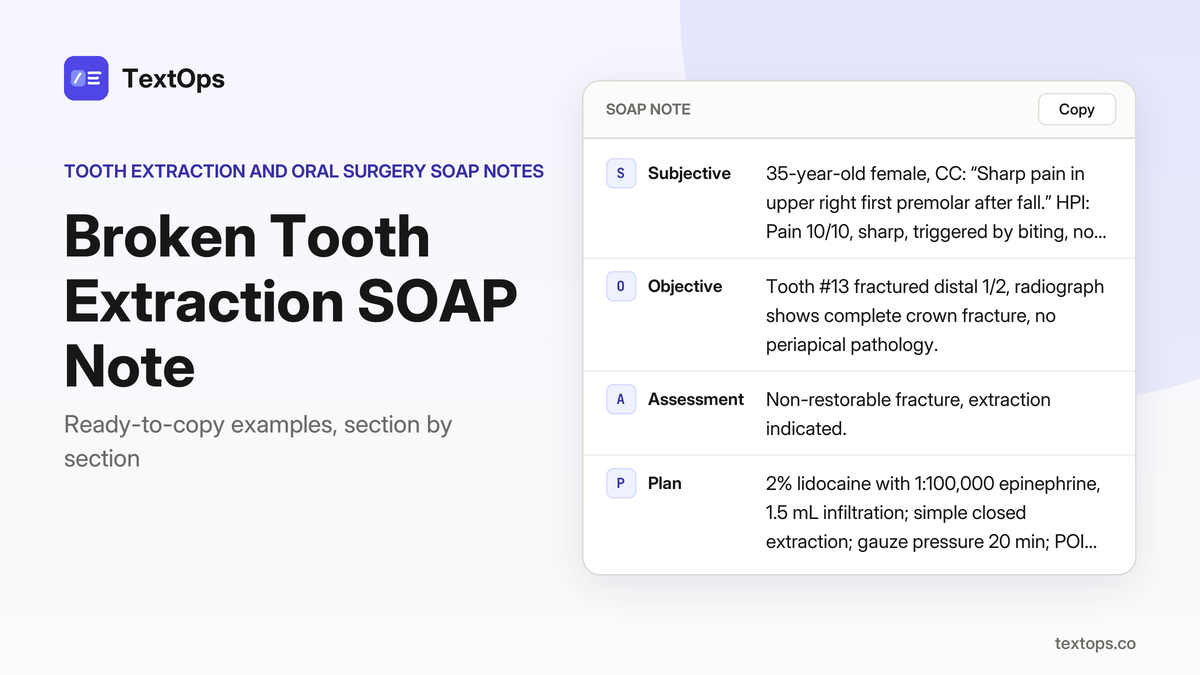
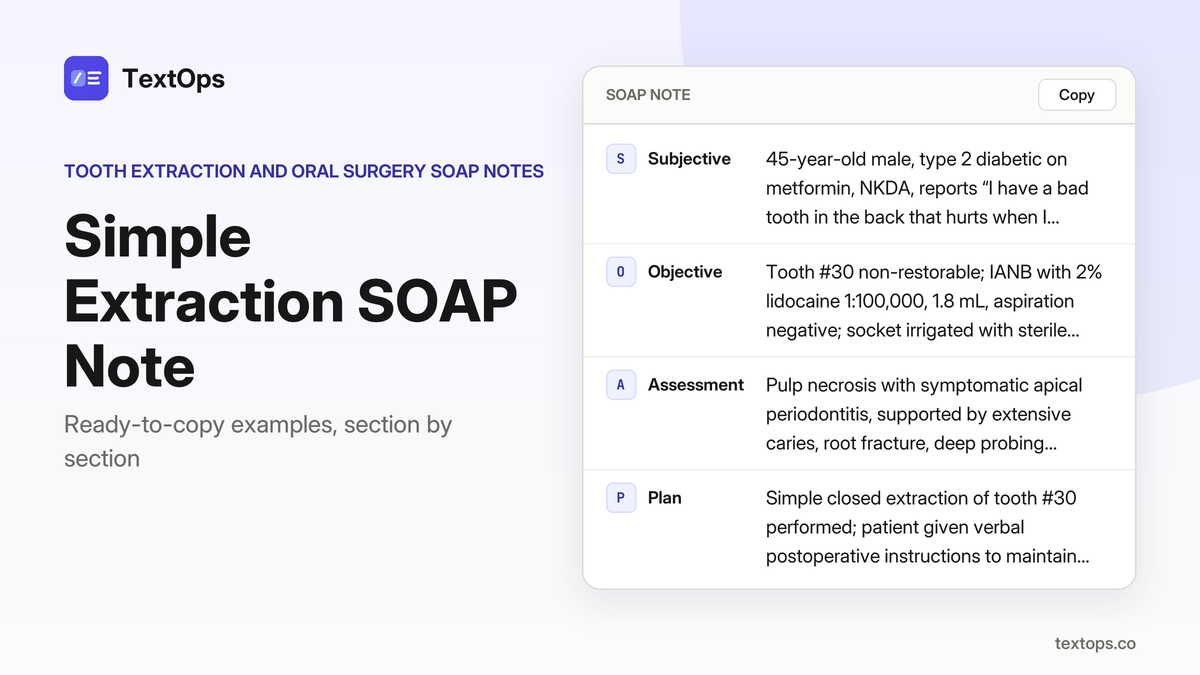
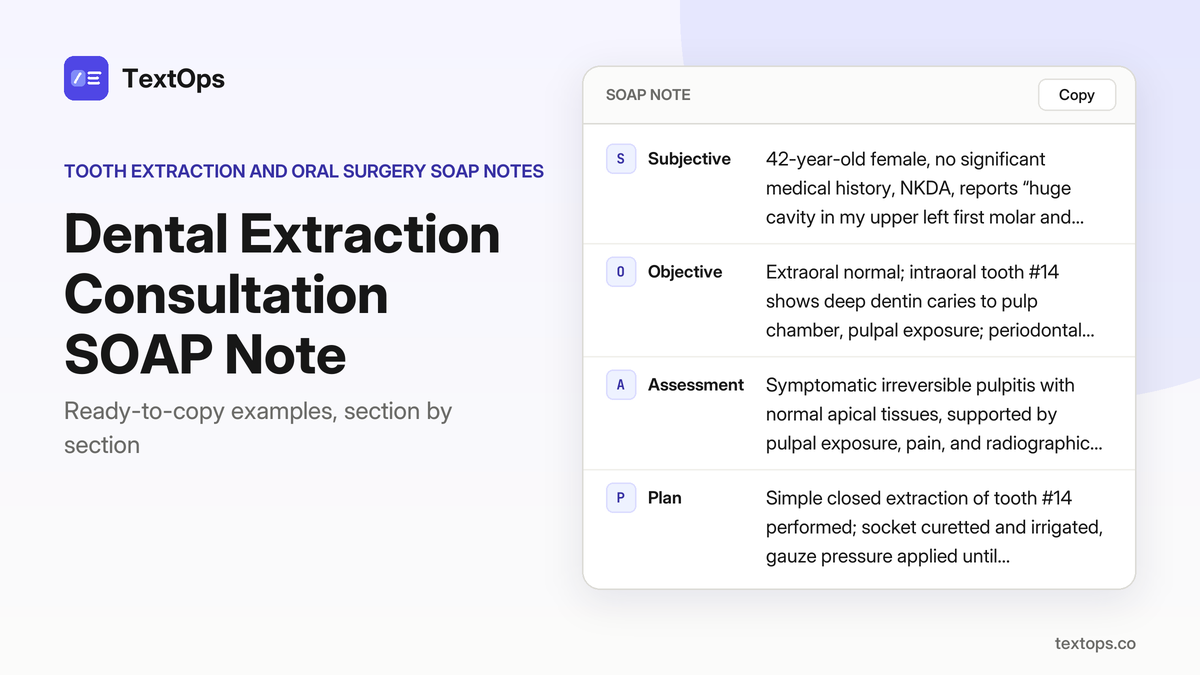
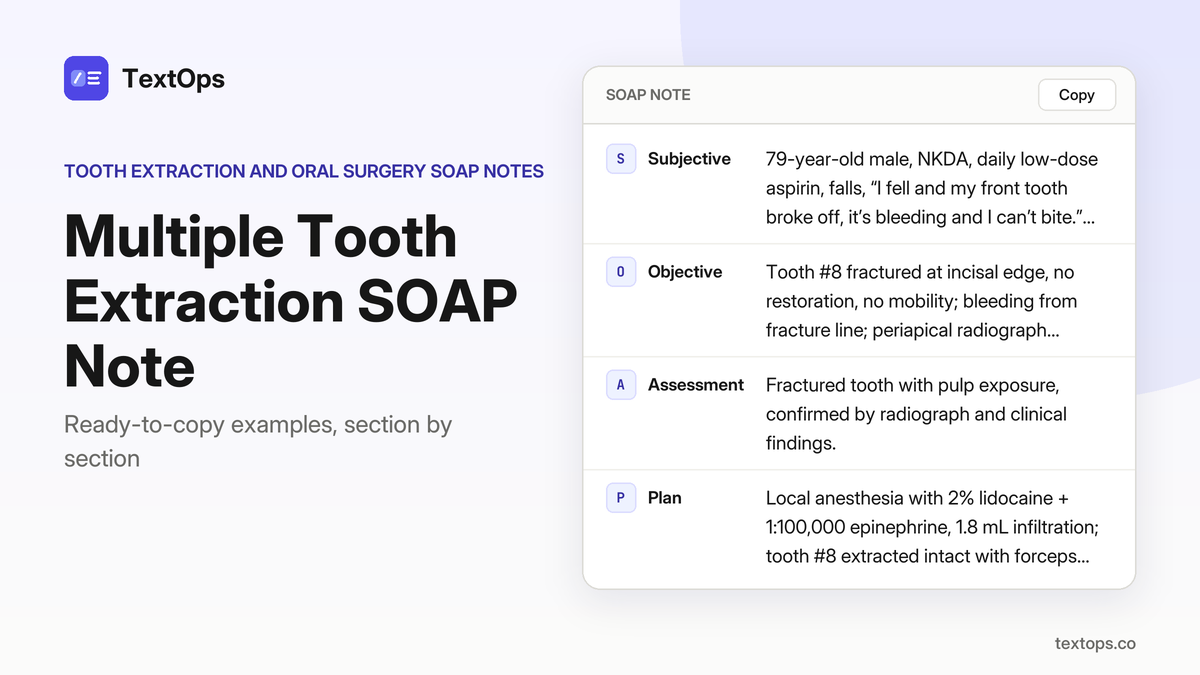
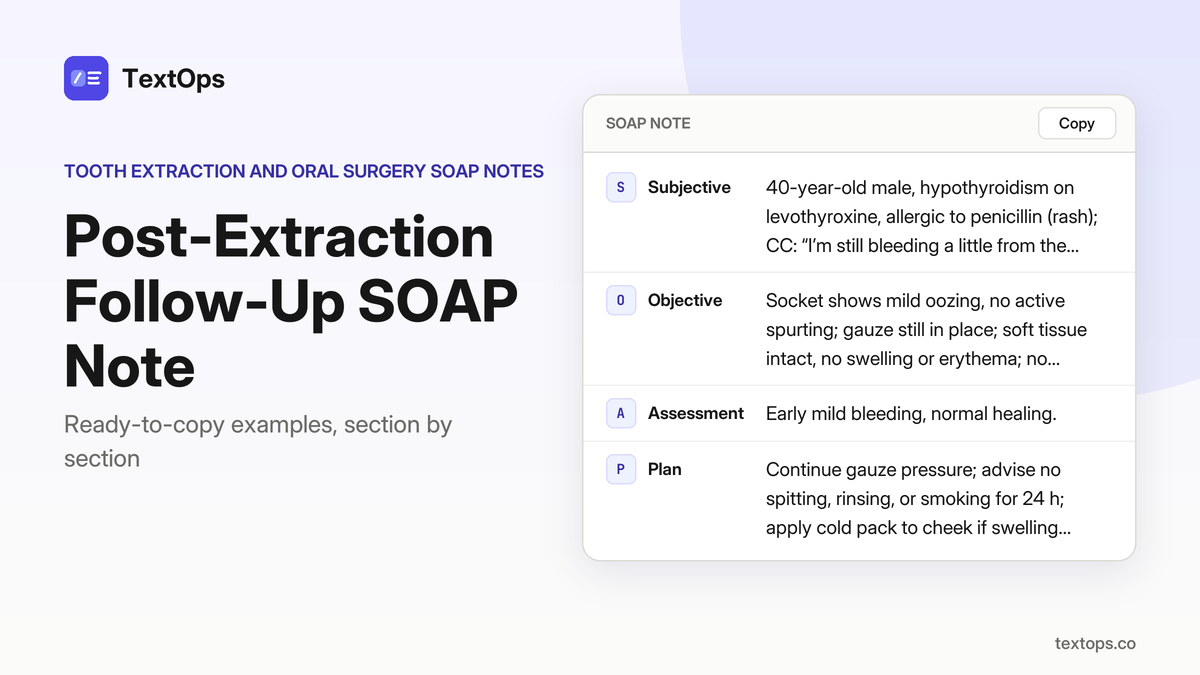
Simple Extraction SOAP Note: ready-to-copy templates begin with a first-screen example note that can be copied verbatim. The remainder of the content supplies 30-40 fully populated SOAP notes, grouped by visit type, each including tooth ID, anesthesia, technique, post-op instructions, follow-up, complications, and consent. Guidance on tailoring the templates for special patients and ensuring legal compliance accompanies the examples.
Simple First-Time Extractions
Adult Male, 45, First-Time Lower Molar Extraction
SOAP note
SSubjective
45-year-old male, type 2 diabetic on metformin, NKDA, reports “I have a bad tooth in the back that hurts when I chew”; history shows extensive caries and root fracture on tooth #30, with 6 mm probing depth, BOP, 4 mm periapical radiolucency, swelling in the lower right molar region, no mobility, no sinus tract, no systemic signs.
OObjective
Tooth #30 non-restorable; IANB with 2% lidocaine 1:100,000, 1.8 mL, aspiration negative; socket irrigated with sterile saline; gauze pressure applied for 30 min; no drug administered.
AAssessment
Pulp necrosis with symptomatic apical periodontitis, supported by extensive caries, root fracture, deep probing depth, BOP, periapical radiolucency, and pain on chewing.
PPlan
Simple closed extraction of tooth #30 performed; patient given verbal postoperative instructions to maintain gauze pressure, avoid hard foods, use ice packs, and return for follow-up in 7 days to assess healing.
First-Time Visit, 22, Extraction of Upper Third Molar for Orthodontics
SOAP note
SSubjective
22-year-old male, hypothyroid on levothyroxine, allergic to penicillin (rash). Chief complaint: “My orthodontist said I need to get my wisdom tooth out.” No systemic signs, no pain or swelling.
OObjective
Tooth #3 mesioangular, Pell and Gregory class II, depth B; radiograph shows close proximity to maxillary sinus, no root resorption, no periapical pathology, no mobility.
AAssessment
Impacted third molar, orthodontic indication, supported by radiographic findings of sinus proximity and lack of pathology.
PPlan
Simple closed extraction performed under 4% articaine with 1:100,000 epinephrine, 1.8 mL infiltration buccal and palatal. Socket curetted, irrigated with saline, hemostasis achieved with gauze pressure. No medication prescribed. Verbal and written postoperative instructions given; next visit for suture removal not required.
First-Time Visit, 34, Extraction of Lower Second Molar for Severe Periodontitis
SOAP note
SSubjective
34-year-old male, former smoker, NKDA, reports “My lower molar keeps bleeding and I can’t keep it in place.” HPI: persistent bleeding, mobility, difficulty chewing. PMH: none.
OObjective
Tooth #19 shows deep periodontal pockets 9 mm, BOP present, mobility grade 2; radiograph reveals horizontal bone loss 70 % of root, no periapical lesion, no sinus tract. Extraoral: normal.
AAssessment
Stage III periodontitis, grade B, with severe bone loss of tooth #19, indicated for extraction.
PPlan
2% lidocaine with 1:100,000 epinephrine, 1.8 mL (1 cartridge), IANB, aspiration negative. Simple closed extraction performed; socket irrigated with saline; gauze pressure for 30 min. No drugs prescribed. Verbal and written POI given; next visit scheduled for healing assessment.
First-Time Visit, 25, Extraction of Upper Second Molar for Orthodontic Space Closure
SOAP note
SSubjective
25-year-old male, no significant medical history, allergic to penicillin (rash). Chief complaint: “My orthodontist wants to close the space by removing this tooth.” Tooth #15 is carious with deep dentin, no periapical pathology, no mobility, no swelling.
OObjective
Tooth #15 shows deep dentin caries, intact structure, no bone loss on PA radiograph. Extraoral: normal. Intraoral: no swelling, tooth stable. Periodontal: no BOP, PD 3 mm. Radiograph: no periapical radiolucency, intact root.
AAssessment
Non-restorable caries with orthodontic indication for extraction of tooth #15.
PPlan
2% lidocaine with 1:100,000 epinephrine, 1.8 mL infiltration administered. Simple closed extraction performed; socket irrigated with saline, gauze pressure applied for 30 minutes. No medication prescribed. Verbal and written postoperative instructions given; next visit scheduled for orthodontic appliance adjustment.
Emergency Fractured-Tooth Extractions
Emergency, 30, Extraction of Fractured Upper Incisor
SOAP note
SSubjective
30-year-old female, seasonal allergies, NKDA, reports “I fell and my front tooth broke. It’s bleeding and I can’t bite.” HPI: fractured maxillary central incisor (#7) into two pieces, no pulpal exposure on palpation, afebrile, no swelling or trismus.
OObjective
Extraoral: no facial swelling, intraoral: tooth #7 fractured, two fragments, no pulpal exposure, no periapical radiolucency on PA, no trismus, afebrile. Radiograph: complete fracture line extending to the root.
AAssessment
Fracture of tooth #7 with pulpal exposure, confirmed by PA radiograph and clinical exam.
PPlan
2% lidocaine with 1:100,000 epinephrine, 1.8 mL infiltration; extracted #7 in two pieces with forceps, socket curetted and irrigated with saline, gauze pressure for 30 min. POI: bite on gauze 30–60 min, no chewing, soft diet, avoid hot liquids. Follow-up in 7 days for healing assessment.
Emergency, 27, Extraction of Fractured Upper Lateral Incisor
SOAP note
SSubjective
27-year-old male, controlled hypertension on lisinopril, NKDA, reports “upper left canine snapped while chewing, painful and bleeding.” O: BP 138/84 mmHg; extraoral normal; intraoral shows fractured crown and root fragment of #11, bleeding, no swelling, trismus, or fever; PA radiograph shows fracture line through crown and root, no periapical pathology. A: fracture of tooth #11 with pulpal exposure, confirmed by PA radiograph. P: Local anesthesia with 2% lidocaine 1:100,000, 1.8 mL infiltration; careful sectioning and extraction of #11; socket irrigated, gauze pressure applied; POI: bite on gauze 30-60 min, no spitting, rinsing, or smoking first 24 h, soft diet, cold packs; next visit in 7 days for healing assessment.
Emergency, 33, Extraction of Fractured Lower Incisor with Pericoronitis
SOAP note
SSubjective
33-year-old male, NKDA, presents with “My lower front tooth broke and I have a bad swelling on the lower lip.” He reports 8/10 pain when biting, fever 38.1 °C, trismus, 2 cm tender lower-lip swelling, no lymphadenopathy.
OObjective
Tooth #23 fractured into two pieces with exposed pulp; PA shows a small periapical radiolucency consistent with acute apical abscess. Extraoral swelling 2 cm, tender; intraoral: exposed pulp, periodontal probing normal. Temperature 38.1 °C; trismus present.
AAssessment
Fracture of tooth #23 with acute apical abscess, evidenced by exposed pulp, radiolucency, fever, trismus, and localized swelling.
PPlan
Local anesthesia: 2% lidocaine with 1:100,000 epinephrine, 1.8 mL infiltration. Extraction of fractured #23, socket curetted, hemostasis with gauze and oxidized cellulose. Post-op: Ibuprofen 400 mg q6h PRN, Amoxicillin 500 mg q8h for 7 days, soft diet, avoid spitting, rinse after 24 h, return in 48 h for assessment.
Emergency, 36, Extraction of Fractured Upper Lateral Incisor with Pericoronitis
SOAP note
SSubjective
36-year-old female, chief complaint: “My upper left canine broke and I have a painful swelling on the cheek.” History: fractured #11 into crown and root fragments with pulpal exposure; afebrile, no trismus, pain 7/10 when biting; medical history: daily low-dose aspirin, NKDA.
OObjective
Extraoral: buccal mucosa swelling 3 cm, tender, no lymphadenopathy. Intraoral: fractured #11 with pulpal exposure; periapical radiograph shows a 4 mm radiolucency. Periodontal: no probing data reported. Radiographic: PA of #11 confirms acute apical radiolucency.
AAssessment
Fracture of tooth #11 with acute apical abscess, supported by radiolucency, swelling, and pain on biting.
PPlan
Local anesthesia: 2% lidocaine with 1:100,000 epinephrine, 1.8 mL infiltration. Extraction of fractured #11 performed; socket curetted, hemostasis achieved with gauze and oxidized cellulose. Post-operative instructions: avoid chewing on the side, apply cold packs, maintain soft diet, no smoking or straws for 24 h. Prescribed Amoxicillin 500 mg q8h for 7 days and Ibuprofen 400 mg q6h PRN for 7 days. Next visit: review healing in 7 days.
Emergency, 42, Extraction of Fractured Lower Incisor with Acute Infection
SOAP note
SSubjective
42-year-old female, asthma, NKDA, reports “my lower front tooth broke and I have a bad swelling in my lower jaw”; pain 9/10 when biting, fever 38.3 °C, trismus, 4 cm tender swelling, no lymphadenopathy.
OObjective
Tooth #23 fractured into two pieces with exposed pulp; periapical radiograph shows a 5 mm periapical radiolucency; swelling over lower jaw 4 cm, tender; patient febrile 38.3 °C; trismus present.
AAssessment
Fracture of tooth #23 with acute apical abscess, supported by exposed pulp, radiolucency, fever, trismus, and swelling.
PPlan
Extraction of fractured #23 under 2% lidocaine with 1:100,000 epinephrine, 1.8 mL infiltration; socket curetted, hemostasis achieved with gauze and oxidized cellulose; prescribed amoxicillin 500 mg q8h for 7 days, ibuprofen 400 mg q6h PRN for 7 days; instructed to avoid hard foods, maintain oral hygiene, use cold packs, and return in 48 hours for follow-up.
Emergency, 31, Extraction of Fractured Upper Central Incisor with Pericoronitis
SOAP note
SSubjective
31-year-old male, smoker, NKDA, reports “upper central incisor broke and I can’t bite. I also have a swelling on the cheek.” He reports 6/10 pain when biting, afebrile, no trismus, swelling 2.5 cm buccal, tender, no lymphadenopathy.
OObjective
Tooth #8 fractured into crown and root fragments with pulpal exposure; periapical radiograph shows a 3 mm periapical radiolucency. Swelling over buccal mucosa 2.5 cm, tender. No systemic signs beyond swelling.
AAssessment
Fracture of tooth #8 with acute apical abscess, supported by periapical radiolucency and associated swelling.
PPlan
Extraction of fractured tooth #8 under 2% lidocaine with 1:100,000 epinephrine, 1.8 mL infiltration; socket curetted, hemostasis with gauze and oxidized cellulose. Prescribed Amoxicillin 500 mg q8h for 7 days and Ibuprofen 400 mg q6h PRN for 7 days. POI: bite on gauze 30-60 min, avoid hard foods, use cold packs, maintain oral hygiene. Next visit: review healing in 7 days.
Emergency, 44, Extraction of Fractured Upper Lateral Incisor with Acute Infection
SOAP note
SSubjective
44-year-old female, type 2 diabetes on metformin, NKDA, presents with fractured upper left canine (#11) and painful swelling on the cheek; reports 7/10 pain when biting, afebrile, no trismus, swelling 3 cm buccal, tender, no lymphadenopathy.
OObjective
Radiograph shows crown-root fracture with pulpal exposure and a 4 mm periapical radiolucency; extraoral swelling 3 cm buccal, tender; intraoral exam confirms fracture and abscess; no other oral pathology noted.
AAssessment
Fracture of tooth #11 with acute apical abscess, confirmed by radiolucency and clinical swelling.
PPlan
Administered 2% lidocaine with 1:100,000 epinephrine, 1.8 mL infiltration; extracted fractured tooth #11, curetted socket, achieved hemostasis with gauze and oxidized cellulose. Prescribed Amoxicillin 500 mg q8h for 7 days and Ibuprofen 400 mg q6h PRN for 7 days; instructed to apply ice, maintain soft diet, avoid chewing on side, rinse with salt water after 24 h, and return if pain worsens or swelling increases.
Medical/Compromised Patient Extractions
Pregnant 28-Week Patient, Upper Third Molar Extraction
SOAP note
SSubjective
47-year-old female, pregnant, hypothyroidism on levothyroxine, penicillin allergy (rash); chief complaint: “I have a big pain in my upper right back tooth that won’t stop”; history shows gross caries to pulp with pulpal exposure, afebrile, no lymphadenopathy, BP 120/78, pulse 78.
OObjective
Tooth #3 grossly carious to pulp, pulpal exposure; PA shows 6 mm periapical radiolucency, no sinus tract; extraoral normal; intraoral shows no swelling; vital signs stable; anesthesia: 4 % articaine 1:100 000 epinephrine, 1.8 mL infiltration.
AAssessment
Pulp necrosis with symptomatic apical periodontitis, confirmed by radiograph and clinical findings.
PPlan
Extracted tooth #3 under articaine infiltration; socket irrigated with saline, gauze pressure applied; POI: ice packs, avoid smoking, soft diet; schedule follow-up in 7 days to assess healing.
Diabetic Patient, 60, Extraction of Upper First Molar
SOAP note
SSubjective
60-year-old male, type 2 diabetes on metformin, former smoker, NKDA, reports “My front upper tooth hurts when I bite down”; history shows deep caries with pulpal exposure on tooth #15, 4 mm periapical radiolucency, no sinus tract, BP 138/84, pulse 82, HbA1c 6.8 %, afebrile, no swelling.
OObjective
Tooth #15 shows deep caries to outer dentin, pulpal exposure, 4 mm periapical radiolucency on PA; extraoral normal, intraoral healthy mucosa, no BOP, periodontal probing within normal limits; radiograph confirms chronic apical periodontitis; no systemic signs.
AAssessment
Pulp necrosis with chronic apical periodontitis of tooth #15, supported by pulpal exposure, radiolucency, and clinical pain on biting.
PPlan
Simple extraction of tooth #15 performed under 2% lidocaine with 1:100,000 epinephrine, 1.8 mL infiltration; socket curetted, irrigated, gauze pressure applied; POI: ibuprofen 400 mg q6 h PRN up to 3 days, acetaminophen 500 mg q6 h PRN up to 3 days; patient advised strict glycemic control, soft diet, avoid biting hard foods, and to contact if pain worsens or swelling develops; next visit: follow-up in 7 days.
Pregnancy, 32, Extraction of Lower Second Molar for Infection
SOAP note
SSubjective
32-year-old pregnant female, “My lower left back tooth is swollen and hurts a lot”; grossly carious #19 with pulpal exposure, 8 mm periapical radiolucency, 2 cm buccal swelling, tender, mild trismus, BP 122/76, pulse 80.
OObjective
2% lidocaine with 1:100,000 epinephrine, 1.8 mL IANB; tooth #19 extracted, socket irrigated, gauze pressure applied; no bleeding noted, swelling reduced, trismus resolved.
AAssessment
Pulp necrosis with acute apical abscess, confirmed by radiograph and clinical findings.
PPlan
Extracted tooth #19 under IANB; post-op instructions: ice to buccal area, maintain gauze pressure 30 min, take ibuprofen 400 mg PO every 6 h PRN up to 3 days; advise to avoid hot foods, monitor for fever or increased pain, return if symptoms worsen.
Medically Compromised, 70, Extraction of Lower First Molar
SOAP note
SSubjective
70-year-old male, seasonal allergies, NKDA, reports “My lower front tooth is loose and hurts when I chew”; history of severe periodontal compromise; no systemic symptoms.
OObjective
Tooth #23 shows probing depth 9 mm, CAL 8 mm, horizontal bone loss 70 % of root; periapical radiograph WNL, no radiolucency; afebrile, BP 135/80, pulse 76; extraoral and intraoral otherwise normal.
AAssessment
Stage III periodontitis, grade B, with severe bone loss, indicated for simple extraction of tooth #23.
PPlan
2% lidocaine with 1:100,000 epinephrine, 1.8 mL, IANB administered; simple extraction performed, socket curetted, gauze pressure applied; patient given POI—avoid hard foods, maintain soft diet, use ice packs; next visit scheduled for healing assessment in 7 days.
Medically Compromised, 68, Extraction of Lower First Molar with Anticoagulation
SOAP note
SSubjective
68-year-old male, controlled hypertension on lisinopril, NKDA, presents with loose lower front tooth and bleeding; reports “My lower front tooth is loose and I have a bleeding problem.” HPI: tooth #23 has been mobile for several weeks, no pain, no swelling.
OObjective
BP 140/85, pulse 78; extraoral normal. Intraoral: tooth #23 periodontally compromised, PD 8 mm, CAL 7 mm, 60 % bone loss on PA radiograph. No signs of infection or systemic illness.
AAssessment
Stage III periodontitis, grade B with severe bone loss, confirmed by probing and radiographic findings.
PPlan
Administered 2% lidocaine with 1:100,000 epinephrine, 1.8 mL IANB; performed simple extraction of tooth #23, irrigated socket, applied gauze pressure for 30 min. POI: maintain pressure if bleeding persists, soft diet, avoid smoking, return if bleeding continues or pain worsens.
Medically Compromised, 65, Extraction of Lower First Molar with Bisphosphonate Use
SOAP note
SSubjective
65-year-old female, no significant medical history, NKDA, complains that her lower front tooth is loose and she takes bone-strengthening pills.
OObjective
BP 128/78, pulse 76, no fever or swelling; periodontal bone loss 70 % of root on tooth #23; PA shows no osteonecrosis; 2% lidocaine with 1:100 000 epinephrine, 1.8 mL (1 cartridge) IANB administered; extraction performed with simple closed technique, socket irrigated, gauze pressure applied.
AAssessment
Stage III periodontitis, grade B, severe bone loss with no radiographic osteonecrosis, compatible with bisphosphonate use.
PPlan
Simple extraction of tooth #23 completed; socket irrigated, gauze pressure held; patient instructed to avoid forceful chewing, to report any exposed bone, and to contact clinic if pain worsens; no medications prescribed.
First-Time, 29, Extraction of Upper Second Molar
SOAP note
SSubjective
29-year-old female, low-dose aspirin, NKDA, reports “bad tooth that hurts when I bite down”; deep enamel-to-outer-dentin caries on mesial surface of #16, pulpal necrosis, 3 mm periapical radiolucency, no swelling, trismus, 98.6 °F.
OObjective
Extraoral normal; intraoral shows carious mesial surface of #16, tender to percussion, no swelling; periodontal probing within normal limits; radiograph confirms 3 mm periapical radiolucency; anesthesia 2% lidocaine with 1:100,000 epinephrine, 1.8 mL infiltration.
AAssessment
Pulp necrosis with symptomatic apical periodontitis, supported by caries, pulpal necrosis, radiolucency, percussion pain.
PPlan
Simple closed extraction of #16; socket curetted, irrigated; gauze pressure until hemostasis; prescribed ibuprofen 400 mg PO q6h PRN up to 3 days; advised soft diet, avoid chewing hard foods, maintain oral hygiene, return if pain worsens or swelling develops.
Pregnancy, 34, Extraction of Lower Third Molar
SOAP note
SSubjective
34-year-old pregnant female, asthma on albuterol PRN, NKDA, presents for orthodontic space closure; CC: “My orthodontist wants to remove this tooth to close the space.” HPI: no pain, no swelling, no trismus; PMH: pregnancy, asthma.
OObjective
Extraoral: no facial swelling, trismus WNL. Intraoral: tooth #32 mesioangular impaction, Pell-Gregory class I, depth B; no caries, no infection. Periodontal: healthy surrounding tissues, no BOP. Radiograph: clear root-to-canal relationship, no close proximity to inferior alveolar canal.
AAssessment
Impacted third molar, orthodontic indication, supported by impaction type, radiographic findings, and absence of pathology.
PPlan
Administered 4% articaine with 1:100,000 epinephrine, 1.8 mL IANB; performed simple closed extraction of #32, irrigated socket, applied gauze pressure until hemostasis. Post-op instructions: avoid hard foods, maintain oral hygiene, report bleeding or pain >48 h. Next visit: review healing in 7 days.
Pregnancy, 22, Extraction of Upper First Molar for Infection
SOAP note
SSubjective
22-year-old pregnant female, smoker 5 cigarettes/day, NKDA, chief complaint: “My first molar is swollen and it hurts a lot.” History: low-grade fever 99.5 °F, mild malaise, swelling in buccal vestibule, no trismus. PMH: pregnancy, smoking.
OObjective
deep occlusal caries on #15; clinical pulpal necrosis; acute apical abscess with 4 mm periapical radiolucency; temperature 99.5 °F; mild malaise; swelling buccally.
AAssessment
pulp necrosis with acute apical abscess, supported by deep caries, pulpal necrosis, radiolucency, fever, and swelling.
PPlan
2% lidocaine with 1:100,000 epinephrine, 1.8 mL infiltration; simple closed extraction of #15; socket curetted, irrigated, gauze pressure until hemostasis; amoxicillin 500 mg q8h for 7 days; ibuprofen 400 mg q6h PRN up to 3 days; advised soft diet, avoid smoking for 24 h, keep gauze, report worsening pain or fever; next visit in 7 days for healing assessment.
Pregnancy, 24, Extraction of Upper Second Molar for Periapical Abscess
SOAP note
SSubjective
24-year-old pregnant female, type 2 diabetic on metformin, NKDA, reports “my second molar is swollen and I feel feverish”; fever 100.2 °F, malaise, no trismus.
OObjective
deep caries on mesial of #16; pulpal necrosis clinically; acute apical abscess with 5 mm periapical radiolucency; buccal vestibular swelling; temperature 100.2 °F.
AAssessment
pulp necrosis with acute apical abscess, supported by deep caries, pulpal necrosis, radiolucency, swelling and fever.
PPlan
2% lidocaine with 1:100,000 epinephrine, 1.8 mL infiltration; simple closed extraction of #16; socket curetted, irrigated, gauze pressure until hemostasis; prescribed amoxicillin 500 mg q8h for 7 days, ibuprofen 400 mg q6h PRN up to 3 days; advised soft diet, avoid hot liquids, use cold packs, report any worsening pain or fever; next visit in 7 days for healing assessment.
Pregnancy, 30, Extraction of Lower First Molar for Periapical Abscess
SOAP note
SSubjective
30-year-old pregnant female, hypothyroid on levothyroxine, allergic to penicillin (rash); chief complaint: “My first molar hurts and I have a sore throat”; history: deep buccal caries on #19, pulpal necrosis, acute apical abscess with 4 mm radiolucency, trismus, mild swelling, fever 99.8 °F, no lymphadenopathy; PMH: pregnancy, hypothyroidism; medications: levothyroxine; allergies: penicillin rash.
OObjective
extraoral: mild swelling, temperature 99.8 °F; intraoral: buccal caries on #19, pulpal necrosis, acute apical abscess, 4 mm periapical radiolucency; periodontal: none noted; radiograph: PA shows 4 mm radiolucency at apex of #19; tests: trismus present, no lymphadenopathy.
AAssessment
pulp necrosis with acute apical abscess, supported by pulpal necrosis, radiolucency, fever, trismus.
PPlan
2% lidocaine with 1:100,000 epinephrine, 1.8 mL IANB; simple closed extraction of #19, socket curetted, irrigated, gauze pressure until hemostasis; prescribed clindamycin 300 mg q8h for 7 days, ibuprofen 400 mg q6h PRN up to 3 days; instructed to avoid hard foods, use ice packs, maintain oral hygiene, report bleeding or worsening pain; next visit in 7 days for healing assessment.
Medically Compromised, 35, Extraction of Lower Second Molar
SOAP note
SSubjective
35-year-old male, former smoker, NKDA, reports “my molar is loose and I have bleeding when I floss”; history of periodontal disease with stage III, grade B; no systemic signs, temperature 98.6 °F.
OObjective
Extraoral: no swelling, trismus, or facial asymmetry; intraoral: tooth #3 shows 6 mm clinical attachment loss, 8 mm probing depth, mobility grade 1, no caries; periodontal probing consistent with stage III, grade B; radiograph (PA) shows no periapical pathology; vital signs within normal limits.
AAssessment
Stage III periodontitis, grade B on tooth #3, indicated by deep probing depth, attachment loss, and mobility.
PPlan
2% lidocaine with 1:100,000 epinephrine, 1.8 mL infiltration used; simple closed extraction performed; socket curetted, irrigated, gauze pressure applied until hemostasis achieved; patient instructed to maintain soft diet, avoid spitting or rinsing for 24 h, use cold packs as needed, and report any prolonged bleeding or pain; next visit scheduled in 7 days for healing assessment.
Follow-Up and Re-Evaluation Visits
Re-Evaluation, 40, Follow-Up After Extraction of Lower First Molar
SOAP note
SSubjective
40-year-old female, no significant medical history; chief complaint: “I’m here for my follow-up after the extraction of my lower left first molar.”
OObjective
Socket on tooth #19 shows mild pinkness, no exposed bone; probing depth 2 mm, no bleeding on probing; periapical radiograph shows complete socket healing, no residual root fragments; systemic signs absent; no anesthesia used.
AAssessment
Healing of extraction socket, no complications.
PPlan
No additional treatment needed; advised to maintain oral hygiene, avoid hard foods for 2 weeks, and return if pain, swelling, or bleeding recurs.
Re-Evaluation, 52, Follow-Up After Extraction of Lower Third Molar
SOAP note
SSubjective
52-year-old female patient with seasonal allergies, NKDA, presents for a scheduled re-evaluation after extraction of the lower right third molar (#32); she reports no pain and is satisfied with the healing progress.
OObjective
Extraoral examination shows no facial swelling or lymphadenopathy; intraoral assessment reveals the socket is closed with a faint pink mucosal surface and no exposed bone. Probing depth measures 3 mm, with no bleeding on probing. Panoramic radiograph demonstrates complete socket fill, no residual root fragments, and adequate bone support around adjacent teeth.
AAssessment
The patient is healing normally; there are no signs of dry socket, infection, or other complications, consistent with the diagnosis of “healing of extraction socket, no complications.”
PPlan
No additional procedures performed. Post-operative instructions reinforced: maintain a soft diet for one week, abstain from smoking for 48 hours, and monitor for any sudden pain, swelling, or discharge. Advised to return in two weeks for a routine check-up or sooner if symptoms arise.
Re-Evaluation, 58, Follow-Up After Extraction of Upper Third Molar with Dry Socket
SOAP note
SSubjective
58-year-old male, controlled hypertension on lisinopril, NKDA; CC: “I’m here because I still have pain after the upper right third molar extraction.” HPI: persistent severe pain radiating to the ear, no systemic signs.
OObjective
socket shows exposed bone, no clot, 4 mm probing depth with bleeding on probing; radiograph reveals empty socket, no residual root fragments.
AAssessment
alveolar osteitis (dry socket) confirmed by exposed bone, absence of clot, and pain pattern.
PPlan
gentle saline irrigation performed, medicated dressing placed in socket; instructed to avoid spitting, smoking, and to keep a soft diet. Prescribed ibuprofen 400 mg q6 h PRN up to 3 days and acetaminophen 500 mg q6 h PRN up to 3 days. Advised to return in 3 days for dressing change and assessment of healing.
Re-Evaluation, 50, Follow-Up After Extraction of Lower Third Molar with Post-operative Bleeding
SOAP note
SSubjective
50-year-old female, NKDA, reports “I had bleeding after my lower right third molar was removed and I’m here to check it.” She had no systemic symptoms; medical history is unremarkable.
OObjective
Extraoral exam WNL. Intraoral: socket #32 shows moderate bleeding, clot intact, no exposed bone. Probing depth 3 mm with mild bleeding on probing. Panoramic radiograph shows complete socket healing, no residual root fragments.
AAssessment
Post-operative bleeding, resolved, based on clot presence, absence of exposed bone, and radiographic healing.
PPlan
Applied gauze pressure; instructed to avoid vigorous rinsing, straws, and smoking for 24 h. No medication prescribed. Scheduled follow-up in 5 days if bleeding persists.
Re-Evaluation, 56, Follow-Up After Extraction of Upper Third Molar with Early Bleeding
SOAP note
SSubjective
56-year-old female, takes low-dose aspirin, NKDA; CC: “I’m back because I had some bleeding after my upper right third molar was taken.” HPI: returned 2 days post-extraction with persistent oozing, no pain, no swelling, no fever. O: Socket #3 shows slight bleeding, clot intact, no exposed bone; probing depth 3 mm, no BOP; PAN shows complete socket healing, no residual root fragments. A: Early post-operative bleeding, controlled, no infection or complications. P: Applied gauze pressure, advised to avoid smoking and hard foods for 24 hrs, no medication prescribed, scheduled review in 4 days.
Re-Evaluation, 62, Follow-Up After Extraction of Lower Second Molar with Dry Socket
SOAP note
SSubjective
62-year-old female, asthma, NKDA, presents with “I’m still in pain after the lower left second molar was removed.” HPI: pain severe, radiating to jaw, persists since extraction.
OObjective
Socket shows exposed bone, no clot, severe pain, probing depth 4 mm, bleeding on probing; panoramic radiograph confirms empty socket, no residual root fragments.
AAssessment
Alveolar osteitis (dry socket) supported by exposed bone, absence of clot, and pain radiating to the jaw.
PPlan
Gentle saline irrigation performed, medicated dressing placed in socket; instructed to avoid smoking and hard foods for 48 hrs, take Ibuprofen 400 mg q6h PRN up to 3 days and Acetaminophen 500 mg q6h PRN up to 3 days; next review scheduled in 3 days.
Smoker, 55, Extraction of Lower Third Molar with Dry Socket History
SOAP note
SSubjective
55-year-old male smoker, 5 cigarettes/day, NKDA, returns for dry socket after extraction of tooth #32; reports sharp pain radiating to ear, no systemic symptoms.
OObjective
Socket shows exposed bone, no clot, 4 mm probing depth, bleeding on probing; panoramic radiograph confirms empty socket, no root fragments; no extraoral findings.
AAssessment
Alveolar osteitis (dry socket) evidenced by exposed bone, absence of clot, pain radiating to ear and bleeding on probing.
PPlan
Gentle saline irrigation performed; medicated dressing placed in socket; patient instructed to avoid smoking for 48 hrs, maintain soft diet, apply cold packs, and rinse with warm water; prescribed ibuprofen 400 mg q6h PRN and acetaminophen 500 mg q6h PRN for 3 days; next review scheduled in 3 days to assess healing and dressing removal.
Periodontal Extraction Cases
Elderly Female, 78, Extraction of Upper Second Molar with Periodontal Disease
SOAP note
SSubjective
78-year-old female, type 2 diabetes on metformin, NKDA, reports “I have a lot of bleeding and pain around my upper right second molar.” HPI: bleeding and pain with no systemic symptoms.
OObjective
Periodontal probing depths 6–8 mm buccal and lingual on #2, BOP present, CAL 6 mm, mobility grade 1. Radiograph shows horizontal bone loss, furcation involvement, no periapical radiolucency.
AAssessment
Stage III periodontitis, grade B, with severe bone loss and periodontal mobility.
PPlan
2% lidocaine with 1:100,000 epinephrine, 1.8 mL buccal infiltration, aspiration negative. Tooth #2 extracted, socket curetted, irrigated with saline, gauze pressure for 30 min. POI: avoid smoking, use chlorhexidine 0.12% rinse 15 mL for 30 s twice daily, take ibuprofen 400 mg PO q6 h PRN up to 3 days. Next visit: review healing in 7 days.
First-Time Visit, 29, Extraction of Lower Third Molar for Periodontal Disease
SOAP note
SSubjective
29-year-old female, hypothyroidism on levothyroxine, allergic to penicillin (rash), first-time visit; CC: “My lower right third molar keeps bleeding and hurts when I bite”; HPI: bleeding on chewing, no systemic signs; PMH: hypothyroidism.
OObjective
Probing depth 5 mm buccal #32, BOP present, mobility grade 0; radiograph shows moderate bone loss around #32 with pericoronal radiolucency; no sinus tract; IANB with 2% lidocaine 1:100,000, 1.8 mL, aspiration negative.
AAssessment
Stage II periodontitis, grade A, with moderate bone loss around tooth #32.
PPlan
Extraction of tooth #32 under IANB; tooth sectioned mesio-distally, socket curetted, irrigated with saline, gauze pressure 30 min; prescribed ibuprofen 400 mg q6 h PRN up to 3 days, chlorhexidine 0.12% rinse 15 mL 30 s twice daily; instructed to avoid hard foods and follow POI; next visit for healing assessment.
First-Time Visit, 47, Extraction of Lower Second Molar for Advanced Periodontitis
SOAP note
SSubjective
47-year-old male, former smoker, NKDA; chief complaint: “My lower left second molar is loose and hurts when I chew”; history: advanced periodontal disease, no systemic signs.
OObjective
Probing depths 7–9 mm buccal and lingual on #19, bleeding on probing present, mobility grade 2; radiograph shows vertical bone loss and furcation involvement, no periapical radiolucency; IANB with 2% lidocaine + 1:100,000 epinephrine, 1.8 mL, aspiration negative.
AAssessment
Stage III periodontitis, grade C, with advanced bone loss and tooth mobility.
PPlan
Extraction of tooth #19 under IANB; tooth removed intact, socket curetted and irrigated with saline; gauze pressure for 30 min; patient advised to avoid smoking, use chlorhexidine 0.12% rinse 15 mL for 30 s twice daily, take ibuprofen 400 mg PO q6 h PRN up to 3 days; next visit in 7 days for healing assessment.
Pediatric Extractions
Pediatric, 12, Extraction of Primary Second Molars
SOAP note
SSubjective
12-year-old female, no significant medical history, allergic to penicillin (rash); CC: “My baby tooth is hurting and it keeps falling out”; HPI: pain localized to primary second molar K, spontaneous, 8/10, worsens with biting; PMH: none.
OObjective
Extraoral: no swelling, no lymphadenopathy; Intraoral: primary second molar K with extensive outer dentin caries and pulpal exposure; Periodontal: no BOP; Radiographic: PA shows no periapical radiolucency; Tests: none.
AAssessment
Pulp necrosis with symptomatic apical periodontitis of tooth K, supported by caries with pulpal exposure and clinical pain.
PPlan
Closed-simple extraction of tooth K with forceps; socket curetted, irrigated with saline; 4% articaine 1:100,000, 1.8 mL buccal infiltration; gauze pressure for 30 min; no medication prescribed; parental counseling on soft diet, avoid hard foods, keep gauze for 30 min, report bleeding or severe pain; next visit in 7 days for healing check.
Pediatric, 8, Extraction of Primary Canine
SOAP note
SSubjective
8-year-old female, seasonal allergies, NKDA, reports “My front tooth keeps falling out and it hurts”; deep dentin caries with pulpal exposure on primary canine J, no extraoral swelling.
OObjective
4% articaine 1:100,000, 1.8 mL buccal infiltration; periapical radiograph shows no periapical pathology; tooth J shows symptomatic apical periodontitis.
AAssessment
Pulp necrosis with symptomatic apical periodontitis of primary canine J, supported by carious exposure and radiographic lack of periapical pathology.
PPlan
Closed-simple extraction of tooth J performed; socket irrigated with saline, gauze pressure for 30 min; no medication prescribed; parental counseling on soft diet, avoid hard foods, and monitor for bleeding or infection; next visit in 7 days for healing assessment.
Pediatric, 10, Extraction of Primary Molar with Severe Caries
SOAP note
SSubjective
10-year-old female, controlled hypertension on lisinopril, NKDA, reports “My molar tooth is very painful and it keeps falling out.” O: Primary molar L shows extensive outer dentin caries with pulpal exposure; periapical radiograph reveals a small periapical radiolucency; mild swelling of the lower buccal mucosa adjacent to tooth L; vital signs within normal limits. A: Pulp necrosis with symptomatic apical periodontitis, evidenced by pulpal exposure, radiolucency, and clinical swelling. P: Administered 4% articaine with 1:100,000 epinephrine, 1.8 mL buccal infiltration; performed closed-simple extraction of tooth L, curetted and irrigated socket with saline, applied gauze pressure for 30 minutes. No medications prescribed. Discussed postoperative care: avoid hard foods, maintain oral hygiene, monitor for infection. Schedule follow-up in 7 days to assess healing.
Pediatric, 9, Extraction of Primary Second Molar with Severe Caries
SOAP note
SSubjective
9-year-old female, no significant medical history, NKDA, reports “my second molar is very painful and it keeps falling out.” HPI: severe pain, tooth M feels loose.
OObjective
Primary second molar M shows extensive outer dentin caries with pulpal exposure; PA shows a small periapical radiolucency; mild swelling of lower buccal mucosa adjacent to tooth M; vital signs WNL.
AAssessment
Pulp necrosis with symptomatic apical periodontitis, supported by caries with pulpal exposure, periapical radiolucency, and localized swelling.
PPlan
Closed-simple extraction of tooth M under 4% articaine 1:100,000, 1.8 mL buccal infiltration; socket curetted, irrigated with saline; gauze pressure for 30 min. No medication prescribed. Parents advised to keep gauze in place, avoid chewing hard foods for 24 h, monitor for bleeding or pain, and return if swelling worsens or pain persists.
Smoker and CBCT-Guided Extractions
Smoker, 50, Extraction of Upper Third Molar with Close Canal Proximity
SOAP note
SSubjective
50-year-old male, smoker 5 cigarettes/day, on low-dose aspirin, NKDA; CC: “I have a big tooth in the back that hurts when I bite”; HPI: pain on biting, no swelling, no systemic symptoms; PMH: smoking, aspirin; no allergies.
OObjective
Extraoral: no facial swelling; Intraoral: impacted mesioangular upper third molar #3, Pell & Gregory class II, depth B; periodontal: mild BOP on adjacent teeth, no pockets; Radiographic: CBCT shows root apex 2 mm from the mandibular canal, no periapical radiolucency; Tests: none.
AAssessment
Impacted upper third molar with orthodontic indication and close proximity to the mandibular canal; findings support surgical extraction.
PPlan
CBCT-guided surgical extraction of #3 performed with flap reflection, bone removal, tooth sectioning, removal of all roots; socket curetted, irrigated; hemostasis with gauze pressure and oxidized cellulose; no drugs prescribed; POI: maintain gauze pressure 30-60 min, avoid hard foods for 48 h, soft diet, no smoking or straws for 24 h; follow-up in 7 days for healing assessment.
First-Time Visit, 41, Extraction of Upper Third Molar for Orthodontic Space Closure
SOAP note
SSubjective
41-year-old female, asthma, NKDA, reports “My upper back tooth is loose and I want it removed for orthodontic reasons”; no systemic symptoms.
OObjective
Panoramic radiograph shows impacted vertical #3, Pell and Gregory class I, depth A, no sinus proximity, no periapical radiolucency; CBCT confirms no root-sinus contact; mild BOP on adjacent teeth; 2% lidocaine with 1:100,000 epinephrine, 1.8 mL infiltration administered.
AAssessment
Impacted third molar with orthodontic indication; CBCT confirms no sinus proximity, supporting surgical extraction.
PPlan
CBCT-guided surgical extraction performed: flap reflection, bone removal, tooth sectioning, removal of all roots; socket curetted, irrigated; hemostasis achieved with gauze pressure and oxidized cellulose; postoperative instructions given to avoid hard foods, maintain oral hygiene, report any pain >48 h; next visit in 7 days for healing assessment.
Checklist for Legal Compliance in Extraction Documentation
Extraction technique performed (e.g., closed extraction, forceps, elevation).
Findings: tooth removed intact or in pieces, root tips retained or removed, socket condition.
Hemostasis measures: gauze pressure, hemostatic agents, sutures (type, size, number), time to hemostasis.
Post-operative instructions given verbally and in writing (biting, diet, rinsing, smoking, analgesics).
Prescription details: medication name, dose, frequency, duration, and any allergy precautions.
Follow-up plan: date or purpose of next visit, expected healing milestones.
Complications noted: pain level, swelling, bleeding, dry socket, nerve injury, or other adverse events.
Any additional interventions performed (e.g., irrigation, socket curettage, medication placement).
Verification of radiographic review: type of radiograph, key findings, and relevance to the extraction.
Documentation of any deviations from the planned procedure and the reason.
Confirmation that all legal and institutional policies were followed.
Provider’s signature, date, and authentication method recorded.
Verify each item before signing.
Adapting the SOAP Note for Special Patient Populations
Simple Extraction SOAP Notes must be tailored to the patient’s risk profile. For medically compromised patients, use lower-dose, short-acting local anesthetics, consider adjunctive tranexamic acid mouthwash, and extend the follow-up to 48 h with explicit bleeding-control instructions. Pediatric cases require topical anesthetic, minimal-volume infiltration, and a child-friendly postoperative plan that includes a soft diet, ice packs, and a brief, age-appropriate explanation of the procedure. Smokers and CBCT-guided extractions demand a higher-concentration anesthetic, meticulous hemostasis with oxidized cellulose or sutures, and a written smoking-cessation reminder plus a 72-hour follow-up to monitor for dry socket.
Medically compromised patients
Use 2% lidocaine with 1:100,000 epinephrine, 1.5 mL; avoid high-dose volumes.
Apply tranexamic acid 5 % mouthwash for 30 s, twice daily for 3 days.
Document anticoagulant status; schedule a 48 h post-op visit.
Pediatric patients
Topical 20% benzocaine, then 1.7 mL 4% articaine with 1:100,000 epinephrine infiltration.
Provide a child-friendly POI sheet; include ice pack use and soft diet.
Follow up in 24 h to assess pain and bleeding.
Smokers / CBCT-guided cases
Use 4% articaine with 1:200,000 epinephrine, 2 mL; consider adjunctive hemostatic agent.
Place oxidized cellulose in the socket; suture if needed.
Issue smoking-cessation counseling; schedule a 72 h review for dry socket.
When a Simple Extraction SOAP Note Is Insufficient
When a tooth is impacted, requires flap elevation and bone removal, needs root sectioning, presents significant bone loss, or a surgical approach is anticipated, a simple extraction SOAP note is inadequate. In these cases, document flap design, bone removal details, and any grafting or membrane placement to ensure complete, compliant surgical documentation.
These examples show structure and wording only. Record what you actually found and did, and follow your practice’s documentation requirements.
Dr. Rahul Joshi is a Specialist Orthodontist with extensive clinical experience in orthodontics, dentofacial orthopaedics, and dental aesthetics. Holding a Master of Dental Surgery (MDS) in Orthodontics and Dentofacial Orthopaedics and a Bachelor of Dental Surgery (BDS) from Manipal Academy of Higher Education, he brings expertise in orthodontic treatment planning, teeth alignment, and Invisalign treatment. With professional experience across India and the Netherlands, Dr. Joshi combines clinical knowledge with practical experience in orthodontic care, dental aesthetics, and improving patients' oral health.
Master of Dental Surgery (MDS) in Orthodontics and Dentofacial Orthopaedics — Manipal Academy of Higher Education
Bachelor of Dental Surgery (BDS) — Manipal Academy of Higher Education
Stop retyping your templates
Save any template to TextOps once, then insert it anywhere on the web without retyping. Share it with your team so everyone uses the same wording.