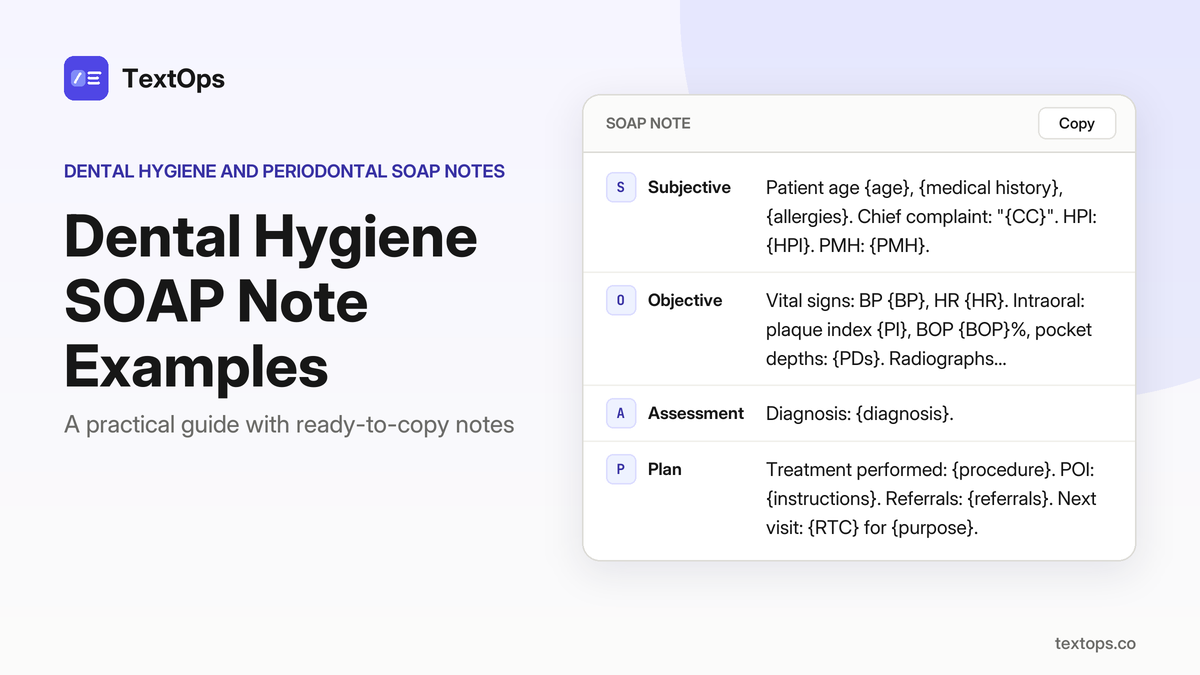
Scaling and Root Planing SOAP Note offers a library of ready-to-copy deep-cleaning templates, each grouped by patient scenario. Every note contains fully populated S, O, A, P sections tailored to SRP, with mobile-friendly formatting so clinicians can copy, paste, and adapt instantly for their charting needs.
Generalized Scaling for Mild to Moderate Periodontitis
First-time Patient, Stage I Periodontitis
SOAP note
SSubjective
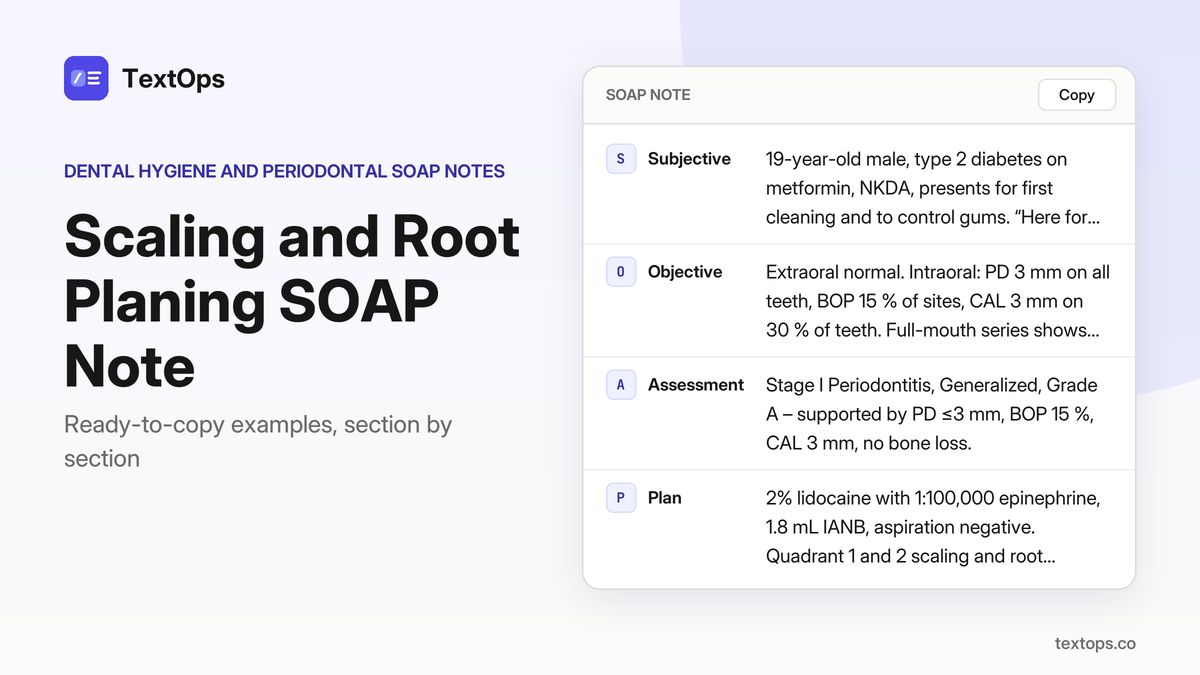
19-year-old male, type 2 diabetes on metformin, NKDA, presents for first cleaning and to control gums. “Here for my first cleaning and to get my gums under control.” No systemic infection signs; BP 118/72, pulse 78.
OObjective
Extraoral normal. Intraoral: PD 3 mm on all teeth, BOP 15 % of sites, CAL 3 mm on 30 % of teeth. Full-mouth series shows no bone loss, mild interproximal calculus.
AAssessment
Stage I Periodontitis, Generalized, Grade A – supported by PD ≤3 mm, BOP 15 %, CAL 3 mm, no bone loss.
PPlan
2% lidocaine with 1:100,000 epinephrine, 1.8 mL IANB, aspiration negative. Quadrant 1 and 2 scaling and root planing with ultrasonic scaler and Gracey curettes; quadrants 3 and 4 deferred to next visit. Fluoride varnish 5 % applied to all teeth. Oral hygiene instruction given. No medications prescribed. Next visit: complete SRP.
First-time Patient, Stage II, Generalized Disease
SOAP note
SSubjective
29-year-old male, seasonal allergies, NKDA, reports “I have noticed my gums bleed more when I brush”; no systemic infection signs, BP 122/78, pulse 80.
OObjective
Full-mouth series shows mild horizontal bone loss in molars; PD 4 mm at 35 % of sites, BOP 25 % of sites, CAL 4 mm on 30 % of teeth; IANB 2% lidocaine 1:100,000, 1.8 mL, aspiration negative; no other abnormalities.
AAssessment
Stage II Periodontitis, Generalized, Grade A, supported by ≥4 mm PD, BOP, CAL, and radiographic bone loss.
PPlan
Quadrant 1 and 2 scaling and root planing performed under IANB; chlorhexidine 0.12 % rinse 15 mL, 30 s, twice daily for 7 days; oral hygiene instruction reinforced; quadrants 3 and 4 scheduled for next visit.
First-time Patient, Stage I, Generalized Disease
SOAP note
SSubjective
61-year-old female, asthma (albuterol PRN), NKDA, reports “My gums feel swollen and I get bleeding when I floss.”
OObjective
Full-mouth radiograph shows no bone loss; PD 3 mm on all teeth, BOP 18 % of sites, CAL 3 mm on 25 % of teeth. Vital signs 110/70 mmHg, pulse 76 bpm; no systemic infection.
AAssessment
Stage I Periodontitis, Generalized, Grade A, supported by PD ≤3 mm, BOP 18 %, CAL 3 mm, and normal radiographs.
PPlan
Full-mouth scaling and root planing performed under 2% lidocaine with 1:100,000 epinephrine, 1.8 mL IANB, aspiration negative. Fluoride varnish 5 % applied to all teeth. Oral hygiene instruction given; patient advised to use a soft-bristled brush and interdental floss. No medications prescribed. Next visit: periodontal maintenance in 3 months.
First-time Patient, Stage II, Localized Disease
SOAP note
SSubjective
33-year-old male, chief complaint: “I have bleeding from my lower molars when I brush”; history: no systemic disease except daily low-dose aspirin; NKDA; BP 115/73, pulse 78.
OObjective
Full-mouth radiograph shows localized bone loss around lower molars; probing depths 4 mm on #30-#32 and #28-#29; bleeding on probing 30 % of sites; CAL 4 mm on 20 % of teeth; vital signs WNL; no signs of infection.
AAssessment
Stage II Periodontitis, Localized, Grade A – supported by 4 mm PDs, 30 % BOP, localized bone loss and CAL of 4 mm.
PPlan
Scaling and root planing of the lower posterior quadrant with 2% lidocaine 1:100,000, 1.8 mL IANB; post-op chlorhexidine 0.12 % rinse, 15 mL, 30 s, twice daily for 7 days; reinforced OHI; next visit in 4 weeks for re-evaluation.
Scaling for Smokers and Diabetic Patients
Smoker, Stage III Periodontitis, Generalized Disease
SOAP note
SSubjective
38-year-old female smoker (5 cigarettes/day) with hypothyroidism on levothyroxine presents with “bad gum bleed and bad breath.”
OObjective
Extraoral normal. Intraoral: PD 6–8 mm generalized, BOP 70 %, CAL 6 mm, plaque score 90 %. Radiograph: generalized bone loss 30–40 %, no suppuration.
AAssessment
Stage III Periodontitis, Generalized, Grade C supported by PD 6–8 mm, BOP 70 %, CAL 6 mm, generalized bone loss.
PPlan
Scaling and root planing of all quadrants with ultrasonic and hand curettes; 2 % lidocaine with 1:100,000 epinephrine, 1.8 mL infiltration for upper teeth; 4 % articaine with 1:100,000 epinephrine, 1.8 mL IANB for lower molars; chlorhexidine 0.12 % rinse 15 mL 30 s twice daily; oral hygiene instruction; smoking cessation counseling; next visit in 4 weeks for reassessment.
Post-Extraction, Day 3, Lower Molar, Deep Cleaning
SOAP note
SSubjective
51-year-old female; CC: “My lower left molar still hurts after extraction.” HPI: pain persists post-extraction; PMH: no significant history; allergy: penicillin rash. O: extraction socket healing well; PD 5 mm around #19; BOP 30 %; no suppuration; PA shows no periapical radiolucency. A: Stage II Periodontitis, Localized, Grade A – 5 mm PD, 30 % BOP, and post-extraction socket status. P: SRP performed with hand curettes around #19; irrigation with saline; chlorhexidine 0.12 % rinse 15 mL 30 s twice daily; oral hygiene instruction; no medications; next visit in 4 weeks for re-evaluation.
Diabetic Patient, Stage II, Poor Glycemic Control
SOAP note
SSubjective
71-year-old male, type 2 diabetes on metformin, smoker 5 cigarettes/day, NKDA; CC: “My gums bleed a lot.” HPI: reports frequent bleeding during brushing, no pain, no swelling; PMH: diabetes, smoking; medications: metformin; allergies: none.
OObjective
Extraoral: normal; Intraoral: generalized erythema, plaque score 85%; Periodontal: PD 5–6 mm all quadrants, BOP 60%, CAL 5 mm; Radiographic: generalized bone loss 25–35%; Tests: none; Vital signs WNL.
AAssessment
Stage II Periodontitis, Generalized, Grade C, supported by PD 5–6 mm, BOP 60%, CAL 5 mm, generalized bone loss 25–35%.
PPlan
Scaling and root planing of all quadrants with ultrasonic and hand curettes; anesthesia: 2% lidocaine 1:100,000, 1.8 mL infiltration (upper), 4% articaine 1:100,000, 1.8 mL IANB (lower); POI: chlorhexidine 0.12% rinse 15 mL 30 s twice daily, oral hygiene instruction, advise tighter glycemic control; next visit: maintenance in 3 months.
Smoker, Stage II, Localized Disease
SOAP note
SSubjective
47-year-old female, former smoker, NKDA, reports “My right molars feel sore.” History: localized soreness for 2 weeks, no systemic symptoms.
OObjective
Extraoral: normal. Intraoral: plaque score 70 %. Periodontal: PD 5 mm on #15-#18, BOP 40 %, CAL 4 mm, no suppuration. Radiographic: localized bone loss 15–20 % on #15-#18.
AAssessment
Stage II Periodontitis, Localized, Grade A, supported by PD 5 mm, CAL 4 mm, BOP 40 %, localized bone loss.
PPlan
SRP performed on #15-#18 with ultrasonic and hand curettes under 2% lidocaine 1:100,000 epinephrine, 1.8 mL IANB. Prescribed chlorhexidine 0.12 % rinse 15 mL for 30 s twice daily; given oral hygiene instruction. Next visit in 4 weeks for re-evaluation.
Smoker, Stage II, Generalized Disease
SOAP note
SSubjective
41-year-old male, smoker 5 cigarettes/day, controlled hypertension on lisinopril, NKDA, CC: “I have bad gums and bad breath,” HPI: chronic gingival inflammation, no pain, no systemic symptoms.
OObjective
PD 5–7 mm generalized, BOP 55 %, CAL 5 mm, plaque score 80 %, radiograph shows generalized bone loss 30–40 %, no suppuration, extraoral and intraoral exam within normal limits, no mobility or furcation involvement noted.
AAssessment
Stage II Periodontitis, Generalized, Grade C, supported by generalized PD 5–7 mm, BOP >50 %, CAL 5 mm, and 30–40 % bone loss on radiograph.
PPlan
Scaling and root planing of all quadrants with ultrasonic and hand curettes; anesthesia: 2% lidocaine 1:100,000, 1.8 mL infiltration for upper teeth; 4% articaine 1:100,000, 1.8 mL IANB for lower molars; chlorhexidine 0.12 % rinse 15 mL 30 s twice daily; oral hygiene instruction; smoking cessation counseling; next visit in 4 weeks for reassessment.
Diabetic Patient, Stage III, Poor Glycemic Control
SOAP note
SSubjective
77-year-old female, type 2 diabetes on metformin, NKDA; CC: “My gums bleed and I feel sore.” HPI: generalized bleeding, soreness, no systemic signs.
OObjective
PD 6–8 mm generalized, BOP 70 %, CAL 6 mm, plaque score 90 %; radiograph shows generalized bone loss 40–50 %; no suppuration; extraoral and intraoral otherwise WNL.
AAssessment
Stage III Periodontitis, Generalized, Grade C, supported by PD 6–8 mm, BOP 70 %, CAL 6 mm, radiographic bone loss 40–50 %.
PPlan
Scaling and root planing of all quadrants with ultrasonic and hand curettes; anesthesia: 2 % lidocaine 1:100,000, 1.8 mL infiltration for upper teeth; 4 % articaine 1:100,000, 1.8 mL IANB for lower molars. POI: chlorhexidine 0.12 % rinse 15 mL 30 s twice daily, oral hygiene instruction, advise tighter glycemic control; next visit in 4 weeks for re-evaluation.
Smoker, Stage IV, Generalized Disease
SOAP note
SSubjective
65-year-old male, smoker 5 cigarettes/day, type 2 diabetes on metformin, NKDA, CC: “My gums are bad and I have lost some teeth,” HPI: progressive gingival recession, tooth loss, no pain, PMH: smoking, diabetes, no systemic signs.
OObjective
PD 8–10 mm generalized, BOP 80 %, CAL 8 mm, 6 teeth lost, plaque score 95 %, radiograph: generalized bone loss 50–60 %, no suppuration; extraoral and intraoral exam within normal limits.
AAssessment
Stage IV Periodontitis, Generalized, Grade C, supported by generalized PD ≥8 mm, CAL 8 mm, bone loss 50–60 %, high BOP and plaque, tooth loss.
PPlan
Scaling and root planing of all quadrants with ultrasonic and hand curettes; anesthesia: 2% lidocaine with 1:100,000 epinephrine, 1.8 mL infiltration upper, 4% articaine with 1:100,000 epinephrine, 1.8 mL IANB lower; chlorhexidine 0.12 % rinse 15 mL 30 s twice daily; oral hygiene instruction; refer for periodontal maintenance and complex rehabilitation; next visit in 4 weeks for reassessment.
Scaling for Medically Complicated Patients
Pregnant Patient, Stage II Periodontitis, 2nd Trimester
SOAP note
SSubjective
35-year-old female, pregnant, seasonal allergies, NKDA; CC: “Here for my deep cleaning, I've had a sore spot on my lower right molars for a few weeks”; HPI: sore spot localized to lower right molars, lasting several weeks; PMH: pregnancy, seasonal allergies; Meds: none; Allergies: NKDA.
OObjective
Extraoral: no swelling, extraoral lymphadenopathy absent; Intraoral: generalized plaque, BOP 70%; Periodontal: PD 5-6 mm on all teeth, CAL 6 mm on #30-#32; Radiographic: generalized bone loss, no periapical radiolucencies; Tests: none.
AAssessment
Stage II Periodontitis, Generalized, Grade A; supported by PD 5-6 mm, BOP 70%, CAL 6 mm on #30-#32 and generalized bone loss on radiograph.
PPlan
Full-mouth SRP performed in quadrants with 2% lidocaine + 1:100,000 epinephrine, 1.8 mL (1 cartridge) IANB, aspiration negative; ultrasonic scaling and hand curettes used; postoperative chlorhexidine 0.12 % rinse 15 mL, 30 s, twice daily; no drugs prescribed; advised to avoid hard foods for 24 h, maintain oral hygiene, return in 6 weeks for re-evaluation.
Pregnancy, 3rd Trimester, Stage II
SOAP note
SSubjective
73-year-old female, pregnant, asthma (albuterol PRN), NKDA, CC: “I need a deep cleaning, my gums bleed a lot when I brush.” HPI: bleeding on brushing, no pain, no systemic symptoms.
OObjective
Extraoral: no facial swelling, intraoral: generalized erythema, PD 6-7 mm on all teeth, BOP 80 %, CAL 7 mm on #30-#32, radiograph: generalized bone loss, mild periapical radiolucency on #15, asthma well controlled, no recent exacerbations.
AAssessment
Stage II Periodontitis, Generalized, Grade A – supported by PD ≥6 mm, BOP 80 %, CAL 7 mm, generalized bone loss on radiograph.
PPlan
Full-mouth SRP performed under 4% articaine with 1:100,000 epinephrine, 1.8 mL (1 cartridge), IANB, aspiration negative. Ultrasonic scaler and hand curettes used; postoperative chlorhexidine 0.12 % rinse 15 mL for 30 s twice daily prescribed. Informed consent obtained; patient advised to avoid NSAIDs, maintain oral hygiene, report any bleeding or swelling. Next visit: periodontal maintenance in 3 months.
Scaling in a Pregnant Patient With Rapid Progression
SOAP note
SSubjective
53-year-old female, pregnant, on low-dose aspirin, NKDA; CC: “My gums bleed and I have a rapid progression of pockets, especially on the lower molars”; HPI: bleeding gums, rapid pocket deepening, no systemic symptoms.
OObjective
Extraoral WNL; intraoral BOP 90%, PD 8-9 mm on #30-#32, CAL 9 mm on #30-#32; radiograph shows rapid bone loss, no abscess; anesthesia 2% lidocaine + 1:100,000 epinephrine, 1.8 mL, IANB, aspiration negative.
AAssessment
Stage III Periodontitis, Generalized, Grade C, supported by PD 8-9 mm, CAL 9 mm, BOP 90%, rapid bone loss on radiograph.
PPlan
Full-mouth SRP performed with ultrasonic scaling and hand curettes; postoperative chlorhexidine 0.12% rinse 15 mL for 30 s twice daily; advised to continue aspirin; next visit in 4 weeks for reevaluation.
Scaling for Periodontitis in a Bisphosphonate User
SOAP note
SSubjective
25-year-old male, chief complaint: “I need a deep cleaning, my gums bleed a lot and I have a history of rapid bone loss.” History: hypothyroidism on levothyroxine; no systemic signs. O: Extraoral normal. Intraoral: PD 6-7 mm on all teeth, BOP 75 %, CAL 7 mm on #30-#32. Radiograph: generalized bone loss, no periapical radiolucencies. A: Stage II Periodontitis, Generalized, Grade B – supported by PD 6-7 mm, BOP 75 %, CAL 7 mm and generalized bone loss. P: Full-mouth SRP performed under 2% lidocaine with 1:100,000 epinephrine, 1.8 mL (1 cartridge), IANB, aspiration negative. Ultrasonic scaler and hand curettes used; postoperative chlorhexidine 0.12 % rinse prescribed twice daily for 7 days. No medications prescribed. Patient advised on bleeding precautions and bisphosphonate interaction risks; next visit: re-evaluation in 6 weeks.
SRP in a Patient With Anticoagulant Therapy
SOAP note
SSubjective
26-year-old male, chief complaint: “My gums bleed and I need a deep cleaning”; medical history: no significant conditions, allergic to penicillin (rash); medications: none.
OObjective
Extraoral: normal. Intraoral: generalized BOP 70%; probing depths 5-6 mm on all teeth; CAL 6 mm on #30-#32; radiograph: generalized bone loss, no periapical radiolucencies.
AAssessment
Stage II Periodontitis, Generalized, Grade A, supported by 5-6 mm pockets, 70 % BOP, 6 mm CAL, and generalized bone loss on radiograph.
PPlan
Full-mouth SRP performed under 2% lidocaine with 1:100,000 epinephrine, 1.8 mL (1 cartridge), IANB; ultrasonic scaling and hand curettes used; postoperative chlorhexidine 0.12 % rinse 15 mL for 30 s twice daily; no drugs prescribed; next visit in 4 weeks for re-evaluation.
Scaling for Periodontitis in a Patient With Allergic Rhinitis
SOAP note
SSubjective
22-year-old male, smoker 5 cigarettes/day, NKDA, CC: “My gums bleed a lot and I smoke, so I need a deep cleaning”; HPI: bleeding gums, no systemic symptoms; PMH: allergic rhinitis noted but not active; medications: none.
OObjective
Extraoral: normal. Intraoral: PD 6-7 mm on all teeth, BOP 80 %, CAL 7 mm on #30-#32; Radiograph: generalized bone loss, no periapical radiolucencies; tests: none.
AAssessment
Stage II Periodontitis, Generalized, Grade B – generalized PD 6-7 mm, BOP 80 %, CAL 7 mm, radiographic bone loss.
PPlan
Full-mouth SRP performed with ultrasonic scaler and hand curettes under 2% lidocaine with 1:100,000 epinephrine, 1.8 mL IANB; postoperative POI: 0.12 % chlorhexidine rinse 15 mL twice daily for 7 days; smoking cessation counseling provided; next visit: periodontal maintenance in 3 months.
Scaling and Root Planing in a Patient on Anticoagulants
SOAP note
SSubjective
59-year-old male, former smoker, NKDA, “I need a deep cleaning, my gums bleed and I used to smoke.” HPI: bleeding gums, generalized periodontal disease. PMH: none.
OObjective
Extraoral: normal. Intraoral: PD 5-6 mm on all teeth, BOP 70 %, CAL 6 mm on #30-#32. Radiograph: generalized bone loss, no periapical radiolucencies.
AAssessment
Stage II Periodontitis, Generalized, Grade A – supported by PD 5-6 mm, BOP 70 %, CAL 6 mm, generalized bone loss.
PPlan
Full-mouth SRP performed with ultrasonic scaling and hand curettes; anesthesia 2% lidocaine with 1:100,000 epinephrine, 1.8 mL, IANB, aspiration negative. Post-op: chlorhexidine 0.12 % rinse, 15 mL, 30 s, twice daily. No medications prescribed. Next visit: periodontal maintenance in 3 months.
Follow-up and Re-evaluation After SRP
Re-evaluation, 6 weeks after SRP, Stage II
SOAP note
SSubjective
57-year-old male, controlled hypertension on lisinopril, NKDA, reports “I’m here for my 6-week check-up after the deep cleaning.”
OObjective
Extraoral normal. Intraoral: probing depths 4 mm at #15, 5 mm at #16, 4 mm at #17, 5 mm at #18; BOP 20 % of sites; CAL 4 mm at #15, 5 mm at #16, 4 mm at #17, 5 mm at #18; plaque score 25 %; radiograph shows mild bone loss around #16 and #18, no furcation involvement.
AAssessment
Stage II Periodontitis, Generalized, Grade A; probing depths and CAL have stabilized since SRP, indicating successful treatment.
PPlan
No additional SRP performed. Scheduled periodontal maintenance in 3 months. No medications prescribed. Patient advised to maintain oral hygiene, use a soft-bristle brush and interdental cleaning, and to return for maintenance.
Chronic Periodontitis, Stage IV, Severe Bone Loss
SOAP note
SSubjective
81-year-old male, NKDA, returns for a 6-week re-evaluation after scaling and root planing; he reports no new symptoms.
OObjective
PD 6 mm at #30, 5 mm at #31, 6 mm at #32; BOP 35 % of sites; CAL 6 mm at #30, 5 mm at #31, 6 mm at #32; plaque score 40 %; radiograph shows moderate bone loss around #30 and #32, slight furcation involvement Glickman I at #30.
AAssessment
Stage IV Periodontitis, Generalized, Grade C, evidenced by deep pockets, high BOP, CAL loss, bone loss and furcation involvement.
PPlan
Plan additional SRP for #30 and #32; refer to periodontist for possible regenerative therapy; continue maintenance every 3 months; no medications prescribed.
28-year-old male, type 2 diabetes on metformin, NKDA, presents for routine cleaning and check-up. Chief complaint: “I’m here for my routine cleaning and check-up.” Past medical history: type 2 diabetes, HbA1c 7.2 %, no systemic signs.
OObjective
PD 3 mm at all sites on #11-#14; BOP 10 % of sites; CAL 3 mm at all sites; plaque score 15 %; radiograph shows no bone loss; HbA1c 7.2 %; extraoral and intraoral findings within normal limits; no anesthesia administered.
AAssessment
Stage I Periodontitis, Localized, Grade B (diabetes modifier); probing depths, attachment loss, and bleeding support mild disease.
PPlan
Performed prophylaxis with ultrasonic scaling and hand instruments; reinforced oral hygiene instructions; no SRP indicated; patient advised to maintain plaque control; next periodontal maintenance in 3 months; no medications prescribed.
Re-evaluation, 8 weeks after SRP, Stage I
SOAP note
SSubjective
21-year-old female, seasonal allergies, NKDA, reports “I’m back for my 8-week follow-up after the deep cleaning.”
OObjective
Extraoral normal. Intraoral: PD 4 mm at #5, 3 mm at #6, 4 mm at #7, 3 mm at #8; BOP 15 % of sites; CAL 4 mm at #5, 3 mm at #6, 4 mm at #7, 3 mm at #8; plaque score 20 %; PAN shows slight bone loss around #5 and #7, no furcation involvement.
AAssessment
Stage I Periodontitis, Generalized, Grade A – supported by PD ≤ 4 mm, CAL 3–4 mm, BOP 15 %, and radiographic bone loss.
PPlan
No additional SRP performed. Instructed on oral hygiene. Scheduled periodontal maintenance in 3 months.
Re-evaluation, 4 weeks after SRP, Stage III
SOAP note
SSubjective
36-year-old male, asthma, NKDA, CC “I’m here for my 4-week check-up after the scaling and root planing.” HPI: no pain, routine follow-up.
OObjective
PD 5 mm at #19, 4 mm at #20, 5 mm at #21, 4 mm at #22; BOP 25 % of sites; CAL 5 mm at #19, 4 mm at #20, 5 mm at #21, 4 mm at #22; plaque score 30 %; PA shows moderate bone loss around #19 and #21, no furcation.
AAssessment
Stage III Periodontitis, Localized, Grade B; pocket depths and bone loss consistent with persistent periodontal destruction.
PPlan
Re-evaluated pockets; plan additional SRP for #19 and #21. No anesthesia needed. Refer to periodontist if bone loss progresses. Schedule maintenance in 3 months.
Pregnancy, 1st Trimester, Stage I
SOAP note
SSubjective
68-year-old female, pregnant, on low-dose aspirin, NKDA; CC: “I’m here for my 1-month follow-up after the deep cleaning.” HPI: none.
OObjective
PD 4 mm at #30, 5 mm at #31, 4 mm at #32; BOP 20 % of sites; CAL 4 mm at #30, 5 mm at #31, 4 mm at #32; plaque score 25 %; radiograph shows mild bone loss around #31, no furcation.
AAssessment
Stage I Periodontitis, Generalized, Grade A, supported by PD ≤5 mm, BOP 20 %, CAL 4-5 mm, mild radiographic bone loss.
PPlan
No additional SRP performed. Reinforced OHI, advised to avoid smoking. Scheduled periodontal maintenance in 3 months. POI: maintain oral hygiene, avoid hard foods for 24 h. No medications prescribed.
Re-evaluation, 6 weeks after SRP, Stage IV
SOAP note
SSubjective
63-year-old male, hypothyroid on levothyroxine, chief complaint: “Here for my 6-week check-up after the deep cleaning.”
OObjective
PD 4–5 mm on all teeth, BOP 15 % of sites, CAL 5–6 mm, plaque 20 %, mobility Miller 0, no furcation, radiograph mild horizontal bone loss, no periapical radiolucencies.
AAssessment
Stage IV Periodontitis, Generalized, Grade C, supported by generalized deep pockets, significant attachment loss, high BOP, and radiographic bone loss.
PPlan
Discussed maintenance plan: full-mouth scaling and root planing of all teeth, oral hygiene instruction, fluoride varnish 5 % sodium fluoride on all teeth; no drugs given. Next visit scheduled in 3 months for periodontal maintenance.
Pregnancy, 2nd Trimester, Stage II
SOAP note
SSubjective
54-year-old pregnant female reports “Just checking in after my cleaning.” She is following up after a recent SRP. Past medical history includes pregnancy; she has no other systemic conditions.
OObjective
Probing depths 3–4 mm on teeth #15-#18, BOP 10 % of sites, CAL 4–5 mm, plaque score 18 %. Mobility Miller 0, no furcation involvement. Panoramic radiograph shows no bone loss or periapical lesions.
AAssessment
Stage II Periodontitis, Generalized, Grade A – evidenced by moderate PDs, CAL, BOP, plaque, and absence of radiographic bone loss.
PPlan
Scaling of all teeth, oral hygiene instruction, fluoride varnish applied to all teeth; no drugs prescribed, no anesthesia used. Next visit scheduled in 3 months.
Re-evaluation After Antibiotic-Assisted SRP
SOAP note
SSubjective
23-year-old female, smoker 5 cigarettes/day, NKDA, CC: “I’m back for my 6-week follow-up after the deep cleaning.” HPI: returned for reassessment after initial SRP; no pain or systemic symptoms. O: PD 4–5 mm on all teeth, BOP 12 % of sites, CAL 5–6 mm, plaque score 22 %; radiograph shows mild bone loss, no periapical lesions; mobility Miller 0, no furcation involvement. A: Stage III Periodontitis, Generalized, Grade C (smoking modifier) supported by PD, CAL, BOP, and radiographic bone loss. P: Plan full-mouth SRP again, reinforce smoking cessation counseling, provide oral hygiene instruction, apply fluoride varnish 5 % sodium fluoride to all teeth; no medications prescribed; next visit in 3 months.
Re-evaluation After Periodontal Regeneration
SOAP note
SSubjective
55-year-old female, former smoker, NKDA, presents with “checking in after my cleaning.” HPI: no pain, routine follow-up after SRP. PMH: former smoker, no systemic disease.
OObjective
Extraoral normal. Intraoral: PD 3–4 mm on #15-#18, BOP 8 % of sites, CAL 4–5 mm, plaque score 15 %. Radiograph: no bone loss, no periapical lesions. Mobility Miller 0, no furcation involvement.
AAssessment
Stage II Periodontitis, Generalized, Grade A – supported by PD 3–4 mm, CAL 4–5 mm, BOP 8 % and plaque 15 %.
PPlan
Maintain periodontal health: full-mouth scaling, oral hygiene instruction, fluoride varnish 5 % sodium fluoride on all teeth. No drugs prescribed. Next maintenance visit scheduled in 3 months.
Re-evaluation After Antibiotic-Assisted SRP in a Diabetic
SOAP note
SSubjective
80-year-old male, type 2 diabetes on metformin, controlled hypertension on lisinopril, NKDA; CC: “I’m here for my 6-week check-up after the deep cleaning”; HPI: no new symptoms, reports routine oral hygiene, no pain or swelling.
OObjective
Extraoral: no swelling or lymphadenopathy; Intraoral: PD 5–6 mm on all teeth, BOP 18 % of sites, CAL 6–7 mm; Plaque score 25 %; Radiograph: moderate bone loss, no periapical lesions; Mobility Miller 0, no furcation involvement.
AAssessment
Stage IV Periodontitis, Generalized, Grade C (diabetes modifier) supported by PD 5–6 mm, BOP 18 %, CAL 6–7 mm, moderate bone loss.
PPlan
Re-perform full-mouth SRP, reinforce glycemic control discussion, provide oral hygiene instruction, apply fluoride varnish 5 % sodium fluoride to all teeth, schedule next maintenance in 3 months.
Post-Surgical Follow-up Visits
Post-Surgical Follow-up, 4 weeks after Open Flap Debridement
SOAP note
SSubjective
58-year-old male, NKDA, presents for follow-up after open flap debridement of #30-#32; says “I’m here for my follow-up after the flap surgery.” No systemic symptoms, no pain, no swelling.
OObjective
Probing depths: #30 4 mm, #31 3 mm, #32 4 mm; bleeding on probing 0 %; plaque 10 %; radiograph shows no new bone loss; no suppuration.
AAssessment
Stage II Periodontitis, Generalized, Grade A – healing stable, pocket depths within acceptable limits for this stage.
PPlan
Reviewed healing; no additional therapy required. Advised to maintain oral hygiene and avoid trauma to the surgical sites. Scheduled periodontal maintenance in 3 months.
Post-Surgical, 2 weeks after Gingivectomy
SOAP note
SSubjective
37-year-old male, type 2 diabetes on metformin, NKDA; chief complaint: “Just checking how the gums are healing after the gingivectomy”; no pain, no swelling; medical history: diabetes, no other systemic signs.
OObjective
Extraoral: no swelling, extraoral facial symmetry normal; Intraoral: gingival healing at #12-#13, PD 2 mm each, BOP 0 %; Plaque 15 %; Radiograph: no pathology; no pain reported.
AAssessment
Stage I Periodontitis, Localized, Grade A – supported by PD 2 mm, no BOP, and absence of radiographic pathology.
PPlan
No anesthesia or medication administered; instructed to use gentle brushing, avoid flossing the sites for 48 hours; next visit in 4 weeks for re-evaluation.
Post-Surgery, 1 month after Open Flap Debridement
SOAP note
SSubjective
69-year-old female, seasonal allergies, NKDA, reports “I’m here for my post-op check after the flap surgery.”
OObjective
Extraoral normal. Intraoral: PD #20 5 mm, #21 4 mm, #22 5 mm; BOP 0 %; plaque 20 %; radiograph shows slight bone fill at #20 and #22; no suppuration, swelling, or pain.
AAssessment
Stage III Periodontitis, Generalized, Grade B, supported by pocket depths ≥4 mm, BOP 0 %, and radiographic bone fill.
PPlan
No anesthesia or drugs administered. Bone fill noted; continue SRP in remaining quadrants. Instructed on oral hygiene and to avoid trauma to the surgical site. Next visit scheduled in 6 weeks for reassessment.
Post-Surgical, 3 weeks after Flap Surgery
SOAP note
SSubjective
39-year-old male, asthma controlled with albuterol PRN, NKDA, reports “checking how my gums are healing after the flap.” History of present illness: postoperative follow-up after flap surgery on teeth #8 and #9, no pain, no swelling.
OObjective
Extraoral: no facial asymmetry, no swelling. Intraoral: flap sites on #8 and #9 appear healed, no erythema or exudate. Periodontal: probing depths 3 mm on #8 and #9, bleeding on probing 0 %, plaque score 12 %. Radiograph: panoramic shows no new bone loss. Tests: none performed.
AAssessment
Stage I Periodontitis, localized, Grade A—supported by probing depths ≤3 mm, absence of BOP, and radiographic stability.
PPlan
No anesthesia used. Advised chlorhexidine 0.12 % rinse, 15 mL twice daily for 7 days. Instructed to maintain oral hygiene, avoid trauma to flap sites, and report any pain or swelling. Next visit scheduled in 4 weeks for reassessment.
Post-Surgical, 1 month after Gingivoplasty
SOAP note
SSubjective
67-year-old female, chief complaint: “Just a quick check after my gingivoplasty.” Medical history: daily low-dose aspirin, NKDA. HPI: no pain, no swelling, no bleeding.
OObjective
Probing depths: #15 2 mm, #16 2 mm; BOP 0%; plaque 18%; radiograph shows no pathology; extraoral exam WNL; no systemic signs.
AAssessment
Stage I Periodontitis, Localized, Grade A – supported by PDs ≤3 mm, no BOP, and absence of radiographic bone loss.
PPlan
No anesthesia used. Instructed on gentle brushing technique; no additional treatment indicated. Advised to return for periodontal maintenance in 3 months.
Post-Surgical, 2 weeks after Open Flap Debridement
SOAP note
SSubjective
44-year-old female, hypothyroidism on levothyroxine, penicillin allergy (rash); CC: "I'm here for my follow-up after the flap surgery"; HPI: no pain, no swelling, normal function; PMH: hypothyroidism, no other systemic issues; no tobacco or alcohol use.
OObjective
Extraoral: no swelling, no lymphadenopathy; Intraoral: surgical sites at #30-#32 show healthy mucosa, no erythema; Periodontal chart: PD #30 4 mm, #31 3 mm, #32 4 mm; BOP 0 %; Plaque 10 %; Radiograph: no new bone loss; all findings within expected healing limits.
AAssessment
Stage II Periodontitis, Generalized, Grade A; healing is appropriate with pocket depths reduced to 3–4 mm and no bleeding or suppuration, consistent with successful open flap debridement.
PPlan
No additional therapy required; patient educated on oral hygiene and postoperative care; prescribed no drugs; scheduled next periodontal maintenance in 3 months.
Post-Surgical Follow-up After Crown Lengthening
SOAP note
SSubjective
72-year-old female, no significant medical history, allergic to penicillin (rash); chief complaint: “Checking how my gums are healing after the crown lengthening”; PMH; no medications.
OObjective
Extraoral: normal; intraoral: gingival tissues around #11-#12 show healthy healing, no swelling or pain; periodontal charting shows PD 2 mm at #11 and #12, BOP 0 %; plaque score 15 %; radiograph reveals bone crest 3 mm apical to planned restoration margin; all other sites within normal limits.
AAssessment
Stage I Periodontitis, Localized, Grade A; supported by probing depths ≤3 mm, no BOP, and bone crest position relative to restoration margin.
PPlan
No anesthesia used; instructed on gentle brushing technique and to avoid flossing the crown-lengthened sites for 48 hours; prescribed no drugs; POI given; next visit scheduled in 4 weeks.
Emergency Scaling and Acute Cases
Emergency Scaling for Acute Abscess
SOAP note
SSubjective
75-year-old female, smoker 5 cigarettes/day, NKDA, CC: “I have a big swelling on my lower right molars and it’s painful.” HPI: swelling and pain localized to lower right molars for 2 days, no trismus, temperature 99.1 °F, no lymphadenopathy.
OObjective
Extraoral: localized swelling on right mandibular angle, no trismus, 99.1 °F. Intraoral: tooth #30, PD 12 mm, BOP +, suppuration present. Radiograph: periapical radiolucency extending to apex of #30.
AAssessment
Acute periodontal abscess, Stage II Periodontitis, Localized, Grade C (smoking modifier) supported by PD 12 mm, BOP +, suppuration, periapical radiolucency.
PPlan
2% lidocaine with 1:100,000 epinephrine, 1.8 mL (1 cartridge), IANB, aspiration negative. Immediate SRP of #30 with ultrasonic scaler and hand curettes, irrigated with 0.12% chlorhexidine, drainage of purulent exudate. Prescribed Ibuprofen 400 mg q6h PRN up to 3 days. Oral hygiene instructions given. Follow-up in 48 h for reassessment.
Emergency SRP for Acute Gingival Bleeding
SOAP note
SSubjective
82-year-old female, former smoker, NKDA, reports “My gums are bleeding a lot and I can’t eat.” HPI: sudden onset of profuse gingival bleeding, inability to chew. PMH: none relevant.
OObjective
Extraoral: no swelling, no trismus, temp 98.6 °F, no lymphadenopathy. Intraoral: PD 8 mm on #15 and #16, BOP +, no suppuration. Radiograph: mild bone loss around #15 and #16, no radiolucency.
AAssessment
Acute periodontal inflammation, Stage I Periodontitis, Localized, Grade A, evidenced by 8 mm pockets, BOP, mild bone loss, no systemic signs.
PPlan
SRP of #15 and #16 with ultrasonic scaler and hand curettes; local hemostasis with 2% lidocaine 1:100,000 epinephrine; 4% articaine 1:100,000 infiltration 1.8 mL for anesthesia. Prescribed Ibuprofen 400 mg PO q6h PRN for 3 days. Chlorhexidine 0.12% rinse 15 mL 30 s twice daily. Oral hygiene instruction given. Follow-up in 2 weeks for re-evaluation.
Emergency Scaling for Acute Periodontal Abscess
SOAP note
SSubjective
60-year-old female, controlled hypertension on lisinopril, NKDA; CC: “There’s a painful swelling on my upper right molar and I can’t bite.” HPI: acute swelling on #3, pain on biting, fever 100.2 °F, no trismus, no lymphadenopathy.
OObjective
Extraoral: localized swelling at upper right molar, temperature 100.2 °F. Intraoral: #3 PD 10 mm, BOP +, suppuration present. Radiograph: periapical radiolucency extending to the apex of #3.
AAssessment
Acute periodontal abscess, Stage II Periodontitis, Localized, Grade A, supported by 10 mm PD, suppuration, periapical radiolucency, and low-grade fever.
PPlan
Immediate SRP of #3 with ultrasonic scaler and hand curettes, drainage of purulent exudate, irrigation with 0.12 % chlorhexidine. Anesthesia: 2 % lidocaine with 1:100,000 epinephrine, 1.8 mL infiltration, aspiration negative. Prescribed Amoxicillin 500 mg q8h for 7 days and Ibuprofen 400 mg q6h PRN up to 3 days. Oral hygiene instructions given; next visit in 48 hours.
Maintenance and Long-Term Follow-up
Re-evaluation After Periodontal Maintenance Post-SRP
SOAP note
SSubjective
50-year-old male, NKDA, reports “here for my routine checkup after my last cleaning.” He has no systemic signs and denies pain.
OObjective
Extraoral: WNL. Intraoral: plaque score 15%, BOP 20% of sites, no suppuration, no mobility, no furcation involvement. Periodontal charting: #30 PD 4 mm, CAL 3 mm; #31 PD 4 mm, CAL 3 mm; #32 PD 3 mm, CAL 2 mm. Radiographs not taken this visit.
AAssessment
Stage II Periodontitis, Generalized, Grade A – supported by probing depths ≥4 mm, BOP 20%, CAL 2–3 mm, and plaque score 15%.
PPlan
Reinforced oral hygiene instruction; no SRP needed. Scheduled periodontal maintenance in 3 months. No medications prescribed.
Definition of Scaling and Root Planing
Scaling and root planing (SRP) is a therapeutic periodontal procedure that removes subgingival calculus and smooths root surfaces to eliminate bacterial biofilm and promote reattachment. SRP targets pockets ≥4 mm in patients with periodontitis, aiming to reduce pocket depth, bleeding on probing, and attachment loss while preserving tooth structure. SRP removes subgingival calculus, eliminates bacterial biofilm, and smooths root surfaces to promote reattachment. SRP is performed by hand instruments and ultrasonic scalers, often quadrant-by-quadrant, and may include adjunctive antimicrobials. Unlike routine prophylaxis, which cleans supragingival plaque and calculus in healthy or gingivitis patients, SRP addresses diseased pockets, requires anesthesia, and is guided by a periodontal diagnosis and charting.
Clinical Context of Deep Cleaning
Scaling and root planing (SRP) is indicated for patients with Stage I–III periodontitis, whether localized or generalized. In Stage I, pockets ≤4 mm with minimal attachment loss are treated to prevent progression; Stage II involves moderate attachment loss and deeper pockets that benefit from full-mouth debridement; Stage III presents advanced bone loss and tooth loss, requiring aggressive SRP combined with adjunctive therapy. Localized disease focuses on affected quadrants, while generalized disease mandates quadrant-by-quadrant treatment. Systemic factors—diabetes, smoking, immunosuppression—necessitate earlier intervention and tighter monitoring. The primary therapeutic goals are complete plaque and calculus removal, reduction of probing depth, elimination of bleeding on probing, and gain of clinical attachment to stabilize the periodontium.
SOAP Structure for a Deep Cleaning Visit
Subjective
Record the CC verbatim, e.g., “I have bleeding gums and a bad taste.”
Risk of progression: rapid grade if smoking or poor glycemic control.
Plan
Home care: brushing twice daily, interdental cleaning, chlorhexidine 0.12 % rinse 15 mL for 30 s, twice daily.
Recall interval: 4 weeks for active disease, 3 months for maintenance.
Adjunctive therapy: local antimicrobials (e.g., 0.12 % chlorhexidine gel), systemic antibiotics if indicated (e.g., amoxicillin 500 mg TID for 7 days).
Referrals: periodontist for surgical consideration if CAL > 5 mm or furcation involvement.
Patient education: explain goals, risks, and importance of compliance.
Schedule next visit: 4 weeks post-SRP for re-evaluation.
Assessment Components for a Deep Cleaning Visit
Periodontal Charting
Record probing depth (PD) at six sites per tooth, bleeding on probing (BOP) per site, plaque index (%), clinical attachment level (CAL = PD + recession), recession depth, mobility (Miller grade), and furcation involvement (Glickman grade). In the objective section, enter a succinct table or list: “PD: 4 mm (mesio-labial), 5 mm (mid-mesial), 4 mm (distal); BOP: 2/6 sites; CAL: 3 mm; recession: 1 mm; mobility: 0; furcation: none.” Use abbreviations (PD, BOP, CAL, R, M, F) to keep the note concise yet complete.
Radiographic Findings
Document the radiograph type (PA, BWX, PAN, FMX) and the key findings: bone loss pattern, furcation involvement, periapical pathology, and root morphology. In the objective section, write: “PAN: generalized horizontal bone loss 35 %, furcation involvement Grade I at #18; PA: root resorption at #15.” Keep the description brief but capture all clinically relevant changes that influence the assessment.
Systemic Factors
Note conditions that alter periodontal prognosis: diabetes (HbA1c > 7 %), anticoagulant or antiplatelet therapy, pregnancy (trimester), smoking ≥10 cigarettes/day. In the objective part, add a line: “Systemic: type 2 DM, HbA1c 7.2 %; anticoagulant therapy (warfarin); pregnancy, 2nd trimester.” These factors modify the risk assessment, dictate tighter monitoring, and may influence the choice of adjunctive therapy or recall interval.
Plan Components for a Deep Cleaning Visit
Home Care Instructions
Record brushing twice daily with a soft-bristle brush and fluoride toothpaste. Add interdental cleaning: floss or interdental brushes at least once per day. Prescribe chlorhexidine 0.12 % rinse, 15 mL for 30 s, twice daily for 7 days. Note that the patient will receive written instructions and verbal demonstration.
Recall Interval
Document the next visit as 4 weeks for active disease, 6 weeks if the patient has a recent infection or poor compliance, and 3 months for maintenance once stability is achieved. Include the purpose: re-evaluation of pocket depths, BOP, and plaque control.
Adjunctive Therapy
If systemic antibiotics are indicated, write “Amoxicillin 500 mg TID for 7 days” or “Clindamycin 300 mg TID for 7 days” depending on allergy status. For local antimicrobials, note “0.12 % chlorhexidine gel applied to root surfaces” or “0.2 % chlorhexidine mouthwash prescribed for 14 days.” Record the rationale: deep pockets ≥5 mm, furcation involvement, or poor oral hygiene.
Referrals
Include a referral line when surgical intervention is needed: “Refer to periodontist for flap surgery if CAL > 5 mm or Grade C furcation.” Also note referrals for systemic control: “Refer to primary care for HbA1c monitoring if uncontrolled diabetes.” Document the referral purpose and any urgency.
Follow-up and Outcome Tracking After SRP
Re-evaluation Schedule
Schedule the first re-evaluation 4–8 weeks after SRP, depending on disease severity and systemic factors. Stage I or II patients with good compliance return at 6 weeks; Stage III–IV or medically compromised patients return at 8 weeks. Record the exact date and purpose: compare baseline and current periodontal parameters to determine stability and need for further therapy.
Pocket Depth Changes
Document probing depth (PD) at six sites per tooth. Note the mean PD and the number of sites ≥4 mm. Record any reduction of ≥1 mm as a gain in clinical attachment level (CAL). If pockets ≥5 mm persist, list the affected teeth and consider adjunctive local antimicrobials or referral for surgical therapy. Use a concise table: “Mean PD: 3.2 mm (baseline 4.5 mm); CAL gain: 1.3 mm; pockets ≥5 mm: 4 sites.”
Bleeding and Plaque
Calculate bleeding on probing (BOP) as a percentage of sites. A reduction of ≥50 % from baseline indicates effective debridement. Record plaque index (PI) as a percentage or O’Leary score. Note any sites with persistent BOP or PI >30 % and advise intensified home-care instruction or chlorhexidine rinse. Include a brief note: “BOP 12 % (baseline 28 %); PI 25 % (baseline 40 %).”
Treatment Goal Assessment
Assess whether the patient achieved the predefined goals: pocket depth ≤4 mm, BOP ≤10 %, plaque control ≤30 %, and CAL gain ≥1 mm. If goals are met, schedule maintenance at 3 months. If not, extend recall to 4 weeks, prescribe adjunctive therapy, or refer for surgical evaluation. Record the decision: “Goals met – maintenance 3 months; goals not met – next visit 4 weeks, local antimicrobial, re-evaluation of pockets ≥5 mm.”
Special-Case Modifications for Systemic Conditions and Combined Surgery
Diabetes and Smoking
Record HbA1c or recent glucose control in the objective. Note smoking status and pack-years in the subjective. In the assessment, shift the periodontal grade to C if HbA1c ≥ 7 % or smoking ≥ 10 cigs/day. In the plan, schedule the next re-evaluation at 6 weeks instead of 4 weeks, prescribe chlorhexidine 0.12 % rinse for 14 days, and advise tighter home-care instruction. Document that the patient was counseled on the impact of hyperglycemia and tobacco on healing and that he/she consented to the modified recall interval.
Anticoagulants and Antiresorptives
In the objective, list the anticoagulant (warfarin, DOAC) or bisphosphonate (oral or IV) and the INR or bone-resorption risk. In the assessment, note the risk of postoperative bleeding or osteonecrosis. In the plan, obtain an INR < 1.7 (or per protocol) before SRP, consider local hemostatic agents (gelfoam, oxidized regenerated cellulose), and schedule a postoperative follow-up at 48 hours to check hemostasis. Document the discussion of bleeding risks, the patient’s willingness to postpone surgery if INR is high, and any referrals to the prescriber for medication adjustment.
SRP with Periodontal Surgery
When SRP is combined with open-flap debridement or regenerative surgery, record the flap design and any bone-debridement details in the objective. In the assessment, note the extent of bone loss and the need for regenerative material. In the plan, specify the type of graft or barrier membrane, the suture technique, and the postoperative instructions (avoid brushing the flap for 7 days, chlorhexidine rinse). Record that the patient was informed of the increased postoperative discomfort and the need for a 2-week suture-removal visit.
Contraindications and Precautions for Scaling and Root Planing
Absolute Contraindications
Uncontrolled bleeding disorders (e.g., hemophilia, thrombocytopenia <50 × 10⁹/L). Acute infection with systemic signs (fever >38 °C, leukocytosis) or active periodontal abscess requiring immediate drainage. Recent major surgery or trauma that compromises wound healing. Severe uncontrolled hypertension or unstable cardiac conditions that preclude local anesthesia with vasoconstrictor.
Relative Precautions
Patients on anticoagulants (warfarin, DOACs) or antiplatelet agents (aspirin, clopidogrel) with INR >1.7 or on dual therapy. Bisphosphonate or denosumab users, especially with IV therapy or high cumulative dose, due to osteonecrosis risk. Pregnant patients in the first trimester, uncontrolled diabetes (HbA1c >8 %), or severe immunosuppression. Use caution in patients with recent antibiotic therapy or known drug allergies that may limit adjunctive options.
Hemostasis and Antibiotic Prophylaxis
Document pre-operative INR or coagulation status. Note use of local hemostatic agents (gelfoam, oxidized regenerated cellulose) and the volume of anesthesia with vasoconstrictor. Record any intra-operative bleeding episodes and resolution method. For prophylaxis, write “Amoxicillin 2 g PO 30 min pre-procedure” or “Clindamycin 600 mg PO 30 min pre-procedure” when indicated by cardiac risk. Include the patient’s consent for prophylaxis and any documented refusal.
Differentiating Deep Cleaning from Routine Prophylaxis
Procedure Scope
Deep cleaning targets pockets ≥4 mm and requires quadrant-by-quadrant debridement with local anesthesia. Routine prophylaxis cleans supragingival plaque, uses no anesthesia, and treats the whole mouth in a single session. In the SOAP note, list “Quadrants treated: 1–4” and “Anesthesia: 2% lidocaine with 1:100,000 epinephrine, 1.8 mL, infiltration” under Objective. Prophylaxis notes omit anesthesia and quadrant detail, noting only “Full-mouth supragingival scaling and polishing.”
Documentation Requirements
SRP demands full periodontal charting: PD, BOP, CAL, recession, mobility, furcation. Record a concise table or list: “PD: 5 mm (mesial), 4 mm (mid), 5 mm (distal); BOP 2/6; CAL 3 mm.” Prophylaxis notes record plaque index and surface calculus only. In the Assessment, add “Stage II, Grade B periodontitis” for SRP; prophylaxis omits a periodontal diagnosis. Radiographs for SRP should include PA or PAN with bone loss description; prophylaxis may note “PA taken for baseline.”
Patient Education
For SRP, counsel on intensive home care: brushing twice daily, interdental cleaning, chlorhexidine 0.12 % rinse 15 mL for 30 s, twice daily for 7 days, and a recall in 4 weeks. For prophylaxis, advise routine brushing, flossing, and a 3-month recall. In the Plan, write “Patient educated on plaque control, recall interval, and signs of bleeding” for SRP; for prophylaxis, “Patient advised on regular home care and next prophylaxis in 3 months.”
These examples show structure and wording only. Record what you actually found and did, and follow your practice’s documentation requirements.
Dr. Rahul Joshi is a Specialist Orthodontist with extensive clinical experience in orthodontics, dentofacial orthopaedics, and dental aesthetics. Holding a Master of Dental Surgery (MDS) in Orthodontics and Dentofacial Orthopaedics and a Bachelor of Dental Surgery (BDS) from Manipal Academy of Higher Education, he brings expertise in orthodontic treatment planning, teeth alignment, and Invisalign treatment. With professional experience across India and the Netherlands, Dr. Joshi combines clinical knowledge with practical experience in orthodontic care, dental aesthetics, and improving patients' oral health.
Master of Dental Surgery (MDS) in Orthodontics and Dentofacial Orthopaedics — Manipal Academy of Higher Education
Bachelor of Dental Surgery (BDS) — Manipal Academy of Higher Education
Stop retyping your templates
Save any template to TextOps once, then insert it anywhere on the web without retyping. Share it with your team so everyone uses the same wording.