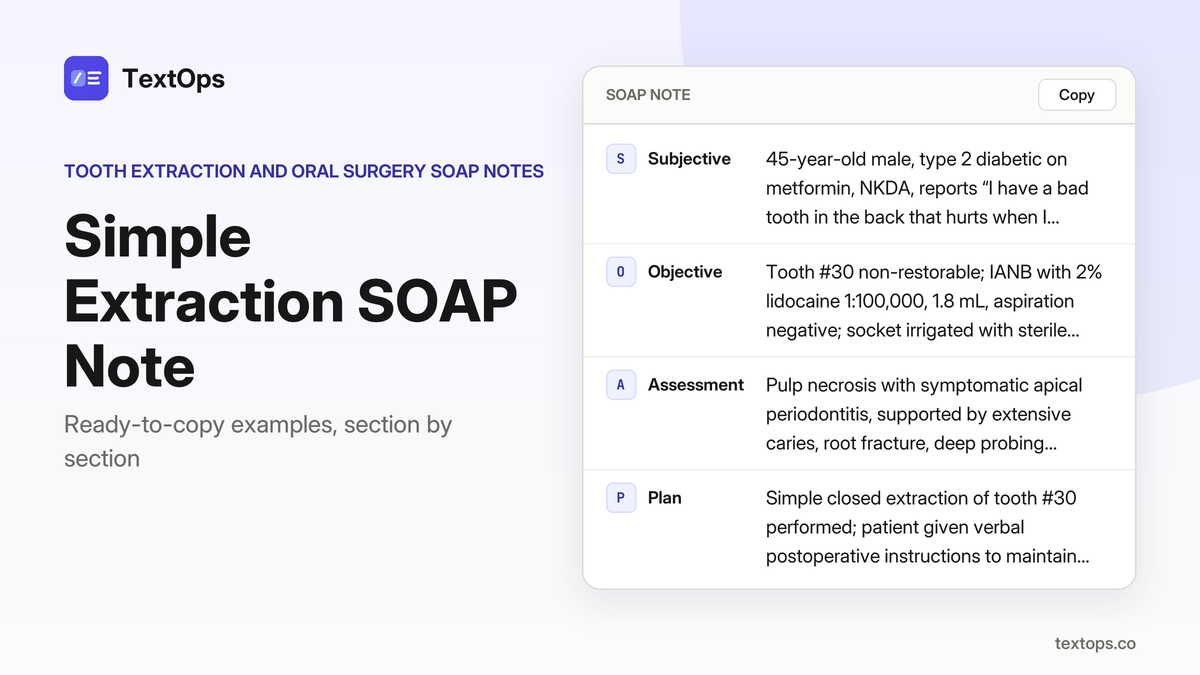
Post-extraction follow-up notes are presented ready to copy, with a concise, mobile-friendly template that captures healing status, pain intensity, vital signs, and next-visit planning. The format includes a quick S-O-A-P layout, a 0-10 pain scale, and clear guidance on documenting vital signs, oral findings, and discharge instructions. Use the template to document the patient’s recovery efficiently, whether on a tablet or a phone.
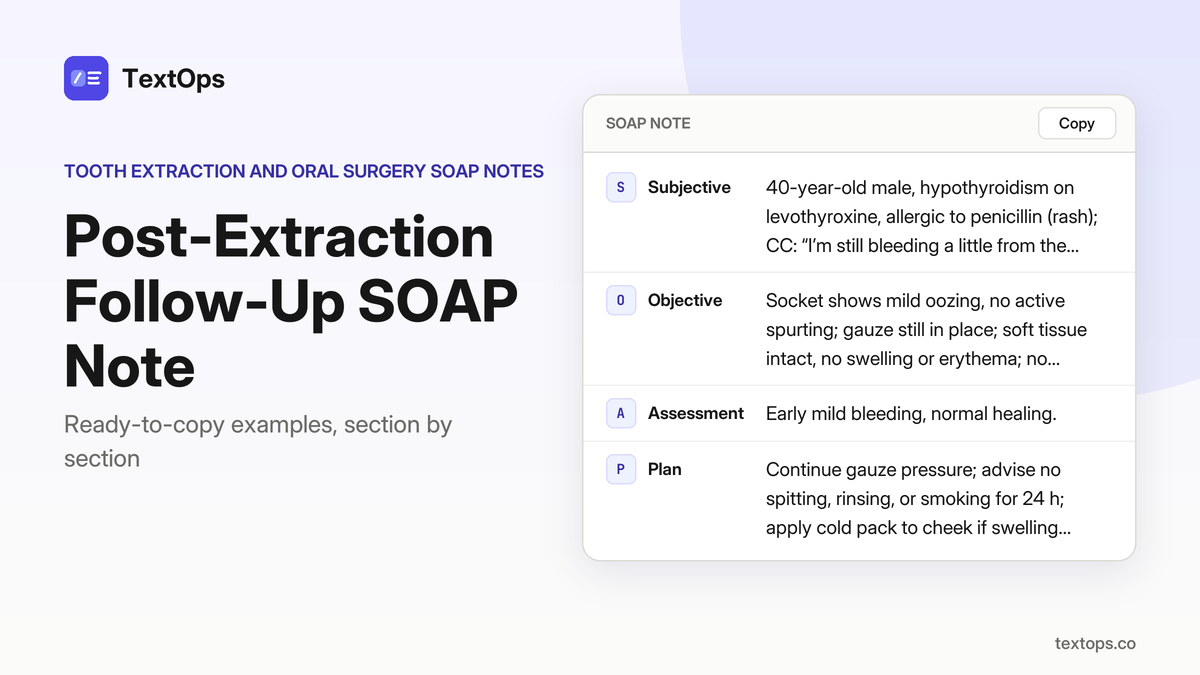
40-year-old male, hypothyroidism on levothyroxine, allergic to penicillin (rash); CC: “I’m still bleeding a little from the socket.” HPI: mild oozing noted at day-1 post-extraction of tooth #30; PMH: hypothyroidism; no other medications.
OObjective
Socket shows mild oozing, no active spurting; gauze still in place; soft tissue intact, no swelling or erythema; no trismus; T 98.6 °F; no lymphadenopathy; anesthesia: 2% lidocaine with 1:100,000 epinephrine, 1.8 mL, IANB, aspiration negative.
AAssessment
Early mild bleeding, normal healing.
PPlan
Continue gauze pressure; advise no spitting, rinsing, or smoking for 24 h; apply cold pack to cheek if swelling develops; re-evaluate in 2 days if bleeding persists. No medications prescribed.
Day 1 Follow-Up, 28-Year-Old Male, Post-Extraction Bleeding
SOAP note
SSubjective
28-year-old male, asthma, NKDA, reports “I’m still bleeding a bit from the extraction site.” He had a buccal infiltration of 2% lidocaine with 1:100,000 epinephrine, 1.8 mL, aspiration negative. HPI: mild discomfort, no pain, no swelling, temperature 98.4 °F, no lymphadenopathy.
OObjective
Socket shows minimal bleeding with gauze still in place; soft tissue healthy; extraoral exam WNL; intraoral exam WNL; no pain beyond mild discomfort; vital signs normal; no systemic signs.
AAssessment
Early mild bleeding, normal healing, supported by minimal bleeding, intact gauze, absence of swelling or pain, and normal vital signs.
PPlan
Gauze pressure maintained; patient advised to avoid strenuous activity for 24 h, use ice packs if swelling develops, and return in 2 days if bleeding persists. No medications prescribed.
Day 1 Follow-Up, 33-Year-Old Female, Post-Extraction Bleeding
SOAP note
SSubjective
33-year-old female, takes low-dose aspirin, NKDA, reports “I’m still bleeding a little from the socket.”
OObjective
Socket shows slight oozing, gauze still in place; no swelling, mild discomfort only; soft tissue intact; temperature 98.5 °F; no lymphadenopathy; anesthesia 2% lidocaine with 1:100,000 epinephrine, 1.8 mL, IANB, aspiration negative.
AAssessment
Early mild bleeding, normal healing supported by minimal oozing, intact soft tissue, and absence of pain or systemic signs.
PPlan
Continue gauze pressure, advise no spitting, rinsing, or smoking for 24 h; apply cold pack if swelling develops; no medication prescribed; re-evaluate in 2 days if bleeding persists.
Day 1 Follow-Up, 27-Year-Old Male, Post-Extraction Bleeding with Smoking History
SOAP note
SSubjective
27-year-old male, smoker 5 cig/day, type 2 diabetes on metformin, NKDA; CC: “I’m still bleeding a little from the socket.” HPI: mild oozing from #32 socket, no pain beyond mild discomfort, no swelling, temp 98.7 °F, no lymphadenopathy.
OObjective
Socket shows mild oozing, gauze still in place; soft tissue intact; no swelling; temperature 98.7 °F; no lymphadenopathy; ASA I.
AAssessment
Early mild bleeding, normal healing, supported by mild oozing, intact soft tissue, no pain or swelling.
PPlan
2% lidocaine with 1:100,000 epinephrine, 1.8 mL (1 cartridge), IANB, aspiration negative; maintain gauze pressure, avoid smoking for 24 h, use ice packs if swelling; no drugs prescribed; return in 2 days if bleeding continues.
Day 1 Follow-Up, 34-Year-Old Male, Post-Extraction Bleeding with Diabetes
SOAP note
SSubjective
34-year-old male with type 2 diabetes on metformin, smoker 5 cigarettes/day, NKDA; CC: “I’m still bleeding a little from the socket.” HPI: mild bleeding persists 24 h after extraction of tooth #30; no pain beyond mild discomfort.
OObjective
socket shows minimal bleeding, gauze still in place; soft tissue intact; temperature 98.6 °F; no swelling, no lymphadenopathy; anesthesia: 2% lidocaine with 1:100,000 epinephrine, 1.8 mL, IANB, aspiration negative.
AAssessment
early mild bleeding, normal healing, evidenced by minimal socket bleeding, intact soft tissue, and absence of systemic signs.
PPlan
continue gauze pressure, avoid smoking and vigorous rinsing for 24 h; apply ice packs if swelling develops; no medication prescribed; re-evaluate in 2 days if bleeding persists.
Dry Socket Management
Day 3 Follow-Up, 25-Year-Old Female, Dry Socket
SOAP note
SSubjective
25-year-old female, former smoker, NKDA, reports “I have a bad taste and the socket feels exposed” after extraction of tooth #30; pain 8/10, throbbing, worsens with pressure; no swelling, lymphadenopathy, or fever.
OObjective
Intraoral exam shows dry socket with exposed bone, no clot, mild erythema; no systemic signs; temperature 98.6 °F; diagnosis: alveolar osteitis.
AAssessment
Alveolar osteitis (dry socket) confirmed by exposed bone, absence of clot, and severe throbbing pain with pressure.
PPlan
Gentle saline irrigation performed; 0.12 % chlorhexidine gel dressing placed; gauze pressure applied for 15 min; no medications prescribed; instructed to avoid spitting, rinsing, smoking, and to use cold packs; scheduled next visit in 3 days for reassessment.
Day 3 Follow-Up, 50-Year-Old Male, Dry Socket
SOAP note
SSubjective
50-year-old male, seasonal allergies, NKDA; chief complaint: “The pain is intense and I taste metal”; pain 9/10, sharp, radiates to ear; no swelling, no fever, temp 99.1 °F; PMH: none.
OObjective
intraoral exam reveals dry socket at #19 with exposed bone, no clot, moderate erythema; socket confirmed dry; no systemic signs.
AAssessment
alveolar osteitis (dry socket) supported by exposed bone, absent clot, intense sharp pain radiating to ear and metallic taste.
PPlan
performed saline irrigation, placed 0.12% chlorhexidine gel dressing; instructed soft diet, ice packs to manage pain; no medications prescribed; next visit scheduled Day 4 for reassessment.
Day 4 Follow-Up, 55-Year-Old Female, Dry Socket Management
SOAP note
SSubjective
55-year-old female, no significant medical history, allergic to penicillin (rash); CC: “I still have a bad taste and the bone feels exposed”; HPI: day-4 post-extraction of tooth #30, reports dull pain 7/10, worsens with chewing, no fever, no lymphadenopathy; PMH: none.
OObjective
Extraoral: mild swelling of adjacent mucosa; intraoral: dry socket confirmed, exposed bone, no bleeding; pain 7/10, dull, worsens with chewing; temperature 98.7 °F; no lymphadenopathy.
AAssessment
Alveolar osteitis (dry socket) supported by dry socket with exposed bone, mild mucosal swelling, and persistent dull pain.
PPlan
Re-apply medicated dressing with 0.12% chlorhexidine gel; instruct rinse with warm salt water twice daily; advise avoidance of smoking; no drugs prescribed; next visit in 7 days for healing assessment.
Day 4 Re-evaluation, 48-Year-Old Female, Dry Socket with Bad Taste
SOAP note
SSubjective
48-year-old female, controlled hypertension on lisinopril, NKDA; CC: “I have a metallic taste and the socket feels exposed”; HPI: pain 6/10 throbbing, worsens with pressure, no swelling or fever; PMH: hypertension, no other meds; no allergies.
OObjective
Extraoral: no swelling, temperature 98.4 °F; Intraoral: tooth #28 socket shows exposed bone, no clot, mild erythema; dry socket confirmed; pain 6/10 throbbing; no systemic signs.
AAssessment
Alveolar osteitis (dry socket) supported by exposed bone, absence of clot, throbbing pain, and metallic taste.
PPlan
Gentle saline irrigation performed; medicated dressing with 0.12% chlorhexidine gel placed; patient advised soft diet, avoid smoking, keep mouth moist, and return in 2 days for reassessment.
Day 4 Follow-Up, 45-Year-Old Male, Dry Socket with Exposed Bone
SOAP note
SSubjective
45-year-old male, NKDA, reports “the bone is exposed and I taste metal”; pain 8/10, sharp, radiating to ear; temperature 98.9°F; no swelling or lymphadenopathy.
OObjective
Intraoral exam shows tooth #32 socket with exposed bone, no clot, moderate erythema; dry socket confirmed; no other findings.
AAssessment
Alveolar osteitis (dry socket) based on exposed bone, lack of clot, severe pain, and metallic taste.
PPlan
Saline irrigation performed; medicated dressing placed with 0.12% chlorhexidine gel; patient instructed to use ice packs, maintain a soft diet, and avoid spitting or rinsing for 24 h; no medications prescribed; next visit scheduled for Day 7 to assess healing.
Day 4 Follow-Up, 70-Year-Old Male, Dry Socket with Metallic Taste
SOAP note
SSubjective
70-year-old male, hypothyroidism on levothyroxine, reports “I taste metal and the socket feels exposed”; pain 7/10, dull, worsens with chewing, no systemic symptoms.
OObjective
Intraoral examination shows tooth #30 socket with exposed bone, no clot, mild swelling; extraoral exam reveals no lymphadenopathy; temperature 98.5 °F; pain rating 7/10; no other systemic signs.
AAssessment
Alveolar osteitis (dry socket) confirmed by exposed bone, absence of clot, and characteristic pain pattern.
PPlan
Re-applied medicated dressing with 0.12 % chlorhexidine gel; instructed soft diet, avoidance of smoking, and no medication prescribed; scheduled next visit in 3 days for reassessment and possible further dressing.
Day 5 Follow-Up, 45-Year-Old Male, Dry Socket with Bad Taste
SOAP note
SSubjective
45-year-old male, asthma on albuterol PRN, NKDA, reports “I still have a bad taste and the bone feels exposed” after extraction of tooth #30.
OObjective
dry socket confirmed; exposed bone, mild erythema, pain 6/10 throbbing, worsens with pressure; temperature 98.6 °F; no swelling, no fever; intraoral exam shows dry socket, no active bleeding.
AAssessment
Alveolar osteitis (dry socket) with exposed bone and persistent metallic taste.
PPlan
Applied final dressing with 0.12 % chlorhexidine gel; instructed patient to rinse with warm salt water, maintain a soft diet, avoid smoking, and return in 2 days for reassessment.
Infection & Swelling Follow-Ups
Day 2 Re-evaluation, 35-Year-Old Female, Post-Extraction Infection
SOAP note
SSubjective
35-year-old female patient, takes daily low-dose aspirin, NKDA; CC: “I still have a bad swelling and pain around the socket.” HPI: She reports persistent swelling and throbbing pain 48 hours after extraction of tooth #30, noting that the pain has not improved with home care and that the swelling feels firm and tender to palpation.
OObjective
Extraoral examination shows a 1.5 cm diameter swelling over the right mandibular molar region with erythema and slight warmth; intraoral findings reveal purulent drainage from the socket, exposed bone in the socket walls, and a soft, tender floor. Temperature is 38.2 °C, indicating low-grade fever.
AAssessment
Acute infection of extraction socket with systemic signs of fever, consistent with a localized abscess formation.
PPlan
Prescribed amoxicillin 500 mg q8h for 7 days, chlorhexidine 0.12 % rinse 15 mL twice daily for 7 days, advised strict rest, soft diet, and avoidance of mouth rinsing for the first 24 hours; instructed to apply cold packs to the cheek externally for 15 minutes every 2 hours as needed for pain and swelling; scheduled review in 2 days to reassess drainage, temperature, and pain level.
Day 3 Follow-Up, 22-Year-Old Female, Post-Extraction Swelling
SOAP note
SSubjective
22-year-old female, type 2 diabetes on metformin, NKDA, reports “swelling is still there, but not as bad.” History: extraction of tooth #14 performed 3 days ago; pain 4/10, no drainage, temperature 36.8 °C.
OObjective
Extraoral swelling 1 cm, erythema present, intraoral examination shows no exposed bone or drainage; vital signs WNL, no systemic signs.
AAssessment
Post-extraction swelling, likely inflammatory reaction to surgical trauma, supported by localized swelling, erythema, and pain without systemic involvement.
PPlan
No anesthesia used. Patient instructed to maintain oral hygiene, take ibuprofen 400 mg q6h PRN for 3 days, and return in 2 days for reassessment.
Day 3 Re-evaluation, 52-Year-Old Female, Persistent Pain
SOAP note
SSubjective
52-year-old female, smoker 5 cigarettes/day, NKDA, reports “pain hasn’t gone down, still throbbing.” HPI: persistent throbbing pain after extraction of tooth #19, now on day 3.
OObjective
Swelling 1.2 cm, erythema, pain 7/10, no drainage, temperature 36.9 °C, no systemic signs.
AAssessment
Acute infection of extraction socket, supported by localized swelling, erythema, high pain score, and absence of drainage or fever.
PPlan
Prescribed amoxicillin 500 mg q8h for 7 days, chlorhexidine 0.12 % rinse 15 mL twice daily for 7 days, advised rest; next visit day 7 for reassessment.
Day 3 Follow-Up, 58-Year-Old Male, Mild Swelling After Third-Molar Extraction
SOAP note
SSubjective
58-year-old male, former smoker, NKDA, presents on day-three post-extraction of tooth #30 with the chief complaint, “Mild swelling, but still sore.” He reports the swelling has not increased, the pain remains mild, and he denies fever, trismus, or any drainage; he has no systemic symptoms and is otherwise healthy.
OObjective
Extraoral exam shows a 0.8 cm localized swelling over the right mandibular molar area with mild erythema. Intraoral assessment reveals a healing socket with no exposed bone, no purulent discharge, and normal mucosal color. Pain rating is 3/10, temperature is 36.7 °C, and there is no trismus or lymphadenopathy.
AAssessment
Post-extraction swelling, evidenced by localized 0.8 cm edema, erythema, mild pain, and absence of systemic signs.
PPlan
Prescribe ibuprofen 400 mg q6h PRN for 3 days, advise rest, avoid heat and strenuous activity, maintain oral hygiene with gentle rinsing, and schedule a review in 2 days to assess resolution of swelling and pain.
Day 3 Follow-Up, 39-Year-Old Male, Post-Extraction Swelling After Antibiotic Use
SOAP note
SSubjective
39-year-old male, seasonal allergies, NKDA, presents with “swelling after antibiotics stopped.” HPI: swelling started two days ago after discontinuing a course of amoxicillin prescribed for the extraction of tooth #3; pain rated 5/10, no drainage, temperature 36.8 °C, no fever or systemic symptoms.
OObjective
extraoral: localized swelling 1 cm in the lower left second premolar region, erythema present, no fluctuation, no lymphadenopathy; intraoral: extraction socket dry, no exposed bone, mucosa intact; vital signs: temperature 36.8 °C, pulse 78 bpm, BP 118/72 mmHg.
AAssessment
post-extraction swelling after antibiotic discontinuation, evidenced by 1 cm localized edema, erythema, pain 5/10, absence of drainage or systemic signs.
PPlan
prescribed amoxicillin 500 mg q8h for 7 days, chlorhexidine 0.12 % rinse 15 mL twice daily for 7 days, instructed to rest, maintain oral hygiene, avoid vigorous rinsing or spitting for 24 h, and to return in 7 days for reassessment of swelling resolution and pain control.
Day 3 Re-evaluation, 55-Year-Old Female, Post-Extraction Infection with Fever
SOAP note
SSubjective
55-year-old female, no significant medical history, allergic to penicillin (rash); CC: “I have fever and swelling.” HPI: presents on day 3 post-extraction of tooth #28 with fever and localized swelling.
OObjective
Swelling 1.5 cm, erythema, purulent drainage noted; temperature 38.5 °C; no anesthesia used; systemic sign: fever.
AAssessment
Acute infection of extraction socket, supported by purulent drainage, erythema, swelling, and fever.
PPlan
Prescribed clindamycin 300 mg q8h for 7 days, chlorhexidine 0.12 % rinse 15 mL twice daily for 7 days, advised rest; next visit in 7 days to reassess resolution of infection.
Day 4 Re-evaluation, 36-Year-Old Male, Post-Extraction Infection
SOAP note
SSubjective
36-year-old male with controlled hypertension on lisinopril, NKDA, presents on day 4 after extraction of tooth #32 with chief complaint “swelling still present, pain moderate.” He reports a 1-cm swelling that is erythematous, with a pain rating of 6/10, no drainage, and a temperature of 36.9 °C; he denies fever, chills, or other systemic symptoms.
OObjective
extraoral assessment shows a 1-cm localized swelling with surrounding erythema; intraoral examination reveals mild tenderness over the extraction socket, no purulent drainage, and no signs of infection such as pus or necrotic tissue. Vital signs are stable, with a temperature of 36.9 °C and no other abnormalities.
AAssessment
post-extraction swelling, supported by the 1-cm localized edema, erythema, moderate pain, and absence of systemic signs or drainage.
PPlan
prescribe ibuprofen 400 mg every 6 hours as needed for pain for 3 days; advise patient to monitor for worsening swelling, fever, or drainage and to return in 2 days for reevaluation.
Day 4 Follow-Up, 38-Year-Old Male, Post-Extraction Swelling
SOAP note
SSubjective
38-year-old male, NKDA, reports “swelling has gone down but still slight.” HPI: post-extraction of tooth #30, swelling noted 0.5 cm, erythema, pain 2/10, no drainage, afebrile (36.8 °C), no systemic signs.
OObjective
extraoral swelling 0.5 cm, erythema present, intraoral socket shows mild erythema, no discharge, temperature 36.8 °C, pain 2/10, no fever, no trismus, no lymphadenopathy.
AAssessment
post-extraction swelling, consistent with mild inflammatory response without infection.
PPlan
continue oral hygiene; prescribe ibuprofen 400 mg q6h PRN for 3 days; advise rest, avoid hot foods, apply cold packs as needed; schedule review in 2 days.
Day 5 Re-evaluation, 60-Year-Old Male, Persistent Swelling
SOAP note
SSubjective
60-year-old male, hypothyroidism on levothyroxine, presents on day 5 post-extraction of tooth #30 with chief complaint: “Swelling still there, feels hard.” History of present illness: swelling persists, pain 5/10, no drainage, no fever.
OObjective
Swelling 1 cm, erythema, hard consistency, temperature 36.9 °C, no systemic signs.
AAssessment
Persistent swelling of the extraction socket, likely early infection.
PPlan
Prescribed clindamycin 300 mg q8h for 7 days, chlorhexidine 0.12 % rinse 15 mL twice daily for 7 days, advised rest and monitoring of pain and swelling. Follow-up in 2 days to assess resolution.
Day 3 Follow-Up, 47-Year-Old Male, Post-Extraction Swelling After Antibiotic Discontinuation
SOAP note
SSubjective
47-year-old male with a history of asthma managed with albuterol as needed, NKDA, presents with swelling after stopping antibiotics; he reports a 1-cm swelling, mild erythema, pain rated 4/10, no drainage, and a normal temperature of 36.8 °C, with no systemic signs.
OObjective
Extraoral: 1-cm diffuse swelling, erythema, no fluctuation, no lymphadenopathy. Intraoral: mild buccal mucosal erythema around the extraction site of tooth #30, no discharge, socket intact, no exposed bone. Vital signs: temperature 36.8 °C, heart rate and blood pressure within normal limits.
AAssessment
Post-extraction swelling secondary to discontinuation of antibiotics, evidenced by localized erythema, mild pain, and recent cessation of antimicrobial therapy without systemic involvement.
PPlan
Prescribed amoxicillin 500 mg q8h for 7 days, chlorhexidine 0.12 % rinse 15 mL twice daily for 7 days, advised rest, maintain oral hygiene, avoid spicy foods, and return for reassessment on Day 5 to evaluate resolution of swelling and pain.
Hemorrhage Emergencies
Day 2 Emergency, 70-Year-Old Female, Post-Extraction Hemorrhage
SOAP note
SSubjective
70-year-old female patient, on daily low-dose aspirin, NKDA, presents with “I’m bleeding again and it’s getting worse”; she reports throbbing pain rated 6/10, denies fever, swelling, or trismus, and has no lymphadenopathy.
OObjective
Examination shows active spurting from the extraction socket of tooth #30, with the clot dislodged and the socket exposed; vital signs are within normal limits; there is no extraoral swelling or facial asymmetry, and the patient is afebrile.
AAssessment
Post-extraction hemorrhage, evidenced by spurting bleeding, clot loss, and socket exposure, with no systemic signs of infection or inflammation.
PPlan
Applied firm gauze pressure for 30 minutes, instructed the patient to bite down firmly on the gauze, and prescribed tranexamic acid mouthwash 15 mL to be used three times daily for three days; advised the patient to avoid spitting, rinsing, or using a straw, to maintain a soft diet, and to return to the clinic immediately if bleeding recurs or pain worsens.
Day 2 Re-evaluation, 45-Year-Old Female, Post-Extraction Hemorrhage on Warfarin
SOAP note
SSubjective
45-year-old female, type 2 diabetes on metformin, NKDA, reports “I’m still bleeding after the first visit”; pain 4/10 dull, no fever, no swelling, no trismus, glucose 190 mg/dL.
OObjective
Persistent oozing from socket of tooth #28, clot partially formed; no lymphadenopathy, no systemic signs; vital signs within normal limits.
AAssessment
Post-extraction hemorrhage, supported by ongoing oozing and partial clot in the socket of #28.
PPlan
Re-applied gauze with pressure; instructed to avoid spitting, rinsing, and smoking; prescribed tranexamic acid mouthwash 15 mL, 3 times daily for 3 days; advised to return if bleeding worsens or if pain increases.
Day 2 Emergency, 60-Year-Old Female, Post-Extraction Hemorrhage After Anticoagulant Discontinuation
SOAP note
SSubjective
60-year-old female, smoker, NKDA, presents on Day 2 post-extraction of tooth #19 with complaint: “The bleeding won’t stop, I’m scared.” She reports throbbing pain 5/10, active bleeding from the socket, clot dislodged, no swelling, no trismus, vital signs WNL, no fever, no lymphadenopathy.
OObjective
Active bleeding from socket of #19, clot dislodged, pain 5/10 throbbing, no swelling, no trismus, vital signs WNL, patient smokes 5 cigarettes daily for 20 years, no fever, no lymphadenopathy.
AAssessment
Post-extraction hemorrhage supported by active bleeding, dislodged clot, and lack of hemostasis.
PPlan
Applied gauze pressure for 30 min, instructed patient to bite firmly, prescribed tranexamic acid mouthwash 15 mL, 3 times daily for 3 days, advised smoking cessation, and scheduled return visit in 3 days for reassessment.
Day 4 Emergency, 45-Year-Old Smokers, Post-Extraction Hemorrhage
SOAP note
SSubjective
45-year-old female, former smoker, NKDA, reports “The bleeding started again after I stopped the gauze.” She notes dull pain 3/10, no swelling, no trismus, vital signs WNL, no fever or lymphadenopathy.
OObjective
Oozing from socket of tooth #30, clot partially formed, no extraoral swelling, intraoral exam shows no trismus, pain 3/10, vital signs WNL, no systemic signs.
AAssessment
Post-extraction hemorrhage, supported by oozing from the socket of #30 with a partially formed clot and patient-reported pain.
PPlan
Re-applied gauze pressure for 30 minutes, instructed to keep gauze in place for 24 hours, prescribed tranexamic acid mouthwash 15 mL, 3 times daily for 3 days, advised to avoid spitting, rinsing, or smoking for 24 hours, next visit in 7 days for socket healing assessment.
Day 4 Emergency, 60-Year-Old Male, Post-Extraction Hemorrhage
SOAP note
SSubjective
60-year-old male, seasonal allergies, NKDA, presents with “I’m bleeding again and it’s getting worse.” He reports throbbing pain rated 4/10, denies swelling, trismus, fever, or lymphadenopathy. Vital signs are within normal limits.
OObjective
Examination shows active bleeding from the socket of tooth #32; the clot has been dislodged. No other intra-oral or extra-oral abnormalities are noted.
AAssessment
Post-extraction hemorrhage, confirmed by persistent bleeding and clot loss in the #32 socket.
PPlan
Applied firm gauze pressure for 30 minutes and instructed the patient to bite firmly on the gauze. Prescribed tranexamic acid mouthwash 15 mL, to be used three times daily for three days. Advised the patient to monitor for recurrent bleeding or increased pain and to return immediately if symptoms worsen.
Day 4 Emergency, 32-Year-Old Male, Post-Extraction Hemorrhage After NSAID Use
SOAP note
SSubjective
32-year-old male, no significant medical history, allergic to penicillin (rash); CC: “I’m bleeding”; HPI: post-extraction of tooth #19, reports 3/10 dull pain, no swelling, no trismus, vital signs WNL, no fever, no lymphadenopathy.
OObjective
Extraoral: no facial swelling, trismus; Intraoral: oozing from socket of #19, clot partially formed; Periodontal: socket dry, no BOP; Radiographic: none taken; Tests: none.
AAssessment
Post-extraction hemorrhage, supported by oozing from socket with partial clot and absence of systemic infection signs.
PPlan
Re-applied gauze pressure for 30 min; instructed to avoid NSAIDs; prescribed tranexamic acid mouthwash 15 mL, 3 × daily for 3 days; advised to return if bleeding persists or pain worsens.
Day 5 Emergency, 65-Year-Old Male, Hemorrhage After Anticoagulant Discontinuation
SOAP note
SSubjective
65-year-old male, controlled hypertension on lisinopril, NKDA, reports “the bleeding started again after I stopped the gauze.” HPI: Post-extraction bleeding from socket of #30, pain 2/10 dull, no swelling, no trismus, vital signs WNL, no fever, no lymphadenopathy.
OObjective
Extraoral: no edema, extraoral lymph nodes not enlarged. Intraoral: oozing from socket of #30, clot partially formed, no active bleeding beyond oozing, no trismus, no tenderness. Periodontal: socket healing stage I, no BOP. Radiographic: none taken.
AAssessment
Post-extraction hemorrhage, supported by oozing from socket, partial clot, pain 2/10, absence of systemic signs.
PPlan
Re-applied gauze with 30-minute pressure, instructed to keep gauze in place for 24 h, prescribed tranexamic acid mouthwash 15 mL, 3 × daily for 3 days, advised to avoid forceful rinsing, return to clinic in 2 days for reassessment.
Day 5 Emergency, 70-Year-Old Male, Post-Extraction Bleeding
SOAP note
SSubjective
70-year-old male, NKDA, presents Day 5 after extraction of tooth #28 with persistent bleeding; he reports a dull pain rated 3/10, denies swelling, trismus, fever, or lymphadenopathy; vital signs are within normal limits.
OObjective
Examination shows active oozing from the socket of #28 with a partially formed clot; the surrounding mucosa is pink and intact, no purulent exudate, no induration, and no evidence of trismus or facial swelling; the patient is afebrile and his systemic review is unremarkable.
AAssessment
Post-extraction hemorrhage is confirmed by the presence of ongoing bleeding and an incomplete clot formation in the socket of tooth #28.
PPlan
Applied firm gauze pressure for 30 minutes, instructed the patient to bite steadily on the gauze; prescribed tranexamic acid mouthwash 15 mL, to be used three times daily for three days; advised to monitor for re-bleeding, to avoid spitting, rinsing, or using a straw, and to return to the clinic immediately if bleeding resumes or pain worsens.
Routine Healing Checks
Day 7 Routine Check, 70-Year-Old Female, Healing Socket
SOAP note
SSubjective
70-year-old female, hypothyroidism on levothyroxine, allergic to penicillin (rash); CC: “I’m here for my routine check after the extraction”; HPI: no pain, VAS 0/10, no drainage or foul taste; PMH: levothyroxine; allergy: penicillin rash.
OObjective
Socket #30 shows normal pink granulation tissue, mild erythema, no swelling; probing depth 2 mm, no bleeding on probing; radiograph shows complete healing, no residual root fragments; adjacent tooth pathology WNL; no systemic signs.
AAssessment
Healing socket, supported by well-vascularized granulation tissue, absence of pain or inflammation, and radiographic evidence of complete socket closure.
PPlan
Reassure patient; reinforce oral hygiene; advise avoidance of hard foods for 48 h; no medication prescribed; schedule next routine check in 4 weeks.
Day 7 Routine Check, 52-Year-Old Male, Healing Socket
SOAP note
SSubjective
52-year-old male with a history of asthma treated with as-needed albuterol, NKDA, comes for a Day 7 routine check-in after extraction of tooth #30. He reports “Just checking in after my extraction,” and states he has had no pain, no drainage, and no foul taste since the procedure, rating his discomfort 0/10 on a VAS scale.
OObjective
Extraoral examination shows no erythema or swelling in the maxillary region. Intraorally, the socket of tooth #30 exhibits healthy pink granulation tissue that is well-vascularized and free of exposed bone. Probing depth measures 2 mm with no bleeding on probing. Radiographic assessment confirms complete healing with no residual root fragments and no pathology affecting adjacent teeth.
AAssessment
Healing socket.
PPlan
The patient is reassured that healing is progressing normally. Oral hygiene instructions are reinforced, emphasizing gentle brushing and interdental cleaning around the socket, and the patient is advised to avoid hard or chewy foods for the next 48 hours. No medications are prescribed. The next appointment is scheduled for a routine follow-up in one month to confirm complete socket closure.
Day 7 Routine Check, 50-Year-Old Male, Healing Socket with Minor Exposed Bone
SOAP note
SSubjective
50-year-old male, no known drug allergies, takes daily low-dose aspirin; chief complaint: “I’m here for my routine check after the extraction.” History: no pain, VAS 0/10, no drainage or foul taste.
OObjective
Socket #30 shows granulation tissue, pink, well-vascularized; mild erythema, no swelling; exposed bone 2 mm mesial; probing depth 2 mm, no bleeding on probing; PA radiograph confirms complete healing, no residual root fragments; adjacent tooth normal.
AAssessment
Healing socket with minor exposed bone, supported by granulation tissue, absence of inflammation, and radiographic evidence of complete healing.
PPlan
Advise maintenance of oral hygiene, avoid trauma to exposed bone; prescribe chlorhexidine gluconate 0.12% rinse, 15 mL, 30 seconds, twice daily for 3 days; schedule follow-up in 3 days if bone remains exposed.
Pain & Medication Adjustments
Day 2 Follow-Up, 30-Year-Old Male, Post-Extraction Pain
SOAP note
SSubjective
30-year-old male with type 2 diabetes on metformin, NKDA, reports “I’m still having a lot of pain in the socket.” HPI: pain 5/10, dull, not triggered by food or temperature; no swelling, erythema, or systemic signs. PMH: diabetes, no other conditions.
OObjective
Socket healing with minimal soft tissue edema; no swelling or erythema; pain 5/10, dull, not triggered by food or temperature; temperature 98.6 °F; BP 128/78 mmHg.
AAssessment
Post-extraction pain, no infection.
PPlan
Continue ibuprofen 400 mg PO q6h PRN, up to 3 days; advise soft diet, no smoking; review in 5 days or sooner if pain increases or signs of infection develop.
Day 3 Follow-Up, 50-Year-Old Male, Pain Management
SOAP note
SSubjective
50-year-old male smoker 5 cigarettes/day, NKDA, reports “The pain is getting worse, especially when I drink cold water.” HPI: pain 7/10, throbbing, cold-triggered, worsening over 3 days; no trismus, temperature 98.4 °F, BP 135/80 mmHg.
OObjective
Socket #30 shows mild buccal swelling; no trismus; pain 7/10, throbbing, cold-triggered; vital signs stable; no systemic signs.
AAssessment
Post-extraction pain with mild swelling, likely inflammatory response to extraction trauma.
PPlan
Continue ibuprofen 400 mg every 6 hours PRN; add acetaminophen 500 mg every 6 hours PRN for breakthrough pain; advise cold compresses, soft diet, avoid smoking for 24 hrs; schedule next visit in 7 days for healing assessment.
Day 2 Follow-Up, 28-Year-Old Female, Post-Extraction Pain After Low-Dose Aspirin
SOAP note
SSubjective
28-year-old female, former smoker, NKDA, reports “I’m still sore, but it’s not too bad.” Pain rated 4/10, dull, no triggers; temperature 98.7 °F, BP 122/76 mmHg; no swelling in socket of #30.
OObjective
Socket clear of visible swelling; pain 4/10, dull; vital signs within normal limits; no systemic signs.
AAssessment
Post-extraction pain with aspirin effect, supported by persistent soreness despite no swelling and normal vitals.
PPlan
Continue ibuprofen 400 mg every 6 hours PRN; advise to avoid low-dose aspirin; counsel on NSAID use and possible side effects; next visit scheduled Day 4 for reassessment of pain control and socket healing.
Day 5 Follow-Up, 63-Year-Old Female, Persistent Pain Without Swelling
SOAP note
SSubjective
63-year-old female, seasonal allergies, NKDA, reports “the pain is still there and it’s radiating to my jaw.” History: day-5 post-extraction of tooth #30; pain 6/10, radiating, no triggers, no systemic symptoms. PMH: none relevant; no medications except NSAID.
OObjective
Socket shows mild buccal edema; no swelling beyond 1 cm. Pain 6/10, radiating, no triggers. Temperature 98.5 °F; BP 130/78 mmHg.
AAssessment
Persistent post-extraction pain supported by ongoing moderate intensity, radiating discomfort, and lack of resolution after 5 days.
PPlan
Increased ibuprofen to 400 mg every 6 hours PRN; advised addition of topical lidocaine gel as needed. Instructed to monitor for swelling, fever, or worsening pain; schedule next visit in 2 days for reassessment.
Day 6 Re-evaluation, 40-Year-Old Male, Persistent Pain
SOAP note
SSubjective
40-year-old male, allergic to penicillin (rash); chief complaint: “The pain is sharp and I have swelling that’s spreading.” History: extraction of tooth #30 performed 6 days ago; pain 8/10, throbbing, spreading to adjacent area; mild trismus. PMH: no significant medical history.
Acute infection of extraction socket, supported by swelling, high pain score, low-grade fever, and trismus.
PPlan
Prescribed clindamycin 300 mg PO q8h for 7 days; instructed on oral hygiene, avoid smoking, and report worsening symptoms. Advised follow-up in 3 days for reassessment.
Day 2 Follow-Up, 30-Year-Old Pregnant Female, Anticoagulant Therapy
SOAP note
SSubjective
30-year-old pregnant female, controlled hypertension on lisinopril, no known drug allergies. Chief complaint: “I still feel pain but it’s not too bad.” History: Day-2 post-extraction of tooth #30, pain 5/10, dull, no triggers, no swelling. Medical history: pregnancy, hypertension, NSAID avoidance after 20 weeks.
OObjective
Socket shows no swelling; pain 5/10, dull, no triggers; temperature 98.6 °F; BP 125/78 mmHg; no other systemic signs.
AAssessment
Post-extraction pain with pregnancy considerations, supported by pain level, lack of swelling, and normal vitals.
PPlan
Prescribed acetaminophen 500 mg every 6 hours PRN for pain; advised to avoid NSAIDs after 20 weeks gestation; instructed to monitor pain and report worsening or new symptoms; next visit in 5 days for reassessment.
Day 2 Follow-Up, 42-Year-Old Female, Post-Extraction Pain
SOAP note
SSubjective
42-year-old female, no significant medical history, NKDA, presents for Day 2 follow-up after extraction of tooth #30; she reports, “The pain is pretty mild now.” HPI: pain rated 3/10, mild, no triggers, no swelling; temperature 98.5 °F, blood pressure 120/75 mmHg; she is eating a soft diet and taking ibuprofen as needed.
OObjective
Socket examination shows no swelling or erythema; mucosa is intact; pain score remains 3/10; vital signs are within normal limits; no other abnormalities noted.
AAssessment
Post-extraction pain, evidenced by persistent mild discomfort in the socket without systemic signs or local swelling, consistent with the expected postoperative course.
PPlan
Continue ibuprofen 400 mg every 6 hours PRN for pain; advise patient to maintain a soft diet, avoid spitting, rinsing, or using straws for the next 24 hours; counsel on signs of infection or increased pain and to contact the office if pain exceeds 5/10 or if swelling develops; schedule next visit in 5 days for reassessment of healing and pain control.
Normal vs Abnormal Healing Response
Clot stability and firm pressure tolerance by 24 h; any loose clot or fresh bleeding beyond this is abnormal.
Mild swelling confined to the buccal vestibule, peaking <24 h; swelling that persists >48 h or expands beyond the socket is abnormal.
Pain ≤ 4/10 on the numeric scale within 24 h; pain > 6/10 or worsening after 24 h signals abnormality.
Socket appearance: clean, pink, with a pale clot; exposed bone, purulent discharge, or foul odor indicates infection or dry socket.
Temperature ≤ 37.5 °C; fever > 38 °C or chills suggest systemic infection.
Vital signs: pulse < 100 bpm and BP within patient’s baseline; tachycardia or hypotension after extraction warrants review.
Functional: patient tolerates soft diet and minimal oral hygiene disruption; inability to manage oral hygiene or persistent trismus beyond 48 h is abnormal.
Thresholds guide documentation of expected healing versus red-flag signs that require intervention.
Using the 0-10 Numeric Pain Scale
The patient reports, “I’m only having a mild ache, like a dull throbbing.” Assign a numeric value: 2/10, indicating mild pain. Use the scale consistently: 0 = no pain, 1–3 = mild, 4–6 = moderate, 7–10 = severe. Record the exact words in quotes, then the score in parentheses. Note any triggers—e.g., “pain worsens with cold drinks” or “tight bite aggravates it”—and any relief measures the patient has tried, such as “ice packs help a little” or “over-the-counter ibuprofen reduces it to 4/10.” Include the trigger/relief details in the same sentence or as a brief addendum: “Trigger: cold liquids; Relief: ice pack, 5 minutes.” This concise format captures intensity, context, and management cues for the next visit.
Scheduling the Next Follow-Up Visit
Day-1 for mild bleeding: schedule next visit on day 1 if clot stable and pain ≤ 4/10. Bring forward to day 0 if bleeding > 2 mL or pain > 6/10. Postpone to day 2 if clot remains intact but pain rises to 5–6/10 or swelling > 1 cm.
Day-3 for dry socket: arrange review on day 3 if pain > 6/10, radiating to ear, or exposed bone > 5 mm. Advance to day 2 if pain > 8/10 or patient reports metallic taste. Delay to day 4 if pain subsides to ≤ 4/10 and socket shows clot formation.
Day-5 for early infection: plan visit on day 5 if temperature > 38 °C, swelling > 2 cm, or purulent drainage. Move to day 3 if fever > 38.5 °C or swelling > 3 cm. Extend to day 7 if symptoms improve to ≤ 4/10 pain and swelling < 1 cm.
Day-7 for routine check: schedule on day 7 if healing appears normal, no pain, and vital signs WNL. Shift to day 5 if persistent mild pain or slight swelling < 1 cm. Extend to day 10 if patient reports delayed healing or new onset discomfort.
Recording Vital Signs and Physical Findings
Vital signs
Record systolic/diastolic BP and pulse rate in the objective line: BP 128/82 mmHg, pulse 78 bpm.
Measure temperature only when infection is suspected; note as T 38.2 °C.
Intraoral findings
Clot integrity: clot intact, no loose fragments.
Socket appearance: socket pink, pale clot, no exposed bone.
Swelling: mild buccal swelling, 1 cm increase from baseline.
Erythema: moderate erythema around socket, 2 cm radius.
Purulence: no purulent discharge, socket dry.
These examples show structure and wording only. Record what you actually found and did, and follow your practice’s documentation requirements.
Dr. Rahul Joshi is a Specialist Orthodontist with extensive clinical experience in orthodontics, dentofacial orthopaedics, and dental aesthetics. Holding a Master of Dental Surgery (MDS) in Orthodontics and Dentofacial Orthopaedics and a Bachelor of Dental Surgery (BDS) from Manipal Academy of Higher Education, he brings expertise in orthodontic treatment planning, teeth alignment, and Invisalign treatment. With professional experience across India and the Netherlands, Dr. Joshi combines clinical knowledge with practical experience in orthodontic care, dental aesthetics, and improving patients' oral health.
Master of Dental Surgery (MDS) in Orthodontics and Dentofacial Orthopaedics — Manipal Academy of Higher Education
Bachelor of Dental Surgery (BDS) — Manipal Academy of Higher Education
Stop retyping your templates
Save any template to TextOps once, then insert it anywhere on the web without retyping. Share it with your team so everyone uses the same wording.