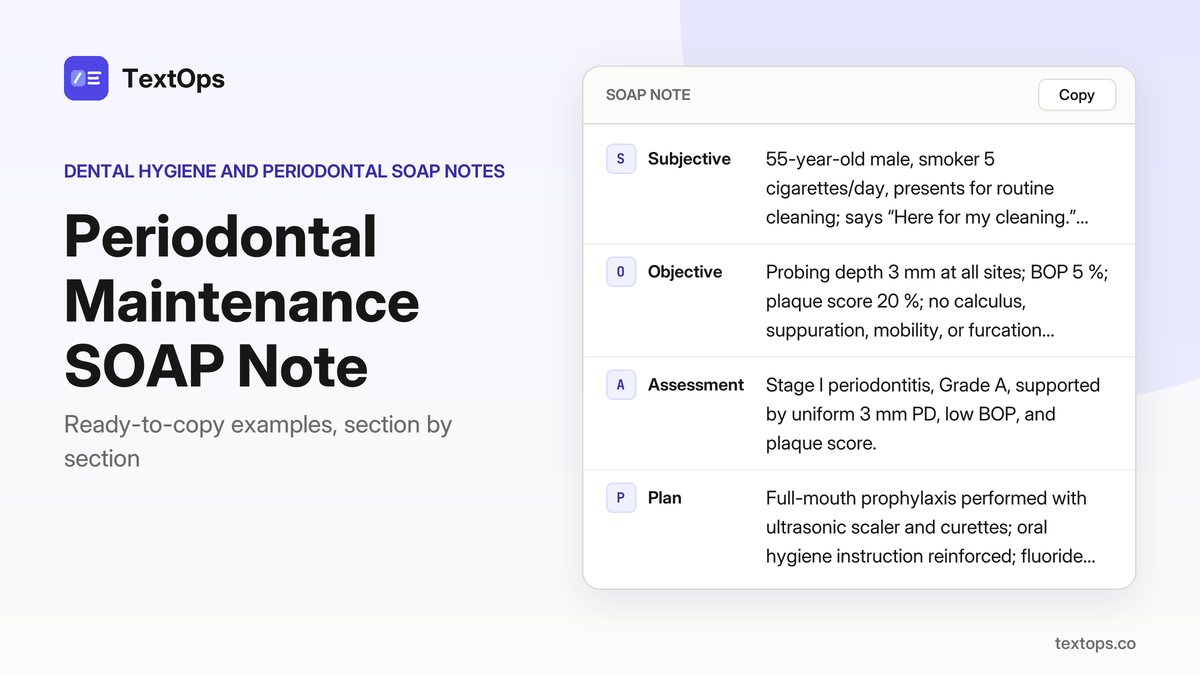
The collection presents 30-40 fully populated SOAP notes for periodontitis cases with bone loss, sorted by severity stage. Each note contains patient demographics, chief complaint, comprehensive periodontal charting, assessment, treatment plan, patient education, and follow-up directives. The entries reflect contemporary documentation standards, with contemporaneous, signed entries and explicit patient statements. Use these templates to model precise, objective recording and to ensure every critical element of a periodontitis SOAP note is captured.
Initial Periodontal Evaluations
Non-Smoker, 45-Year-Old Female, First Periodontal Evaluation
SOAP note
SSubjective
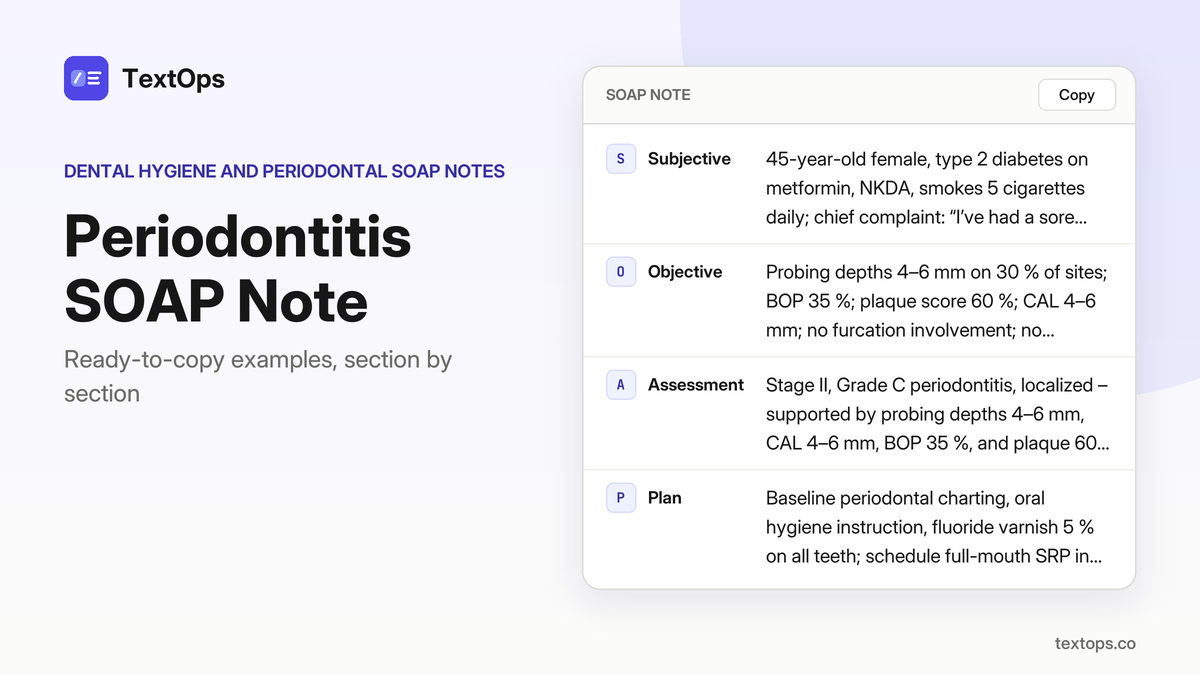
45-year-old female, type 2 diabetes on metformin, NKDA, smokes 5 cigarettes daily; chief complaint: “I’ve had a sore spot in my gums for a few weeks and it’s bleeding when I brush.”
OObjective
Probing depths 4–6 mm on 30 % of sites; BOP 35 %; plaque score 60 %; CAL 4–6 mm; no furcation involvement; no mobility.
AAssessment
Stage II, Grade C periodontitis, localized – supported by probing depths 4–6 mm, CAL 4–6 mm, BOP 35 %, and plaque 60 %.
PPlan
Baseline periodontal charting, oral hygiene instruction, fluoride varnish 5 % on all teeth; schedule full-mouth SRP in 2 weeks.
Post-Orthodontic, 30-Year-Old Female, Bone Loss After Braces
SOAP note
SSubjective
30-year-old female, controlled hypertension on lisinopril, NKDA, reports “after my braces came off, my gums feel swollen and I see a bit of bone loss.”
OObjective
Probing depths 5–7 mm on 25 % of sites; BOP 30 %; plaque score 55 %; CAL 5–7 mm; no furcation involvement; no mobility; extraoral and intraoral otherwise normal.
AAssessment
Stage III, Grade B periodontitis, generalized, supported by generalized PD ≥5 mm, CAL 5–7 mm, BOP 30 %, and plaque score 55 %.
PPlan
Discussed full-mouth scaling and root planing (SRP) with no anesthesia required; advised smoking cessation counseling; referred to orthodontist for follow-up; scheduled SRP in 1 month; no medications prescribed.
Heavy Plaque, 50-Year-Old Female, Generalized Bone Loss
SOAP note
SSubjective
50-year-old female, NKDA, reports “my gums bleed a lot and I feel a lot of plaque build-up.” She has no systemic disease and is not on medication.
OObjective
Probing depths 6–8 mm on 40 % of sites; bleeding on probing 45 %; plaque score 70 %; clinical attachment loss 6–8 mm; no furcation involvement; no mobility; extraoral and intraoral otherwise normal.
AAssessment
Stage IV, Grade C periodontitis, generalized, supported by deep pockets, high BOP, high CAL, and extensive plaque.
PPlan
Full-mouth scaling and root planing performed; no anesthesia used. Oral hygiene instruction given; fluoride varnish 5 % applied to all teeth. Patient advised to avoid smoking, maintain daily brushing and interdental cleaning, and to return in 3 months for maintenance.
Post-Surgery, 40-Year-Old Female, Healing After Graft
SOAP note
SSubjective
40-year-old female, smoker 5 cig/day, NKDA; chief complaint: “I had a bone graft last month and my gums are still tender.” HPI: graft site still tender, no pain spikes, no swelling, no bleeding from wound. PMH: none.
OObjective
Probing depths 3–5 mm around graft site (#15, #16); BOP 20%; plaque score 50%; CAL 3–5 mm; no furcation involvement; no mobility; extraoral and intraoral otherwise within normal limits.
AAssessment
Stage I, Grade C periodontitis, localized—supported by pocket depths 3–5 mm, CAL 3–5 mm, BOP 20%, and plaque 50%.
PPlan
Post-surgical care: chlorhexidine 0.12% rinse twice daily; avoid brushing graft site for 48 h; schedule follow-up in 2 weeks.
Post-CBCT, 48-Year-Old Male, Bone Loss Assessment
SOAP note
SSubjective
48-year-old male, allergic to penicillin (rash), presents with the chief complaint: “I just got a CBCT and it shows some bone loss; I want to know what it means.” He reports no pain, no systemic symptoms, and no prior periodontal treatment.
OObjective
CBCT shows 2–3 mm buccal bone loss on #18, #19. Probing depths 4–6 mm on 20 % of sites, Bleeding on probing 25 %, plaque score 55 %, CAL 4–6 mm. No furcation involvement, no mobility.
AAssessment
Stage II, Grade B periodontitis, localized, supported by 2–3 mm bone loss on CBCT, moderate probing depths, significant CAL, and high plaque/BOP.
PPlan
Discussed full-mouth scaling and root planing (SRP), explained CBCT findings, provided oral hygiene instruction, and scheduled SRP in 3 weeks. No medication prescribed; patient advised to maintain oral hygiene and return for SRP.
Non-Smoker, 38-Year-Old Male, Early Stage Periodontitis
SOAP note
SSubjective
38-year-old male, smoker 5 cig/day, asthma on albuterol, NKDA; “I’ve had a sore spot in my gums for a month and it’s bleeding when I brush.”
OObjective
Probing depths 4–5 mm on 30 % of sites; bleeding on probing 30 %; plaque score 60 %; clinical attachment loss 4–5 mm; no furcation involvement; no mobility.
AAssessment
Stage II, Grade C periodontitis, localized – supported by PD 4–5 mm, CAL 4–5 mm, BOP 30 % and plaque 60 %.
PPlan
Baseline charting performed; oral hygiene instruction given; fluoride varnish 5 % applied to all teeth; SRP scheduled in 2 weeks; no anesthesia or medications administered.
Smoker, 52-Year-Old Female, Stage III Periodontitis
SOAP note
SSubjective
52-year-old female smoker 5 cig/day, seasonal allergies, NKDA; CC: “My gums bleed a lot and I feel a lot of bone loss.” HPI: reports frequent bleeding and a sensation of bone loss; no systemic symptoms. O: Probing depths 7–9 mm on 35 % of sites; BOP 50 %; plaque score 75 %; CAL 7–9 mm; no furcation involvement; no mobility; extraoral and intraoral otherwise within normal limits; no radiographs taken at this visit. A: Stage IV, Grade C periodontitis, generalized – deep probing depths, high CAL, extensive bleeding, and poor plaque control. P: Full-mouth SRP performed with no anesthesia; oral hygiene instruction given; fluoride varnish 5 % applied to all teeth; next visit scheduled for periodontal maintenance in 3 months.
Non-Smoker, 48-Year-Old Male, First Periodontal Evaluation
SOAP note
SSubjective
48-year-old male, former smoker, NKDA, presents for his first periodontal evaluation. He reports no pain or bleeding, only a routine check to assess his gum health. Past medical history is unremarkable, with no systemic conditions or medications. He denies tobacco use currently and has no known drug allergies.
OObjective
Extraoral examination is within normal limits. Intraorally, gingival tissues appear pink and firm, with no visible lesions or recession. Probing depths range from 3 to 4 mm on 15 % of sites, with bleeding on probing observed at 15 % of sites. Plaque accumulation is moderate, scoring 40 %. Clinical attachment level is 3–4 mm across the mouth. No furcation involvement or tooth mobility is noted.
AAssessment
Gingival health; plaque-induced gingivitis, as indicated by probing depths of 3–4 mm, BOP 15 %, CAL 3–4 mm, and a plaque score of 40 %.
PPlan
Provided comprehensive oral hygiene instruction, emphasizing proper brushing, flossing, and interdental cleaning techniques. Applied fluoride varnish 5 % to all teeth, with instructions to avoid brushing and hard foods for several hours post-application. No local anesthesia or medication was required. Scheduled a follow-up periodontal evaluation in 6 months to reassess probing depths, plaque control, and overall gingival status.
Special Medical Conditions
Diabetic, 62-Year-Old Male, Stage III Periodontitis
SOAP note
SSubjective
62-year-old male with type 2 diabetes on metformin and hypothyroidism on levothyroxine, allergic to penicillin (rash). Chief complaint: “I have been having bleeding gums and bad breath for the last few weeks.” History: no systemic symptoms, stable glycemic control, no recent medication changes.
OObjective
Extraoral: normal. Intraoral: generalized plaque score 65%, BOP 80% of sites. Periodontal: PD 6 mm mesial/distal of #15, 5 mm buccal of #16; CAL 7 mm (#15) and 6 mm (#16); mobility Miller I (#15); furcation Glickman I (#16). Radiograph: generalized bone loss, 1.5 mm radiolucency around #15.
AAssessment
Stage III, Grade C periodontitis, generalized – supported by PD ≥6 mm, CAL ≥6 mm, BOP >80 %, radiolucency, mobility, furcation involvement.
PPlan
Deep cleaning of quadrants 1 and 2 with 2% lidocaine + 1:100,000 epinephrine, 1.8 mL buccal infiltration, aspiration negative. Ultrasonic scaling and hand curettes; root planing to 3 mm depth on #15 and #16. Oral hygiene instruction; chlorhexidine 0.12% rinse twice daily; schedule periodontal maintenance in 3 months.
Pregnancy, 28-Year-Old Female, Stage I Periodontitis
SOAP note
SSubjective
28-year-old pregnant female, daily low-dose aspirin, NKDA, reports “gums bleed when I brush and I feel a slight ache in the upper front teeth.”
OObjective
PD 4 mm mesial #3, 3 mm distal #4; BOP 30 % of sites; CAL 4 mm #3, 3 mm #4; plaque score 45 %; mild bone loss on #3 radiograph; mobility Miller 0 both teeth; 4% articaine 1:100,000, 1.8 mL infiltration, aspiration negative.
AAssessment
Stage I, Grade A periodontitis, localized, supported by PD ≤4 mm, CAL ≤4 mm, BOP 30 %, mild radiographic bone loss.
PPlan
Quadrant 3 SRP with ultrasonic scaling; oral hygiene instruction; advised to withhold aspirin during cleaning; no drugs prescribed; schedule recall in 4 weeks.
Systemic Anticoagulant, 70-Year-Old Male, Stage II Periodontitis
SOAP note
SSubjective
70-year-old male with type 2 diabetes on metformin, NKDA, reports “deep pocket on my lower molars and it hurts when I chew.” HPI: pain on chewing, no systemic symptoms.
OObjective
Extraoral normal. Intraoral: plaque score 70%, BOP 70% of sites. Periodontal: PD 7 mm buccal #18, 6 mm lingual #19; CAL 8 mm #18, 7 mm #19; mobility Miller 2 on #18; furcation Glickman II on #19. Radiograph: 2 mm radiolucency around #18.
AAssessment
Stage II, Grade C periodontitis, generalized, supported by deep pockets, high BOP, CAL loss, mobility, furcation involvement and radiolucency.
PPlan
2% lidocaine with 1:100,000 epinephrine, 1.8 mL IANB, aspiration negative. Performed deep cleaning of quadrants 3 & 4 with ultrasonic scaling and root planing on #18-#19. Gave oral hygiene instruction, chlorhexidine 0.12% rinse 15 mL 30 s twice daily. No drugs prescribed. Scheduled periodontal maintenance in 3 months.
Pregnancy, 32-Year-Old Female, Stage II Periodontitis
SOAP note
SSubjective
32-year-old pregnant female, controlled hypertension on lisinopril, NKDA. Chief complaint: “My lower back molars feel sore and the gums bleed.” History: pain localized to lower molars, bleeding on brushing, no systemic symptoms. PMH: hypertension, pregnancy, no allergies.
OObjective
Extraoral WNL. Intraoral: plaque score 55%; PD 5 mm mesial #28, 4 mm distal #29; BOP 40% of sites; CAL 5 mm #28, 4 mm #29; mobility Miller 1 #28; furcation Glickman I #29. Radiograph: moderate bone loss around #28.
AAssessment
Stage II, Grade B periodontitis, localized – supported by PD ≥4 mm, CAL ≥4 mm, BOP >30 %, and radiographic bone loss.
PPlan
Quadrant 4 scaling and root planing performed under 4% articaine 1:200,000, 1.8 mL infiltration; ultrasonic scaling and hand root planing completed. Oral hygiene instruction given; patient advised to avoid aspirin and to maintain good plaque control. No medication prescribed. Recall scheduled in 4 weeks for re-evaluation.
Systemic Anticoagulant, 68-Year-Old Female, Stage II Periodontitis
SOAP note
SSubjective
68-year-old female, no significant medical history, NKDA; CC: “I have a pocket on my upper canine and it hurts when I bite.” HPI: pain on biting, no systemic symptoms.
OObjective
Extraoral normal. Intraoral: PD 6 mm buccal #11, 5 mm lingual #12; BOP 60 % sites; CAL 7 mm #11, 6 mm #12; plaque score 60 %; radiograph shows 1.5 mm radiolucency around #11; mobility Miller 1 #11; furcation Glickman I #12.
AAssessment
Stage II, Grade A periodontitis, localized – supported by PD > 5 mm, CAL > 5 mm, BOP > 50 %, radiolucency and furcation involvement.
PPlan
Quadrant 1 SRP performed with ultrasonic scaling and root planing; 2% lidocaine with 1:100,000 epinephrine, 1.8 mL buccal infiltration, aspiration negative. Oral hygiene instruction given; chlorhexidine 0.12 % rinse prescribed. Next visit: periodontal maintenance in 3 months.
Bisphosphonate-Associated Periodontitis in a 70-Year-Old Female
SOAP note
SSubjective
70-year-old female, smoker 5 cigarettes/day, NKDA, chief complaint: “My lower molars feel loose and the gums bleed a lot.” History: no systemic disease reported. O: PD 8 mm mesial #30, 7 mm distal #31; BOP 80 % of sites; CAL 9 mm #30, 8 mm #31; plaque score 75 %; radiograph shows 3 mm radiolucency around #30; mobility Miller II #30; furcation Glickman II #31. A: Stage IV, Grade C periodontitis, generalized, supported by deep pockets, high BOP, significant CAL loss, radiolucency, mobility and furcation involvement. P: IANB with 2 % lidocaine + 1:100,000 epinephrine, 1.8 mL; performed deep cleaning of quadrants 3 & 4 with ultrasonic scaling and root planing; gave chlorhexidine 0.12 % rinse, oral hygiene instruction, advised smoking cessation; no drugs prescribed; schedule periodontal maintenance in 3 months.
Steroid-Related Periodontitis in a 25-Year-Old Male
SOAP note
SSubjective
25-year-old male, no significant medical history, allergic to penicillin (rash); CC: “I have bleeding gums and deep pockets around my lower molars.” HPI: reports bleeding with brushing, no pain, no swelling. PMH: none; allergy to penicillin; no systemic signs.
OObjective
Extraoral: normal. Intraoral: plaque score 60%; BOP 80% of sites; no mobility; no furcation involvement. Periodontal: PD 6 mm mesial/dorsal on #17, 5 mm buccal/lingual on #18; CAL 7 mm #17, 6 mm #18. Radiograph: horizontal bone loss 3 mm on #17 and #18; no suppuration.
AAssessment
Stage III, Grade B periodontitis, generalized – supported by PD ≥6 mm, CAL ≥6 mm, BOP >70 %, radiographic bone loss, and plaque score >50 %.
PPlan
Anesthesia: 2% lidocaine with 1:100,000 epinephrine, 1.8 mL, IANB, aspiration negative. Performed SRP on #17 and #18 with ultrasonic scaler and hand curettes; irrigated with 0.12% chlorhexidine. No drugs prescribed. POI: avoid hard foods, use chlorhexidine rinse 15 mL for 30 s twice daily, maintain oral hygiene. Next visit: periodontal maintenance in 3 months.
Pregnancy-Safe Periodontal Therapy in a 40-Year-Old Female (Second Trimester)
SOAP note
SSubjective
40-year-old pregnant female, asthma, NKDA; CC: “My gums bleed when I brush and I feel a deep pocket on the upper left molars.” HPI: reports bleeding on brushing, no pain, no swelling.
OObjective
Extraoral WNL. Intraoral: plaque score 55%; PD 5 mm mesial/distal on #12, 4 mm buccal/lingual on #13; BOP 70% of sites; CAL 6 mm on #12, 5 mm on #13; radiograph shows 2 mm bone loss on #12 and #13; no suppuration, no mobility, no furcation.
AAssessment
Stage II, Grade B periodontitis, localized to #12-#13, supported by PD ≥4 mm, CAL ≥5 mm, BOP 70%, and 2 mm radiographic bone loss.
PPlan
Infiltration 2% lidocaine with 1:100,000 epinephrine, 1.8 mL; performed SRP on #12-#13 with ultrasonic scaler and hand curettes, irrigated with 0.12% chlorhexidine; instructed to use chlorhexidine rinse 15 mL for 30 s twice daily, avoid brushing the sites for 24 h, and maintain good oral hygiene; next visit in 3 months for maintenance.
75-year-old female, seasonal allergies, NKDA, reports “I have a lot of plaque and my lower back molars feel loose.”
OObjective
Extraoral: normal. Intraoral: plaque score 65%; #30 mesial and distal PD 6 mm, #31 buccal and lingual PD 5 mm; BOP 75% of sites; CAL 7 mm on #30, 6 mm on #31; mobility Miller I on #30; no furcation. Radiograph: 3 mm bone loss on #30 and #31; no suppuration.
AAssessment
Stage III, Grade C periodontitis, generalized, supported by PD ≥5 mm, CAL ≥6 mm, BOP 75%, radiographic bone loss 3 mm, and mobility.
PPlan
2% lidocaine with 1:100,000 epinephrine, 1.8 mL, IANB, aspiration negative; conservative SRP performed on #30 and #31 with ultrasonic scaler and hand curettes; irrigated with 0.12% chlorhexidine; POI: avoid brushing the sites for 24 h, use chlorhexidine rinse twice daily, maintain oral hygiene; next visit: periodontal maintenance in 3 months.
Stage III Periodontitis in a 55-Year-Old Male With Uncontrolled Hypertension
SOAP note
SSubjective
55-year-old male, former smoker, NKDA, reports “my gums bleed a lot and I have deep pockets on the upper right molars.” History of uncontrolled hypertension noted but no current medication changes.
OObjective
Extraoral normal. Intraoral: plaque score 70%; BOP 85% of sites; PD 7 mm on #19 mesial and distal, 6 mm on #20 buccal and lingual; CAL 8 mm on #19, 7 mm on #20; mobility Miller I on #19; no furcation involvement; radiograph shows 4 mm bone loss on #19 and #20; no suppuration.
AAssessment
Stage III, Grade C periodontitis, generalized—supported by PD ≥6 mm, CAL ≥7 mm, BOP ≥80 %, radiographic bone loss ≥4 mm, and plaque score >60 %.
PPlan
2% lidocaine with 1:100,000 epinephrine, 1.8 mL IANB, aspiration negative. Performed SRP on #19 and #20 with ultrasonic scaler and hand curettes; irrigated with 0.12% chlorhexidine; gave postoperative instructions on oral hygiene and chlorhexidine rinse; no medication prescribed; scheduled periodontal maintenance in 3 months.
Diabetic, 70-Year-Old Male, Stage IV Periodontitis Referral
SOAP note
SSubjective
70-year-old male, type 2 diabetes on metformin, hypothyroidism on levothyroxine, allergic to penicillin (rash); CC: “My gums are very swollen and I have lost several teeth; I need help to stop the bone loss.” HPI: reports progressive swelling and tooth loss; PMH includes diabetes (HbA1c 8.2 %) and hypothyroidism; no tobacco use.
OObjective
Extraoral: mild fever 99.4 °F, mild malaise; Intraoral: plaque score 75 %; Periodontal: PD 9 mm mesial/distal on #8, 8 mm buccal/lingual on #9; BOP 90 % of sites; CAL 10 mm on #8, 9 mm on #9; Mobility Miller II on #8; Radiograph: 5 mm bone loss on #8 and #9, furcation Glickman II on #8; No suppuration.
AAssessment
Stage IV, Grade C periodontitis, generalized – supported by PD ≥ 8 mm, CAL ≥ 9 mm, BOP 90 %, 75 % plaque, furcation involvement, and systemic diabetes control (HbA1c 8.2 %).
PPlan
Discussed referral to periodontist for possible flap surgery and regenerative therapy; advised strict glycemic control; scheduled follow-up in 2 weeks to confirm referral and review medical clearance.
Orthodontic, Extraction, and Implant Follow-Ups
Post-Extraction, 35-Year-Old Male, Bone Loss at Extraction Site
SOAP note
SSubjective
35-year-old male, takes daily low-dose aspirin, NKDA, reports “I have a sore socket after my molar was removed.”
OObjective
Socket shows mild erythema, no suppuration; probing depth 3 mm buccally; radiograph reveals 1.5 mm radiolucent area at extraction site; adjacent teeth have no mobility.
AAssessment
Stage II, Grade B periodontitis, localized – bone loss at extraction site, supported by the 3 mm pocket, radiolucency, and socket erythema.
PPlan
2% lidocaine with 1:100,000 epinephrine, 1.8 mL buccal infiltration, aspiration negative; reinforced oral hygiene instruction; chlorhexidine 0.12% rinse twice daily; schedule follow-up in 4 weeks to assess healing.
Post-Orthodontic, 25-Year-Old Male, Bone Loss After Braces
SOAP note
SSubjective
25-year-old male, type 2 diabetes on metformin, NKDA, reports “My lower front teeth feel loose after braces were removed.”
OObjective
Extraoral normal; intraoral shows mild gingival recession at #11–#12, probing depths 5 mm mesial #11, 4 mm distal #12, BOP present at both sites; radiograph reveals 2 mm bone loss around #11, no swelling or inflammation.
AAssessment
Stage III, Grade C periodontitis, localized – bone loss after orthodontic treatment, supported by probing depths >5 mm, BOP, and radiographic bone loss.
PPlan
Local infiltration of 2% lidocaine with 1:100,000 epinephrine, 1.8 mL; no drugs prescribed. Reinforce plaque control, schedule periodontal maintenance in 3 months, advise referral for surgical intervention if pockets deepen.
Post-Extraction, 42-Year-Old Female, Bone Loss at Extraction Site
SOAP note
SSubjective
42-year-old female, controlled hypertension on lisinopril, NKDA, reports “My lower right molar socket still looks red” and notes mild swelling.
OObjective
Extraoral: no facial swelling or lymphadenopathy. Intraoral: socket at #30 shows 2 mm erythema, no suppuration. Periodontal: PD 4 mm buccally. Radiographic: 1.8 mm radiolucent area at socket; adjacent teeth stable. No other findings.
AAssessment
Stage II, Grade B periodontitis, localized – bone loss at extraction site, supported by 4 mm PD, radiolucency, and erythema.
PPlan
Local anesthesia: 2% lidocaine with 1:100,000 epinephrine, 1.8 mL (1 cartridge), IANB, aspiration negative. Prescribed chlorhexidine 0.12% rinse, 15 mL for 30 seconds twice daily, with gentle rinsing technique. Advised to avoid vigorous rinsing. Scheduled review in 6 weeks to reassess socket healing and bone fill.
Periodontal Abscess After Orthodontic Relapse in a 45-Year-Old Male
SOAP note
SSubjective
45-year-old male, NKDA, reports a painful bump on lower right canine after braces relapse; pain described as throbbing, localized to #27.
OObjective
Localized swelling 1.5 cm over #27, tender to palpation; PD 7 mm with purulent exudate; radiograph shows 3 mm radiolucent area at apex of #27; no systemic signs.
AAssessment
Acute periodontal abscess – localized suppuration at #27, supported by deep pocket, purulence, and apical radiolucency.
PPlan
2% lidocaine with 1:100,000 epinephrine, 1.8 mL infiltration, aspiration negative; incision and drainage of abscess, irrigation with saline; chlorhexidine 0.12% rinse 15 mL, 30 sec, twice daily; follow-up in 48 hours.
Early Periodontitis After Implant-Site Preparation in a 30-Year-Old Female
SOAP note
SSubjective
30-year-old female, smoker 5 cigarettes/day, NKDA; CC: “My implant site feels sore after the prep”; HPI: mild discomfort when chewing, no swelling or suppuration; PMH: none.
OObjective
Extraoral: normal; Intraoral: implant #16 with 6 mm probing depth, BOP present; Periodontal: localized bone loss; Radiographic: 2 mm radiolucency around fixture; Tests: none.
AAssessment
Stage II, Grade C periodontitis, localized – early bone loss around implant site, supported by 6 mm PD, BOP, and 2 mm radiolucency.
PPlan
2% lidocaine with 1:100,000 epinephrine, 1.8 mL infiltration, aspiration negative; prescribe chlorhexidine 0.12% rinse, reinforce oral hygiene; schedule implant maintenance in 4 weeks; consider surgical debridement if pockets persist.
Post-Orthodontic, 28-Year-Old Male, Localized Bone Loss Check
SOAP note
SSubjective
28-year-old male, no significant medical history, chief complaint: “I feel some bone loss around my upper front teeth after braces”; reports no pain, no swelling, no systemic symptoms.
OObjective
Extraoral: normal; Intraoral: healthy mucosa, no ulceration; Periodontal: PD 5 mm mesial of #3, 4 mm distal of #4, BOP present at both sites; Radiograph: 2 mm radiographic bone loss around #3, no suppuration; No other findings.
AAssessment
Stage III, Grade B periodontitis, localized – localized bone loss check after orthodontics, supported by PD ≥5 mm, BOP, and 2 mm radiographic bone loss.
PPlan
2% lidocaine with 1:100,000 epinephrine, 1.8 mL infiltration, aspiration negative; no drugs prescribed; reinforce plaque control with OHI, schedule periodontal maintenance in 3 months, no antibiotics indicated.
45-year-old female, asthma on albuterol PRN, NKDA, reports “my lower left molar socket looks healing but still a bit red.”
OObjective
Extraoral normal; intraoral socket on #19 shows mild erythema, no suppuration, probing depth 3 mm buccally; radiograph reveals a 1.2 mm radiolucent area at the socket; adjacent teeth stable, no swelling or pain.
AAssessment
Stage II, Grade B periodontitis, localized – socket healing observation, supported by mild erythema, 3 mm probing depth, and a 1.2 mm radiolucent area.
PPlan
Administered 2% lidocaine with 1:100,000 epinephrine, 1.8 mL (1 cartridge), IANB; instructed gentle chlorhexidine 0.12% rinse, 15 mL for 30 s twice daily; scheduled review in 4 weeks.
Post-SRP Maintenance and Recall Visits
Smoker, 58-Year-Old Male, Re-evaluation After 3-Month Recall
SOAP note
SSubjective
58-year-old male smoker (5 cigarettes/day), seasonal allergies, NKDA, presents for his 3-month recall, stating “Here for my 3-month recall.”
OObjective
Probing depths measured 4 mm on tooth #15 and #16; bleeding on probing present at 20 % of sites; clinical attachment level 4 mm; plaque index 60 %; extraoral exam unremarkable; no anesthesia administered; systemic review negative for new symptoms.
AAssessment
Stage II, Grade C generalized periodontitis, evidenced by uniform 4 mm probing depths, significant BOP, CAL of 4 mm, and high plaque accumulation, indicating ongoing disease activity despite previous therapy.
PPlan
Reviewed and reinforced oral hygiene instructions, emphasizing interdental cleaning and chlorhexidine rinsing; advised increased frequency of home care; no pharmacologic therapy prescribed; scheduled next maintenance visit in 3 months, with re-evaluation of probing depths and plaque control.
60-year-old male, former smoker, NKDA, reports “Just checking the flap”; no pain, no swelling, routine follow-up after flap surgery.
OObjective
Flap closed, no suppuration; probing depth 3 mm on #30 and #31, bleeding on probing 5 %; no mobility; extraoral and intraoral exam WNL; IANB with 2 % lidocaine + 1:100,000 epinephrine, 1.8 mL, aspiration negative.
AAssessment
Post-flap healing, no infection, stable periodontal status.
PPlan
Sutures removed; instructed to use chlorhexidine 0.12 % rinse twice daily, avoid brushing surgical site for 48 h; no medication prescribed; advised to maintain oral hygiene, report any bleeding or pain immediately; next visit scheduled in 4 weeks for maintenance and reassessment of probing depths and BOP.
Heavy Plaque, 55-Year-Old Male, Generalized Bone Loss
SOAP note
SSubjective
55-year-old male with hypothyroidism on levothyroxine, reports “I feel a bit sore and the gums bleed.”
OObjective
PD 6 mm on #18 and #19; BOP 35 %; CAL 6 mm; plaque index 80 %; panoramic radiograph shows generalized bone loss; no suppuration; no anesthesia used.
AAssessment
Stage III, Grade B generalized periodontitis supported by PD ≥6 mm, CAL 6 mm, BOP 35 % and radiographic bone loss.
PPlan
Performed SRP on #18 and #19, reinforced oral hygiene instruction, no drugs prescribed; patient advised to maintain plaque control, return in 2 weeks for reassessment.
65-year-old female, on daily low-dose aspirin, NKDA, chief complaint: “Just a quick check on the flap.”
OObjective
Flap healing noted, no suppuration; probing depths 4 mm on #28 and #29, bleeding on probing 10 %; no mobility; anesthesia: 2% lidocaine with 1:100,000 epinephrine, 1.8 mL (1 cartridge), IANB, aspiration negative.
AAssessment
Post-flap healing, no infection.
PPlan
Suture removal performed; instructed to use chlorhexidine 0.12 % rinse twice daily and avoid brushing the surgical site for 48 h. No medications prescribed. Next visit in 4 weeks for maintenance and re-evaluation.
Post-Surgery, 48-Year-Old Male, Healing After Graft
SOAP note
SSubjective
48-year-old male with type 2 diabetes on metformin, NKDA, reports “Just checking the graft.”
OObjective
Graft stable, no suppuration; PD 3 mm on #11 and #12; BOP 5 %; no mobility; buccal infiltration 2% lidocaine with 1:100,000 epinephrine, 1.8 mL, aspiration negative.
AAssessment
Healing after connective tissue graft, supported by stable graft, shallow PD, low BOP, and absence of suppuration.
PPlan
Suture removal performed; patient instructed to use chlorhexidine 0.12 % rinse twice daily and to avoid brushing the surgical site for 48 h. No medications prescribed. Next visit: 4-week recall to assess graft integration and periodontal status.
Patient Refusal of Scaling Due to Dental Anxiety in a 50-Year-Old Male
SOAP note
SSubjective
50-year-old male, controlled hypertension on lisinopril, NKDA, reports “I’m too anxious to have scaling done”; no pain, no swelling, no systemic symptoms.
OObjective
PD 5 mm on multiple sites, BOP 25 %, CAL 5 mm, plaque index 70 %, no suppuration; extraoral and intraoral otherwise normal; no anesthesia administered.
AAssessment
Stage II, Grade A periodontitis, generalized, supported by PD ≥ 5 mm, BOP > 20 %, CAL 5 mm, high plaque burden.
PPlan
Discussed anxiety-management strategies and sedation options; no medication prescribed today. Scheduled next visit in 4 weeks for scaling once patient feels comfortable; instructed to maintain oral hygiene and report any pain or bleeding.
Non-Smoker, 52-Year-Old Male, Stage II Periodontitis Re-evaluation
SOAP note
SSubjective
52-year-old male, smoker 5 cigarettes/day, NKDA; chief complaint: “Here for my routine cleaning and check of my gums”; no systemic signs; no medications.
OObjective
PD #15 4 mm, #16 4 mm; BOP 10 % of sites; CAL #15 4 mm, #16 4 mm; plaque score 15 %; FMX shows no new bone loss, slight radiolucency at #15 buccal root; mobility Miller 0; furcation none; anesthesia none.
AAssessment
Stage II, Grade B periodontitis, localized – supported by PD 4 mm, CAL 4 mm, BOP 10 %, plaque 15 %, radiolucency at #15.
PPlan
Re-evaluation only; recommend maintenance cleaning in 3 months; reinforce oral hygiene instruction; no active therapy or drugs prescribed.
Pregnancy, 30-Year-Old Female, Stage I Periodontitis Maintenance
SOAP note
SSubjective
30-year-old pregnant female, smoker 5 cigarettes/day, NKDA, reports “Just a quick check-up after my last cleaning.”
OObjective
PD #3 3 mm, #4 3 mm; BOP 5 % of sites; CAL #3 3 mm, #4 3 mm; plaque score 10 %; PA of #3-#4 shows no bone loss; mobility Miller 0; no furcation involvement.
AAssessment
Stage I, Grade A periodontitis, localized – supported by PD ≤3 mm, BOP 5 %, CAL 3 mm, no radiographic bone loss.
PPlan
No treatment performed; advised smoking cessation counseling, continued oral hygiene instruction, and scheduled next maintenance in 4 months.
Heavy Plaque, 55-Year-Old Female, Generalized Periodontitis Re-evaluation
SOAP note
SSubjective
55-year-old female, no significant medical history, allergic to penicillin (rash); chief complaint: “I’m here for my regular cleaning”; history: post-SRP maintenance visit; PMH: none; medications: none; allergies: penicillin rash.
OObjective
Extraoral: normal; Intraoral: plaque score 25%; Periodontal: PD #18 5 mm, #19 5 mm, #20 4 mm; BOP 20 % of sites; CAL #18 5 mm, #19 5 mm, #20 4 mm; Mobility Miller 0; Furcation none; Radiographic: FMX shows generalized bone loss, slight radiolucency at #19 mesial root; Tests: none.
AAssessment
Stage III, Grade B generalized periodontitis, supported by PD ≥ 5 mm in multiple sites, BOP 20 %, CAL ≥ 4 mm, generalized bone loss on FMX.
PPlan
Continue periodontal maintenance; reinforce oral hygiene instruction; schedule scaling of all quadrants at next visit; no antibiotics indicated; patient advised to maintain plaque control and return in 3 months for re-evaluation.
62-year-old male, asthma, NKDA, CC: “Checking on how my gums are healing after the flap”; PMH: albuterol PRN, no systemic signs.
OObjective
Tooth #30, #31: PD 3 mm each, BOP 0%, CAL 3 mm each, plaque score 5%; CBCT shows bone fill, no radiolucency; mobility Miller 0, no furcation.
AAssessment
Stage II, Grade A periodontitis, localized – post-surgical healing; supported by stable PD/CAL, absence of BOP, and radiographic bone fill.
PPlan
No drugs prescribed; sutures removed in 7 days; schedule next maintenance in 3 months; advise oral hygiene and avoid trauma to the site.
Smoker, 61-Year-Old Female, Re-evaluation After 6-Month Recall
SOAP note
SSubjective
61-year-old female smoker, 5 cigarettes/day, seasonal allergies, NKDA; CC: “I’m back for my 6-month check-up”; HPI: routine recall, no pain or swelling; PMH: none; medication: none.
OObjective
Extraoral: normal; Intraoral: healthy mucosa; Periodontal: PD #28 4 mm, #29 4 mm; BOP 15% of sites; CAL #28 4 mm, #29 4 mm; plaque score 18%; Mobility Miller 0; Furcation none; Radiographic: FMX shows slight buccal bone loss progression at #28; Tests: none.
AAssessment
Stage II, Grade B periodontitis, localized – progression noted, supported by PD 4 mm, CAL 4 mm, 15% BOP, and radiographic bone loss at #28.
PPlan
Recommend scaling of all quadrants, reinforce oral hygiene, provide smoking cessation counseling; no drugs prescribed; next visit in 3 months.
Smoker, 63-Year-Old Female, Stage III Periodontitis Follow-up
SOAP note
SSubjective
63-year-old female, former smoker, NKDA; CC: “Just a quick check after my last cleaning”; HPI: no pain, reports routine follow-up after SRP; PMH: none; medications: none; allergies: NKDA.
OObjective
Extraoral: normal; Intraoral: plaque score 30%; Periodontal chart: #11 PD 6 mm, BOP 25%, CAL 6 mm; #12 PD 6 mm, BOP 25%, CAL 6 mm; #13 PD 5 mm, BOP 25%, CAL 5 mm; Mobility Miller 0; Furcation none; Radiograph: FMX shows generalized bone loss, slight radiolucency at #12 mesial root; Tests: none.
AAssessment
Stage III, Grade B periodontitis, generalized – advanced disease, supported by PD ≥6 mm, CAL ≥5 mm, 25% BOP, generalized bone loss on FMX.
PPlan
Continue periodontal maintenance; reinforce oral hygiene instruction; discuss regenerative therapy if progression continues; schedule next visit in 4 months; no drugs prescribed.
Advanced Periodontitis and Surgical Referrals
Smoking, 55-Year-Old Male, Stage IV Periodontitis
SOAP note
SSubjective
55-year-old male, smoker 5 cigarettes/day, hypothyroidism on levothyroxine, allergic to penicillin (rash); CC: “I’ve had a lot of bleeding and pain around my lower molars for the last few months.” HPI: bleeding, pain, 3-month duration; PMH: hypothyroidism, smoking; no other drug allergies; no systemic signs.
OObjective
Extraoral: normal. Intraoral: severe gingival inflammation, BOP 100%, suppuration at #32. Periodontal: PD #30 9 mm, #31 8 mm, #32 10 mm; CAL #30 12 mm, #31 11 mm, #32 13 mm; Mobility Miller 1 on #32; plaque 45 %. Radiograph: PAN shows 4 mm bone loss around #30-#32, furcation Glickman I on #32.
AAssessment
Stage IV, Grade C periodontitis, generalized—evidenced by PD ≥ 8 mm, CAL ≥ 11 mm, 100 % BOP, 4 mm bone loss on PAN, furcation involvement, and mobility.
PPlan
Administered 2% lidocaine with 1:100,000 epinephrine, 1.8 mL IANB; discussed open-flap debridement with bone grafting and guided tissue regeneration; patient consented to periodontist referral; advised strict OHI and smoking cessation; no drugs prescribed; next visit to confirm referral.
Stage IV Periodontitis with Tooth Loss in a 60-Year-Old Female
SOAP note
SSubjective
60-year-old female, NKDA, on low-dose aspirin, reports loose upper front teeth and frequent bleeding when brushing.
OObjective
2% lidocaine 1:100,000, 1.8 mL buccal infiltration, aspiration negative; probing depths #8 7 mm, #9 8 mm, #10 6 mm; BOP 80%; CAL #8 10 mm, #9 11 mm, #10 9 mm; Miller grade 2 mobility on #9; plaque score 30%; bitewing shows 3 mm bone loss around #8-#10, no furcation involvement; no suppuration; systemic signs none.
AAssessment
Stage III, Grade B periodontitis, localized, with significant bone loss and mobility on #8-#10.
PPlan
Open flap debridement with regenerative material planned for #8-#10; patient will hold aspirin 24 h pre-op; oral hygiene instructions and smoking cessation counseling provided; referral to periodontist arranged; return in 2 weeks for post-operative assessment.
How to Read and Use a Periodontitis SOAP Note
SOAP note
SSubjective
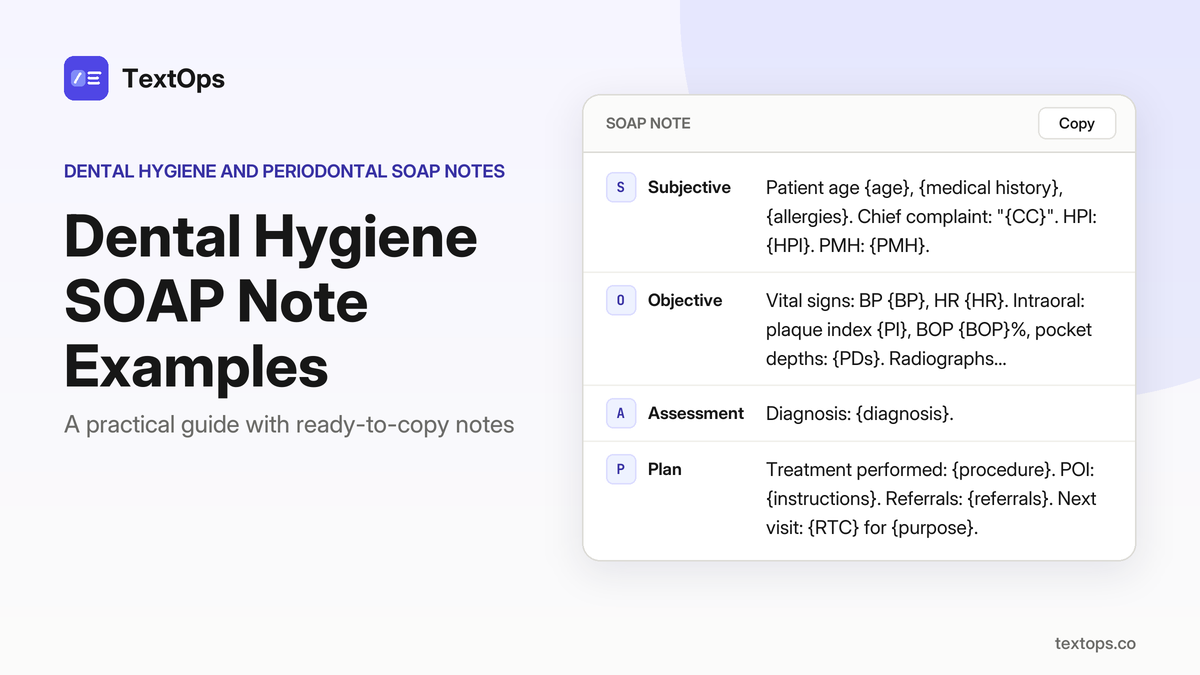
Record the patient’s chief complaint and HPI in the patient’s own words, note pain intensity (0-10), onset, triggers, and any systemic symptoms.
OObjective
Document probing depth (PD) at six sites per tooth, bleeding on probing (BOP) by site, recession, and calculate clinical attachment level (CAL = PD + recession). Include radiographic findings: bone loss height, furcation involvement, and any radiolucencies.
AAssessment
State the periodontal stage (I-IV) and grade (A-C) based on CAL, bone loss, and risk factors. Mention any associated diagnoses (e.g., periodontal abscess).
PPlan
Outline treatment performed today (e.g., SRP, flap surgery), postoperative instructions (POI), prescriptions, referrals, and next visit (RTC) with purpose.
Interpreting Periodontal Charting for Bone Loss Severity
Probing depth (PD) is the distance from the gingival margin to the base of the pocket, measured in millimetres at six sites per tooth. Clinical attachment level (CAL) equals PD plus recession when the margin is apical to the cementoenamel junction; CAL = PD + recession. Bone loss is categorized by extent and severity: localized (≤30 % of teeth) versus generalized (≥30 %); severity is staged as mild (Stage I, CAL 1-2 mm), moderate (Stage II, CAL 3-4 mm), or severe (Stage III/IV, CAL ≥5 mm with tooth loss). To calculate CAL, add the PD to the recession value for each site and average per tooth or per sextant. Bleeding on probing (BOP) is expressed as a percentage of sites that bleed; a BOP > 20 % supports active disease. Radiographs are interpreted by comparing the radiographic bone level to the cementoenamel junction: 1-3 mm loss = mild, 4-6 mm = moderate, >6 mm = severe. Correlate the radiographic bone loss with CAL and BOP to assign stage and grade: higher CAL, greater radiographic loss, and higher BOP shift the case toward Stage III/IV and Grade B/C, guiding treatment intensity and prognosis.
When to Add Systemic Antibiotics in Periodontitis Treatment
Systemic antibiotics are reserved for acute infection, severe bone loss, or patients with systemic risk factors.
Acute periodontal abscess or spreading cellulitis: prescribe amoxicillin 500 mg TID for 7 days; document fever, trismus, and antibiotic choice.
Severe bone loss (Stage III–IV) with uncontrolled diabetes or uncontrolled hypertension: amoxicillin 500 mg TID 7 days; note HbA1c, blood pressure, and rationale.
Immunocompromised or bisphosphonate-treated patients: amoxicillin 500 mg TID 7 days; record medication list and allergy status.
Allergic to penicillin: clindamycin 300 mg QID 7 days; document allergy history and alternative.
Record the indication, drug, dose, frequency, duration, and any adverse reaction. Include a signed, dated entry with the decision rationale.
Checklist of Documentation Items for Every Periodontitis SOAP Note
Dr. Rahul Joshi is a Specialist Orthodontist with extensive clinical experience in orthodontics, dentofacial orthopaedics, and dental aesthetics. Holding a Master of Dental Surgery (MDS) in Orthodontics and Dentofacial Orthopaedics and a Bachelor of Dental Surgery (BDS) from Manipal Academy of Higher Education, he brings expertise in orthodontic treatment planning, teeth alignment, and Invisalign treatment. With professional experience across India and the Netherlands, Dr. Joshi combines clinical knowledge with practical experience in orthodontic care, dental aesthetics, and improving patients' oral health.
Master of Dental Surgery (MDS) in Orthodontics and Dentofacial Orthopaedics — Manipal Academy of Higher Education
Bachelor of Dental Surgery (BDS) — Manipal Academy of Higher Education
Stop retyping your templates
Save any template to TextOps once, then insert it anywhere on the web without retyping. Share it with your team so everyone uses the same wording.