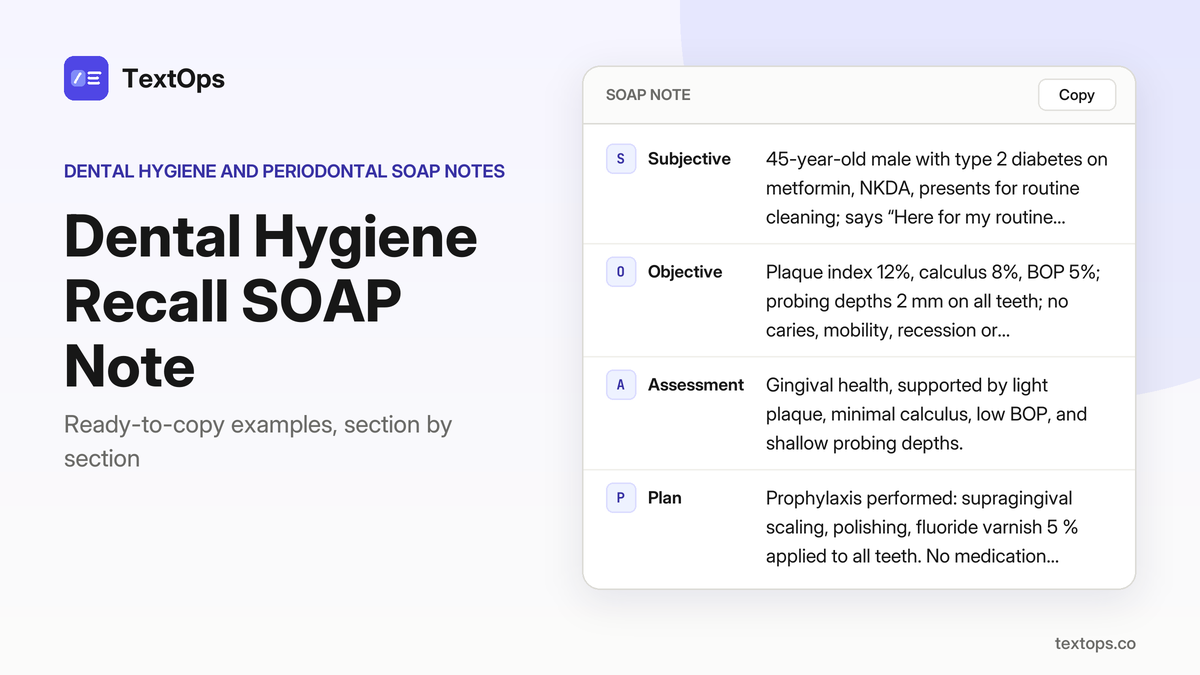
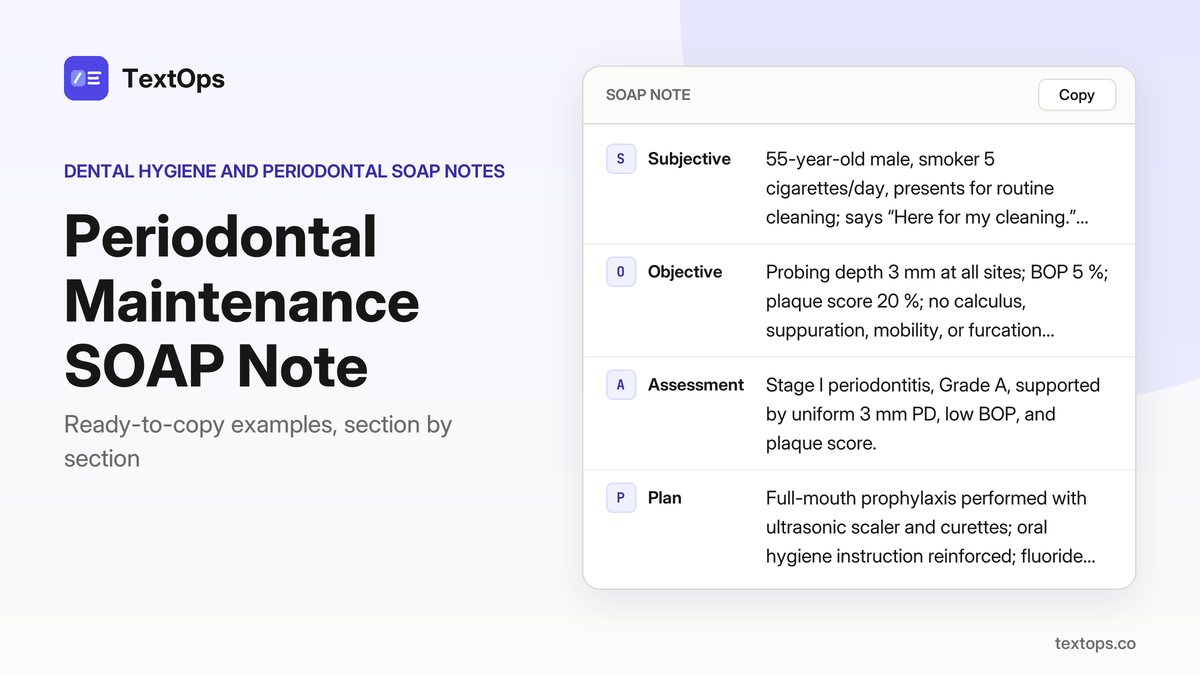
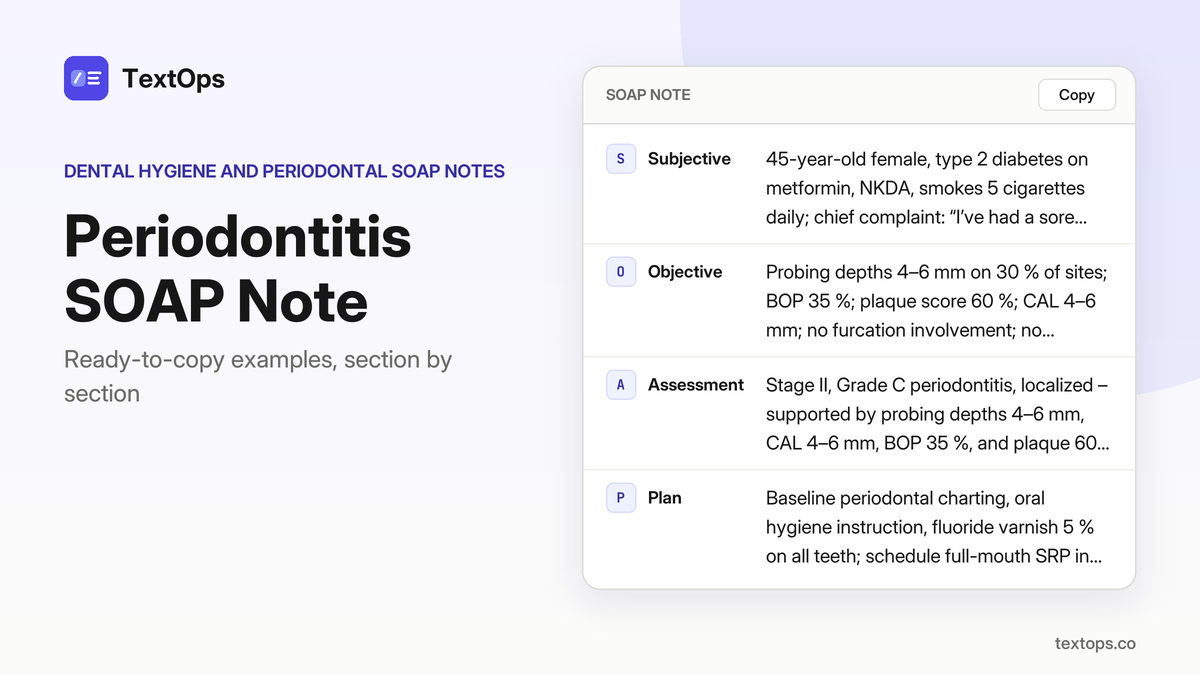
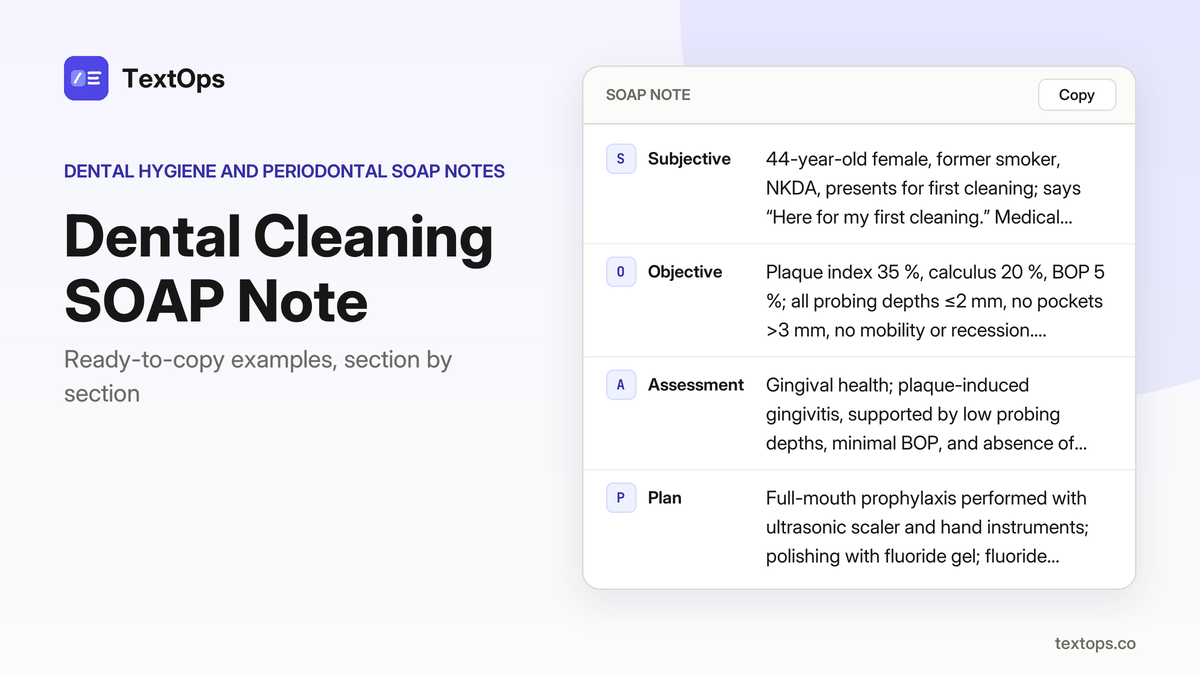
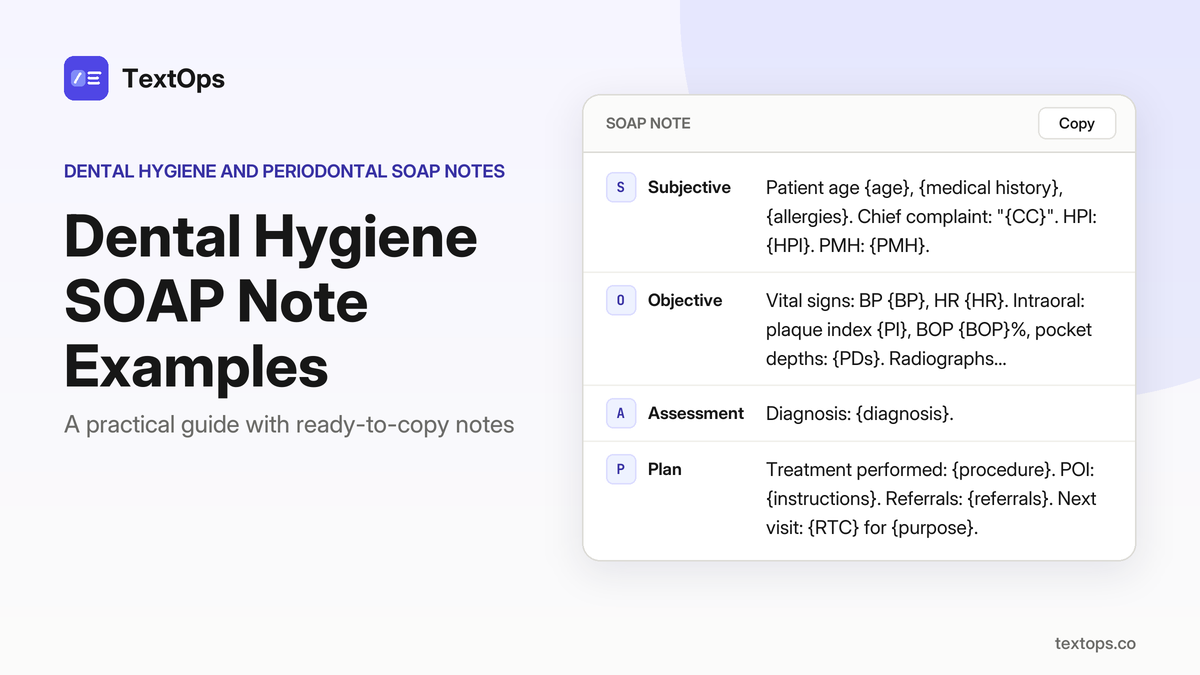
A fully populated, copy-ready SOAP note for periodontal maintenance visits is available here. It contains every essential element: patient demographics, objective periodontal findings, assessment, plan, follow-up, and documented patient education. Designed for hygienists and assistants, the template saves time while ensuring comprehensive, defensible documentation for each maintenance appointment.
55-year-old male, smoker 5 cigarettes/day, presents for routine cleaning; says “Here for my cleaning.” No medical complaints; NKDA.
OObjective
Probing depth 3 mm at all sites; BOP 5 %; plaque score 20 %; no calculus, suppuration, mobility, or furcation involvement.
AAssessment
Stage I periodontitis, Grade A, supported by uniform 3 mm PD, low BOP, and plaque score.
PPlan
Full-mouth prophylaxis performed with ultrasonic scaler and curettes; oral hygiene instruction reinforced; fluoride varnish 5 % sodium fluoride applied to all teeth. No anesthesia or medications used. Next maintenance visit scheduled in 3 months.
Maintenance, 40-year-old, 3-month visit, no changes
SOAP note
SSubjective
40-year-old female with type 2 diabetes on metformin, NKDA, presents for a routine periodontal maintenance visit and states “just a routine checkup.”
OObjective
Extraoral examination is unremarkable. Intraoral probing shows uniform 3 mm depth at all sites, BOP at 4 % of sites, and a plaque score of 15 %. No calculus, no suppuration, no tooth mobility, and no furcation involvement are noted. Radiographs are not indicated at this visit.
AAssessment
Stage I periodontitis, Grade A, is confirmed by the stable probing depths, low BOP, and good plaque control.
PPlan
Full-mouth prophylaxis performed with ultrasonic scaler and hand curettes; no scaling required. Oral hygiene instruction reinforced, emphasizing proper brushing, interdental cleaning, and the importance of maintaining glycemic control for periodontal health. No medications prescribed. Patient advised to return for the next maintenance visit in 3 months.
38-year-old male, controlled hypertension on lisinopril, NKDA, reports “My plaque has gone down.”
OObjective
Probing depth 3 mm at all sites, BOP 2 % of sites, plaque score 10 %, no calculus, no suppuration, no mobility, no furcation involvement.
AAssessment
Stage I periodontitis, Grade A, supported by uniform 3 mm pockets, minimal BOP, low plaque score and absence of attachment loss.
PPlan
Full-mouth prophylaxis performed with ultrasonic scaler and curettes; fluoride varnish 5 % sodium fluoride applied; oral hygiene instruction reinforced; next visit in 3 months for routine maintenance.
Maintenance, 40-year-old, 3-month visit, no plaque
SOAP note
SSubjective
40-year-old female, “I’m here for my cleaning.” No significant medical history, allergic to penicillin (rash).
OObjective
Probing depth 3 mm at all sites, BOP 0 %, plaque score 5 %, no calculus, no suppuration, no mobility, no furcation involvement.
AAssessment
Stage I periodontitis, Grade A, supported by uniform 3 mm PD, 0 % BOP, low plaque score and absence of attachment loss.
PPlan
Full-mouth prophylaxis with ultrasonic scaler and curettes performed; oral hygiene instruction reinforced; 5 % sodium fluoride varnish applied; no medications prescribed; next maintenance visit scheduled in 3 months.
Maintenance with Medical Conditions
Smoker, 48-year-old, 6-month maintenance visit
SOAP note
SSubjective
48-year-old male, smoker 5 cigarettes/day, asthma on albuterol PRN, NKDA, chief complaint: “Here for my routine cleaning and check-up.” HPI: no pain, no bleeding, routine maintenance.
OObjective
Extraoral: normal. Intraoral: plaque score 18%; PD 3 mm on all teeth; BOP 12% of sites; CAL 3 mm all teeth; no suppuration, mobility, or furcation involvement. Radiographs: none taken this visit.
AAssessment
Stage I periodontitis, Grade C (smoking modifier) supported by uniform 3 mm PD, 12% BOP, and 18% plaque score.
PPlan
Prophylaxis performed: full-mouth scaling and polishing, fluoride varnish 5 % sodium fluoride applied to all teeth, oral hygiene instruction reinforced, tobacco cessation counseling provided. No anesthesia used. Advised to maintain twice-daily brushing, interdental cleaning, and to return in 6 months for next maintenance visit.
Pregnant, 32-year-old, 3-month maintenance visit
SOAP note
SSubjective
32-year-old pregnant female, first trimester, hypothyroidism on levothyroxine, allergic to penicillin (rash); chief complaint: “Just a routine cleaning”; medical history: hypothyroidism, no other systemic signs; medications: levothyroxine; allergies: penicillin; no other drug allergies.
OObjective
Extraoral: normal; intraoral: plaque score 15%; periodontal chart: PD 3 mm, BOP 10% of sites, CAL 3 mm, no suppuration, no mobility, no furcation involvement; radiographs: none taken; tests: none.
AAssessment
Stage I periodontitis, Grade A, supported by PD 3 mm, BOP 10%, CAL 3 mm, plaque 15%, no attachment loss beyond mild.
PPlan
Prophylaxis performed: scaling and polishing, oral hygiene instruction, review of pregnancy-safe oral care products, fluoride varnish 5% sodium fluoride applied to all teeth; no drugs prescribed; next visit scheduled in 3 months for maintenance.
Diabetic, 60-year-old, 4-month maintenance visit
SOAP note
SSubjective
60-year-old female with type 2 diabetes on metformin and low-dose aspirin, NKDA, reports “Cleaning today.”
OObjective
Extraoral normal. Intraoral: plaque score 20%; probing depth 4 mm on 12 teeth, BOP 18 % of sites, CAL 4 mm on those teeth; no suppuration, mobility, or furcation involvement. Radiographs not taken.
AAssessment
Stage II periodontitis, Grade C (HbA1c ≥ 7.0 % modifier) supported by PD 4 mm, BOP 18 %, CAL 4 mm on 12 teeth.
PPlan
Full-mouth scaling and polishing performed; fluoride varnish 5 % sodium fluoride applied to all teeth; oral hygiene instruction reinforced; patient advised to maintain glycemic control; next maintenance visit scheduled in 4 months.
Extraoral: normal; Intraoral: plaque score 17%; Periodontal chart: PD 3 mm, BOP 12 % of sites, CAL 3 mm, no suppuration, no mobility, no furcation involvement; Radiographs: none taken; Tests: none.
AAssessment
Stage I periodontitis, Grade C (smoking modifier) supported by PD 3 mm, BOP 12 %, CAL 3 mm and smoking history.
PPlan
Prophylaxis performed: scaling and polishing, fluoride varnish 5 % sodium fluoride applied to all teeth; oral hygiene instruction given; tobacco cessation counseling offered; no anesthesia; POI: maintain oral hygiene, avoid smoking; next visit: 3 months for maintenance.
Extraoral normal. Intraoral: plaque score 15%, PD 3 mm, BOP 10% of sites, CAL 3 mm, no suppuration, no mobility, no furcation involvement.
AAssessment
Stage I periodontitis, Grade C (smoking modifier) supported by PD ≤3 mm, BOP 10%, CAL 3 mm, no attachment loss beyond mild.
PPlan
Prophylaxis performed: scaling, polishing, fluoride varnish 5 % sodium fluoride applied to all teeth; brief tobacco cessation counseling given; no anesthesia or medication prescribed. Next visit scheduled in 3 months for maintenance.
60-year-old male with type 2 diabetes on metformin, former smoker, NKDA, reports “Cleaning.” HPI: routine periodontal maintenance, no pain or bleeding complaints. Medical history: controlled diabetes, no systemic signs, no medication changes.
OObjective
Extraoral: normal. Intraoral: plaque score 18%; probing depths 4 mm on 10 teeth, bleeding on probing 15% of sites, CAL 4 mm on those teeth, no suppuration, no mobility, no furcation involvement. Radiographs: none taken this visit.
AAssessment
Stage II periodontitis, Grade C (HbA1c ≥7.0% modifier) supported by PD ≥4 mm, BOP 15%, CAL 4 mm on multiple teeth.
PPlan
Prophylaxis performed with scaling and polishing; fluoride varnish 5% sodium fluoride applied to all teeth. Oral hygiene instruction emphasized glycemic control and daily brushing/flossing; patient advised to monitor blood glucose and schedule next maintenance in 3 months.
47-year-old male, NKDA, presents for routine cleaning; says “Here for my cleaning.” No medical issues reported.
OObjective
Extraoral normal. Intraoral: tooth #14 shows PD 3 mm mesial and distal, BOP 0%; buccal recession 1 mm, CAL 4 mm; plaque score 15%; no suppuration, mobility, or furcation involvement. Radiograph not taken.
AAssessment
Stage I periodontitis, Grade A; supported by probing depths ≤3 mm, minimal recession, and low plaque index.
PPlan
Scaling of supragingival plaque on #14, polishing, and OHI reinforcement performed. No local anesthesia used. Patient advised to maintain twice-daily brushing and interdental cleaning; next maintenance visit in 3 months.
58-year-old female, type 2 diabetes on metformin, NKDA, comes for routine cleaning and gum check; says “Cleaning and check for my gums.”
OObjective
Extraoral normal. Intraoral: plaque score 20%; tooth #30 mesial PD 4 mm, distal 3 mm, BOP 10%; buccal recession 2 mm, CAL 6 mm; no suppuration, no mobility, no furcation involvement. Radiographs not taken this visit.
AAssessment
Stage II periodontitis, Grade C (HbA1c ≥ 7.0 % modifier) – supported by PD ≥ 3 mm, BOP, CAL, and diabetes status.
PPlan
Scaling of subgingival deposits at #30 mesial, polishing, OHI, advised to monitor glucose control; no drugs prescribed. Next maintenance visit in 3 months.
57-year-old female, controlled hypertension on lisinopril, NKDA, CC: “Just a routine cleaning.” HPI: no pain, no swelling, routine maintenance visit.
OObjective
extraoral normal. Intraoral: tooth #3 mesial and distal PD 3 mm, BOP 5 %; buccal recession 1 mm, CAL 4 mm; plaque score 12 %; no suppuration, mobility, or furcation. Radiograph not taken.
AAssessment
Stage I periodontitis, Grade A; findings support mild attachment loss with minimal inflammation.
PPlan
Scaling of supragingival plaque on #3, polishing, OHI given; no anesthesia or drugs. Advised to maintain daily brushing and interdental cleaning; next maintenance in 3 months.
52-year-old male, “Cleaning and check for gum health.” No significant medical history; allergic to penicillin (rash).
OObjective
Extraoral WNL. Intraoral: tooth #27 mesial PD 4 mm, distal 3 mm, BOP 15 %. Recession 2 mm buccal, CAL 6 mm buccal, plaque score 18 %. No suppuration, no mobility, no furcation.
AAssessment
Stage II periodontitis, Grade C, supported by PD ≥ 3 mm, BOP > 10 %, CAL 6 mm, and plaque ≥ 15 %.
PPlan
Scaling of subgingival deposits at #27 mesial, polishing, oral hygiene instruction. No antibiotics or anesthesia. Advised to maintain plaque control, re-visit in 3 months for maintenance.
Maintenance, 59-year-old, 3-month visit, chronic gingival bleeding after anticoagulant therapy
SOAP note
SSubjective
59-year-old male, chief complaint: “Cleaning and check my gums.” History: asthma, albuterol PRN, NKDA. HPI: reports regular bleeding from gums during brushing; denies pain or swelling.
OObjective
Extraoral normal. Intraoral: tooth #19, PD 3 mm mesial and distal, BOP 20 %; buccal recession 1 mm, CAL 4 mm; plaque score 22 %; no suppuration, no mobility, no furcation involvement.
AAssessment
Stage I periodontitis, Grade C (smoking modifier) supported by PD ≤3 mm, BOP 20 %, CAL 4 mm, and smoking history.
PPlan
Prophylaxis performed—scaling of supragingival plaque on #19, polishing, and OHI. No anesthesia used. Discussed smoking cessation; patient agreed to quit. Next visit in 3 months for routine maintenance.
43-year-old male, chief complaint: “Cleaning and check my gums.” He reports routine maintenance; no pain or swelling. Medical history: hypothyroidism on levothyroxine. O: Extraoral normal. Intraoral: tooth #11 mesial PD 4 mm, distal 3 mm, BOP 25 %. Recession 2 mm buccal, CAL 6 mm buccal, plaque score 25 %. No suppuration, no mobility, no furcation involvement. A: Stage II periodontitis, Grade C (smoking modifier); moderate pocket depths, significant BOP, and buccal recession support the diagnosis. P: Scaling of subgingival deposits at #11 mesial, polishing, and oral-hygiene instruction performed. Discussed smoking cessation and its impact on periodontal health. Next maintenance visit scheduled in 3 months.
30-year-old male, takes daily low-dose aspirin, NKDA, reports “Here for my follow-up after the cleaning.”
OObjective
PD 3 mm at tooth #30, BOP 0 %; plaque score 12 %; no suppuration; periapical radiograph shows no new bone loss.
AAssessment
Stage I periodontitis, Grade A, supported by probing depths ≤3 mm, absence of bleeding, and stable radiographic findings.
PPlan
Re-evaluation performed; no active therapy required. Advised to continue routine maintenance every 3 months, maintain oral hygiene, and report any new bleeding or discomfort. No medications prescribed. Next visit scheduled for 3-month maintenance.
Post-SRP, 45-year-old, 8-week re-evaluation visit
SOAP note
SSubjective
45-year-old male, seasonal allergies, NKDA, reports “Just checking in after my SRP.” He notes no pain or swelling and is compliant with home care.
OObjective
Extraoral normal. Intraoral: PD 4 mm at tooth #3, 3 mm at #14; BOP 10%; plaque score 18%; no suppuration. Radiograph shows slight bone loss at #3; no other findings.
AAssessment
Stage II periodontitis, Grade A, supported by PDs ≥3 mm, BOP, plaque, and radiographic bone loss at #3.
PPlan
No anesthesia or drugs used. Reinforced oral hygiene instruction; scheduled periodontal maintenance in 3 months. No additional SRP indicated at this time.
70-year-old male, smoker 5 cigarettes/day, NKDA, reports “I still have a lot of plaque buildup.”
OObjective
Plaque score 35 %; BOP 25 %; PD 5 mm at #17, 4 mm at #18, 3 mm elsewhere; generalized bone loss on radiograph, no acute changes; no anesthesia used.
AAssessment
Stage III periodontitis, Grade C (smoking modifier), supported by PD ≥5 mm, BOP 25 %, and generalized bone loss.
PPlan
Full-mouth debridement performed; no drugs prescribed. Counselled on smoking cessation, reinforced OHI. Plan SRP in 4 weeks; next visit in 1 month for reassessment.
55-year-old female, former smoker, NKDA; CC: “My gums bleed more lately”; HPI: reports increased bleeding during brushing over past month; PMH: none; medications: none; allergies: NKDA.
OObjective
Extraoral: normal; Intraoral: PD 4 mm at #27, BOP 30 % of sites, plaque score 20 %; Radiograph: stable bone levels, no suppuration noted; no adjunctive tests performed.
AAssessment
Stage II periodontitis, Grade A, with increased BOP indicating active inflammation but no deep pockets or bone loss.
PPlan
Re-evaluation performed; advised intensified plaque control with home-care instruction; no SRP indicated; next maintenance visit scheduled in 3 months; no drugs prescribed; anesthesia not required.
Maintenance, 50-year-old, 3-month visit, localized deep pocket
SOAP note
SSubjective
50-year-old female patient, NKDA, presents with chief complaint “I feel a deep pocket around my tooth.” She reports no pain, no systemic symptoms, and has no significant medical history; she is otherwise healthy and compliant with her routine dental care.
OObjective
Extraoral exam is unremarkable. Intraoral findings reveal a localized deep pocket at tooth #19 with a probing depth of 6 mm, bleeding on probing of 20 %, and a plaque score of 15 %. Suppuration is noted at the margin of #19. Radiographic assessment shows localized bone loss at #19, with no other radiographic abnormalities.
AAssessment
Diagnosis is Stage II periodontitis, Grade A, based on the 6 mm pocket depth, significant BOP, presence of suppuration, and localized radiographic bone loss at tooth #19.
PPlan
Scaling and root planing was performed on tooth #19 with no local anesthesia. Post-procedure oral hygiene instruction was reinforced, emphasizing interdental cleaning and proper brushing technique. No medications were prescribed. The patient is scheduled for a re-evaluation in 4 weeks to assess pocket depth reduction and healing.
Maintenance, 60-year-old, 3-month visit, heavy plaque
SOAP note
SSubjective
60-year-old male, type 2 diabetes on metformin, NKDA, reports “teeth feel dirty and I have a bad taste.” HPI: heavy plaque accumulation, no pain or bleeding complaints. PMH: diabetes, no other systemic disease.
OObjective
Plaque score 40 %; BOP 35 %; PD 4 mm at tooth #12, 3 mm elsewhere; radiograph shows moderate bone loss, no acute changes; extraoral and intraoral exams within normal limits.
AAssessment
Stage II periodontitis, Grade C (HbA1c ≥ 7.0 %) supported by 40 % plaque, 35 % BOP, 4 mm pocket at #12 and moderate bone loss.
PPlan
Full-mouth debridement performed; no anesthesia used. Discussed importance of glycemic control and oral hygiene; instructed to maintain regular flossing. Next maintenance scheduled in 3 months.
55-year-old male, controlled hypertension on lisinopril, NKDA, CC: “I have a painful swelling near my molar.” HPI: swelling noted 3 days ago, throbbing, no fever, denies trismus.
OObjective
Extraoral: buccal mucosa swelling adjacent to #30. Intraoral: #30, PD 7 mm, BOP 40 %, suppuration, no mobility. Periodontal chart: Stage II periodontitis, Grade A. Radiograph: localized bone loss, no sinus tract. Temperature 98.6 °F.
AAssessment
Acute apical abscess on #30, Stage II periodontitis, Grade A; supported by 7 mm pocket, suppuration, BOP 40 %, localized bone loss.
PPlan
Incision and drainage of abscess at #30, SRP performed on #30, no anesthesia used. POI: apply warm compress, maintain oral hygiene, avoid hard foods for 24 h, report increased pain or fever. Next visit: 4-week re-evaluation to assess healing and pocket depth.
Maintenance, 48-year-old, 3-month visit, deep pocket in molar
SOAP note
SSubjective
48-year-old male, no significant medical history, allergic to penicillin (rash), presents for routine check-up and cleaning; reports no pain or discomfort.
OObjective
Extraoral normal. Intraoral: PD 4 mm mesial, 5 mm distal, 4 mm buccal, 4 mm lingual, 4 mm mesiolingual, 4 mm distolingual at tooth #30; BOP 20 % of sites at #30; CAL 5 mm distal; plaque score 35 %; radiograph shows mild bone loss around #30, no furcation; no suppuration, no mobility.
AAssessment
Stage II periodontitis, Grade A, based on probing depths ≥5 mm, CAL 5 mm, bone loss, and BOP >20 %.
PPlan
Scaling and root planing of #30 performed with ultrasonic scalers and hand curettes; polishing completed; fluoride varnish 5 % sodium fluoride applied to all teeth; oral hygiene instruction reinforced; no medications prescribed; next maintenance visit scheduled in 3 months.
62-year-old female, asthma, NKDA, reports soreness around molars; no systemic symptoms; history of periodontal maintenance.
OObjective
Extraoral normal. Intraoral: tooth #14 shows PD 6 mm mesial, 5 mm distal, buccal, lingual, mesiolingual, distolingual; BOP 30 % of sites; CAL 7 mm mesial; plaque score 40 %; radiograph: moderate bone loss at #14, slight furcation Grade I; no suppuration; mobility Miller I.
AAssessment
Stage III periodontitis, Grade C, based on deep pockets, CAL, bone loss, and furcation involvement.
PPlan
Deep scaling and root planing of #14 performed with ultrasonic scalers and hand curettes for furcation; oral hygiene instruction reinforced; chlorhexidine 0.12 % rinse 15 mL 30 sec twice daily prescribed; no drugs; next visit in 3 months for reassessment of pocket depths and BOP.
63-year-old female, hypothyroidism on levothyroxine, allergic to penicillin (rash); CC: “My gums still feel a little tender”; HPI: post-surgical healing after SRP, reports mild tenderness; PMH: hypothyroidism, no other systemic signs.
OObjective
Full mouth prophylaxis performed; plaque score 30%; PD 4 mm at all sites on tooth #27, BOP 15% of sites at #27, CAL 4 mm at all sites; no suppuration, mobility, or furcation involvement; slight bone loss on radiograph; no radiographic furcation.
AAssessment
Stage I periodontitis, Grade A, based on PD ≤4 mm, BOP 15%, CAL 4 mm, and slight bone loss.
PPlan
No anesthesia used; polishing and full-mouth prophylaxis completed; fluoride varnish 5 % sodium fluoride applied to all teeth; oral hygiene instruction reinforced; next visit in 3 months for maintenance and reassessment of pocket depths.
Maintenance, 37-year-old, 3-month visit, early onset periodontitis with rapid progression
SOAP note
SSubjective
37-year-old female, chief complaint: “My front teeth look a bit uneven.” She reports no pain; takes daily low-dose aspirin; NKDA.
OObjective
Extraoral normal. Intraoral: tooth #7 shows PD 5 mm at all six sites; BOP 25 % of sites; CAL 6 mm mesial and distal; plaque score 45 %; mild bone loss on radiograph; no furcation involvement; mobility Miller I.
AAssessment
Stage II periodontitis, Grade B, based on PD ≥5 mm, CAL ≥6 mm, 25 % BOP, and radiographic bone loss.
PPlan
Scaling and root planing of #7 performed with ultrasonic scalers and hand curettes; oral hygiene instruction given; chlorhexidine 0.12 % rinse 15 mL for 30 s twice daily prescribed; no medication; next maintenance visit in 3 months to reassess pocket depths and BOP.
Maintenance, 70-year-old, 3-month visit, post-surgical flap healing with residual pockets
SOAP note
SSubjective
70-year-old male, seasonal allergies, NKDA, complains “my molars feel a bit loose”; reports mild discomfort after recent SRP; no systemic symptoms.
OObjective
Extraoral normal. Intraoral: #19 PD 6 mm all sites, BOP 35% of sites, CAL 8 mm mesial/distal, plaque 50%; radiograph shows moderate bone loss, furcation Grade I; suppuration at mesial site; mobility Miller 2, furcation Grade I.
AAssessment
Stage III periodontitis, Grade C, with residual pockets and furcation involvement.
PPlan
Completed deep scaling and root planing of #19 with hand curettes for furcation; prescribed chlorhexidine 0.12% rinse 15 mL 30 sec twice daily; reinforced oral hygiene instruction; scheduled flap surgery in 4 weeks; no medications prescribed.
Maintenance, 60-year-old, 3-month visit, peri-implantitis with suppuration
SOAP note
SSubjective
60-year-old female, smoker 5 cigarettes/day, NKDA, CC: “My implant site still has some swelling”; HPI: swelling noted for 3 months, no pain, no systemic symptoms.
OObjective
Implant #3 probing depths 5 mm at all six sites, BOP 30% of sites, CAL 5 mm, plaque score 40%; radiograph shows 1.5 mm peri-implant bone loss, no radiolucency; suppuration at mesial site; no mobility or furcation involvement.
AAssessment
Peri-implantitis, Stage II, Grade C, supported by uniform 5 mm pockets, BOP, plaque, bone loss and suppuration.
PPlan
Scaling of implant surface with plastic curette performed; chlorhexidine 0.12 % rinse 15 mL for 30 s twice daily prescribed; oral hygiene instruction reinforced; next implant maintenance visit scheduled in 4 weeks.
70-year-old male, former smoker, NKDA, presents for routine implant check-up, stating “Here for my routine implant check-up.” No medical complaints or systemic signs noted.
OObjective
Implant #30 PD 3 mm, BOP 0 %, suppuration 0 %; plaque index 15 %; radiograph shows no bone loss, no peri-implant radiolucency.
AAssessment
Implant maintenance, peri-implant mucositis, Stage I, Grade A, supported by 3 mm probing depth, 0 % BOP, and absence of bone loss.
PPlan
Scaling of implant surface with ultrasonic scaler performed; oral hygiene instruction given; chlorhexidine 0.12 % rinse 15 mL for 30 s twice daily prescribed; next visit in 3 months for routine maintenance.
52-year-old female, NKDA, reports “cleaning my implant, it feels a bit red.” History of implant #15 maintenance, no systemic symptoms.
OObjective
Implant #15 probing depth 5 mm, BOP 30 %, no suppuration; plaque index 25 %; radiograph shows 0.5 mm radiolucency at crest; extraoral and intraoral otherwise normal.
AAssessment
Peri-implant mucositis, Stage II, Grade B, supported by PD 5 mm, BOP 30 %, radiolucency 0.5 mm.
PPlan
Manual debridement of implant surface and ultrasonic scaling performed; chlorhexidine 0.12 % rinse 15 mL for 30 s twice daily prescribed; oral hygiene instruction given; next maintenance visit in 3 months.
Maintenance, 68-year-old, 3-month visit, peri-implant mucositis with bone loss
SOAP note
SSubjective
68-year-old female, type 2 diabetes on metformin, NKDA, reports “my implant looks swollen and I have a bad taste.”
OObjective
Implant #22 shows PD 6 mm, BOP 40 %, 1 site of suppuration; plaque index 35 %; periapical radiograph reveals 1.5 mm bone loss at the apex; no systemic signs noted.
AAssessment
Peri-implantitis, Stage III, Grade C, supported by deep probing, high BOP, suppuration, and radiographic bone loss.
PPlan
Debridement of implant surface with ultrasonic scaler, removal of granulation tissue; prescribed chlorhexidine 0.12 % rinse 15 mL for 30 s twice daily; provided oral hygiene instruction; discussed surgical options for next visit; no anesthesia or medications administered.
30-year-old female, controlled hypertension on lisinopril, NKDA, comes for routine check-up and to clean braces; reports no pain or discomfort.
OObjective
Brackets intact, no loose or broken components; ligature wires tight, no visible corrosion; oral hygiene adequate; plaque index 15%; no gingival inflammation around brackets; no inter-bracket calculus; no pain or discomfort reported.
AAssessment
Orthodontic appliance maintenance, no complications, supported by intact brackets, tight ligatures, adequate plaque control and absence of inflammation.
PPlan
Cleaned brackets with ultrasonic scaler and hand curette; reinforced ligature wires; instructed patient on proper flossing with orthodontic floss and daily interdental brush use; no medication prescribed; next maintenance visit in 3 months.
39-year-old male, allergic to penicillin (rash); CC: “I’m here for my 3-month check-up and to get the braces cleaned.” HPI: reports occasional soreness after meals; no pain or swelling. O: extraoral normal; intraoral: brackets on #15-#16 intact, ligature wires tight, no corrosion; plaque index 20% inter-bracket; mild gingival erythema around #15-#16; no inter-bracket calculus; BOP none; PDs 3 mm at inter-bracket sites; no suppuration; radiographs not taken. A: Orthodontic relapse: mild inter-arch spacing on #15-#16; orthodontic appliance maintenance. P: Removed loose inter-bracket calculus with hand curette; tightened ligature wires; gentle scaling of inter-bracket areas; instructed on orthodontic floss and interdental brushes; no drugs; next maintenance in 3 months.
45-year-old female, asthma on albuterol PRN, NKDA, reports “I’m here for my routine cleaning and to check the braces.” HPI: no pain, routine maintenance visit.
OObjective
Brackets on #24-#25 intact, ligature wires tight, no corrosion. Plaque index 18% on inter-bracket surfaces, moderate inter-bracket calculus on #24 and #25. Gingival inflammation present around #24-#25. No systemic signs.
AAssessment
Orthodontic appliance maintenance with calculus accumulation; no active infection.
PPlan
Removed inter-bracket calculus with hand curette, reinforced ligature wires, ultrasonic scaling of surrounding enamel. Instructed patient on improved interdental cleaning, advised softer brush for braces. No drugs prescribed. Next maintenance scheduled in 3 months.
44-year-old female, hypothyroidism on levothyroxine, allergic to penicillin (rash); chief complaint: “I have a sharp pain in my lower right molar that started this morning.” History: pain started this morning, no fever or systemic symptoms. PMH: hypothyroidism; medications: levothyroxine.
OObjective
Extraoral: swelling of lower right buccal mucosa; intraoral: PD #30 6 mm mesial, 5 mm distal, 5 mm buccal, 5 mm lingual; BOP 100 % of sites; suppuration mesially; CAL 8 mm; plaque score 45 %; radiograph PA #30 shows periapical radiolucency to the root apex; vital signs WNL.
AAssessment
Acute apical abscess, Stage II periodontitis, Grade A – supported by deep pockets, 100 % BOP, suppuration, radiolucency, and clinical pain.
PPlan
Incision and drainage of periapical abscess performed under 2 % lidocaine 1:100 000, 1.8 mL IANB; irrigated with sterile saline; oral hygiene instruction given; prescribed ibuprofen 400 mg PO q6 h PRN up to 3 days; advised to return if pain worsens or swelling increases.
71-year-old female, NKDA, reports “My implant in the lower right has cracked and is loose.” She takes low-dose aspirin daily. No systemic signs, temperature 98.4 °F.
OObjective
Implant #30 shows 3 mm mobility, 2 mm peri-implant probing depth, BOP 50 %. Plaque score 30 %. PAN radiograph reveals a 4 mm fracture line extending apically. No extraoral findings noted.
AAssessment
Implant fracture with peri-implant mucositis, Stage I, Grade A, supported by mobility, deep pocket, BOP, radiographic fracture line and plaque level.
PPlan
Re-positioned implant, splinted with composite resin, temporary crown placed. Instructed to avoid hard foods and to use chlorhexidine 0.12 % rinse 15 mL for 30 s twice daily. Next visit in 3 months for maintenance and healing assessment.
36-year-old female patient, pregnant, seasonal allergies, NKDA; CC: “My gums look swollen and pink, especially around my front teeth.” HPI: reports generalized gingival swelling, no pain, normal temperature 98.7 °F.
OObjective
Extraoral normal. Intraoral: generalized BOP 60 %; PD max 4 mm, CAL max 3 mm; gingival margin 1 mm recession on #7, #8; plaque score 55 %; PA radiograph shows no bone loss.
AAssessment
Gingival hyperplasia, Stage I periodontitis, Grade A, supported by 60 % BOP, 4 mm PD, 3 mm CAL, 55 % plaque, and absence of bone loss.
PPlan
Full-mouth prophylaxis performed; supragingival scaling completed; oral hygiene instruction reinforced; chlorhexidine 0.12 % rinse 15 mL BID for 7 days prescribed; next maintenance visit in 3 months.
50-year-old male, smoker 5 cigarettes/day, NKDA, reports “I’m nervous about the cleaning; I don’t want to feel any pain.”
OObjective
Extraoral WNL. Intraoral: tooth #11 PD 4 mm mesial, 3 mm distal, 4 mm buccal, 3 mm lingual; BOP 30 %; CAL 4 mm; plaque score 40 %; temperature 98.5 °F. No systemic signs noted.
AAssessment
Localized Stage I periodontitis, Grade A, supported by PD ≤4 mm, BOP 30 %, CAL 4 mm, and plaque 40 %.
PPlan
Prophylaxis with ultrasonic scaler performed under 2 % lidocaine with 1:100,000 epinephrine, 1.8 mL infiltration; aspiration negative. Offered nitrous oxide for anxiety management; patient declined. Oral hygiene instruction reinforced. No medications prescribed. Next visit in 3 months for routine maintenance.
51-year-old female, pregnant, former smoker, NKDA; CC: “My gums feel sore and bleed when I brush.” HPI: reports generalized soreness and bleeding with brushing, no pain, no systemic symptoms. PMH: pregnancy; no medications.
OObjective
Extraoral WNL. Intraoral: generalized BOP 70 %; PD max 5 mm; CAL max 4 mm; plaque score 60 %; PA radiograph shows no bone loss; temperature 98.6 °F.
AAssessment
Gingival inflammation, Stage I periodontitis, Grade A—supported by generalized BOP 70 %, PD ≤5 mm, CAL ≤4 mm, no radiographic bone loss.
PPlan
Full-mouth prophylaxis performed; supragingival plaque scaled; oral hygiene instruction reinforced; prescribed chlorhexidine gluconate 0.12 % rinse 15 mL BID for 7 days; instructed to rinse 30 s after brushing, avoid hard foods for 2 h; next visit in 3 months for maintenance.
Documenting Patient Education in the SOAP Note
Documenting patient education captures what was conveyed, how the patient reacted, and any written or visual aids given. Record the content in objective language, quote the patient’s exact words when they clarify understanding or express concern, and note the patient’s verbal or written acknowledgment of the instructions. Specify the medium used—hand-written handout, printed pamphlet, or digital link—and the patient’s response, such as “understands” or “needs clarification.” This level of detail protects the practitioner and demonstrates that care instructions were effectively communicated.
Education section template (insert after Plan)
SOAP note
E: Education provided:
- Discussed plaque control technique, emphasizing interdental brushing and chlorhexidine rinsing.
- Reviewed risk of progression to periodontitis if compliance lapses.
- Provided written handout (Plaque Control Guide) and demonstrated brushing on tooth #30.
Patient response:
- “I will start using the interdental brush tomorrow.”
Use this quick reference to keep maintenance documentation focused on periodontal status and avoid surgical jargon that belongs in the operative note.
Structuring the Note for Mobile Readability
Use short, capitalized headings—S, O, A, P—each followed by a single line of concise text. Keep each line under four lines of content and insert a line break after every heading. Bold or caps the headings so they stand out on a small screen. Arrange the note so the entire SOAP fits within one vertical scroll; avoid extra padding or long paragraphs that force extra scrolling. The layout lets a hygienist tap the heading, read the concise data, and quickly move to the next section without losing context. The result is a clean, mobile-friendly note that preserves detail while fitting on a single phone screen.
Assessment in a Periodontal Maintenance SOAP Note
Patient Demographics and Visit Context
Record age, sex, medical history, allergies, and tobacco use in a single line. Add visit frequency and reason (e.g., “3-month maintenance” or “post-SRP re-evaluation”). Keep the sentence short and factual:
Age 55, male, NKDA, non-smoker, 3-month maintenance visit.
Summarise the most critical periodontal metrics in order. Use the format:
PD: 3 mm; CAL: 1 mm; BOP %: 12 %; Plaque %: 18 %.
If any site exceeds thresholds, list the max depth and number of sites:
Max PD 5 mm at sites 15, 16; BOP % 20 %; Plaque % 22 %.
Other Objective Findings (Mobility, Furcation, Radiographs)
Include mobility grades, furcation involvement, and key radiographic observations in a single line. Example:
Mobility: Miller 0; Furcation: none; Radiograph: mild interproximal bone loss at 24, 25.
Plan in a Periodontal Maintenance SOAP Note
Scaling Frequency
Assign intervals based on max probing depth and BOP %.
≤3 mm, BOP ≤10 %: 3-month scaling.
4–5 mm or BOP 11–20 %: 2-month scaling.
≥6 mm or BOP >20 %: 1-month scaling.
Document the interval and rationale in the note.
Oral Hygiene Instruction
Record the specific OHI delivered: “demonstrated interdental brushing, reinforced brushing technique, advised chlorhexidine 0.12 % rinse twice daily.”
Note patient’s ability to perform the technique and any barriers observed.
Referrals and Adjunctive Care
If a site remains ≥5 mm after scaling or if the patient has uncontrolled systemic disease, add a referral to a periodontist.
Document adjunctive measures: “prescribed chlorhexidine 0.12 % rinse, scheduled next visit in 4 weeks for reassessment.”
Documentation of Patient Education
Insert the education template:
SOAP note
E: Education provided:
- Discussed plaque control technique, emphasizing interdental brushing and chlorhexidine rinsing.
- Reviewed risk of progression to periodontitis if compliance lapses.
- Provided written handout (Plaque Control Guide) and demonstrated brushing on tooth #30.
Patient response:
- “I will start using the interdental brush tomorrow.”
Write the exact calendar date for the next visit, e.g., “Next appointment: 15-Oct-2025.”
If the date is not yet decided, note “Next appointment: TBD.”
Monitoring Goals
Summarise the quantitative targets: “Maintain PD ≤ 3 mm; BOP ≤ 10 %; plaque ≤ 15 %.”
If a site exceeds a threshold, note the specific max depth and number of sites, e.g., “Max PD 4 mm at 15, 16; BOP 12 %.”
Patient Response and Consent
Document the patient’s verbal or written acknowledgment of the plan:
“Patient agrees to the 3-month interval and understands the goals.”
If the patient refuses or requests a different interval, record the reason and obtain a signature if required.
Dr. Rahul Joshi is a Specialist Orthodontist with extensive clinical experience in orthodontics, dentofacial orthopaedics, and dental aesthetics. Holding a Master of Dental Surgery (MDS) in Orthodontics and Dentofacial Orthopaedics and a Bachelor of Dental Surgery (BDS) from Manipal Academy of Higher Education, he brings expertise in orthodontic treatment planning, teeth alignment, and Invisalign treatment. With professional experience across India and the Netherlands, Dr. Joshi combines clinical knowledge with practical experience in orthodontic care, dental aesthetics, and improving patients' oral health.
Master of Dental Surgery (MDS) in Orthodontics and Dentofacial Orthopaedics — Manipal Academy of Higher Education
Bachelor of Dental Surgery (BDS) — Manipal Academy of Higher Education
Stop retyping your templates
Save any template to TextOps once, then insert it anywhere on the web without retyping. Share it with your team so everyone uses the same wording.