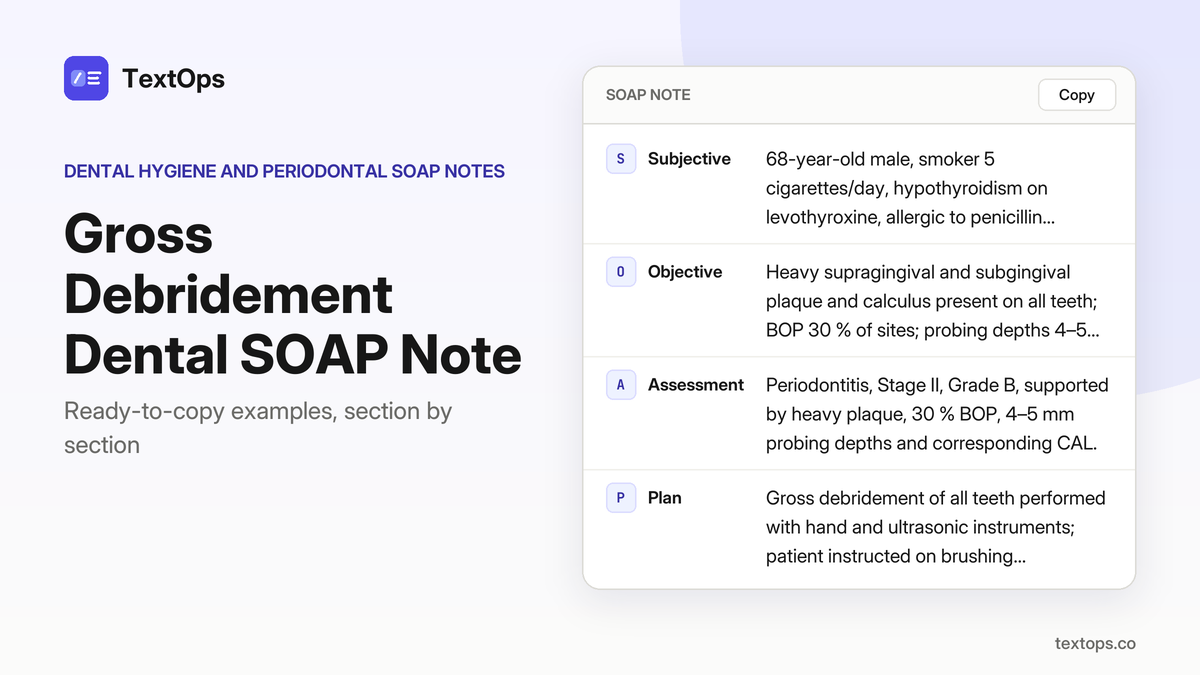
Ready-to-copy nutritional counseling SOAP notes for dental hygienists and students are available for immediate use. The first example is fully populated and can be pasted directly into a chart. The content also includes a concise adaptation guide, showing how to tailor each note to individual patients and special populations such as pregnancy, diabetes, and smoking.
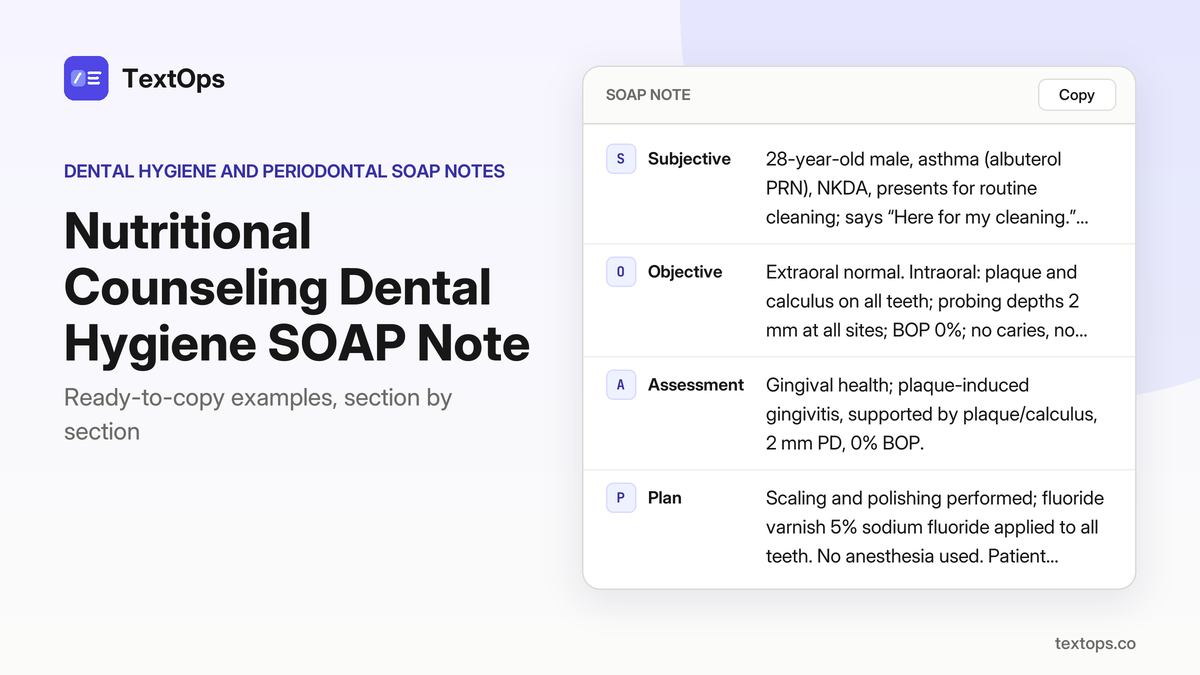
28-year-old male, asthma (albuterol PRN), NKDA, presents for routine cleaning; says “Here for my cleaning.” No medical complaints, no pain.
OObjective
Extraoral normal. Intraoral: plaque and calculus on all teeth; probing depths 2 mm at all sites; BOP 0%; no caries, no gingival inflammation. Radiographs not taken.
AAssessment
Gingival health; plaque-induced gingivitis, supported by plaque/calculus, 2 mm PD, 0% BOP.
PPlan
Scaling and polishing performed; fluoride varnish 5% sodium fluoride applied to all teeth. No anesthesia used. Patient instructed to maintain twice-daily brushing, interdental cleaning, limit sugary snacks, and to return in 6 months for maintenance.
First-Time Patient, 22-Year-Old Male, Sugar-Free Diet Plan
SOAP note
SSubjective
22-year-old male, hypothyroidism on levothyroxine, chief complaint: “I want to cut down on sugar.” History: no caries, mild plaque, no gingival inflammation, no systemic signs.
OObjective
Extraoral and intraoral examination shows good oral hygiene, mild plaque accumulation, no caries, no gingival inflammation.
AAssessment
Nutritional counseling for a sugar-free diet plan, supported by absence of caries and mild plaque.
PPlan
Discussed sugar-free diet: limit sugary drinks, use sugar-free gum, encourage water, advise on snacking patterns. No anesthesia or drugs administered. Next visit: routine check-up in 3 months.
Pregnant, 32-Week, Routine Check-Up
SOAP note
SSubjective
59-year-old female, pregnant 32 weeks, type 2 diabetes on metformin, NKDA, presents for a routine check-up.
OObjective
Extraoral normal. Intraoral: mild plaque, no caries, no gingival inflammation. Periodontal chart: PD ≤3 mm, BOP 10% of sites, no pockets >3 mm.
AAssessment
Plaque-induced gingivitis, gingival health per 2017 AAP/EFP criteria, supported by mild plaque, PD ≤3 mm, BOP 10% and absence of inflammation.
PPlan
Prophylaxis performed with hand instruments and ultrasonic scaler; fluoride varnish 5% sodium fluoride applied to all tooth surfaces; patient instructed to use pregnancy-safe fluoride toothpaste (1 tsp every 12 h) and to avoid high-sugar snacks; advised to maintain twice-daily brushing and interdental cleaning; next visit in 3 months for periodontal maintenance.
Diabetic, HbA1c 8.2%, Follow-Up
SOAP note
SSubjective
73-year-old male, type 2 diabetes on metformin, HbA1c 8.2%, NKDA, chief complaint: “Checking my gums.” History: routine follow-up, no systemic symptoms, no pain.
OObjective
Probing depths 4 mm in several sites; Bleeding on probing 20 % of sites; Clinical attachment level 2 mm; mild calculus; no caries; extraoral and intraoral otherwise normal.
AAssessment
Periodontitis Stage II, Grade B (moderate progression) supported by PD ≥ 4 mm, BOP 20 %, CAL 2 mm, mild calculus.
PPlan
Scaling and root planing performed in quadrant 1 using ultrasonic and hand instruments; fluoride varnish 5 % sodium fluoride applied to all tooth surfaces; oral hygiene instruction given with emphasis on interdental cleaning and diet; no anesthesia used; patient advised to monitor glycemic control, maintain daily brushing twice; next visit in 3 months for maintenance.
Probing depths 3 mm at all sites; Bleeding on probing 5% of sites; Clinical attachment level 1 mm; mild calculus; no caries; no anesthesia required.
AAssessment
Periodontitis Stage I, Grade C (rapid progression) attributed to smoking, supported by uniform 3 mm pockets, 5% BOP, and 1 mm CAL.
PPlan
Prophylaxis performed with ultrasonic scaler and hand instruments; oral hygiene instruction given; smoking cessation counseling discussed; no drugs prescribed; next visit scheduled for periodontal maintenance in 3 months.
Elderly, 70-Year-Old, Oral Cancer Screening
SOAP note
SSubjective
70-year-old male, daily low-dose aspirin, NKDA, presents for routine oral cancer screening with the chief complaint “Just a check.” He reports no pain, no recent trauma, and denies tobacco use or alcohol excess; medical history is otherwise unremarkable.
OObjective
Comprehensive oral examination reveals normal-appearing mucosa, no ulceration, no abnormal pigmentation, and no swelling. Extraoral assessment shows symmetrical facial musculature, no lymphadenopathy, and normal tongue mobility. Intraoral inspection confirms healthy gingiva, intact mucosa, and no lesions. Palpation of the floor of the mouth, buccal mucosa, and tonsillar pillars is negative for induration or masses.
AAssessment
Oral cancer screening negative; no suspicious lesions or findings warranting further diagnostic workup.
PPlan
Conducted a thorough visual inspection; educated patient on self-examination techniques, including checking the tongue, buccal mucosa, and floor of the mouth for changes. Advised to report any new lesions, pain, or ulcerations immediately. No medications were prescribed. Scheduled a follow-up in 12 months for routine screening and oral hygiene reinforcement.
Teenager, 16-Year-Old, First Visit
SOAP note
SSubjective
16-year-old female, former smoker, NKDA, reports “First dental visit.” HPI: no pain, no prior dental care, seeks routine exam. PMH: none.
OObjective
Extraoral: normal. Intraoral: good oral hygiene, mild plaque, no caries, no gingival inflammation. Periodontal: BOP 0%, PD 1-2 mm, CAL 0. Radiographs: none taken.
AAssessment
Gingival health; findings: mild plaque, no inflammation, normal probing depths, no attachment loss.
PPlan
Prophylaxis performed; fluoride varnish 5% sodium fluoride applied to all tooth surfaces. Oral hygiene instruction given, including brushing technique, interdental cleaning, and dietary advice to limit sugary snacks. No anesthesia or medication used. Next visit scheduled in 6 months for routine maintenance.
Post-Extraction, Day 3, Lower Molar
SOAP note
SSubjective
68-year-old female, no significant medical history, allergic to penicillin (rash); chief complaint: “Pain after extraction.” History: extraction of tooth #30 performed 3 days ago; no systemic symptoms.
OObjective
Extraction site shows healing, mild swelling, no infection. Probing depths 3 mm around adjacent teeth; no bleeding on probing; no caries.
AAssessment
Post-extraction healing, no infection.
PPlan
No anesthesia required. Post-operative instructions given: chlorhexidine 0.12% rinse 15 mL for 30 s twice daily, soft diet, avoid hot foods. Prescribed ibuprofen 400 mg PO q6h PRN for 3 days. Next visit: follow-up in 7 days to assess healing.
Orthodontic Patient, 12-Year-Old, Retainer Use
SOAP note
SSubjective
12-year-old female, seasonal allergies, NKDA, presents with chief complaint “Need to check retainer.” She reports no pain or discomfort and reports routine daily brushing and flossing. No medical or dental history beyond allergies.
OObjective
Retainer is in place, no decay noted, good oral hygiene, no gingival inflammation. Extraoral normal. Intraoral surfaces smooth, no plaque accumulation. Periodontal probing shows no bleeding on probing. Radiograph not taken.
AAssessment
Retainer maintenance; findings support intact appliance, healthy periodontium, and adequate oral hygiene.
PPlan
Cleaned retainer with ultrasonic scaler and hand instruments, applied 5% sodium fluoride varnish to retainers and surrounding teeth, instructed patient and guardian on daily retainer care, proper cleaning with soft brush and mild soap, and advised to avoid sugary snacks. No anesthesia or medications used. Next visit scheduled in 6 months for retainer check and hygiene reinforcement.
Patient with Renal Disease, 50-Year-Old, Low-Phosphate Diet
SOAP note
SSubjective
50-year-old female, smoker (5 cigarettes/day), NKDA, reports “Need diet advice for kidney disease.” No medical history beyond renal disease, no current medications listed.
OObjective
Extraoral: no swelling or asymmetry. Intraoral: good oral hygiene, no caries, no gingival inflammation. Periodontal chart: PD 2 mm all sites, BOP 0 %. Radiographs: none taken.
AAssessment
Nutritional counseling for renal disease, supported by absence of oral pathology and patient’s request for dietary guidance.
PPlan
Discussed low-phosphate diet: limit dairy, use phosphate binders as prescribed, encourage regular dental check-ups. No anesthesia or medications administered. Next visit: routine prophylaxis in 6 months.
Post-Surgery, 6 weeks, Implant Site
SOAP note
SSubjective
45-year-old female, asthma (albuterol PRN), NKDA, presents for implant check-up; reports no pain or swelling.
OObjective
Panoramic radiograph shows no peri-implant bone loss; implant surface smooth. Probing depth at implant #30 is 2 mm, no bleeding on probing; peri-implant mucosa pink and healthy.
AAssessment
Implant maintenance; findings support a stable implant with healthy peri-implant tissues.
PPlan
No anesthesia required. Reinforced oral hygiene instruction given; patient advised to maintain daily brushing with a soft-bristled brush and interdental cleaning. No medications prescribed. Next visit scheduled in 3 months for routine maintenance.
Patient with Xerostomia, 60-Year-Old, Saliva Substitute
SOAP note
SSubjective
60-year-old female, hypothyroidism on levothyroxine, allergic to penicillin (rash), CC: “I feel dry all the time after meals”; HPI: xerostomia noted for several weeks, no pain or lesions; PMH: hypothyroidism; no other systemic signs.
OObjective
Oral mucosa dry, no ulcerations; salivary flow rate 0.3 mL/min (low); plaque index 45 %; no extraoral findings; no radiographs taken; all tests normal.
AAssessment
Xerostomia, stage I, supported by dry mucosa, low flow rate, and high plaque index.
PPlan
Prescribed 2 % xylitol saliva substitute spray, 4 × daily; applied fluoride varnish 5 % sodium fluoride to all teeth; instructed to rinse with water after spray, maintain oral hygiene, avoid dry foods, and return in 4 weeks for reassessment.
Smoker, 35-Year-Old, Periodontal Surgery
SOAP note
SSubjective
35-year-old female, smoker 5 cigarettes/day, type 2 diabetes on metformin, NKDA; CC: “My gums bleed a lot and I have a pocket that hurts”; HPI: bleeding with brushing, deep pocket, no pain at rest; PMH: type 2 diabetes, no systemic signs.
OObjective
Extraoral: normal; Intraoral: gingival recession 2 mm at #15, BOP present; Periodontal: pocket depth 6 mm at #15, no suppuration; Radiograph: 3 mm bone loss at #15; Tests: none.
AAssessment
Periodontitis Stage II, Grade C (rapid progression) supported by 6 mm pocket, 3 mm bone loss, BOP, and recession.
PPlan
Open flap debridement at #15, sutured with 4-0 vicryl; anesthesia: 2% lidocaine with 1:100,000 epinephrine, 1.8 mL buccal infiltration; POI: chlorhexidine gluconate 0.12% 15 mL rinse, 30 sec, twice daily; next visit: periodontal maintenance in 4 weeks.
Patient with Allergic Rhinitis, 25-Year-Old, Oral Hygiene
SOAP note
SSubjective
25-year-old female, NKDA, presents with sore spot on tongue and inflamed gums; reports “I have a sore spot on my tongue and my gums feel inflamed.” HPI: soreness localized to tongue, gingival inflammation noted around #12-#13, no pain elsewhere, no systemic symptoms.
OObjective
Extraoral: normal. Intraoral: gingival inflammation around #12-#13, BOP 15% of sites, plaque index 60%; no caries, no swelling, no tooth mobility. Periodontal charting: PD ≤3 mm, CAL normal, BOP present. Radiographs: none taken.
AAssessment
Plaque-induced gingivitis, supported by BOP 15% of sites, high plaque index, and localized gingival inflammation around #12-#13.
PPlan
Full mouth prophylaxis performed; fluoride varnish 5% sodium fluoride applied to all teeth; patient received oral hygiene instruction focusing on brushing technique, interdental cleaning, and dietary advice to reduce sugary snacks and drinks; advised to maintain twice-daily brushing and flossing; next visit scheduled in 3 months for periodontal maintenance.
Post-Orthodontic, 18-Year-Old, Retainer Care
SOAP note
SSubjective
18-year-old male, controlled hypertension on lisinopril, NKDA, presents with chief complaint “my retainer feels loose and I get a bit of pain when I bite”; history shows he has recently finished orthodontic treatment and has been wearing a removable retainer daily for the past three months, reports occasional discomfort on maximal intercuspation and a sense that the appliance no longer sits snugly against the teeth.
OObjective
Clinical examination reveals the retention appliance fits within the dental arches, with no visible plaque accumulation, no carious lesions, and no periodontal pockets; gingival tissues appear healthy and without inflammation; blood pressure recorded at 128/78 mmHg, within acceptable limits for a patient on lisinopril; no other systemic signs noted.
AAssessment
Diagnosis is retainer maintenance, justified by the appliance’s adequate fit, absence of oral pathology, and the patient’s reported discomfort indicating a need for routine adjustment and hygiene reinforcement.
PPlan
Reinforced retainer hygiene instructions were provided, including brushing the appliance with a soft brush and mild soap, rinsing with chlorhexidine 0.12% twice daily, and avoiding hard or sticky foods that may dislodge the appliance; no anesthesia or medications were necessary; a follow-up retainer check is scheduled in 6 months to reassess fit and oral health status.
Patient with Gout, 58-Year-Old, Low-Purine Diet
SOAP note
SSubjective
58-year-old female patient presents with chief complaint: “I want to know what foods I should avoid to keep my joints healthy.” She takes daily low-dose aspirin, reports no known drug allergies, and denies other systemic illnesses; no dental history of pain or infection. O: Extraoral examination shows no swelling or tenderness; intraoral surfaces reveal plaque accumulation with a plaque index of 50%; no caries, restorations, or periodontal pockets noted; vital signs within normal limits; no systemic signs of infection or inflammation. A: Gout, dietary counseling; diagnosis supported by patient’s history of gout, request for joint-health diet, and absence of acute oral pathology. P: Counseled on low-purine dietary modifications, advised limiting red meat, organ meats, shellfish, and alcohol, and encouraged increased hydration and consumption of low-purine foods such as fruits, vegetables, and whole grains; provided a written diet sheet; no local anesthesia or medication prescribed. Next visit: routine prophylaxis in 3 months.
Pregnancy, 28-Week, Dental Anxiety
SOAP note
SSubjective
26-year-old female, pregnant at 28 weeks, former smoker, NKDA; CC: “I’m nervous about getting a filling during pregnancy”; HPI: reports dental anxiety, no pain; PMH: pregnancy, former smoker; no medications; allergies: NKDA.
OObjective
Extraoral: normal; Intraoral: mild gingivitis, BOP 10% of sites, no caries; Periodontal: PD ≤3 mm, no attachment loss; Radiographic: none taken; Vital signs: BP 110/70 mmHg, no systemic infection.
AAssessment
Gingival health; dental anxiety—mild gingivitis with BOP 10% of sites, no caries, normal BP.
PPlan
Reinforced oral hygiene instructions, discussed anxiety-management techniques, no local anesthesia used; scheduled prophylaxis in 3 months; no drugs prescribed; advised to maintain good oral hygiene and to seek dental care promptly if symptoms change.
Elderly, 80-Year-Old, Dementia, Oral Care
SOAP note
SSubjective
80-year-old female with dementia, reports “I can’t keep my mouth clean.” No significant medical history; allergic to penicillin (rash). O: Severe plaque accumulation noted on all surfaces; BOP present at 30 % of sites; mild gingival recession observed; no caries, no signs of systemic infection. A: Plaque-induced gingivitis, Stage I, confirmed by extensive plaque, BOP 30 % and mild recession. P: Completed full-mouth prophylaxis with ultrasonic scaling and hand curettage; applied 5 % sodium fluoride varnish to all teeth; educated caregiver on proper brushing technique, frequency, and use of fluoride toothpaste; no anesthesia or medications administered. Follow-up: routine maintenance in 3 months, reassess plaque control and gingival health.
Patient with Hypertension, 52-Year-Old, Low-Sodium Diet
SOAP note
SSubjective
52-year-old female patient, seasonal allergies, NKDA, presents with the chief complaint “I want to reduce my sodium intake to help my blood pressure,” and reports no other oral or systemic symptoms; she has no history of significant dental disease and is a first-time patient.
OObjective
Extraoral examination shows no swelling, asymmetry, or facial nerve deficit; intraoral surfaces are free of caries, periodontal pockets are shallow, and gingival tissues appear healthy; plaque index registers at 55 %; blood pressure reading is 140/85 mmHg; no radiographs were obtained as no pathology was suspected.
AAssessment
Hypertension, dietary counseling; the diagnosis is supported by the elevated blood pressure reading and the patient’s expressed goal to lower sodium intake, with no other systemic signs present.
PPlan
Provided comprehensive low-sodium diet counseling, including written guidelines on sodium limits, processed food avoidance, and home cooking tips; no medications or anesthesia were administered; the patient was instructed to monitor her blood pressure at home and to return for a follow-up in 6 months to reassess blood pressure and dietary adherence.
Orthodontic, 14-Year-Old, Fixed Appliance
SOAP note
SSubjective
14-year-old male, smokes 5 cigarettes/day, NKDA, CC “My braces are painful and I have plaque buildup”; HPI: pain localized to brackets, increased after meals; PMH: none.
OObjective
Fixed appliance present; plaque accumulation around brackets; BOP 20% of sites; no caries, no periodontal pockets; PA, BWX not taken.
AAssessment
Plaque-induced gingivitis, Stage I, supported by BOP 20% and plaque around brackets.
PPlan
Full-mouth prophylaxis performed; fluoride varnish 5% sodium fluoride applied to all teeth; oral hygiene instruction focused on interdental brushes and floss threaders for appliance care; advised smoking cessation discussion; next visit in 3 months for maintenance.
Patient with Celiac Disease, 30-Year-Old, Gluten-Free Diet
SOAP note
SSubjective
30-year-old female, asthma, NKDA, says “I’m here for my first cleaning.” HPI: no pain, routine visit. PMH: asthma, albuterol PRN.
OObjective
plaque score 25 %; BOP 12 %; PD 3 mm all sites; no CAL; no anesthesia used.
AAssessment
Plaque-induced gingivitis, supported by plaque score, BOP, and 3 mm probing depths without attachment loss.
PPlan
Prophylaxis performed; fluoride varnish 5 % sodium fluoride applied to all tooth surfaces; oral hygiene instruction given; nutritional counseling focused on maintaining a gluten-free diet to reduce systemic inflammation and support periodontal health; no medications prescribed; next visit in 6 months for routine maintenance.
Pregnancy, 34-Week, Dental Check-Up
SOAP note
SSubjective
36-year-old female, pregnant, hypothyroidism on levothyroxine, chief complaint: “Just a check-up before delivery.”
OObjective
Plaque score 30 %; Bleeding on probing 15 %; Probing depth 3 mm at all sites; no clinical attachment loss; extraoral and intraoral otherwise normal; no radiographs taken.
AAssessment
Plaque-induced gingivitis, supported by 30 % plaque, 15 % BOP, 3 mm PD and absence of attachment loss.
PPlan
Prophylaxis performed with hand instruments and ultrasonic scaler; fluoride varnish 5 % sodium fluoride applied to all tooth surfaces; oral hygiene instruction given, emphasizing proper brushing, interdental cleaning and diet; discussed pregnancy-safe medications; no drugs prescribed; next visit scheduled for routine maintenance in 3 months.
Patient with Asthma, 40-Year-Old, Medication Side-Effects
SOAP note
SSubjective
40-year-old female with type 2 diabetes on metformin, NKDA, CC: “I’d like a cleaning.” HPI: no pain, routine visit, no known asthma medication side-effects reported. O: plaque score 35 %; bleeding on probing 20 %; probing depth 3 mm at all sites; no clinical attachment loss; extraoral and intraoral examination within normal limits. A: plaque-induced gingivitis, evidenced by BOP ≥20 % and PD ≤3 mm with no attachment loss. P: Prophylaxis performed with ultrasonic scaling and hand instrumentation; fluoride varnish 5 % sodium fluoride applied to all tooth surfaces; comprehensive oral hygiene instruction delivered, emphasizing brushing technique, interdental cleaning, and diet; patient advised to monitor glycemic control and report any medication side-effects; no anesthesia or drugs prescribed; next visit scheduled in 3 months for periodontal maintenance.
Elderly, 75-Year-Old, Oral Hygiene
SOAP note
SSubjective
75-year-old female, no significant medical history, NKDA, states “First visit, want to see what my gums look like.”
OObjective
Plaque score 40 %; Bleeding on probing 18 %; Probing depth 3 mm at all sites; no clinical attachment loss; extraoral and intraoral findings within normal limits; no radiographs taken.
AAssessment
Plaque-induced gingivitis, supported by plaque score >30 %, BOP 18 %, PD 3 mm, and absence of attachment loss.
PPlan
Prophylaxis performed with hand scaling and polishing; fluoride varnish 5 % sodium fluoride applied to all tooth surfaces; oral hygiene instruction given, including interdental aid recommendation; no medication prescribed; next visit scheduled in 6 months for routine maintenance.
Post-Surgery, 8 weeks, Implant Maintenance
SOAP note
SSubjective
74-year-old female, controlled hypertension on lisinopril, NKDA, presents for a cleaning after her implant; “Need a cleaning after my implant.”
OObjective
Plaque score 20%; Bleeding on probing 10%; Probing depth 3 mm at all implant sites; no clinical attachment loss; extraoral and intraoral otherwise within normal limits; no radiographs taken.
AAssessment
Plaque-induced gingivitis, supported by 20% plaque, 10% BOP, 3 mm PD and absence of attachment loss.
PPlan
Prophylaxis performed; implant maintenance with ultrasonic scaling and hand curettes; fluoride varnish 5% sodium fluoride applied to implant surfaces; oral hygiene instruction given; no drugs prescribed; next visit in 6 months for routine maintenance.
Patient with Hyperthyroidism, 35-Year-Old, Low-Iodine Diet
SOAP note
SSubjective
35-year-old female, first-time visit, says “First visit, want to learn about diet.” Medical history: low-dose aspirin daily, NKDA.
OObjective
Plaque score 28 %; BOP 12 %; probing depth 3 mm all sites, no attachment loss.
AAssessment
Plaque-induced gingivitis, supported by plaque score >20 %, BOP 12 %, PD 3 mm, no CAL.
PPlan
Prophylaxis performed; fluoride varnish 5 % sodium fluoride applied to all teeth; oral hygiene instruction given; nutritional counseling focused on a low-iodine diet, emphasizing reduction of iodinated salt, processed foods, and seafood; advised to maintain balanced diet and avoid excessive iodine; next visit in 3 months for maintenance.
Patient with Osteoporosis, 65-Year-Old, Low-Calcium Diet
SOAP note
SSubjective
65-year-old male, former smoker, NKDA, chief complaint: “First cleaning.” HPI: presents for initial routine prophylaxis, reports no pain or systemic symptoms.
OObjective
Plaque score 45 %; Bleeding on probing 22 %; Probing depth 3 mm at all sites; No clinical attachment loss; No extraoral or intraoral abnormalities noted.
AAssessment
Plaque-induced gingivitis, supported by high plaque and BOP with shallow, uniform probing depths and absence of attachment loss.
PPlan
Prophylaxis performed with ultrasonic scaling and hand curettes; fluoride varnish 5 % sodium fluoride applied to all tooth surfaces; oral hygiene instruction emphasized brushing technique, interdental cleaning, and diet; smoking cessation counseling provided; no medication prescribed; next visit scheduled in 3 months for maintenance.
Diabetic, 60-Year-Old, Periodontal Re-evaluation
SOAP note
SSubjective
60-year-old male, type 2 diabetes on metformin, allergic to penicillin (rash); chief complaint: “Need a cleaning.” History of present illness: routine first-time visit, no systemic signs.
OObjective
Plaque score 38 %; Bleeding on probing 18 %; probing depth 3 mm all sites; no clinical attachment loss; extraoral and intraoral otherwise normal.
AAssessment
Plaque-induced gingivitis, supported by high plaque and BOP with normal pocket depths and no attachment loss.
PPlan
Prophylaxis performed; fluoride varnish 5 % sodium fluoride applied to all tooth surfaces; oral hygiene instruction given, emphasizing glycemic control and its impact on periodontal health; no anesthesia or medication used; next visit scheduled for routine maintenance.
Smoker, 55-Year-Old, Implant Maintenance
SOAP note
SSubjective
55-year-old male smoker (5 cigarettes/day), seasonal allergies, NKDA, presents for his first routine visit and reports “First cleaning.” He has no other medical concerns and is not on medication; he denies pain or swelling.
OObjective
Extraoral examination is unremarkable. Intraoral findings show a plaque score of 50 % and bleeding on probing (BOP) of 25 %. Probing depths are uniformly 3 mm at all sites, with no clinical attachment loss and no signs of periodontal abscess or mobility. No anesthesia was required.
AAssessment
Plaque-induced gingivitis is diagnosed, evidenced by the high plaque accumulation, significant BOP, and shallow, uniform pocket depths without attachment loss.
PPlan
Prophylaxis was completed with ultrasonic scaling and hand curette debridement of all tooth surfaces. A 5 % sodium fluoride varnish was applied to all teeth. Comprehensive oral hygiene instruction was provided, emphasizing interdental cleaning and proper brushing technique. Smoking cessation counseling was discussed, with referral to a quitline. No medication was prescribed. The patient was advised to return in 6 months for implant maintenance and to reassess periodontal status.
15-year-old female; smokes ~5 cigarettes/day; NKDA; CC: “First cleaning before braces.” HPI: no pain, routine first visit.
OObjective
Plaque score 30%; BOP 10%; PD 3 mm all sites; no CAL; extraoral and intraoral normal.
AAssessment
Plaque-induced gingivitis – supported by plaque score >25%, BOP 10%, and PD ≤3 mm with no attachment loss.
PPlan
Prophylaxis performed; 5% sodium fluoride varnish applied to all tooth surfaces; oral hygiene instruction given, emphasizing interdental brushing and flossing; smoking risks discussed and cessation resources offered; next visit scheduled for retainer placement and periodontal re-evaluation.
How to Read and Use the Example Notes
S: Patient: 28-year-old male, PMH: none, NKDA, CC: “I want a clean smile.” HPI: “No pain, just routine care.” O: PMH reviewed; oral exam shows plaque and calculus on all teeth, BOP 12%, PD ≤3 mm, CAL 2 mm. PA: panoramic taken, no pathology. P: 5% fluoride varnish on all teeth, OHI given, next visit in 3 months for maintenance.
O: The “S:” line begins with patient demographics, medical history, and chief complaint in the patient’s words. The “O:” line lists objective findings—exam, periodontal charting, radiographs—without interpretation. The “A:” line states the assessment: diagnosis, stage/grade, and any risk factors. The “P:” line records interventions, instructions, prescriptions, and the next visit’s purpose.
Each example note is a complete SOAP block ready to paste into a chart. The notes are written contemporaneously, dated, and include patient quotes where the exact wording matters (e.g., “I want a clean smile”). The format follows the same pattern for every visit type, ensuring that every required element—demographics, visit context, objectives, assessment findings, plan actions, and follow-up—is present and neatly separated for quick copying.
Checklist & Quick-Adapt Guide
The checklist for a complete Nutritional Counseling Dental Hygiene SOAP Note includes:
Patient ID and DOB
Visit date and type (prophylaxis, maintenance, etc.)
Follow-up schedule and purpose (RTC, re-evaluation)
Provider signature and date
5-Step Quick-Adapt Workflow
Copy the ready-to-paste example note.
Replace the placeholder patient name, DOB, and ID with the current patient’s details.
Update the visit date and type to match the appointment.
Edit the nutrition goal and dietary assessment lines to reflect the patient’s actual eating habits and clinical findings.
Add any referrals or schedule the next visit, then sign and date the note.
Adapting Notes to Special Populations
Adapt the generic note by tailoring the S, O, and P content to the specific population while keeping the SOAP structure intact. For a pregnant patient, add a line in the S section noting gestational age and in the O section record iron-status indicators; in the P section emphasize iron-rich foods such as lean red meat, spinach, and fortified cereals. For a diabetic patient, include HbA1c in the S, document sugary snack frequency in the O, and in the P recommend limiting sweets, monitoring blood glucose, and scheduling a follow-up when HbA1c falls below 7.0 %. For an elderly patient, note diminished chewing ability or denture use in the S, assess masticatory efficiency in the O, and in the P suggest softer, nutrient-dense foods, chewing aids, and regular review of oral appliance fit. The same SOAP headings are used; only the details shift to reflect the patient’s medical status, dietary habits, and clinical findings.
Frequently Asked Questions About Nutrition Counseling SOAP Notes
Can I include a patient’s food diary in the SOAP note?
Yes. Place the diary entry in the O: line as an objective finding, for example:
O: Food diary reviewed; patient records 4 sugary snacks/day, 2 soda drinks/day, and irregular meal timing.
Do I need to document the exact amount of sugar intake?
Only if the amount is clinically relevant. Record a quantified range when it informs the plan:
O: Sugar intake estimated at 25–30 g/day; patient consumes 1–2 oz of soda per day.
How do I note a patient’s refusal of dietary advice?
Document the recommendation, the risks discussed, the patient’s decision, and any follow-up plan:
P: Discussed reducing sugary snacks; patient declined counseling, citing time constraints. Re-address at next visit.
Can I use a generic nutrition goal for all patients?
No. Tailor the goal to the individual’s status. For a diabetic:
P: Goal – limit sugary snacks to ≤1/day and monitor blood glucose. Refer to dietitian if HbA1c >7.0 %.
These examples show structure and wording only. Record what you actually found and did, and follow your practice’s documentation requirements.
Dr. Rahul Joshi is a Specialist Orthodontist with extensive clinical experience in orthodontics, dentofacial orthopaedics, and dental aesthetics. Holding a Master of Dental Surgery (MDS) in Orthodontics and Dentofacial Orthopaedics and a Bachelor of Dental Surgery (BDS) from Manipal Academy of Higher Education, he brings expertise in orthodontic treatment planning, teeth alignment, and Invisalign treatment. With professional experience across India and the Netherlands, Dr. Joshi combines clinical knowledge with practical experience in orthodontic care, dental aesthetics, and improving patients' oral health.
Master of Dental Surgery (MDS) in Orthodontics and Dentofacial Orthopaedics — Manipal Academy of Higher Education
Bachelor of Dental Surgery (BDS) — Manipal Academy of Higher Education
Stop retyping your templates
Save any template to TextOps once, then insert it anywhere on the web without retyping. Share it with your team so everyone uses the same wording.