A limited dental exam focuses on a single chief complaint, documenting only the pertinent history, focused intra-oral findings, and a targeted plan. The note excludes full charting and routine screenings unless clinically indicated. The first example below is a concise, copy-ready SOAP note that fits on a phone screen. The page offers many more templates and a side-by-side comparison with emergency exams.
SOAP note
SSubjective
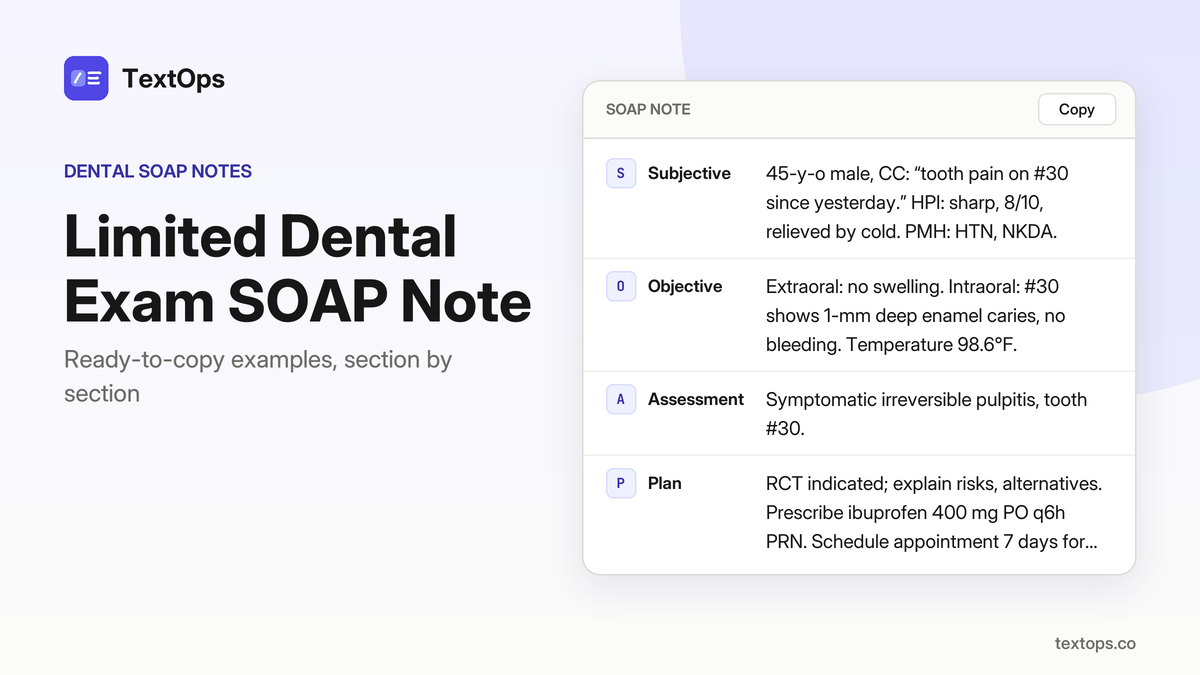
45-y-o male, CC: “tooth pain on #30 since yesterday.” HPI: sharp, 8/10, relieved by cold. PMH: HTN, NKDA.
OObjective
Extraoral: no swelling. Intraoral: #30 shows 1-mm deep enamel caries, no bleeding. Temperature 98.6°F.
AAssessment
Symptomatic irreversible pulpitis, tooth #30.
PPlan
RCT indicated; explain risks, alternatives. Prescribe ibuprofen 400 mg PO q6h PRN. Schedule appointment 7 days for RCT.
Diabetes Post-Extraction Follow-Up
Diabetic, Post-Extraction, 1 Week Follow-Up
SOAP note
SSubjective
43-year-old female, type 2 diabetes on metformin, controlled hypertension on lisinopril, NKDA; CC: “I still have a little swelling and a dull ache in the back of my mouth”; HPI: one week post-extraction of tooth #30, reports persistent mild swelling and dull ache; PMH: type 2 diabetes, hypertension; medications: metformin, lisinopril; allergies: NKDA.
OObjective
Extraoral: mild swelling of the right mandibular angle, no lymphadenopathy; Intraoral: extraction socket of #30 healed, slight erythema, no drainage; Probing: 3 mm depth at #30, no BOP; Radiograph: periapical PA of #30 shows normal healing, no radiolucency; systemic signs: none.
AAssessment
Symptomatic apical periodontitis of tooth #30, evidenced by persistent swelling, dull ache, 3 mm probing depth, and normal radiographic healing without radiolucency.
PPlan
No anesthesia or medications administered; instructed to continue chlorhexidine 0.12% rinse twice daily, maintain oral hygiene, avoid hard foods for 3 days; scheduled return visit in 2 weeks for reassessment of healing and glycemic control.
Diabetic, 2-Day Post-Extraction
SOAP note
SSubjective
65-year-old female, type 2 diabetes on metformin, seasonal allergies, NKDA; CC: “The pain is getting worse and I feel a bit feverish”; HPI: 2-day post-extraction of upper left molar #14, reports increasing discomfort and low-grade fever; PMH: type 2 diabetes, metformin; no known drug allergies.
OObjective
Extraoral: mild swelling of the left mandibular angle, no lymphadenopathy; Intraoral: extraction socket of upper left molar #14 shows slight drainage, erythema; Probing depth 4 mm at #14 with BOP; PA radiograph of #14 reveals a small radiolucent area at the apex; systemic: temperature 99.6 °F.
AAssessment
Acute apical abscess of upper left molar #14, supported by socket drainage, erythema, 4 mm probing depth with BOP, radiolucent apex, and low-grade fever.
PPlan
Prescribed amoxicillin 500 mg PO q8h for 7 days; ibuprofen 400 mg PO q6h PRN for pain; instructed to maintain oral hygiene, monitor swelling, report any worsening or high fever; next visit in 7 days for reassessment.
Diabetic, 2-Week Post-Extraction, Complication
SOAP note
SSubjective
73-year-old male, type 2 diabetes on metformin, NKDA; CC: “The socket is still red and I have a bad taste in my mouth”; HPI: 2-week post-extraction of lower left molar #19, reports persistent redness, foul taste, mild fever; PMH: diabetes, no other meds; allergies: NKDA.
OObjective
Extraoral: moderate swelling of left mandibular angle, tender cervical lymph nodes; Intraoral: extraction socket of #19 shows purulent drainage, erythema, no clot; Probing: 5 mm depth at #19, BOP present; Radiograph: PA of #19 shows a 4 mm radiolucent lesion extending to the root apex; systemic: fever 100.4°F, malaise.
AAssessment
Acute apical abscess of #19 with spreading cellulitis, supported by purulent drainage, erythema, 5 mm probing depth, BOP, radiolucent lesion, fever, and cervical lymphadenopathy.
PPlan
Advised immediate return for incision and drainage; prescribed clindamycin 300 mg PO q8h for 7 days; instructed warm saline rinses, maintain glycemic control, monitor temperature, and report worsening symptoms; next visit: incision and drainage procedure.
Diabetic, 1-Day Post-Extraction, Infection Alert
SOAP note
SSubjective
75-year-old male, type 2 diabetes on metformin, former smoker, NKDA, CC “I feel a sharp pain when I bite down and my mouth feels hot”; HPI: pain began 24 h post-extraction of #28, associated with heat sensation; PMH: diabetes, smoking history; no systemic symptoms.
OObjective
Extraoral: swelling of right mandibular angle, no lymphadenopathy; Intraoral: extraction socket of #28 shows slight bleeding, erythema; Probing depth 4 mm at socket, BOP present; Radiograph: periapical PA of #28 reveals a 3 mm radiolucent area at the apex; all other findings within normal limits.
AAssessment
Symptomatic apical periodontitis of tooth #28, supported by socket erythema, bleeding, BOP, 4 mm probing depth, and a 3 mm periapical radiolucency.
PPlan
Instructed patient to maintain oral hygiene, avoid chewing on the extraction side, and take ibuprofen 400 mg PO q6h PRN for pain; advised to monitor for fever or increased swelling and return if symptoms worsen.
Diabetic, 2-Month Post-Extraction, Re-evaluation
SOAP note
SSubjective
51-year-old male, type 2 diabetes on metformin, smoker 5 cig/day, NKDA, CC: “My extraction site looks fine, but I still have a slight sensitivity.” HPI: 2 months post-extraction of tooth #30, reports mild sensitivity but no pain or swelling.
OObjective
Extraoral: no swelling, no lymphadenopathy. Intraoral: socket of #30 fully healed, no erythema, probing depth 2 mm, no BOP. Radiograph: periapical PA of #30 shows normal bone density, no radiolucency.
AAssessment
Normal healing of extraction site #30; no infection or pathology noted.
PPlan
Reassured patient, advised to maintain routine oral hygiene, no medication prescribed. Next visit: routine check-up in 3 months.
Diabetic, 3-Day Post-Extraction, Mild Fever
SOAP note
SSubjective
50-year-old female, type 2 diabetes on metformin, NKDA, presents 3-day post-extraction of upper left first molar (#14) with low fever and mild ache around the socket. HPI: “I have a low fever and a mild ache around the extraction.”
OObjective
Extraoral: mild swelling of the left mandibular angle, no lymphadenopathy. Intraoral: extraction socket of #14 shows slight erythema, no drainage; probing depth 3 mm, BOP present. Radiograph: periapical PA of #14 shows a small radiolucent area at the apex.
AAssessment
Symptomatic apical periodontitis of #14, supported by socket erythema, BOP, 3 mm probing depth, radiolucent apex, and low fever 99.8 °F.
PPlan
Prescribed amoxicillin 500 mg PO q8h for 7 days, ibuprofen 400 mg PO q6h PRN for pain, instructed to use warm saline rinses twice daily; advised to monitor temperature and report worsening swelling or drainage; next visit in 1 week for reassessment.
Hypertension Post-Extraction Follow-Up
Hypertensive, 2-Week Post-Extraction
SOAP note
SSubjective
34-year-old male, on daily low-dose aspirin, NKDA, presents for 2-week post-extraction follow-up after tooth #15 extraction; reports no pain or swelling.
OObjective
Extraoral: no facial swelling, lymph nodes not enlarged. Intraoral: extraction site shows mild erythema, clot intact, no drainage. Probing depth 2 mm, no bleeding on probing. Radiograph: periapical radiograph shows no radiolucency. Soft tissue healing within expected limits.
AAssessment
Normal healing of extraction site, supported by intact clot, absence of drainage, 2 mm probing depth without bleeding, and radiographic absence of periapical pathology.
PPlan
No additional treatment performed. Post-operative instructions given verbally and in writing: maintain oral hygiene, avoid hard foods, and return in 4 weeks for final assessment. No medications prescribed.
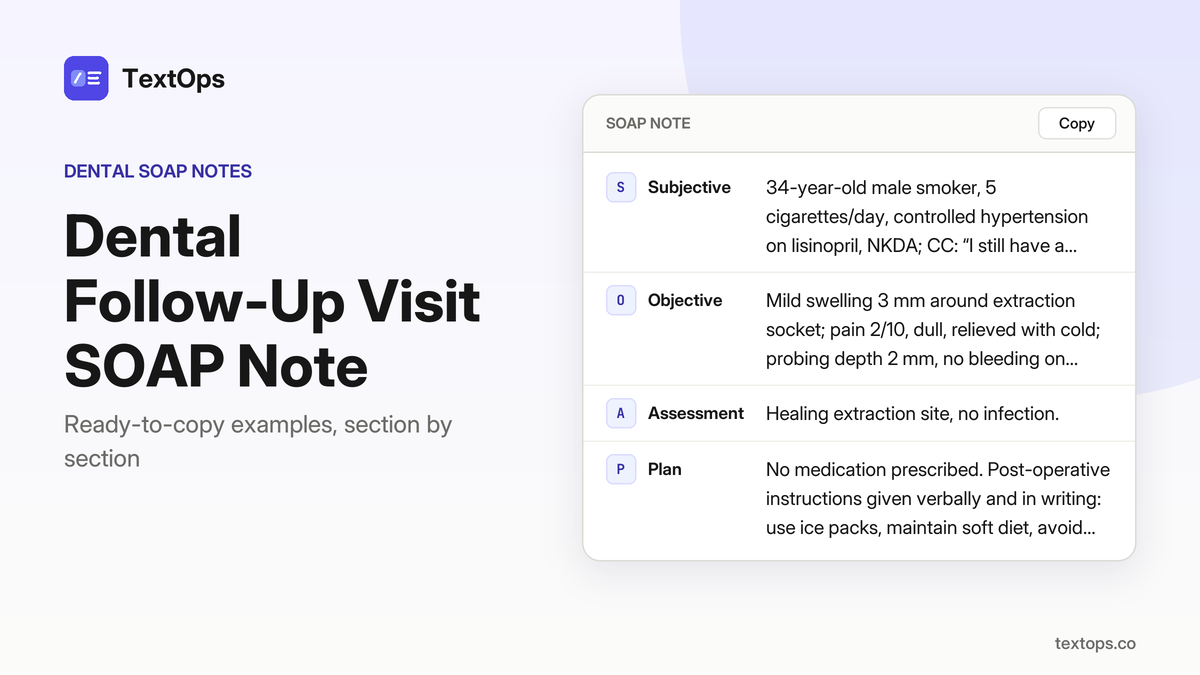
66-year-old male, no significant medical history, allergic to penicillin (rash), presents for a one-month post-extraction check-up after tooth #12 extraction; states “I’m here for my one-month check-up after the extraction.” O: Extraction site shows well-formed scar tissue, no swelling or drainage; probing depth 1 mm, no bleeding on probing; periapical radiograph shows complete bone fill; soft tissue appears healthy, no ulceration. A: Normal healing of extraction site, supported by scar tissue, 1 mm probing depth, no bleeding, and complete bone fill on radiograph. P: Reviewed current medications, advised to continue aspirin as prescribed, no changes recommended; postoperative instructions reiterated; next visit scheduled in 3 months for routine recall.
82-year-old female, hypothyroid on levothyroxine, allergic to penicillin (rash), reports “I’m here to check the bleeding after my extraction.”
OObjective
Extraction site #28 shows a stable clot, no oozing, soft-tissue margin intact, mild erythema, no swelling; probing depth 2 mm, no bleeding on probing; periapical radiograph shows no pathology.
AAssessment
Adequate hemostasis, supported by intact clot, absence of bleeding on probing, and normal radiograph.
PPlan
Reinforced hemostasis instructions given; patient advised to avoid vigorous rinsing, use gauze pad for 30 min, and no medications prescribed. Next visit scheduled in 4 weeks for final healing assessment.
56-year-old female, asthma on albuterol inhaler PRN, NKDA, chief complaint: "I'm here for my follow-up after the extraction." O: Extraction site shows mild swelling, clot intact, probing depth 1 mm, no bleeding on probing, periapical radiograph shows no radiolucency, soft tissue healing within expected limits, no systemic signs. A: Normal healing of extraction site, supported by intact clot, shallow probing depth, absence of radiolucency, and lack of bleeding. P: Reviewed inhaler use; patient advised to continue albuterol PRN and avoid strenuous activity that could increase bleeding risk. Post-operative instructions reiterated; next visit scheduled in 2 weeks.
47-year-old male, controlled hypertension on lisinopril, NKDA, CC: “I’m here to make sure the extraction site is healing properly,” HPI: 1-month post-extraction of tooth #30, no complaints of pain or bleeding.
OObjective
Extraction site shows no bleeding, mild scar tissue, no swelling; probing depth 1 mm, no bleeding on probing; periapical radiograph shows complete bone fill; soft tissue appears healthy; extraoral exam normal.
AAssessment
Adequate hemostasis, complete bone fill, and healthy soft tissue indicate successful healing of extraction site #30.
PPlan
Reinforced postoperative care instructions; advised to maintain oral hygiene and avoid hard foods; no medications prescribed; next visit scheduled in 6 weeks for final assessment.
32-year-old female, seasonal allergies, NKDA, presents for her one-week post-extraction check-up after removal of tooth #19; she reports no pain, no swelling, and is satisfied with healing. HPI: the patient has no new complaints and is compliant with postoperative care, noting that she has been monitoring her home blood pressure as advised during the last visit.
OObjective
Extraoral and intraoral examination shows a stable clot at the extraction site with mild erythema and no active bleeding; probing depth measures 2 mm with no bleeding on probing. Periapical radiograph of #19 reveals no pathology or radiolucency. Vital signs: blood pressure recorded at 145/90 mmHg, which is elevated for her age and sex; heart rate and temperature are within normal limits.
AAssessment
Adequate hemostasis achieved; blood pressure remains elevated, suggesting the need for antihypertensive reassessment.
PPlan
No new medication was prescribed. The patient was counseled to continue home blood pressure monitoring, to record any readings exceeding 160/100 mmHg, and to contact the office immediately if such readings occur. Post-operative instructions regarding wound care, diet, and activity were reiterated verbally and in writing. The next appointment is scheduled in two weeks to reassess blood pressure control and evaluate the extraction site for complete healing.
Asthma Post-Extraction Follow-Up
Asthma, 1-Day Post-Extraction
SOAP note
SSubjective
57-year-old female, NKDA, reports “I have a little pain and some swelling around the extraction site”; mild wheezing on exertion but no current respiratory symptoms.
OObjective
Extraction site #30 shows mild erythema, 1 mm soft tissue swelling, no drainage; socket tender on palpation, no fluctuation; temperature 98.6 °F; no lymphadenopathy.
AAssessment
Normal healing of #30 extraction site, supported by erythema, minimal swelling, absence of drainage or systemic signs.
PPlan
Reviewed postoperative instructions; advised to keep area clean, use ice packs, and avoid smoking; no drugs prescribed; next visit scheduled in 7 days for healing assessment.
Asthma, 3-Day Post-Extraction, Respiratory Check
SOAP note
SSubjective
55-year-old male, former smoker, NKDA, presents 3 days post-extraction of tooth #14 with complaint “The area is still a bit sore and I feel a little cough.” HPI: mild swelling, 2 mm erythema, tender socket, no drainage, temperature 98.7 °F, no lymphadenopathy, occasional dry cough, no shortness of breath.
OObjective
Extraoral: mild swelling, 2 mm erythema, no drainage. Intraoral: socket tender, no fluctuation. Periodontal: none noted. Radiographic: none taken. Tests: respiratory exam—no wheeze, normal breath sounds.
AAssessment
Normal healing of extraction site #14; no evidence of infection or respiratory compromise.
PPlan
Reviewed postoperative instructions; advised to monitor breathing and report any wheezing. No medications prescribed. Next visit scheduled in 7 days for healing assessment.
39-year-old female, smoker 5 cigarettes/day, NKDA, chief complaint “I have a sore spot and a mild cough that started after the extraction.” HPI: soreness at #19 extraction, mild cough began 2 days ago.
OObjective
Extraction site shows mild swelling, 1.5 mm erythema, no drainage; socket tender, no fluctuation. Temperature 98.5 °F, no lymphadenopathy. Respiratory exam: mild cough on deep breath, no wheeze, normal breath sounds; patient continues smoking.
AAssessment
Normal healing of #19 extraction site; no infection or respiratory compromise noted.
PPlan
Reviewed postoperative instructions; advised smoking reduction, use of ice packs, and site cleanliness. Prescribed ibuprofen 400 mg PO every 6 hours PRN, up to 3 days for pain. Next visit scheduled in 5 days for healing assessment.
Asthma, 4-Day Post-Extraction, Local Anesthetic Allergy
SOAP note
SSubjective
69-year-old female, type 2 diabetes on metformin, allergic to local anesthetic (rash); CC: “I had a rash around the extraction site after the anesthetic was given.” HPI: rash appeared 30 min after anesthetic, 4 days post-extraction of tooth #28; PMH: diabetes, asthma; medications: metformin.
OObjective
Extraction site: mild swelling, 2 mm erythema, no drainage; socket tender on palpation, no fluctuation; temp 98.4 °F; no lymphadenopathy; maculopapular rash noted; respiratory exam: normal breath sounds, no wheeze.
AAssessment
Normal healing of #28 extraction site with allergic reaction to local anesthetic; no systemic involvement.
PPlan
Advised avoidance of local anesthetic in future; prescribed ibuprofen 400 mg PO q6 h PRN for up to 3 days for pain; instructed to seek allergist evaluation; reviewed POI; scheduled RTC in 7 days for healing assessment.
Allergy Post-Extraction Follow-Up
Allergic to Penicillin, 2-Day Post-Root Canal
SOAP note
SSubjective
64-year-old male, daily low-dose aspirin, allergic to penicillin (rash). Chief complaint: “I have a sore spot near the back of my mouth that feels tender when I bite down.” History: 2-day post-root canal on tooth #14. PMH: aspirin; no other systemic signs.
OObjective
Intraoral: mild buccal swelling adjacent to #14, 2 mm erythema. Probing: 3 mm pocket depth distal to #14, no BOP. Periapical radiograph: radiolucency around #14 consistent with apical periodontitis. Temperature 98.6 °F; no lymphadenopathy.
AAssessment
Symptomatic apical periodontitis of tooth #14, supported by radiolucency, pocket depth, and tenderness on bite.
PPlan
Root canal therapy completed, temporary restoration placed. Instructed on meticulous oral hygiene, use of pain control without NSAIDs, avoid chewing on the area, apply cold compresses, and return in 7 days for final restoration.
Allergy to NSAIDs, 3-Day Post-Extraction
SOAP note
SSubjective
79-year-old male, no significant medical history, allergic to penicillin (rash) and NSAIDs (rash); chief complaint: “My extraction site feels sore and I can’t eat without pain.” O: Intraoral exam shows 4 mm soft tissue healing, mild erythema, 2 mm probing depth buccally, no BOP; PA radiograph confirms complete socket healing, no residual pathology; temperature 98.4 °F, no extraoral swelling or lymphadenopathy. A: Normal healing of #30 extraction site, supported by soft tissue assessment and radiographic findings. P: Reviewed postoperative instructions, reinforced gentle 0.12% chlorhexidine rinses and soft diet; prescribed acetaminophen 400 mg PO q6 h PRN, up to 3 days; instructed to return if pain worsens or new symptoms appear.
Allergy to NSAIDs, 1-Week Post-Extraction, Pain Management
SOAP note
SSubjective
68-year-old male, hypothyroid on levothyroxine, allergic to penicillin and NSAIDs; chief complaint: “I still feel a dull ache around the extraction area and it’s getting harder to chew”; no systemic symptoms, temperature 98.7 °F.
OObjective
Intraoral: extraction socket of #19 shows 5 mm soft-tissue healing, mild erythema; probing 3 mm depth buccally, no BOP; periapical radiograph: socket fully healed, no residual pathology; no extraoral swelling or lymphadenopathy.
AAssessment
Normal healing of #19 extraction site, supported by 5 mm soft-tissue healing, 3 mm probing depth, and radiographic evidence of complete socket closure.
PPlan
Discussed pain control; prescribed acetaminophen 500 mg PO q6h PRN for 3 days; instructed to use only acetaminophen due to NSAID allergy, report any worsening pain or signs of infection, and return if symptoms persist.
Pregnancy Dental Visits
Pregnant, First Trimester, Routine Check-In
SOAP note
SSubjective
45-year-old female, pregnant, asthma (albuterol PRN), NKDA, presents for routine check-in; states “just want to make sure everything’s fine.”
OObjective
Extraoral shows facial symmetry, no lymphadenopathy; intraoral gingiva pink, no ulcerations, BOP 0%; periodontal PSR 0 on all teeth; PA of tooth #15 shows no caries or periapical pathology; no restorations noted.
AAssessment
Normal periodontal health; no pulpal or periapical disease.
PPlan
Reinforced oral hygiene instructions; fluoride varnish applied to all teeth; no medication prescribed; patient advised to continue albuterol PRN and to report any new symptoms; next visit scheduled in 6 months for routine check-in.
Pregnancy, 3rd Trimester, Tooth Pain
SOAP note
SSubjective
49-year-old female, pregnant, controlled hypertension on lisinopril, NKDA; CC: “My lower right first molar hurts when I bite down, especially on the left side.” HPI: pain on biting, no swelling, no systemic symptoms.
OObjective
Extraoral: no swelling, no lymphadenopathy. Intraoral: tooth #30 shows deep mesial caries extending into dentin, no pulpal exposure. Periodontal: PSR 1 on #30. Radiograph: PA of #30 shows deep caries, no periapical radiolucency.
AAssessment
Symptomatic irreversible pulpitis of tooth #30; normal apical tissues, supported by deep dentin caries and absence of periapical pathology.
PPlan
Pulpectomy performed; calcium hydroxide apexification placed, temporary restoration. Anesthesia: 2% lidocaine with 1:100,000 epinephrine, 1.8 mL IANB. Medications: Ibuprofen 400 mg q6h PRN up to 3 days; Acetaminophen 500 mg q6h PRN up to 3 days. POI: keep mouth clean, avoid hard foods, monitor pain. Next visit: RTC in 2 weeks for interim restoration.
Pregnancy, 2nd Trimester, Routine Check-In
SOAP note
SSubjective
80-year-old pregnant patient, seasonal allergies, NKDA; CC: “Just a quick check-up, nothing else.” HPI: patient reports no pain or swelling; PMH: pregnancy, seasonal allergies; medications: none; allergies: none.
OObjective
Extraoral: facial symmetry, no lymphadenopathy; Intraoral: gingiva pink, BOP 0%; Periodontal: PSR 0 on all teeth; Restorations: composite on #19, amalgam on #30; Radiographs: PA of #19 shows no periapical pathology, PA of #30 shows mild periapical radiolucency; Caries risk moderate.
AAssessment
Chronic apical periodontitis of tooth #30; normal periodontal health.
PPlan
No anesthesia used; scheduled root-canal therapy for #30 at next visit; reinforced oral hygiene instructions; no medications prescribed; patient advised to maintain regular prenatal care and report any new symptoms.
Pregnancy, 1st Trimester, Tooth Pain
SOAP note
SSubjective
20-year-old pregnant female; CC: “My upper left first molar hurts when I chew, especially on the right side.” HPI: pain localized to chewing, no swelling, no lymphadenopathy; PMH: pregnancy, NKDA.
OObjective
Extraoral: no swelling, no lymphadenopathy. Intraoral: tooth #14 shows deep caries on distal surface, no pulpal exposure. Periodontal: PSR 1 on #14. Radiograph PA of #14: deep caries, no periapical radiolucency.
AAssessment
Symptomatic irreversible pulpitis of tooth #14 with normal apical tissues, supported by deep caries, pain on chewing, and lack of periapical pathology.
PPlan
Pulpectomy performed under 2% lidocaine with 1:100,000 epinephrine, 1.8 mL infiltration; calcium hydroxide apexification placed, temporary restoration placed. Prescribed Ibuprofen 400 mg q6h PRN up to 3 days and Acetaminophen 500 mg q6h PRN up to 3 days. Instructed on oral hygiene, avoidance of hard foods, and to return if pain worsens or swelling develops.
Pregnancy, 4th Trimester, Routine Check-In
SOAP note
SSubjective
48-year-old female patient, pregnant, former smoker, NKDA; CC: “Just a routine check-up, no problems.” HPI: denies pain or swelling; PMH: pregnancy; meds: none.
OObjective
Extraoral: facial symmetry, no lymphadenopathy; Intraoral: gingiva pink, BOP 0%; Periodontal: PSR 0 on all teeth; Restorations: none; PA of #15 shows no caries, no periapical pathology.
AAssessment
Normal periodontal health; no pulpal or periapical disease, consistent with PSR 0 and clear PA.
PPlan
Reinforced oral hygiene instructions; fluoride varnish applied to all teeth; no drugs prescribed; advised to maintain hydration and balanced diet; next visit scheduled in 3 months for routine check-in.
Pregnancy, 2nd Trimester, Tooth Pain
SOAP note
SSubjective
26-year-old female, pregnant, smoker, NKDA, reports “upper right canine hurts when I bite down, especially on the left side.” HPI: pain on biting, no swelling or systemic symptoms.
OObjective
Extraoral: no swelling, no lymphadenopathy. Intraoral: deep caries on the mesial surface of tooth #6 extending into dentin, no pulpal exposure; periodontal: PSR 1 on #6; PA of #6 shows deep caries, no periapical radiolucency.
AAssessment
Symptomatic irreversible pulpitis of tooth #6 with normal apical tissues, supported by deep dentin caries, pain on biting, and lack of periapical pathology.
PPlan
Pulpectomy performed under 2% lidocaine with 1:100,000 epinephrine, 1.8 mL infiltration; calcium hydroxide apexification placed; temporary restoration placed. Prescribed ibuprofen 400 mg PO q6 h PRN up to 3 days and acetaminophen 500 mg PO q6 h PRN up to 3 days. Instructed on pain management, oral hygiene, and to return in 3 days for interim review.
28-year-old female, pregnant, type 2 diabetic on metformin, NKDA, presents for a limited exam with chief complaint: “My lower right molar feels a bit loose when I chew.” She reports no pain, no swelling, and denies recent trauma or changes in her oral hygiene routine. She is in her second trimester and has no systemic symptoms such as fever or malaise.
OObjective
Extraoral examination reveals facial symmetry with no cervical or submandibular lymphadenopathy. Intraoral soft tissues are pink and healthy, with no ulceration or erythema. Tooth #30 exhibits mild mobility, classified as Miller grade 1, with a probing depth of 3 mm; there is no bleeding on probing, no caries, and no existing restoration. Periodontal assessment shows no other sites with increased probing depths or bleeding, and the overall gingival condition is consistent with pregnancy-associated gingival changes.
AAssessment
Mild periodontal mobility of tooth #30 secondary to pregnancy-associated gingival changes.
PPlan
Reinforced oral hygiene instruction emphasizing gentle brushing, interdental cleaning, and the use of a soft-bristled brush; advised to avoid hard foods that may exacerbate mobility. Discussed safe home care practices during pregnancy and the importance of maintaining glycemic control for periodontal health. No anesthesia or medication was required. Scheduled a follow-up in 4 weeks for reassessment of tooth mobility and periodontal status.
24-year-old pregnant female, CC “My upper left first molar hurts when I bite down.” HPI: pain on biting, sensitivity to cold, no swelling. PMH: pregnancy, daily low-dose aspirin, NKDA.
OObjective
Tooth #14 shows deep caries in outer dentin, no restoration. Sensitivity to cold and pain on biting. No BOP, no swelling. Extraoral: facial symmetry, no lymphadenopathy. Intraoral: gingiva pink, no lesions.
AAssessment
Symptomatic irreversible pulpitis of tooth #14; no apical involvement, supported by deep caries, biting pain, cold sensitivity, and absence of swelling or BOP.
PPlan
Prescribed ibuprofen 400 mg PO q6 h PRN for pain, max 3 days. Advised avoidance of hard foods, maintain oral hygiene, and refer for endodontic treatment. Next visit: endodontic appointment.
21-year-old female, pregnant, allergic to penicillin (rash); CC: “My lower left first molar feels a little loose when I chew”; HPI: mild mobility noticed during chewing, no pain or swelling; PMH: pregnancy; allergy: penicillin; no other drug allergies.
OObjective
Extraoral: facial symmetry, no lymphadenopathy; Intraoral: gingiva pink, no swelling; Tooth #19: mild mobility, Miller grade 1; probing depth 3 mm, no BOP; no caries or restoration; periodontal assessment shows pregnancy-associated gingival changes.
AAssessment
Mild periodontal mobility of tooth #19 with pregnancy-associated gingival changes, supported by Miller 1 mobility, 3 mm probing depth, and healthy gingiva.
PPlan
No anesthesia or drugs administered; oral hygiene instruction and home care tips for pregnancy given; patient advised to return in 4 weeks for reassessment.
61-year-old female, pregnant, hypothyroidism on levothyroxine, allergic to penicillin (rash); CC: “My lower right molar hurts when I drink hot coffee”; HPI: sensitivity to hot liquids, no pain on biting, no swelling, no BOP; PMH: hypothyroidism; no other medications listed.
OObjective
Extraoral: facial symmetry, no lymphadenopathy; Intraoral: gingiva pink, no lesions; Tooth #30: enamel caries class I, no restoration, sensitivity to hot liquids, no pain on biting, no swelling, no BOP; no extra findings.
AAssessment
Reversible pulpitis of tooth #30; no apical involvement, supported by sensitivity to hot liquids, absence of pain on biting, lack of swelling or BOP.
PPlan
Applied fluoride varnish to tooth #30; instructed oral hygiene and to avoid very hot drinks; no drugs prescribed; advised to return if pain worsens or new symptoms develop.
41-year-old pregnant female, chief complaint: “My upper right canine hurts when I bite down on cold food.” HPI: sensitivity to cold and pain on biting, no swelling, no bleeding on probing. PMH: pregnancy, asthma, albuterol PRN, NKDA.
OObjective
Tooth #6 shows deep caries in outer dentin, no restoration. Sensitivity to cold, pain on biting; extraoral symmetry, no lymphadenopathy. Intraoral gingiva pink, no lesions, BOP negative.
AAssessment
Symptomatic irreversible pulpitis of tooth #6; no apical involvement, supported by deep outer dentin caries, cold sensitivity, biting pain, and absence of swelling or BOP.
PPlan
Prescribed ibuprofen 400 mg PO q6 h PRN for pain, up to 3 days; advised to avoid hard foods and to continue albuterol as needed. Referred for endodontic treatment; instructed to return if pain worsens or persists beyond 3 days.
Elderly Limited Exams
Elderly, 80, New Patient, Limited Exam
SOAP note
SSubjective
80-year-old male, controlled hypertension on lisinopril, NKDA, reports “my molars hurt when I chew.” History of present illness: pain localized to #30, no swelling or fever.
OObjective
Extraoral: facial symmetry, no lymphadenopathy, TMJ normal. Intraoral: tooth #30 shows buccal and lingual probing depth 4 mm, bleeding on probing; no caries, no restorations, no mobility. Periodontal: all other teeth within normal limits. No extraoral or intraoral lesions noted.
AAssessment
Mild periodontal disease, stage I, supported by 4 mm probing depth with bleeding on #30 and otherwise healthy periodontium.
PPlan
Provided oral hygiene instruction and applied fluoride varnish to #30. No anesthesia used. Advised to maintain daily brushing with fluoride toothpaste, use interdental brushes, and schedule recall in 3 months.
Elderly, 75, Limited Exam, Dental Trauma
SOAP note
SSubjective
75-year-old female with seasonal allergies, NKDA, reports “My front tooth chipped when I fell.” HPI: fall caused a chipped front tooth; no pain, no swelling, no difficulty chewing.
OObjective
Extraoral normal. Intraoral: fractured enamel on mesial surface of tooth #9; no mobility, no tenderness on palpation. Periodontal: healthy gingiva, no bleeding on probing. Radiograph: periapical PA shows no radiolucency, no caries or restoration.
AAssessment
Enamel fracture of tooth #9, supported by visible enamel break on mesial surface and absence of pulpal or periapical pathology.
PPlan
Composite resin restoration of tooth #9 performed under local conditions; no anesthesia used. Postoperative instructions: avoid hard foods for 24 h, maintain oral hygiene, report any sensitivity. Recall in 6 weeks for restoration evaluation.
Elderly, 80, Limited Exam, Xerostomia
SOAP note
SSubjective
80-year-old male patient, no significant medical history, NKDA, presents with chief complaint “My mouth feels dry all the time” for the past six months; patient reports that the dryness is constant and worsens in the evening, and he has tried drinking water with limited relief.
OObjective
Unstimulated salivary flow measured at 0.3 mL/min; extraoral examination shows no facial asymmetry or lymphadenopathy; intraoral examination reveals no caries, no periodontal pockets, no ulcerations, and no mucosal lesions; patient has no swelling or pain in the salivary glands.
AAssessment
Xerostomia, evidenced by the markedly reduced unstimulated salivary flow rate of 0.3 mL/min and the patient’s six-month history of persistent dry mouth without associated systemic findings.
PPlan
Prescribed a saliva substitute to be used as needed; instructed the patient to increase oral fluid intake to at least 150 mL per hour during the day, chew sugar-free gum for 15 minutes every two hours, and use a humidifier at night; advised to schedule a follow-up in four weeks to reassess symptoms and consider ENT referral if dryness persists.
Elderly, 78, Limited Exam, Post-Extraction Pain
SOAP note
SSubjective
78-year-old female, former smoker, NKDA, reports “pain after my wisdom tooth was removed.” HPI: pain localized to extraction site of tooth #32, onset immediately post-surgery, mild, relieved by rest, no aggravating factors noted. Medical history: no current medications, no systemic disease, temperature 98.6 °F.
OObjective
Extraoral: facial symmetry intact, no cervical lymphadenopathy. Intraoral: extraction socket of #32 shows healing tissue, mild swelling confined to socket, tenderness to palpation, no purulent drainage, no trismus. Periodontal: surrounding tissues appear healthy, no gingival erythema. Radiograph: none taken this visit. Tests: none performed.
AAssessment
Post-extraction pain, supported by healing socket with mild swelling and tenderness, no signs of infection or systemic involvement.
PPlan
Ibuprofen 400 mg PO every 6 hours as needed, up to 3 days. Postoperative instructions: keep head elevated, apply ice packs, maintain oral hygiene, avoid smoking. Follow-up in 48 hours to reassess pain and healing.
Elderly, 70, Limited Exam, Post-Traumatic Pain
SOAP note
SSubjective
70-year-old female, smoker 5 cigarettes/day, NKDA, reports “my molar hurts after a fall.” HPI: pain localized to tooth #30, onset immediately post-fall, throbbing, worsens with chewing, no swelling or trismus. PMH: none relevant.
OObjective
Extraoral: normal. Intraoral: fractured cusp on occlusal surface of #30 with pulpal exposure; probing depth 3 mm, no BOP. Periodontal: healthy. Radiograph: periapical PA shows no radiolucency.
AAssessment
Symptomatic irreversible pulpitis of tooth #30, supported by exposed pulp, pain on function, and normal periapical radiograph.
PPlan
Referred for root canal therapy. Prescribed ibuprofen 400 mg PO q6h PRN, up to 3 days. POI: maintain oral hygiene, avoid hard foods, apply cold compress, report worsening pain or swelling. Next visit: RTC for endodontic treatment.
Smoking-Related Visits
Smoker, Day 3 After Lower Molar Extraction
SOAP note
SSubjective
74-year-old female, smoker 5 cigarettes/day, type 2 diabetes on metformin, NKDA; CC: “I’m here for a quick check-up and to talk about quitting smoking”; HPI: no pain, routine follow-up after lower molar extraction; PMH: diabetes, smoking; medications: metformin; allergies: NKDA.
OObjective
Extraoral: facial symmetry normal, no cervical lymphadenopathy, TMJ sounds normal, maximum opening 35 mm; Intraoral soft tissue: mild gingival erythema on buccal surfaces of lower molars, no ulcerations; Hard tissue: no caries, no restorations, no fractures; Periodontal: PSR code 1 (mild plaque) on all teeth, no mobility; Oral cancer screening: no suspicious lesions, tongue, buccal mucosa, floor of mouth, palate, gingiva all within normal limits; Radiographs: PA of lower molars #30-32 shows no periapical pathology, bone levels within normal limits.
AAssessment
Mild periodontal disease, stage I; smoking-related gingival inflammation, supported by PSR 1, mild gingival erythema, and normal bone levels.
PPlan
Discussed smoking cessation resources, provided written materials on benefits of quitting, and referred to primary care for counseling; advised to maintain oral hygiene and schedule next limited exam in 6 months; no drugs administered.
Smoking Cessation, 5-Year History, Follow-Up
SOAP note
SSubjective
27-year-old male, smokes ~5 cigarettes/day, takes low-dose aspirin, NKDA, CC: “I want to quit smoking and get a quick check-up,” HPI: no pain, seeks cessation advice.
OObjective
Extraoral: facial symmetry WNL, no lymphadenopathy, TMJ normal, opening 38 mm; Intraoral: mild gingival redness on lower molars, no ulcerations; Hard tissue: no caries, restorations, fractures; Periodontal: PSR code 1 on all teeth, no mobility; Oral cancer screening: no lesions; PA of #30-32: no periapical pathology, bone levels normal.
AAssessment
Mild periodontal disease, stage I; smoking-related gingival inflammation, supported by PSR 1 and gingival redness.
PPlan
Counseling on smoking cessation provided; nicotine patch trial offered; oral hygiene instructions given; no drugs prescribed; next visit scheduled in 3 months for reassessment.
Smoking Cessation, 1-Month Follow-Up
SOAP note
SSubjective
81-year-old male, smoker 5 cigarettes/day, allergic to penicillin (rash), presents for a quick check-up and to discuss quitting smoking.
OObjective
Extraoral: facial symmetry normal, no cervical lymphadenopathy, TMJ normal, opening 34 mm. Intraoral soft tissue: mild gingival erythema on lower molars, no ulcerations or lesions. Hard tissue: no caries, restorations, or fractures. Periodontal: PSR code 1 on all teeth, no mobility. Oral cancer screening: no suspicious lesions; tongue, buccal mucosa, floor of mouth, palate, gingiva normal. Radiographs: PA of lower molars #30-32 shows no periapical pathology; bone levels normal.
AAssessment
Mild periodontal disease, stage I; smoking-related gingival inflammation, supported by PSR 1, gingival erythema, and normal bone levels.
PPlan
Counseled on smoking cessation, provided written resources, advised to maintain oral hygiene; no drugs prescribed; next visit scheduled in 6 months.
Smoking Cessation, 6-Month Follow-Up, Oral Cancer Screening
SOAP note
SSubjective
72-year-old male, smoker 5 cigarettes/day, hypothyroidism on levothyroxine; chief complaint: “I’m here for a quick check-up and to talk about quitting smoking.”
OObjective
Extraoral: facial symmetry normal, no cervical lymphadenopathy, TMJ normal, maximum opening 36 mm. Intraoral soft tissue: mild gingival erythema on lower molars, no ulcerations or lesions. Hard tissue: no caries, no restorations, no fractures. Periodontal: PSR code 1 on all teeth, no mobility. Oral cancer screening: no suspicious lesions; tongue, buccal mucosa, floor of mouth, palate, gingiva normal. Radiographs: PA of lower molars #30-32 show no periapical pathology, bone levels normal.
AAssessment
Mild periodontal disease, stage I; smoking-related gingival inflammation, supported by PSR 1, mild erythema, and normal bone levels.
PPlan
Discussed smoking cessation strategies, provided written materials, advised on oral hygiene; no drugs prescribed; scheduled follow-up in 3 months.
SOAP Structure for a Limited Exam
Subjective
Record the chief complaint verbatim, then the HPI with onset, character, triggers, relief, and intensity on a 0-10 scale. Include PMH, current meds, allergies, tobacco/alcohol use, and pregnancy status if relevant. Example: “CC: ‘tooth pain on #30 since yesterday.’ HPI: sharp, 8/10, relieved by cold, no swelling.”
Objective
Document vital signs when indicated, extraoral findings, and focused intraoral exam. Note tooth number, surface, depth, and any bleeding or mobility. Include radiographic findings and any procedural details such as local anesthesia. Example: “O: Extraoral: no swelling. Intraoral: #30 shows 1-mm deep enamel caries, no bleeding. 0-10 °F.”
Assessment
State the clinical impression using standard terminology. Keep it concise and directly tied to the findings. Example: “A: Symptomatic irreversible pulpitis, tooth #30.”
Plan
Outline the immediate treatment, postoperative instructions, prescriptions, referrals, and next visit. Use clear, actionable language. Example: “P: RCT indicated; explain risks, alternatives. Prescribe ibuprofen 400 mg PO q6h PRN. Schedule appointment 7 days for RCT.”
Emergency exams document a patient’s acute presentation, requiring vital signs, a full extraoral assessment, emergency radiographs, and triage notes, all in one concise SOAP. The limited exam records only the chief complaint, focused intra-oral findings, and a targeted plan; it omits vital signs, comprehensive extraoral findings, and emergency imaging unless indicated. In an emergency note, include BP, pulse, temperature, and a note on airway, breathing, and circulation status. Add a triage comment such as “patient stable, pain 9/10, no trismus.” Record emergency radiographs (PA, BWX) and any urgent findings. Example:
SOAP note
SSubjective
45-y-o male, CC: “severe pain in lower right molar #30, swelling, fever.” HPI: sudden onset, 9/10, worsens with heat. PMH: HTN, NKDA. O: BP 158/96, pulse 102, temp 101.2°F. Extraoral: left submandibular lymphadenopathy, 2 cm, tender. Intraoral: #30 exposed, purulent exudate, buccal mucosa erythematous. PA: periapical abscess. A: Acute apical abscess with cellulitis. P: Administer 2% lidocaine with 1:100,000 epinephrine, IANB, 1.8 mL. Prescribe amoxicillin 500 mg PO q8h for 7 days. Instruct to apply ice, take ibuprofen 400 mg q6h PRN. Schedule follow-up in 24 h.
Dr. Rahul Joshi is a Specialist Orthodontist with extensive clinical experience in orthodontics, dentofacial orthopaedics, and dental aesthetics. Holding a Master of Dental Surgery (MDS) in Orthodontics and Dentofacial Orthopaedics and a Bachelor of Dental Surgery (BDS) from Manipal Academy of Higher Education, he brings expertise in orthodontic treatment planning, teeth alignment, and Invisalign treatment. With professional experience across India and the Netherlands, Dr. Joshi combines clinical knowledge with practical experience in orthodontic care, dental aesthetics, and improving patients' oral health.
Master of Dental Surgery (MDS) in Orthodontics and Dentofacial Orthopaedics — Manipal Academy of Higher Education
Bachelor of Dental Surgery (BDS) — Manipal Academy of Higher Education
Stop retyping your templates
Save any template to TextOps once, then insert it anywhere on the web without retyping. Share it with your team so everyone uses the same wording.