A ready-to-paste SOAP note for irreversible pulpitis appears here, complete with diagnosis, clinical findings, treatment plan, and post-operative instructions. Each template follows AAE terminology, records objective findings, and includes a brief comparison to reversible pulpitis to justify the diagnosis. Copy the note directly into your chart and update only the patient-specific details.
First-Time Visits with Symptomatic Irreversible Pulpitis
First-Time Visit, 35-Year-Old Male, Left Upper Central Incisor
SOAP note
SSubjective
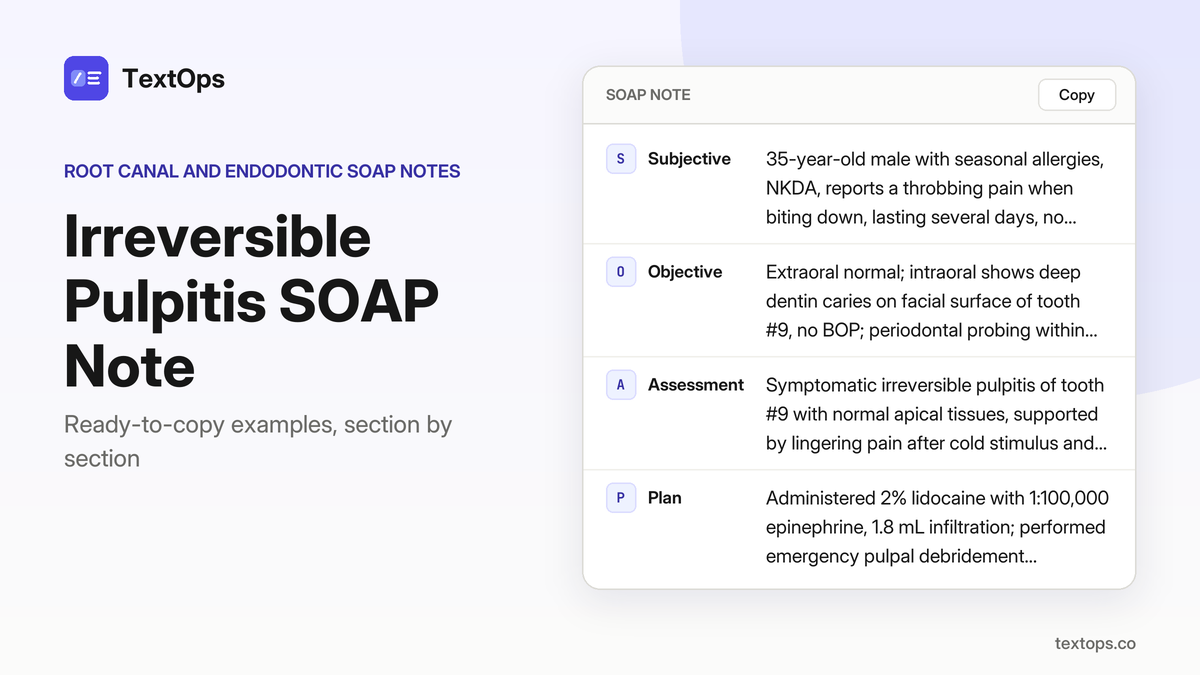
35-year-old male with seasonal allergies, NKDA, reports a throbbing pain when biting down, lasting several days, no swelling or mobility.
OObjective
Extraoral normal; intraoral shows deep dentin caries on facial surface of tooth #9, no BOP; periodontal probing within normal limits; PA radiograph shows no periapical radiolucency; cold test positive with lingering pain; percussion and palpation non-sensitive.
AAssessment
Symptomatic irreversible pulpitis of tooth #9 with normal apical tissues, supported by lingering pain after cold stimulus and absence of periapical pathology.
PPlan
Administered 2% lidocaine with 1:100,000 epinephrine, 1.8 mL infiltration; performed emergency pulpal debridement (pulpectomy) of #9, placed calcium hydroxide intracanal medicament, sealed temporarily with glass ionomer. Prescribed ibuprofen 400 mg PO q6h PRN for 5 days. Instructed patient on oral hygiene, pain control, and to return for definitive root canal therapy in 2 weeks.
First-Time Visit, 31-Year-Old Female, Right Lower Incisor
SOAP note
SSubjective
31-year-old female, NKDA, reports “sharp pain whenever I chew” for the past 2 days; pain is throbbing, lasts several seconds after biting, no swelling or mobility.
OObjective
Extraoral normal; intraoral shows moderate dentin caries on lingual surface of tooth #25; no BOP, probing depths within normal limits; periapical radiograph of #25 shows no radiolucency; cold test positive with lingering pain; no percussion tenderness; mobility grade 0.
AAssessment
Symptomatic irreversible pulpitis of tooth #25 with normal apical tissues, supported by lingering pain on cold, caries depth, and clear radiograph.
PPlan
Administered 4% articaine with 1:100,000 epinephrine, 1.8 mL infiltration; performed pulpectomy of #25, placed calcium hydroxide intracanal medicament, and sealed temporarily with glass ionomer. Prescribed ibuprofen 400 mg PO q6h PRN for 5 days; instructed to avoid hard foods, maintain oral hygiene, and return in 7 days for temporary restoration removal and assessment.
First-Time Visit, 45-Year-Old Male, Left Lower Incisor
SOAP note
SSubjective
45-year-old male reports a lingering throbbing pain after eating cold foods; pain started 2 days ago and worsens with cold stimuli. He has controlled hypertension on lisinopril, NKDA, and denies other systemic symptoms.
OObjective
Extraoral exam shows no facial swelling or lymphadenopathy; intraoral inspection reveals deep dentin caries on the facial surface of tooth #24. Periodontal probing is within normal limits; no mobility. Periapical radiograph shows a 2 mm radiolucency at the apex of #24. Cold test produces lingering pain, confirming symptomatic irreversible pulpitis with symptomatic apical periodontitis.
AAssessment
Symptomatic irreversible pulpitis with symptomatic apical periodontitis, supported by lingering pain after cold test and periapical radiolucency.
PPlan
Administered 4% articaine with 1:100,000 epinephrine, 1.8 mL infiltration; performed access, rubber dam isolation, working-length determination, instrumentation, irrigation with 2.5% NaOCl, calcium hydroxide medicament, and temporary restoration. Instructed patient on postoperative pain control and avoidance of cold foods, and scheduled return in 7 days for completion of endodontic therapy.
First-Time Visit, 52-Year-Old Male, Right Upper Lateral Incisor
SOAP note
SSubjective
52-year-old male, former smoker, NKDA, reports “I feel a throbbing pain and swelling when I bite.” He notes pain began 3 days ago, worsens with biting, and is relieved only by rest. No medications or allergies.
OObjective
Extraoral swelling in the buccal vestibule of the left maxillary region, mild trismus, no facial asymmetry. Intraoral: deep dentin caries on facial surface of tooth #10, moderate buccal vestibular swelling. Periodontal probing shows normal depth. PA radiograph shows 1.5 mm radiolucency at apex of #10. Cold test positive with lingering pain.
AAssessment
Pulp necrosis with acute apical abscess of tooth #10, supported by deep caries, lingering cold pain, periapical radiolucency, swelling, and trismus.
PPlan
Administered 2% lidocaine with 1:100,000 epinephrine, 1.8 mL (1 cartridge) infiltration; performed pulpectomy of #10, placed calcium hydroxide intracanal medicament, and restored temporarily with glass ionomer. Prescribed ibuprofen 400 mg PO q6h PRN for 5 days. Advised to avoid hard foods, maintain oral hygiene, report fever or worsening swelling, and return in 7 days for final restoration.
First-Time Visit, 30-Year-Old Female, Left Upper Central Incisor
SOAP note
SSubjective
30-year-old female, hypothyroid on levothyroxine, allergic to penicillin (rash), NKDA; reports dull pain when biting, started 2 days ago, no swelling or fever.
OObjective
Extraoral: facial symmetry, no lymphadenopathy. Intraoral: deep dentin caries on facial surface of tooth #9, no restoration, no discoloration. Periodontal: probing depth 2 mm, no bleeding on probing. Radiograph: PA of #9 shows no periapical radiolucency. Cold test: positive with lingering pain; no response on adjacent teeth.
AAssessment
Symptomatic irreversible pulpitis of tooth #9, normal apical tissues, supported by lingering pain after cold and absence of periapical pathology.
PPlan
Infiltration with 2% lidocaine + 1:100,000 epinephrine, 1.8 mL (1 cartridge); pulpectomy performed, calcium hydroxide intracanal medicament placed, temporary glass ionomer restoration. Ibuprofen 400 mg PO q6h PRN for 5 days prescribed. Advised to avoid hard foods, maintain oral hygiene, and return in 7 days for follow-up.
First-Time Visit, 39-Year-Old Male, Right Upper Second Molar
SOAP note
SSubjective
39-year-old male, NKDA, reports “sharp pain and swelling when I chew”; pain started 2 days ago, throbbing, radiating to the left cheek, worsens with biting, no relief with OTC meds. O: extraoral swelling in the buccal vestibule of the right maxilla; intraoral deep dentin caries on the facial surface of tooth #16; moderate buccal vestibular swelling; periapical radiograph shows a 3 mm radiolucency at the apex of #16; no mobility; cold test positive with lingering pain. A: pulp necrosis with acute apical abscess of tooth #16, confirmed by lingering pain on cold, radiolucency, and swelling. P: administered 2% lidocaine with 1:100,000 epinephrine, 1.8 mL infiltration; performed pulpectomy, placed calcium hydroxide intracanal medicament, restored temporarily with glass ionomer; prescribed ibuprofen 400 mg PO q6h PRN for 5 days; instructed to avoid hard foods, maintain oral hygiene, and return for final restoration in 2 weeks.
Emergency Visits for Sudden Pulpal Pain
Emergency Visit, 28-Year-Old Female, Right Lower Molar
SOAP note
SSubjective
28-year-old female, no PMH, NKDA, reports “sudden, sharp pain in my lower right molar that started a few minutes ago”; pain persists after cold stimulus, no swelling or trismus.
OObjective
Extraoral: no facial swelling, trismus WNL. Intraoral: deep caries to outer dentin on buccal surface of tooth #30, pulp exposure, lingering pain after cold. Periodontal: healthy. Radiograph: PA shows normal periapical tissues. Cold test: lingering pain. Vital signs: temp 98.6 °F, pulse 78 bpm.
AAssessment
Symptomatic irreversible pulpitis of tooth #30 with normal apical tissues, supported by deep caries, pulp exposure, lingering pain after cold and normal periapical radiograph.
PPlan
Administered 2% lidocaine with 1:100,000 epinephrine, 1.8 mL (1 cartridge), IANB, aspiration negative. Pulpectomy performed, calcium hydroxide intracanal medicament placed, temporary restoration placed. Prescribed ibuprofen 400 mg q6h PRN up to 3 days and acetaminophen 500 mg q6h PRN up to 3 days. Instructed to avoid hard foods, maintain oral hygiene, report swelling or persistent pain. Next visit: follow-up in 7 days for interim restoration and assessment.
Emergency Visit, 47-Year-Old Male, Left Lower Molar
SOAP note
SSubjective
47-year-old male reports “left lower molar throbbing for the last hour and now it hurts when I bite.” He has asthma, uses albuterol PRN, NKDA.
OObjective
Extraoral normal. Intraoral: moderate dentin caries on mesial surface of tooth #18; pain on percussion, no swelling, trismus, or fever. Periodontal probing WNL. Periapical radiograph shows slight radiolucency at apex of #18. Vital signs: T 98.4°F, pulse 80 bpm.
AAssessment
Symptomatic irreversible pulpitis with symptomatic apical periodontitis, supported by pulpal pain on percussion, radiolucency at apex, and absence of systemic signs.
PPlan
Administered 2% lidocaine with 1:100,000 epinephrine, 1.8 mL (1 cartridge) via IANB, aspiration negative. Performed pulpectomy, placed calcium hydroxide intracanal medicament, and temporary restoration. Prescribed ibuprofen 400 mg q6h PRN up to 3 days and acetaminophen 500 mg q6h PRN up to 3 days. Instructed on oral hygiene, avoidance of hard foods, and to return in 7 days for interim restoration.
Emergency Visit, 36-Year-Old Female, Right Upper Central Incisor
SOAP note
SSubjective
36-year-old female smoker, 5 cigarettes/day, NKDA. Chief complaint: “My right upper front tooth hurts like a knife whenever I drink cold coffee.” History: pain began abruptly, worsens with cold, no swelling or trismus, normal temperature 98.5°F, pulse 76 bpm.
OObjective
Extraoral: no swelling, trismus WNL. Intraoral: deep enamel caries on labial surface of tooth #8 with pulp exposure; lingering pain after cold stimulus. Periodontal: probing depths 1-2 mm, no BOP. Radiograph: PA of #8 shows normal periapical tissues. Cold test: lingering pain.
AAssessment
Symptomatic irreversible pulpitis of tooth #8, normal apical tissues supported by lingering pain after cold and normal PA.
PPlan
2% lidocaine with 1:100,000 epinephrine, 1.8 mL infiltration, aspiration negative. Pulpectomy performed; calcium hydroxide intracanal medicament placed; temporary restoration placed. Prescribed ibuprofen 400 mg q6h PRN up to 3 days and acetaminophen 500 mg q6h PRN up to 3 days. Instructed on pain control, diet, and to return for permanent restoration in 2 weeks.
Emergency Visit, 51-Year-Old Female, Left Lower First Molar
SOAP note
SSubjective
51-year-old female reports that her left lower first molar has a sudden, severe pain that started after a meal. She has type 2 diabetes on metformin, NKDA, and denies swelling or trismus.
OObjective
Extraoral: no swelling, trismus, or facial asymmetry. Intraoral: moderate dentin caries on buccal surface of tooth #19; pain on percussion and biting; no mobility. Periodontal probing WNL. Radiograph: slight radiolucency at apex of #19. Vital signs: temperature 98.7 °F, pulse 82 bpm.
AAssessment
Symptomatic irreversible pulpitis with symptomatic apical periodontitis, supported by pain on percussion, biting, and periapical radiolucency.
PPlan
Administered 2% lidocaine with 1:100,000 epinephrine, 1.8 mL (1 cartridge), IANB, aspiration negative. Performed pulpectomy, placed calcium hydroxide intracanal medicament, and temporary restoration. Prescribed ibuprofen 400 mg q6h PRN up to 3 days; acetaminophen 500 mg q6h PRN up to 3 days. Instructed patient to avoid hard foods, maintain oral hygiene, and return for definitive root canal treatment in 7 days.
Follow-Up Visits After Root-Canal Therapy
Follow-Up, 42-Year-Old Male, Left Upper Canine
SOAP note
SSubjective
42-year-old male, seasonal allergies, NKDA, reports “I just want to check that the tooth is fine.” No pain, no swelling, no history of recent trauma.
OObjective
Extraoral: no swelling or erythema. Intraoral: tooth #6 intact, no mobility, no sinus tract. Periodontal: probing depth within normal limits. Radiograph: periapical radiograph shows no radiolucency. Tests: percussion and palpation pain-free.
AAssessment
Root-canal treated tooth with normal apical tissues; findings of no pain, no mobility, clear radiograph support this diagnosis.
PPlan
Reviewed post-treatment status; no anesthesia required. Advised permanent restoration within 2 weeks, with oral hygiene instructions. Next visit: scheduled for permanent crown placement.
Follow-Up, 60-Year-Old Female, Right Upper Central Incisor
SOAP note
SSubjective
60-year-old female reports “a slight ache when I bite down” for the past week; no prior pain history for tooth #11, no medical conditions, NKDA.
OObjective
Extraoral exam shows no swelling or sinus tract; intraoral tenderness on percussion of tooth #11, mobility grade 0; periapical radiograph reveals a 2 mm radiolucency at the apex; palpation of surrounding tissues is normal.
AAssessment
Root-canal treated tooth #11 with asymptomatic apical periodontitis, evidenced by periapical radiolucency and percussion tenderness.
PPlan
No anesthesia administered; patient given verbal instructions to maintain good oral hygiene, avoid hard foods, and report any increase in pain. Scheduled obturation and placement of a full-coverage crown in 4 weeks; next visit is a follow-up in 4 weeks to evaluate healing and prepare for final restoration.
Follow-Up, 68-Year-Old Male, Right Upper Central Incisor
SOAP note
SSubjective
68-year-old male, NKDA, controlled hypertension on lisinopril, reports “I have a fever and the tooth hurts a lot”; pain is throbbing, worsens on biting, started 2 days ago.
OObjective
Extraoral: mild swelling of vestibule adjacent to tooth #11; intraoral: tender to percussion, no trismus, no lymphadenopathy; periodontal: normal probing; PA radiograph: 4 mm well-defined periapical radiolucency with sinus tract tracing; temperature 99.5 °F.
AAssessment
Root-canal treated tooth #11 with acute apical abscess, evidenced by swelling, pain on biting and percussion, sinus tract, radiolucency, and low-grade fever.
PPlan
Incision and drainage performed; no local anesthesia used. Prescribed amoxicillin 500 mg PO, 3×/day for 7 days. Advised oral hygiene, avoid hard foods, report worsening pain or fever. Schedule follow-up in 1 week to assess drainage and symptom resolution.
Follow-Up, 65-Year-Old Female, Right Upper Lateral Incisor
SOAP note
SSubjective
65-year-old female, former smoker, NKDA, reports “It hurts when I bite down on the front teeth”; pain started two weeks ago, worsens with chewing, no night pain, no swelling.
OObjective
Extraoral: no facial swelling, no trismus. Intraoral: tooth #10 shows no caries, intact restoration, no tenderness on palpation of surrounding tissues. Periodontal: mobility grade 0, probing depths 1-2 mm, no BOP. Radiograph: periapical PA shows a 3 mm radiolucency at the apex of #10, no sinus tract. Percussion: pain on tapping #10; bite test: pain on occlusion.
AAssessment
Root-canal treated tooth with symptomatic apical periodontitis, supported by pain on biting, percussion tenderness, and periapical radiolucency.
PPlan
Discussed definitive restoration with a porcelain-fused-to-metal crown; no anesthesia required today. Advised oral hygiene, avoid hard foods, and return in 4 weeks for crown placement and to assess symptom resolution.
Re-evaluation and Retreatments
Re-evaluation, 55-Year-Old Female, Right Lower Premolar
SOAP note
SSubjective
55-year-old female, chief complaint: “I still feel a dull ache when I bite down on the back right side.” She reports intermittent dull pain for the past two weeks, no spontaneous episodes, and denies swelling or fever. Past medical history: hypothyroidism on levothyroxine; allergic to penicillin (rash); NKDA.
OObjective
Extraoral: no facial swelling, no lymphadenopathy. Intraoral: tooth #28 shows mild tenderness on biting, no spontaneous pain; probing depth 2 mm, BOP none, mobility Miller grade 0. Periapical radiograph: 2 mm radiolucency at apex of #28, no other changes. Temperature 98.6 °F.
AAssessment
Symptomatic irreversible pulpitis of tooth #28 with normal apical tissues, supported by biting tenderness, periapical radiolucency, and lack of spontaneous pain.
PPlan
Administered 4% articaine with 1:100,000 epinephrine, 1.8 mL (1 cartridge), IANB; aspiration negative. Scheduled root-canal treatment for next visit; rubber dam isolation, working length determination, instrumentation to #30, irrigation with 2.5% NaOCl, calcium hydroxide intracanal medicament, temporary restoration. No medications prescribed. Next visit: completion of RCT.
Re-evaluation, 38-Year-Old Male, Left Lower Premolar
SOAP note
SSubjective
38-year-old male, “My left lower back tooth has been sore for a week, especially when I chew,” reports intermittent pain on chewing; no other symptoms. PMH: takes low-dose aspirin daily; NKDA.
OObjective
Extraoral: no swelling, no lymphadenopathy; temperature 98.7 °F. Intraoral: tooth #19 moderate percussion tenderness, no spontaneous pain; mobility Miller grade 0; probing depth 2 mm, BOP none. Radiograph: 3 mm periapical radiolucency, slight root resorption.
AAssessment
Symptomatic apical periodontitis of tooth #19, supported by percussion tenderness, radiolucency, and root resorption.
PPlan
Retreatment performed: IANB with 2% lidocaine 1:100,000, 1.8 mL, aspiration negative; existing obturation removed, canals cleaned and shaped to #30, irrigated with 2.5% NaOCl, calcium hydroxide placed, temporary restoration placed. Prescribed ibuprofen 400 mg PO q6h PRN. Instructed to avoid hard foods, maintain oral hygiene, report swelling or fever. Next visit: 4 weeks for interim assessment.
Referral to an Endodontist for Deep Caries
Referral, 23-Year-Old Male, Left Upper Molar
SOAP note
SSubjective
23-year-old male, no significant medical history, allergic to penicillin (rash). Chief complaint: “I have a big cavity on my upper left molar that's been hurting when I bite.” History: pain worsens with biting, no swelling or trismus, vital signs WNL, NKDA.
OObjective
Extraoral normal. Intraoral: deep caries on buccal and mesial surfaces of tooth #14 extending to outer dentin. Periodontal: probing within normal limits. Radiograph: extensive caries, no periapical radiolucency. Cold test not performed due to extensive caries; no response to percussion or palpation.
AAssessment
Symptomatic irreversible pulpitis of tooth #14 with normal apical tissues; supported by deep caries, pain on biting, absence of periapical pathology.
PPlan
Administered 2% lidocaine with 1:100,000 epinephrine, 1.8 mL infiltration. Discussed referral to an endodontist for definitive root canal therapy; patient consented. No immediate operative treatment performed. Informed patient of possible need for temporary restoration if pain persists and scheduled follow-up in 2 weeks for referral confirmation.
Referral, 29-Year-Old Female, Right Upper Molar
SOAP note
SSubjective
29-year-old female reports a “huge cavity on my upper right front tooth that hurts when I eat sweets”; she has asthma, uses albuterol PRN, NKDA.
OObjective
Extraoral: no swelling, trismus, or facial asymmetry; intraoral: deep caries involving outer dentin on labial and lingual surfaces of tooth #7; periodontal: normal probing, no BOP; radiograph: caries present, no periapical radiolucency; cold test not performed due to extensive caries; vital signs WNL.
AAssessment
Symptomatic irreversible pulpitis of tooth #7, normal apical tissues, supported by deep caries, absence of response to cold, and lack of periapical pathology.
PPlan
Administered 2% lidocaine with 1:100,000 epinephrine, 1.8 mL infiltration; advised referral to an endodontist for root canal treatment; patient consented; explained possibility of temporary restoration if pain persists; no medication prescribed; schedule follow-up after specialist appointment.
Definition and Diagnostic Criteria of Irreversible Pulpitis
Irreversible pulpitis is a pulpal pathology in which inflammation has progressed beyond reversible limits, producing persistent, spontaneous or lingering pain and often referred discomfort. The American Association of Endodontists defines it by three key clinical criteria:
Lingering pain after a thermal stimulus – a cold or heat test produces pain that does not cease within seconds of stimulus removal.
Spontaneous pain – the patient reports pain occurring without provocation.
Referred pain – pain radiates to adjacent teeth or the jaw, often following a thermal stimulus.
In the SOAP note, document each criterion in the O and S sections, then synthesize them in the A section. For example:
S: “Patient reports sudden, throbbing pain in tooth #16, lasting >10 s after cold stimulus; pain radiates to the left canine.”
O: “Cold test: pain persists >10 s; spontaneous pain noted; referred pain to adjacent tooth.”
A: “Symptomatic irreversible pulpitis (AAE).”
Record the diagnosis succinctly in the Assessment: A: Symptomatic irreversible pulpitis (AAE). This statement anchors the treatment plan and satisfies documentation standards.
Clinical and Radiographic Findings
Pain Assessment
Record the patient’s exact words: location, onset, duration, character, triggers, relief, spontaneous vs. provoked, and intensity on a 0-10 scale.
Character: sharp, dull, throbbing, aching.
Onset: sudden, gradual, after a stimulus.
Duration: seconds, minutes, hours.
Triggers: cold, heat, sweet, biting, pressure.
Relief: heat, ice, analgesic, rest.
Spontaneous: pain without stimulus.
Provoked: pain elicited by a test or pressure.
Intensity: 0-10 numeric rating.
O: Pain: {sharp/dull/throbbing} in tooth #, onset {sudden/gradual}, duration {seconds/minutes}, triggered by {cold/heat/sweet/biting}, relieved by {ice/heat/analgesic}, spontaneous {yes/no}, provoked {yes/no}, intensity {0-10}.
Percussion & Palpation
Document tenderness to percussion and palpation of the tooth, periapical tissues, and adjacent musculature.
Percussion: note if pain is sharp, dull, or absent; record unilateral or bilateral.
Palpation: assess for swelling, muscle spasm, or localized tenderness.
Mobility: grade Miller 0-3.
O: Percussion: {painful/normal} on tooth #; Palpation: {painful/normal} over periapical area; Mobility: Miller {grade}.
Radiographic Evaluation
Indicate which radiographs were taken and why.
PA: primary view for periapical status.
CBCT: when root morphology, fracture, or complex anatomy is suspected.
O: Radiographs: PA of tooth # shows {radiolucency/no radiolucency}; CBCT (if taken) reveals {root fracture/root resorption}; pulp chamber size {normal/enlarged}.
Treatment Plan
Root Canal Therapy
Emergency pulpal debridement: “Remove inflamed coronal pulp tissue with a #15 K-file, irrigate with 2.5 % NaOCl, and place calcium hydroxide dressing.”
Access: “Create a conservative access cavity on tooth #, ensuring complete removal of caries and exposure of the pulp chamber.”
Canal instrumentation: “Locate canals with a #10 K-file, establish working length with an apex locator, and instrument to a master apical file size of #30, taper 0.06.”
Irrigation: “Irrigate continuously with 2.5 % NaOCl, followed by a 17 % EDTA rinse, and final flush with sterile saline.”
Intracanal medicament: “Place a calcium hydroxide paste (Calcium hydroxide + saline) in all canals, leaving it in place for 7 days.”
Temporary seal: “Apply a zinc-oxide eugenol temporary restoration (e.g., Cavit) over the access cavity, ensuring a hermetic seal.”
Permanent restoration recommendation: “Plan for a full-coverage crown on tooth # after obturation, to protect the tooth and prevent fracture.”
Emergency Pulpal Debridement
Calcium hydroxide dressing: “Insert a calcium hydroxide paste into the pulp chamber, covering the entire canal orifices, to neutralize bacterial toxins and promote healing.”
Temporary restoration: “Place a moisture-tight temporary restoration (e.g., Cavit or IRM) to isolate the tooth until definitive treatment can be performed.”
Medications
Pain Management
First-line NSAID: ibuprofen 400 mg PO q6h PRN for acute pain.
Optional acetaminophen: acetaminophen 500 mg PO q6h PRN if additional analgesia is needed.
Record in the Plan:SOAP note
PPlan
Ibuprofen 400 mg PO q6h PRN for pain. Acetaminophen 500 mg PO q6h PRN if pain persists.
Antibiotics (when indicated)
Indications: fever, trismus, spreading swelling, or systemic signs.
First-choice regimen: amoxicillin 500 mg PO TID for 7 days (or 875 mg PO BID if available).
Record in the Plan:SOAP note
PPlan
Amoxicillin 500 mg PO TID for 7 days (if fever, trismus, or spreading swelling present).
If the patient is allergic to penicillin, document the alternative:SOAP note
PPlan
Clindamycin 300 mg PO QID for 7 days (if amoxicillin contraindicated).
Make sure to note the allergy status in the Subjective section and include the prescription in the Plan line.
Informed Consent
Procedure Discussion
Describe the diagnosis, the proposed root-canal therapy or pulpal debridement, and the expected outcome.
Cold test shows lingering pain >10 s; spontaneous pain present.
AAssessment
Symptomatic irreversible pulpitis (AAE).
PPlan
Recommend pulpal debridement with temporary restoration, followed by definitive root-canal therapy.
Plan: Discuss treatment steps, duration, and required visits.
Risks & Alternatives
List the procedural risks (e.g., post-operative pain, infection, fracture, anesthesia failure) and the alternatives (no treatment, pulpotomy, extraction).
Pain persists after procedure; patient reports relief with ibuprofen.
AAssessment
Post-operative pain expected; manage with NSAIDs.
PPlan
Ibuprofen 400 mg PO q6h PRN for pain; acetaminophen 500 mg PO q6h PRN if pain persists.
Dietary Restrictions
SOAP note
SSubjective
“Patient advised to avoid hard foods for 24 h.”
OObjective
Patient acknowledges understanding of soft diet recommendation.
AAssessment
Soft diet for 24 h to protect operative site.
PPlan
Eat soft foods only for 24 h; avoid chewing on treated side.
Oral Hygiene
SOAP note
SSubjective
“Patient instructed to rinse with chlorhexidine 0.12 % twice daily.”
OObjective
Patient understands rinsing technique.
AAssessment
Chlorhexidine rinse recommended to reduce bacterial load.
PPlan
Rinse 15 mL chlorhexidine 0.12 % for 30 s, twice daily; avoid rinsing immediately after meals.
Activity Limits
SOAP note
SSubjective
“Patient asked about activity restrictions.”
OObjective
Patient agrees to limit strenuous activity.
AAssessment
Activity limited to light daily tasks for 48 h.
PPlan
Avoid heavy chewing, vigorous exercise, or mouth-bending for 48 h; report swelling or severe pain immediately.
Follow-up Schedule
Immediate Check-in
Document the visit purpose as a pain-control assessment:SOAP note
PPlan
Return visit in 7 days to evaluate pain control and wound healing after pulpal debridement.
Short-term Recall
Record the goal of the 6-month recall:SOAP note
PPlan
6-month review to assess periapical healing, confirm symptom resolution, and plan definitive root-canal therapy.
Long-term Recall
Specify the 12-month follow-up objective:SOAP note
PPlan
12-month appointment to evaluate final restoration integrity, periapical status, and long-term tooth prognosis.
Documentation Checklist
Patient name – record in the S section.
Date of encounter – include in the header or S section.
Chief complaint (CC) – document verbatim in the S section.
Pain rating (0-10) – note in the S section.
Test results (cold/heat, percussion, palpation) – place in the O section.
Radiograph findings (PA, CBCT) – record in the O section.
Diagnosis (e.g., “Symptomatic irreversible pulpitis”) – state in the A section.
Treatment plan (e.g., pulpal debridement, RCT) – detail in the P section.
Informed consent discussion – document in the P section.
Post-operative instructions – list in the P section.
Template Modifications
Pulpal Necrosis
When a tooth shows no response to cold, heat, or electric pulp testing, document pulpal necrosis by noting the absence of pain or reaction. Record the lack of response in the O section and state the diagnosis in the A section.
SOAP note
SSubjective
Patient reports no pain during cold or heat tests.
OObjective
Cold test: no response; heat test: no response; EPT: 0/20.
AAssessment
Pulpal necrosis (AAE).
PPlan
No treatment indicated at this visit; discuss options at next appointment.
Partial Pulpotomy
For a partial pulpotomy, record the material used to cover the remaining pulp and the amount of pulp removed. Specify the depth of removal and the medicament placed over the remaining tissue.
SOAP note
SSubjective
Patient reports lingering pain after cold stimulus.
OObjective
Coronal pulp removed to 2 mm depth; remaining pulp exposed.
AAssessment
Partial pulpotomy indicated (AAE).
PPlan
Place calcium silicate material over remaining pulp; apply temporary restoration with zinc-oxide eugenol.
Emergency De-bridement
During emergency de-debridement, note the temporary restoration placed and the intracanal medicament used. Include the type of sealant and the medicament’s composition.
SOAP note
SSubjective
Patient presents with acute pulpal pain and swelling.
Dr. Rahul Joshi is a Specialist Orthodontist with extensive clinical experience in orthodontics, dentofacial orthopaedics, and dental aesthetics. Holding a Master of Dental Surgery (MDS) in Orthodontics and Dentofacial Orthopaedics and a Bachelor of Dental Surgery (BDS) from Manipal Academy of Higher Education, he brings expertise in orthodontic treatment planning, teeth alignment, and Invisalign treatment. With professional experience across India and the Netherlands, Dr. Joshi combines clinical knowledge with practical experience in orthodontic care, dental aesthetics, and improving patients' oral health.
Master of Dental Surgery (MDS) in Orthodontics and Dentofacial Orthopaedics — Manipal Academy of Higher Education
Bachelor of Dental Surgery (BDS) — Manipal Academy of Higher Education
Stop retyping your templates
Save any template to TextOps once, then insert it anywhere on the web without retyping. Share it with your team so everyone uses the same wording.