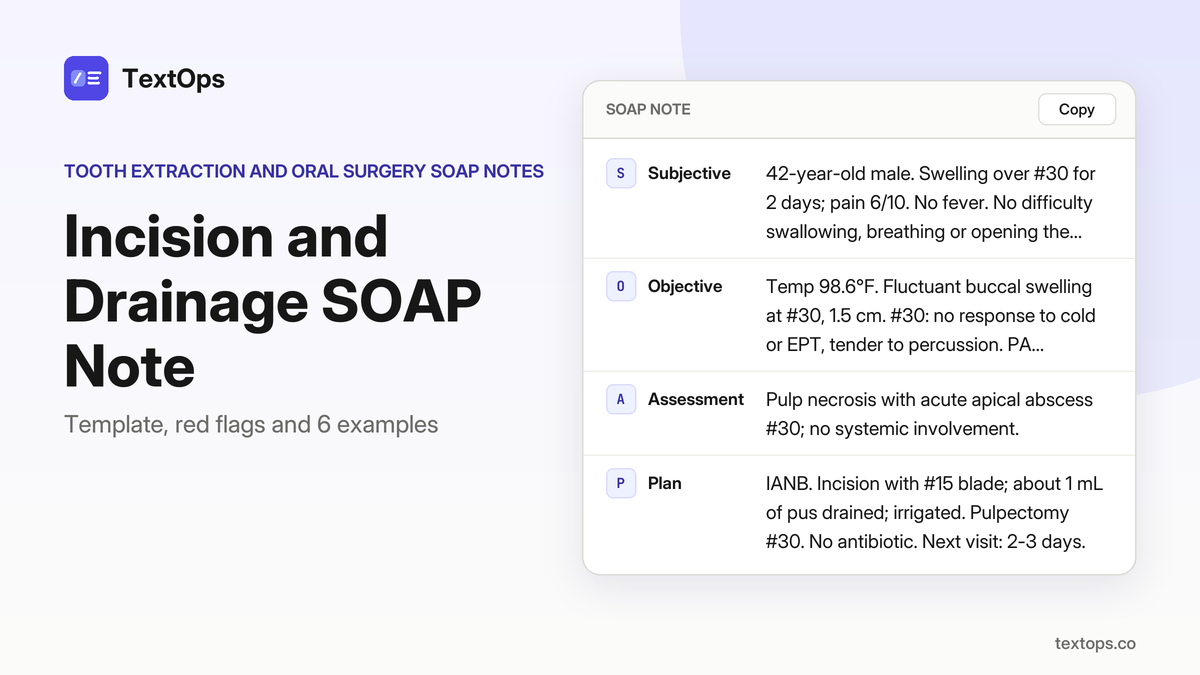
An incision and drainage (I&D) note for a dental abscess has to show where the infection came from, that you checked for signs of spread, what you drained, and how the source will be treated. This page gives you a copy-ready template, what to record in each section, the red flags that mean emergency referral instead of drainage in the chair, and six examples.
Teeth use Universal numbering (#1–32, A–T for primary teeth) and endodontic diagnoses follow the AAE terms. The patients are fictional: replace every finding with what you actually saw and did.
Incision and Drainage SOAP Note Template
Copy the template and fill in the fields in braces.
- Subjective
- {age}-year-old {sex}. CC: "{patient's words}". Swelling for {days}, {getting worse / stable}; pain {score}/10. Fever or chills: {yes / no}. Difficulty swallowing, breathing or opening the mouth: {none / describe}. Medical history: {diabetes, immunosuppression, heart conditions}. Medications: {list}. Allergies: {list, especially antibiotics}.
- Objective
- Temp {value}, pulse {value}. Extraoral: {swelling site and size, lymph nodes}. Mouth opening {mm}. Floor of mouth {soft / raised}. Intraoral: {fluctuant / indurated} swelling at {site}, {size}. Source: #{tooth} {pulp and periapical tests / periodontal findings}. Radiograph: {findings}.
- Assessment
- {Pulp and periapical diagnosis, e.g. pulp necrosis with acute apical abscess #…} / {periodontal abscess #…}{, with / without systemic involvement}.
- Plan
- Findings and options discussed. Consent obtained. Anesthesia: {technique away from the swelling}, {agent}, {mL}. Incision at {site} with {blade}; blunt dissection; {amount and character of pus} drained{; sample sent for culture}. Irrigated with saline. {No drain / drain placed and secured}. Source: {pulpectomy / extraction / periodontal debridement} {today / planned}. {Antibiotic only if systemic signs: agent, dose, duration}. Pain relief reviewed. Told to go to the emergency department if {red flags}. Next visit: {24–72 hours}.
Red Flags: Refer, Don’t Drain in the Chair
Record that you checked for these. Any of them means urgent referral to an oral and maxillofacial surgeon or the emergency department:
- Difficulty breathing or swallowing, drooling, or a change in voice
- Raised floor of the mouth or swelling under the tongue
- Swelling spreading below the jaw or to the neck, or toward the eye
- Severe trismus
- Fever with a rapid pulse, or a patient who looks unwell
- Immunosuppression with a spreading infection
What to Write in Each Section
Subjective
- How long the swelling has been there and whether it is getting worse.
- Systemic symptoms: fever, chills, feeling unwell.
- Airway symptoms, recorded as present or absent: difficulty breathing, swallowing or opening the mouth.
- Medical history that raises risk: diabetes, immunosuppression, and antibiotic allergies.
Objective
- Vital signs: at least temperature and pulse.
- Extraoral findings: swelling and its spread, lymph nodes, mouth opening in mm, and the floor of the mouth.
- The swelling: site, size, and whether it is fluctuant (ready to drain) or indurated.
- The source: the tooth and its pulp, periapical and periodontal tests, and the radiograph.
Assessment
Name the source and the abscess, using AAE terms for teeth (for example, pulp necrosis with acute apical abscess #30), or periodontal abscess, and say whether there is systemic involvement.
Plan
- Anesthesia: injected away from the infected tissue, such as a nerve block or infiltration around the edge of the swelling, since anesthetic works poorly in infected tissue.
- The drainage: where you cut, what came out, irrigation, and whether you placed a drain.
- The source: drainage alone doesn’t cure the infection. Record the pulpectomy, extraction or periodontal treatment done today or planned.
- Antibiotics: only as an adjunct when there are systemic signs or spreading infection. Record the agent, dose and duration, and why.
- Safety-net advice and a review within 24–72 hours.
Incision and Drainage SOAP Note Examples
| # | Example | Assessment |
|---|---|---|
| 1 | Localized abscess, no systemic signs | Acute apical abscess #30; no antibiotic |
| 2 | Abscess with fever | Acute apical abscess #8 with systemic involvement |
| 3 | Periodontal abscess | Periodontal abscess #3 |
| 4 | Child with a primary molar abscess | Acute apical abscess #T |
| 5 | Red flags: referred, not drained | Spreading infection from #18 |
| 6 | 48-hour review | Resolving abscess #8 |
1. Localized Abscess, No Systemic Signs
When the swelling is localized and the patient is well, drainage and treatment of the tooth are enough.
- Subjective
- 42-year-old male. CC: "My gum is swollen over my bottom right tooth." Swelling for 2 days, stable; pain 6/10. No fever or chills. No difficulty swallowing, breathing or opening the mouth. Medical history: none. Medications: ibuprofen. Allergies: NKDA.
- Objective
- Temp 98.6°F, pulse 76. No extraoral swelling; no lymphadenopathy. Mouth opening 45 mm; floor of mouth soft. Fluctuant buccal swelling at #30, 1.5 cm. #30: large restoration, no response to cold or EPT, tender to percussion and palpation. PA #30: periapical radiolucency at both roots.
- Assessment
- Pulp necrosis with acute apical abscess #30; no systemic involvement.
- Plan
- Findings and options discussed: I&D with root canal treatment, or I&D with extraction. Patient chose root canal treatment. Consent obtained. IANB, 2% lidocaine with 1:100,000 epinephrine, 1 cartridge (1.7 mL). Horizontal incision at the base of the swelling with a #15 blade; blunt dissection with a hemostat; about 1 mL of pus drained. Irrigated with saline. No drain. Pulpectomy #30; canals irrigated with NaOCl; calcium hydroxide; temporary filling. No antibiotic: localized, no systemic signs. Pain relief reviewed. Told to go to the emergency department if swallowing or breathing becomes difficult or the swelling spreads. Next visit: 2–3 days.
More examples: Irreversible Pulpitis SOAP Note.
2. Abscess with Fever
Fever and swelling beyond the vestibule are the systemic signs that justify an antibiotic alongside drainage.
- Subjective
- 35-year-old female. CC: "My upper lip is swollen and I feel feverish." Swelling for 2 days, getting worse; pain 7/10. Chills last night. No difficulty swallowing or breathing; no swelling near the eye. Medical history: none. Medications: none. Allergies: NKDA.
- Objective
- Temp 100.9°F, pulse 96. Upper lip swollen; tender submandibular lymph node on the right. No swelling near the eye. Mouth opening 42 mm. Fluctuant labial vestibular swelling at #8, 2 cm. #8: discolored, no response to cold or EPT, tender to percussion. PA #8: periapical radiolucency.
- Assessment
- Pulp necrosis with acute apical abscess #8, with systemic involvement (fever, lymphadenopathy).
- Plan
- Findings and options discussed. Consent obtained. Infiltration around the edge of the swelling, not into it, plus nasopalatine injection; 2% lidocaine with 1:100,000 epinephrine, 1.5 cartridges (2.6 mL). Incision at the most fluctuant point with a #15 blade; blunt dissection; about 2 mL of pus drained. Irrigated with saline. Rubber dam drain placed and secured with one suture, to be removed in 48 hours. Pulp chamber opened on #8; canal cleaned and calcium hydroxide placed; temporary filling. Amoxicillin prescribed because of fever and lymphadenopathy (dose and duration recorded). Pain relief reviewed. Told to go to the emergency department if swelling spreads toward the eye or swallowing or breathing becomes difficult. Next visit: 48 hours.
3. Periodontal Abscess
A periodontal abscess can often drain through the pocket. Record pulp tests to show the tooth is vital.
- Subjective
- 57-year-old male. CC: "My gum is swollen and bleeding on the upper right." Swelling for 3 days; pain 5/10. No fever. Medical history: type 2 diabetes, last HbA1c 8.1%. Medications: metformin. Allergies: NKDA.
- Objective
- Temp 98.8°F. No extraoral swelling. Fluctuant swelling on the buccal gingiva of #3, 1 cm. PD 8 mm buccal #3 with pus on probing; mobility grade I. #3 responds normally to cold; not tender to percussion. PA #3: vertical bone loss on the mesial; no periapical radiolucency.
- Assessment
- Periodontal abscess #3, in a patient with periodontitis and diabetes. Vital pulp.
- Plan
- Findings discussed. Consent obtained. Buccal and palatal infiltration, 2% lidocaine with 1:100,000 epinephrine, 1 cartridge (1.7 mL). Drained through the pocket; pocket debrided and irrigated with saline. No incision needed. No antibiotic: localized, no systemic signs. Advised on glucose control. Next visit: 1 week; full periodontal assessment to follow.
More examples: Periodontitis SOAP Note.
4. Child with a Primary Molar Abscess
For a child, record weight. Removing the primary tooth is often both the source treatment and the drainage.
- Subjective
- 7-year-old male, 24 kg, with mother. CC: "His gum has a bump and it hurts to chew." Swelling for 3 days. No fever. No difficulty swallowing or opening the mouth. Medical history: none. Allergies: NKDA.
- Objective
- Temp 98.6°F. No extraoral swelling. Fluctuant buccal swelling at #T. #T: large carious lesion into the pulp, mobile. PA #T: radiolucency in the furcation; developing #29 intact below.
- Assessment
- Pulp necrosis with acute apical abscess #T (primary tooth).
- Plan
- Options discussed with mother: extraction or pulpectomy. Mother chose extraction. Consent signed by mother. IANB, 2% lidocaine with 1:100,000 epinephrine, 0.9 mL (18 mg). Extraction #T; abscess drained through the socket; socket irrigated with saline. No antibiotic: localized, no systemic signs. Space maintainer discussed. Post-op instructions given to mother. Next visit: 1 week; space maintainer to be planned.
5. Red Flags: Referred, Not Drained
When red flags are present, the note should record the findings, the referral and how the patient got there.
- Subjective
- 29-year-old male. CC: "My jaw is swollen and it hurts to swallow." Swelling for 4 days, much worse today; pain 8/10. Fever and chills. Difficulty swallowing; no difficulty breathing. Medical history: none. Allergies: NKDA.
- Objective
- Temp 102.1°F, pulse 112. Firm swelling under the left side of the jaw, extending toward the neck. Mouth opening 18 mm. Floor of mouth raised on the left. Voice normal; no drooling. #18: large carious lesion; tender to percussion.
- Assessment
- Spreading odontogenic infection from #18, with trismus, dysphagia and a raised floor of the mouth. Possible airway risk.
- Plan
- Not drained in the dental chair. Findings and urgency explained. Oral and maxillofacial surgery on call contacted; patient sent to the hospital emergency department, accompanied by a family member. Referral letter with findings and radiograph given. No treatment provided here. Follow-up call tomorrow.
6. 48-Hour Review
At the review, record whether the swelling and systemic signs are settling, remove any drain, and confirm the plan for the source.
- Subjective
- 35-year-old female, 48 hours after I&D and pulp opening #8. Swelling much reduced; no fever since yesterday. Taking amoxicillin as prescribed.
- Objective
- Temp 98.4°F. Lip swelling resolved. Lymph node no longer tender. Drain in place; no further pus. #8 temporary filling intact.
- Assessment
- Resolving acute apical abscess #8.
- Plan
- Drain and suture removed. Finish the antibiotic course as prescribed. Next visit: 1 week to continue root canal treatment #8.
Codes
- CDT: D7510, incision and drainage of abscess, intraoral soft tissue. D7511, the same when complicated (involving drainage of multiple fascial spaces). D7520, extraoral.
- ICD-10-CM: K04.7, periapical abscess without sinus. K12.2, cellulitis and abscess of the mouth.
Mistakes to Avoid
- No record of red-flag checks. Write “no difficulty swallowing or breathing; floor of mouth soft; mouth opening 45 mm”, not just “swelling”.
- Drainage without a source plan. Record the pulpectomy, extraction or periodontal treatment.
- Antibiotics without a reason. If you prescribe one, the note should show the systemic signs that justify it.
- No vital signs. Temperature and pulse are part of judging spread.
- No safety-net advice or review date. Record what the patient should do if it gets worse, and when you will see them again.
Frequently Asked Questions
What should an incision and drainage SOAP note include?
Duration, systemic and airway symptoms, and allergies (S); vital signs, extraoral and intraoral findings, the source tooth and radiograph (O); the diagnosis and whether there is systemic involvement (A); and anesthesia, the incision, what drained, any drain, the source treatment, any antibiotic with its reason, safety-net advice and a review (P).
Do you always prescribe antibiotics after incision and drainage?
No. For a localized abscess in a healthy patient, drainage and treatment of the tooth are usually enough. Antibiotics are added when there are systemic signs such as fever or lymphadenopathy, a spreading infection, or a medically compromised patient.
When should a dental abscess not be drained in the office?
When there are red flags such as difficulty breathing or swallowing, a raised floor of the mouth, swelling spreading to the neck or eye, or severe trismus. Refer urgently instead.
Why inject away from the swelling?
Local anesthetic works poorly in infected, acidic tissue, and injecting into an abscess can spread infection. Use a nerve block or infiltrate around the edge of the swelling.
Do you suture an incision and drainage site?
No. The incision is left open so it can keep draining. If a drain is placed, a single suture may be used to hold it, and both are removed at the review.
For the general structure of a dental note, see the dental SOAP note template.
These examples show structure and wording only. The patients are fictional. Record what you actually found and did, and follow your practice’s documentation requirements and the rules where you work.