Gross debridement removes excessive plaque and calculus that obstruct a full periodontal assessment. It clears the mouth so probing, charting and diagnosis can be performed accurately. The procedure is often followed by a separate evaluation visit to document changes and plan further therapy. Fully populated, copy-paste SOAP notes for every common variation are provided, enabling clinicians to document each visit quickly and consistently.
First-Time Gross Debridement
Non-smoker, First Gross Debridement Visit
SOAP note
SSubjective
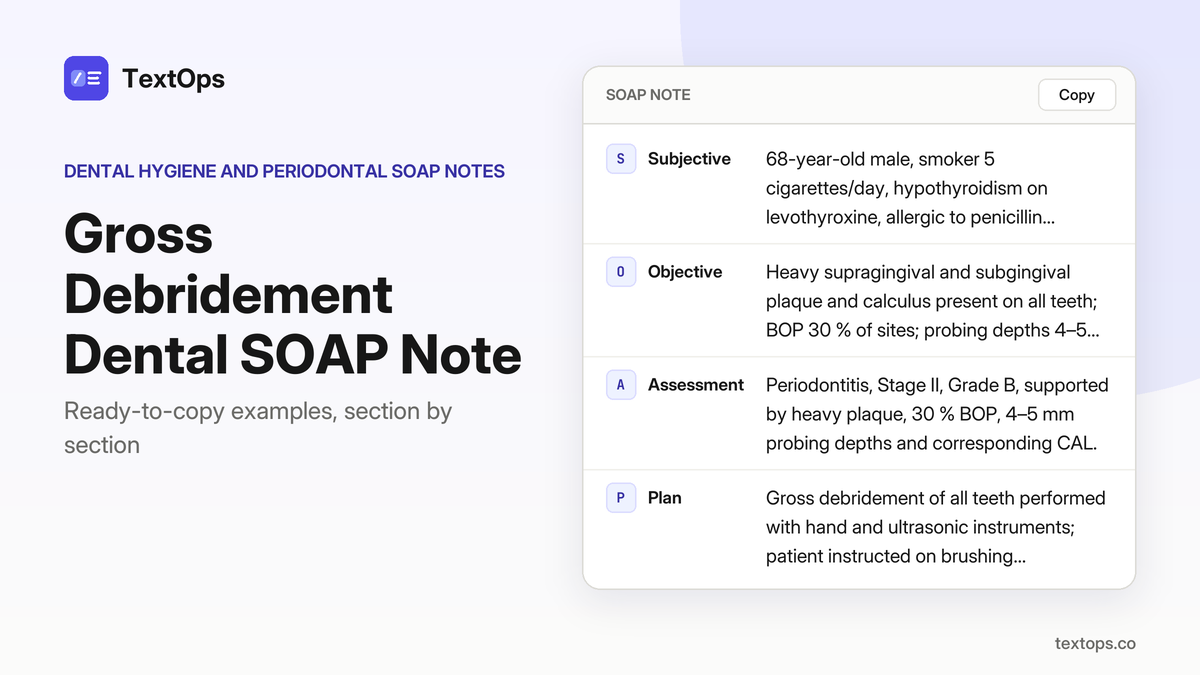
68-year-old male, smoker 5 cigarettes/day, hypothyroidism on levothyroxine, allergic to penicillin (rash); chief complaint: “Here for my first cleaning”; no systemic signs, no medication allergies beyond penicillin; no anesthesia requested.
OObjective
Heavy supragingival and subgingival plaque and calculus present on all teeth; BOP 30 % of sites; probing depths 4–5 mm on most teeth; CAL 4–5 mm; extraoral and intraoral examination otherwise within normal limits; no radiographs taken today.
AAssessment
Periodontitis, Stage II, Grade B, supported by heavy plaque, 30 % BOP, 4–5 mm probing depths and corresponding CAL.
PPlan
Gross debridement of all teeth performed with hand and ultrasonic instruments; patient instructed on brushing technique, interdental cleaning, and oral hygiene maintenance; advised to return for scaling and root planing in 4 weeks.
Gingival Recession, Gross Debridement with Soft Tissue Assessment
SOAP note
SSubjective
47-year-old former smoker female; CC: “I have noticed some gum recession”; HPI: reports gradual recession of upper right canine and lateral incisor; PMH: former smoker, NKDA; no systemic signs.
OObjective
Extraoral: normal; Intraoral: recession 3 mm on #15 and #16; PD 3 mm; BOP 20 % of sites; CAL 6 mm on #15 and #16; Radiographs: none taken; Tests: none.
AAssessment
Periodontitis, Stage I, Grade A; supported by 3 mm recession, 20 % BOP, 3 mm PD, 6 mm CAL on #15 and #16.
PPlan
Gross debridement of #15 and #16 performed; no anesthesia used; patient instructed to maintain daily brushing and flossing; scheduled periodontal maintenance in 3 months.
Dental Implant, Gross Debridement of Peri-implant Plaque
SOAP note
SSubjective
25-year-old female, NKDA, takes low-dose aspirin, reports “my implant feels a bit loose and there's plaque buildup.”
OObjective
Heavy plaque and calculus on implant #25; BOP 25 % of sites; PD 4 mm; CAL 4 mm; no systemic signs; no anesthesia used.
AAssessment
Peri-implant mucositis, supported by heavy plaque, BOP 25 %, PD 4 mm and CAL 4 mm on implant #25.
PPlan
Gross debridement of implant #25 surface performed; patient taught implant-specific cleaning technique; no drugs prescribed; next implant maintenance scheduled in 3 months.
Emergency, Gross Debridement of Acute Infection
SOAP note
SSubjective
76-year-old female, type 2 diabetes on metformin, NKDA; CC: “My lower right molar is swollen and very painful”; HPI: throbbing pain 8/10, relieved only by cold, swelling and erythema around #30, fever 38.5 °C, malaise; PMH: diabetes, no other meds.
OObjective
Extraoral: facial swelling; Intraoral: erythema and edema around #30; Periodontal: BOP 100 % of sites, PD 8 mm, suppuration present; Radiographic: periapical radiolucency at apex of #30; Vital signs: temperature 38.5 °C; Anesthesia: 2% lidocaine with 1:100,000 epinephrine, 1.8 mL (1 cartridge), IANB, aspiration negative.
AAssessment
Acute apical abscess of tooth #30, supported by deep pocket, suppuration, periapical radiolucency, systemic fever, and malaise.
PPlan
Incision and drainage of abscess performed; amoxicillin 500 mg PO, 3×/day for 7 days prescribed; patient advised to maintain oral hygiene and report any worsening pain or fever; next visit in 7 days for drainage site evaluation.
Periodontal Maintenance, Gross Debridement as Part of 3-Month Recall
SOAP note
SSubjective
49-year-old female, asthma on albuterol PRN, NKDA, chief complaint: “I just came for my routine cleaning”; no systemic signs.
OObjective
Extraoral normal; intraoral: plaque moderate; periodontal charting shows 15 % BOP, PD 3 mm, CAL 3 mm on #12-#13; radiographs not taken this visit.
AAssessment
Periodontitis, Stage I, Grade A, supported by 15 % BOP, PD 3 mm, CAL 3 mm.
PPlan
Gross debridement performed on #12-#13 without anesthesia; patient instructed on daily brushing, interdental cleaning; scheduled SRP in 4 weeks; no medications prescribed.
Post-Root Canal, Gross Debridement of Failing Tooth
SOAP note
SSubjective
67-year-old female, controlled hypertension on lisinopril, NKDA; CC: “My tooth still hurts after the root canal”; HPI: pain 7/10, throbbing, relieved by cold; swelling around #19; no systemic signs.
OObjective
Extraoral: swelling pericoronal; intraoral: bleeding on probing 80% of sites, probing depth 7 mm, suppuration present; periodontal charting consistent with severe inflammation; radiograph: radiolucency at apex of #19; no other findings.
AAssessment
Symptomatic apical periodontitis of tooth #19, supported by pain, swelling, deep probing, suppuration and apical radiolucency.
PPlan
Removal of failed root canal performed; 2% lidocaine with 1:100,000 epinephrine, 1.8 mL (1 cartridge), IANB, aspiration negative; postoperative instructions given; no medication prescribed; next visit scheduled for restoration evaluation.
Gingival Hyperplasia, Gross Debridement with Soft Tissue Evaluation
SOAP note
SSubjective
63-year-old female smoker, 5 cigarettes/day, NKDA, reports “My gums look thick and red”; history of gingival hyperplasia on tooth #9; no systemic signs.
OObjective
Extraoral normal. Intraoral: gingival hyperplasia covering tooth #9; BOP 30% of sites; PD 4 mm; CAL 4 mm; no mobility, no suppuration; radiograph not taken.
AAssessment
Periodontitis, Stage II, Grade B, supported by PD ≥ 4 mm, CAL 4 mm, BOP 30% and hyperplastic gingiva.
PPlan
Gross debridement performed on tooth #9; patient instructed on effective brushing and interdental cleaning; no drugs prescribed; advised to return for periodontal surgery in 6 weeks.
Post-Orthodontic Retainer, Gross Debridement with Plaque Index
SOAP note
SSubjective
29-year-old female with seasonal allergies, NKDA, reports “I have a lot of plaque around my retainer.” HPI: plaque accumulation noted on #22, no pain or swelling. PMH: seasonal allergies, no systemic disease.
OObjective
Plaque index 40% on #22; BOP 20% of sites; PD 3 mm; no extraoral or radiographic findings reported.
AAssessment
Periodontitis, Stage I, Grade A, supported by PD 3 mm, BOP 20%, plaque index 40%.
PPlan
Gross debridement of #22 performed without anesthesia; patient instructed on retainer hygiene and to avoid plaque accumulation; schedule maintenance visit in 3 months.
Gross Debridement for a Recent Dental Implant Placement
SOAP note
SSubjective
50-year-old female, no significant medical history, allergic to penicillin (rash); CC: “My new implant has plaque buildup”; HPI: implant placed recently, reports visible plaque and occasional bleeding; PMH: none; medications: none; allergies: penicillin rash.
OObjective
Extraoral: normal; Intraoral: implant at #27 with plaque and calculus on surface; BOP 20% of implant sites; PD 3 mm; periodontal chart shows healthy gingiva elsewhere; radiograph: implant in situ, no bone loss; tests: none.
AAssessment
Peri-implant mucositis, supported by plaque/calculus, BOP 20%, PD 3 mm, no bone loss.
PPlan
Gross debridement of implant surface performed; no anesthesia used; patient instructed on implant hygiene with interdental brush; advised to avoid smoking and maintain oral hygiene; scheduled implant maintenance in 3 months; POI given; no medications prescribed.
Medical Condition-Specific Gross Debridement
Pregnant, Gross Debridement with Local Anesthesia
SOAP note
SSubjective
24-year-old female patient, pregnant, NKDA, reports “I have a lot of gum bleeding and bad breath”; history shows heavy plaque accumulation and bleeding.
OObjective
Extraoral normal. Intraoral: heavy supragingival and subgingival calculus on tooth #20; BOP 70% of sites; PD 6 mm; plaque score 85%; radiograph shows mild bone loss around #20.
AAssessment
Periodontitis, Stage II, Grade B, supported by 6 mm probing depths, 70% BOP, heavy calculus, and radiographic bone loss.
PPlan
Full-mouth gross debridement performed under local anesthesia—2% lidocaine with 1:100,000 epinephrine, 1.8 mL infiltration, aspiration negative. Calculus removed supragingival and subgingival; gingival tissues irrigated with saline. Post-operative instructions given; no medications prescribed. Next visit scheduled for periodontal re-evaluation in 6 weeks.
Diabetic, Gross Debridement with Antibiotic Prophylaxis
SOAP note
SSubjective
55-year-old male, type 2 diabetes on metformin, hypothyroidism on levothyroxine, allergic to penicillin (rash); chief complaint: “My gums are swollen and I feel a bit feverish”; history of present illness: low-grade fever, heavy plaque and calculus on tooth #28; medical history: diabetes, hypothyroidism, penicillin allergy; medications: metformin, levothyroxine.
OObjective
Extraoral: temperature 99.4°F; intraoral: heavy calculus on #28, bleeding on probing 80% of sites, probing depth 7 mm, plaque score 90%; periodontal: moderate bone loss around #28 on radiograph; tests: none additional.
AAssessment
Periodontitis, Stage III, Grade C, supported by 7 mm PD, 80% BOP, heavy calculus, plaque score 90%, moderate bone loss and low-grade fever.
PPlan
Gross debridement of #28 performed under 2% lidocaine with 1:100,000 epinephrine, 1.8 mL infiltration, aspiration negative. Prescribed clindamycin 300 mg PO q12 h for 7 days as antibiotic prophylaxis; instructed on oral hygiene and to return for periodontal re-evaluation in 6 weeks.
Anticoagulated, Gross Debridement with Hemostasis
SOAP note
SSubjective
64-year-old male, former smoker, NKDA, reports “My gums bleed a lot when I brush.” Heavy calculus on tooth #31, bleeding on probing 75 % of sites, probing depth 6.5 mm, plaque score 88 %, mild bone loss on radiograph.
OObjective
Extraoral: normal. Intraoral: heavy supragingival calculus on #31, erythematous gingiva, BOP 75 %, PD 6.5 mm. Periodontal chart: CAL 6.5 mm, BOP 75 %. Radiograph: mild horizontal bone loss around #31. No systemic signs.
AAssessment
Periodontitis, Stage II, Grade B, supported by heavy calculus, BOP >70 %, PD ≥6 mm, and radiographic bone loss.
PPlan
Gross debridement of #31 performed under 2% lidocaine with 1:100,000 epinephrine, 1.8 mL IANB. Hemostasis achieved with saline irrigation and pressure. No medications prescribed. Post-operative instructions: maintain oral hygiene, avoid vigorous brushing for 48 h, return for reevaluation in 6 weeks.
Allergic to Benzocaine, Gross Debridement with Alternative Topical
SOAP note
SSubjective
52-year-old male, NKDA, chief complaint “My gums hurt and bleed when I floss,” heavy calculus on tooth #23, 80% BOP, 6 mm PD, mild bone loss on radiograph, takes low-dose aspirin.
OObjective
Extraoral WNL. Intraoral: heavy calculus on #23, BOP 70%, PD 6 mm, plaque 80%. Radiograph: mild bone loss around #23.
AAssessment
Periodontitis, Stage I, Grade A, supported by heavy calculus, 70% BOP, 6 mm PD, mild bone loss.
PPlan
Gross debridement of #23 performed with 4% prilocaine plain, 1.8 mL infiltration, aspiration negative. Post-operative instructions given. No medication prescribed.
Pregnancy, Gross Debridement with Chlorhexidine Rinse
SOAP note
SSubjective
72-year-old female, pregnant, type 2 diabetes on metformin, NKDA, reports “bad breath and my gums bleed.” HPI: heavy calculus on tooth #18, bleeding on probing 65% of sites, PD 5.5 mm, plaque score 82%; radiograph shows mild bone loss around #18.
OObjective
Extraoral normal. Intraoral: heavy supragingival calculus on #18, BOP 65%, PD 5.5 mm, CAL 5.5 mm. Periodontal charting consistent with Stage I, Grade A periodontitis. Radiograph: mild bone loss around #18.
AAssessment
Periodontitis, Stage I, Grade A, supported by PD 5.5 mm, BOP 65%, heavy calculus, mild bone loss.
PPlan
Gross debridement of #18 performed under 2% lidocaine with 1:100,000 epinephrine, 1.8 mL IANB, aspiration negative. Prescribed chlorhexidine gluconate 0.12% rinse 15 mL, 30 sec, twice daily for 7 days. Instructed on rinsing technique, avoid brushing the area for 24 h, and return for reevaluation in 6 weeks.
Allergy to Penicillin, Gross Debridement with Clindamycin
SOAP note
SSubjective
19-year-old female, asthma, allergic to penicillin (rash) and clindamycin (rash). CC: “My gums bleed and I feel a little feverish.” HPI: heavy calculus on tooth #11, BOP 70 % of sites, PD 6 mm, plaque score 85 %, temp 99.6 °F. PMH: asthma, albuterol PRN, no other drug allergies.
OObjective
Extraoral: no facial swelling. Intraoral: heavy supragingival and subgingival calculus on #11, erythematous gingiva, BOP 70 %. Periodontal: PD 6 mm at all sites, CAL consistent with Stage II. Radiograph: moderate bone loss around #11. Vital signs: temp 99.6 °F, pulse 78 bpm.
AAssessment
Periodontitis, Stage II, Grade B, supported by PD 6 mm, BOP 70 %, plaque 85 %, moderate bone loss, low-grade fever.
PPlan
Gross debridement of #11 performed under 2% lidocaine with 1:100,000 epinephrine, 1.8 mL infiltration; aspiration negative. No antibiotics due to dual allergy. POI: maintain oral hygiene, avoid brushing the area for 24 h, report any worsening pain or swelling. RTC in 4 weeks for periodontal re-evaluation.
Gross Debridement in a Patient with Sjögren’s Syndrome
SOAP note
SSubjective
38-year-old male, controlled hypertension on lisinopril, NKDA, reports “My gums bleed a lot and I have dry mouth.” History: heavy calculus on tooth #16, bleeding on probing 80 % of sites, probing depth 7 mm, plaque score 90 %.
OObjective
Extraoral normal; intraoral heavy calculus on #16, BOP 80 %, PD 7 mm, moderate bone loss on periapical radiograph; dry mouth noted.
AAssessment
Periodontitis, Stage III, Grade C, supported by 7 mm probing depth, 80 % BOP, 90 % plaque, moderate bone loss.
PPlan
Gross debridement of #16 performed under 2 % lidocaine with 1:100,000 epinephrine, 1.8 mL infiltration; aspiration negative. Post-op: chlorhexidine gluconate 0.12 % rinse, 15 mL for 30 sec twice daily for 7 days to aid plaque control; patient instructed on oral hygiene and to report worsening bleeding. Next visit: periodontal re-evaluation in 6 weeks.
Special Situations and Emergency Debridement
Dental Implant, Gross Debridement with Implant-Safe Instruments
SOAP note
SSubjective
58-year-old male smoker, NKDA, reports “a lot of gum swelling around my lower right molar and it hurts when I bite.” HPI: swelling and pain on biting, no systemic symptoms. PMH: smoking 5 cigarettes/day, no other conditions.
OObjective
Extraoral: no facial asymmetry. Intraoral: heavy supragingival and subgingival plaque and calculus on implant #30. Periodontal: BOP 30%, PD 5 mm, no suppuration. Radiograph: mild peri-implant bone loss, no radiolucency.
AAssessment
Peri-implant mucositis, supported by BOP 30%, PD 5 mm, heavy plaque, and radiographic bone loss.
PPlan
2% lidocaine with 1:100,000 epinephrine, 1.8 mL IANB for anesthesia. Implant-safe debridement performed with curette and ultrasonic scaler, irrigated with saline. Applied chlorhexidine 0.12% rinse; provided oral hygiene instruction. Scheduled maintenance visit in 4 weeks.
Anticoagulated, Gross Debridement with Hemostatic Gel
SOAP note
SSubjective
51-year-old male, warfarin 5 mg daily, seasonal allergies, NKDA; CC: “My gums are swollen and bleeding a lot, and I’m worried about bleeding because of my blood thinner.” HPI: heavy plaque on #15-#16, PD 6 mm, BOP 40 %, mild suppuration, no systemic signs.
OObjective
Extraoral: no facial swelling; Intraoral: heavy plaque and calculus on #15-#16, PD 6 mm, BOP 40 %, mild suppuration; Periodontal chart: generalized bone loss on radiograph, no abscess; Tests: none.
AAssessment
Periodontitis, Stage III, Grade C, supported by PD 6 mm, BOP 40 %, heavy calculus, generalized bone loss.
PPlan
Gross debridement with hand curettes and ultrasonic scaler; 2% lidocaine with 1:100,000 epinephrine, 1.8 mL buccal infiltration; hemostatic gel (oxidized regenerated cellulose) applied to control bleeding; chlorhexidine 0.12% rinse 15 mL 30 sec twice daily; oral hygiene instruction; next visit in 2 weeks for reassessment.
Emergency Gross Debridement for Acute Pericoronitis
SOAP note
SSubjective
69-year-old female, no significant medical history, allergic to penicillin; CC: “My lower right wisdom tooth hurts a lot and the area is swollen.” HPI: acute pain, swelling, mild malaise, temperature 99.5 °F.
OObjective
Extraoral: erythematous swelling around follicular area of #30. Intraoral: PD 8 mm, BOP, purulent drainage. Radiograph: pericoronitis, no abscess cavity. Vital sign: 99.5 °F.
AAssessment
Acute pericoronitis with systemic signs of low-grade fever and malaise, supported by deep pocket, BOP, purulent drainage, and radiographic evidence.
PPlan
2% lidocaine with 1:100,000 epinephrine, 1.8 mL (1 cartridge), IANB; incision and drainage of pericoronal space, removal of debris, curettage. Prescribed clindamycin 300 mg QID for 7 days, ibuprofen 400 mg PRN for pain, chlorhexidine 0.12% rinse 15 mL 30 sec twice daily. Oral hygiene instruction given. RTC in 1 week for reassessment.
Healing Socket Debridement
Post-Extraction, Gross Debridement of Healing Socket
SOAP note
SSubjective
77-year-old female, no significant medical history, NKDA, reports “I have a sore socket after the extraction”; history of no systemic signs.
OObjective
Extraoral: mild erythema over the socket; intraoral: socket shows mild erythema, no suppuration, no bleeding on probing; probing depth 2 mm, no mobility; radiograph: complete extraction of #30, no residual bone fragments; periodontal charting normal.
AAssessment
Healing socket, no infection, supported by erythema without suppuration, 2 mm probing depth, and clear radiograph.
PPlan
Gross debridement of the socket performed; irrigation with sterile saline; sutures removed; no drugs prescribed. Patient instructed to rinse with warm salt water twice daily, avoid smoking, maintain soft diet, report any increase in pain or swelling; next visit in 7 days for healing assessment.
Post-Extraction, Gross Debridement of Healing Socket with Antibiotics
SOAP note
SSubjective
60-year-old female, hypothyroidism on levothyroxine, allergic to penicillin (rash); chief complaint: “My socket feels sore and I’m worried about infection”; no systemic signs.
OObjective
Socket #15 shows mild bleeding, no suppuration; probing depth 3 mm, no mobility; radiograph confirms complete extraction, no residual bone fragments; extraoral and intraoral otherwise normal.
AAssessment
Healing socket with risk of infection, supported by mild bleeding, probing depth, and patient anxiety.
PPlan
Gross debridement of the socket performed; irrigated with sterile saline; prescribed clindamycin 300 mg four times daily for 7 days; instructed to avoid smoking and report fever or increased pain; next visit in 7 days for reassessment.
Post-Extraction, Gross Debridement of Healing Socket with Chlorhexidine
SOAP note
SSubjective
61-year-old male, former smoker, NKDA, reports “My socket is still red and sore”; no systemic signs, no pain noted beyond mild soreness.
OObjective
Socket #28 shows slight erythema, 2 mm probing depth, no mobility, no suppuration; radiograph confirms complete extraction with no residual bone fragments; sterile saline irrigation performed.
AAssessment
Healing socket, supported by erythema, shallow probing depth, absence of suppuration or mobility, and radiographic confirmation of complete extraction.
PPlan
Gross debridement of socket performed, irrigated with sterile saline; prescribe chlorhexidine gluconate 0.12% rinse 15 mL for 30 seconds, twice daily for 7 days; advise avoid smoking, maintain oral hygiene, return if pain worsens or swelling develops.
Post-Surgery, Gross Debridement of Healing Flap with Antibiotics
SOAP note
SSubjective
75-year-old male, takes low-dose aspirin, NKDA, reports “my flap is still sore and I’m concerned about infection.”
OObjective
Flap debrided, mild bleeding, no suppuration; probing depth 4 mm, no mobility; radiograph shows complete flap surgery, no bone loss.
AAssessment
Healing flap, risk of infection, supported by mild bleeding, 4 mm probing depth and patient’s concern.
PPlan
Gross debridement of the flap performed, irrigation with sterile saline, prescribe amoxicillin 500 mg PO three times daily for 7 days; advise to avoid trauma to the site, maintain oral hygiene, report any fever or increasing pain; next visit in 7 days for reassessment.
Post-Extraction, Gross Debridement of Healing Socket with Local Anesthesia
SOAP note
SSubjective
40-year-old male, type 2 diabetes on metformin, NKDA, reports “My socket hurts after the extraction”; history of extraction of tooth #10 with mild socket erythema, no suppuration, probing depth 2 mm, no mobility, radiograph shows complete extraction, no residual bone fragments; PMH uncomplicated except diabetes.
OObjective
Extraoral exam normal; intraoral shows healing socket at tooth #10 with mild erythema, no suppuration; periodontal probing depth 2 mm, no mobility; radiograph confirms complete extraction, no bone fragments; no systemic signs.
AAssessment
Healing socket, uncomplicated post-extraction with mild erythema and 2 mm probing depth, no infection or mobility.
PPlan
Gross debridement of the socket performed under 2% lidocaine with 1:100,000 epinephrine, 1.8 mL buccal infiltration; socket irrigated with sterile saline; no drugs prescribed; instructed to rinse with sterile saline, avoid hard foods for 48 h, monitor for increased pain or swelling; next visit scheduled in 2 weeks for reassessment.
Post-Extraction, Gross Debridement of Healing Socket with Pain Management
SOAP note
SSubjective
44-year-old female, asthma, NKDA, CC: "My socket is sore and I need pain relief," HPI: post-extraction soreness, no systemic symptoms.
OObjective
Socket shows mild bleeding, no suppuration; PD 3 mm, no mobility; radiograph: complete extraction, no residual bone fragments; anesthesia: none.
AAssessment
Healing socket, supported by mild bleeding, 3 mm probing depth, absence of suppuration or mobility.
PPlan
Gross debridement of socket, irrigation with sterile saline; prescribe ibuprofen 400 mg PO q6h PRN for 5 days; advise avoid hard foods, maintain oral hygiene with gentle rinses, return if pain worsens or bleeding persists.
Post-Extraction, Gross Debridement of Healing Socket with Anticoagulant Management
SOAP note
SSubjective
28-year-old male, controlled hypertension on lisinopril, NKDA, reports a sore spot after extraction of tooth #30 and that bleeding has not stopped.
OObjective
Extraction site shows a fresh clot, no exposed bone; PD 0 mm, BOP negative, no suppuration; vital signs WNL, no fever, no trismus. 2% lidocaine with 1:100,000 epinephrine, 1.8 mL (1 cartridge), IANB, aspiration negative.
AAssessment
Healing socket, no infection, managed with anticoagulant precautions.
PPlan
Gross debridement of the healing socket performed; site irrigated with sterile saline, clot protected with gauze, patient instructed to keep gauze in place for 30 min. No medications prescribed. Patient advised to avoid rinsing or spitting for 24 h, to use a soft toothbrush, and to report any increased pain, bleeding, or swelling. Next visit: 7-day follow-up to assess healing and ensure resolution of symptoms.
Post-Extraction, Gross Debridement of Healing Socket with Antibiotic Prophylaxis
SOAP note
SSubjective
42-year-old male, smoker 5 cigarettes/day, NKDA, reports “I had my molar pulled yesterday and I'm worried about infection.” History: extraction of tooth #15 yesterday, no pain or swelling. PMH: smoking only.
OObjective
Extraction site shows firm clot, no exposed bone; PD 0 mm, BOP negative; no suppuration; vital signs WNL, no fever, no trismus.
AAssessment
Healing socket, risk of infection.
PPlan
Gross debridement of healing socket performed; irrigated with sterile saline. 2% lidocaine with 1:100,000 epinephrine, 1.8 mL buccal infiltration, aspiration negative. Patient prescribed amoxicillin 500 mg PO q8h for 5 days. Instructed to maintain oral hygiene, avoid rinsing vigorously, report fever or swelling. RTC in 7 days for healing assessment.
Post-Extraction, Gross Debridement of Healing Socket with Chlorhexidine Rinse
SOAP note
SSubjective
71-year-old male, seasonal allergies, NKDA, reports “My tooth was removed and I want to keep it clean.” Extraction of tooth #28 was performed previously; no pain or swelling now.
OObjective
Extraction site shows a stable clot, no exposed bone; PD 0 mm, BOP negative; no suppuration; vital signs WNL, no fever, no trismus.
AAssessment
Healing socket, evidenced by intact clot, absence of bone exposure or infection, and normal vital signs.
PPlan
Gross debridement of the healing socket performed; site irrigated with sterile saline. 2% lidocaine with 1:100,000 epinephrine, 1.8 mL (1 cartridge), IANB, aspiration negative. Patient instructed to rinse with 15 mL 0.12% chlorhexidine for 30 s twice daily for 7 days; no medications prescribed. Next visit in 7 days for socket evaluation.
Post-Extraction, Gross Debridement of Healing Socket with Bisphosphonate Monitoring
SOAP note
SSubjective
74-year-old female, allergic to penicillin (rash); chief complaint: “I had my tooth pulled and I'm concerned about bone loss.” History: extraction of tooth #20 completed; no pain. O: Extraction site shows clot, no exposed bone; PD 0 mm, BOP negative; no suppuration; vital signs WNL; no fever; no trismus. A: Healing socket, evidenced by intact clot, absence of bone exposure, negative BOP, and no suppuration. P: Gross debridement of the healing socket performed under 2% lidocaine with 1:100,000 epinephrine, 1.8 mL (1 cartridge), IANB; irrigated with sterile saline; no medications prescribed. Patient advised to avoid hard foods, report new pain or swelling, and maintain gentle oral hygiene. Follow-up scheduled in 7 days to assess healing.
Gross Debridement for a Patient with Recent Dental Trauma
SOAP note
SSubjective
53-year-old male, NKDA, reports “I fell and my tooth popped out, I need it cleaned.” He has no significant medical history and denies fever or trismus.
OObjective
Fresh clot present at extraction site of tooth #12, PD 0 mm, BOP negative, no suppuration. Vital signs WNL, no exposed bone.
AAssessment
Healing socket, supported by absence of infection, normal clot, and negative probing.
PPlan
Gross debridement of the healing socket performed; 2% lidocaine with 1:100,000 epinephrine, 1.8 mL buccal infiltration, aspiration negative. Socket irrigated with sterile saline. Patient instructed to keep gauze in place for 30 min, avoid chewing on that side, and return for follow-up in 7 days.
Healing Flap/Surgery Debridement
Periodontal Abscess, Gross Debridement and Drainage
SOAP note
SSubjective
21-year-old male, hypothyroidism on levothyroxine, allergic to penicillin (rash); chief complaint: “I have a big sore in my lower back tooth and it hurts when I bite”; mild fever 99.5 °F, malaise.
OObjective
Pockets 12 mm buccal and lingual on tooth #30, bleeding on probing, purulent exudate from surgical flap, buccal mucosal swelling; periapical radiolucency on PA radiograph; IANB with 2% lidocaine + 1:100,000 epinephrine, 1.8 mL administered.
AAssessment
Acute periodontal abscess on tooth #30, supported by deep pockets, purulent exudate, radiolucency, and systemic signs of infection.
PPlan
Gross debridement of the flap, drainage of pus, curettage of granulation tissue, irrigation with sterile saline, suturing of the flap; prescribed clindamycin 300 mg q8h for 5 days; chlorhexidine 0.12 % rinse 15 mL for 30 s twice daily; advised oral hygiene, return in 7 days for suture removal and healing assessment.
Post-Surgery, Gross Debridement of Healing Flap
SOAP note
SSubjective
32-year-old female, former smoker, NKDA; CC: “My mouth feels raw after the surgery, and I want to make sure it heals.” HPI: postoperative discomfort after flap surgery on tooth #15; no systemic symptoms.
OObjective
Flap healing noted; mild erythema present, no suppuration. Pocket depth 4 mm, BOP 10 %.
AAssessment
Healing flap, no infection, supported by mild erythema, pocket depth 4 mm, and absence of suppuration.
PPlan
Gross debridement of the flap performed, debris removed, irrigation with sterile saline; sutures left in place. No drugs prescribed. Oral hygiene instructions given; patient advised to avoid brushing the flap for 48 h and to use a soft brush thereafter. Return to clinic in 2 weeks for flap assessment.
Post-Sedation, Gross Debridement with Minimal Anesthesia
SOAP note
SSubjective
65-year-old female, takes low-dose aspirin, NKDA, reports “I feel a bit sore after the sedation, but I think the area is clean.”
OObjective
Flap healing over tooth #28, mild erythema, no suppuration; pocket depth 5 mm, bleeding on probing 15 %; no systemic signs; no anesthesia used.
AAssessment
Healing flap, no infection, supported by mild erythema, normal pocket depth, and absence of suppuration.
PPlan
Gross debridement with minimal anesthesia performed; irrigated with sterile saline, sutures reviewed; prescribed ibuprofen 400 mg PO q6 h PRN, up to 3 days; advised to avoid heavy chewing, maintain oral hygiene, and return if pain worsens or swelling develops.
Post-Surgery, Gross Debridement of Healing Flap with Sutures
SOAP note
SSubjective
41-year-old female, type 2 diabetes on metformin, NKDA; CC: “My gums are still swollen after the surgery, can you clean them?”; HPI: post-surgery swelling, no systemic symptoms.
Healing flap with risk of infection, supported by 6 mm pocket, 20 % BOP and erythema.
PPlan
Gross debridement performed; sutures left in place; irrigation with sterile saline; chlorhexidine 0.12 % rinse 15 mL for 30 s twice daily for 7 days; glycemic control advice given; next visit in 2 weeks for suture removal and healing assessment.
Gross Debridement for a Patient with a History of Periodontal Surgery
SOAP note
SSubjective
30-year-old female, asthma, NKDA; CC: “I have a sore spot near my upper canine after my last surgery, can you clean it?”; HPI: sore spot post-periodontal surgery, no systemic symptoms; PMH: asthma, albuterol PRN; allergies: NKDA.
OObjective
Flap healing observed; pocket depth 7 mm at tooth #6; BOP 25 %; mild suppuration present; PA shows slight bone loss; no extraoral findings noted.
AAssessment
Periodontal abscess, acute – supported by 7 mm pocket, BOP 25 %, suppuration, and radiographic bone loss.
PPlan
Gross debridement performed with 4% articaine 1:200,000, 1.8 mL buccal infiltration; pus drained, curetted, irrigated with sterile saline; sutures removed; chlorhexidine 0.12 % rinse 15 mL for 30 s twice daily; no medication prescribed; next visit in 2 weeks for healing assessment.
Orthodontic and Trauma Debridement
Post-Orthodontic Retainer, Gross Debridement
SOAP note
SSubjective
45-year-old male, controlled hypertension on lisinopril, NKDA, reports “My retainer is loose and there's a lot of plaque buildup.” History: orthodontic retainer placed 6 months ago; no pain, no swelling.
OObjective
Extraoral: normal. Intraoral: heavy supragingival plaque and subgingival calculus on buccal surface of tooth #22. Periodontal: probing depth 4 mm at buccal and mesial sites, bleeding on probing present, no suppuration, no mobility. Radiograph: no periapical pathology.
AAssessment
Periodontitis, Stage I, Grade A, supported by PD 4 mm, BOP, heavy plaque and calculus, normal radiograph.
PPlan
Gross debridement of tooth #22 performed; plaque and calculus removed with hand curettes and ultrasonic scaler; 5 % sodium fluoride varnish applied to cleaned surfaces. No anesthesia or medications used. Patient instructed to maintain daily brushing with floss and use a soft-bristle brush around the retainer; advised to return in 4 weeks for periodontal re-evaluation.
Dental Trauma, Gross Debridement of Fractured Tooth
SOAP note
SSubjective
81-year-old male, smoker 5 cigarettes/day, NKDA, says “I fell and the front tooth cracked.” History: no pain, no swelling, no mobility.
OObjective
Tooth #7 shows an oblique enamel-outer dentin fracture, no pulpal exposure, PD 2 mm mesial and distal, no BOP; radiograph shows no root fracture or periapical radiolucency. Extraoral and intraoral otherwise unremarkable.
AAssessment
Dental trauma, fractured tooth #7, pulpal status normal, supported by fracture line, intact periodontal probing and absence of periapical pathology.
PPlan
Gross debridement of fractured surfaces performed, composite restoration placed on tooth #7, no anesthesia used, patient instructed to avoid hard foods for 24 h, maintain oral hygiene, and return in 1 week for restoration check.
Gross Debridement in a Patient with Recent Orthodontic Bonding
SOAP note
SSubjective
79-year-old male, seasonal allergies, NKDA, reports “After bonding, my lower front teeth feel gritty and there's plaque.”
OObjective
Heavy supragingival plaque on bonding surfaces of teeth #15 and #16; mild gingival inflammation, pocket depths 3 mm mesial and distal, BOP present; no suppuration, no mobility; radiograph shows no periapical pathology.
AAssessment
Periodontitis, Stage I, Grade A, supported by pocket depths of 3 mm, BOP, and heavy plaque on bonded surfaces.
PPlan
Gross debridement of bonding surfaces with ultrasonic scaler and hand curettes, polishing of bonding with rubber cup, application of 5 % sodium fluoride varnish to #15-#16; no anesthesia or medications used; patient instructed to maintain oral hygiene, avoid hard foods for 24 h, and return for routine recall in 3 months.
Follow-Up Gross Debridement
Smoker, Follow-up Gross Debridement
SOAP note
SSubjective
56-year-old male, smoker 5 cigarettes/day, allergic to penicillin (rash). Chief complaint: “I’m back for a follow-up after my last cleaning.” History: no systemic signs, no acute pain.
OObjective
Heavy supragingival and subgingival calculus present in all quadrants. Probing depths 4–6 mm on 30 % of sites; Bleeding on probing 25 % of sites; Plaque score 60 %. No suppuration or swelling. Panoramic radiograph shows mild bone loss around molars; no acute pathology noted.
AAssessment
Periodontitis, Stage II, Grade C, supported by pocket depths >4 mm, high BOP, heavy calculus, and radiographic bone loss.
PPlan
Re-debridement of remaining calculus performed; oral hygiene instructions reinforced; patient advised to maintain daily brushing with interdental aids and to schedule a periodontal referral if pockets persist. No anesthesia or medications used. Next visit: periodontal evaluation in 4 weeks.
Re-evaluation, Gross Debridement After 6 Weeks
SOAP note
SSubjective
39-year-old female, no significant medical history, NKDA, states “I’m here for my 6-week check after the scaling and root planing.”
OObjective
Plaque score 30%; probing depths 3–4 mm on 20% of sites; BOP 10% of sites; no suppuration; radiograph shows stable bone levels; no acute pathology.
AAssessment
Periodontitis, Stage I, Grade A, supported by reduced plaque, shallow probing depths, low BOP, and stable bone.
PPlan
Completed remaining scaling and root planing; no anesthesia used; no drugs prescribed; instructed on oral hygiene, advised to return for periodontal maintenance in 3 months.
Definition and Scope of Gross Debridement
Gross debridement is a full-mouth plaque and calculus removal performed when accumulated deposits impede a thorough periodontal assessment. The procedure differs from prophylaxis, which targets healthy gingiva or mild gingivitis, and from scaling and root planing (SRP), which selectively removes subgingival calculus in periodontitis pockets. Gross debridement is indicated when plaque or calculus coverage is so extensive that probing, charting, or diagnosis would be unreliable. Typical triggers include a first visit for a patient with generalized heavy plaque, a post-extraction or implant site with significant plaque accumulation, or a patient presenting with acute infection where full clearance is needed before definitive therapy. The procedure precedes a comprehensive periodontal evaluation, ensuring accurate probing depths, bleeding on probing, and attachment level measurements.
SOAP Note Structure for Gross Debridement
Subjective (S)
S: Patient reports “heavy plaque buildup” and “difficulty brushing.”
S: HPI notes that symptoms began 2 weeks ago, with no pain or swelling.
S: PMH includes hypertension, controlled with amlodipine; NKDA.
S: Tobacco use is none; patient is non-smoker.
S: No recent travel or illness; vital signs WNL.
Objective (O)
O: Extraoral exam shows no facial swelling or lymphadenopathy.
O: Intraoral exam reveals generalized supragingival calculus, plaque index 70 %, BOP 25 %.
O: Probing depths: 3 mm maxillary incisors, 4 mm molars; no suppuration.
O: Radiographs: PA of #15 shows no periapical pathology; panoramic shows no bone loss.
O: Vital signs: BP 128/78 mmHg, HR 72 bpm, Temp 98.6 °F.
Assessment (A)
A: Generalized plaque-induced gingivitis, Stage I, Grade A.
A: No periodontal pockets >4 mm; no attachment loss.
A: No active infection or systemic involvement.
A: Patient’s oral hygiene inadequate, requiring full-mouth debridement.
Plan (P)
P: Perform gross debridement of all teeth, removing supragingival calculus and plaque.
P: Apply 0.12 % chlorhexidine rinse, 15 mL, 30 s, twice daily for 7 days.
P: Instruct patient on brushing technique and interdental cleaning.
P: Schedule re-evaluation in 4 weeks to chart PD, BOP, and plaque index.
P: No medication prescribed today.
Variations in the Note Based on Clinical Factors
Use local anesthesia when the patient reports pain or when the debridement extends beyond the buccal vestibule; note the agent, volume, and technique in the Objective, and add “anesthesia administered” to the Plan. When gingival bleeding or infection is present, document the extent of bleeding on probing and suppuration in the Objective, and include a hemostatic or antibiotic directive in the Plan. Gross debridement that differs from selective scaling and root planing should list the full-mouth plaque index and the absence of subgingival calculus removal in the Objective, and state that the visit is a preliminary clearance before a definitive periodontal evaluation in the Plan. In diabetic patients, record HbA1c or mention diabetes in the Subjective, add a prophylactic antibiotic in the Plan, and note monitoring for healing in the Objective. Anticoagulated patients require a hemostatic gel or gauze in the Objective and a hemostasis protocol in the Plan. For implant sites, record implant-safe instruments in the Objective and specify implant-specific charting in the Plan. Acute infections warrant a note of suppuration in the Objective and an antibiotic prescription in the Plan. Healing sockets or flaps need the socket status or flap description in the Objective and a postoperative chlorhexidine rinse in the Plan. Orthodontic appliances call for appliance stability assessment in the Objective and a reminder to maintain appliance hygiene in the Plan. Follow-up visits should list the interval, the purpose (re-evaluation of probing depths, BOP, plaque index), and any changes in treatment in the Plan.
These examples show structure and wording only. Record what you actually found and did, and follow your practice’s documentation requirements.
Dr. Rahul Joshi is a Specialist Orthodontist with extensive clinical experience in orthodontics, dentofacial orthopaedics, and dental aesthetics. Holding a Master of Dental Surgery (MDS) in Orthodontics and Dentofacial Orthopaedics and a Bachelor of Dental Surgery (BDS) from Manipal Academy of Higher Education, he brings expertise in orthodontic treatment planning, teeth alignment, and Invisalign treatment. With professional experience across India and the Netherlands, Dr. Joshi combines clinical knowledge with practical experience in orthodontic care, dental aesthetics, and improving patients' oral health.
Master of Dental Surgery (MDS) in Orthodontics and Dentofacial Orthopaedics — Manipal Academy of Higher Education
Bachelor of Dental Surgery (BDS) — Manipal Academy of Higher Education
Stop retyping your templates
Save any template to TextOps once, then insert it anywhere on the web without retyping. Share it with your team so everyone uses the same wording.