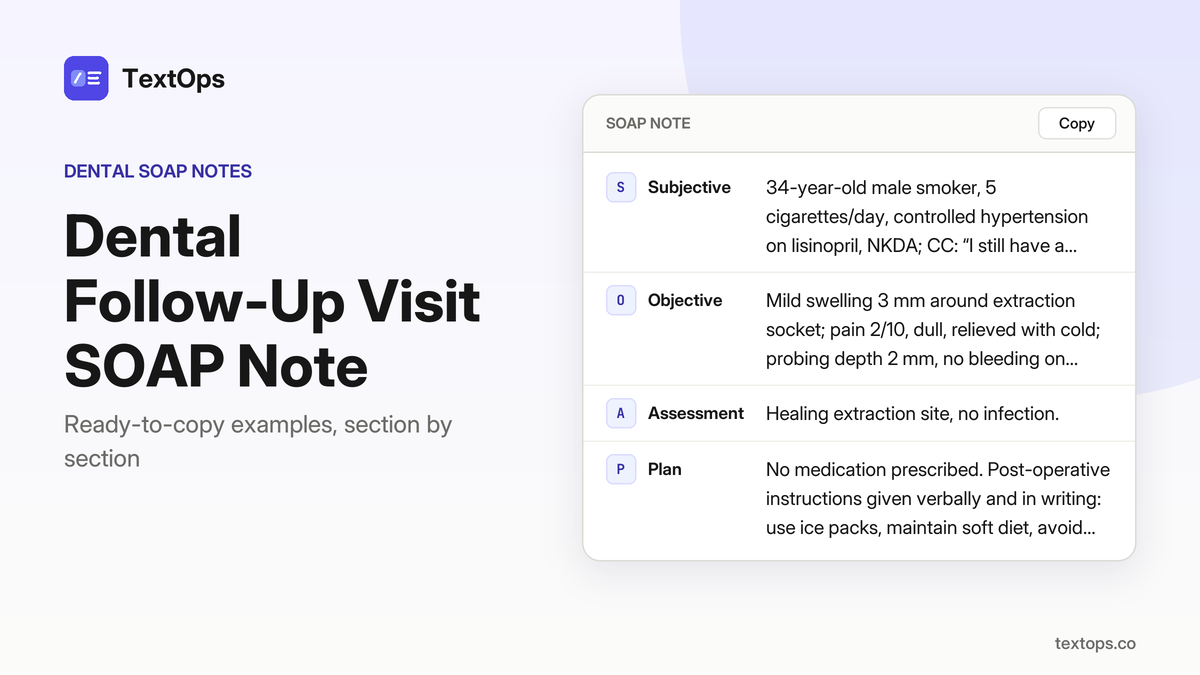
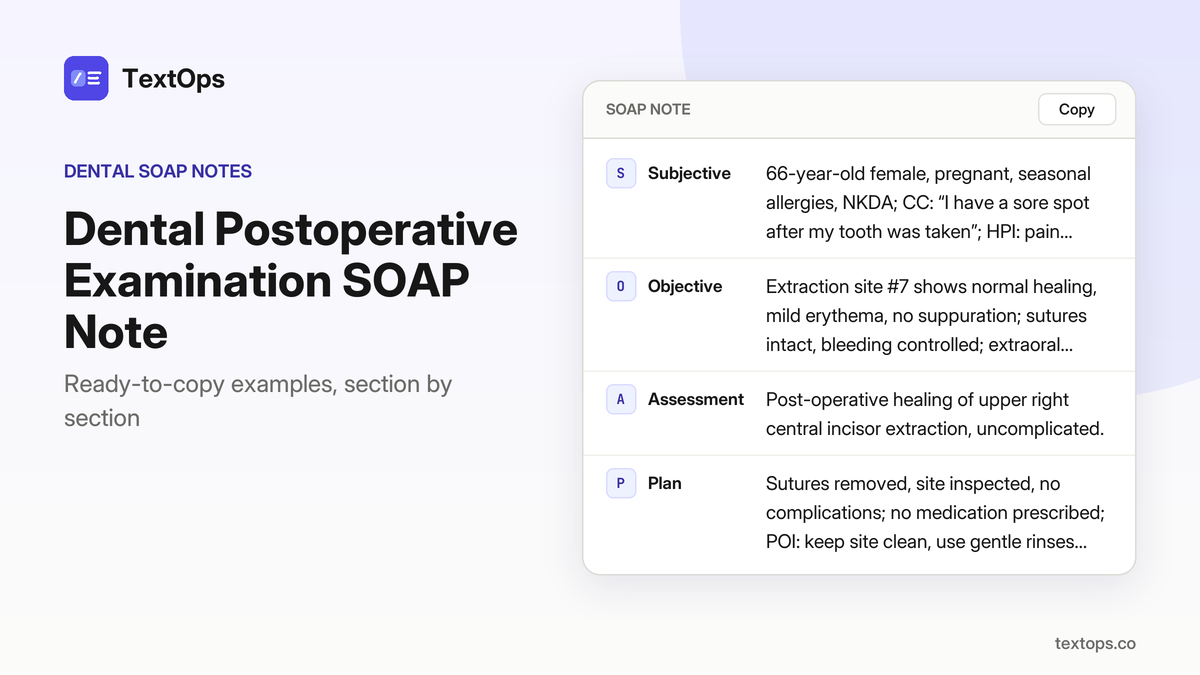
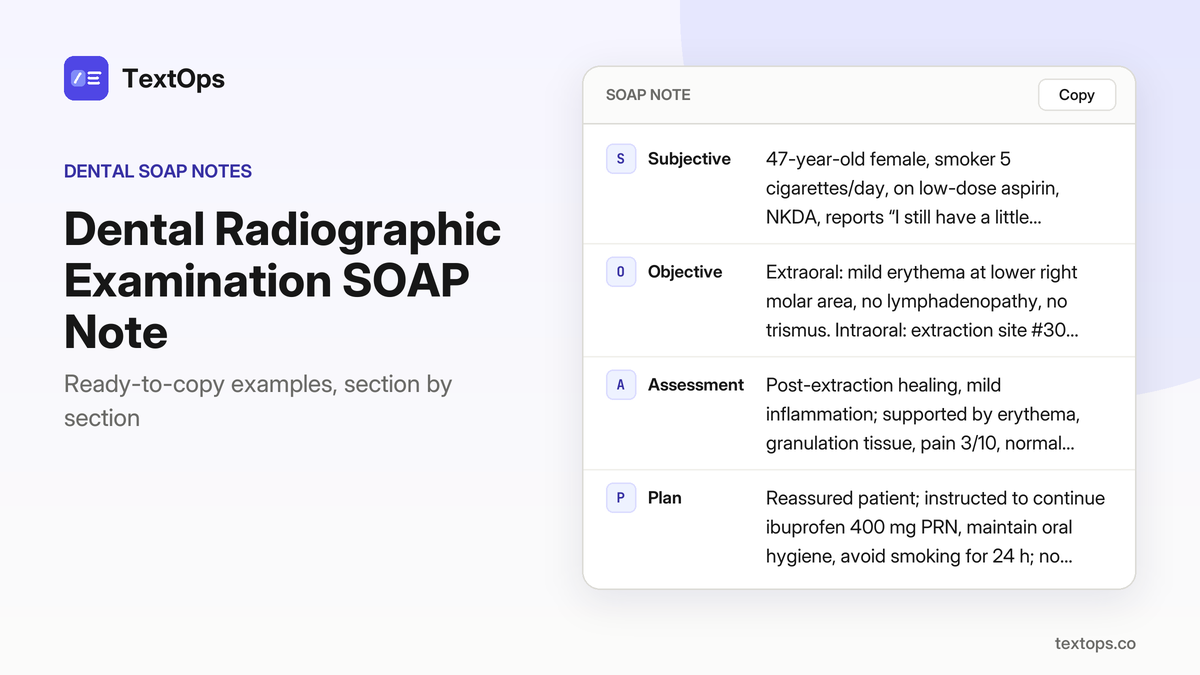
Extraoral Examination SOAP Note templates provide ready-filled, copy-pasteable notes for diverse visit types, from routine check-ups to emergency facial issues. Each template contains complete S, O, A, P sections, including patient history, objective findings, assessment, and plan. Guidance explains how to adapt wording for age, medical status, or specific clinical scenarios, ensuring documentation remains precise, contemporaneous, and clinically useful without referencing billing or coding.
Post-Op Follow-Up With Mild Swelling or Trismus
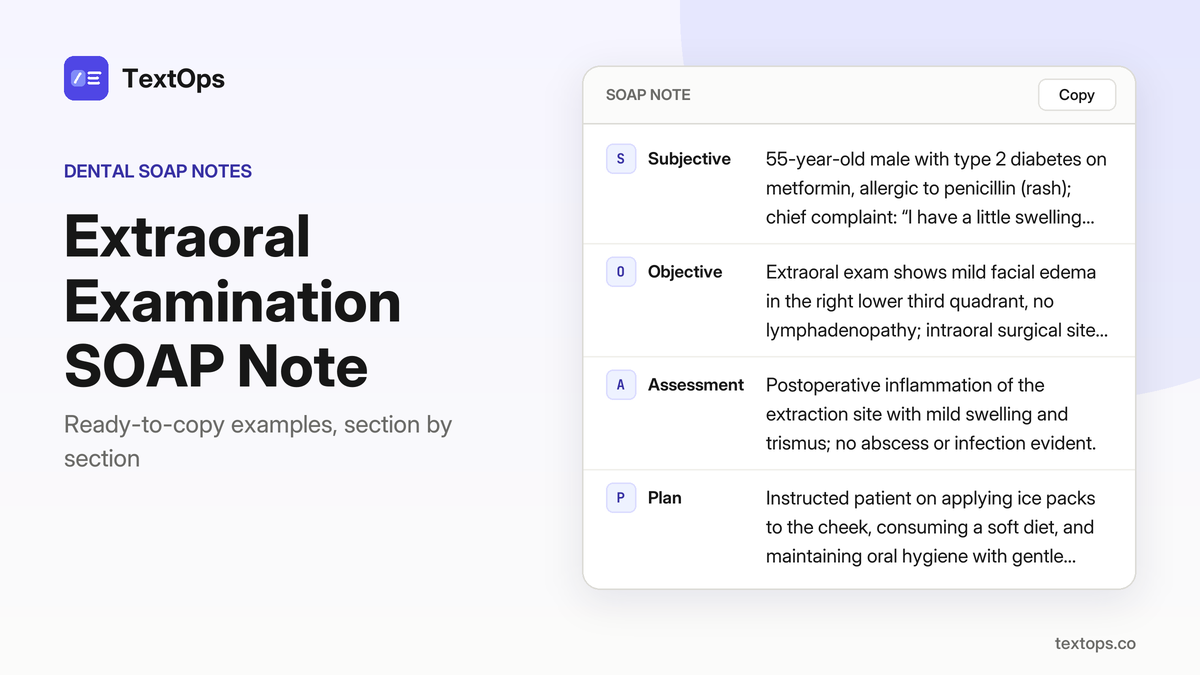
Diabetic, Post-Op Day 1 After Third-Molar Surgery
SOAP note
SSubjective
55-year-old male with type 2 diabetes on metformin, allergic to penicillin (rash); chief complaint: “I have a little swelling and my mouth feels a bit tight”; history: post-op day 1 after extraction of tooth #30; no other medications.
OObjective
Extraoral exam shows mild facial edema in the right lower third quadrant, no lymphadenopathy; intraoral surgical site demonstrates dry socket signs, pink mucosa, no drainage; TMJ maximum opening 35 mm indicating slight trismus; temperature 37.1 °C; local anesthesia administered: 2% lidocaine with 1:100,000 epinephrine, 1.8 mL (1 cartridge), IANB, aspiration negative.
AAssessment
Postoperative inflammation of the extraction site with mild swelling and trismus; no abscess or infection evident.
PPlan
Instructed patient on applying ice packs to the cheek, consuming a soft diet, and maintaining oral hygiene with gentle rinsing; advised no antibiotics; scheduled next visit in 3 days for reassessment of healing and trismus resolution.
Post-Op Day 2 After Apicoectomy
SOAP note
SSubjective
63-year-old female, controlled hypertension on lisinopril, NKDA, reports “My left upper molar area still hurts a little” (Day 2 post-apicoectomy).
OObjective
Extraoral: mild swelling left upper premolar region, no lymphadenopathy; intraoral: surgical flap healing, slight erythema, no discharge; TMJ: opening 38 mm, no deviation; temperature 36.9 °C; anesthesia: 2% lidocaine with 1:100,000 epinephrine, 1.8 mL buccal infiltration, aspiration negative.
AAssessment
Postoperative healing of tooth #16, no infection evidenced by normal extraoral/intraoral findings and lack of systemic signs.
PPlan
Administered 2% lidocaine with 1:100,000 epinephrine, 1.8 mL buccal infiltration; prescribed ibuprofen 400 mg q4h PRN up to 3 days, chlorhexidine gluconate 0.12% 15 mL rinse 30 s twice daily; instructed to monitor swelling and pain, return in 5 days for reassessment.
Post-Op Day 5 After Orthognathic Surgery
SOAP note
SSubjective
65-year-old male with type 2 diabetes on metformin, NKDA, states “I feel a bit sore and my jaw still feels tight.”
OObjective
Extraoral exam shows resolving swelling in the midface, no lymphadenopathy; intraoral mucosa is pink, surgical sites are closed with no drainage; TMJ opening measures 40 mm, indicating mild trismus; temperature is 36.8 °C.
AAssessment
Normal postoperative healing with mild trismus.
PPlan
Continue a soft diet and apply ice packs as needed; no medication is prescribed. The patient is advised to monitor for increased swelling, fever, or worsening pain and to return for a follow-up on Post-Op Day 7 to reassess healing and ensure trismus resolves.
Post-Op Day 1 After Wisdom Tooth Extraction
SOAP note
SSubjective
28-year-old male, former smoker, NKDA, chief complaint: “My jaw feels a bit tight and there's a little swelling”; post-op day 1 after extraction of tooth #30.
OObjective
Extraoral mild swelling right lower third quadrant, no lymph nodes; intraoral extraction socket healing, no bleeding or drainage; TMJ opening 34 mm, mild trismus; temperature 37.0 °C.
AAssessment
Postoperative inflammation, no infection, evidenced by mild swelling, trismus, normal temperature, and healing socket.
PPlan
Ice packs applied, soft diet advised, chlorhexidine gluconate 0.12 % rinse 15 mL 30 sec twice daily, no antibiotics; next visit day 3 for reassessment.
Post-Op Day 4 After Endodontic Surgery
SOAP note
SSubjective
64-year-old male, hypothyroidism on levothyroxine, allergic to penicillin (rash), reports “My upper left canine still hurts a little” on post-op day 4 after endodontic surgery on tooth #11.
OObjective
Extraoral shows mild swelling in the left upper canine region, no lymphadenopathy; intraoral surgical site healing with slight erythema, no drainage; TMJ opening 39 mm, no deviation; temperature 36.7 °C.
AAssessment
Postoperative healing of tooth #11, no abscess, consistent with mild inflammation.
PPlan
Administered 2% lidocaine with 1:100,000 epinephrine, 1.8 mL buccal infiltration, aspiration negative. Prescribed ibuprofen 400 mg PO q4h PRN up to 3 days; chlorhexidine gluconate 0.12% 15 mL rinse, 30 sec twice daily. Instructed patient on pain control, oral hygiene, and scheduled follow-up in 3 days.
Post-Op Day 1 After Root Canal Therapy
SOAP note
SSubjective
67-year-old female, chief complaint: “My lower right molar area still feels sore”; history: post-RCT of tooth #30, takes daily low-dose aspirin, NKDA.
OObjective
Extraoral: no swelling, no lymph nodes; Intraoral: post-RCT restoration, no bleeding, no drainage; TMJ opening 42 mm, no trismus; Temperature 36.9 °C.
AAssessment
Normal postoperative healing, supported by absence of inflammation or systemic signs.
PPlan
2% lidocaine with 1:100,000 epinephrine, 1.8 mL (1 cartridge), IANB, aspiration negative; continue chlorhexidine gluconate 0.12% 15 mL rinse 30 sec twice daily; no medication prescribed; next visit to assess healing.
Post-Op Day 3 After Maxillary Sinus Augmentation
SOAP note
SSubjective
25-year-old female, smoker, NKDA, presents on Post-Op Day 3 after maxillary sinus augmentation with the chief complaint “My upper jaw feels a bit tight and there's some swelling”; she reports mild discomfort and a sensation of tightness that has not worsened since the procedure.
OObjective
Extraoral examination shows mild swelling over the maxillary sinus region with no palpable lymph nodes; intraoral inspection reveals the graft site is healing without drainage or exudate, and the mucosa is intact. The temporomandibular joint opening measures 41 mm, indicating mild trismus, and the patient’s temperature is 37.0 °C, within normal limits.
AAssessment
Postoperative healing with mild trismus and no evidence of infection or inflammation beyond expected postoperative changes.
PPlan
The patient was instructed to apply ice packs to the affected area for 15 minutes every 2–3 hours as needed, maintain a soft diet, and perform a chlorhexidine gluconate 0.12 % rinse (15 mL for 30 seconds) twice daily; no antibiotics are prescribed. Follow-up is scheduled in 7 days to reassess healing and ensure resolution of trismus.
Post-Op Day 1 After Periodontal Flap Surgery
SOAP note
SSubjective
38-year-old male with asthma, NKDA, reports “My lower left molar area still feels tight”; no fever, chills, or systemic symptoms.
OObjective
Extraoral examination shows mild swelling in the left lower molar region, no palpable lymph nodes; intraoral flap over tooth #19 is healing well with no bleeding or drainage; TMJ opening measures 40 mm, indicating no trismus; temperature 36.8 °C; overall findings consistent with expected postoperative healing.
AAssessment
Post-operative healing of periodontal flap surgery, no infection or complications identified.
PPlan
Local anesthesia administered: 2% lidocaine with 1:100,000 epinephrine, 1.8 mL (1 cartridge), IANB, aspiration negative; patient instructed to use chlorhexidine gluconate 0.12% rinse, 15 mL for 30 seconds twice daily; no systemic medication prescribed; patient advised to monitor swelling and report any increase, pain, or fever; next visit scheduled for Day 3 to reassess healing and ensure resolution of swelling.
Post-Op Day 4 After Maxillary Third Molar Extraction
SOAP note
SSubjective
22-year-old male, seasonal allergies, NKDA, reports “My upper right molar area still hurts a little” on day 4 after extraction of tooth #3.
OObjective
Extraoral shows mild swelling in the right upper third quadrant, no lymphadenopathy; intraoral socket healing, no drainage; TMJ opening 38 mm, mild trismus; temperature 37.0 °C.
AAssessment
Postoperative healing with mild trismus, no abscess.
PPlan
Administered 2% lidocaine with 1:100,000 epinephrine, 1.8 mL buccal infiltration, aspiration negative. Prescribed ibuprofen 400 mg q4h PRN up to 3 days; chlorhexidine gluconate 0.12 % 15 mL rinse 30 s twice daily. Instructed patient on pain control, oral hygiene, and to return in 3 days for reevaluation.
Post-Op Day 2 After Maxillary Sinus Lift
SOAP note
SSubjective
66-year-old female, no significant medical history, NKDA, reports “upper jaw feels a bit tight and there's some swelling.”
OObjective
Extraoral: mild swelling over maxillary sinus area, no lymphadenopathy. Intraoral: graft site healing, no drainage. TMJ: maximum opening 42 mm, mild trismus. Temperature 36.9 °C.
AAssessment
Postoperative healing with mild trismus, no infection.
PPlan
Applied ice packs to the maxillary region, instructed soft diet, chlorhexidine gluconate 0.12 % rinse 15 mL for 30 sec twice daily, no antibiotics. Advised to monitor swelling and report any fever or increased pain. Next visit: Post-Op Day 5 to assess graft healing and trismus resolution.
Post-Op Follow-Up With Normal Extraoral Exam
Smoker, Day 3 After Lower Molar Extraction
SOAP note
SSubjective
30-year-old female, smoker 5 cigarettes/day, allergic to penicillin (rash); CC: “I’m here for the follow-up after my molar extraction”; PMH: smoking; no other meds; no known drug allergies besides penicillin; no systemic signs.
OObjective
Extraoral: facial symmetry preserved, no swelling, no lymphadenopathy; Intraoral: extraction socket #30 healing, mild erythema, no drainage; Palpation: no tenderness, no trismus; Vital signs: BP 128/78 mmHg, pulse 72 bpm, Temp 36.8°C.
AAssessment
Extraction site healing, no infection.
PPlan
Reviewed postoperative instructions: maintain oral hygiene, avoid rinsing for 24 h, soft diet for 48 h; no medications prescribed; next visit scheduled for post-op day 7.
Post-Op Day 7 After Implant Placement
SOAP note
SSubjective
50-year-old female patient, controlled hypertension on lisinopril, NKDA, reports “Just checking in after my implant.”
OObjective
Extraoral exam shows no swelling, no lymphadenopathy, TMJ normal. Intraoral exam: implant site #15 stable, no redness, soft tissue intact; palpation reveals no tenderness, no implant mobility. Vital signs: BP 122/76 mmHg, pulse 70 bpm, temperature 36.7 °C.
AAssessment
Implant site healing, no infection.
PPlan
Reinforced oral hygiene instructions; advised to avoid hard foods for 2 weeks. No medications prescribed. Patient educated on signs of infection and instructed to return immediately if swelling, pain, or drainage develops. Next appointment scheduled for implant integration assessment in 4 weeks, with a review of peri-implant bone levels and function.
Elderly, Follow-up After Maxillary Sinus Lift
SOAP note
SSubjective
43-year-old male, type 2 diabetes on metformin, NKDA, presents for sinus lift follow-up and states “I’m here for my sinus lift follow-up.”
OObjective
Extraoral exam reveals facial symmetry, no swelling, no lymphadenopathy; intraoral exam shows maxillary vestibule healing with no sinus membrane exposure; palpation of the maxilla and surrounding musculature is non-tender and trismus is absent; vital signs are BP 135/80 mmHg, pulse 68 bpm, temperature 36.6 °C, all within normal limits.
AAssessment
Sinus lift healing, no infection.
PPlan
Reviewed postoperative care instructions: avoid nose blowing, maintain oral hygiene, use saline rinses as needed; no medications prescribed at this visit. Scheduled next appointment in 2 weeks for graft integration assessment and possible implant placement.
Elderly, Follow-up After Periodontal Surgery
SOAP note
SSubjective
19-year-old female patient, former smoker, NKDA, chief complaint: “Just a quick check after my periodontal surgery.” History: postoperative follow-up after surgery on tooth #24.
OObjective
Extraoral: facial symmetry, no swelling, no lymphadenopathy. Intraoral: surgical site healing, no redness, no drainage; palpation: no tenderness, no mobility of tooth #24. Vital signs: BP 118/74 mmHg, pulse 72 bpm, temperature 36.7 °C.
AAssessment
Periodontal surgical site healing, no infection, supported by normal extraoral and intraoral findings.
PPlan
Reinforced oral hygiene instructions given; chlorhexidine 0.12% rinse twice daily prescribed; no medication administered; next visit scheduled for routine follow-up in 2 weeks.
Post-Op Day 2 After Dental Implant Removal
SOAP note
SSubjective
29-year-old male, hypothyroidism on levothyroxine, allergic to penicillin (rash), chief complaint: “I’m here for my implant removal follow-up”; post-op day 2 after removal of implant at #28, no pain reported, PMH: hypothyroidism, meds: levothyroxine.
OObjective
Extraoral: facial symmetry, no swelling, no lymphadenopathy; intraoral: extraction socket healing, mild erythema, no drainage; palpation: no tenderness, no trismus; vital signs: BP 120/78 mmHg, pulse 70 bpm, temperature 36.8 °C; anesthesia: none.
AAssessment
Implant removal site healing, no infection.
PPlan
Reviewed postoperative instructions: maintain oral hygiene, avoid rinsing for 24 h, soft diet for 48 h; no drugs prescribed; next visit scheduled in 7 days for routine follow-up.
Post-Op Day 6 After Orthodontic Adjustment
SOAP note
SSubjective
34-year-old male, chief complaint: “Just a quick check after my orthodontic adjustment”; medical history: daily low-dose aspirin, NKDA, no other systemic complaints; no new symptoms reported.
OObjective
Extraoral examination shows facial symmetry, no swelling, no lymphadenopathy; intraoral assessment reveals all brackets intact, gingiva pink and free of erythema, no mucosal swelling; palpation of the jaw and neck is non-tender, no trismus; vital signs are within normal limits with BP 125/77 mmHg, pulse 68 bpm, temperature 36.7 °C.
AAssessment
Orthodontic adjustment healing, no infection or adverse reaction noted.
PPlan
Reinforced oral hygiene instructions, advised use of orthodontic floss and interdental brushes to maintain plaque control around brackets; no medications prescribed; patient advised to monitor for any new pain or swelling, and to return for routine follow-up in four weeks or sooner if symptoms develop.
Follow-up After Bilateral Wisdom Tooth Extraction
SOAP note
SSubjective
81-year-old female, smoker 5 cigarettes/day, NKDA, chief complaint: “I’m here for my wisdom tooth follow-up.” HPI: postoperative day 1 after bilateral lower third molar extraction, no new symptoms.
OObjective
Extraoral: facial symmetry, no swelling, no lymphadenopathy. Intraoral: bilateral extraction sites healing, mild erythema, no drainage. Palpation: no tenderness, no trismus. Vital signs: BP 130/78 mmHg, pulse 70 bpm, temperature 36.6°C.
AAssessment
Wisdom tooth extraction sites healing, no infection.
PPlan
Reviewed postoperative care: maintain oral hygiene, avoid rinsing for 24 h, soft diet for 48 h. No medications prescribed. Patient instructed on signs of complications and scheduled for next visit in 7 days to assess healing progress.
Re-evaluation After Orthodontic Bracket Removal
SOAP note
SSubjective
61-year-old female, asthma (albuterol PRN), NKDA, reports “I’m here for my bracket removal follow-up”; no pain, no swelling, normal oral health history.
OObjective
Extraoral: facial symmetry, no swelling, no lymphadenopathy; Intraoral: brackets removed, gingiva pink, no redness or swelling; Palpation: no tenderness, no trismus; Vital signs: BP 118/75 mmHg, pulse 66 bpm, Temp 36.7°C.
AAssessment
Bracket removal healing, no infection or complications noted, normal postoperative course.
PPlan
Reinforced oral hygiene instructions given; advised use of orthodontic floss and interdental brushes; no medications prescribed; next visit scheduled in 4 weeks for routine check-up.
Emergency Facial Issues
Allergic to Penicillin, Emergency Visit for Facial Swelling
SOAP note
SSubjective
76-year-old male with seasonal allergies; chief complaint: “I have a big swelling on my left cheek that’s been getting worse for the last two days.” History: two-day progression, no pain, no fever.
OObjective
Facial swelling over left buccal region, 3 cm diameter, erythematous, non-tender; no lymphadenopathy; mouth opening 35 mm, no trismus; no facial asymmetry; panoramic radiograph shows no periapical radiolucency; vital signs WNL; temperature 37.2 °C.
AAssessment
Acute perioral cellulitis supported by erythematous, non-tender buccal swelling, absence of dental pathology on radiograph, and lack of systemic signs.
PPlan
Applied warm compresses, instructed oral hygiene, no medication prescribed; scheduled follow-up in 24 hours.
Teenager, Trauma to Upper Lip
SOAP note
SSubjective
49-year-old male, no significant medical history, NKDA, fell and cut upper lip, reports heavy bleeding and pain, says the cut is long and visible, wants quick control.
OObjective
Upper lip laceration 2.5 cm, active bleeding, no exposed bone, mouth opening 38 mm, no trismus, facial symmetry intact, no facial swelling, panoramic radiograph not indicated, vital signs WNL, temperature 36.8 °C.
AAssessment
Laceration of upper lip.
PPlan
Sutured the lip with 4-0 nylon, instructed patient on wound care and oral hygiene, prescribed chlorhexidine gluconate 0.12 % rinse 15 mL, 30 seconds, twice daily for 7 days, advised to keep lip clean, avoid hot foods and strenuous activity, and to return if bleeding recurs or signs of infection develop.
Pregnancy, First Trimester, Emergency Visit for TMJ Pain
SOAP note
SSubjective
80-year-old female, pregnant, allergic to penicillin (rash); chief complaint: “My jaw hurts when I open my mouth, especially after chewing.” History: pain worsens with opening, no swelling, no trismus, no fever.
OObjective
Maximum opening 30 mm, deviation to right, clicking on opening; palpable right TMJ tenderness; panoramic radiograph shows no bony changes; vital signs WNL, temperature 36.9 °C.
AAssessment
TMJ internal derangement with disc displacement without reduction, supported by limited opening, deviation, clicking, and tenderness.
PPlan
Ibuprofen 400 mg PO every 6 h as needed for pain, 5 days; advise heat packs; refer to TMJ specialist if no improvement in 2 weeks.
Pregnancy, Second Trimester, Emergency Visit for Facial Swelling
SOAP note
SSubjective
70-year-old female, pregnant, controlled hypertension on lisinopril, NKDA, reports “I have a swelling on my right cheek that’s been getting worse over the past day.” History: swelling present 1 day, no prior pain, no dental symptoms.
OObjective
Facial swelling right buccal region 2.5 cm, erythematous, tender to palpation; no lymphadenopathy; mouth opening 34 mm, no trismus; no facial asymmetry; PAN shows no periapical radiolucency; vital signs WNL; temperature 37.4 °C.
AAssessment
Acute perioral cellulitis, evidenced by erythematous tender swelling, absence of lymphadenopathy, normal mouth opening, and no radiographic pathology.
PPlan
Warm compresses applied, oral hygiene reinforced, no medications prescribed, follow-up scheduled in 24 h; no local anesthesia used.
Pregnancy, First Trimester, Emergency Visit for TMJ Dislocation
SOAP note
SSubjective
72-year-old pregnant female, type 2 diabetic on metformin, NKDA, reports “My jaw popped and I can’t close it properly.” HPI: acute TMJ dislocation with pain, no swelling, no trismus.
OObjective
Max mouth opening 28 mm, deviation left, no clicking; left TMJ tender on palpation; panoramic radiograph shows no bony change; vital signs WNL, T 36.7 °C.
AAssessment
TMJ disc displacement with reduction, supported by limited opening, deviation, tenderness, and radiographic absence of osseous pathology.
PPlan
Prescribed ibuprofen 400 mg PO q6h PRN for pain, 5 days; advised heat packs; instructed to return or refer to TMJ specialist if no improvement in 2 weeks.
Emergency Visit for Facial Numbness Post-Root Canal
SOAP note
SSubjective
56-year-old male, former smoker, NKDA, reports “I feel numbness on the right side of my face after my root canal.” HPI: numbness began 2 days after root canal on upper right first molar (#3).
OObjective
Extraoral: facial sensory exam shows loss of light touch over right buccal mucosa and lower lip; mouth opening 36 mm, no trismus; no swelling. Panoramic radiograph shows no periapical pathology. Vital signs WNL; temperature 36.8 °C.
AAssessment
Inferior alveolar nerve paresthesia, evidenced by sensory loss over right buccal mucosa and lower lip following recent root canal on #3 with normal radiograph.
PPlan
Advise avoidance of hot foods, schedule follow-up in 1 week, consider referral to oral surgeon if no recovery; no drugs prescribed.
First Visit for Chronic TMJ Pain in a Pregnant Patient
SOAP note
SSubjective
33-year-old female, pregnant, hypothyroid on levothyroxine, allergic to penicillin (rash); CC: “I’ve had jaw pain for months, especially after chewing, and it’s getting worse.” HPI: chronic TMJ pain worsening with mastication, no facial swelling or trismus.
OObjective
maximum mouth opening 32 mm, deviation to right, clicking on opening; palpable TMJ tenderness on right side; panoramic radiograph shows no bony changes; vital signs WNL, temperature 36.9 °C.
AAssessment
chronic TMJ internal derangement with disc displacement without reduction, supported by limited opening, deviation, clicking, and right-sided tenderness.
PPlan
prescribe ibuprofen 400 mg PO q6 h PRN for pain, 5 days; advise heat packs; counsel on avoiding hard foods; refer to TMJ specialist if no improvement in 2 weeks; no local anesthesia used.
Emergency Visit for Facial Hemorrhage After Biopsy
SOAP note
SSubjective
31-year-old female patient, chief complaint: “I had a biopsy on my cheek and it’s bleeding a lot.” History: biopsy of right buccal mucosa 1.5 cm, active bleeding, no clot; medical history: daily low-dose aspirin, NKDA.
OObjective
Biopsy site right buccal mucosa, 1.5 cm, active bleeding, no clot; mouth opening 38 mm, no trismus; facial symmetry intact; no facial swelling; panoramic radiograph not indicated; vital signs WNL; temperature 36.7 °C.
AAssessment
Post-biopsy hemorrhage, supported by active bleeding at the biopsy site with no clot and normal vital signs.
PPlan
Applied direct pressure with gauze to the biopsy site; advised patient to avoid aspirin for 24 hours; scheduled follow-up in 24 hours; no drugs prescribed.
Pregnancy Routine Visits
Pregnant, First Trimester, Routine Check-up
SOAP note
SSubjective
46-year-old female, pregnant, smokes 5 cigarettes/day, NKDA, chief complaint: “Here for my routine check-up.”
OObjective
Extraoral: facial symmetry, no lymphadenopathy, TMJ normal; Intraoral: mild gingival inflammation on tooth #15, no caries or restorations; probing depths 2–3 mm, BOP 10 %; panoramic radiograph: no periapical pathology, no root resorption; bitewing radiographs: no interproximal caries; periodontal charting: PSR 1 (mild gingivitis); vital signs: BP 118/72 mmHg, HR 78 bpm, Temp 98.6 °F.
AAssessment
Mild gingivitis, periodontal health stage I, grade A, supported by 2–3 mm probing depths, 10 % BOP, PSR 1 and normal radiographs.
PPlan
Reinforced oral hygiene instructions, applied fluoride varnish to all teeth, advised smoking cessation, no medication prescribed, next routine visit scheduled in 6 months.
Pregnancy, Second Trimester, Routine Check-up
SOAP note
SSubjective
37-year-old female patient, pregnant, asthma (albuterol PRN), NKDA; chief complaint: “Here for my routine check-up”; medical history: pregnancy, asthma, no other systemic signs; vital signs: BP 120/74 mmHg, HR 80 bpm, Temp 98.7 °F.
OObjective
Extraoral: facial symmetry, no lymphadenopathy, TMJ normal; Intraoral: mild gingival inflammation on tooth #19, no caries, no restorations; probing depths 2–3 mm, BOP 12 %; panoramic radiograph: no periapical pathology, no root resorption; bitewing radiographs: no interproximal caries; periodontal charting: PSR 1 (mild gingivitis).
AAssessment
Mild gingivitis, periodontal health stage I, grade A, supported by 2–3 mm probing depths, 12 % BOP, PSR 1, and normal radiographs.
PPlan
Reinforced oral hygiene instructions; applied fluoride varnish to all teeth; reviewed asthma control and inhaler use; no medications prescribed; next routine visit scheduled in 6 months.
Pregnancy, Third Trimester, Routine Check-up
SOAP note
SSubjective
41-year-old female patient, pregnant, presents for routine check-up; chief complaint: “Here for my routine check-up”; medical history: pregnancy, seasonal allergies, NKDA; no other systemic signs.
OObjective
Extraoral: facial symmetry, no lymphadenopathy, TMJ normal; Intraoral: mild gingival inflammation on tooth #10, no caries or restorations; probing depths 2–3 mm, BOP 8 %; panoramic radiograph: no periapical pathology or root resorption; bitewing radiographs: no interproximal caries; periodontal charting: PSR 1 (mild gingivitis); vital signs: BP 118/70 mmHg, HR 76 bpm, Temp 98.5 °F.
AAssessment
Mild gingivitis, periodontal health stage I, grade A, supported by 2–3 mm probing depths, 8 % BOP, PSR 1 and absence of radiographic pathology.
PPlan
Reinforced oral hygiene instructions; applied fluoride varnish to all teeth; advised allergy management; no medication prescribed; next routine visit scheduled in 6 months.
Routine Visits for Medical Conditions
Asthmatic, Routine Check-up With New Medication
SOAP note
SSubjective
75-year-old female with no significant medical history, NKDA, presents for a routine dental check-up and reports that she has just started a new inhaler for asthma control.
OObjective
Extraoral exam reveals normal facial symmetry, no swelling, and no cervical or submandibular lymphadenopathy. Intraoral findings show mild gingivitis with bleeding on probing at 10 %, probing depths of 3 mm throughout, and no clinical attachment loss. Periodontal charting confirms stage I, grade A periodontal health. There are no carious lesions, no existing restorations, and no visible soft-tissue lesions.
AAssessment
Mild gingivitis, periodontal health stage I, grade A, evidenced by BOP 10 % and PD 3 mm with CAL 0 mm.
PPlan
Oral hygiene instruction was reinforced, focusing on proper brushing technique and interdental cleaning; a fluoride varnish was applied to all tooth surfaces; no local anesthesia or systemic medication was administered. The patient was advised to continue her new inhaler as prescribed and to return for a routine recall in 6 months.
Diabetic, Follow-up After Root Canal Therapy
SOAP note
SSubjective
20-year-old male, type 2 diabetes on metformin, reports “My tooth still feels a bit tender after the root canal.” No systemic symptoms reported.
OObjective
Root-canal treated tooth #16 with gutta-percha well seated; periapical radiograph shows no radiolucency; mild buccal mucosal swelling; BOP 5 %; PD 2 mm; no caries or restorations; extraoral exam normal.
AAssessment
Previously treated tooth #16, normal apical tissues – supported by radiograph and clinical findings.
PPlan
Place temporary restoration on tooth #16; no medication prescribed; instructed to maintain oral hygiene, avoid hard foods, and report any increased pain; schedule definitive crown in 4 weeks.
Post-Op Day 3 After Orthodontic Bonding
SOAP note
SSubjective
74-year-old female with controlled hypertension on lisinopril, NKDA, reports “My braces are in, but my molars feel a little sore.”
OObjective
Brackets bonded to tooth #3; no decalcification or enamel loss; mild mucosal irritation; no swelling or lymphadenopathy; BOP 0%; PD 2 mm.
AAssessment
Postoperative inflammation of orthodontic bonding, no infection.
PPlan
Instructed on proper brushing and flossing around brackets; advised to avoid hard foods for 24 h; prescribed chlorhexidine gluconate 0.12% rinse, 15 mL, 30 sec, twice daily for 7 days; instructed to return in 7 days for follow-up or sooner if pain worsens.
Allergic to Latex, Routine Check-up
SOAP note
SSubjective
51-year-old male with type 2 diabetes on metformin, NKDA, presents for a routine check-up and notes a latex allergy; he reports “just a routine check, but I have a latex allergy.”
OObjective
Extraoral examination shows symmetrical facial features, no swelling or cervical lymphadenopathy, and normal TMJ function; intraoral findings reveal mild gingivitis with bleeding on probing in 8 % of sites, probing depths of 3 mm throughout, and no clinical attachment loss. Periodontal charting indicates stage I, grade A health with no caries or restorations present.
AAssessment
Mild gingivitis, periodontal health stage I, grade A, supported by BOP 8 % and PD 3 mm with CAL 0 mm.
PPlan
Provided comprehensive oral hygiene instruction emphasizing proper brushing and interdental cleaning techniques; applied a fluoride varnish to all tooth surfaces; advised use of latex-free instruments and gloves during future visits; no local anesthesia was required; scheduled next recall in 6 months.
Allergic to Aspirin, Routine Check-up
SOAP note
SSubjective
27-year-old female patient, former smoker, allergic to aspirin (rash), reports “Routine check, but I can’t take aspirin.” PMH: no systemic disease.
OObjective
Extraoral exam: normal symmetry, no swelling or lymphadenopathy. Intraoral: mild gingivitis, BOP 7 %, PD 3 mm, CAL 0 mm, no caries or restorations. Periodontal health stage I, grade A.
AAssessment
Mild gingivitis, periodontal health stage I, grade A, supported by BOP 7 %, PD 3 mm, CAL 0 mm.
PPlan
Oral hygiene instruction delivered; fluoride varnish applied to all teeth. Advised to avoid aspirin. Next recall scheduled in 6 months.
Re-evaluation After Periodontal Grafting
SOAP note
SSubjective
21-year-old female, hypothyroidism on levothyroxine, chief complaint: “Checking on my graft site after the procedure.”
OObjective
Periodontal graft site on tooth #15 healed; BOP 0%; PD 2 mm; CAL 0 mm; no caries or restorations; extraoral exam normal, no swelling or lymphadenopathy; no inflammation or redness observed.
AAssessment
Periodontal graft healing, no infection.
PPlan
Continue oral hygiene; prescribe chlorhexidine gluconate 0.12 % rinse 15 mL 30 sec twice daily for 7 days; advise patient to report any new pain, swelling, or discoloration.
Elderly Routine and Follow-Up Visits
Elderly, Re-evaluation After Periodontal Therapy
SOAP note
SSubjective
26-year-old female, low-dose aspirin, NKDA, says “I’m here for my routine check-up and to see how my gums are healing after the last periodontal scaling.”
OObjective
Extraoral: facial symmetry, no lymphadenopathy. Intraoral: mild gingival recession 1 mm on buccal surface of #30, BOP 0/6, PD 3 mm, CAL 2 mm. Radiograph: periapical of #30 shows no radiolucency, bone level 1 mm apical to CEJ; no infection or systemic illness.
AAssessment
Stage I periodontitis, grade A, with residual probing depths 3 mm.
PPlan
Re-scaling and root planing of #30 performed; patient instructed on home care and chlorhexidine 0.12% rinse twice daily; no drugs prescribed; next visit in 3 months for maintenance.
Elderly, Follow-up After Oral Cancer Screening
SOAP note
SSubjective
69-year-old female, smoker 5 cigarettes/day, NKDA, reports “I’m here for my routine visit and to check the area where I had a suspicious lesion last year.”
OObjective
Extraoral: facial symmetry WNL, no cervical lymphadenopathy. Intraoral: no new lesions; previous ulcerated area on right buccal mucosa now healed, no erythema or induration. Panoramic radiograph: no bone loss in maxillary molars.
AAssessment
No evidence of oral cancer; previous lesion resolved, consistent with healing findings and absence of suspicious features.
PPlan
Re-education on oral cancer self-screening, advised to quit smoking; no further intervention needed.
Elderly, Follow-up After Dental Implant Placement
SOAP note
SSubjective
54-year-old female, asthma on albuterol PRN, NKDA, chief complaint: “I’m here for my implant follow-up; the site feels fine but I want to make sure it’s healing properly.” HPI: no pain, no swelling, implant site #15 feels stable.
OObjective
Extraoral: no swelling, facial symmetry normal. Intraoral: implant site #15 shows healthy mucosa, no erythema, no suppuration, probing depth 1 mm. Radiograph: periapical of #15 shows good bone support, no radiolucency around implant.
AAssessment
Successful implant integration, no peri-implant pathology, supported by healthy mucosa, shallow probing depth, and normal radiographic bone support.
PPlan
Continue regular oral hygiene; no medications prescribed. Schedule next check-up in 6 months. No anesthesia used.
Elderly, Follow-up After Oral Surgery
SOAP note
SSubjective
48-year-old female, seasonal allergies, NKDA, states “I’m here for my post-surgery check-up; the extraction site feels fine but I want to make sure there are no complications.”
OObjective
Extraoral: no facial swelling, normal mouth opening; Intraoral: extraction site #28 shows healthy healing, no bleeding, no discharge, mucosa intact; Radiograph: periapical radiograph of #28 shows no radiolucency, bone fill appears adequate; systemic signs: none; anesthesia: none.
AAssessment
Healing extraction site, no infection, supported by normal extraoral findings, intact mucosa, absence of bleeding or discharge, and radiographic bone fill.
PPlan
Advise on postoperative care: keep site clean, avoid hot liquids for 24 h, use saline rinses, monitor for swelling or pain; no medication prescribed; schedule next follow-up in 4 weeks for routine check-up.
Follow-up After Dental Implant Placement in a Bisphosphonate User
SOAP note
SSubjective
44-year-old female, NKDA, presents for implant follow-up; she is on bisphosphonate therapy and asks about osteonecrosis risk.
OObjective
Extraoral exam shows normal facial symmetry, no swelling; intraoral exam of implant site #19 reveals healthy mucosa, no erythema, probing depth 1 mm; periapical radiograph of #19 shows good bone support, no radiolucency around the implant.
AAssessment
Successful implant integration with no peri-implant pathology, confirmed by clinical and radiographic findings.
PPlan
No anesthesia or medication was administered; counselled the patient on signs of osteonecrosis, advised continuation of bisphosphonate therapy as prescribed, and scheduled the next check-up in 6 months.
Key Extraoral Landmarks and Normal Findings
Facial symmetry: no asymmetry, no midline deviation, no facial swelling or contour irregularity.
Submandibular & cervical lymph nodes: non-tender, <5 mm, no induration or fluctuation.
TMJ: audible clicking only with mandibular protrusion, no pain, maximum opening 35 mm, no deviation.
Muscles of mastication: no hypertrophy, no tenderness on palpation of masseter, temporalis, pterygoids.
Lips: intact, no fissures, no erythema, no ulceration, no edema.
Skin: normal color, texture, no lesions, no scars, no erythema, no induration.
Recording normal findings in the SOAP note: in the “O” section, write a concise sentence such as “Facial symmetry WNL; submandibular and cervical nodes non-tender, <5 mm; TMJ no pain, clicking only with protrusion; maximum opening 35 mm; muscles of mastication non-tender; lips and skin WNL.” Use “WNL” (within normal limits) to denote the absence of abnormality, and include any measurable values (e.g., opening in mm) to provide objective data.
Assessment and Plan Wording for Common Scenarios
Routine postoperative visit with mild swelling and trismus
Assessment: “Mild periorbital edema and limited mouth opening (35 mm) consistent with expected postoperative healing.”
Plan: “Prescribe ibuprofen 400 mg PO q6h PRN for pain; advise salt-water rinses, ice packs, and soft diet for 48 h. Schedule re-evaluation in 5 days to assess resolution of swelling and trismus.”
Routine postoperative visit with normal extraoral exam
Assessment: “Facial symmetry WNL; no lymphadenopathy; TMJ functional with no pain; mouth opening 40 mm. Healing appears uncomplicated.”
Plan: “No medication prescribed. Reinforce postoperative instructions: maintain oral hygiene, avoid hard foods, and report any new pain or swelling. Return to clinic in 2 weeks for final healing assessment.”
Trauma to the upper lip with minor laceration
Assessment: “Clean, superficial laceration of the upper lip, 1.5 cm, no active bleeding, no underlying bone involvement.”
Plan: “Suture with 5-0 nylon, prescribe amoxicillin 500 mg PO TID for 5 days due to oral flora exposure, and chlorhexidine 0.12% rinse twice daily. Advise cold compresses and soft diet. Return in 7 days for suture removal.”
Facial swelling with suspected cellulitis
Assessment: “Diffuse facial swelling, erythema, warmth, and tenderness over the right cheek; no trismus; temperature 99.5 °F.”
Plan: “Start clindamycin 300 mg PO QID for 7 days; monitor for fever or worsening edema. If no improvement in 48 h, refer to urgent care. Educate patient on signs of systemic spread.”
TMJ pain in a first-trimester pregnant patient
Assessment: “Painful clicking on opening, no deviation, no joint effusion; pregnancy confirmed, first trimester.”
Plan: “Prescribe acetaminophen 500 mg PO Q6h PRN; recommend gentle jaw exercises, heat packs, and avoid hard foods. Counsel on safe medication use during pregnancy; schedule follow-up in 2 weeks.”
Facial numbness post-root canal
Assessment: “Area of hypoesthesia over the right upper lip, likely mental nerve paresthesia; no swelling or infection.”
Plan: “Reassure patient; no medication indicated. Advise soft diet and monitor for sensory recovery. Return to clinic in 4 weeks or sooner if numbness persists.”
Emergency facial hemorrhage after biopsy
Assessment: “Active bleeding from biopsy site in the buccal mucosa, controlled with pressure; no airway compromise.”
Plan: “Apply gauze pressure for 15 min, then suture if bleeding persists. Prescribe chlorhexidine 0.12% rinse, advise avoidance of alcohol and smoking. Schedule surgical review in 24 h.”
Chronic TMJ pain in a pregnant patient (second trimester)
Assessment: “Recurrent TMJ pain with limited opening (30 mm), no swelling; pregnancy confirmed, second trimester.”
Plan: “Recommend physical therapy referral; prescribe acetaminophen 500 mg PO Q6h PRN. Counsel on safe exercise and stress reduction. Follow up in 3 weeks.”
Follow-up after dental implant placement in a bisphosphonate user
Assessment: “Implant site shows stable healing, no pain, no swelling; patient on bisphosphonate therapy.”
Plan: “Continue bisphosphonate regimen; no antibiotics indicated. Instruct on oral hygiene and avoid pressure on implant site. Schedule radiographic review in 6 months.”
Copy-Paste Ready Formatting Guidelines
Plain-text formatting for extraoral SOAP notes uses simple line breaks and a colon after each section header to keep the structure visible when pasted into any charting system. Write each section on its own line: S:, O:, A:, P:. Avoid tabs or special characters that may not transfer; use a single space after the colon. If you need to indent sub-points, use two spaces before the text; this preserves readability in plain-text editors and most EHRs. Keep the note under 200 characters per line to prevent wrapping issues in narrow windows. Verify that the note remains legible by pasting it into a plain-text editor—line breaks should stay intact, and the “S:”, “O:”, “A:”, “P:” labels should be clearly visible. The format transfers cleanly into any charting system without loss of structure. A short example:
SOAP note
SSubjective
45-yr-old male, NKDA, reports mild facial swelling after extraction.
OObjective
Facial symmetry WNL; submandibular nodes non-tender, <5 mm; TMJ no pain, clicking only with protrusion; mouth opening 38 mm; lips and skin WNL.
AAssessment
Post-operative swelling, expected healing.
PPlan
Advise ice packs q6h, soft diet, follow-up in 5 days.
These examples show structure and wording only. Record what you actually found and did, and follow your practice’s documentation requirements.
Dr. Rahul Joshi is a Specialist Orthodontist with extensive clinical experience in orthodontics, dentofacial orthopaedics, and dental aesthetics. Holding a Master of Dental Surgery (MDS) in Orthodontics and Dentofacial Orthopaedics and a Bachelor of Dental Surgery (BDS) from Manipal Academy of Higher Education, he brings expertise in orthodontic treatment planning, teeth alignment, and Invisalign treatment. With professional experience across India and the Netherlands, Dr. Joshi combines clinical knowledge with practical experience in orthodontic care, dental aesthetics, and improving patients' oral health.
Master of Dental Surgery (MDS) in Orthodontics and Dentofacial Orthopaedics — Manipal Academy of Higher Education
Bachelor of Dental Surgery (BDS) — Manipal Academy of Higher Education
Stop retyping your templates
Save any template to TextOps once, then insert it anywhere on the web without retyping. Share it with your team so everyone uses the same wording.