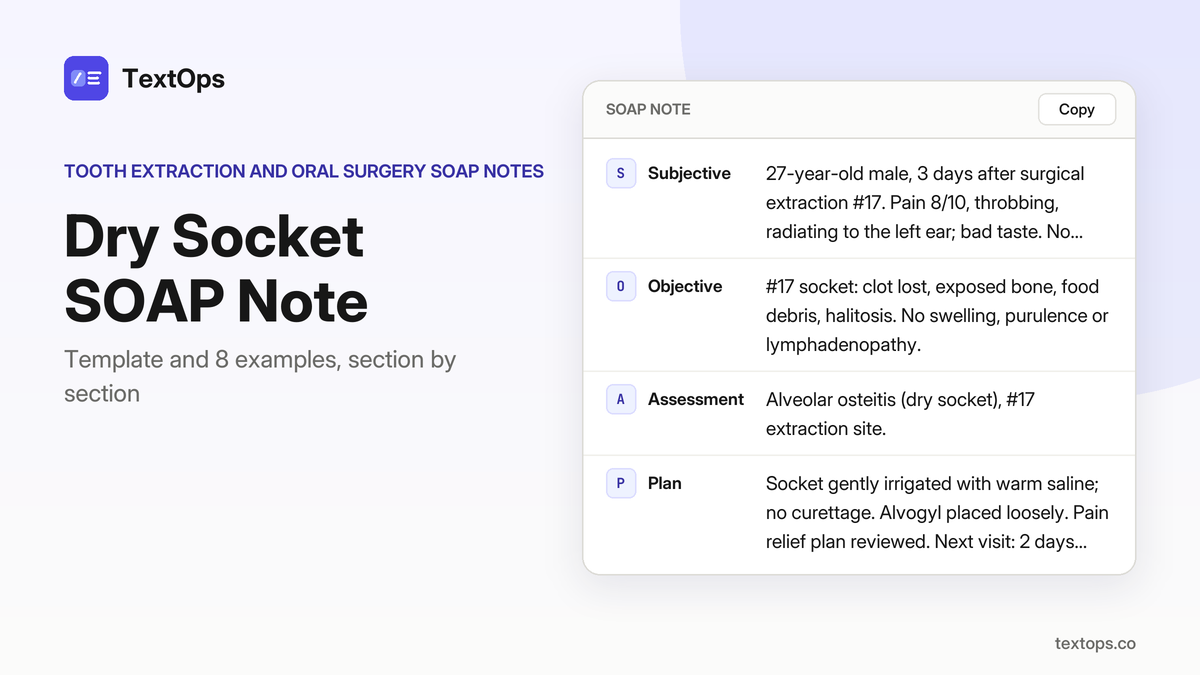
A dry socket (alveolar osteitis) note has to show three things: that the pain fits dry socket rather than normal healing or infection, what you did in the socket, and when you will see the patient again. This page gives you a copy-ready template, what to record in each section, and eight examples, including two patients whose pain turned out not to be dry socket.
Teeth use Universal numbering (#1–32). The patients are fictional: replace every finding with what you actually saw and did.
Dry Socket SOAP Note Template
Copy the template and fill in the fields in braces.
- Subjective
- {age}-year-old {sex}, {number} days after {simple / surgical} extraction #{tooth} on {date}. CC: "{patient's words}". Pain {score}/10, {throbbing / constant}, started on day {number}, radiating to {ear / temple / none}; {bad taste / odor}. Not controlled by {current pain relief}. No fever or swelling. Risk factors: {smoking, oral contraceptive, previous dry socket, difficult extraction}. Medical history: {conditions}. Medications: {list}. Allergies: {list, including iodine or eugenol}.
- Objective
- Temp {value}. #{tooth} socket: {empty / partly lost clot}, {exposed bone}, {food debris}, {halitosis}. Surrounding mucosa {normal / red}; no swelling, purulence or lymphadenopathy. {Radiograph if taken: no retained root or bone fragment}.
- Assessment
- Alveolar osteitis (dry socket), #{tooth} extraction site.
- Plan
- Diagnosis explained. {Anesthesia if needed: technique, agent, mL}. Socket gently irrigated with {warm saline / 0.12% chlorhexidine}; no curettage. {Dressing name} placed. Pain relief {reviewed / changed to …}. Instructions: {what to avoid, how to keep the dressing in, when to call}. Next visit: {2–3 days} for review and dressing change.
What to Write in Each Section
Subjective
- The timeline: the extraction date, and the day the pain started. Dry socket typically begins 2–4 days after the extraction, after an initial improvement. Severe pain from day 1 is usually ordinary post-operative pain.
- The pain: score, character, radiation (often to the ear), and what the patient has tried.
- Bad taste or odor, and the absence of fever and swelling, which point to infection instead.
- Risk factors: smoking, oral contraceptives, a difficult or surgical extraction, a previous dry socket.
- Allergies to dressing ingredients: many dressings contain eugenol or iodoform.
Objective
- The socket: empty or partly empty, exposed bone, food debris, halitosis.
- Signs of infection, recorded as absent: swelling, purulence, fever, lymphadenopathy, trismus.
- A radiograph when you suspect a retained root, a bone fragment or other pathology.
Assessment
Write “alveolar osteitis (dry socket)” and the tooth site. If the findings don’t fit, write what they do fit instead, such as normal post-operative pain or a post-extraction infection.
Plan
- Irrigation: what you used, and that you did not curette the socket.
- Dressing: the product, and that it was placed loosely.
- Pain relief: what you advised or prescribed. Antibiotics are not routine for dry socket.
- Instructions and next visit: dry socket usually needs review every 2–3 days, with a dressing change, until the pain settles.
Dry Socket SOAP Note Examples
| # | Example | Assessment |
|---|---|---|
| 1 | After a wisdom tooth extraction, smoker | Alveolar osteitis #17 |
| 2 | After a simple extraction, oral contraceptive | Alveolar osteitis #30 |
| 3 | Patient with diabetes | Alveolar osteitis #19 |
| 4 | Pregnant patient | Alveolar osteitis #32 |
| 5 | Upper molar | Alveolar osteitis #14 |
| 6 | Dressing change and resolution | Resolving alveolar osteitis #17 |
| 7 | Day 1 pain: not dry socket | Normal post-operative pain #31 |
| 8 | Swelling and fever: not dry socket | Post-extraction infection #18 |
1. After a Wisdom Tooth Extraction
The classic case: a lower third molar, a smoker, and pain that got worse on day 3.
- Subjective
- 27-year-old male, 3 days after surgical extraction #17. CC: "The pain got better, then much worse last night." Pain 8/10, throbbing, radiating to the left ear; bad taste. Ibuprofen not helping. No fever or swelling. Smokes 10 cigarettes/day; smoked on the day of extraction. Medical history: none. Medications: ibuprofen. Allergies: NKDA.
- Objective
- Temp 98.4°F. #17 socket: clot lost, exposed bone on the walls, food debris, halitosis. Mucosa slightly red at the margins; no swelling, purulence or lymphadenopathy. Mouth opening 40 mm. PA #17: no retained root or bone fragment.
- Assessment
- Alveolar osteitis (dry socket), #17 extraction site.
- Plan
- Diagnosis explained. IANB, 2% lidocaine with 1:100,000 epinephrine, 1 cartridge (1.7 mL). Socket gently irrigated with warm saline; debris removed; no curettage. Alvogyl placed loosely. Pain relief plan reviewed. Advised not to smoke while the socket heals; chew on the right; no rinsing for 24 hours, then gentle salt-water rinses. Next visit: 2 days for review and dressing change.
More examples: Wisdom Tooth Extraction SOAP Note.
2. After a Simple Extraction
Record risk factors even when the extraction was straightforward.
- Subjective
- 29-year-old female, 2 days after simple extraction #30. CC: "Throbbing pain and a horrible taste." Pain 7/10, constant, started this morning, worse at night. No fever or swelling. Takes a combined oral contraceptive. Medical history: none. Allergies: NKDA.
- Objective
- Temp 98.6°F. #30 socket: empty, grey-white bone visible, food debris, halitosis. No swelling, purulence or lymphadenopathy.
- Assessment
- Alveolar osteitis (dry socket), #30 extraction site.
- Plan
- Diagnosis explained. Socket irrigated with warm saline; no curettage. Zinc oxide–eugenol paste on iodoform gauze placed loosely. Over-the-counter pain relief reviewed. Instructions given on keeping the dressing in place. Next visit: 3 days for review and dressing change.
More examples: Simple Extraction SOAP Note.
3. Patient with Diabetes
Record glucose control, since it affects healing, and look harder for signs of infection.
- Subjective
- 56-year-old male, 4 days after extraction #19. CC: "My jaw aches all the time since Monday." Pain 7/10, constant, radiating to the ear. No fever or swelling. Medical history: type 2 diabetes, last HbA1c 7.8%. Medications: metformin. Allergies: NKDA.
- Objective
- Temp 98.8°F. #19 socket: empty, exposed bone, halitosis. No swelling, purulence or lymphadenopathy.
- Assessment
- Alveolar osteitis (dry socket), #19 extraction site. Diabetes may slow healing.
- Plan
- Diagnosis explained. Socket irrigated with warm saline; no curettage. Alvogyl placed loosely. Pain relief reviewed. Advised to keep glucose under control and to call if swelling or fever develops. Next visit: 2 days for review and dressing change.
4. Pregnant Patient
Record the stage of pregnancy, and choose pain relief and dressing with it in mind.
- Subjective
- 31-year-old female, 22 weeks pregnant, 3 days after extraction #32 for recurrent pericoronitis. CC: "Really bad pain on the right side and a bad taste." Pain 7/10, radiating to the ear. No fever or swelling. Medical history: uncomplicated pregnancy. Medications: prenatal vitamins. Allergies: NKDA.
- Objective
- Temp 98.6°F. #32 socket: clot lost, exposed bone, food debris. No swelling, purulence or lymphadenopathy.
- Assessment
- Alveolar osteitis (dry socket), #32 extraction site.
- Plan
- Diagnosis explained. Socket irrigated with warm saline; no curettage. Zinc oxide–eugenol dressing on plain gauze placed loosely. Acetaminophen advised for pain; NSAIDs avoided in pregnancy. Obstetrician informed. Next visit: 2–3 days for review and dressing change.
5. Upper Molar
Dry socket is less common in the upper jaw. When it happens near the sinus, record that there is no communication.
- Subjective
- 44-year-old female, 3 days after extraction #14. CC: "Aching under my left eye and a bad taste." Pain 6/10. No fever or swelling; no air or fluid passing into the nose. Medical history: none. Allergies: NKDA.
- Objective
- Temp 98.4°F. #14 socket: empty, exposed bone on the walls, halitosis. No swelling or purulence. Nose-blow test negative.
- Assessment
- Alveolar osteitis (dry socket), #14 extraction site; no oro-antral communication.
- Plan
- Diagnosis explained. Socket irrigated with warm saline; no curettage. Alvogyl placed loosely. Pain relief reviewed. Next visit: 3 days for review.
6. Dressing Change and Resolution
At each review, record the change in pain and whether you placed a new dressing.
- Subjective
- 27-year-old male, 5 days after surgical extraction #17; dry socket dressed 2 days ago. Pain down from 8/10 to 3/10; sleeping through the night. Not smoking since the last visit.
- Objective
- #17 socket: dressing in place; granulation tissue starting at the walls; less exposed bone. No swelling or purulence.
- Assessment
- Resolving alveolar osteitis, #17 extraction site.
- Plan
- Dressing removed; socket irrigated with warm saline; new Alvogyl dressing placed. Next visit: 3 days. If pain stays under 3/10 then, no further dressing.
7. Day 1 Pain: Not Dry Socket
Pain on day 1 with a clot in place is usually normal healing. Chart why it isn’t dry socket.
- Subjective
- 22-year-old female, 1 day after surgical extraction #31. CC: "It hurts a lot and my cheek is swollen." Pain 6/10, improving since last night. No bad taste. Taking pain relief as advised.
- Objective
- Temp 98.6°F. Mild right cheek swelling, consistent with the surgery. #31 socket: clot in place, no exposed bone. Sutures intact. Mouth opening 32 mm.
- Assessment
- Normal post-operative pain and swelling, #31 extraction site. No signs of dry socket or infection.
- Plan
- Reassured; post-op instructions reviewed again, including cold packs for the first day. Advised to call if pain gets worse after day 2, or if fever or more swelling develops. Next visit: 1 week as planned.
8. Swelling and Fever: Not Dry Socket
Swelling, pus or fever points to infection, which is treated differently. Record the findings that changed the diagnosis.
- Subjective
- 38-year-old male, 6 days after extraction #18. CC: "My face is swelling and I feel hot." Pain 7/10, swelling increasing since yesterday. No difficulty swallowing or breathing. Medical history: none. Allergies: NKDA.
- Objective
- Temp 100.6°F. Left buccal swelling, tender, not spreading below the jaw. Left submandibular lymph node tender. #18 socket: purulent discharge, clot partly lost. Mouth opening 35 mm; floor of mouth soft.
- Assessment
- Post-extraction infection, #18 extraction site; not dry socket.
- Plan
- Findings explained. Socket irrigated with saline; purulence drained. Antibiotic prescribed because of fever and swelling (agent, dose and duration recorded). Pain relief reviewed. Told to go to the emergency department if swallowing or breathing becomes difficult or the swelling spreads. Next visit: 48 hours.
More examples: Post-Extraction Follow-Up SOAP Note.
Dry Socket or Something Else?
| Finding | Dry socket | Normal healing | Infection |
|---|---|---|---|
| Pain starts | Day 2–4, after improving | Day 1, then improves | Often day 3 or later |
| Socket | Empty, exposed bone | Clot in place | Pus, clot may be lost |
| Swelling | None or slight | Mild, early, settling | Increasing |
| Fever | No | No | Often |
| Bad taste or odor | Common | Uncommon | Common |
Codes
- ICD-10-CM: M27.3, alveolitis of jaws.
- CDT: D9930, treatment of complications (post-surgical), unusual circumstances, by report. Some practices include dry socket care in the global fee for the extraction; check your payer.
Mistakes to Avoid
- No timeline. Without the extraction date and the day pain started, the diagnosis isn’t supported.
- Not recording the absence of infection. Write “no swelling, purulence or fever”, not just “dry socket”.
- Not naming the dressing. Record the product, so the next clinician knows what to remove and what the patient was exposed to.
- Routine antibiotics. If you prescribe one, the note should show why.
- No review date. Dry socket usually needs to be seen again in 2–3 days.
Frequently Asked Questions
When does dry socket usually start?
Typically 2–4 days after the extraction, often after the pain had started to improve. Severe pain on day 1 is more often normal post-operative pain.
What should a dry socket SOAP note include?
The extraction date and tooth, pain onset and character, risk factors and allergies (S); the socket findings and the absence of infection signs (O); “alveolar osteitis” with the site (A); and irrigation, dressing, pain relief, instructions and the next visit (P).
Do you prescribe antibiotics for dry socket?
Not routinely. Dry socket is treated with irrigation, a dressing and pain relief. Swelling, pus or fever suggest infection instead, which should be charted and managed as infection.
Should you curette a dry socket?
Generally no. Gentle irrigation to remove debris is enough; scraping the socket can increase pain.
How often should the dressing be changed?
Usually every 2–3 days, until the patient’s pain is controlled without it.
For the general structure of a dental note, see the dental SOAP note template. For a full extraction note, see the tooth extraction SOAP note.
These examples show structure and wording only. The patients are fictional. Record what you actually found and did, and follow your practice’s documentation requirements and the rules where you work.