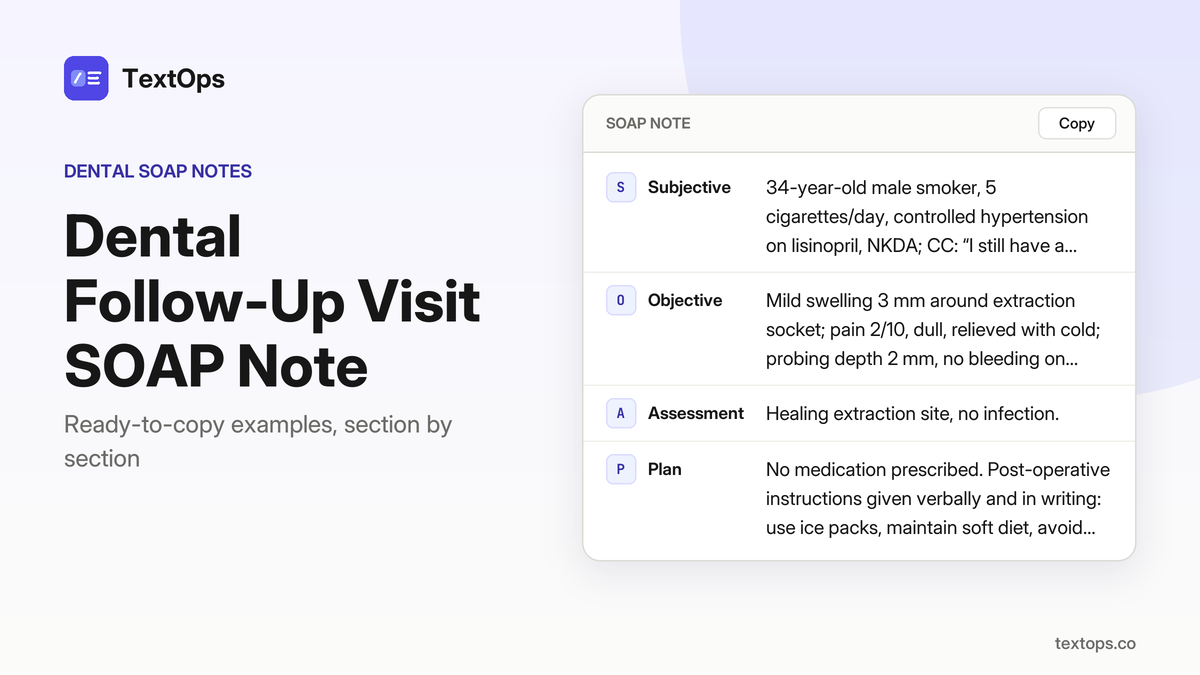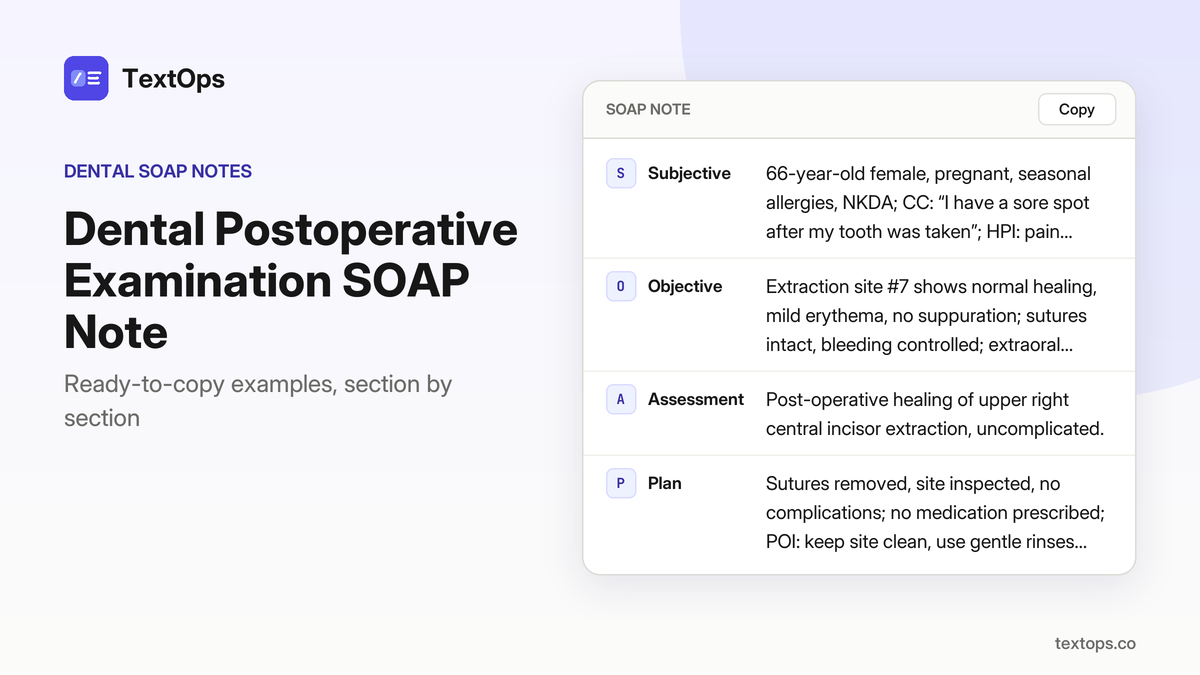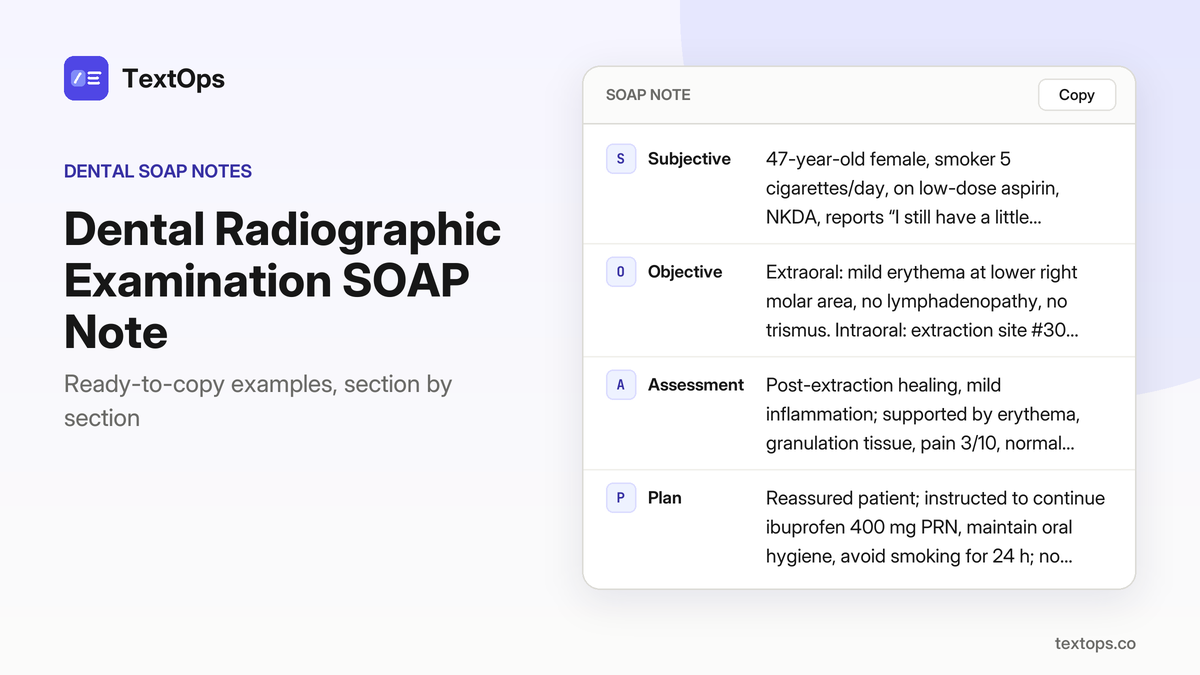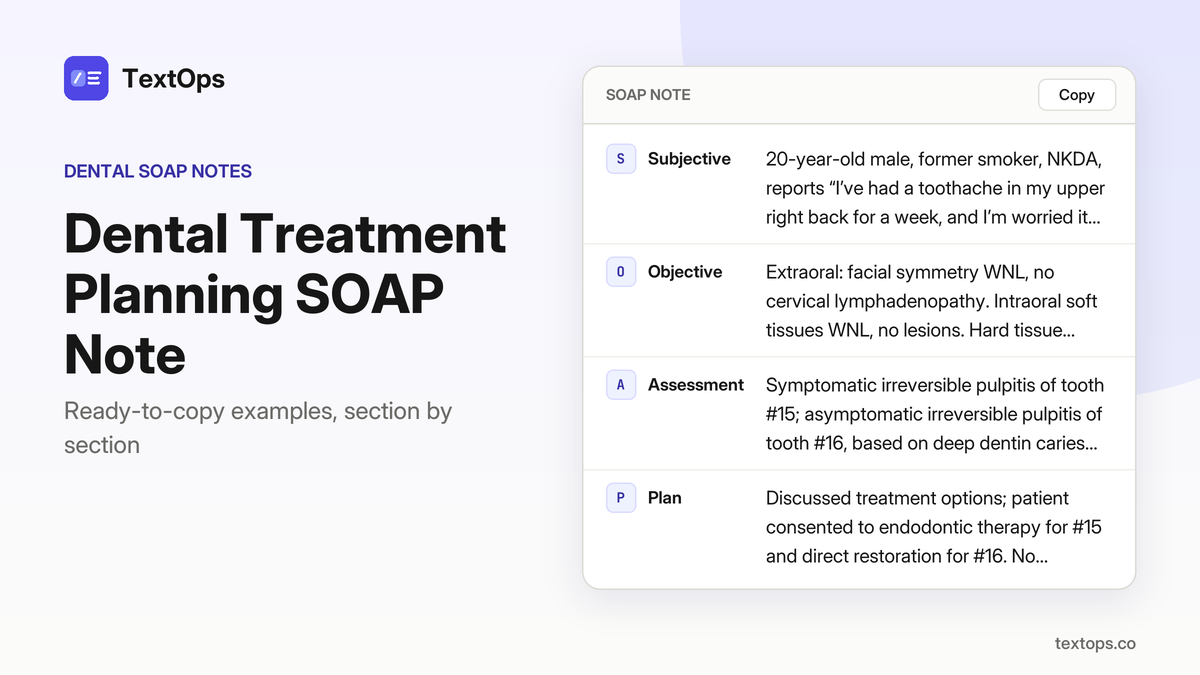
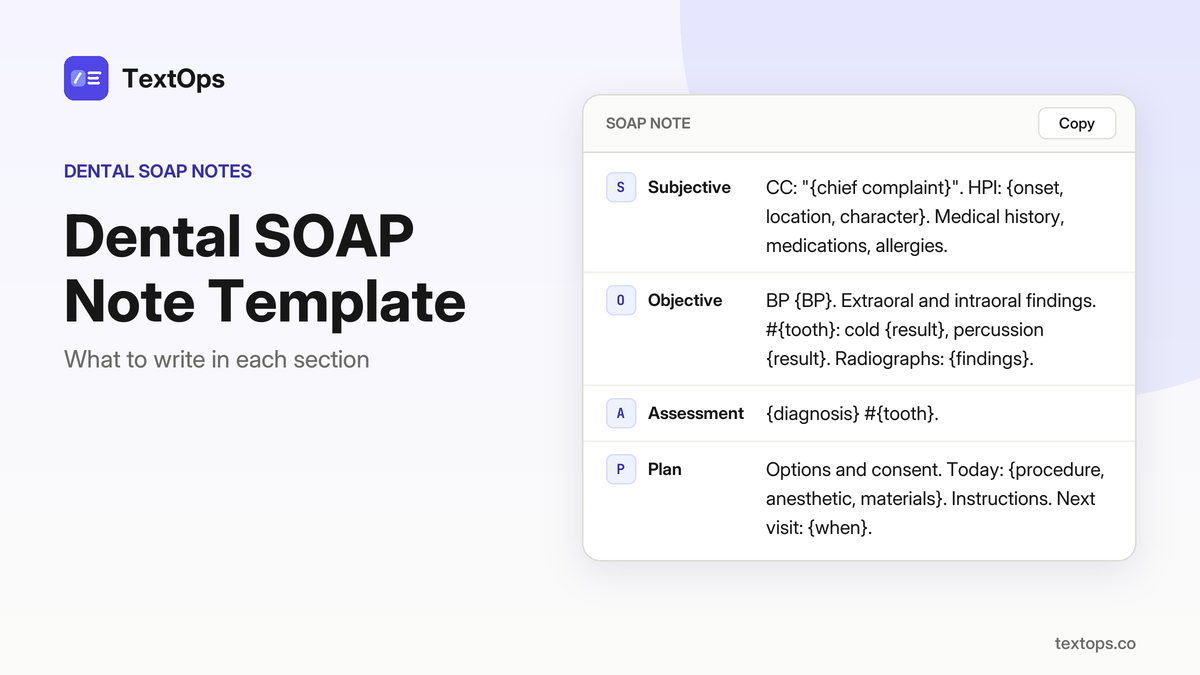
A dental SOAP note records a visit in four parts: Subjective (what the patient tells you), Objective (what you find), Assessment (your diagnosis, tooth by tooth) and Plan (what you did today and what happens next). Copy the template below, replace each {field} with what you actually found and did, and delete any line that doesn’t apply to the visit.
Dental SOAP Note Template
- Subjective
- {age}-year-old {sex}, {new patient / recall / emergency} visit. CC: "{chief complaint in the patient's words}". HPI: {onset, location, duration, character, what makes it worse or better}. Medical history: {conditions}. Medications: {medications}. Allergies: {allergies}. Last dental visit: {when}.
- Objective
- BP {BP}, pulse {pulse}. Extraoral: {findings}. Intraoral soft tissue: {findings}. Hard tissue: {teeth and findings}. Periodontal: {probing depths, BOP, mobility, recession}. Tests on #{tooth}: cold {result}, percussion {result}, palpation {result}. Radiographs: {type} of {area}: {findings}.
- Assessment
- {diagnosis} #{tooth}. {second diagnosis} #{tooth}.
- Plan
- Options discussed: {options}; patient chose {option}; risks, benefits and alternatives reviewed; consent {verbal / written}. Today: {procedure}, {anesthetic, amount, technique}, {isolation}, {materials}. Post-op instructions: {instructions}. Rx: {prescription or none}. Referral: {referral or none}. Next visit: {when} for {what}.
What to Write in Each Section
S: Subjective
The subjective section is the patient’s side of the story. Write the chief complaint in the patient’s own words, in quotation marks, so anyone reading the chart later sees why they came in.
- Chief complaint (CC): one line, quoted. “Upper right tooth hurts when I drink cold water.”
- History of present illness (HPI): for pain, record onset, location, duration, character (sharp, dull, throbbing), what sets it off, what relieves it, and whether it wakes the patient at night.
- Medical history update: conditions, medications and allergies, reviewed at every visit, not only at the first one. Note the allergy reaction where you know it (“penicillin, rash”).
- Dental history: last visit, previous treatment on the tooth in question, habits such as clenching or smoking.
O: Objective
The objective section is what you saw, measured and tested. Keep it to findings, not conclusions: “deep distal caries #19” belongs here, “needs a root canal” does not.
- Vital signs, at least blood pressure and pulse, especially before local anesthetic or surgery.
- Extraoral exam: swelling, asymmetry, lymph nodes, TMJ, lips.
- Intraoral soft tissue: mucosa, tongue, floor of mouth, palate. Record oral cancer screening findings even when normal.
- Hard tissue: caries, fractures, existing restorations, with tooth numbers and surfaces.
- Periodontal findings: probing depths, bleeding on probing (BOP), clinical attachment level (CAL), recession, mobility, furcation involvement.
- Tests: cold, electric pulp test, percussion, palpation and bite test, with the tooth tested and a control tooth.
- Radiographs: the type (bitewings, periapical, panoramic, CBCT), the area and what you saw.
A: Assessment
The assessment is your diagnosis, written so it follows from the findings above it. Give each diagnosis its tooth number, and use standard terms so the note reads the same to any clinician:
- Pulpal and periapical: for example “symptomatic irreversible pulpitis with symptomatic apical periodontitis #19”, using the American Association of Endodontists terms.
- Periodontal: for example “generalized periodontitis, stage III, grade B”, using the 2017 AAP/EFP classification. Stage and grade need CAL and radiographic bone loss in the objective section to back them up.
- Caries and restorative: for example “caries #14 MO into dentin”.
If you aren’t sure yet, say so: “suspected cracked tooth #30, to be confirmed at restoration.”
P: Plan
The plan records what you did today and what happens next. This is the section most often questioned later, so it needs the most detail.
- Options and consent: the options you discussed, which one the patient chose, and that risks, benefits and alternatives were reviewed. Note when a patient declines treatment you recommended.
- Procedure today: anesthetic (agent, concentration, amount and technique), isolation, materials and shade, and how the patient tolerated it.
- Instructions and prescriptions: post-op instructions given, and any prescription with drug, dose, quantity and directions.
- Referrals: to whom and why.
- Next visit: when, and for what.
Short Templates for Common Visits
Use these as starting points for the visits you chart most often. Each one keeps only the lines that visit usually needs.
Comprehensive exam (new patient)
- Subjective
- New patient, {age}-year-old {sex}. CC: "{CC}". Last dental visit: {when}. Medical history: {conditions}. Medications: {medications}. Allergies: {allergies}.
- Objective
- BP {BP}. Extraoral: {findings}. Oral cancer screening: {findings}. Hard tissue: {charting}. Periodontal charting: PD {range}, BOP {%}, CAL {range}. Radiographs: {FMX / BWX + pano}: {findings}.
- Assessment
- {caries diagnoses by tooth}. {periodontal diagnosis}. {other findings}.
- Plan
- Treatment plan presented in phases: {phase 1}, {phase 2}. Patient {accepted / will consider}. Next visit: {when} for {first procedure}.
Emergency or limited exam
- Subjective
- {age}-year-old {sex}. CC: "{CC}". HPI: {onset}, {location}, {character}, {triggers}, {night pain yes/no}. Medications: {medications}. Allergies: {allergies}.
- Objective
- Extraoral: {swelling / none}. #{tooth}: {visible findings}. Cold: {result}. Percussion: {result}. Palpation: {result}. PA radiograph #{tooth}: {findings}.
- Assessment
- {pulpal diagnosis} with {periapical diagnosis} #{tooth}.
- Plan
- Options discussed: {options}. Patient chose {option}. Today: {treatment}. Instructions: {instructions}. Next visit: {when} for {definitive treatment}.
Restorative (filling)
- Subjective
- Patient here for planned restoration #{tooth} {surfaces}. No changes to medical history. {Sensitivity / no symptoms}.
- Objective
- #{tooth} {surfaces}: {caries extent}. Cold: {result}. Percussion: {result}.
- Assessment
- Caries #{tooth} {surfaces} {into enamel / dentin}.
- Plan
- Consent reviewed. {anesthetic, amount, technique}. Isolation: {rubber dam / other}. Caries removed; {liner / base if used}; {material} restoration, shade {shade}. Occlusion checked and adjusted. Next visit: {when} for {next treatment}.
Extraction
- Subjective
- Patient here for extraction #{tooth}. Medical history reviewed: {conditions, anticoagulants, bisphosphonates}. Allergies: {allergies}.
- Objective
- BP {BP}. #{tooth}: {findings}. Radiograph: {findings, root form, proximity to nerve or sinus}.
- Assessment
- {reason for extraction} #{tooth}.
- Plan
- Risks, benefits and alternatives reviewed; written consent signed. {anesthetic, amount, technique}. {Simple / surgical} extraction #{tooth}: {technique}. Hemostasis achieved with {method}. Post-op instructions given verbally and in writing. Rx: {prescription or none}. Next visit: {when} for post-op check.
For hygiene visits, see the dental hygiene SOAP note template. For completed notes for each type of visit, see dental SOAP note examples.
Dental SOAP Note Cheat Sheet
| Section | What to include | Example wording |
|---|---|---|
| S | Chief complaint in quotes, HPI, medical history update, medications, allergies | CC: “Lower left tooth throbs at night.” Allergies: penicillin (rash). |
| O | Vitals, extraoral and intraoral findings, charting, tests, radiographs | Cold #19: lingering pain 20 s. Percussion #19: positive. |
| A | Diagnosis per tooth, in standard terms, supported by O | Symptomatic irreversible pulpitis with symptomatic apical periodontitis #19. |
| P | Options and consent, procedure details, instructions, Rx, referral, next visit | Patient chose root canal treatment. Pulpectomy #19 today. Return in 2 weeks. |
Common Dental SOAP Note Abbreviations
| Abbreviation | Meaning |
|---|---|
| CC | Chief complaint |
| HPI | History of present illness |
| PMH | Past medical history |
| NKDA | No known drug allergies |
| WNL | Within normal limits |
| EO / IO | Extraoral / intraoral |
| PD | Probing depth |
| CAL | Clinical attachment level |
| BOP | Bleeding on probing |
| BWX / PA / FMX | Bitewings / periapical / full-mouth series |
| CBCT | Cone-beam computed tomography |
| IANB | Inferior alveolar nerve block |
| RCT | Root canal treatment |
| SRP | Scaling and root planing |
| POI | Post-operative instructions |
| RTC | Return to clinic |
Only use abbreviations your practice has agreed on. When in doubt, write it out.
Mistakes to Avoid
- Copying the last note forward. A recall note that repeats last visit’s findings word for word suggests nothing was examined. Record today’s findings.
- An assessment the findings don’t support. If the assessment says periodontitis, the objective section needs the probing depths, CAL and bone loss that show it.
- Missing tooth numbers and surfaces. “Filling done” is not a record. “#14 MO composite, shade A2” is.
- Leaving out the anesthetic. Record the agent, concentration, amount and technique every time.
- No record of consent or of declined treatment. Note what you offered and what the patient decided, including a refusal.
- Vague phrases on their own. “Patient tolerated procedure well” is fine as a closing line, not as a substitute for what was done.
- Changing an old entry. Add a dated addendum instead of editing or deleting what was written before.
Frequently Asked Questions
What is a dental SOAP note?
A dental SOAP note is a structured record of a dental visit in four sections: subjective, objective, assessment and plan. It gives every clinician who sees the patient the same picture of what was found, what was decided and what was done.
Who writes dental SOAP notes?
Dentists, dental hygienists and dental specialists all write them, each for the care they provided. Assistants may help record information, but the clinician who provided the care should review and sign the note. Check what your state or country’s dental board allows.
How long should a dental SOAP note be?
As long as it needs to be to show what you found, what you decided and what you did. A routine recall may take five or six lines; a surgical visit needs more. Detail matters more than length.
What is the difference between a SOAP note and a progress note?
A progress note is any entry recording a visit. A SOAP note is a progress note written in the subjective, objective, assessment and plan format. Many practices use SOAP for every progress note because it makes the reasoning easy to follow.
Do I need a SOAP note for every dental visit?
Every visit needs a record. Whether it must be in SOAP format depends on your practice, your software and the rules where you work. Many dentists use SOAP for exams, emergencies and treatment visits, and shorter formats for simple follow-ups.
More Dental SOAP Notes
- Dental SOAP Note Examples
- Comprehensive Dental Exam SOAP Note
- Limited Dental Exam SOAP Note
- Dental Hygiene SOAP Note Examples
- Dental Hygiene Assessment SOAP Note
- Tooth Extraction SOAP Note
- Simple Extraction SOAP Note
- Irreversible Pulpitis SOAP Note
These templates show structure and wording only. Record what you actually found and did, and follow your practice’s documentation requirements and the rules where you work.