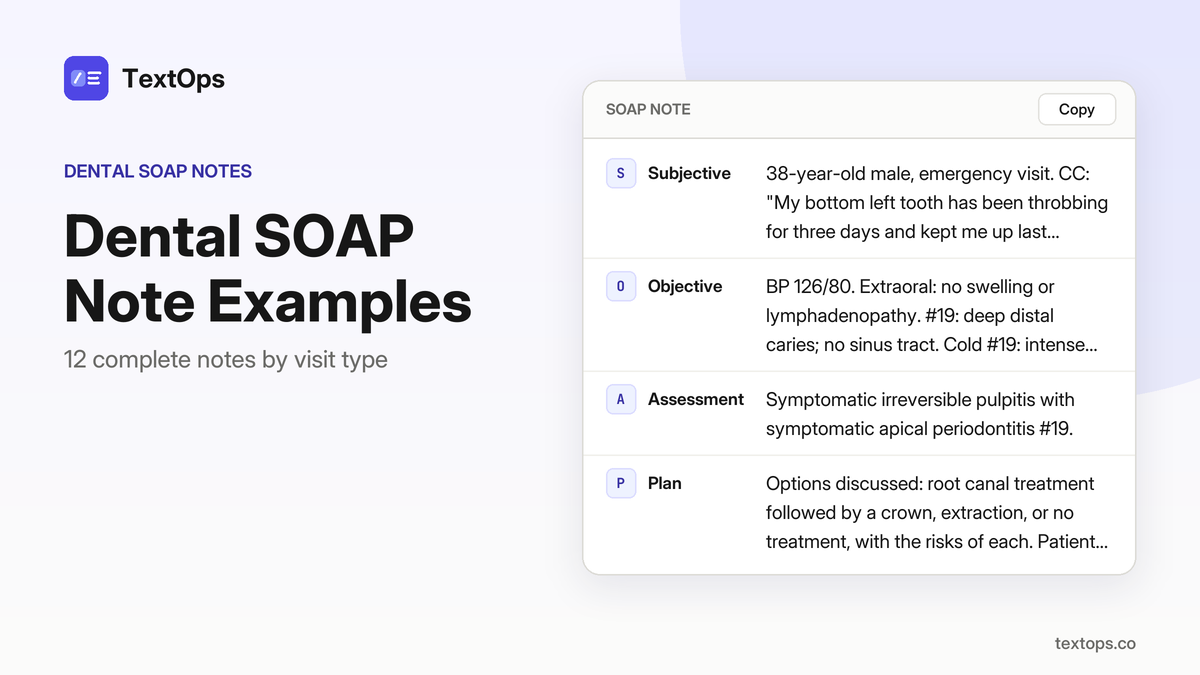
These 12 dental SOAP note examples cover the visits most practices chart every week, from a new-patient exam to an emergency, a filling, an extraction, a crown, an implant consultation, a child’s visit and an orthodontic adjustment. Each one is a complete note you can copy with one click and adapt. Replace the findings with what you actually saw and did; the patients here are fictional.
Teeth use Universal numbering (#1–32 for permanent teeth, A–T for primary teeth). For a blank version with guidance on each section, see the dental SOAP note template.
| # | Visit | Assessment |
|---|---|---|
| 1 | New-patient comprehensive exam | Caries #3, #14, #19; localized gingivitis |
| 2 | Periodic recall exam | No new caries; gingival health |
| 3 | Emergency toothache | Symptomatic irreversible pulpitis #19 |
| 4 | Composite filling | Caries #14 MO into dentin |
| 5 | Scaling and root planing | Periodontitis, stage III, grade C |
| 6 | Simple extraction | Non-restorable #30 |
| 7 | Post-extraction check | Normal healing #30 |
| 8 | Dry socket | Alveolar osteitis #17 |
| 9 | Crown preparation | Endodontically treated #19 |
| 10 | Implant consultation | Edentulous site #30 |
| 11 | Child’s recall visit | Caries #K; high caries risk |
| 12 | Orthodontic adjustment | Fixed appliances; bracket debond #7 |
1. New-Patient Comprehensive Exam
A first visit records the full baseline: medical history, an oral cancer screening, charting, periodontal findings and radiographs, then a treatment plan the patient can agree to.
- Subjective
- 45-year-old female, new patient. CC: "I haven't seen a dentist in three years and want a checkup." No pain. Medical history: hypertension. Medications: lisinopril. Allergies: NKDA. Non-smoker.
- Objective
- BP 134/86, pulse 74. Extraoral: no swelling or lymphadenopathy; TMJ without clicking or tenderness. Intraoral soft tissue WNL; oral cancer screening negative. Hard tissue: caries #3 O, #14 MO, #19 DO; amalgam #30 MOD intact. Periodontal charting: PD 2–4 mm, 4 mm at #2 and #15; BOP 18%; CAL 0–1 mm; no mobility. FMX: caries #3, #14, #19 into dentin; no periapical pathology; bone levels WNL.
- Assessment
- Caries #3 O, #14 MO, #19 DO into dentin. Plaque-induced gingivitis, localized.
- Plan
- Findings and radiographs reviewed with patient. Treatment plan: phase 1, prophylaxis and oral hygiene instruction; phase 2, composite restorations #3 O, #14 MO, #19 DO. Patient accepted. Next visit: 1 week for prophylaxis, then restorations #14 and #19.
More examples: Comprehensive Dental Exam SOAP Note.
2. Periodic Recall Exam
A recall note should show that you examined the patient today, not that last visit’s note was copied forward. Compare with previous findings and radiographs.
- Subjective
- 52-year-old male, 6-month recall. CC: "Just here for my cleaning." Medical history: type 2 diabetes, unchanged; patient reports last HbA1c 6.9%. Medications: metformin. Allergies: NKDA.
- Objective
- BP 128/82. Extraoral WNL. Intraoral soft tissue WNL; oral cancer screening negative. Hard tissue: no new caries; existing restorations intact. Periodontal: PD 2–3 mm, BOP 6%, no mobility. 2 BWX: no interproximal caries; bone levels unchanged from previous images.
- Assessment
- No new caries. Gingival health on an intact periodontium.
- Plan
- Prophylaxis completed; oral hygiene reviewed. Link between diabetes control and periodontal health discussed. Next visit: 6-month recall.
More examples: Periodic Oral Evaluation SOAP Note, Dental Hygiene Recall SOAP Note.
3. Emergency Toothache
An emergency note lives or dies on the tests: which tooth, which test, what response, and a control tooth. The pulpal and periapical diagnosis should follow directly from them.
- Subjective
- 38-year-old male, emergency visit. CC: "My bottom left tooth has been throbbing for three days and kept me up last night." HPI: started with cold sensitivity 3 days ago, now spontaneous throbbing pain, worse lying down; OTC ibuprofen helps for a few hours. Medical history: none. Allergies: NKDA.
- Objective
- BP 126/80. Extraoral: no swelling or lymphadenopathy. #19: deep distal caries; no sinus tract. Cold #19: intense pain lingering 20 seconds after removal; control #20 normal, no lingering. Percussion #19 positive; palpation negative. PA #19: deep distal caries approaching the pulp; widened PDL space at the mesial root apex.
- Assessment
- Symptomatic irreversible pulpitis with symptomatic apical periodontitis #19.
- Plan
- Options discussed: root canal treatment followed by a crown, extraction, or no treatment, with the risks of each. Patient chose root canal treatment; written consent signed. IANB, 2% lidocaine with 1:100,000 epinephrine, 2 cartridges (3.4 mL). Rubber dam. Access and pulpectomy #19; canals irrigated with sodium hypochlorite; calcium hydroxide placed; temporary restoration; occlusion checked. Patient told to expect tenderness for a few days and to chew on the right side. Over-the-counter pain relief reviewed. Next visit: 1–2 weeks to complete root canal treatment; crown to follow.
More examples: Irreversible Pulpitis SOAP Note, Limited Dental Exam SOAP Note.
4. Composite Filling
A restorative note records the tooth and surfaces, the pulp status before you start, the anesthetic, isolation and the material and shade.
- Subjective
- 45-year-old female, here for planned restoration #14 MO. Medical history unchanged. Mild sensitivity to sweets on the upper left.
- Objective
- BP 130/84. #14 MO: caries into dentin, clinically and on bitewing. Cold #14: normal response, no lingering. Percussion negative.
- Assessment
- Caries #14 MO into dentin; normal pulp.
- Plan
- Consent reviewed. Buccal infiltration, 2% lidocaine with 1:100,000 epinephrine, 1 cartridge (1.7 mL). Rubber dam. Caries removed; no pulp exposure. Selective enamel etch, bonding agent, composite placed in increments, shade A2. Contact checked with floss; occlusion checked and adjusted. Patient told numbness lasts 2–3 hours and mild sensitivity may follow. Next visit: restoration #19 DO.
5. Scaling and Root Planing
A periodontal diagnosis needs its evidence in the objective section: probing depths, CAL, bone loss and risk factors such as smoking, which can change the grade.
- Subjective
- 48-year-old male. CC: "My gums bleed when I brush and one tooth feels a bit loose." Smokes 10 cigarettes a day. Medications: none. Allergies: NKDA.
- Objective
- BP 132/84. Periodontal charting: PD 5–7 mm generalized on posterior teeth; interdental CAL 5–6 mm; BOP 45%; mobility grade I #3; subgingival calculus throughout. FMX: generalized horizontal bone loss to the middle third of the roots. No teeth lost to periodontitis.
- Assessment
- Generalized periodontitis, stage III, grade C (smoking 10 cigarettes a day).
- Plan
- Diagnosis and risk factors explained; smoking cessation advised and support offered. SRP planned in 2 visits. Today, UR and LR quadrants: IANB and buccal infiltrations, 2% lidocaine with 1:100,000 epinephrine, 3 cartridges (5.1 mL) total. SRP with ultrasonic and hand instruments. Oral hygiene instruction with interdental brushes. Next visit: 1 week for UL and LL; re-evaluation 4–6 weeks after the second visit.
More examples: Scaling and Root Planing SOAP Note, Periodontitis SOAP Note.
6. Simple Extraction
Before an extraction, record the medical history items that change the plan, such as anticoagulants and antiresorptive drugs, and the written consent.
- Subjective
- 61-year-old female, here for extraction #30. Medical history: hypertension. Medications: amlodipine. No anticoagulants; no bisphosphonate or other antiresorptive history. Allergies: codeine (nausea).
- Objective
- BP 138/86, pulse 78. #30: fractured restoration with recurrent caries extending to the furcation; mobility grade I. PA #30: two roots, clear of the mandibular canal; no periapical pathology.
- Assessment
- Non-restorable #30 due to recurrent caries and fracture.
- Plan
- Options discussed: extraction with later replacement (implant, bridge or partial denture), or no treatment. Patient chose extraction; written consent signed. IANB and long buccal, 2% lidocaine with 1:100,000 epinephrine, 2 cartridges (3.4 mL). Simple extraction #30 with elevator and forceps; roots intact. Socket irrigated; hemostasis with gauze pressure. Post-op instructions given verbally and in writing: gauze for 30–45 minutes; no rinsing, spitting, straws or smoking for 24 hours. Over-the-counter pain relief reviewed; no opioid prescribed. Next visit: 1 week for post-op check.
More examples: Tooth Extraction SOAP Note, Simple Extraction SOAP Note, Surgical Extraction SOAP Note.
7. Post-Extraction Check
A short follow-up note still needs a finding and an assessment, plus the next step for replacing the tooth.
- Subjective
- 61-year-old female, 7 days after extraction #30. Mild soreness for the first 2 days, none now; took ibuprofen for 2 days. No bleeding, fever or bad taste.
- Objective
- #30 socket: granulation tissue, no exposed bone, no swelling or purulence. Adjacent teeth WNL.
- Assessment
- Normal healing, extraction site #30.
- Plan
- Continue gentle warm salt-water rinses for a few more days. Tooth replacement options discussed again; patient would like an implant. Next visit: implant consultation in about 8 weeks.
More examples: Post-Extraction Follow-Up SOAP Note.
8. Dry Socket
When pain gets worse a few days after an extraction, record the timing, what the socket looks like, and signs that would point to infection instead.
- Subjective
- 24-year-old male, 4 days after extraction #17. CC: "The pain is getting worse, not better." Pain increasing since day 2, radiating to the left ear, not controlled by ibuprofen; bad taste. Smoker; resumed smoking the day after the extraction. Allergies: NKDA.
- Objective
- Temperature 98.4 °F. Extraoral: no swelling or lymphadenopathy; mouth opening 35 mm. #17 socket: partially empty with exposed bone and food debris; no purulence. Halitosis.
- Assessment
- Alveolar osteitis (dry socket), #17 socket.
- Plan
- IANB, 2% lidocaine with 1:100,000 epinephrine, 1 cartridge (1.7 mL). Socket gently irrigated with warm saline; medicated dressing placed; no curettage. Advised to stop smoking while the socket heals. Pain relief plan reviewed. Next visit: 2–3 days for dressing change, sooner if swelling or fever develops.
More examples: Dry Socket SOAP Note.
9. Crown Preparation
A crown note links back to why the tooth needs a crown and records the build-up, the impression method, the shade and the provisional.
- Subjective
- 38-year-old male, root canal treatment #19 completed 2 weeks ago; no symptoms since. Here for crown preparation.
- Objective
- #19: temporary restoration intact; percussion negative; no swelling. PA #19: root canal filling well condensed; no new periapical findings.
- Assessment
- Endodontically treated #19 requiring full coverage.
- Plan
- Consent reviewed. IANB, 2% lidocaine with 1:100,000 epinephrine, 1 cartridge (1.7 mL). Composite core build-up. Preparation for full-coverage zirconia crown; retraction cord; digital scan; shade A3. Provisional bis-acryl crown cemented with temporary cement; occlusion checked. Patient told to avoid sticky foods and to slide floss out sideways. Next visit: 2 weeks to seat the crown.
10. Implant Consultation
An implant consultation records the risk factors, the bone available, the alternatives offered and which one the patient chose.
- Subjective
- 61-year-old female, 10 weeks after extraction #30; would like an implant. Medical history: hypertension, controlled. Medications: amlodipine. No diabetes; no bisphosphonate or other antiresorptive history; non-smoker. Allergies: codeine.
- Objective
- BP 132/82. #30 site healed; about 4 mm keratinized tissue; adequate space to the opposing teeth. CBCT #30 site: about 14 mm of bone above the mandibular canal and about 7 mm wide; no pathology.
- Assessment
- Edentulous site #30 with bone adequate for implant placement.
- Plan
- Options discussed with costs: implant and crown, bridge #29–31, removable partial denture, or no replacement. Patient chose an implant. Plan: implant placement #30, about 3 months of healing, then implant crown. Consent forms given to review. Next visit: implant placement.
More examples: Dental Bone Grafting SOAP Note.
11. Child’s Recall Visit
For a child, record who came with them and gave consent, how the child cooperated, caries risk factors, and preventive care as well as treatment.
- Subjective
- 6-year-old male with his mother, recall visit. CC (mother): "He says his back tooth hurts when he eats candy." Brief pain with sweets only; no night pain. No medical conditions; no medications; NKDA. Brushes once a day with help; drinks juice between meals.
- Objective
- Cooperative (Frankl 3). Extraoral WNL. Intraoral soft tissue WNL. #K occlusal caries into dentin. #19 and #30 erupted, sound, deep fissures. Plaque on lower molars. 2 BWX: caries #K into dentin; no furcation radiolucency.
- Assessment
- Caries #K O into dentin with reversible pulpitis. High caries risk.
- Plan
- Findings explained to mother. Prophylaxis; 5% sodium fluoride varnish on all teeth; sealants #19 and #30. Diet advice: juice only with meals; brush twice a day with a pea-sized amount of fluoride toothpaste, with help. Mother consented to restoration #K. Next visit: 2 weeks for restoration #K; recall every 3 months because of high caries risk.
12. Orthodontic Adjustment
An orthodontic note tracks progress against the start of treatment, any breakages, the wires and elastics, and compliance.
- Subjective
- 15-year-old female, month 8 of fixed appliance treatment, upper and lower, with her father. CC: "A bracket on my top tooth came off last week." No pain. Wearing elastics "most of the day." Medical history: none. Allergies: NKDA.
- Objective
- Bracket #7 debonded; other brackets and bands intact. Oral hygiene fair: plaque along the gingival margin of lower anterior teeth with mild gingival inflammation. Archwires: 0.016 NiTi upper and lower. Overjet 5 mm (7 mm at start). Molars half-cusp Class II bilaterally, improving.
- Assessment
- Fixed appliance treatment progressing. Bracket debond #7. Plaque-induced gingivitis, lower anterior teeth. Partial elastic wear.
- Plan
- Bracket #7 rebonded. Archwires changed to 0.016 x 0.022 NiTi upper and lower. Class II elastics bilaterally, to be worn full time except when eating; elastic wear discussed with patient and father. Oral hygiene instruction with an interdental brush around brackets. Next visit: 6 weeks.
How to Adapt These Examples
- Start from the closest visit type, then delete lines that don’t apply rather than leaving them blank.
- Replace every finding with your own. Tooth numbers, test results, probing depths and radiograph findings must be what you recorded today.
- Check the assessment against your findings. If you change the findings, the diagnosis may need to change too.
- Record the anesthetic, materials and consent for every procedure, exactly as given.
- End with the next visit, so whoever sees the patient next knows what was planned.
Frequently Asked Questions
What should a dental SOAP note include?
The patient’s chief complaint and history (subjective), your findings, tests and radiographs (objective), a diagnosis for each tooth or condition (assessment), and what you did and plan to do next (plan). The dental SOAP note template covers each section in detail.
Can I copy these examples into a patient chart?
Use them as a starting point for wording and structure only. Every finding, diagnosis and treatment detail has to reflect your own patient and what you actually did.
Do dental specialists use SOAP notes too?
Yes. Endodontists, periodontists, oral surgeons, pediatric dentists and orthodontists all use the same four sections, with the objective findings and plan suited to their specialty, as examples 3, 5, 6, 11 and 12 show.
More Dental SOAP Notes
- Dental SOAP Note Template
- Dental Hygiene SOAP Note Examples
- Gingivitis SOAP Note
- Tooth Extraction SOAP Note
- Wisdom Tooth Extraction SOAP Note
- Dental Treatment Planning SOAP Note
- All dental SOAP notes
These examples show structure and wording only. The patients are fictional. Record what you actually found and did, and follow your practice’s documentation requirements and the rules where you work.