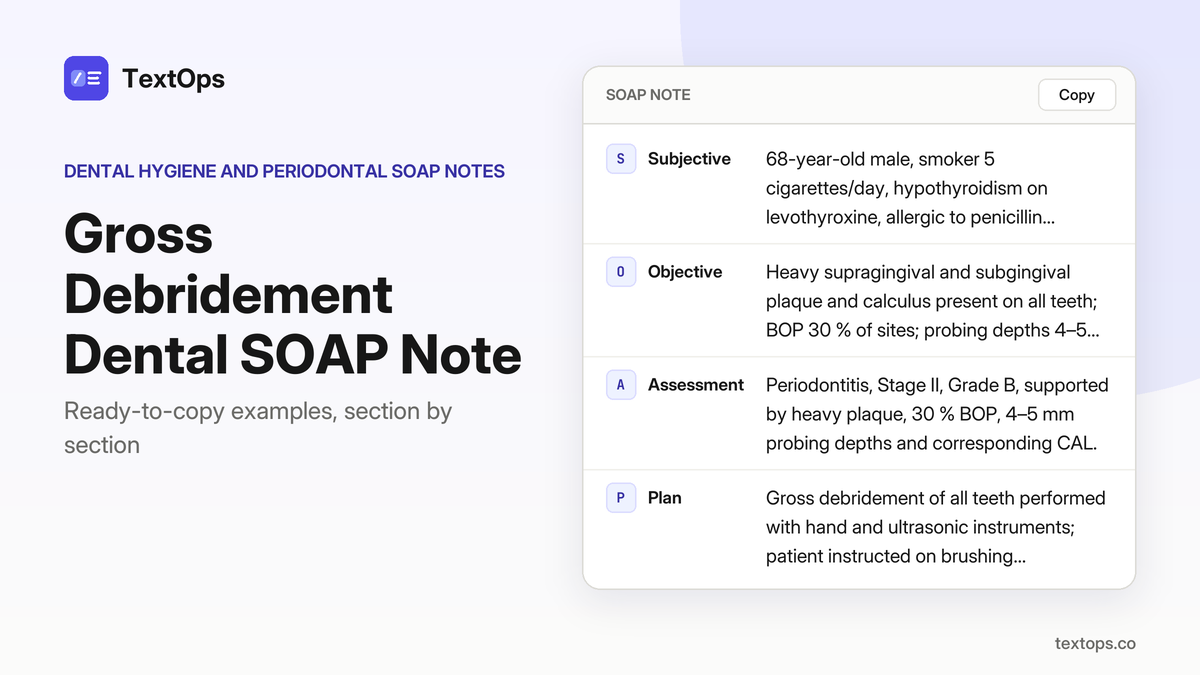
Dental Sealant SOAP Note documentation is concise, fully formatted, and ready to copy for pediatric sealant procedures. The collection includes a comprehensive checklist of required fields, clear tooth-numbering guidance, and patient-education templates. Each example is a complete S-O-A-P block, ensuring hygienists and assistants can paste and adapt instantly for any child sealant visit.
Initial Preventive Sealant Visits
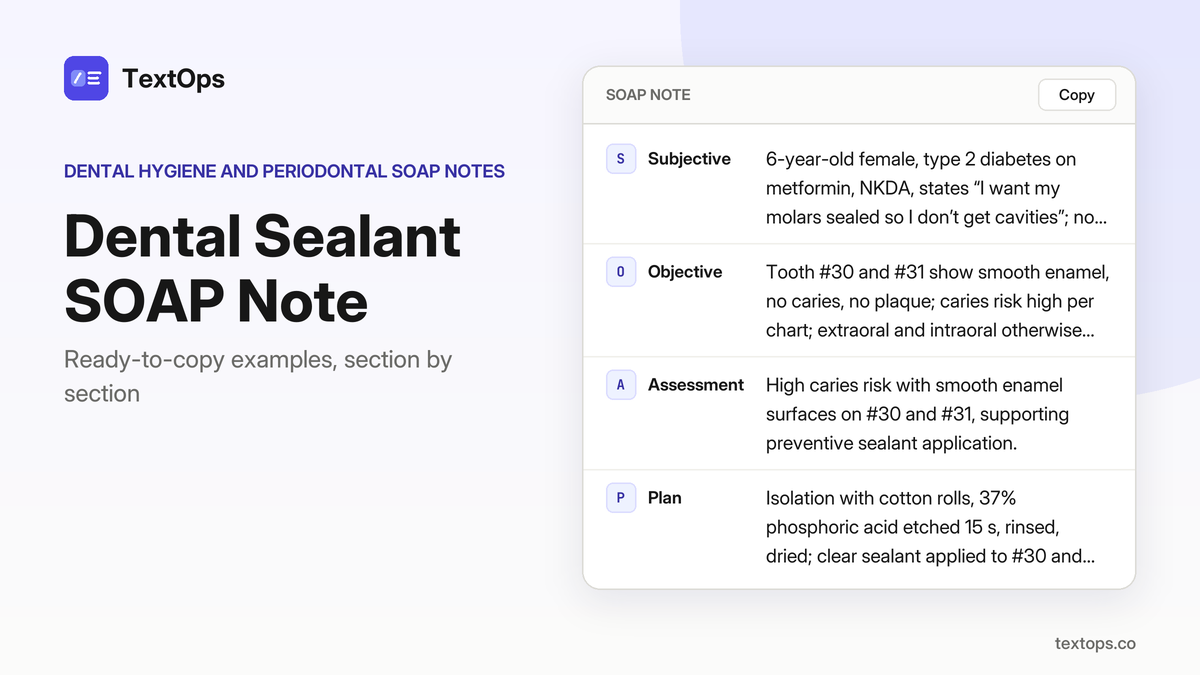
First-Visit Pediatric Sealant for 6-Year-Old Female
SOAP note
SSubjective
6-year-old female, type 2 diabetes on metformin, NKDA, states “I want my molars sealed so I don’t get cavities”; no systemic signs, no pain, oral hygiene acceptable.
OObjective
Tooth #30 and #31 show smooth enamel, no caries, no plaque; caries risk high per chart; extraoral and intraoral otherwise normal; no anesthesia administered.
AAssessment
High caries risk with smooth enamel surfaces on #30 and #31, supporting preventive sealant application.
PPlan
Isolation with cotton rolls, 37% phosphoric acid etched 15 s, rinsed, dried; clear sealant applied to #30 and #31, light cured 20 s each, retention checked with explorer; fluoride varnish 5% applied to all occlusal surfaces; counsel on diet, brushing, and return in 6 months for sealant check.
Sealant on Mixed Dentition with Fluoride Varnish
SOAP note
SSubjective
66-year-old female, controlled hypertension on lisinopril, NKDA, reports “I have a lot of fillings and want to protect my molars.”
OObjective
Tooth #14 and #15 enamel intact, no caries; moderate plaque on occlusal surfaces; gingiva normal; no inflammation; caries risk moderate; no anesthesia used.
AAssessment
Moderate caries risk supported by intact enamel, moderate plaque, and patient history of many fillings.
PPlan
Isolation with cotton rolls; etch with 37% phosphoric acid 15 s, rinse, dry; apply resin sealant to #14 and #15, light cure 20 s each, check retention; apply 5% fluoride varnish to all occlusal surfaces; advised diet and brushing; plan review in 12 months.
Sealant on 5-Year-Old with Early Childhood Caries
SOAP note
SSubjective
5-year-old male, hypothyroidism on levothyroxine, allergic to penicillin (rash). Chief complaint: “My mom says I should get sealants before my baby teeth fall out.” History: early childhood caries, no current caries on #5 or #6, good oral hygiene, no plaque. PMH: levothyroxine, allergy to penicillin.
OObjective
Extraoral: normal. Intraoral: #5 and #6 smooth enamel, no caries; no plaque; oral hygiene good. Periodontal: healthy. Radiographs: none taken. Tests: none.
AAssessment
High caries risk due to early childhood caries history, supported by smooth enamel surfaces and good hygiene but recognized susceptibility.
PPlan
Isolation with cotton rolls; 37% phosphoric acid etch 15 s, rinse, dry. Sealant applied to #5 and #6, light-cured 20 s each, retention checked. Fluoride varnish 5% applied to all occlusal surfaces. Counsel on diet, brushing, and fluoride use. No medication prescribed. Return in 6 months for sealant check.
Sealant on 6-Year-Old with Fluorosis
SOAP note
SSubjective
6-year-old male, no significant medical history, NKDA. Chief complaint: “I have yellow spots on my molars.” History: mild fluorosis on #30 and #31, no caries, plaque, or gingival inflammation.
OObjective
Extraoral normal. Intraoral: #30 and #31 show white opacities, no decay, plaque index 0, gingival health WNL.
AAssessment
Mild fluorosis; moderate caries risk, evidenced by white opacities and absence of caries.
PPlan
Isolation with cotton rolls. Etch with 37% phosphoric acid for 15 s, rinse, dry. Sealant applied to #30 and #31, light cured 20 s each, retention checked. Fluoride varnish 5% applied to all occlusal surfaces. Discussed fluoride exposure and diet. No drugs prescribed. Next review in 12 months.
Sealant on 7-Year-Old with Allergic Rhinitis
SOAP note
SSubjective
7-year-old female, allergic to penicillin (rash), states “I have allergic rhinitis and want to keep my teeth healthy.” No significant medical history, no medications, allergy to penicillin noted.
OObjective
Tooth #30 and #31 show smooth enamel, no caries, no plaque, no gingival inflammation. No other findings noted.
AAssessment
Moderate caries risk, supported by absence of caries, plaque, or gingival inflammation on primary molars #30 and #31.
PPlan
Isolation with cotton rolls, 37% phosphoric acid etch 15 s, rinse, dry, sealant applied to #30 and #31, light cured 20 s each, retention checked. Fluoride varnish 5% applied to all occlusal surfaces. Counsel on diet and brushing. No drugs prescribed. Next visit scheduled in 6 months for sealant check.
Sealant on 8-Year-Old with Lactose Intolerance
SOAP note
SSubjective
8-year-old female, seasonal allergies, NKDA; CC: “I want to avoid cavities before my permanent molars come in”; HPI: parents report good oral hygiene, no pain, no plaque; PMH: seasonal allergies, no medications; allergies: NKDA.
OObjective
Extraoral: normal; Intraoral: tooth #30 and #31 smooth enamel, no caries, no plaque; Periodontal: healthy; Radiographs: none taken; Tests: none.
AAssessment
High caries risk, supported by smooth enamel surfaces, absence of plaque, and parental concern about future permanent molars.
PPlan
Isolation with cotton rolls; etch #30 and #31 with 37% phosphoric acid 15 s, rinse, dry; sealant applied, light-cured 20 s each, retention checked; fluoride varnish 5% applied to all occlusal surfaces; counsel on diet and oral hygiene; plan review of sealants in 6 months; no drugs prescribed.
Sealant on 9-Year-Old with Hypodontia
SOAP note
SSubjective
9-year-old male, asthma on albuterol PRN, NKDA, says “I have missing teeth and want to protect the rest.”
OObjective
Extraoral normal. Intraoral: #30 and #31 smooth enamel, no caries, no plaque, no gingival inflammation. Periodontal: healthy. Radiograph not taken.
AAssessment
Moderate caries risk, supported by smooth enamel, absence of plaque or gingivitis.
PPlan
Isolation with cotton rolls; etched with 37% phosphoric acid 15 s, rinsed, dried; sealant applied to #30 and #31, light-cured 20 s each, retention checked; fluoride varnish 5% applied to all occlusal surfaces; counsel on diet; schedule return in 6 months for sealant check.
Sealant on 6-Year-Old with Severe Fluorosis
SOAP note
SSubjective
6-year-old female, chief complaint “I have severe fluorosis on my molars,” reports no pain, takes low-dose aspirin daily, NKDA.
OObjective
Extraoral normal. Intraoral: tooth #30 and #31 exhibit severe fluorosis with brown staining and pitting, no caries, no plaque, no gingival inflammation. Periodontal: healthy. Radiograph not taken.
AAssessment
Severe fluorosis on #30 and #31; moderate caries risk.
PPlan
Isolation with cotton rolls; etched with 37% phosphoric acid 15 s, rinsed, dried; sealant applied to #30 and #31, light-cured 20 s each, retention checked; fluoride varnish 5% applied to all occlusal surfaces; discussed fluoride exposure, diet, and scheduled review of sealants in 12 months.
Sealant on 10-Year-Old with Dental Caries Experience
SOAP note
SSubjective
10-year-old male, smoker 5 cigarettes/day, NKDA, CC: “I want to protect my molars before they get cavities.” HPI: reports desire for preventive care; no pain or swelling.
OObjective
tooth #30 and #31: smooth enamel, no caries; moderate plaque, no gingival inflammation. Isolation achieved with cotton rolls.
AAssessment
high caries risk due to smoking, supported by smooth enamel and plaque burden.
PPlan
Isolation with cotton rolls; 37% phosphoric acid etch 15 s, rinse, dry; sealant applied to #30 and #31, light-cured 20 s each; retention checked with explorer. Fluoride varnish 5% applied to all occlusal surfaces. Counsel on smoking cessation and diet. No anesthesia or medication used. Next visit: review sealants in 6 months.
Sealant on 8-Year-Old with Early Orthodontic Treatment
SOAP note
SSubjective
8-year-old female, former smoker, NKDA, CC: “I have early orthodontic treatment and want to protect my molars”; HPI: no pain, no decay, wants preventive care.
OObjective
Extraoral: normal; Intraoral: tooth #30 and #31 smooth enamel, no caries, no plaque, no gingival inflammation; Periodontal: healthy; Radiographs: none taken; Tests: none.
AAssessment
Moderate caries risk, supported by smooth enamel, absence of plaque or gingival inflammation, and early orthodontic appliance presence.
PPlan
Isolation with cotton rolls; 37% phosphoric acid etched 15 s, rinsed, dried; sealant applied to #30 and #31, light-cured 20 s each; retention checked; fluoride varnish 5% applied to all occlusal surfaces; dietary counseling provided; next review in 6 months.
First-visit pediatric, primary molar sealant
SOAP note
SSubjective
30-year-old female with type 2 diabetes on metformin, NKDA, presents for her first sealant appointment.
OObjective
Primary molars #30 and #31 are caries-free; occlusal fissures shallow; no restorations; no gingival inflammation; periapical radiograph shows no proximal caries; patient has high caries risk due to diabetes.
AAssessment
High caries risk, supported by diabetes status and absence of current caries or restorations.
PPlan
Isolation with cotton rolls, 37 % phosphoric acid etch for 15 s, rinse, dry, resin sealant applied to #30 and #31, light-cured 20 s; no anesthesia or medication used; patient advised on oral hygiene and scheduled for follow-up in 6 months.
Mixed-dentition, first permanent molar sealant
SOAP note
SSubjective
79-year-old male, no known drug allergies, controlled hypertension on lisinopril, states “I want to protect my molars before they start to decay”; medical history: hypertension; medications: lisinopril; NKDA.
OObjective
#15 and #16 are caries free, deep occlusal fissures present, no restorations, no gingival inflammation; periapical radiograph shows no proximal caries; caries risk moderate.
AAssessment
Moderate caries risk, supported by deep fissures, caries-free status, and risk assessment findings.
PPlan
Isolation with cotton rolls, 37% phosphoric acid etched 15 s, rinsed, dried, resin sealant applied to #15 and #16, light-cured 20 s; no drugs administered; patient advised to maintain oral hygiene and return for routine recall.
Single-visit sealant with fluoride varnish
SOAP note
SSubjective
52-year-old female, chief complaint: “I’d like a sealant and a fluoride varnish before my next cleaning.” She reports no pain. Past medical history: hypothyroidism on levothyroxine; allergic to penicillin (rash).
OObjective
First permanent molars #30 and #31 are caries free; occlusal fissures moderate; no restorations; gingiva healthy; periapical radiograph shows no proximal caries; patient exhibits high caries risk due to age and diet.
AAssessment
High caries risk, supported by caries-free status, moderate fissures, healthy gingiva, and dietary risk factors.
PPlan
Isolation with cotton rolls; 37% phosphoric acid etched for 15 s, rinsed, dried; resin sealant applied to #30 and #31, light-cured 20 s; 5% sodium fluoride varnish applied to all occlusal surfaces. No medications used. Patient instructed to avoid hard foods for 2 h, maintain oral hygiene, and return for routine cleaning in 6 months.
Sealant on primary molars with early orthodontic appliance
SOAP note
SSubjective
42-year-old male, NKDA, reports “I have a new orthodontic appliance and want to seal my molars.”
OObjective
#30 and #31 are caries free, shallow occlusal fissures, no restorations, no gingival inflammation; PA shows no proximal caries; moderate caries risk.
AAssessment
Moderate caries risk supported by caries-free status, shallow fissures, and radiographic absence of caries.
PPlan
Isolation with cotton rolls; 37% phosphoric acid etched 15 s, rinsed, dried; resin sealant applied to #30 and #31, light-cured 20 s; no drugs; patient advised to maintain oral hygiene and return for routine checkup.
Preventive sealant after comprehensive cleaning
SOAP note
SSubjective
38-year-old female, allergic to penicillin (rash); chief complaint: “I just had a cleaning and want to seal my molars”; history of present illness: recent prophylaxis, no pain, no restorations; PMH no significant medical history.
OObjective
Extraoral: normal; intraoral: first permanent molars #15 and #16 caries free, moderate occlusal fissures, no restorations, no gingival inflammation; periodontal: healthy; radiograph: no proximal caries; risk assessment: moderate caries risk.
AAssessment
Moderate caries risk, supported by caries-free status, moderate fissure depth, and radiographic absence of caries.
PPlan
Isolation with cotton rolls, 37% phosphoric acid etch 15 s, rinse, dry, apply resin sealant to #15 and #16, light cure 20 s; no drugs administered; instructed to avoid hard foods for 24 h, maintain oral hygiene, and return for routine check-up in 12 months.
Sealant on primary molars with high caries risk
SOAP note
SSubjective
77-year-old male, seasonal allergies, NKDA, reports “I’m worried about cavities and want a sealant”; caries free first permanent molars #30 and #31 with deep occlusal fissures, no restorations or gingival inflammation, radiograph shows no proximal caries.
OObjective
Extraoral normal; intraoral: #30 and #31 caries free, deep fissures, no restorations; periodontal: no gingival inflammation; radiographic: no proximal caries; caries risk high due to age and diet.
AAssessment
High caries risk, supported by deep fissures on caries-free first permanent molars and age-related dietary habits.
PPlan
Isolation with cotton rolls, 37% phosphoric acid etch 15 s, rinse, dry, apply resin sealant to #30 and #31, light cure 20 s; no medication; patient instructed to maintain oral hygiene and return for routine check in 6 months.
Sealant on first permanent molars in a 6-year-old
SOAP note
SSubjective
6-year-old female; CC: “My mom says I need sealants on my first molars”; HPI: patient is asthmatic (albuterol PRN), NKDA, no systemic signs; moderate caries risk.
OObjective
#6 and #7 are caries free, shallow occlusal fissures, no restorations, no gingival inflammation; PA shows no proximal caries; risk assessment indicates moderate caries risk.
AAssessment
Moderate caries risk, supported by caries-free first molars with shallow fissures and no proximal decay.
PPlan
Isolation with cotton rolls; etched with 37% phosphoric acid 15 s, rinsed, dried; resin sealant applied to #6 and #7, light-cured 20 s; no drugs used; patient advised to maintain oral hygiene and return for routine check-up in 6 months.
Single-visit sealant with rubber dam isolation
SOAP note
SSubjective
74-year-old female, NKDA, on low-dose aspirin, states “I’d like a sealant but I’m on aspirin”; caries free first permanent molars, moderate occlusal fissures, no restorations, no gingival inflammation, moderate caries risk.
OObjective
Extraoral normal; intraoral: #30 and #31 caries free, fissures moderate, no restorations, no gingival inflammation; periodontal: healthy; radiograph: no proximal caries; risk assessment: moderate caries risk.
AAssessment
Moderate caries risk supported by caries-free status, moderate fissures, and absence of restorations or gingival inflammation.
PPlan
Isolation with cotton rolls, 37% phosphoric acid etch 15 s, rinse, dry, apply resin sealant to #30 and #31, light cure 20 s; no drugs administered; patient advised to maintain oral hygiene and return for routine checkup.
Sealant on primary molars with parental consent
SOAP note
SSubjective
23-year-old male, NKDA, reports “I want a sealant before I start smoking more.” He is a smoker (5 cigarettes/day), has no systemic disease. He has no history of dental treatment, presents for an initial preventive sealant visit.
OObjective
Extraoral normal. Intraoral: first permanent molars #30 and #31 are caries-free, with deep occlusal fissures, no restorations, no gingival inflammation. Periodontal: healthy. Radiograph: no proximal caries. Caries risk assessment: high due to smoking.
AAssessment
High caries risk, supported by deep fissures, smoking habit, and absence of decay.
PPlan
No anesthesia used. Isolation achieved with cotton rolls. 37% phosphoric acid etched #30 and #31 for 15 s, rinsed, dried, resin sealant applied, light-cured 20 s. Post-op instructions: maintain good oral hygiene, avoid smoking, return for routine check-up in 6 months.
Sealant on first permanent molars with risk assessment
SOAP note
SSubjective
67-year-old female, former smoker, NKDA, reports “I’d like a sealant on my first molars.” Caries history negative, no restorations, no gingival inflammation.
OObjective
#15 and #16 are caries free; occlusal fissures moderate; radiograph shows no proximal caries; patient classified as moderate caries risk.
AAssessment
Moderate caries risk confirmed by caries-free status, moderate fissures, and radiographic absence of decay.
PPlan
Isolation with cotton rolls, 37% phosphoric acid etch 15 s, rinse, dry, resin sealant applied to #15 and #16, light-cured 20 s; no anesthesia or drugs used; patient advised to maintain oral hygiene and return for routine review.
First-Visit Pediatric Sealant for 6-Year-Old Female
SOAP note
SSubjective
6-year-old female, type 2 diabetes on metformin, NKDA, states “I want my molars sealed so I don’t get cavities”; no systemic signs, no pain, oral hygiene acceptable.
OObjective
Tooth #30 and #31 show smooth enamel, no caries, no plaque; caries risk high per chart; extraoral and intraoral otherwise normal; no anesthesia administered.
AAssessment
High caries risk with smooth enamel surfaces on #30 and #31, supporting preventive sealant application.
PPlan
Isolation with cotton rolls, 37% phosphoric acid etched 15 s, rinsed, dried; clear sealant applied to #30 and #31, light cured 20 s each, retention checked with explorer; fluoride varnish 5% applied to all occlusal surfaces; counsel on diet, brushing, and return in 6 months for sealant check.
Sealant on Mixed Dentition with Fluoride Varnish
SOAP note
SSubjective
66-year-old female, controlled hypertension on lisinopril, NKDA, reports “I have a lot of fillings and want to protect my molars.”
OObjective
Tooth #14 and #15 enamel intact, no caries; moderate plaque on occlusal surfaces; gingiva normal; no inflammation; caries risk moderate; no anesthesia used.
AAssessment
Moderate caries risk supported by intact enamel, moderate plaque, and patient history of many fillings.
PPlan
Isolation with cotton rolls; etch with 37% phosphoric acid 15 s, rinse, dry; apply resin sealant to #14 and #15, light cure 20 s each, check retention; apply 5% fluoride varnish to all occlusal surfaces; advised diet and brushing; plan review in 12 months.
Sealant on 5-Year-Old with Early Childhood Caries
SOAP note
SSubjective
5-year-old male, hypothyroidism on levothyroxine, allergic to penicillin (rash). Chief complaint: “My mom says I should get sealants before my baby teeth fall out.” History: early childhood caries, no current caries on #5 or #6, good oral hygiene, no plaque. PMH: levothyroxine, allergy to penicillin.
OObjective
Extraoral: normal. Intraoral: #5 and #6 smooth enamel, no caries; no plaque; oral hygiene good. Periodontal: healthy. Radiographs: none taken. Tests: none.
AAssessment
High caries risk due to early childhood caries history, supported by smooth enamel surfaces and good hygiene but recognized susceptibility.
PPlan
Isolation with cotton rolls; 37% phosphoric acid etch 15 s, rinse, dry. Sealant applied to #5 and #6, light-cured 20 s each, retention checked. Fluoride varnish 5% applied to all occlusal surfaces. Counsel on diet, brushing, and fluoride use. No medication prescribed. Return in 6 months for sealant check.
Sealant on 6-Year-Old with Fluorosis
SOAP note
SSubjective
6-year-old male, no significant medical history, NKDA. Chief complaint: “I have yellow spots on my molars.” History: mild fluorosis on #30 and #31, no caries, plaque, or gingival inflammation.
OObjective
Extraoral normal. Intraoral: #30 and #31 show white opacities, no decay, plaque index 0, gingival health WNL.
AAssessment
Mild fluorosis; moderate caries risk, evidenced by white opacities and absence of caries.
PPlan
Isolation with cotton rolls. Etch with 37% phosphoric acid for 15 s, rinse, dry. Sealant applied to #30 and #31, light cured 20 s each, retention checked. Fluoride varnish 5% applied to all occlusal surfaces. Discussed fluoride exposure and diet. No drugs prescribed. Next review in 12 months.
Sealant on 7-Year-Old with Allergic Rhinitis
SOAP note
SSubjective
7-year-old female, allergic to penicillin (rash), states “I have allergic rhinitis and want to keep my teeth healthy.” No significant medical history, no medications, allergy to penicillin noted.
OObjective
Tooth #30 and #31 show smooth enamel, no caries, no plaque, no gingival inflammation. No other findings noted.
AAssessment
Moderate caries risk, supported by absence of caries, plaque, or gingival inflammation on primary molars #30 and #31.
PPlan
Isolation with cotton rolls, 37% phosphoric acid etch 15 s, rinse, dry, sealant applied to #30 and #31, light cured 20 s each, retention checked. Fluoride varnish 5% applied to all occlusal surfaces. Counsel on diet and brushing. No drugs prescribed. Next visit scheduled in 6 months for sealant check.
Sealant on 8-Year-Old with Lactose Intolerance
SOAP note
SSubjective
8-year-old female, seasonal allergies, NKDA; CC: “I want to avoid cavities before my permanent molars come in”; HPI: parents report good oral hygiene, no pain, no plaque; PMH: seasonal allergies, no medications; allergies: NKDA.
OObjective
Extraoral: normal; Intraoral: tooth #30 and #31 smooth enamel, no caries, no plaque; Periodontal: healthy; Radiographs: none taken; Tests: none.
AAssessment
High caries risk, supported by smooth enamel surfaces, absence of plaque, and parental concern about future permanent molars.
PPlan
Isolation with cotton rolls; etch #30 and #31 with 37% phosphoric acid 15 s, rinse, dry; sealant applied, light-cured 20 s each, retention checked; fluoride varnish 5% applied to all occlusal surfaces; counsel on diet and oral hygiene; plan review of sealants in 6 months; no drugs prescribed.
Sealant on 9-Year-Old with Hypodontia
SOAP note
SSubjective
9-year-old male, asthma on albuterol PRN, NKDA, says “I have missing teeth and want to protect the rest.”
OObjective
Extraoral normal. Intraoral: #30 and #31 smooth enamel, no caries, no plaque, no gingival inflammation. Periodontal: healthy. Radiograph not taken.
AAssessment
Moderate caries risk, supported by smooth enamel, absence of plaque or gingivitis.
PPlan
Isolation with cotton rolls; etched with 37% phosphoric acid 15 s, rinsed, dried; sealant applied to #30 and #31, light-cured 20 s each, retention checked; fluoride varnish 5% applied to all occlusal surfaces; counsel on diet; schedule return in 6 months for sealant check.
Sealant on 6-Year-Old with Severe Fluorosis
SOAP note
SSubjective
6-year-old female, chief complaint “I have severe fluorosis on my molars,” reports no pain, takes low-dose aspirin daily, NKDA.
OObjective
Extraoral normal. Intraoral: tooth #30 and #31 exhibit severe fluorosis with brown staining and pitting, no caries, no plaque, no gingival inflammation. Periodontal: healthy. Radiograph not taken.
AAssessment
Severe fluorosis on #30 and #31; moderate caries risk.
PPlan
Isolation with cotton rolls; etched with 37% phosphoric acid 15 s, rinsed, dried; sealant applied to #30 and #31, light-cured 20 s each, retention checked; fluoride varnish 5% applied to all occlusal surfaces; discussed fluoride exposure, diet, and scheduled review of sealants in 12 months.
Sealant on 10-Year-Old with Dental Caries Experience
SOAP note
SSubjective
10-year-old male, smoker 5 cigarettes/day, NKDA, CC: “I want to protect my molars before they get cavities.” HPI: reports desire for preventive care; no pain or swelling.
OObjective
tooth #30 and #31: smooth enamel, no caries; moderate plaque, no gingival inflammation. Isolation achieved with cotton rolls.
AAssessment
high caries risk due to smoking, supported by smooth enamel and plaque burden.
PPlan
Isolation with cotton rolls; 37% phosphoric acid etch 15 s, rinse, dry; sealant applied to #30 and #31, light-cured 20 s each; retention checked with explorer. Fluoride varnish 5% applied to all occlusal surfaces. Counsel on smoking cessation and diet. No anesthesia or medication used. Next visit: review sealants in 6 months.
Sealant on 8-Year-Old with Early Orthodontic Treatment
SOAP note
SSubjective
8-year-old female, former smoker, NKDA, CC: “I have early orthodontic treatment and want to protect my molars”; HPI: no pain, no decay, wants preventive care.
OObjective
Extraoral: normal; Intraoral: tooth #30 and #31 smooth enamel, no caries, no plaque, no gingival inflammation; Periodontal: healthy; Radiographs: none taken; Tests: none.
AAssessment
Moderate caries risk, supported by smooth enamel, absence of plaque or gingival inflammation, and early orthodontic appliance presence.
PPlan
Isolation with cotton rolls; 37% phosphoric acid etched 15 s, rinsed, dried; sealant applied to #30 and #31, light-cured 20 s each; retention checked; fluoride varnish 5% applied to all occlusal surfaces; dietary counseling provided; next review in 6 months.
First-visit pediatric, primary molar sealant
SOAP note
SSubjective
30-year-old female with type 2 diabetes on metformin, NKDA, presents for her first sealant appointment.
OObjective
Primary molars #30 and #31 are caries-free; occlusal fissures shallow; no restorations; no gingival inflammation; periapical radiograph shows no proximal caries; patient has high caries risk due to diabetes.
AAssessment
High caries risk, supported by diabetes status and absence of current caries or restorations.
PPlan
Isolation with cotton rolls, 37 % phosphoric acid etch for 15 s, rinse, dry, resin sealant applied to #30 and #31, light-cured 20 s; no anesthesia or medication used; patient advised on oral hygiene and scheduled for follow-up in 6 months.
Mixed-dentition, first permanent molar sealant
SOAP note
SSubjective
79-year-old male, no known drug allergies, controlled hypertension on lisinopril, states “I want to protect my molars before they start to decay”; medical history: hypertension; medications: lisinopril; NKDA.
OObjective
#15 and #16 are caries free, deep occlusal fissures present, no restorations, no gingival inflammation; periapical radiograph shows no proximal caries; caries risk moderate.
AAssessment
Moderate caries risk, supported by deep fissures, caries-free status, and risk assessment findings.
PPlan
Isolation with cotton rolls, 37% phosphoric acid etched 15 s, rinsed, dried, resin sealant applied to #15 and #16, light-cured 20 s; no drugs administered; patient advised to maintain oral hygiene and return for routine recall.
Single-visit sealant with fluoride varnish
SOAP note
SSubjective
52-year-old female, chief complaint: “I’d like a sealant and a fluoride varnish before my next cleaning.” She reports no pain. Past medical history: hypothyroidism on levothyroxine; allergic to penicillin (rash).
OObjective
First permanent molars #30 and #31 are caries free; occlusal fissures moderate; no restorations; gingiva healthy; periapical radiograph shows no proximal caries; patient exhibits high caries risk due to age and diet.
AAssessment
High caries risk, supported by caries-free status, moderate fissures, healthy gingiva, and dietary risk factors.
PPlan
Isolation with cotton rolls; 37% phosphoric acid etched for 15 s, rinsed, dried; resin sealant applied to #30 and #31, light-cured 20 s; 5% sodium fluoride varnish applied to all occlusal surfaces. No medications used. Patient instructed to avoid hard foods for 2 h, maintain oral hygiene, and return for routine cleaning in 6 months.
Sealant on primary molars with early orthodontic appliance
SOAP note
SSubjective
42-year-old male, NKDA, reports “I have a new orthodontic appliance and want to seal my molars.”
OObjective
#30 and #31 are caries free, shallow occlusal fissures, no restorations, no gingival inflammation; PA shows no proximal caries; moderate caries risk.
AAssessment
Moderate caries risk supported by caries-free status, shallow fissures, and radiographic absence of caries.
PPlan
Isolation with cotton rolls; 37% phosphoric acid etched 15 s, rinsed, dried; resin sealant applied to #30 and #31, light-cured 20 s; no drugs; patient advised to maintain oral hygiene and return for routine checkup.
Preventive sealant after comprehensive cleaning
SOAP note
SSubjective
38-year-old female, allergic to penicillin (rash); chief complaint: “I just had a cleaning and want to seal my molars”; history of present illness: recent prophylaxis, no pain, no restorations; PMH no significant medical history.
OObjective
Extraoral: normal; intraoral: first permanent molars #15 and #16 caries free, moderate occlusal fissures, no restorations, no gingival inflammation; periodontal: healthy; radiograph: no proximal caries; risk assessment: moderate caries risk.
AAssessment
Moderate caries risk, supported by caries-free status, moderate fissure depth, and radiographic absence of caries.
PPlan
Isolation with cotton rolls, 37% phosphoric acid etch 15 s, rinse, dry, apply resin sealant to #15 and #16, light cure 20 s; no drugs administered; instructed to avoid hard foods for 24 h, maintain oral hygiene, and return for routine check-up in 12 months.
Sealant on primary molars with high caries risk
SOAP note
SSubjective
77-year-old male, seasonal allergies, NKDA, reports “I’m worried about cavities and want a sealant”; caries free first permanent molars #30 and #31 with deep occlusal fissures, no restorations or gingival inflammation, radiograph shows no proximal caries.
OObjective
Extraoral normal; intraoral: #30 and #31 caries free, deep fissures, no restorations; periodontal: no gingival inflammation; radiographic: no proximal caries; caries risk high due to age and diet.
AAssessment
High caries risk, supported by deep fissures on caries-free first permanent molars and age-related dietary habits.
PPlan
Isolation with cotton rolls, 37% phosphoric acid etch 15 s, rinse, dry, apply resin sealant to #30 and #31, light cure 20 s; no medication; patient instructed to maintain oral hygiene and return for routine check in 6 months.
Sealant on first permanent molars in a 6-year-old
SOAP note
SSubjective
6-year-old female; CC: “My mom says I need sealants on my first molars”; HPI: patient is asthmatic (albuterol PRN), NKDA, no systemic signs; moderate caries risk.
OObjective
#6 and #7 are caries free, shallow occlusal fissures, no restorations, no gingival inflammation; PA shows no proximal caries; risk assessment indicates moderate caries risk.
AAssessment
Moderate caries risk, supported by caries-free first molars with shallow fissures and no proximal decay.
PPlan
Isolation with cotton rolls; etched with 37% phosphoric acid 15 s, rinsed, dried; resin sealant applied to #6 and #7, light-cured 20 s; no drugs used; patient advised to maintain oral hygiene and return for routine check-up in 6 months.
Single-visit sealant with rubber dam isolation
SOAP note
SSubjective
74-year-old female, NKDA, on low-dose aspirin, states “I’d like a sealant but I’m on aspirin”; caries free first permanent molars, moderate occlusal fissures, no restorations, no gingival inflammation, moderate caries risk.
OObjective
Extraoral normal; intraoral: #30 and #31 caries free, fissures moderate, no restorations, no gingival inflammation; periodontal: healthy; radiograph: no proximal caries; risk assessment: moderate caries risk.
AAssessment
Moderate caries risk supported by caries-free status, moderate fissures, and absence of restorations or gingival inflammation.
PPlan
Isolation with cotton rolls, 37% phosphoric acid etch 15 s, rinse, dry, apply resin sealant to #30 and #31, light cure 20 s; no drugs administered; patient advised to maintain oral hygiene and return for routine checkup.
Sealant on primary molars with parental consent
SOAP note
SSubjective
23-year-old male, smoker 5 cigarettes/day, NKDA, CC: “I want sealants on my molars before they get cavities”; HPI: no current pain, reports poor oral hygiene; PMH: smoking, no contraindications to sealants.
OObjective
Caries risk high; #30 and #31 smooth surfaces, no caries; bitewing shows no proximal caries; plaque index 65%; extraoral and intraoral otherwise normal; no systemic infection.
AAssessment
High caries risk, no active decay; findings support preventive sealant application on #30 and #31.
PPlan
Isolation with cotton rolls; 37% phosphoric acid etch 15 s, rinse, dry; resin-based sealant applied to #30 and #31, light cured 20 s; retention checked, occlusion confirmed; advised smoking cessation and improved oral hygiene; no drugs prescribed; next visit in 6 months for sealant integrity check.
Sealant on first permanent molars with risk assessment
SOAP note
SSubjective
67-year-old female, former smoker, NKDA, reports “I’d like a sealant on my first molars.” Caries history negative, no restorations, no gingival inflammation.
OObjective
#15 and #16 are caries free; occlusal fissures moderate; radiograph shows no proximal caries; patient classified as moderate caries risk.
AAssessment
Moderate caries risk confirmed by caries-free status, moderate fissures, and radiographic absence of decay.
PPlan
Isolation with cotton rolls, 37% phosphoric acid etch 15 s, rinse, dry, resin sealant applied to #15 and #16, light-cured 20 s; no anesthesia or drugs used; patient advised to maintain oral hygiene and return for routine review.
Follow-Up, Emergency, and Multi-Visit Anxiety
Re-Sealant After 6-Month Follow-Up
SOAP note
SSubjective
51-year-old female, type 2 diabetes mellitus on metformin, NKDA, presents for her routine 6-month preventive visit; she reports “I’m here for my 6-month check-up” and expresses no pain or sensitivity.
OObjective
Extraoral examination shows no facial asymmetry or swelling. Intraoral inspection reveals the sealant on tooth #30 has partially peeled away, exposing the enamel surface; no carious lesions are present and the tooth is asymptomatic on palpation and percussion. Periodontal probing shows healthy gingiva with no bleeding on probing, and the surrounding teeth exhibit normal plaque control. No radiographs were taken as the clinical findings were sufficient.
AAssessment
Sealant failure on tooth #30, evidenced by the peeled material, absence of caries, and lack of sensitivity, indicating the need for restoration of the fissure sealant.
PPlan
The peeled sealant was carefully removed with a scaler and air-drying; the enamel was etched with 37% phosphoric acid for 15 s, rinsed, and dried. A light-curing composite sealant was applied to the fissures of tooth #30 and cured per manufacturer instructions. A 5% sodium fluoride varnish was then applied to the entire occlusal surface. Post-operative instructions included avoiding hard foods for 2 hours, maintaining regular brushing, and scheduling a 12-month recall for re-evaluation.
Emergency Sealant for 8-Year-Old with Caries Risk
SOAP note
SSubjective
8-year-old male, controlled hypertension on lisinopril, NKDA, reports “My child has a painful tooth.” HPI: pain localized to primary molar K, no swelling or systemic symptoms.
OObjective
Extraoral normal. Intraoral: cavitated caries on tooth K, no pulpal involvement, no swelling. No periodontal findings.
AAssessment
Active caries on primary molar K, requiring sealant application.
PPlan
Anesthesia: 2% lidocaine with 1:100,000 epinephrine, 1.8 mL (1 cartridge), IANB, aspiration negative. Procedure: isolation, drying, phosphoric acid etch, sealant placement on K, fluoride varnish applied. No medication prescribed. Instructed to maintain oral hygiene, avoid hard foods for 24 h, and return for routine check-up.
Two-Visit Sealant for 9-Year-Old with Anxiety
SOAP note
SSubjective
9-year-old male, hypothyroid on levothyroxine; CC: “I’m nervous about the procedure.” HPI: reports anxiety about dental treatment; no pain or other symptoms.
OObjective
Extraoral: normal; Intraoral: healthy enamel, no caries on #30 and #31; periodontal: healthy; radiograph: none taken; tests: none.
AAssessment
High caries risk, sealant indicated for primary molars #30, #31; anxiety noted as a contributing factor.
PPlan
Sealant applied to #30 with no anesthesia; rubber dam isolation used, verbal reassurance provided; patient instructed to avoid hard foods for 24 h; next visit scheduled for #31 to complete sealant series.
Sealant on 7-Year-Old with Dental Fear
SOAP note
SSubjective
7-year-old female; “I’m scared of the drill”; no significant medical history, NKDA; no medications; patient reports anxiety about dental instruments.
OObjective
Tooth #30 exhibits smooth enamel with no caries or restorations; periodontal assessment shows healthy gingiva; patient demonstrates dental fear through guarded posture and vocal apprehension; vital signs within normal limits; no systemic signs.
AAssessment
High caries risk based on age, enamel morphology, and patient anxiety; sealant indicated as preventive measure to protect #30 from future decay.
PPlan
Sealant applied to #30 using behavioral techniques (positive reinforcement, distraction, and minimal stimulation); no local anesthesia or drugs administered; patient and parent given verbal instructions on brushing technique, fluoride use, and the importance of sealant retention; written guidance on avoiding hard foods for 24 h; next visit scheduled in 6 months for sealant integrity check and oral hygiene reinforcement.
Sealant on 9-Year-Old with Dental Anxiety and Parental Consent
SOAP note
SSubjective
9-year-old male, no significant medical history, allergic to penicillin (rash). Chief complaint: “I’m nervous, but mom says it’s okay.” History: patient anxious, parental consent obtained, no caries on #30 or #31. O: Extraoral exam normal. Intraoral: #30 and #31 sound, no caries, gingiva healthy, no BOP. Periodontal chart: PD ≤3 mm, no recession. Radiographs: none taken. Tests: none. A: High caries risk; sealant indicated on #30 with plan for #31 at a second visit. P: Sealant applied to #30 using rubber dam isolation, no local anesthesia. Post-operative instructions: avoid hard foods for 24 h, maintain oral hygiene, use fluoride toothpaste twice daily. Next visit: 6-month recall for sealant on #31 and evaluation of sealant integrity.
6-month recall, sealant peeled
SOAP note
SSubjective
63-year-old female with type 2 diabetes on metformin, NKDA, presents for her 6-month recall; she states, “I’m here for my 6-month recall.”
OObjective
Extraoral examination is within normal limits. Intraoral inspection reveals that tooth #30, previously sealed, now has a partially peeled sealant margin; there is no evidence of caries, no sensitivity on probing, and the surrounding gingiva is healthy with no bleeding on probing. No other restorative or periodontal findings are noted.
AAssessment
Diagnosis is sealant failure on tooth #30, evidenced by the peeled surface and absence of decay or sensitivity.
PPlan
The peeled sealant was carefully removed with a scaler, ensuring the enamel surface was clean and free of debris. A new sealant was applied to #30 following the manufacturer’s protocol, with adequate isolation and drying. A 5 % sodium fluoride varnish was then applied to the sealed tooth to enhance remineralization. No local anesthesia or medications were required. Patient was instructed to maintain excellent oral hygiene, avoid hard or sticky foods for 24 h, and to return for a 6-month recall to assess sealant integrity.
Urgent sealant for high-caries-risk child
SOAP note
SSubjective
26-year-old male, NKDA, controlled hypertension on lisinopril; chief complaint: “My child has a tooth that hurts.” HPI: pain localized to tooth #14, no swelling or pulpal symptoms.
OObjective
Caries present on tooth #14, no pulpal involvement, no swelling; extraoral normal; intraoral: carious lesion on occlusal surface of #14, no mobility.
AAssessment
Active caries on #14 requiring sealant application.
PPlan
2% lidocaine with 1:100,000 epinephrine, 1.8 mL buccal infiltration, aspiration negative. Isolate with rubber dam, dry, etch, apply sealant to #14, apply fluoride varnish. No medications prescribed. Next visit: routine recall in 6 months.
Multi-visit sealant plan for anxious patient
SOAP note
SSubjective
80-year-old male, hypothyroid on levothyroxine. Chief complaint: “I’m anxious, but want to protect my teeth.” History: no systemic signs, no current pain, anxious about dental treatment.
OObjective
Extraoral: normal mouth opening. Intraoral: healthy enamel on tooth #30, tooth #31 appears sound. Periodontal: no bleeding on probing, plaque control adequate. Radiograph: periapical radiograph of #30 shows no pathology.
AAssessment
High caries risk with anxious behavior; sealant indicated on tooth #30 to prevent decay.
PPlan
Applied resin sealant to the occlusal surface of #30 under rubber-dam isolation. No local anesthesia used. Informed the patient of the need for a second visit for tooth #31, explained the anxiety-management plan, and scheduled the follow-up. POI: maintain oral hygiene, avoid hard foods for 24 h, and return for completion of sealants.
Sealant on primary molar with parental consent
SOAP note
SSubjective
48-year-old male patient; chief complaint: “My child needs a sealant.”; medical history: no significant medical history; NKDA; parental consent obtained for the procedure on primary molar K.
OObjective
Examination revealed primary molar K with no caries or restorations; tooth was isolated with a rubber dam, dried with air-spray, and etched with 37% phosphoric acid for 15 seconds; sealant was applied to the occlusal surface and light-cured for 20 seconds; fluoride varnish 5% sodium fluoride (22 600 ppm) was then applied to the sealant surface; no other intra-oral findings were noted.
AAssessment
Preventive sealant indicated for caries-free primary molar K; findings of a clean, dry tooth surface and parental consent support the preventive treatment plan.
PPlan
2% lidocaine with 1:100,000 epinephrine, 1.8 mL (1 cartridge), IANB, aspiration negative; isolate, dry, etch, apply sealant to K, apply fluoride varnish; no medications prescribed; postoperative instructions included maintaining oral hygiene, avoiding hard foods for 24 hours, and monitoring for any discomfort; next visit scheduled for routine check-up in 12 months.
Sealant on first permanent molar after pulpal therapy
SOAP note
SSubjective
32-year-old female, allergic to penicillin (rash); CC: “I need a sealant after my root canal.” HPI: post-root-canal tooth #30 restored with composite, no caries; PMH: no significant medical history.
OObjective
Extraoral: normal. Intraoral: #30 restored, smooth, no decay, good restoration integrity. Periodontal: healthy, no BOP. Radiograph: periapical film shows root-canal fill, no periapical pathology. Tests: none.
AAssessment
Restored tooth #30, sealant indicated to protect against micro-leakage and future caries, based on absence of caries and restoration integrity.
PPlan
Administered 2% lidocaine with 1:100,000 epinephrine, 1.8 mL (1 cartridge) IANB, aspiration negative. Applied sealant to #30, then 5% sodium fluoride varnish. Instructed patient to avoid hard foods for 2 h, maintain oral hygiene, and return for routine check-up in 6 months. No medications prescribed.
Re-Sealant After 6-Month Follow-Up
SOAP note
SSubjective
51-year-old female, type 2 diabetes mellitus on metformin, NKDA, presents for her routine 6-month preventive visit; she reports “I’m here for my 6-month check-up” and expresses no pain or sensitivity.
OObjective
Extraoral examination shows no facial asymmetry or swelling. Intraoral inspection reveals the sealant on tooth #30 has partially peeled away, exposing the enamel surface; no carious lesions are present and the tooth is asymptomatic on palpation and percussion. Periodontal probing shows healthy gingiva with no bleeding on probing, and the surrounding teeth exhibit normal plaque control. No radiographs were taken as the clinical findings were sufficient.
AAssessment
Sealant failure on tooth #30, evidenced by the peeled material, absence of caries, and lack of sensitivity, indicating the need for restoration of the fissure sealant.
PPlan
The peeled sealant was carefully removed with a scaler and air-drying; the enamel was etched with 37% phosphoric acid for 15 s, rinsed, and dried. A light-curing composite sealant was applied to the fissures of tooth #30 and cured per manufacturer instructions. A 5% sodium fluoride varnish was then applied to the entire occlusal surface. Post-operative instructions included avoiding hard foods for 2 hours, maintaining regular brushing, and scheduling a 12-month recall for re-evaluation.
Emergency Sealant for 8-Year-Old with Caries Risk
SOAP note
SSubjective
8-year-old male, controlled hypertension on lisinopril, NKDA, reports “My child has a painful tooth.” HPI: pain localized to primary molar K, no swelling or systemic symptoms.
OObjective
Extraoral normal. Intraoral: cavitated caries on tooth K, no pulpal involvement, no swelling. No periodontal findings.
AAssessment
Active caries on primary molar K, requiring sealant application.
PPlan
Anesthesia: 2% lidocaine with 1:100,000 epinephrine, 1.8 mL (1 cartridge), IANB, aspiration negative. Procedure: isolation, drying, phosphoric acid etch, sealant placement on K, fluoride varnish applied. No medication prescribed. Instructed to maintain oral hygiene, avoid hard foods for 24 h, and return for routine check-up.
Two-Visit Sealant for 9-Year-Old with Anxiety
SOAP note
SSubjective
9-year-old male, hypothyroid on levothyroxine; CC: “I’m nervous about the procedure.” HPI: reports anxiety about dental treatment; no pain or other symptoms.
OObjective
Extraoral: normal; Intraoral: healthy enamel, no caries on #30 and #31; periodontal: healthy; radiograph: none taken; tests: none.
AAssessment
High caries risk, sealant indicated for primary molars #30, #31; anxiety noted as a contributing factor.
PPlan
Sealant applied to #30 with no anesthesia; rubber dam isolation used, verbal reassurance provided; patient instructed to avoid hard foods for 24 h; next visit scheduled for #31 to complete sealant series.
Sealant on 7-Year-Old with Dental Fear
SOAP note
SSubjective
7-year-old female; “I’m scared of the drill”; no significant medical history, NKDA; no medications; patient reports anxiety about dental instruments.
OObjective
Tooth #30 exhibits smooth enamel with no caries or restorations; periodontal assessment shows healthy gingiva; patient demonstrates dental fear through guarded posture and vocal apprehension; vital signs within normal limits; no systemic signs.
AAssessment
High caries risk based on age, enamel morphology, and patient anxiety; sealant indicated as preventive measure to protect #30 from future decay.
PPlan
Sealant applied to #30 using behavioral techniques (positive reinforcement, distraction, and minimal stimulation); no local anesthesia or drugs administered; patient and parent given verbal instructions on brushing technique, fluoride use, and the importance of sealant retention; written guidance on avoiding hard foods for 24 h; next visit scheduled in 6 months for sealant integrity check and oral hygiene reinforcement.
Sealant on 9-Year-Old with Dental Anxiety and Parental Consent
SOAP note
SSubjective
9-year-old male, no significant medical history, allergic to penicillin (rash). Chief complaint: “I’m nervous, but mom says it’s okay.” History: patient anxious, parental consent obtained, no caries on #30 or #31. O: Extraoral exam normal. Intraoral: #30 and #31 sound, no caries, gingiva healthy, no BOP. Periodontal chart: PD ≤3 mm, no recession. Radiographs: none taken. Tests: none. A: High caries risk; sealant indicated on #30 with plan for #31 at a second visit. P: Sealant applied to #30 using rubber dam isolation, no local anesthesia. Post-operative instructions: avoid hard foods for 24 h, maintain oral hygiene, use fluoride toothpaste twice daily. Next visit: 6-month recall for sealant on #31 and evaluation of sealant integrity.
6-month recall, sealant peeled
SOAP note
SSubjective
63-year-old female with type 2 diabetes on metformin, NKDA, presents for her 6-month recall; she states, “I’m here for my 6-month recall.”
OObjective
Extraoral examination is within normal limits. Intraoral inspection reveals that tooth #30, previously sealed, now has a partially peeled sealant margin; there is no evidence of caries, no sensitivity on probing, and the surrounding gingiva is healthy with no bleeding on probing. No other restorative or periodontal findings are noted.
AAssessment
Diagnosis is sealant failure on tooth #30, evidenced by the peeled surface and absence of decay or sensitivity.
PPlan
The peeled sealant was carefully removed with a scaler, ensuring the enamel surface was clean and free of debris. A new sealant was applied to #30 following the manufacturer’s protocol, with adequate isolation and drying. A 5 % sodium fluoride varnish was then applied to the sealed tooth to enhance remineralization. No local anesthesia or medications were required. Patient was instructed to maintain excellent oral hygiene, avoid hard or sticky foods for 24 h, and to return for a 6-month recall to assess sealant integrity.
Urgent sealant for high-caries-risk child
SOAP note
SSubjective
26-year-old male, NKDA, controlled hypertension on lisinopril; chief complaint: “My child has a tooth that hurts.” HPI: pain localized to tooth #14, no swelling or pulpal symptoms.
OObjective
Caries present on tooth #14, no pulpal involvement, no swelling; extraoral normal; intraoral: carious lesion on occlusal surface of #14, no mobility.
AAssessment
Active caries on #14 requiring sealant application.
PPlan
2% lidocaine with 1:100,000 epinephrine, 1.8 mL buccal infiltration, aspiration negative. Isolate with rubber dam, dry, etch, apply sealant to #14, apply fluoride varnish. No medications prescribed. Next visit: routine recall in 6 months.
Multi-visit sealant plan for anxious patient
SOAP note
SSubjective
80-year-old male, hypothyroid on levothyroxine. Chief complaint: “I’m anxious, but want to protect my teeth.” History: no systemic signs, no current pain, anxious about dental treatment.
OObjective
Extraoral: normal mouth opening. Intraoral: healthy enamel on tooth #30, tooth #31 appears sound. Periodontal: no bleeding on probing, plaque control adequate. Radiograph: periapical radiograph of #30 shows no pathology.
AAssessment
High caries risk with anxious behavior; sealant indicated on tooth #30 to prevent decay.
PPlan
Applied resin sealant to the occlusal surface of #30 under rubber-dam isolation. No local anesthesia used. Informed the patient of the need for a second visit for tooth #31, explained the anxiety-management plan, and scheduled the follow-up. POI: maintain oral hygiene, avoid hard foods for 24 h, and return for completion of sealants.
Sealant on primary molar with parental consent
SOAP note
SSubjective
48-year-old male patient; chief complaint: “My child needs a sealant.”; medical history: no significant medical history; NKDA; parental consent obtained for the procedure on primary molar K.
OObjective
Examination revealed primary molar K with no caries or restorations; tooth was isolated with a rubber dam, dried with air-spray, and etched with 37% phosphoric acid for 15 seconds; sealant was applied to the occlusal surface and light-cured for 20 seconds; fluoride varnish 5% sodium fluoride (22 600 ppm) was then applied to the sealant surface; no other intra-oral findings were noted.
AAssessment
Preventive sealant indicated for caries-free primary molar K; findings of a clean, dry tooth surface and parental consent support the preventive treatment plan.
PPlan
2% lidocaine with 1:100,000 epinephrine, 1.8 mL (1 cartridge), IANB, aspiration negative; isolate, dry, etch, apply sealant to K, apply fluoride varnish; no medications prescribed; postoperative instructions included maintaining oral hygiene, avoiding hard foods for 24 hours, and monitoring for any discomfort; next visit scheduled for routine check-up in 12 months.
Sealant on first permanent molar after pulpal therapy
SOAP note
SSubjective
32-year-old female, allergic to penicillin (rash), reports “I have a restoration on my molar and want to protect it.” No significant medical history, no systemic signs.
OObjective
Tooth #30 restored with composite on occlusal surface; no caries under restoration; probing depth 1 mm, no BOP; extraoral and intraoral otherwise normal.
AAssessment
Restored tooth #30 with sealant indicated; findings support sealant to prevent future decay.
PPlan
Sealant applied to occlusal surface of #30 after rubber-dam isolation; patient advised to avoid hard foods and maintain oral hygiene; no drugs prescribed; next visit not scheduled.
Sealant on Patients with Medical Conditions
Sealant on 11-Year-Old with Systemic Condition
SOAP note
SSubjective
11-year-old male, seasonal allergies, NKDA, says “I just want to keep my teeth clean”; no pain or sensitivity, history of mild enamel hypoplasia on tooth #30.
OObjective
Extraoral normal; intraoral surfaces of #30 and #31 smooth, no caries; periodontal pockets 1–2 mm, no BOP; radiograph shows no decay, mild hypoplasia on #30; no systemic signs noted.
AAssessment
High caries risk, supported by enamel hypoplasia, smooth surfaces, and general pediatric susceptibility; no contraindication to light-cure resin sealant.
PPlan
Sealant placed on #30 and #31 with light-cure resin; no anesthesia used; patient and parent instructed on brushing, flossing, and diet to maintain sealant integrity; advised to return in 6 months for sealant integrity check and fluoride varnish.
Sealant on 12-Year-Old with Orthodontic Appliance
SOAP note
SSubjective
12-year-old male, asthma controlled with as needed albuterol, NKDA; chief complaint: “My mom says I need a sealant.” HPI: parent reports routine preventive care; no pain or sensitivity reported.
OObjective
Extraoral: normal. Intraoral: teeth #14 and #15 caries-free, mild fluorosis on #15 noted; no restorations or lesions. Periodontal: healthy gingiva, no BOP. Radiograph: periapical of #14-#15 shows no decay, bone levels normal.
AAssessment
Moderate caries risk, supported by healthy dentition, family history of early caries, and mild fluorosis on #15.
PPlan
Sealant placed on #14 and #15 under rubber-dam isolation; no anesthesia required. Instructed patient and parent on sealant care, avoidance of hard foods for 24 h, and to return for routine check in 12 months.
Sealant on 13-Year-Old with Diabetes
SOAP note
SSubjective
13-year-old female with type 2 diabetes on metformin and daily low-dose aspirin, NKDA, who reports “I want to avoid cavities” and is concerned about future decay.
OObjective
Tooth #30 and #31 are caries-free; periapical radiograph shows no radiolucencies; HbA1c is 8.2%; extraoral exam normal; no swelling or tenderness; no local anesthesia required; patient exhibits good oral hygiene with no plaque accumulation around the molars.
AAssessment
High caries risk secondary to poorly controlled type 2 diabetes (HbA1c > 7.0%) and the presence of a low-dose antiplatelet agent, with caries-free but susceptible permanent molars.
PPlan
Sealant applied to #30 and #31 using standard isolation and etch-and-seal technique; patient instructed on stringent glycemic control, daily low-dose aspirin safety, and the importance of regular dental visits; advised to avoid sugary snacks and to maintain twice-daily brushing with fluoride toothpaste; next visit scheduled in 6 months for sealant integrity check and diabetes status review.
Sealant on 14-Year-Old with Smoking Habit
SOAP note
SSubjective
14-year-old female, smoker (~5 cigarettes/day), NKDA, says “I need something to protect my teeth.” HPI: no pain, reports routine dental check-up. PMH: smoking habit only, no systemic disease.
OObjective
Extraoral normal. Intraoral: teeth #14 and #15 caries-free, mild enamel hypoplasia on #14, no gingival inflammation. Periodontal: PD ≤3 mm, no BOP. Radiograph: no decay, no periapical pathology.
AAssessment
High caries risk, supported by smoking history, enamel hypoplasia, and lack of decay on adjacent teeth.
PPlan
Sealant placed on #14 and #15 with no anesthesia. Patient advised on smoking cessation, good oral hygiene, and to avoid sugary drinks. Scheduled return visit in 6 months for sealant check and reinforcement.
Sealant on 15-Year-Old with Pregnancy
SOAP note
SSubjective
15-year-old female, pregnant, former smoker, NKDA; CC: “I want to keep my teeth healthy during pregnancy”; HPI: no pain, reports desire for preventive care; PMH: pregnancy, no systemic signs; medications: none; allergies: NKDA.
OObjective
Extraoral: normal; Intraoral: tooth #30 and #31 caries-free, mild fluorosis on #31; Periodontal: healthy gingiva, no BOP; Radiograph: no decay; Tests: none; Anesthesia: none.
AAssessment
Moderate caries risk, supported by caries-free status, radiographic clearance, and mild fluorosis indicating potential enamel vulnerability.
PPlan
Sealant placed on #30 and #31 with standard etch-and-seal technique; no local anesthetic used; patient advised to maintain oral hygiene, avoid sugary snacks, and continue routine fluoride rinses; instructed to report any sensitivity; next visit scheduled in 6 months for sealant integrity check.
Sealant on 16-Year-Old with Anticoagulant Therapy
SOAP note
SSubjective
16-year-old female, type 2 diabetes on metformin, NKDA, reports “I need protection for my molars.” HPI: no pain, no decay. O: Tooth #14 and #15 caries-free; periapical radiograph shows no decay; HbA1c 7.8%; overall oral health within normal limits. A: High caries risk, supported by diabetes status and lack of current decay. P: Sealant placed on #14 and #15 under rubber dam isolation; no local anesthesia used. Post-op instructions: avoid hard foods for 24 h, maintain good oral hygiene, and return for a 6-month recall to assess sealant integrity.
Sealant on 17-Year-Old with Dental Trauma
SOAP note
SSubjective
17-year-old female, controlled hypertension on lisinopril, NKDA; CC: “I want to avoid cavities after my trauma”; HPI: concussion 2 months ago, no pain, no swelling; PMH: hypertension, no other systemic issues.
OObjective
Extraoral: no swelling, normal facial symmetry; Intraoral: tooth #30 and #31 caries-free, smooth enamel, no restorations; Periodontal: healthy gingiva, no BOP; Radiograph: PA of #30-#31 shows no decay, no root fracture; Tests: none performed.
AAssessment
Moderate caries risk, supported by good oral hygiene, recent trauma history, and lack of decay on exam and radiograph.
PPlan
Sealant placed on #30 and #31 with no anesthesia; patient instructed to maintain oral hygiene, avoid hard foods for 24 h, and report any sensitivity; next visit in 6 months for sealant integrity check.
Sealant on 18-Year-Old with Chronic Pain
SOAP note
SSubjective
18-year-old male, chief complaint “I need a sealant to protect my teeth”; history of hypothyroidism on levothyroxine, allergic to penicillin (rash); no other systemic signs.
OObjective
Extraoral normal; intraoral: teeth #14 and #15 caries-free, mild enamel hypoplasia on #15; periodontal: healthy, no BOP; radiograph: no decay; all findings consistent with high caries risk.
AAssessment
High caries risk, supported by caries-free surfaces, enamel hypoplasia on #15, and medical history of hypothyroidism.
PPlan
Sealant placed on #14 and #15 with no anesthesia; patient instructed to maintain oral hygiene, avoid sugary snacks, and return for routine check in 6 months; no contraindication to sealant material noted.
Sealant on 10-Year-Old with Celiac Disease
SOAP note
SSubjective
10-year-old female, no significant medical history, NKDA, says “I want to keep my teeth clean.” HPI: caries-free, mild enamel hypoplasia on #30, radiograph shows no decay.
OObjective
Extraoral: normal. Intraoral: #30 and #31 caries-free, mild enamel hypoplasia on #30, no swelling or pain. Periodontal: healthy, no BOP. Radiographic: periapical films of #30-#31 show no radiolucency.
AAssessment
Moderate caries risk, supported by enamel hypoplasia, normal oral hygiene, and caries-free status.
PPlan
Sealant applied to #30 and #31 under rubber-dam–free isolation, no anesthesia required. Instructed on brushing technique, fluoride use, and to return for routine recall in 12 months. No contraindication to sealant material noted; patient has no systemic disease affecting procedure.
Sealant on 11-Year-Old with Epilepsy
SOAP note
SSubjective
11-year-old male, no significant medical history, allergic to penicillin (rash); chief complaint: “I want my molars sealed.” HPI: desires primary prevention of caries on posterior teeth.
OObjective
Bitewing radiographs show no caries on #30, #31; soft tissue exam reveals healthy gingiva; caries risk assessment moderate due to mixed dentition.
AAssessment
Sealant indicated for primary prevention of caries on #30 and #31, supported by absence of caries and moderate risk status.
PPlan
Sealant placed on #30 and #31 using standard isolation, phosphoric acid etch, and resin sealant; no anesthesia required. Post-operative instructions: avoid hard foods for 24 h, maintain oral hygiene, return for routine checkup in 6 months.
Sealant on 12-Year-Old with Autism Spectrum Disorder
SOAP note
SSubjective
12-year-old female, seasonal allergies, NKDA; chief complaint: “My parents want me to get sealants.” History: low caries risk, no pain or swelling.
OObjective
Bitewing radiographs show mild fluorosis on #14, no caries; soft tissue exam reveals mild gingival inflammation; caries risk assessment low; no anesthesia used.
AAssessment
Sealant indicated for preventive care on #14 and #15, supported by radiographic absence of caries and low caries risk.
PPlan
Sealant applied to occlusal surfaces of #14 and #15 with standard light-curing protocol; patient advised to maintain oral hygiene and avoid hard foods for 24 h; no medication prescribed; next visit in 12 months for sealant check.
Sealant on 13-Year-Old with ADHD
SOAP note
SSubjective
13-year-old male, asthma managed with albuterol as needed, no known drug allergies, reports “I have a tooth ache but I think it’s just a cavity.” He has a history of ADHD, but this does not affect the procedure or material choice.
OObjective
Bitewing radiographs show enamel caries confined to the mesial surface of tooth #30; tooth #31 is caries-free. Soft-tissue examination reveals healthy gingiva with no signs of inflammation or recession. The caries risk assessment is high, indicating a need for preventive intervention.
AAssessment
Early enamel caries on tooth #30 with a high caries-risk profile; sealant indicated for both #30 and #31 to arrest progression and protect adjacent surfaces.
PPlan
Sealant was applied to tooth #31 under isolation with a rubber dam. On tooth #30, a partial sealant was placed over the carious lesion after restoration of the affected enamel with a composite resin. No local anesthesia was required. Patient was advised to maintain excellent oral hygiene, use fluoride toothpaste, and return for a routine check in six months to assess sealant integrity and caries progression.
Sealant on 14-Year-Old with Chronic Kidney Disease
SOAP note
SSubjective
14-year-old male, NKDA, takes daily low-dose aspirin, reports “I want to protect my molars.” He has a history of chronic kidney disease, but no current systemic signs or contraindications to sealant material were noted.
OObjective
Bitewing radiographs of the posterior region show no carious lesions; soft-tissue examination reveals healthy gingiva around #30 and #31. Caries risk assessment is moderate based on dietary habits and oral hygiene. No anesthesia was required, and the patient tolerated the procedure well.
AAssessment
Sealant indicated for preventive care on teeth #30 and #31, supported by the absence of caries, moderate risk assessment, and the patient’s desire for protection.
PPlan
Sealant material was applied to #30 and #31 under rubber-dam isolation; no local anesthetic was used. Post-operative instructions included avoiding hard foods for 24 h, maintaining regular brushing with fluoride toothpaste, and scheduling a routine recall in 6 months. The patient was counseled on the importance of monitoring renal function and reporting any changes in oral health.
Sealant on 15-Year-Old with Sickle Cell Anemia
SOAP note
SSubjective
15-year-old male patient, smoker 5 cigarettes/day, NKDA, reports parents want sealants; no systemic symptoms reported.
OObjective
Bitewing radiographs show no caries on #30 and #31; soft-tissue exam reveals mild enamel staining; caries-risk assessment is high due to tobacco use; no periodontal pockets or mobility noted; extra-oral exam WNL.
AAssessment
Sealant placement indicated for #30 and #31 as preventive care; findings of no decay, high caries risk from smoking, and mild enamel staining support this assessment.
PPlan
Sealant applied to #30 and #31 under rubber-dam-free isolation; no local anesthesia required. Patient received counseling on smoking cessation, oral hygiene instruction, and the importance of regular dental visits; advised to avoid sugary foods and to use fluoride toothpaste twice daily. A 6-month recall scheduled for sealant integrity check and caries risk reassessment.
Sealant on 16-Year-Old with HIV
SOAP note
SSubjective
16-year-old female, former smoker, NKDA, CC: “I want sealants.” HPI: patient seeks preventive sealants on mandibular molars. PMH: HIV infection controlled, no acute systemic signs.
OObjective
Bitewing radiographs reveal no caries; soft tissue exam shows healthy gingiva; caries risk assessment moderate; no lesions or restorations on #30-#31.
AAssessment
Sealant indicated for preventive care on #30 and #31, supported by radiographic clearance and healthy gingiva.
PPlan
Applied resin sealant to #30 and #31 under rubber-dam-free isolation; no local anesthesia used. Counselled patient on HIV-related oral care, confirmed no material contraindication, and instructed to maintain oral hygiene and return for routine recall.
Sealant on 17-Year-Old with Down Syndrome
SOAP note
SSubjective
17-year-old female patient with type 2 diabetes mellitus managed with metformin, NKDA, presents with the chief complaint “I want sealants.” The patient reports no pain or sensitivity and is motivated to prevent future caries, especially given her high caries risk associated with diabetes. She denies any recent illness or medication changes and states she has never had sealants before.
OObjective
Bitewing radiographs of the mandibular first molars show no carious lesions and a normal proximal relationship. Soft tissue examination reveals mild gingival inflammation limited to the buccal sulcus of teeth #30 and #31. The caries risk assessment is high due to the patient’s diabetes, with no other systemic signs observed.
AAssessment
Sealant placement indicated for preventive care on teeth #30 and #31 to reduce caries risk in a diabetic adolescent.
PPlan
Sealant material applied to the occlusal surfaces of #30 and #31 under rubber-dam isolation; no local anesthesia required. The patient received oral hygiene instructions emphasizing twice-daily brushing with fluoride toothpaste, interdental cleaning, and avoidance of sugary snacks. A follow-up preventive visit is scheduled in 6 months to assess sealant integrity and reinforce caries-preventive measures.
Sealant on 18-Year-Old with Post-Op Chemotherapy
SOAP note
SSubjective
18-year-old female with controlled hypertension on lisinopril, NKDA, presents with the chief complaint “I want sealants.” She reports no pain or sensitivity and has no history of bleeding disorders or recent chemotherapy; she is currently in remission from her post-operative cancer treatment.
OObjective
Bitewing radiographs of the mandibular first molars show no caries or restoration; soft-tissue examination reveals healthy, non-inflamed gingiva around #30 and #31. Caries risk assessment is moderate based on dietary habits and oral hygiene practices; no systemic signs such as leukopenia or thrombocytopenia are noted.
AAssessment
Sealant indicated for preventive care on #30 and #31, with no contraindication from her hypertension or post-operative status.
PPlan
Sealant applied to #30 and #31 under rubber-dam isolation; no local anesthesia required. Patient instructed to avoid hard foods for 24 h, maintain twice-daily brushing with fluoride toothpaste, and to return for a routine recall in 6 months for sealant integrity check.
Sealant on 11-Year-Old with Systemic Antibiotic Use
SOAP note
SSubjective
11-year-old female, “I want sealants.” History: hypothyroidism on levothyroxine; no current systemic medication use. No systemic symptoms reported.
Sealant indicated for preventive care on tooth #30 and #31, supported by absence of caries, healthy gingiva, and low caries risk.
PPlan
Sealant placed on #30 and #31 with no anesthesia. No drugs prescribed. Patient and parent were informed that the material is safe with levothyroxine and that no contraindication exists. Instructed on maintaining oral hygiene and avoiding sugary snacks. Next visit: routine recall in 12 months for sealant integrity check.
Sealant on 12-Year-Old with Chronic Pain Management
SOAP note
SSubjective
12-year-old male, NKDA, no significant medical history, presents for first sealant; says “Here for my first sealant.” HPI: cooperative, no pain or complaints.
OObjective
Extraoral: normal. Intraoral: #30 and #31 smooth, enamel intact, no caries; BOP 0%; PD 2 mm. Periodontal: healthy. Radiograph: no radiolucency. Tests: none.
AAssessment
High caries risk, supported by smooth enamel surfaces, 2 mm PD, BOP 0%, and radiographic absence of caries.
PPlan
Isolation with cotton rolls, 37% phosphoric acid etch 15 s, rinse, dry, light-cure sealant applied to #30 and #31, cured 20 s each; retention checked with explorer. Oral hygiene instructions given. No anesthesia or drugs used. Next visit: routine recall in 6 months for sealant integrity check.
Sealant on 13-Year-Old with Chronic Obstructive Pulmonary Disease
SOAP note
SSubjective
13-year-old male, “I want my molars sealed before they get cavities.” No significant medical history, allergic to penicillin (rash).
OObjective
Tooth #14 and #15 smooth, no caries; BOP 0%; PD 2 mm; PA shows no radiolucency; patient anxious but cooperative.
AAssessment
Moderate caries risk, supported by smooth surfaces, normal probing depths, and absence of decay.
PPlan
Isolation with cotton rolls; 37% phosphoric acid etched 20 s, rinsed, dried; sealant applied to #14 and #15, cured 20 s each; retention checked. Counsel on diet, brushing technique, and schedule next preventive visit.
Sealant on 14-Year-Old with Chronic Liver Disease
SOAP note
SSubjective
14-year-old female, seasonal allergies, NKDA; chief complaint: “My parents want me to get sealants.” Patient reports no pain or sensitivity, cooperative throughout.
OObjective
Enamel on #30 and #31 intact, no caries; BOP 0%; PD 2 mm; PA shows no radiolucency. Extraoral and intraoral exams normal; patient is calm and compliant.
AAssessment
High caries risk, supported by intact enamel, absence of decay, and patient’s age and family history of sealant use.
PPlan
Isolation with rubber dam; 37% phosphoric acid etch 15 s, rinse, dry; sealant applied to #30 and #31, cured 20 s each; retention checked with explorer. Fluoride varnish 5% sodium fluoride applied to all molars. Instructed patient to avoid hard foods for 2 h, maintain twice-daily brushing, and return for a 6-month recall for sealant integrity.
Sealant on 15-Year-Old with Chronic Inflammatory Disease
SOAP note
SSubjective
15-year-old male, NKDA, asthma controlled with albuterol 2 puffs daily, says “I want to protect my molars.”
OObjective
Extraoral normal. Intraoral: #14 and #15 smooth, no caries; BOP 0 %; PD 2 mm; radiograph shows no radiolucency.
AAssessment
Moderate caries risk, supported by smooth surfaces, low PD, and absence of decay.
PPlan
Isolation with rubber dam, 37 % phosphoric acid etch 15 s, rinse, dry, sealant applied to #14 and #15, cured 20 s each, retention confirmed. No anesthesia used. Discussed asthma management, inhaler technique, and oral hygiene; instructed to avoid chewing on hard objects and to use fluoride toothpaste. Next visit: 6-month recall for sealant integrity and caries risk reassessment.
Sealant on 16-Year-Old with Chronic Neurological Condition
SOAP note
SSubjective
16-year-old male, NKDA, on daily low-dose aspirin; chief complaint: “I need sealants before my sports season.” History of present illness: no pain, no caries, wants preventive care.
OObjective
Extraoral: patient cooperative. Intraoral: teeth #30 and #31 smooth, no caries; BOP 0%; PD 2 mm. Periodontal: healthy. Radiograph: no radiolucency. Tests: none.
AAssessment
High caries risk, supported by smooth enamel, low plaque, and sports-related exposure.
PPlan
Isolation with rubber dam; 37% phosphoric acid etch, rinse, dry, sealant applied to #30 and #31, cured 20 s each; retention checked. No anesthesia used. Counselled on aspirin use and potential bleeding; advised to avoid vigorous brushing for 24 h and to maintain oral hygiene. No medication prescribed. Next visit: 6-month recall for sealant integrity and caries assessment.
Sealant on 17-Year-Old with Chronic Dermatological Condition
SOAP note
SSubjective
17-year-old male, smoker 5 cigarettes/day, NKDA, CC: “I want sealants before I get cavities.” HPI: no acute illness, no caries, smooth #14-#15, BOP 0%, PD 2 mm, radiograph shows no radiolucency.
OObjective
Extraoral normal, intraoral #14-#15 smooth, no caries, BOP 0%, PD 2 mm, radiograph no radiolucency, patient smokes 5 cigarettes/day, no acute illness.
AAssessment
High caries risk, supported by smooth surfaces, low PD, smoking habit, and absence of caries.
PPlan
Isolation, 37 % phosphoric acid etch, rinse, dry, sealant applied to #14 and #15, cured 20 s each, retention checked. Discussed smoking cessation and oral hygiene; no anesthesia or medication used. Next visit: routine preventive review in 6 months.
Sealant on 18-Year-Old with Chronic Psychiatric Condition
SOAP note
SSubjective
18-year-old female, former smoker, NKDA, states “I want my molars sealed.” No systemic signs, cooperative, no pain.
OObjective
Tooth #30 and #31 smooth, no caries; BOP 0%; PD 2 mm; PA radiograph shows no radiolucency. Extraoral and intraoral exam normal.
AAssessment
Moderate caries risk, supported by smooth surfaces, low PD, absence of decay, and patient’s age and smoking history.
PPlan
Isolation with rubber dam, 37 % phosphoric acid etch 15 s, rinse, dry, sealant applied to #30 and #31, cured 20 s each, retention confirmed. Fluoride varnish 5 % sodium fluoride applied. No anesthesia or medication used. Next visit: routine recall in 6 months.
Asthma, primary molar sealant
SOAP note
SSubjective
56-year-old male, seasonal allergies, NKDA, says “I want sealants on my molars” and reports no pain.
OObjective
Tooth #30 and #31 are smooth, no caries; BOP 0%; PD 2 mm; periapical radiograph shows no radiolucency; patient is cooperative.
AAssessment
High caries risk, supported by smooth enamel surfaces, normal probing depths, and absence of current decay.
PPlan
Isolation with rubber dam, 37% phosphoric acid etch for 15 s, rinse, dry, apply sealant to #30 and #31, cure 20 s each; retention confirmed with explorer. Discussed diet, fluoride varnish, and routine recall. No anesthesia or medication administered.
Diabetes, first permanent molar sealant
SOAP note
SSubjective
57-year-old female, type 2 diabetes on metformin, asthma controlled with albuterol 2 puffs daily, NKDA; CC: “I need sealants before I get cavities”; HPI: cooperative, no pain, reports good oral hygiene; PMH: diabetes (HbA1c 7.2 %), asthma; no other systemic signs.
OObjective
Tooth #14 and #15 smooth, no caries; BOP 0 %; PD 2 mm; PA radiograph shows no radiolucency; patient cooperative, no extraoral findings.
AAssessment
High caries risk, supported by smooth occlusal surfaces, low PD, and diabetic status with HbA1c > 7 %.
PPlan
Isolation with rubber dam, 37 % phosphoric acid etch 15 s, rinse, dry, sealant placed on #14 and #15, cured 20 s each; retention confirmed with explorer; counselled on glycemic control, daily brushing, flossing, and regular dental visits; no anesthesia used; next visit: routine recall in 6 months.
Epilepsy, primary molar sealant
SOAP note
SSubjective
21-year-old female, chief complaint: “Here for a sealant on my molars”; medical history: daily low-dose aspirin, NKDA; no systemic signs; caries risk high due to aspirin therapy; plaque index 20%; no restorations, no sensitivity.
OObjective
Tooth #K smooth, no caries; intraoral hygiene adequate; no restorations; no sensitivity; plaque index 20%; no other findings.
AAssessment
Sealant indicated for primary prevention, supported by smooth tooth surface, high caries risk from aspirin, and absence of caries or restorations.
PPlan
Isolation with cotton rolls; 37% phosphoric acid etched 15 s, rinsed, dried; resin sealant applied and light-cured 20 s; retention confirmed with explorer, occlusion checked; 2% lidocaine with 1:100,000 epinephrine, 0.5 mL infiltration used; no drugs prescribed; patient advised to maintain oral hygiene and return for routine recall.
Chronic kidney disease, first permanent molar sealant
SOAP note
SSubjective
40-year-old male, NKDA, reports “I want a sealant on my first molars”; he smokes about five cigarettes daily, has a high caries risk, and reports no pain or sensitivity in the area.
OObjective
Tooth #30 is smooth, free of caries or restorations, and shows no signs of hypersensitivity; extraoral and intraoral examinations are otherwise within normal limits.
AAssessment
Sealant indicated for primary prevention on tooth #30 based on its sound structure, high caries risk, and the patient’s smoking habit.
PPlan
Administered 2% lidocaine with 1:100,000 epinephrine, 1.8 mL via IANB with negative aspiration; isolated the tooth with cotton rolls, etched with 37% phosphoric acid for 15 s, rinsed, dried, applied resin sealant, light-cured for 20 s, verified retention and occlusion, and provided oral hygiene counseling; no medications prescribed; scheduled routine recall in 6 months.
HIV, primary molar sealant
SOAP note
SSubjective
36-year-old male, former smoker, NKDA, reports “I’d like a sealant on my molars.” He has no pain or sensitivity and denies systemic illness.
OObjective
Tooth #L is smooth, caries free, no restorations, moderate caries risk due to past smoking. Extraoral and intraoral examination WNL. No periodontal or pulpal findings.
AAssessment
Sealant indicated for primary prevention of caries on tooth #L, supported by smooth enamel and moderate risk.
PPlan
Infiltration with 2% lidocaine with 1:100,000 epinephrine, 0.5 mL, aspiration negative. Isolation, phosphoric acid etch, rinse, dry, sealant application, light cure, retention and occlusion check performed. No medication prescribed. Patient advised to maintain oral hygiene, avoid sugary snacks, and return for routine checkup in 12 months.
Chronic psychiatric disorder, first permanent molar sealant
SOAP note
SSubjective
47-year-old female, type 2 diabetes on metformin, NKDA, reports “I need a sealant on my first molars.” Caries risk high due to diabetes; no sensitivity reported.
OObjective
Tooth #31 smooth, no caries, no restorations, no sensitivity. Caries risk high.
AAssessment
Primary prevention sealant indicated for tooth #31 based on smooth surface and high caries risk from diabetes.
PPlan
Isolation with rubber dam, 35% phosphoric acid etch 15 s, rinse, dry, apply sealant, light cure 20 s, retention and occlusion checked. 2% lidocaine with 1:100,000 epinephrine, 1.8 mL (IANB) used; aspiration negative. No medications prescribed. Instructed patient on maintaining good glycemic control, oral hygiene, and to return for routine checkup in 6 months.
Anticoagulant therapy, primary molar sealant
SOAP note
SSubjective
59-year-old female, controlled hypertension on lisinopril, NKDA; CC: “I want a sealant on my molars”; HPI: no pain, no sensitivity, smooth molars, moderate caries risk from antihypertensive medication; PMH: hypertension, no other systemic conditions; medications: lisinopril; allergies: none.
OObjective
Extraoral: WNL; Intraoral: tooth #M smooth, no caries, no restorations, no sensitivity; Periodontal: healthy, no BOP; Radiographic: none taken; Tests: none.
AAssessment
Sealant indicated for primary prevention of caries on tooth #M, supported by smooth surface, absence of caries, and moderate caries risk from antihypertensive therapy.
PPlan
Isolation with rubber dam; 35% phosphoric acid etch for 15 s, rinse, dry; 2% lidocaine with 1:100,000 epinephrine 0.5 mL infiltration, aspiration negative; sealant applied, light-cured, retention checked, occlusion verified; no drugs prescribed; patient instructed to maintain oral hygiene and return for routine recall in 6 months.
Down syndrome, first permanent molar sealant
SOAP note
SSubjective
46-year-old female, hypothyroid on levothyroxine, allergic to penicillin (rash); CC: “I need a sealant on my first molars”; HPI: reports difficulty maintaining oral hygiene; PMH: hypothyroidism; allergy: penicillin; no other systemic signs.
OObjective
Tooth #30 smooth, no caries or restorations; caries risk high due to oral hygiene challenges; no sensitivity noted; extraoral normal; intraoral: no lesions; periodontal: healthy; radiograph not taken; tests: none.
AAssessment
Sealant indicated for primary prevention of caries on tooth #30, supported by smooth surface, high caries risk, and absence of decay.
PPlan
Isolation with rubber dam; 2% lidocaine with 1:100,000 epinephrine, 1.8 mL IANB, aspiration negative; etch, rinse, dry; sealant applied, light-cured, retention and occlusion checked; POI: avoid brushing the sealed surface for 24 h, maintain regular brushing and flossing; next visit: routine recall in 6 months.
Recent chemotherapy, primary molar sealant
SOAP note
SSubjective
54-year-old female, NKDA, says “I want a sealant on my molars”; recent chemotherapy has lowered salivary flow, giving moderate caries risk; no caries, no sensitivity, no restorations.
OObjective
Tooth #N smooth, caries risk moderate, no restorations, no sensitivity; no systemic signs; anesthesia 2% lidocaine with 1:100,000 epinephrine, 0.5 mL infiltration, aspiration negative.
AAssessment
Sealant indicated for primary prevention, supported by smooth tooth surface, moderate caries risk from chemotherapy-related hyposalivation, and absence of caries or sensitivity.
PPlan
Isolation with rubber dam, 37% phosphoric acid etch 15 s, rinse, dry, apply sealant, light cure 20 s, retention and occlusion check; no drugs prescribed; advised to maintain good oral hygiene, use fluoride toothpaste, and report any new sensitivity; next visit in 6 months for sealant evaluation.
Bisphosphonate therapy, first permanent molar sealant
SOAP note
SSubjective
35-year-old female, “I need a sealant on my first molars”; allergic to penicillin (rash); no medications; no other significant medical history.
OObjective
Tooth #31 smooth, no caries; caries risk moderate due to bisphosphonate therapy affecting bone turnover; no restorations; no sensitivity; IANB 2% lidocaine with 1:100,000 epinephrine, 1.8 mL, aspiration negative; isolation achieved, etch applied, rinsed, dried, sealant placed, light-cured, retention verified, occlusion checked.
AAssessment
Sealant indicated for primary prevention of caries on tooth #31, supported by smooth surface, moderate caries risk from bisphosphonate therapy, and absence of existing lesions.
PPlan
Sealant applied to tooth #31 under isolation with no adjunctive drugs; patient instructed to avoid hard foods for 24 h, maintain oral hygiene, and report any sensitivity; next visit scheduled in 12 months for sealant integrity check.
Pregnancy, primary molar sealant
SOAP note
SSubjective
66-year-old female, pregnant, seasonal allergies, NKDA; CC: "I want a sealant on my molars"; HPI: no caries, no sensitivity, moderate caries risk from pregnancy hormones; PMH: pregnancy, seasonal allergies, NKDA.
OObjective
Tooth #K smooth, no caries or restorations; caries risk moderate; no sensitivity; isolation achieved; no extraoral or intraoral abnormalities noted.
AAssessment
Sealant indicated for primary prevention of caries on tooth #K, supported by smooth surface, no decay, and moderate risk from hormonal changes.
PPlan
Applied isolation, 37% phosphoric acid etch, rinse, dry, placed resin sealant, light cured, retention and occlusion checked; 2% lidocaine with 1:100,000 epinephrine 0.5 mL infiltration used; no drugs prescribed; advised to maintain oral hygiene, avoid sugary foods, and return for routine checkup.
Sickle cell disease, first permanent molar sealant
SOAP note
SSubjective
43-year-old male, asthma (albuterol inhaler PRN), NKDA, states “Here for my first sealant on my molars” and reports no pain or sensitivity.
OObjective
Tooth #30 is smooth with no cavitation; periapical radiograph shows no radiolucency or abnormal bone; the patient has mild, well-controlled asthma with no current symptoms or recent exacerbations; vital signs within normal limits.
AAssessment
Sealant indicated for primary prevention of occlusal caries on tooth #30 in a patient with no active decay and no medical contraindication to resin sealant.
PPlan
Isolated tooth #30 with cotton rolls, etched with 37 % phosphoric acid for 15 s, rinsed, dried, applied 5 % fluoride varnish, then placed resin sealant and light-cured for 20 s; no local anesthesia or medication used. Patient instructed to avoid hard foods for 24 h, maintain oral hygiene, and return for a 12-month recall for sealant integrity and caries assessment.
Autoimmune disease, primary molar sealant
SOAP note
SSubjective
70-year-old female, “I want to protect my molars before they start to decay,” reports no pain or sensitivity; medical history includes daily low-dose aspirin, no known drug allergies, no bleeding history.
OObjective
Extraoral exam WNL. Intraoral: tooth #14 smooth, no caries, no restorations; periodontal probing within normal limits. Radiograph shows no decay or periapical pathology. No bleeding on probing, no abnormal findings.
AAssessment
Primary prevention sealant indicated for tooth #14, supported by smooth enamel, absence of caries, and radiographic normalcy.
PPlan
Isolated tooth #14, etched 15 s, rinsed, dried, applied resin sealant, light cured 20 s. No anesthesia or medications used. Patient advised to maintain oral hygiene, avoid hard foods for 24 h, and return for routine check-up in 6 months.
Immunosuppressive therapy, first permanent molar sealant
SOAP note
SSubjective
72-year-old male, NKDA, reports “I want to keep my molars from getting cavities”; no pain, no sensitivity, and he smokes about five cigarettes daily.
OObjective
Tooth #31 is smooth, caries-free; periapical radiograph shows no decay or pathology; heavy smoking noted, placing the patient at high caries risk; extraoral and intraoral examination otherwise normal.
AAssessment
Primary-prevention sealant indicated for tooth #31, justified by a caries-free surface, radiographic clearance, and the patient’s elevated caries risk from smoking.
PPlan
Isolated #31, etched with phosphoric acid for 15 s, rinsed, dried, applied resin sealant, and light-cured for 20 s; no local anesthesia required. Counselled on smoking cessation, reinforced oral hygiene, and advised a follow-up preventive visit in six months to assess sealant integrity and reinforce caries-risk management.
Severe anemia, primary molar sealant
SOAP note
SSubjective
20-year-old male, former smoker, NKDA, CC: “I’d like a sealant on my first molars”; HPI: no pain, wants preventive sealant; PMH: former smoker, no systemic disease; allergies: NKDA.
OObjective
Tooth #30 smooth, no caries; periapical radiograph shows no decay; moderate caries risk; isolation achieved; no anesthesia used.
AAssessment
Sealant indicated for primary prevention of caries on tooth #30, supported by smooth surface and radiographic clearance.
PPlan
Isolated #30, etched with phosphoric acid 15 s, rinsed, dried, resin sealant applied, light cured 20 s; no drugs administered; patient advised to maintain oral hygiene, avoid hard foods for 24 h, and return for routine check-up in 6 months.
Cardiac condition, first permanent molar sealant
SOAP note
SSubjective
81-year-old female, type 2 diabetes on metformin, NKDA, reports “I want to protect my molars from decay”; no pain, no swelling.
OObjective
Tooth #30 is smooth, no caries; periapical radiograph shows no decay. HbA1c 7.2%, moderate caries risk. Extraoral and intraoral exams normal.
AAssessment
Primary-prevention sealant indicated for tooth #30, supported by smooth surface, absence of caries, and moderate caries risk in a diabetic patient.
PPlan
Isolated #30, etched 15 s, rinsed, dried, applied resin sealant, light-cured 20 s. No anesthesia or medication used. Informed the patient that sealant is safe in diabetes, advised good oral hygiene and to return for a 6-month recall to check sealant integrity.
Severe obesity, primary molar sealant
SOAP note
SSubjective
64-year-old female, controlled hypertension on lisinopril, NKDA, states “I’d like a sealant on my molars to prevent cavities.” History shows no prior caries, no bleeding disorders, and no contraindication to sealant material.
OObjective
Tooth #14 is smooth, no caries, PA radiograph shows no decay. Extraoral exam normal, intraoral exam shows healthy gingiva, no periodontal pockets. No systemic signs of bleeding risk; blood pressure well controlled.
AAssessment
Primary prevention sealant indicated for tooth #14; findings support absence of decay and suitability for resin sealant application.
PPlan
No anesthesia used. Isolated tooth #14, etched with phosphoric acid 15 s, rinsed, dried, applied resin sealant, light cured 20 s. Patient advised to maintain oral hygiene, avoid hard foods for 24 h, and return for routine check-up in 6 months.
Hypertension, first permanent molar sealant
SOAP note
SSubjective
50-year-old male, chief complaint: “I want to protect my molars from decay”; history of hypothyroidism on levothyroxine, allergic to penicillin (rash); no other systemic signs.
OObjective
Tooth #31 smooth, no caries; periapical radiograph shows no decay; patient otherwise clinically stable; no need for local anesthesia.
AAssessment
Sealant indicated for primary prevention of caries on tooth #31, supported by absence of decay and smooth surface.
PPlan
Isolated #31, etched 15 s, rinsed, dried, applied resin sealant, light cured 20 s; no medication prescribed; instructed to maintain oral hygiene and return for routine check-up.
Diabetes type 1, primary molar sealant
SOAP note
SSubjective
37-year-old male, type 2 diabetes on metformin, NKDA, presents with the chief complaint “I’d like a sealant on my first molars.” He reports no pain or sensitivity and is otherwise systemically stable with an HbA1c of 6.8 %. HPI notes a moderate caries risk per the ADA risk assessment.
OObjective
Tooth #30 is smooth and caries-free; periapical radiograph shows no decay or periapical pathology. The tooth’s surfaces are clean, with no plaque or calculus noted. No swelling, redness, or tenderness on palpation.
AAssessment
Sealant indicated for primary prevention on a smooth, caries-free first permanent molar with a moderate caries risk in a patient with well-controlled type 2 diabetes.
PPlan
Isolated tooth #30, etched with phosphoric acid for 15 s, rinsed, dried, applied a light-curable resin sealant, and cured for 20 s. No local anesthesia was required. Patient was counseled on maintaining good oral hygiene, the importance of regular dental visits, and the need for glycemic control to support oral health. No medication was prescribed. Next visit scheduled for routine check-up and sealant integrity assessment.
Diabetes type 2, first permanent molar sealant
SOAP note
SSubjective
51-year-old male, type 2 diabetes on metformin, allergic to penicillin (rash); chief complaint: “I want a sealant on my molars.” HPI: no pain, reports routine preventive care. PMH: HbA1c 7.5 %, moderate caries risk; no systemic signs.
OObjective
Tooth #31 smooth, no caries; PA radiograph shows no decay. Isolation achieved with cotton rolls; no extraoral or periodontal findings noted.
AAssessment
Sealant indicated for primary prevention of caries on tooth #31; diagnosis supported by smooth surface, caries-free radiograph, and moderate caries risk in a diabetic patient.
PPlan
No anesthesia used. Etched with 35 % phosphoric acid for 15 s, rinsed, dried, resin sealant applied and light-cured for 20 s. Informed the patient of sealant benefits, advised regular oral hygiene, and scheduled a 12-month recall for sealant integrity.
Asthma on steroids, primary molar sealant
SOAP note
SSubjective
58-year-old male, seasonal allergies, NKDA, states “I just want to get my molars sealed before the next school year.” No pain, no caries, tooth #30 smooth and enamel intact.
OObjective
Tooth #30 shows no restorations or decay; occlusion normal; periapical radiograph reveals no pathology.
AAssessment
Sealant indicated for primary prevention on a smooth, caries-free permanent molar.
PPlan
Isolation with cotton roll, 37 % phosphoric acid etch 30 s, rinse, dry, apply resin sealant, light cure 20 s; no anesthesia or drugs used. Instructed to avoid hard foods for 2 h and to maintain regular brushing; next visit scheduled in 6 months for sealant integrity check.
Epilepsy on medication, first permanent molar sealant
SOAP note
SSubjective
53-year-old male with epilepsy on medication, NKDA, states “I have epilepsy but I want my first permanent molars sealed.” O: Tooth #15 smooth, enamel intact, no decay; occlusion normal; periapical radiograph shows no caries; patient reports controlled seizures with medication, no recent status epilepticus; no systemic signs. A: Sealant indicated for primary prevention of caries on tooth #15. P: Isolation with cotton roll, 37% phosphoric acid etched 30 sec, rinsed, dried, resin sealant applied and light-cured 20 sec; no anesthesia or drugs used; patient advised to maintain good oral hygiene, avoid chewing on hard objects, and to notify if any new symptoms; next visit scheduled for routine recall in 12 months.
Chronic kidney disease on dialysis, primary molar sealant
SOAP note
SSubjective
62-year-old male, NKDA, reports taking low-dose aspirin daily; chief complaint: “I take aspirin daily and want my molars sealed.” HPI: no bleeding or pain, no caries history.
OObjective
Tooth #31 smooth, enamel intact, no decay; occlusion normal; periapical radiograph shows no caries; patient reports no bleeding issues.
AAssessment
Primary prevention sealant indicated on tooth #31, supported by intact enamel, absence of decay, and normal occlusion.
PPlan
Isolation with cotton roll; etch 37% phosphoric acid 30 sec, rinse, dry; apply resin sealant, light cure 20 sec; no anesthesia or drugs used; patient advised to maintain oral hygiene and return for routine recall.
HIV on ART, first permanent molar sealant
SOAP note
SSubjective
45-year-old female, NKDA, smokes 5 cigarettes/day, CC: “I smoke but I want my molars sealed before the next exam.” HPI: reports mild gum bleeding when brushing, no pain.
OObjective
Tooth #16 smooth, enamel intact, no decay; occlusion normal; radiograph shows no caries; mild gingival bleeding on brushing.
AAssessment
Sealant indicated for primary prevention of caries on tooth #16.
PPlan
Isolation with cotton roll, 37% phosphoric acid etch 30 s, rinse, dry, apply resin sealant, light cure 20 s; no anesthesia or drugs used; advised to maintain oral hygiene, report any bleeding, and return for routine check-up.
Down syndrome with orthodontics, primary molar sealant
SOAP note
SSubjective
24-year-old male, former smoker, NKDA, presents for an initial preventive sealant visit; he states, “I used to smoke but I want my molars sealed now,” and reports no current smoking.
OObjective
Tooth #30 is smooth with intact enamel, no decay, and occlusion is normal; periapical radiograph shows no carious lesions or pathology. Extraoral examination is unremarkable, and the patient reports no pain or sensitivity.
AAssessment
Sealant indicated for primary prevention on tooth #30, with no contraindications from the patient’s medical history or current habits.
PPlan
Isolation achieved with cotton roll; 37% phosphoric acid etched for 30 seconds, rinsed, and dried; resin sealant applied and light-cured for 20 seconds. No local anesthesia or medications were required. Post-operative instructions included avoiding hard foods for 24 hours and maintaining good oral hygiene; the next visit is scheduled for a routine recall in 12 months.
Recent chemotherapy, first permanent molar sealant
SOAP note
SSubjective
28-year-old male, type 2 diabetes on metformin, NKDA; chief complaint: “I have diabetes and want my first molars sealed.” HPI: patient reports HbA1c 6.8 %, no pain or decay, seeks preventive sealant on tooth #15.
OObjective
Tooth #15 smooth, enamel intact, no caries; occlusion normal; periapical radiograph shows no decay; periodontal exam WNL.
AAssessment
Primary-prevention sealant indicated for tooth #15, supported by intact enamel, absence of caries, and normal periodontal status.
PPlan
Isolation with cotton roll, etched with 37 % phosphoric acid 30 s, rinsed, dried, resin sealant applied and light-cured 20 s; no anesthesia or medication used. Patient advised to maintain good glycemic control, continue routine oral hygiene, and return for a 6-month recall to assess sealant integrity.
Anticoagulant therapy, first permanent molar sealant
SOAP note
SSubjective
34-year-old male, controlled hypertension on lisinopril, NKDA, reports BP 128/78 mmHg; chief complaint: “I have hypertension but I want my molars sealed.”
OObjective
Tooth #16 smooth, enamel intact, no decay; occlusion normal; periapical radiograph shows no caries; no systemic signs noted.
AAssessment
Sealant indicated for primary prevention of caries on tooth #16, supported by intact enamel, absence of decay, and normal occlusion.
PPlan
Isolation with cotton roll, 37 % phosphoric acid etched 30 s, rinsed, dried, resin sealant applied and light-cured 20 s; no medication prescribed; patient advised to maintain oral hygiene and return for routine check-up.
Severe anemia, first permanent molar sealant
SOAP note
SSubjective
55-year-old male, hypothyroid on levothyroxine, reports TSH 2.1 mIU/L, states “I have hypothyroidism and want my molars sealed.”
OObjective
Tooth #30 smooth, enamel intact, no decay; occlusion normal; PA radiograph shows no caries; no systemic signs noted.
AAssessment
Sealant indicated for primary prevention of caries on tooth #30, supported by intact enamel, absence of decay, and normal radiograph.
PPlan
Isolation with cotton roll; 37% phosphoric acid etched 30 s, rinsed, dried; resin sealant applied and light-cured 20 s; no drugs or anesthesia used; instructed to maintain oral hygiene and return in 12 months for sealant check.
Sealant on 11-Year-Old with Systemic Condition
SOAP note
SSubjective
11-year-old male, seasonal allergies, NKDA, says “I just want to keep my teeth clean”; no pain or sensitivity, history of mild enamel hypoplasia on tooth #30.
OObjective
Extraoral normal; intraoral surfaces of #30 and #31 smooth, no caries; periodontal pockets 1–2 mm, no BOP; radiograph shows no decay, mild hypoplasia on #30; no systemic signs noted.
AAssessment
High caries risk, supported by enamel hypoplasia, smooth surfaces, and general pediatric susceptibility; no contraindication to light-cure resin sealant.
PPlan
Sealant placed on #30 and #31 with light-cure resin; no anesthesia used; patient and parent instructed on brushing, flossing, and diet to maintain sealant integrity; advised to return in 6 months for sealant integrity check and fluoride varnish.
Sealant on 12-Year-Old with Orthodontic Appliance
SOAP note
SSubjective
12-year-old male, asthma controlled with as needed albuterol, NKDA; chief complaint: “My mom says I need a sealant.” HPI: parent reports routine preventive care; no pain or sensitivity reported.
OObjective
Extraoral: normal. Intraoral: teeth #14 and #15 caries-free, mild fluorosis on #15 noted; no restorations or lesions. Periodontal: healthy gingiva, no BOP. Radiograph: periapical of #14-#15 shows no decay, bone levels normal.
AAssessment
Moderate caries risk, supported by healthy dentition, family history of early caries, and mild fluorosis on #15.
PPlan
Sealant placed on #14 and #15 under rubber-dam isolation; no anesthesia required. Instructed patient and parent on sealant care, avoidance of hard foods for 24 h, and to return for routine check in 12 months.
Sealant on 13-Year-Old with Diabetes
SOAP note
SSubjective
13-year-old female with type 2 diabetes on metformin and daily low-dose aspirin, NKDA, who reports “I want to avoid cavities” and is concerned about future decay.
OObjective
Tooth #30 and #31 are caries-free; periapical radiograph shows no radiolucencies; HbA1c is 8.2%; extraoral exam normal; no swelling or tenderness; no local anesthesia required; patient exhibits good oral hygiene with no plaque accumulation around the molars.
AAssessment
High caries risk secondary to poorly controlled type 2 diabetes (HbA1c > 7.0%) and the presence of a low-dose antiplatelet agent, with caries-free but susceptible permanent molars.
PPlan
Sealant applied to #30 and #31 using standard isolation and etch-and-seal technique; patient instructed on stringent glycemic control, daily low-dose aspirin safety, and the importance of regular dental visits; advised to avoid sugary snacks and to maintain twice-daily brushing with fluoride toothpaste; next visit scheduled in 6 months for sealant integrity check and diabetes status review.
Sealant on 14-Year-Old with Smoking Habit
SOAP note
SSubjective
14-year-old female, smoker (~5 cigarettes/day), NKDA, says “I need something to protect my teeth.” HPI: no pain, reports routine dental check-up. PMH: smoking habit only, no systemic disease.
OObjective
Extraoral normal. Intraoral: teeth #14 and #15 caries-free, mild enamel hypoplasia on #14, no gingival inflammation. Periodontal: PD ≤3 mm, no BOP. Radiograph: no decay, no periapical pathology.
AAssessment
High caries risk, supported by smoking history, enamel hypoplasia, and lack of decay on adjacent teeth.
PPlan
Sealant placed on #14 and #15 with no anesthesia. Patient advised on smoking cessation, good oral hygiene, and to avoid sugary drinks. Scheduled return visit in 6 months for sealant check and reinforcement.
Sealant on 15-Year-Old with Pregnancy
SOAP note
SSubjective
15-year-old female, pregnant, former smoker, NKDA; CC: “I want to keep my teeth healthy during pregnancy”; HPI: no pain, reports desire for preventive care; PMH: pregnancy, no systemic signs; medications: none; allergies: NKDA.
OObjective
Extraoral: normal; Intraoral: tooth #30 and #31 caries-free, mild fluorosis on #31; Periodontal: healthy gingiva, no BOP; Radiograph: no decay; Tests: none; Anesthesia: none.
AAssessment
Moderate caries risk, supported by caries-free status, radiographic clearance, and mild fluorosis indicating potential enamel vulnerability.
PPlan
Sealant placed on #30 and #31 with standard etch-and-seal technique; no local anesthetic used; patient advised to maintain oral hygiene, avoid sugary snacks, and continue routine fluoride rinses; instructed to report any sensitivity; next visit scheduled in 6 months for sealant integrity check.
Sealant on 16-Year-Old with Anticoagulant Therapy
SOAP note
SSubjective
16-year-old female, type 2 diabetes on metformin, NKDA, reports “I need protection for my molars.” HPI: no pain, no decay. O: Tooth #14 and #15 caries-free; periapical radiograph shows no decay; HbA1c 7.8%; overall oral health within normal limits. A: High caries risk, supported by diabetes status and lack of current decay. P: Sealant placed on #14 and #15 under rubber dam isolation; no local anesthesia used. Post-op instructions: avoid hard foods for 24 h, maintain good oral hygiene, and return for a 6-month recall to assess sealant integrity.
Sealant on 17-Year-Old with Dental Trauma
SOAP note
SSubjective
17-year-old female, controlled hypertension on lisinopril, NKDA; CC: “I want to avoid cavities after my trauma”; HPI: concussion 2 months ago, no pain, no swelling; PMH: hypertension, no other systemic issues.
OObjective
Extraoral: no swelling, normal facial symmetry; Intraoral: tooth #30 and #31 caries-free, smooth enamel, no restorations; Periodontal: healthy gingiva, no BOP; Radiograph: PA of #30-#31 shows no decay, no root fracture; Tests: none performed.
AAssessment
Moderate caries risk, supported by good oral hygiene, recent trauma history, and lack of decay on exam and radiograph.
PPlan
Sealant placed on #30 and #31 with no anesthesia; patient instructed to maintain oral hygiene, avoid hard foods for 24 h, and report any sensitivity; next visit in 6 months for sealant integrity check.
Sealant on 18-Year-Old with Chronic Pain
SOAP note
SSubjective
18-year-old male, chief complaint “I need a sealant to protect my teeth”; history of hypothyroidism on levothyroxine, allergic to penicillin (rash); no other systemic signs.
OObjective
Extraoral normal; intraoral: teeth #14 and #15 caries-free, mild enamel hypoplasia on #15; periodontal: healthy, no BOP; radiograph: no decay; all findings consistent with high caries risk.
AAssessment
High caries risk, supported by caries-free surfaces, enamel hypoplasia on #15, and medical history of hypothyroidism.
PPlan
Sealant placed on #14 and #15 with no anesthesia; patient instructed to maintain oral hygiene, avoid sugary snacks, and return for routine check in 6 months; no contraindication to sealant material noted.
Sealant on 10-Year-Old with Celiac Disease
SOAP note
SSubjective
10-year-old female, no significant medical history, NKDA, says “I want to keep my teeth clean.” HPI: caries-free, mild enamel hypoplasia on #30, radiograph shows no decay.
OObjective
Extraoral: normal. Intraoral: #30 and #31 caries-free, mild enamel hypoplasia on #30, no swelling or pain. Periodontal: healthy, no BOP. Radiographic: periapical films of #30-#31 show no radiolucency.
AAssessment
Moderate caries risk, supported by enamel hypoplasia, normal oral hygiene, and caries-free status.
PPlan
Sealant applied to #30 and #31 under rubber-dam–free isolation, no anesthesia required. Instructed on brushing technique, fluoride use, and to return for routine recall in 12 months. No contraindication to sealant material noted; patient has no systemic disease affecting procedure.
Sealant on 11-Year-Old with Epilepsy
SOAP note
SSubjective
11-year-old male, no significant medical history, allergic to penicillin (rash); chief complaint: “I want my molars sealed.” HPI: desires primary prevention of caries on posterior teeth.
OObjective
Bitewing radiographs show no caries on #30, #31; soft tissue exam reveals healthy gingiva; caries risk assessment moderate due to mixed dentition.
AAssessment
Sealant indicated for primary prevention of caries on #30 and #31, supported by absence of caries and moderate risk status.
PPlan
Sealant placed on #30 and #31 using standard isolation, phosphoric acid etch, and resin sealant; no anesthesia required. Post-operative instructions: avoid hard foods for 24 h, maintain oral hygiene, return for routine checkup in 6 months.
Sealant on 12-Year-Old with Autism Spectrum Disorder
SOAP note
SSubjective
12-year-old female, seasonal allergies, NKDA; chief complaint: “My parents want me to get sealants.” History: low caries risk, no pain or swelling.
OObjective
Bitewing radiographs show mild fluorosis on #14, no caries; soft tissue exam reveals mild gingival inflammation; caries risk assessment low; no anesthesia used.
AAssessment
Sealant indicated for preventive care on #14 and #15, supported by radiographic absence of caries and low caries risk.
PPlan
Sealant applied to occlusal surfaces of #14 and #15 with standard light-curing protocol; patient advised to maintain oral hygiene and avoid hard foods for 24 h; no medication prescribed; next visit in 12 months for sealant check.
Sealant on 13-Year-Old with ADHD
SOAP note
SSubjective
13-year-old male, asthma managed with albuterol as needed, no known drug allergies, reports “I have a tooth ache but I think it’s just a cavity.” He has a history of ADHD, but this does not affect the procedure or material choice.
OObjective
Bitewing radiographs show enamel caries confined to the mesial surface of tooth #30; tooth #31 is caries-free. Soft-tissue examination reveals healthy gingiva with no signs of inflammation or recession. The caries risk assessment is high, indicating a need for preventive intervention.
AAssessment
Early enamel caries on tooth #30 with a high caries-risk profile; sealant indicated for both #30 and #31 to arrest progression and protect adjacent surfaces.
PPlan
Sealant was applied to tooth #31 under isolation with a rubber dam. On tooth #30, a partial sealant was placed over the carious lesion after restoration of the affected enamel with a composite resin. No local anesthesia was required. Patient was advised to maintain excellent oral hygiene, use fluoride toothpaste, and return for a routine check in six months to assess sealant integrity and caries progression.
Sealant on 14-Year-Old with Chronic Kidney Disease
SOAP note
SSubjective
14-year-old male, NKDA, takes daily low-dose aspirin, reports “I want to protect my molars.” He has a history of chronic kidney disease, but no current systemic signs or contraindications to sealant material were noted.
OObjective
Bitewing radiographs of the posterior region show no carious lesions; soft-tissue examination reveals healthy gingiva around #30 and #31. Caries risk assessment is moderate based on dietary habits and oral hygiene. No anesthesia was required, and the patient tolerated the procedure well.
AAssessment
Sealant indicated for preventive care on teeth #30 and #31, supported by the absence of caries, moderate risk assessment, and the patient’s desire for protection.
PPlan
Sealant material was applied to #30 and #31 under rubber-dam isolation; no local anesthetic was used. Post-operative instructions included avoiding hard foods for 24 h, maintaining regular brushing with fluoride toothpaste, and scheduling a routine recall in 6 months. The patient was counseled on the importance of monitoring renal function and reporting any changes in oral health.
Sealant on 15-Year-Old with Sickle Cell Anemia
SOAP note
SSubjective
15-year-old male patient, smoker 5 cigarettes/day, NKDA, reports parents want sealants; no systemic symptoms reported.
OObjective
Bitewing radiographs show no caries on #30 and #31; soft-tissue exam reveals mild enamel staining; caries-risk assessment is high due to tobacco use; no periodontal pockets or mobility noted; extra-oral exam WNL.
AAssessment
Sealant placement indicated for #30 and #31 as preventive care; findings of no decay, high caries risk from smoking, and mild enamel staining support this assessment.
PPlan
Sealant applied to #30 and #31 under rubber-dam-free isolation; no local anesthesia required. Patient received counseling on smoking cessation, oral hygiene instruction, and the importance of regular dental visits; advised to avoid sugary foods and to use fluoride toothpaste twice daily. A 6-month recall scheduled for sealant integrity check and caries risk reassessment.
Sealant on 16-Year-Old with HIV
SOAP note
SSubjective
16-year-old female, former smoker, NKDA, CC: “I want sealants.” HPI: patient seeks preventive sealants on mandibular molars. PMH: HIV infection controlled, no acute systemic signs.
OObjective
Bitewing radiographs reveal no caries; soft tissue exam shows healthy gingiva; caries risk assessment moderate; no lesions or restorations on #30-#31.
AAssessment
Sealant indicated for preventive care on #30 and #31, supported by radiographic clearance and healthy gingiva.
PPlan
Applied resin sealant to #30 and #31 under rubber-dam-free isolation; no local anesthesia used. Counselled patient on HIV-related oral care, confirmed no material contraindication, and instructed to maintain oral hygiene and return for routine recall.
Sealant on 17-Year-Old with Down Syndrome
SOAP note
SSubjective
17-year-old female patient with type 2 diabetes mellitus managed with metformin, NKDA, presents with the chief complaint “I want sealants.” The patient reports no pain or sensitivity and is motivated to prevent future caries, especially given her high caries risk associated with diabetes. She denies any recent illness or medication changes and states she has never had sealants before.
OObjective
Bitewing radiographs of the mandibular first molars show no carious lesions and a normal proximal relationship. Soft tissue examination reveals mild gingival inflammation limited to the buccal sulcus of teeth #30 and #31. The caries risk assessment is high due to the patient’s diabetes, with no other systemic signs observed.
AAssessment
Sealant placement indicated for preventive care on teeth #30 and #31 to reduce caries risk in a diabetic adolescent.
PPlan
Sealant material applied to the occlusal surfaces of #30 and #31 under rubber-dam isolation; no local anesthesia required. The patient received oral hygiene instructions emphasizing twice-daily brushing with fluoride toothpaste, interdental cleaning, and avoidance of sugary snacks. A follow-up preventive visit is scheduled in 6 months to assess sealant integrity and reinforce caries-preventive measures.
Sealant on 18-Year-Old with Post-Op Chemotherapy
SOAP note
SSubjective
18-year-old female with controlled hypertension on lisinopril, NKDA, presents with the chief complaint “I want sealants.” She reports no pain or sensitivity and has no history of bleeding disorders or recent chemotherapy; she is currently in remission from her post-operative cancer treatment.
OObjective
Bitewing radiographs of the mandibular first molars show no caries or restoration; soft-tissue examination reveals healthy, non-inflamed gingiva around #30 and #31. Caries risk assessment is moderate based on dietary habits and oral hygiene practices; no systemic signs such as leukopenia or thrombocytopenia are noted.
AAssessment
Sealant indicated for preventive care on #30 and #31, with no contraindication from her hypertension or post-operative status.
PPlan
Sealant applied to #30 and #31 under rubber-dam isolation; no local anesthesia required. Patient instructed to avoid hard foods for 24 h, maintain twice-daily brushing with fluoride toothpaste, and to return for a routine recall in 6 months for sealant integrity check.
Sealant on 11-Year-Old with Systemic Antibiotic Use
SOAP note
SSubjective
11-year-old female, “I want sealants.” History: hypothyroidism on levothyroxine; no current systemic medication use. No systemic symptoms reported.
Sealant indicated for preventive care on tooth #30 and #31, supported by absence of caries, healthy gingiva, and low caries risk.
PPlan
Sealant placed on #30 and #31 with no anesthesia. No drugs prescribed. Patient and parent were informed that the material is safe with levothyroxine and that no contraindication exists. Instructed on maintaining oral hygiene and avoiding sugary snacks. Next visit: routine recall in 12 months for sealant integrity check.
Sealant on 12-Year-Old with Chronic Pain Management
SOAP note
SSubjective
12-year-old male, NKDA, no significant medical history, presents for first sealant; says “Here for my first sealant.” HPI: cooperative, no pain or complaints.
OObjective
Extraoral: normal. Intraoral: #30 and #31 smooth, enamel intact, no caries; BOP 0%; PD 2 mm. Periodontal: healthy. Radiograph: no radiolucency. Tests: none.
AAssessment
High caries risk, supported by smooth enamel surfaces, 2 mm PD, BOP 0%, and radiographic absence of caries.
PPlan
Isolation with cotton rolls, 37% phosphoric acid etch 15 s, rinse, dry, light-cure sealant applied to #30 and #31, cured 20 s each; retention checked with explorer. Oral hygiene instructions given. No anesthesia or drugs used. Next visit: routine recall in 6 months for sealant integrity check.
Sealant on 13-Year-Old with Chronic Obstructive Pulmonary Disease
SOAP note
SSubjective
13-year-old male, “I want my molars sealed before they get cavities.” No significant medical history, allergic to penicillin (rash).
OObjective
Tooth #14 and #15 smooth, no caries; BOP 0%; PD 2 mm; PA shows no radiolucency; patient anxious but cooperative.
AAssessment
Moderate caries risk, supported by smooth surfaces, normal probing depths, and absence of decay.
PPlan
Isolation with cotton rolls; 37% phosphoric acid etched 20 s, rinsed, dried; sealant applied to #14 and #15, cured 20 s each; retention checked. Counsel on diet, brushing technique, and schedule next preventive visit.
Sealant on 14-Year-Old with Chronic Liver Disease
SOAP note
SSubjective
14-year-old female, seasonal allergies, NKDA; chief complaint: “My parents want me to get sealants.” Patient reports no pain or sensitivity, cooperative throughout.
OObjective
Enamel on #30 and #31 intact, no caries; BOP 0%; PD 2 mm; PA shows no radiolucency. Extraoral and intraoral exams normal; patient is calm and compliant.
AAssessment
High caries risk, supported by intact enamel, absence of decay, and patient’s age and family history of sealant use.
PPlan
Isolation with rubber dam; 37% phosphoric acid etch 15 s, rinse, dry; sealant applied to #30 and #31, cured 20 s each; retention checked with explorer. Fluoride varnish 5% sodium fluoride applied to all molars. Instructed patient to avoid hard foods for 2 h, maintain twice-daily brushing, and return for a 6-month recall for sealant integrity.
Sealant on 15-Year-Old with Chronic Inflammatory Disease
SOAP note
SSubjective
15-year-old male, NKDA, asthma controlled with albuterol 2 puffs daily, says “I want to protect my molars.”
OObjective
Extraoral normal. Intraoral: #14 and #15 smooth, no caries; BOP 0 %; PD 2 mm; radiograph shows no radiolucency.
AAssessment
Moderate caries risk, supported by smooth surfaces, low PD, and absence of decay.
PPlan
Isolation with rubber dam, 37 % phosphoric acid etch 15 s, rinse, dry, sealant applied to #14 and #15, cured 20 s each, retention confirmed. No anesthesia used. Discussed asthma management, inhaler technique, and oral hygiene; instructed to avoid chewing on hard objects and to use fluoride toothpaste. Next visit: 6-month recall for sealant integrity and caries risk reassessment.
Sealant on 16-Year-Old with Chronic Neurological Condition
SOAP note
SSubjective
16-year-old male, NKDA, on daily low-dose aspirin; chief complaint: “I need sealants before my sports season.” History of present illness: no pain, no caries, wants preventive care.
OObjective
Extraoral: patient cooperative. Intraoral: teeth #30 and #31 smooth, no caries; BOP 0%; PD 2 mm. Periodontal: healthy. Radiograph: no radiolucency. Tests: none.
AAssessment
High caries risk, supported by smooth enamel, low plaque, and sports-related exposure.
PPlan
Isolation with rubber dam; 37% phosphoric acid etch, rinse, dry, sealant applied to #30 and #31, cured 20 s each; retention checked. No anesthesia used. Counselled on aspirin use and potential bleeding; advised to avoid vigorous brushing for 24 h and to maintain oral hygiene. No medication prescribed. Next visit: 6-month recall for sealant integrity and caries assessment.
Sealant on 17-Year-Old with Chronic Dermatological Condition
SOAP note
SSubjective
17-year-old male, smoker 5 cigarettes/day, NKDA, CC: “I want sealants before I get cavities.” HPI: no acute illness, no caries, smooth #14-#15, BOP 0%, PD 2 mm, radiograph shows no radiolucency.
OObjective
Extraoral normal, intraoral #14-#15 smooth, no caries, BOP 0%, PD 2 mm, radiograph no radiolucency, patient smokes 5 cigarettes/day, no acute illness.
AAssessment
High caries risk, supported by smooth surfaces, low PD, smoking habit, and absence of caries.
PPlan
Isolation, 37 % phosphoric acid etch, rinse, dry, sealant applied to #14 and #15, cured 20 s each, retention checked. Discussed smoking cessation and oral hygiene; no anesthesia or medication used. Next visit: routine preventive review in 6 months.
Sealant on 18-Year-Old with Chronic Psychiatric Condition
SOAP note
SSubjective
18-year-old female, former smoker, NKDA, states “I want my molars sealed.” No systemic signs, cooperative, no pain.
OObjective
Tooth #30 and #31 smooth, no caries; BOP 0%; PD 2 mm; PA radiograph shows no radiolucency. Extraoral and intraoral exam normal.
AAssessment
Moderate caries risk, supported by smooth surfaces, low PD, absence of decay, and patient’s age and smoking history.
PPlan
Isolation with rubber dam, 37 % phosphoric acid etch 15 s, rinse, dry, sealant applied to #30 and #31, cured 20 s each, retention confirmed. Fluoride varnish 5 % sodium fluoride applied. No anesthesia or medication used. Next visit: routine recall in 6 months.
Asthma, primary molar sealant
SOAP note
SSubjective
56-year-old male, seasonal allergies, NKDA, says “I want sealants on my molars” and reports no pain.
OObjective
Tooth #30 and #31 are smooth, no caries; BOP 0%; PD 2 mm; periapical radiograph shows no radiolucency; patient is cooperative.
AAssessment
High caries risk, supported by smooth enamel surfaces, normal probing depths, and absence of current decay.
PPlan
Isolation with rubber dam, 37% phosphoric acid etch for 15 s, rinse, dry, apply sealant to #30 and #31, cure 20 s each; retention confirmed with explorer. Discussed diet, fluoride varnish, and routine recall. No anesthesia or medication administered.
Diabetes, first permanent molar sealant
SOAP note
SSubjective
57-year-old female, type 2 diabetes on metformin, asthma controlled with albuterol 2 puffs daily, NKDA; CC: “I need sealants before I get cavities”; HPI: cooperative, no pain, reports good oral hygiene; PMH: diabetes (HbA1c 7.2 %), asthma; no other systemic signs.
OObjective
Tooth #14 and #15 smooth, no caries; BOP 0 %; PD 2 mm; PA radiograph shows no radiolucency; patient cooperative, no extraoral findings.
AAssessment
High caries risk, supported by smooth occlusal surfaces, low PD, and diabetic status with HbA1c > 7 %.
PPlan
Isolation with rubber dam, 37 % phosphoric acid etch 15 s, rinse, dry, sealant placed on #14 and #15, cured 20 s each; retention confirmed with explorer; counselled on glycemic control, daily brushing, flossing, and regular dental visits; no anesthesia used; next visit: routine recall in 6 months.
Epilepsy, primary molar sealant
SOAP note
SSubjective
21-year-old female, chief complaint: “Here for a sealant on my molars”; medical history: daily low-dose aspirin, NKDA; no systemic signs; caries risk high due to aspirin therapy; plaque index 20%; no restorations, no sensitivity.
OObjective
Tooth #K smooth, no caries; intraoral hygiene adequate; no restorations; no sensitivity; plaque index 20%; no other findings.
AAssessment
Sealant indicated for primary prevention, supported by smooth tooth surface, high caries risk from aspirin, and absence of caries or restorations.
PPlan
Isolation with cotton rolls; 37% phosphoric acid etched 15 s, rinsed, dried; resin sealant applied and light-cured 20 s; retention confirmed with explorer, occlusion checked; 2% lidocaine with 1:100,000 epinephrine, 0.5 mL infiltration used; no drugs prescribed; patient advised to maintain oral hygiene and return for routine recall.
Chronic kidney disease, first permanent molar sealant
SOAP note
SSubjective
40-year-old male, NKDA, reports “I want a sealant on my first molars”; he smokes about five cigarettes daily, has a high caries risk, and reports no pain or sensitivity in the area.
OObjective
Tooth #30 is smooth, free of caries or restorations, and shows no signs of hypersensitivity; extraoral and intraoral examinations are otherwise within normal limits.
AAssessment
Sealant indicated for primary prevention on tooth #30 based on its sound structure, high caries risk, and the patient’s smoking habit.
PPlan
Administered 2% lidocaine with 1:100,000 epinephrine, 1.8 mL via IANB with negative aspiration; isolated the tooth with cotton rolls, etched with 37% phosphoric acid for 15 s, rinsed, dried, applied resin sealant, light-cured for 20 s, verified retention and occlusion, and provided oral hygiene counseling; no medications prescribed; scheduled routine recall in 6 months.
HIV, primary molar sealant
SOAP note
SSubjective
36-year-old male, former smoker, NKDA, reports “I’d like a sealant on my molars.” He has no pain or sensitivity and denies systemic illness.
OObjective
Tooth #L is smooth, caries free, no restorations, moderate caries risk due to past smoking. Extraoral and intraoral examination WNL. No periodontal or pulpal findings.
AAssessment
Sealant indicated for primary prevention of caries on tooth #L, supported by smooth enamel and moderate risk.
PPlan
Infiltration with 2% lidocaine with 1:100,000 epinephrine, 0.5 mL, aspiration negative. Isolation, phosphoric acid etch, rinse, dry, sealant application, light cure, retention and occlusion check performed. No medication prescribed. Patient advised to maintain oral hygiene, avoid sugary snacks, and return for routine checkup in 12 months.
Chronic psychiatric disorder, first permanent molar sealant
SOAP note
SSubjective
47-year-old female, type 2 diabetes on metformin, NKDA, reports “I need a sealant on my first molars.” Caries risk high due to diabetes; no sensitivity reported.
OObjective
Tooth #31 smooth, no caries, no restorations, no sensitivity. Caries risk high.
AAssessment
Primary prevention sealant indicated for tooth #31 based on smooth surface and high caries risk from diabetes.
PPlan
Isolation with rubber dam, 35% phosphoric acid etch 15 s, rinse, dry, apply sealant, light cure 20 s, retention and occlusion checked. 2% lidocaine with 1:100,000 epinephrine, 1.8 mL (IANB) used; aspiration negative. No medications prescribed. Instructed patient on maintaining good glycemic control, oral hygiene, and to return for routine checkup in 6 months.
Anticoagulant therapy, primary molar sealant
SOAP note
SSubjective
59-year-old female, controlled hypertension on lisinopril, NKDA; CC: “I want a sealant on my molars”; HPI: no pain, no sensitivity, smooth molars, moderate caries risk from antihypertensive medication; PMH: hypertension, no other systemic conditions; medications: lisinopril; allergies: none.
OObjective
Extraoral: WNL; Intraoral: tooth #M smooth, no caries, no restorations, no sensitivity; Periodontal: healthy, no BOP; Radiographic: none taken; Tests: none.
AAssessment
Sealant indicated for primary prevention of caries on tooth #M, supported by smooth surface, absence of caries, and moderate caries risk from antihypertensive therapy.
PPlan
Isolation with rubber dam; 35% phosphoric acid etch for 15 s, rinse, dry; 2% lidocaine with 1:100,000 epinephrine 0.5 mL infiltration, aspiration negative; sealant applied, light-cured, retention checked, occlusion verified; no drugs prescribed; patient instructed to maintain oral hygiene and return for routine recall in 6 months.
Down syndrome, first permanent molar sealant
SOAP note
SSubjective
46-year-old female, hypothyroid on levothyroxine, allergic to penicillin (rash); CC: “I need a sealant on my first molars”; HPI: reports difficulty maintaining oral hygiene; PMH: hypothyroidism; allergy: penicillin; no other systemic signs.
OObjective
Tooth #30 smooth, no caries or restorations; caries risk high due to oral hygiene challenges; no sensitivity noted; extraoral normal; intraoral: no lesions; periodontal: healthy; radiograph not taken; tests: none.
AAssessment
Sealant indicated for primary prevention of caries on tooth #30, supported by smooth surface, high caries risk, and absence of decay.
PPlan
Isolation with rubber dam; 2% lidocaine with 1:100,000 epinephrine, 1.8 mL IANB, aspiration negative; etch, rinse, dry; sealant applied, light-cured, retention and occlusion checked; POI: avoid brushing the sealed surface for 24 h, maintain regular brushing and flossing; next visit: routine recall in 6 months.
Recent chemotherapy, primary molar sealant
SOAP note
SSubjective
54-year-old female, NKDA, says “I want a sealant on my molars”; recent chemotherapy has lowered salivary flow, giving moderate caries risk; no caries, no sensitivity, no restorations.
OObjective
Tooth #N smooth, caries risk moderate, no restorations, no sensitivity; no systemic signs; anesthesia 2% lidocaine with 1:100,000 epinephrine, 0.5 mL infiltration, aspiration negative.
AAssessment
Sealant indicated for primary prevention, supported by smooth tooth surface, moderate caries risk from chemotherapy-related hyposalivation, and absence of caries or sensitivity.
PPlan
Isolation with rubber dam, 37% phosphoric acid etch 15 s, rinse, dry, apply sealant, light cure 20 s, retention and occlusion check; no drugs prescribed; advised to maintain good oral hygiene, use fluoride toothpaste, and report any new sensitivity; next visit in 6 months for sealant evaluation.
Bisphosphonate therapy, first permanent molar sealant
SOAP note
SSubjective
35-year-old female, “I need a sealant on my first molars”; allergic to penicillin (rash); no medications; no other significant medical history.
OObjective
Tooth #31 smooth, no caries; caries risk moderate due to bisphosphonate therapy affecting bone turnover; no restorations; no sensitivity; IANB 2% lidocaine with 1:100,000 epinephrine, 1.8 mL, aspiration negative; isolation achieved, etch applied, rinsed, dried, sealant placed, light-cured, retention verified, occlusion checked.
AAssessment
Sealant indicated for primary prevention of caries on tooth #31, supported by smooth surface, moderate caries risk from bisphosphonate therapy, and absence of existing lesions.
PPlan
Sealant applied to tooth #31 under isolation with no adjunctive drugs; patient instructed to avoid hard foods for 24 h, maintain oral hygiene, and report any sensitivity; next visit scheduled in 12 months for sealant integrity check.
Pregnancy, primary molar sealant
SOAP note
SSubjective
66-year-old female, pregnant, seasonal allergies, NKDA; CC: "I want a sealant on my molars"; HPI: no caries, no sensitivity, moderate caries risk from pregnancy hormones; PMH: pregnancy, seasonal allergies, NKDA.
OObjective
Tooth #K smooth, no caries or restorations; caries risk moderate; no sensitivity; isolation achieved; no extraoral or intraoral abnormalities noted.
AAssessment
Sealant indicated for primary prevention of caries on tooth #K, supported by smooth surface, no decay, and moderate risk from hormonal changes.
PPlan
Applied isolation, 37% phosphoric acid etch, rinse, dry, placed resin sealant, light cured, retention and occlusion checked; 2% lidocaine with 1:100,000 epinephrine 0.5 mL infiltration used; no drugs prescribed; advised to maintain oral hygiene, avoid sugary foods, and return for routine checkup.
Sickle cell disease, first permanent molar sealant
SOAP note
SSubjective
43-year-old male, asthma (albuterol inhaler PRN), NKDA, states “Here for my first sealant on my molars” and reports no pain or sensitivity.
OObjective
Tooth #30 is smooth with no cavitation; periapical radiograph shows no radiolucency or abnormal bone; the patient has mild, well-controlled asthma with no current symptoms or recent exacerbations; vital signs within normal limits.
AAssessment
Sealant indicated for primary prevention of occlusal caries on tooth #30 in a patient with no active decay and no medical contraindication to resin sealant.
PPlan
Isolated tooth #30 with cotton rolls, etched with 37 % phosphoric acid for 15 s, rinsed, dried, applied 5 % fluoride varnish, then placed resin sealant and light-cured for 20 s; no local anesthesia or medication used. Patient instructed to avoid hard foods for 24 h, maintain oral hygiene, and return for a 12-month recall for sealant integrity and caries assessment.
Autoimmune disease, primary molar sealant
SOAP note
SSubjective
70-year-old female, “I want to protect my molars before they start to decay,” reports no pain or sensitivity; medical history includes daily low-dose aspirin, no known drug allergies, no bleeding history.
OObjective
Extraoral exam WNL. Intraoral: tooth #14 smooth, no caries, no restorations; periodontal probing within normal limits. Radiograph shows no decay or periapical pathology. No bleeding on probing, no abnormal findings.
AAssessment
Primary prevention sealant indicated for tooth #14, supported by smooth enamel, absence of caries, and radiographic normalcy.
PPlan
Isolated tooth #14, etched 15 s, rinsed, dried, applied resin sealant, light cured 20 s. No anesthesia or medications used. Patient advised to maintain oral hygiene, avoid hard foods for 24 h, and return for routine check-up in 6 months.
Immunosuppressive therapy, first permanent molar sealant
SOAP note
SSubjective
72-year-old male, NKDA, reports “I want to keep my molars from getting cavities”; no pain, no sensitivity, and he smokes about five cigarettes daily.
OObjective
Tooth #31 is smooth, caries-free; periapical radiograph shows no decay or pathology; heavy smoking noted, placing the patient at high caries risk; extraoral and intraoral examination otherwise normal.
AAssessment
Primary-prevention sealant indicated for tooth #31, justified by a caries-free surface, radiographic clearance, and the patient’s elevated caries risk from smoking.
PPlan
Isolated #31, etched with phosphoric acid for 15 s, rinsed, dried, applied resin sealant, and light-cured for 20 s; no local anesthesia required. Counselled on smoking cessation, reinforced oral hygiene, and advised a follow-up preventive visit in six months to assess sealant integrity and reinforce caries-risk management.
Severe anemia, primary molar sealant
SOAP note
SSubjective
20-year-old male, former smoker, NKDA, CC: “I’d like a sealant on my first molars”; HPI: no pain, wants preventive sealant; PMH: former smoker, no systemic disease; allergies: NKDA.
OObjective
Tooth #30 smooth, no caries; periapical radiograph shows no decay; moderate caries risk; isolation achieved; no anesthesia used.
AAssessment
Sealant indicated for primary prevention of caries on tooth #30, supported by smooth surface and radiographic clearance.
PPlan
Isolated #30, etched with phosphoric acid 15 s, rinsed, dried, resin sealant applied, light cured 20 s; no drugs administered; patient advised to maintain oral hygiene, avoid hard foods for 24 h, and return for routine check-up in 6 months.
Cardiac condition, first permanent molar sealant
SOAP note
SSubjective
81-year-old female, type 2 diabetes on metformin, NKDA, reports “I want to protect my molars from decay”; no pain, no swelling.
OObjective
Tooth #30 is smooth, no caries; periapical radiograph shows no decay. HbA1c 7.2%, moderate caries risk. Extraoral and intraoral exams normal.
AAssessment
Primary-prevention sealant indicated for tooth #30, supported by smooth surface, absence of caries, and moderate caries risk in a diabetic patient.
PPlan
Isolated #30, etched 15 s, rinsed, dried, applied resin sealant, light-cured 20 s. No anesthesia or medication used. Informed the patient that sealant is safe in diabetes, advised good oral hygiene and to return for a 6-month recall to check sealant integrity.
Severe obesity, primary molar sealant
SOAP note
SSubjective
64-year-old female, controlled hypertension on lisinopril, NKDA, states “I’d like a sealant on my molars to prevent cavities.” History shows no prior caries, no bleeding disorders, and no contraindication to sealant material.
OObjective
Tooth #14 is smooth, no caries, PA radiograph shows no decay. Extraoral exam normal, intraoral exam shows healthy gingiva, no periodontal pockets. No systemic signs of bleeding risk; blood pressure well controlled.
AAssessment
Primary prevention sealant indicated for tooth #14; findings support absence of decay and suitability for resin sealant application.
PPlan
No anesthesia used. Isolated tooth #14, etched with phosphoric acid 15 s, rinsed, dried, applied resin sealant, light cured 20 s. Patient advised to maintain oral hygiene, avoid hard foods for 24 h, and return for routine check-up in 6 months.
Hypertension, first permanent molar sealant
SOAP note
SSubjective
50-year-old male, chief complaint: “I want to protect my molars from decay”; history of hypothyroidism on levothyroxine, allergic to penicillin (rash); no other systemic signs.
OObjective
Tooth #31 smooth, no caries; periapical radiograph shows no decay; patient otherwise clinically stable; no need for local anesthesia.
AAssessment
Sealant indicated for primary prevention of caries on tooth #31, supported by absence of decay and smooth surface.
PPlan
Isolated #31, etched 15 s, rinsed, dried, applied resin sealant, light cured 20 s; no medication prescribed; instructed to maintain oral hygiene and return for routine check-up.
Diabetes type 1, primary molar sealant
SOAP note
SSubjective
37-year-old male, type 2 diabetes on metformin, NKDA, presents with the chief complaint “I’d like a sealant on my first molars.” He reports no pain or sensitivity and is otherwise systemically stable with an HbA1c of 6.8 %. HPI notes a moderate caries risk per the ADA risk assessment.
OObjective
Tooth #30 is smooth and caries-free; periapical radiograph shows no decay or periapical pathology. The tooth’s surfaces are clean, with no plaque or calculus noted. No swelling, redness, or tenderness on palpation.
AAssessment
Sealant indicated for primary prevention on a smooth, caries-free first permanent molar with a moderate caries risk in a patient with well-controlled type 2 diabetes.
PPlan
Isolated tooth #30, etched with phosphoric acid for 15 s, rinsed, dried, applied a light-curable resin sealant, and cured for 20 s. No local anesthesia was required. Patient was counseled on maintaining good oral hygiene, the importance of regular dental visits, and the need for glycemic control to support oral health. No medication was prescribed. Next visit scheduled for routine check-up and sealant integrity assessment.
Diabetes type 2, first permanent molar sealant
SOAP note
SSubjective
51-year-old male, type 2 diabetes on metformin, allergic to penicillin (rash); chief complaint: “I want a sealant on my molars.” HPI: no pain, reports routine preventive care. PMH: HbA1c 7.5 %, moderate caries risk; no systemic signs.
OObjective
Tooth #31 smooth, no caries; PA radiograph shows no decay. Isolation achieved with cotton rolls; no extraoral or periodontal findings noted.
AAssessment
Sealant indicated for primary prevention of caries on tooth #31; diagnosis supported by smooth surface, caries-free radiograph, and moderate caries risk in a diabetic patient.
PPlan
No anesthesia used. Etched with 35 % phosphoric acid for 15 s, rinsed, dried, resin sealant applied and light-cured for 20 s. Informed the patient of sealant benefits, advised regular oral hygiene, and scheduled a 12-month recall for sealant integrity.
Asthma on steroids, primary molar sealant
SOAP note
SSubjective
58-year-old male, seasonal allergies, NKDA, states “I just want to get my molars sealed before the next school year.” No pain, no caries, tooth #30 smooth and enamel intact.
OObjective
Tooth #30 shows no restorations or decay; occlusion normal; periapical radiograph reveals no pathology.
AAssessment
Sealant indicated for primary prevention on a smooth, caries-free permanent molar.
PPlan
Isolation with cotton roll, 37 % phosphoric acid etch 30 s, rinse, dry, apply resin sealant, light cure 20 s; no anesthesia or drugs used. Instructed to avoid hard foods for 2 h and to maintain regular brushing; next visit scheduled in 6 months for sealant integrity check.
Epilepsy on medication, first permanent molar sealant
SOAP note
SSubjective
53-year-old male with epilepsy on medication, NKDA, states “I have epilepsy but I want my first permanent molars sealed.” O: Tooth #15 smooth, enamel intact, no decay; occlusion normal; periapical radiograph shows no caries; patient reports controlled seizures with medication, no recent status epilepticus; no systemic signs. A: Sealant indicated for primary prevention of caries on tooth #15. P: Isolation with cotton roll, 37% phosphoric acid etched 30 sec, rinsed, dried, resin sealant applied and light-cured 20 sec; no anesthesia or drugs used; patient advised to maintain good oral hygiene, avoid chewing on hard objects, and to notify if any new symptoms; next visit scheduled for routine recall in 12 months.
Chronic kidney disease on dialysis, primary molar sealant
SOAP note
SSubjective
62-year-old male, NKDA, reports taking low-dose aspirin daily; chief complaint: “I take aspirin daily and want my molars sealed.” HPI: no bleeding or pain, no caries history.
OObjective
Tooth #31 smooth, enamel intact, no decay; occlusion normal; periapical radiograph shows no caries; patient reports no bleeding issues.
AAssessment
Primary prevention sealant indicated on tooth #31, supported by intact enamel, absence of decay, and normal occlusion.
PPlan
Isolation with cotton roll; etch 37% phosphoric acid 30 sec, rinse, dry; apply resin sealant, light cure 20 sec; no anesthesia or drugs used; patient advised to maintain oral hygiene and return for routine recall.
HIV on ART, first permanent molar sealant
SOAP note
SSubjective
45-year-old female, NKDA, smokes 5 cigarettes/day, CC: “I smoke but I want my molars sealed before the next exam.” HPI: reports mild gum bleeding when brushing, no pain.
OObjective
Tooth #16 smooth, enamel intact, no decay; occlusion normal; radiograph shows no caries; mild gingival bleeding on brushing.
AAssessment
Sealant indicated for primary prevention of caries on tooth #16.
PPlan
Isolation with cotton roll, 37% phosphoric acid etch 30 s, rinse, dry, apply resin sealant, light cure 20 s; no anesthesia or drugs used; advised to maintain oral hygiene, report any bleeding, and return for routine check-up.
Down syndrome with orthodontics, primary molar sealant
SOAP note
SSubjective
24-year-old male, former smoker, NKDA, presents for an initial preventive sealant visit; he states, “I used to smoke but I want my molars sealed now,” and reports no current smoking.
OObjective
Tooth #30 is smooth with intact enamel, no decay, and occlusion is normal; periapical radiograph shows no carious lesions or pathology. Extraoral examination is unremarkable, and the patient reports no pain or sensitivity.
AAssessment
Sealant indicated for primary prevention on tooth #30, with no contraindications from the patient’s medical history or current habits.
PPlan
Isolation achieved with cotton roll; 37% phosphoric acid etched for 30 seconds, rinsed, and dried; resin sealant applied and light-cured for 20 seconds. No local anesthesia or medications were required. Post-operative instructions included avoiding hard foods for 24 hours and maintaining good oral hygiene; the next visit is scheduled for a routine recall in 12 months.
Recent chemotherapy, first permanent molar sealant
SOAP note
SSubjective
28-year-old male, type 2 diabetes on metformin, NKDA; chief complaint: “I have diabetes and want my first molars sealed.” HPI: patient reports HbA1c 6.8 %, no pain or decay, seeks preventive sealant on tooth #15.
OObjective
Tooth #15 smooth, enamel intact, no caries; occlusion normal; periapical radiograph shows no decay; periodontal exam WNL.
AAssessment
Primary-prevention sealant indicated for tooth #15, supported by intact enamel, absence of caries, and normal periodontal status.
PPlan
Isolation with cotton roll, etched with 37 % phosphoric acid 30 s, rinsed, dried, resin sealant applied and light-cured 20 s; no anesthesia or medication used. Patient advised to maintain good glycemic control, continue routine oral hygiene, and return for a 6-month recall to assess sealant integrity.
Anticoagulant therapy, first permanent molar sealant
SOAP note
SSubjective
34-year-old male, controlled hypertension on lisinopril, NKDA, reports BP 128/78 mmHg; chief complaint: “I have hypertension but I want my molars sealed.”
OObjective
Tooth #16 smooth, enamel intact, no decay; occlusion normal; periapical radiograph shows no caries; no systemic signs noted.
AAssessment
Sealant indicated for primary prevention of caries on tooth #16, supported by intact enamel, absence of decay, and normal occlusion.
PPlan
Isolation with cotton roll, 37 % phosphoric acid etched 30 s, rinsed, dried, resin sealant applied and light-cured 20 s; no medication prescribed; patient advised to maintain oral hygiene and return for routine check-up.
Severe anemia, first permanent molar sealant
SOAP note
SSubjective
55-year-old male with hypothyroidism on levothyroxine; chief complaint: “I have thyroid disease, can I seal my molar?” HPI: patient reports stable thyroid labs, no pain or swelling, no systemic symptoms. PMH: hypothyroidism; no drug allergies.
OObjective
Tooth #30 smooth, no caries; bitewing shows no proximal decay; BOP 0%; periodontal exam within normal limits; no signs of infection or inflammation.
AAssessment
Normal pulp and normal apical tissues; no contraindication to sealant material in presence of hypothyroidism.
PPlan
Isolated tooth #30, cleaned, etched, sealant applied, light cured, occlusion checked; no anesthesia used; patient advised to avoid hard foods for 2 hours, maintain oral hygiene, and report any discomfort. Next visit: 6-month recall for sealant integrity and periodontal review.
Initial Preventive Sealant Visits
First-Visit Pediatric Sealant for 6-Year-Old Female
SOAP note
SSubjective
6-year-old female, type 2 diabetes on metformin, NKDA; CC: “I want my molars sealed so I don’t get cavities”; HPI: no pain, reports desire for preventive care; PMH: diabetes, no systemic signs; medications: metformin; allergies: none.
OObjective
Extraoral normal; intraoral: tooth #30 and #31 smooth enamel, no caries, no plaque, oral hygiene acceptable; periodontal: healthy, no BOP; radiographs: none taken; tests: none.
AAssessment
High caries risk based on smooth enamel, lack of decay, and diabetes status; supports preventive sealant placement.
PPlan
Isolation with cotton rolls; etch #30 and #31 with 37% phosphoric acid 15 s, rinse, dry; apply clear sealant, light cure 20 s each; check retention with explorer; apply 5% fluoride varnish to all occlusal surfaces; counsel on diet and brushing; no anesthesia; next visit in 6 months for sealant check.
Sealant on Mixed Dentition with Fluoride Varnish
SOAP note
SSubjective
66-year-old female, NKDA, says “I have a lot of fillings and want to protect my molars”; she has controlled hypertension on lisinopril and reports no pain.
OObjective
Tooth #14 and #15 show intact enamel, no caries; moderate plaque on occlusal surfaces; gingiva is healthy, no inflammation; no extraoral or periodontal findings noted.
AAssessment
Moderate caries risk based on plaque burden and tooth surface status, supporting preventive sealant placement.
PPlan
Isolation with cotton rolls; 37% phosphoric acid etched 15 s, rinsed, dried; resin sealant applied to #14 and #15, light-cured 20 s each, retention confirmed; fluoride varnish 5% applied to all occlusal surfaces; patient advised on diet, brushing technique, and to return in 12 months for sealant review.
Sealant on 5-Year-Old with Early Childhood Caries
SOAP note
SSubjective
5-year-old male, hypothyroidism on levothyroxine, allergic to penicillin (rash). Chief complaint: “My mom says I should get sealants before my baby teeth fall out.” History: early childhood caries, good oral hygiene, no plaque, no caries on #5 or #6. PMH: levothyroxine, allergy to penicillin.
OObjective
Extraoral: normal. Intraoral: #5 and #6 smooth enamel, no caries; no plaque; oral hygiene good. Periodontal: healthy gingiva, no BOP. Radiographs: none taken. Tests: none.
AAssessment
High caries risk due to early childhood caries history; no active decay.
PPlan
Isolation with cotton rolls; 37% phosphoric acid etch 15 s, rinse, dry. Sealant applied to #5 and #6, light cured 20 s each; retention checked. Fluoride varnish 5% applied to all occlusal surfaces. Counsel on diet and oral hygiene. No drugs used. Schedule return in 6 months for sealant check.
Sealant on 6-Year-Old with Fluorosis
SOAP note
SSubjective
6-year-old male, NKDA, reports “I have yellow spots on my molars”; mild fluorosis on #30 and #31, no caries, plaque, or gingival inflammation.
OObjective
Extraoral normal; intraoral: #30 and #31 show white opacities, no decay, plaque score 0%; periodontal: healthy gingiva, no BOP; radiograph not taken; all tests negative.
AAssessment
Mild fluorosis with moderate caries risk, supported by white opacities on #30/#31 and absence of caries or plaque.
PPlan
Isolation with cotton rolls, etched with 37% phosphoric acid 15 s, rinsed, dried; sealant applied to #30 and #31, light-cured 20 s each; retention confirmed; fluoride varnish 5% applied to all occlusal surfaces; discussed fluoride exposure, diet, and scheduled review in 12 months.
Sealant on 7-Year-Old with Allergic Rhinitis
SOAP note
SSubjective
7-year-old female; chief complaint: “I have allergic rhinitis and want to keep my teeth healthy”; medical history: no significant history, allergic to penicillin (rash); no medications.
OObjective
Extraoral: normal; Intraoral: tooth #30 and #31 smooth enamel, no caries, no plaque, no gingival inflammation; Periodontal: healthy, no BOP; Radiographic: none taken; Tests: none.
AAssessment
Moderate caries risk, supported by smooth enamel, absence of plaque or gingival inflammation, and no existing lesions.
PPlan
Isolation with cotton rolls, 37% phosphoric acid etch 15 s, rinse, dry, sealant applied to #30 and #31, light-cured 20 s each, retention checked; fluoride varnish 5% applied to all occlusal surfaces; diet and brushing counseling given; next visit scheduled in 6 months for sealant check.
Sealant on 8-Year-Old with Lactose Intolerance
SOAP note
SSubjective
8-year-old female, seasonal allergies, NKDA; CC: “I want to avoid cavities before my permanent molars come in”; HPI: reports desire for preventive care; PMH: seasonal allergies, no meds; no systemic signs.
OObjective
Extraoral: normal; Intraoral: tooth #30 and #31 smooth enamel, no caries, no plaque; periodontal: healthy gingiva; radiographs: none taken; tests: none.
AAssessment
High caries risk; findings: smooth enamel, no decay, good oral hygiene support preventive strategy.
PPlan
Isolation with cotton rolls; 37% phosphoric acid etch 15 s, rinse, dry; sealant applied to #30 and #31, light-cured 20 s each; retention checked; fluoride varnish 5% applied to all occlusal surfaces; diet counseling given; next visit in 6 months for sealant review.
Sealant on 9-Year-Old with Hypodontia
SOAP note
SSubjective
9-year-old male, asthma (albuterol PRN), NKDA; chief complaint: “I have missing teeth and want to protect the rest”; history: no caries, smooth enamel on #30 and #31, no plaque or gingival inflammation; medical history: asthma, no systemic signs.
OObjective
extraoral normal; intraoral: #30 and #31 smooth enamel, no caries; periodontal: no plaque, no gingival inflammation; radiographic: none taken; tests: none.
AAssessment
moderate caries risk, supported by smooth enamel, absence of plaque or inflammation, and patient’s concern about missing teeth.
PPlan
Isolation with cotton rolls; etched with 37% phosphoric acid 15 s, rinsed, dried; sealant applied to #30 and #31, light-cured 20 s each, retention checked; fluoride varnish 5% applied to all occlusal surfaces; dietary counseling provided; next visit in 6 months for sealant check.
Sealant on 6-Year-Old with Severe Fluorosis
SOAP note
SSubjective
6-year-old female, chief complaint “I have severe fluorosis on my molars.” Medical history: daily low-dose aspirin, NKDA. HPI: reports brown staining and pitting on both first permanent molars, no pain or sensitivity.
OObjective
Extraoral normal. Intraoral: tooth #30 and #31 exhibit severe fluorosis, no caries, no plaque, no gingival inflammation. Periodontal: BOP 0%, PD 2 mm. Radiograph: periapical views of #30-#31 show no pathology.
AAssessment
Severe fluorosis on #30 and #31 with moderate caries risk, supported by brown staining, pitting, and absence of caries or inflammation.
PPlan
Isolation with cotton rolls. Etch with 37 % phosphoric acid 15 s, rinse, dry. Apply sealant to #30 and #31, light cure 20 s each, check retention. Apply 5 % fluoride varnish to all occlusal surfaces. Discuss fluoride exposure, diet, and schedule review in 12 months.
Sealant on 10-Year-Old with Dental Caries Experience
SOAP note
SSubjective
10-year-old male, NKDA, reports “I want to protect my molars before they get cavities.” He smokes ~5 cigarettes/day, a risk factor for caries. No systemic signs noted.
OObjective
Tooth #30 and #31 have smooth enamel, no caries; moderate plaque present, gingiva WNL. No gingival inflammation. Isolation achieved with cotton rolls; no anesthesia used.
AAssessment
High caries risk due to smoking and plaque accumulation; prophylactic sealants indicated on #30 and #31.
PPlan
Isolated with cotton rolls, etched with 37% phosphoric acid 15 s, rinsed, dried. Sealant applied to #30 and #31, light-cured 20 s each, retention confirmed. Fluoride varnish 5% applied to all occlusal surfaces. Counsel on smoking cessation, diet, and schedule review in 6 months.
Sealant on 8-Year-Old with Early Orthodontic Treatment
SOAP note
SSubjective
8-year-old female, former smoker, NKDA, states “I have early orthodontic treatment and want to protect my molars”; she reports no pain or sensitivity and is eager to maintain a healthy mouth during appliance placement.
OObjective
Clinical exam reveals tooth #30 and #31 with smooth, intact enamel, no carious lesions, no plaque accumulation, and no gingival inflammation; extraoral and intraoral findings are otherwise within normal limits.
AAssessment
Moderate caries risk, justified by the presence of orthodontic appliances, smooth enamel surfaces, and the patient’s history of smoking, which may increase susceptibility to demineralization.
PPlan
Isolation achieved with cotton rolls; 37% phosphoric acid etched for 15 s, rinsed, dried, sealant applied to #30 and #31, light-curing for 20 s each, retention confirmed, fluoride varnish 5% applied to all occlusal surfaces, dietary counseling provided, and a follow-up review of sealant integrity scheduled in 6 months.
First-visit pediatric, primary molar sealant
SOAP note
SSubjective
30-year-old female with type 2 diabetes on metformin, NKDA, presents for her first sealant appointment; she reports “Here for my first sealant appointment.” HPI notes primary molars #30 and #31 are caries free, with shallow occlusal fissures, no restorations, and a high caries risk due to diabetes.
OObjective
Extraoral exam WNL. Intraoral: primary molars #30 and #31 caries free, shallow fissures, no gingival inflammation. Radiograph shows no proximal caries. No other findings.
AAssessment
High caries risk, supported by diabetes status and shallow fissures on caries-free primary molars.
PPlan
Isolation with cotton rolls; 37 % phosphoric acid etch for 15 s, rinse, dry; resin sealant applied to #30 and #31, light-cured 20 s. No anesthesia or drugs used. Instructed on oral hygiene, avoid hard foods for 2 hrs, and return for routine check in 6 months.
Mixed-dentition, first permanent molar sealant
SOAP note
SSubjective
79-year-old male, NKDA, says “I want to protect my molars before they start to decay”; caries free, moderate caries risk, controlled hypertension.
OObjective
#15 and #16 first permanent molars caries free, deep occlusal fissures, no restorations, no gingival inflammation; radiograph shows no proximal caries; moderate caries risk.
AAssessment
Moderate caries risk, supported by deep fissures and caries-free status.
PPlan
Isolation with cotton rolls, 37% phosphoric acid etch 15 s, rinse, dry, resin sealant applied to #15 and #16, light cured 20 s; no anesthesia, no drugs; instructed to maintain oral hygiene; next visit in 12 months.
Single-visit sealant with fluoride varnish
SOAP note
SSubjective
52-year-old female, chief complaint: “I’d like a sealant and a fluoride varnish before my next cleaning.” History: no caries, caries-free first permanent molars #30 and #31, moderate occlusal fissures, no restorations, no gingival inflammation, radiograph shows no proximal caries. Medical history: hypothyroidism on levothyroxine, allergic to penicillin (rash).
OObjective
Extraoral: normal. Intraoral: #30 and #31 caries free, moderate fissures, no restorations, healthy gingiva. Periodontal: BOP 0%, PD 1-2 mm. Radiographic: PA of #30-#31 shows no caries. Tests: none.
AAssessment
High caries risk, supported by age, diet, and moderate fissures on caries-free first permanent molars.
PPlan
Isolation with cotton rolls, 37 % phosphoric acid etch 15 s, rinse, dry, resin sealant applied to #30 and #31, light cure 20 s. 5 % sodium fluoride varnish applied to all occlusal surfaces. No drugs used. Patient instructed to avoid hard foods for 2 h and to maintain oral hygiene. Next visit: routine cleaning in 6 months.
Sealant on primary molars with early orthodontic appliance
SOAP note
SSubjective
42-year-old male, no significant medical history, NKDA, reports “I have a new orthodontic appliance and want to seal my molars.” HPI: caries-free first permanent molars, shallow occlusal fissures, no restorations, no gingival inflammation, moderate caries risk.
OObjective
Extraoral: normal. Intraoral: #30 and #31 caries free, shallow fissures, no restorations, gingiva healthy, no BOP. Periodontal: PD 1–2 mm, no recession. Radiograph: no proximal caries.
AAssessment
Moderate caries risk, supported by caries-free molars with shallow fissures, healthy periodontium, and radiographic absence of caries.
PPlan
Isolation with cotton rolls, 37% phosphoric acid etch 15 s, rinse, dry, apply resin sealant to #30 and #31, light cure 20 s. No anesthesia or drugs used. Instructed patient on oral hygiene and to avoid hard foods for 24 h. Next visit: routine recall in 6 months.
Preventive sealant after comprehensive cleaning
SOAP note
SSubjective
38-year-old female, no significant medical history, allergic to penicillin (rash); chief complaint: “I just had a cleaning and want to seal my molars”; moderate caries risk; no medications.
OObjective
First permanent molars #15 and #16 caries free; occlusal fissures moderate; no restorations; gingiva normal; periapical radiograph shows no proximal caries; patient moderate caries risk.
AAssessment
Moderate caries risk supported by caries-free molars, moderate fissures, and radiographic absence of caries.
PPlan
Isolation with cotton rolls; 37% phosphoric acid etch 15 s, rinse, dry; resin sealant applied to #15 and #16, light cured 20 s; no drugs; patient advised to maintain oral hygiene; next visit scheduled for routine recall.
Sealant on primary molars with high caries risk
SOAP note
SSubjective
77-year-old male, seasonal allergies, NKDA, reports “I’m worried about cavities and want a sealant.” HPI: patient concerned about future caries, no pain, no prior restorations. PMH: no systemic disease, high caries risk from age and diet.
OObjective
Tooth #30 and #31 are caries free; occlusal fissures are deep; no restorations; gingiva is healthy; periapical radiograph shows no proximal caries.
AAssessment
High caries risk, supported by deep fissures on caries-free first permanent molars and advanced age.
PPlan
Isolation with cotton rolls; 37% phosphoric acid etched 15 s, rinsed, dried; resin sealant applied to #30 and #31, light-cured 20 s; no anesthesia, no medications; patient instructed to maintain oral hygiene and return for routine recall.
Sealant on first permanent molars in a 6-year-old
SOAP note
SSubjective
6-year-old female; “My mom says I need sealants on my first molars”; history of asthma, uses albuterol inhaler as needed, no known drug allergies.
OObjective
Examination of first permanent molars #6 and #7 shows caries-free surfaces; occlusal fissures are shallow, no restorations present, gingiva appears healthy with no inflammation. Panoramic radiograph demonstrates no proximal caries; overall caries risk is moderate based on fissure morphology, oral hygiene status, and family history.
AAssessment
Moderate caries risk is confirmed by the presence of shallow fissures, absence of decay, and radiographic findings, indicating a need for preventive sealant application.
PPlan
Procedure performed under cotton roll isolation; surfaces etched with 37 % phosphoric acid for 15 s, rinsed, dried, resin sealant applied to #6 and #7, and light-cured for 20 s. No local anesthesia or medication was required. The patient was instructed to avoid hard foods for 24 h, maintain regular brushing, and return for a 6-month recall to assess sealant integrity.
Single-visit sealant with rubber dam isolation
SOAP note
SSubjective
74-year-old female, “I’d like a sealant but I’m on aspirin”; PMH: low-dose aspirin daily, NKDA; no other systemic conditions noted.
OObjective
Examination of first permanent molars #30 and #31 revealed caries-free surfaces, moderate occlusal fissures, no restorations, and no gingival inflammation; periapical radiograph showed no proximal caries; overall caries risk assessed as moderate.
AAssessment
Diagnosis: moderate caries risk with intact first permanent molars; no pulpal or periodontal pathology identified.
PPlan
The patient was isolated with cotton rolls; 37 % phosphoric acid etched for 15 s, rinsed, dried, and a resin sealant was applied to the occlusal surfaces of #30 and #31 and light-cured for 20 s. No local anesthesia or medication was used. Post-operative instructions included avoiding hard foods for 24 h, maintaining regular brushing and flossing, and scheduling a follow-up in 12 months for sealant integrity assessment.
Sealant on primary molars with parental consent
SOAP note
SSubjective
23-year-old male, smokes 5 cigarettes/day, NKDA, CC: “I want a sealant before I start smoking more”; HPI: seeks preventive sealant; PMH: none; allergies: none.
OObjective
#30 and #31 caries-free, deep occlusal fissures, no restorations, no gingival inflammation; PA shows no proximal caries; high caries risk from smoking.
AAssessment
High caries risk, supported by deep fissures, smoking habit, and caries-free status.
PPlan
Isolation with cotton rolls; 37% phosphoric acid etch 15 s, rinse, dry; resin sealant applied to #30 and #31, light-cured 20 s; no medication; POI: avoid hard foods for 2 h; next visit: routine recall in 6 months.
Sealant on first permanent molars with risk assessment
SOAP note
SSubjective
67-year-old female; CC: “I’d like a sealant on my first molars”; HPI: caries-free first permanent molars #15, #16, moderate occlusal fissures, no restorations, no gingival inflammation, radiograph shows no proximal caries; PMH: former smoker, NKDA; no systemic signs.
OObjective
Extraoral: normal; Intraoral: #15, #16 caries free, moderate fissures, no restorations, gingiva healthy; Periodontal: no BOP; Radiograph: no proximal caries; Tests: none.
AAssessment
Moderate caries risk, supported by fissure morphology, caries-free status, and radiographic findings.
PPlan
Isolation with cotton rolls; etch 37% phosphoric acid 15 s, rinse, dry; apply resin sealant to #15 and #16; light cure 20 s; no anesthesia; no medications; instructed to maintain oral hygiene and return for routine recall.
First-Visit Pediatric Sealant for 6-Year-Old Female
SOAP note
SSubjective
6-year-old female, type 2 diabetes on metformin, NKDA; CC: “I want my molars sealed so I don’t get cavities”; HPI: no pain, reports desire for preventive care; PMH: diabetes, no systemic signs; medications: metformin; allergies: none.
OObjective
Extraoral normal; intraoral: tooth #30 and #31 smooth enamel, no caries, no plaque, oral hygiene acceptable; periodontal: healthy, no BOP; radiographs: none taken; tests: none.
AAssessment
High caries risk based on smooth enamel, lack of decay, and diabetes status; supports preventive sealant placement.
PPlan
Isolation with cotton rolls; etch #30 and #31 with 37% phosphoric acid 15 s, rinse, dry; apply clear sealant, light cure 20 s each; check retention with explorer; apply 5% fluoride varnish to all occlusal surfaces; counsel on diet and brushing; no anesthesia; next visit in 6 months for sealant check.
Sealant on Mixed Dentition with Fluoride Varnish
SOAP note
SSubjective
66-year-old female, NKDA, says “I have a lot of fillings and want to protect my molars”; she has controlled hypertension on lisinopril and reports no pain.
OObjective
Tooth #14 and #15 show intact enamel, no caries; moderate plaque on occlusal surfaces; gingiva is healthy, no inflammation; no extraoral or periodontal findings noted.
AAssessment
Moderate caries risk based on plaque burden and tooth surface status, supporting preventive sealant placement.
PPlan
Isolation with cotton rolls; 37% phosphoric acid etched 15 s, rinsed, dried; resin sealant applied to #14 and #15, light-cured 20 s each, retention confirmed; fluoride varnish 5% applied to all occlusal surfaces; patient advised on diet, brushing technique, and to return in 12 months for sealant review.
Sealant on 5-Year-Old with Early Childhood Caries
SOAP note
SSubjective
5-year-old male, hypothyroidism on levothyroxine, allergic to penicillin (rash). Chief complaint: “My mom says I should get sealants before my baby teeth fall out.” History: early childhood caries, good oral hygiene, no plaque, no caries on #5 or #6. PMH: levothyroxine, allergy to penicillin.
OObjective
Extraoral: normal. Intraoral: #5 and #6 smooth enamel, no caries; no plaque; oral hygiene good. Periodontal: healthy gingiva, no BOP. Radiographs: none taken. Tests: none.
AAssessment
High caries risk due to early childhood caries history; no active decay.
PPlan
Isolation with cotton rolls; 37% phosphoric acid etch 15 s, rinse, dry. Sealant applied to #5 and #6, light cured 20 s each; retention checked. Fluoride varnish 5% applied to all occlusal surfaces. Counsel on diet and oral hygiene. No drugs used. Schedule return in 6 months for sealant check.
Sealant on 6-Year-Old with Fluorosis
SOAP note
SSubjective
6-year-old male, NKDA, reports “I have yellow spots on my molars”; mild fluorosis on #30 and #31, no caries, plaque, or gingival inflammation.
OObjective
Extraoral normal; intraoral: #30 and #31 show white opacities, no decay, plaque score 0%; periodontal: healthy gingiva, no BOP; radiograph not taken; all tests negative.
AAssessment
Mild fluorosis with moderate caries risk, supported by white opacities on #30/#31 and absence of caries or plaque.
PPlan
Isolation with cotton rolls, etched with 37% phosphoric acid 15 s, rinsed, dried; sealant applied to #30 and #31, light-cured 20 s each; retention confirmed; fluoride varnish 5% applied to all occlusal surfaces; discussed fluoride exposure, diet, and scheduled review in 12 months.
Sealant on 7-Year-Old with Allergic Rhinitis
SOAP note
SSubjective
7-year-old female; chief complaint: “I have allergic rhinitis and want to keep my teeth healthy”; medical history: no significant history, allergic to penicillin (rash); no medications.
OObjective
Extraoral: normal; Intraoral: tooth #30 and #31 smooth enamel, no caries, no plaque, no gingival inflammation; Periodontal: healthy, no BOP; Radiographic: none taken; Tests: none.
AAssessment
Moderate caries risk, supported by smooth enamel, absence of plaque or gingival inflammation, and no existing lesions.
PPlan
Isolation with cotton rolls, 37% phosphoric acid etch 15 s, rinse, dry, sealant applied to #30 and #31, light-cured 20 s each, retention checked; fluoride varnish 5% applied to all occlusal surfaces; diet and brushing counseling given; next visit scheduled in 6 months for sealant check.
Sealant on 8-Year-Old with Lactose Intolerance
SOAP note
SSubjective
8-year-old female, seasonal allergies, NKDA; CC: “I want to avoid cavities before my permanent molars come in”; HPI: reports desire for preventive care; PMH: seasonal allergies, no meds; no systemic signs.
OObjective
Extraoral: normal; Intraoral: tooth #30 and #31 smooth enamel, no caries, no plaque; periodontal: healthy gingiva; radiographs: none taken; tests: none.
AAssessment
High caries risk; findings: smooth enamel, no decay, good oral hygiene support preventive strategy.
PPlan
Isolation with cotton rolls; 37% phosphoric acid etch 15 s, rinse, dry; sealant applied to #30 and #31, light-cured 20 s each; retention checked; fluoride varnish 5% applied to all occlusal surfaces; diet counseling given; next visit in 6 months for sealant review.
Sealant on 9-Year-Old with Hypodontia
SOAP note
SSubjective
9-year-old male, asthma (albuterol PRN), NKDA; chief complaint: “I have missing teeth and want to protect the rest”; history: no caries, smooth enamel on #30 and #31, no plaque or gingival inflammation; medical history: asthma, no systemic signs.
OObjective
extraoral normal; intraoral: #30 and #31 smooth enamel, no caries; periodontal: no plaque, no gingival inflammation; radiographic: none taken; tests: none.
AAssessment
moderate caries risk, supported by smooth enamel, absence of plaque or inflammation, and patient’s concern about missing teeth.
PPlan
Isolation with cotton rolls; etched with 37% phosphoric acid 15 s, rinsed, dried; sealant applied to #30 and #31, light-cured 20 s each, retention checked; fluoride varnish 5% applied to all occlusal surfaces; dietary counseling provided; next visit in 6 months for sealant check.
Sealant on 6-Year-Old with Severe Fluorosis
SOAP note
SSubjective
6-year-old female, chief complaint “I have severe fluorosis on my molars.” Medical history: daily low-dose aspirin, NKDA. HPI: reports brown staining and pitting on both first permanent molars, no pain or sensitivity.
OObjective
Extraoral normal. Intraoral: tooth #30 and #31 exhibit severe fluorosis, no caries, no plaque, no gingival inflammation. Periodontal: BOP 0%, PD 2 mm. Radiograph: periapical views of #30-#31 show no pathology.
AAssessment
Severe fluorosis on #30 and #31 with moderate caries risk, supported by brown staining, pitting, and absence of caries or inflammation.
PPlan
Isolation with cotton rolls. Etch with 37 % phosphoric acid 15 s, rinse, dry. Apply sealant to #30 and #31, light cure 20 s each, check retention. Apply 5 % fluoride varnish to all occlusal surfaces. Discuss fluoride exposure, diet, and schedule review in 12 months.
Sealant on 10-Year-Old with Dental Caries Experience
SOAP note
SSubjective
10-year-old male, NKDA, reports “I want to protect my molars before they get cavities.” He smokes ~5 cigarettes/day, a risk factor for caries. No systemic signs noted.
OObjective
Tooth #30 and #31 have smooth enamel, no caries; moderate plaque present, gingiva WNL. No gingival inflammation. Isolation achieved with cotton rolls; no anesthesia used.
AAssessment
High caries risk due to smoking and plaque accumulation; prophylactic sealants indicated on #30 and #31.
PPlan
Isolated with cotton rolls, etched with 37% phosphoric acid 15 s, rinsed, dried. Sealant applied to #30 and #31, light-cured 20 s each, retention confirmed. Fluoride varnish 5% applied to all occlusal surfaces. Counsel on smoking cessation, diet, and schedule review in 6 months.
Sealant on 8-Year-Old with Early Orthodontic Treatment
SOAP note
SSubjective
8-year-old female, former smoker, NKDA, states “I have early orthodontic treatment and want to protect my molars”; she reports no pain or sensitivity and is eager to maintain a healthy mouth during appliance placement.
OObjective
Clinical exam reveals tooth #30 and #31 with smooth, intact enamel, no carious lesions, no plaque accumulation, and no gingival inflammation; extraoral and intraoral findings are otherwise within normal limits.
AAssessment
Moderate caries risk, justified by the presence of orthodontic appliances, smooth enamel surfaces, and the patient’s history of smoking, which may increase susceptibility to demineralization.
PPlan
Isolation achieved with cotton rolls; 37% phosphoric acid etched for 15 s, rinsed, dried, sealant applied to #30 and #31, light-curing for 20 s each, retention confirmed, fluoride varnish 5% applied to all occlusal surfaces, dietary counseling provided, and a follow-up review of sealant integrity scheduled in 6 months.
First-visit pediatric, primary molar sealant
SOAP note
SSubjective
30-year-old female with type 2 diabetes on metformin, NKDA, presents for her first sealant appointment; she reports “Here for my first sealant appointment.” HPI notes primary molars #30 and #31 are caries free, with shallow occlusal fissures, no restorations, and a high caries risk due to diabetes.
OObjective
Extraoral exam WNL. Intraoral: primary molars #30 and #31 caries free, shallow fissures, no gingival inflammation. Radiograph shows no proximal caries. No other findings.
AAssessment
High caries risk, supported by diabetes status and shallow fissures on caries-free primary molars.
PPlan
Isolation with cotton rolls; 37 % phosphoric acid etch for 15 s, rinse, dry; resin sealant applied to #30 and #31, light-cured 20 s. No anesthesia or drugs used. Instructed on oral hygiene, avoid hard foods for 2 hrs, and return for routine check in 6 months.
Mixed-dentition, first permanent molar sealant
SOAP note
SSubjective
79-year-old male, NKDA, says “I want to protect my molars before they start to decay”; caries free, moderate caries risk, controlled hypertension.
OObjective
#15 and #16 first permanent molars caries free, deep occlusal fissures, no restorations, no gingival inflammation; radiograph shows no proximal caries; moderate caries risk.
AAssessment
Moderate caries risk, supported by deep fissures and caries-free status.
PPlan
Isolation with cotton rolls, 37% phosphoric acid etch 15 s, rinse, dry, resin sealant applied to #15 and #16, light cured 20 s; no anesthesia, no drugs; instructed to maintain oral hygiene; next visit in 12 months.
Single-visit sealant with fluoride varnish
SOAP note
SSubjective
52-year-old female, chief complaint: “I’d like a sealant and a fluoride varnish before my next cleaning.” History: no caries, caries-free first permanent molars #30 and #31, moderate occlusal fissures, no restorations, no gingival inflammation, radiograph shows no proximal caries. Medical history: hypothyroidism on levothyroxine, allergic to penicillin (rash).
OObjective
Extraoral: normal. Intraoral: #30 and #31 caries free, moderate fissures, no restorations, healthy gingiva. Periodontal: BOP 0%, PD 1-2 mm. Radiographic: PA of #30-#31 shows no caries. Tests: none.
AAssessment
High caries risk, supported by age, diet, and moderate fissures on caries-free first permanent molars.
PPlan
Isolation with cotton rolls, 37 % phosphoric acid etch 15 s, rinse, dry, resin sealant applied to #30 and #31, light cure 20 s. 5 % sodium fluoride varnish applied to all occlusal surfaces. No drugs used. Patient instructed to avoid hard foods for 2 h and to maintain oral hygiene. Next visit: routine cleaning in 6 months.
Sealant on primary molars with early orthodontic appliance
SOAP note
SSubjective
42-year-old male, no significant medical history, NKDA, reports “I have a new orthodontic appliance and want to seal my molars.” HPI: caries-free first permanent molars, shallow occlusal fissures, no restorations, no gingival inflammation, moderate caries risk.
OObjective
Extraoral: normal. Intraoral: #30 and #31 caries free, shallow fissures, no restorations, gingiva healthy, no BOP. Periodontal: PD 1–2 mm, no recession. Radiograph: no proximal caries.
AAssessment
Moderate caries risk, supported by caries-free molars with shallow fissures, healthy periodontium, and radiographic absence of caries.
PPlan
Isolation with cotton rolls, 37% phosphoric acid etch 15 s, rinse, dry, apply resin sealant to #30 and #31, light cure 20 s. No anesthesia or drugs used. Instructed patient on oral hygiene and to avoid hard foods for 24 h. Next visit: routine recall in 6 months.
Preventive sealant after comprehensive cleaning
SOAP note
SSubjective
38-year-old female, no significant medical history, allergic to penicillin (rash); chief complaint: “I just had a cleaning and want to seal my molars”; moderate caries risk; no medications.
OObjective
First permanent molars #15 and #16 caries free; occlusal fissures moderate; no restorations; gingiva normal; periapical radiograph shows no proximal caries; patient moderate caries risk.
AAssessment
Moderate caries risk supported by caries-free molars, moderate fissures, and radiographic absence of caries.
PPlan
Isolation with cotton rolls; 37% phosphoric acid etch 15 s, rinse, dry; resin sealant applied to #15 and #16, light cured 20 s; no drugs; patient advised to maintain oral hygiene; next visit scheduled for routine recall.
Sealant on primary molars with high caries risk
SOAP note
SSubjective
77-year-old male, seasonal allergies, NKDA, reports “I’m worried about cavities and want a sealant.” HPI: patient concerned about future caries, no pain, no prior restorations. PMH: no systemic disease, high caries risk from age and diet.
OObjective
Tooth #30 and #31 are caries free; occlusal fissures are deep; no restorations; gingiva is healthy; periapical radiograph shows no proximal caries.
AAssessment
High caries risk, supported by deep fissures on caries-free first permanent molars and advanced age.
PPlan
Isolation with cotton rolls; 37% phosphoric acid etched 15 s, rinsed, dried; resin sealant applied to #30 and #31, light-cured 20 s; no anesthesia, no medications; patient instructed to maintain oral hygiene and return for routine recall.
Sealant on first permanent molars in a 6-year-old
SOAP note
SSubjective
6-year-old female; “My mom says I need sealants on my first molars”; history of asthma, uses albuterol inhaler as needed, no known drug allergies.
OObjective
Examination of first permanent molars #6 and #7 shows caries-free surfaces; occlusal fissures are shallow, no restorations present, gingiva appears healthy with no inflammation. Panoramic radiograph demonstrates no proximal caries; overall caries risk is moderate based on fissure morphology, oral hygiene status, and family history.
AAssessment
Moderate caries risk is confirmed by the presence of shallow fissures, absence of decay, and radiographic findings, indicating a need for preventive sealant application.
PPlan
Procedure performed under cotton roll isolation; surfaces etched with 37 % phosphoric acid for 15 s, rinsed, dried, resin sealant applied to #6 and #7, and light-cured for 20 s. No local anesthesia or medication was required. The patient was instructed to avoid hard foods for 24 h, maintain regular brushing, and return for a 6-month recall to assess sealant integrity.
Single-visit sealant with rubber dam isolation
SOAP note
SSubjective
74-year-old female, “I’d like a sealant but I’m on aspirin”; PMH: low-dose aspirin daily, NKDA; no other systemic conditions noted.
OObjective
Examination of first permanent molars #30 and #31 revealed caries-free surfaces, moderate occlusal fissures, no restorations, and no gingival inflammation; periapical radiograph showed no proximal caries; overall caries risk assessed as moderate.
AAssessment
Diagnosis: moderate caries risk with intact first permanent molars; no pulpal or periodontal pathology identified.
PPlan
The patient was isolated with cotton rolls; 37 % phosphoric acid etched for 15 s, rinsed, dried, and a resin sealant was applied to the occlusal surfaces of #30 and #31 and light-cured for 20 s. No local anesthesia or medication was used. Post-operative instructions included avoiding hard foods for 24 h, maintaining regular brushing and flossing, and scheduling a follow-up in 12 months for sealant integrity assessment.
Sealant on primary molars with parental consent
SOAP note
SSubjective
23-year-old male, smokes 5 cigarettes/day, NKDA, CC: “I want a sealant before I start smoking more”; HPI: seeks preventive sealant; PMH: none; allergies: none.
OObjective
#30 and #31 caries-free, deep occlusal fissures, no restorations, no gingival inflammation; PA shows no proximal caries; high caries risk from smoking.
AAssessment
High caries risk, supported by deep fissures, smoking habit, and caries-free status.
PPlan
Isolation with cotton rolls; 37% phosphoric acid etch 15 s, rinse, dry; resin sealant applied to #30 and #31, light-cured 20 s; no medication; POI: avoid hard foods for 2 h; next visit: routine recall in 6 months.
Sealant on first permanent molars with risk assessment
SOAP note
SSubjective
67-year-old female, former smoker, NKDA, reports “I’d like sealants on my first permanent molars”; no pain or other symptoms. PMH: former smoker, no systemic disease, no contraindication to sealants.
OObjective
Caries risk moderate; oral hygiene good; plaque index 35%; smooth surfaces of #15 and #16, no caries; bitewing shows no proximal caries; no systemic infection.
AAssessment
Caries risk: moderate, supported by plaque index, smoking history, and absence of caries on #15 and #16.
PPlan
Isolation with cotton rolls; 37% phosphoric acid etch 15 s, rinse, dry; resin-based sealant applied to #15 and #16, light-cured 20 s; retention checked, occlusion verified; patient instructed to maintain oral hygiene; no drugs prescribed; next visit scheduled for routine recall.
Follow-Up, Emergency, and Multi-Visit Anxiety
Re-Sealant After 6-Month Follow-Up
SOAP note
SSubjective
51-year-old female, type 2 diabetes on metformin, NKDA, reports “I’m here for my 6-month check-up.” O: Tooth #30 shows a partially peeled sealant, no caries, no sensitivity, periodontal probing within normal limits, extraoral exam unremarkable. A: Sealant failure on tooth #30, evidenced by peeling and absence of caries or sensitivity. P: Removed peeled sealant, reapplied new sealant to tooth #30, then applied fluoride varnish 5 % NaF (22 600 ppm); no anesthesia used. Instructed patient to avoid hard foods for 24 h, maintain regular brushing, and return in 12 months for routine check-up.
Emergency Sealant for 8-Year-Old with Caries Risk
SOAP note
SSubjective
8-year-old male, controlled hypertension on lisinopril, NKDA; chief complaint: “My child has a painful tooth.” History: cavitated caries on primary molar K, no pulpal involvement, no swelling.
OObjective
Extraoral: normal. Intraoral: cavitated caries on tooth K, no pain on palpation, no swelling. Periodontal: healthy. Radiograph: not taken. Tests: none.
AAssessment
Active caries on primary molar K requiring sealant; no pulpal involvement.
PPlan
Anesthesia: 2% lidocaine with 1:100,000 epinephrine, 1.8 mL (1 cartridge), IANB, aspiration negative. Procedure: isolate with rubber dam, dry, etch enamel, apply resin sealant to K, finish with fluoride varnish 5% sodium fluoride. No medications prescribed. Post-op instructions: avoid hard foods for 24 h, maintain oral hygiene, return for routine check-up in 6 months.
Two-Visit Sealant for 9-Year-Old with Anxiety
SOAP note
SSubjective
9-year-old male, hypothyroidism on levothyroxine; chief complaint: “I’m nervous about the procedure.” History: no caries, healthy enamel on tooth #30, patient anxious.
High caries risk; sealant indicated for #30 and #31.
PPlan
Sealant placed on tooth #30 today with no local anesthesia; patient received verbal reassurance, written sealant-care instructions, and a reminder to avoid hard foods for 24 h. A second visit scheduled for sealant on tooth #31; patient advised to bring a parent or guardian for support.
Sealant on 7-Year-Old with Dental Fear
SOAP note
SSubjective
7-year-old female, no significant medical history, NKDA. Chief complaint: “I’m scared of the drill.” History: patient reports fear of dental instruments; no pain or decay noted.
OObjective
Extraoral: normal. Intraoral: tooth #30 shows smooth enamel, no caries, patient visibly anxious. Periodontal: healthy. Radiograph: not taken.
AAssessment
High caries risk; sealant indicated on tooth #30 to prevent future decay.
PPlan
Sealant placed on #30 using behavioral techniques (positive reinforcement, distraction). No anesthesia used. Post-op instructions: avoid hard foods for 24 h, maintain oral hygiene. Return to clinic in 6 months for sealant integrity check.
Sealant on 9-Year-Old with Dental Anxiety and Parental Consent
SOAP note
SSubjective
9-year-old male, no significant medical history, allergic to penicillin (rash). Chief complaint: “I’m nervous, but mom says it’s okay.” History: patient anxious, parental consent obtained, no caries on tooth #30, high caries risk. O: extraoral normal; intraoral: no caries on #30, patient visibly anxious, no periodontal pathology, no radiographs taken. A: high caries risk with no current caries on #30, indicating need for sealant to prevent future decay. P: Applied a light-curing pit-and-fissure sealant to tooth #30 using rubber-dam isolation and no local anesthesia; instructed the patient and parent on post-operative care, advised to avoid hard foods for 24 h, and scheduled a second visit for sealant on tooth #31.
6-month recall, sealant peeled
SOAP note
SSubjective
63-year-old female, type 2 diabetes on metformin, NKDA, reports “I’m here for my 6-month recall.” She notes no pain or sensitivity and no new caries concerns.
OObjective
Extraoral normal. Intraoral: sealant on tooth #30 partially peeled, no caries, no sensitivity on percussion or thermal testing. Periodontal: healthy, no BOP. Radiograph: none taken.
AAssessment
Sealant failure on tooth #30, with intact underlying enamel and no caries.
PPlan
Removed peeled sealant with hand instruments, re-applied resin sealant to #30, then applied 5% sodium fluoride varnish. No anesthesia used. Advised to avoid hard foods for 24 h and to maintain oral hygiene. Scheduled next recall in 6 months.
Urgent sealant for high-caries-risk child
SOAP note
SSubjective
26-year-old male, NKDA, reports “My child has a tooth that hurts.” HPI: pain localized to #14, no swelling, no pulpal symptoms. PMH: controlled hypertension on lisinopril.
OObjective
Caries present on #14, no pulpal involvement, no swelling. Extraoral: normal. Intraoral: carious lesion on occlusal surface of #14, soft tissues intact. Periodontal: healthy. Radiograph: caries confirmed, no periapical pathology.
AAssessment
Active caries on tooth #14 requiring sealant application.
PPlan
2% lidocaine with 1:100,000 epinephrine, 1.8 mL buccal infiltration, aspiration negative. Tooth isolated, dried, etched with 37% phosphoric acid for 15 s, rinsed, dried, sealant applied to #14, light-cured. Fluoride varnish 5% sodium fluoride applied to adjacent surfaces. Post-operative instructions: avoid hard foods for 2 h, maintain oral hygiene, return to clinic in 6 months for sealant integrity check.
Multi-visit sealant plan for anxious patient
SOAP note
SSubjective
80-year-old male, hypothyroidism on levothyroxine, reports “I’m anxious, but want to protect my teeth.”
OObjective
Extraoral: normal. Intraoral: healthy enamel on tooth #30, tooth #31 also healthy. No pain, swelling, or mobility. Periodontal: BOP 0 %, PD ≤3 mm. Radiograph not taken.
AAssessment
High caries risk; sealant indicated for primary prevention on #30 and #31.
PPlan
Sealant applied to tooth #30 with no local anesthesia. Advised meticulous oral hygiene, reduced sugary snack intake, and avoidance of hard foods for 24 h. Patient instructed to return in 4 weeks for sealant on tooth #31. No medications prescribed.
Sealant on primary molar with parental consent
SOAP note
SSubjective
48-year-old male, NKDA, reports “My child needs a sealant.” History: primary molar K, no caries, parental consent obtained.
Preventive sealant on primary molar K, supported by absence of caries and parental consent.
PPlan
2% lidocaine with 1:100,000 epinephrine, 1.8 mL (1 cartridge), IANB, aspiration negative. Tooth isolated, dried, etched, sealant applied to K, fluoride varnish applied. No medications prescribed. Instructed parent to avoid brushing the sealant for 24 h. Next visit: routine check in 6 months.
Sealant on first permanent molar after pulpal therapy
SOAP note
SSubjective
32-year-old female, allergic to penicillin (rash), CC: “I need a sealant after my root canal.” HPI: root canal on #30 completed; no caries; wants protection. PMH: none significant.
OObjective
#30 shows restored with composite, no caries. Extraoral normal. Intraoral: tooth intact, no sensitivity. Periodontal: healthy gingiva. Radiograph: restored root canal, no periapical pathology.
AAssessment
Restored tooth with composite, sealant indicated to prevent new caries.
PPlan
2% lidocaine with 1:100,000 epinephrine, 1.8 mL (1 cartridge), IANB, aspiration negative. Applied sealant to #30, then fluoride varnish. No medication prescribed. Instructed patient to avoid hard foods for 2 hours and to maintain good oral hygiene. Schedule next visit in 6 months for sealant check.
Re-Sealant After 6-Month Follow-Up
SOAP note
SSubjective
51-year-old female, type 2 diabetes on metformin, NKDA, reports “I’m here for my 6-month check-up.” O: Tooth #30 shows a partially peeled sealant, no caries, no sensitivity, periodontal probing within normal limits, extraoral exam unremarkable. A: Sealant failure on tooth #30, evidenced by peeling and absence of caries or sensitivity. P: Removed peeled sealant, reapplied new sealant to tooth #30, then applied fluoride varnish 5 % NaF (22 600 ppm); no anesthesia used. Instructed patient to avoid hard foods for 24 h, maintain regular brushing, and return in 12 months for routine check-up.
Emergency Sealant for 8-Year-Old with Caries Risk
SOAP note
SSubjective
8-year-old male, controlled hypertension on lisinopril, NKDA; chief complaint: “My child has a painful tooth.” History: cavitated caries on primary molar K, no pulpal involvement, no swelling.
OObjective
Extraoral: normal. Intraoral: cavitated caries on tooth K, no pain on palpation, no swelling. Periodontal: healthy. Radiograph: not taken. Tests: none.
AAssessment
Active caries on primary molar K requiring sealant; no pulpal involvement.
PPlan
Anesthesia: 2% lidocaine with 1:100,000 epinephrine, 1.8 mL (1 cartridge), IANB, aspiration negative. Procedure: isolate with rubber dam, dry, etch enamel, apply resin sealant to K, finish with fluoride varnish 5% sodium fluoride. No medications prescribed. Post-op instructions: avoid hard foods for 24 h, maintain oral hygiene, return for routine check-up in 6 months.
Two-Visit Sealant for 9-Year-Old with Anxiety
SOAP note
SSubjective
9-year-old male, hypothyroidism on levothyroxine; chief complaint: “I’m nervous about the procedure.” History: no caries, healthy enamel on tooth #30, patient anxious.
High caries risk; sealant indicated for #30 and #31.
PPlan
Sealant placed on tooth #30 today with no local anesthesia; patient received verbal reassurance, written sealant-care instructions, and a reminder to avoid hard foods for 24 h. A second visit scheduled for sealant on tooth #31; patient advised to bring a parent or guardian for support.
Sealant on 7-Year-Old with Dental Fear
SOAP note
SSubjective
7-year-old female, no significant medical history, NKDA. Chief complaint: “I’m scared of the drill.” History: patient reports fear of dental instruments; no pain or decay noted.
OObjective
Extraoral: normal. Intraoral: tooth #30 shows smooth enamel, no caries, patient visibly anxious. Periodontal: healthy. Radiograph: not taken.
AAssessment
High caries risk; sealant indicated on tooth #30 to prevent future decay.
PPlan
Sealant placed on #30 using behavioral techniques (positive reinforcement, distraction). No anesthesia used. Post-op instructions: avoid hard foods for 24 h, maintain oral hygiene. Return to clinic in 6 months for sealant integrity check.
Sealant on 9-Year-Old with Dental Anxiety and Parental Consent
SOAP note
SSubjective
9-year-old male, no significant medical history, allergic to penicillin (rash). Chief complaint: “I’m nervous, but mom says it’s okay.” History: patient anxious, parental consent obtained, no caries on tooth #30, high caries risk. O: extraoral normal; intraoral: no caries on #30, patient visibly anxious, no periodontal pathology, no radiographs taken. A: high caries risk with no current caries on #30, indicating need for sealant to prevent future decay. P: Applied a light-curing pit-and-fissure sealant to tooth #30 using rubber-dam isolation and no local anesthesia; instructed the patient and parent on post-operative care, advised to avoid hard foods for 24 h, and scheduled a second visit for sealant on tooth #31.
6-month recall, sealant peeled
SOAP note
SSubjective
63-year-old female, type 2 diabetes on metformin, NKDA, reports “I’m here for my 6-month recall.” She notes no pain or sensitivity and no new caries concerns.
OObjective
Extraoral normal. Intraoral: sealant on tooth #30 partially peeled, no caries, no sensitivity on percussion or thermal testing. Periodontal: healthy, no BOP. Radiograph: none taken.
AAssessment
Sealant failure on tooth #30, with intact underlying enamel and no caries.
PPlan
Removed peeled sealant with hand instruments, re-applied resin sealant to #30, then applied 5% sodium fluoride varnish. No anesthesia used. Advised to avoid hard foods for 24 h and to maintain oral hygiene. Scheduled next recall in 6 months.
Urgent sealant for high-caries-risk child
SOAP note
SSubjective
26-year-old male, NKDA, reports “My child has a tooth that hurts.” HPI: pain localized to #14, no swelling, no pulpal symptoms. PMH: controlled hypertension on lisinopril.
OObjective
Caries present on #14, no pulpal involvement, no swelling. Extraoral: normal. Intraoral: carious lesion on occlusal surface of #14, soft tissues intact. Periodontal: healthy. Radiograph: caries confirmed, no periapical pathology.
AAssessment
Active caries on tooth #14 requiring sealant application.
PPlan
2% lidocaine with 1:100,000 epinephrine, 1.8 mL buccal infiltration, aspiration negative. Tooth isolated, dried, etched with 37% phosphoric acid for 15 s, rinsed, dried, sealant applied to #14, light-cured. Fluoride varnish 5% sodium fluoride applied to adjacent surfaces. Post-operative instructions: avoid hard foods for 2 h, maintain oral hygiene, return to clinic in 6 months for sealant integrity check.
Multi-visit sealant plan for anxious patient
SOAP note
SSubjective
80-year-old male, hypothyroidism on levothyroxine, reports “I’m anxious, but want to protect my teeth.”
OObjective
Extraoral: normal. Intraoral: healthy enamel on tooth #30, tooth #31 also healthy. No pain, swelling, or mobility. Periodontal: BOP 0 %, PD ≤3 mm. Radiograph not taken.
AAssessment
High caries risk; sealant indicated for primary prevention on #30 and #31.
PPlan
Sealant applied to tooth #30 with no local anesthesia. Advised meticulous oral hygiene, reduced sugary snack intake, and avoidance of hard foods for 24 h. Patient instructed to return in 4 weeks for sealant on tooth #31. No medications prescribed.
Sealant on primary molar with parental consent
SOAP note
SSubjective
48-year-old male, NKDA, reports “My child needs a sealant.” History: primary molar K, no caries, parental consent obtained.
Preventive sealant on primary molar K, supported by absence of caries and parental consent.
PPlan
2% lidocaine with 1:100,000 epinephrine, 1.8 mL (1 cartridge), IANB, aspiration negative. Tooth isolated, dried, etched, sealant applied to K, fluoride varnish applied. No medications prescribed. Instructed parent to avoid brushing the sealant for 24 h. Next visit: routine check in 6 months.
Sealant on first permanent molar after pulpal therapy
SOAP note
SSubjective
32-year-old female, no significant medical history, allergic to penicillin (rash). Chief complaint: “I have a restoration on my molar and want to protect it.” History: restored tooth #30 with composite on occlusal surface, no caries under restoration.
OObjective
Extraoral: normal. Intraoral: restored tooth #30, composite on occlusal surface, no caries. Periodontal: probing depth 1 mm, no bleeding on probing. Radiograph: not taken. No tests performed.
AAssessment
Restored tooth #30 with composite, no caries, 1 mm probing depth, no BOP; sealant indicated to protect restored occlusal surface.
PPlan
Sealant applied to occlusal surface of #30 after isolation; no anesthesia used. Patient advised to avoid hard foods and maintain good oral hygiene. No medication prescribed. Next visit: routine check in 6 months.
Sealant on Patients with Medical Conditions
Sealant on 11-Year-Old with Systemic Condition
SOAP note
SSubjective
11-year-old male, seasonal allergies, NKDA, says “I just want to keep my teeth clean.” HPI: no pain, no decay noted; mild enamel hypoplasia on tooth #30. PMH: seasonal allergies, no systemic signs.
OObjective
Extraoral: normal. Intraoral: teeth #30 and #31 smooth, no caries. Periodontal: healthy gingiva, no BOP. Radiograph: PA shows no decay, mild hypoplasia on #30. Tests: none.
AAssessment
High caries risk, supported by enamel hypoplasia on #30, smooth surfaces, and patient’s age and medical history.
PPlan
Sealant placed on #30 and #31 with light-cure resin; no anesthesia used. POI: maintain oral hygiene, avoid hard sugary foods for 24 h. RTC in 6 months for sealant integrity check.
Sealant on 12-Year-Old with Orthodontic Appliance
SOAP note
SSubjective
12-year-old male with asthma using albuterol as needed, NKDA; “My mom says I need a sealant.” No pain or sensitivity reported, teeth #14 and #15 are caries-free, mild fluorosis present on #15, and the patient has a fixed orthodontic appliance that limits home cleaning in the posterior region.
OObjective
Extraoral examination shows no swelling or asymmetry; intraoral surfaces #14 and #15 are caries-free, with mild fluorosis on #15; periodontal probing depths are 2 mm or less, bleeding on probing 0%; radiograph PA of the right second molar shows no radiolucency and no root resorption; no systemic signs or symptoms of asthma exacerbation noted.
AAssessment
Moderate caries risk, evidenced by caries-free status, radiographic clearance, mild fluorosis, and orthodontic appliance that impedes plaque removal.
PPlan
Sealant applied to #14 and #15 using a hand-held isolation tray and no local anesthesia; patient instructed to brush twice daily with fluoride toothpaste, use interdental brushes around the appliance, avoid sticky foods, and return for a 12-month recall to assess sealant integrity and overall oral hygiene.
Sealant on 13-Year-Old with Diabetes
SOAP note
SSubjective
13-year-old female patient with type 2 diabetes mellitus on metformin and daily low-dose aspirin, NKDA, presents with the chief complaint “I want to avoid cavities”; she reports no pain, no swelling, and no other systemic symptoms.
OObjective
Extraoral examination shows no facial asymmetry or lymphadenopathy; intraoral exam reveals teeth #30 and #31 caries-free with intact enamel, no gingival inflammation, and a normal periodontal status. Panoramic radiograph shows no radiolucencies, no root resorption, and no periapical pathology; the recorded HbA1c value is 8.2 %.
AAssessment
Diagnosis is high caries risk secondary to poorly controlled type 2 diabetes (HbA1c 8.2 %) despite caries-free status, warranting preventive sealant placement on the occlusal surfaces of #30 and #31.
PPlan
Sealant was placed on #30 and #31 under rubber-dam isolation with no local anesthesia; no medications were prescribed. Patient was instructed on rigorous oral hygiene, daily fluoride rinse, avoidance of sugary snacks, and to monitor for any signs of decay; a recall visit is scheduled in 6 months for sealant integrity assessment.
Sealant on 14-Year-Old with Smoking Habit
SOAP note
SSubjective
14-year-old female; chief complaint: “I need something to protect my teeth”; history: no dental pain, smokes ~5 cigarettes/day, NKDA; medical history: smoking habit, no other systemic conditions; medications: none.
OObjective
extraoral: WNL; intraoral: tooth #14 and #15 caries-free, mild enamel hypoplasia on #14, no restorations; periodontal: healthy, no BOP; radiograph: PA of the mandibular molars shows no decay or pathology; tests: none performed.
AAssessment
High caries risk, supported by smoking habit, enamel hypoplasia, and caries-free status indicating need for preventive sealants.
PPlan
Sealant applied to #14 and #15 under rubber-dam isolation; no local anesthesia; no medications prescribed; instructed to maintain oral hygiene, avoid sugary snacks, and return for a 6-month recall to assess sealant integrity.
Sealant on 15-Year-Old with Pregnancy
SOAP note
SSubjective
15-year-old female, pregnant, former smoker, NKDA, reports “I want to keep my teeth healthy during pregnancy.” She has no systemic signs beyond pregnancy and no current medications.
OObjective
Clinical exam shows tooth #30 and #31 are caries-free; periapical radiograph reveals no decay and mild fluorosis on #31. Extraoral findings are within normal limits; intraoral surfaces are dry and clean, no gingival inflammation, and no periodontal pockets or mobility.
AAssessment
Moderate caries risk, as indicated by caries-free status, radiographic clearance, and the presence of mild fluorosis, which predisposes to demineralization during pregnancy.
PPlan
Sealant was placed on #30 and #31 using a rubber-dam for isolation; no local anesthesia or medication was required. Post-operative instructions included maintaining excellent oral hygiene, limiting sugary foods, and using a soft-bristle brush. The patient was advised to return in 6 months for a sealant integrity check and to continue routine prenatal care.
Sealant on 16-Year-Old with Anticoagulant Therapy
SOAP note
SSubjective
16-year-old female; chief complaint: “I need protection for my molars”; history: type 2 diabetes on metformin, NKDA, HbA1c 7.8%; teeth #14 and #15 caries-free, radiograph shows no decay.
OObjective
Extraoral: WNL; Intraoral: #14 and #15 smooth, caries-free; Periodontal: BOP 0%; Radiographic: PA of #14-#15 shows no caries or pathology; Tests: none.
AAssessment
High caries risk, supported by diabetic status (HbA1c 7.8%) and caries-free but susceptible molars.
PPlan
Sealant placed on #14 and #15 with no anesthesia; patient instructed to maintain good oral hygiene, avoid sugary snacks, and return for routine check-up in 6 months.
Sealant on 17-Year-Old with Dental Trauma
SOAP note
SSubjective
17-year-old female, controlled hypertension on lisinopril, NKDA, reports “I want to avoid cavities after my trauma” and denies pain; she had a concussion 2 months ago and is otherwise asymptomatic.
OObjective
Tooth #30 and #31 are caries-free and exhibit normal enamel; periapical radiograph shows no decay or fracture; extraoral exam is unremarkable; no systemic signs; no local anesthesia used; no medications administered.
AAssessment
Moderate caries risk, supported by caries-free status, recent trauma, and the patient’s desire for preventive care.
PPlan
Sealant placed on #30 and #31 using standard isolation and etching technique; patient instructed to maintain oral hygiene, avoid sugary snacks, and to return in 6 months for sealant integrity check and routine preventive care.
Sealant on 18-Year-Old with Chronic Pain
SOAP note
SSubjective
18-year-old male, hypothyroidism on levothyroxine, allergic to penicillin (rash). Chief complaint: “I need a sealant to protect my teeth.” History: no pain, no systemic symptoms. Meds: levothyroxine.
OObjective
Extraoral: normal. Intraoral: teeth #14 and #15 caries-free, mild enamel hypoplasia on #15. Periodontal: healthy, no BOP. Radiograph: no decay, no periapical pathology. Tests: none.
AAssessment
High caries risk, supported by enamel hypoplasia on #15 and the patient’s age and medical history.
PPlan
Sealant placed on #14 and #15 with no anesthesia. Instructed patient to avoid hard foods for 24 h, maintain good oral hygiene, and return for a 6-month recall to assess sealant integrity. No medications prescribed.
Sealant on 10-Year-Old with Celiac Disease
SOAP note
SSubjective
10-year-old female; CC: “I want to keep my teeth clean”; HPI: patient reports a strong desire to maintain oral hygiene and prevent cavities; PMH: no significant medical history, NKDA; no known celiac disease symptoms reported.
OObjective
Extraoral: facial symmetry, no swelling; Intraoral: tooth #30 and #31 caries-free, mild enamel hypoplasia noted on #30; Periodontal: healthy gingiva, no bleeding on probing; Radiograph: periapical views of #30 and #31 show no radiolucency, no decay; Tests: none performed.
AAssessment
Moderate caries risk, justified by caries-free status, enamel hypoplasia, and absence of decay on radiographs, placing the patient in a moderate risk category per preventive guidelines.
PPlan
Sealant applied to #30 and #31 using a rubber dam for isolation; no local anesthesia required; patient given postoperative instructions to avoid hard or sticky foods for 24 h, maintain regular brushing with fluoride toothpaste, and to schedule a 6-month recall to assess sealant integrity and oral hygiene.
Sealant on 11-Year-Old with Epilepsy
SOAP note
SSubjective
11-year-old male, no significant medical history, allergic to penicillin (rash); chief complaint: “I want my molars sealed.” History: mixed dentition, moderate caries risk, no prior dental visits noted.
OObjective
Bitewing radiographs show no caries on #30 or #31; soft tissue exam reveals healthy gingiva; caries risk assessment moderate due to mixed dentition; no systemic signs observed.
AAssessment
Sealant indicated for primary prevention on #30 and #31, supported by caries-free status and moderate risk assessment.
PPlan
Sealant placed on #30 and #31 using standard isolation, phosphoric acid etch, and resin sealant; no anesthesia or medication used; patient advised to maintain oral hygiene and return for routine check-up in 6 months.
Sealant on 12-Year-Old with Autism Spectrum Disorder
SOAP note
SSubjective
12-year-old female with seasonal allergies, NKDA; chief complaint: “My parents want me to get sealants.” She reports no pain or sensitivity, and parents note her routine dental visits. No systemic signs or medication use.
OObjective
Bitewing radiographs reveal mild fluorosis on tooth #14, no caries; soft tissue exam shows mild gingival inflammation; caries risk assessment low. Extraoral exam normal. Intraoral findings: teeth #14 and #15 exhibit enamel opacity consistent with fluorosis, but no carious lesions. Periodontal probing depths 1–2 mm, no bleeding on probing. Radiographic interpretation confirms absence of pulpal or periapical pathology.
AAssessment
Sealant indicated for preventive care on #14 and #15 based on mild fluorosis, low caries risk, and parental preference.
PPlan
Sealant applied to occlusal surfaces of #14 and #15 using standard isolation technique; no anesthesia or medications administered. Post-operative instructions given: maintain oral hygiene, avoid hard foods for 24 h, and return for routine preventive care in 6 months.
Sealant on 13-Year-Old with ADHD
SOAP note
SSubjective
13-year-old male, asthma on albuterol PRN, NKDA, reports “I have a tooth ache but I think it’s just a cavity.” O: Bitewing radiographs show enamel caries on the mesial surface of tooth #30; tooth #31 shows no caries. Soft tissue exam reveals healthy gingiva; caries risk assessment is high. A: Early enamel caries on tooth #30 with high risk; sealant indicated for both teeth #30 and #31. P: Sealant placed on tooth #31; partial sealant on tooth #30 with restoration of the carious area. No anesthesia or medications used. Patient advised to maintain oral hygiene, avoid sugary snacks, and return in 6 months for sealant evaluation.
Sealant on 14-Year-Old with Chronic Kidney Disease
SOAP note
SSubjective
14-year-old male, NKDA, takes daily low-dose aspirin; CC: “I want to protect my molars.” HPI: he reports no pain or sensitivity, came for a routine preventive visit, wants to avoid future caries on his first permanent molars.
OObjective
Bitewing radiographs show no caries on #30 or #31; soft-tissue exam reveals healthy gingiva with no inflammation or recession; caries risk assessment: moderate based on diet and oral hygiene; no other findings.
AAssessment
Sealant indicated for preventive care on #30 and #31, justified by caries-free radiographs, healthy gingiva, and moderate caries risk; no systemic contraindications.
PPlan
Applied resin sealant to #30 and #31 under rubber-dam isolation, no local anesthesia; instructed patient and parents on avoiding sticky foods for 24 h, proper brushing technique, and to schedule a follow-up in 6 months for sealant integrity check.
Sealant on 15-Year-Old with Sickle Cell Anemia
SOAP note
SSubjective
15-year-old male, “My parents want me to get sealants.” The patient has a history of smoking about five cigarettes a day, no known drug allergies, and no other systemic conditions. The chief complaint is parental request for preventive sealants; the patient reports no pain or sensitivity.
OObjective
Bitewing radiographs of the mandibular first permanent molars show no carious lesions, and the soft-tissue examination reveals mild enamel staining consistent with tobacco exposure. Caries risk assessment is high due to the patient’s smoking habit, with no other risk factors identified. No swelling, pain, or periodontal pathology was noted.
AAssessment
Sealant indicated for preventive care on teeth #30 and #31, based on high caries risk from smoking and the absence of existing decay.
PPlan
Sealants were placed on #30 and #31 using a standard etch-and-seal technique with no local anesthesia. The patient was instructed on proper brushing technique, advised to reduce smoking, and to avoid sugary drinks. Post-operative instructions included avoiding hard foods for 24 hours and maintaining excellent oral hygiene. A recall for sealant integrity and caries check is scheduled in 6 months.
Sealant on 16-Year-Old with HIV
SOAP note
SSubjective
16-year-old female, former smoker, NKDA, reports “I want sealants.” She has no pain, no dental history of caries, and is seeking preventive protection of her first permanent molars. O: Bitewing radiographs of #30 and #31 show no carious lesions; soft-tissue exam reveals healthy gingiva with no inflammation or recession; caries risk assessment is moderate based on dietary habits and plaque control. A: Sealant indicated for preventive care on tooth #30 and #31, justified by caries-free radiographs, healthy gingiva, and moderate caries risk. P: Applied resin sealant to #30 and #31 without local anesthesia; instructed to brush twice daily with fluoride toothpaste, avoid sticky sugary foods, and to schedule a 6-month recall for sealant integrity assessment.
Sealant on 17-Year-Old with Down Syndrome
SOAP note
SSubjective
17-year-old female, type 2 diabetes on metformin, NKDA, reports “I want sealants.” HPI: no pain, routine preventive visit.
OObjective
Bitewing radiographs show no caries; soft tissue exam reveals mild gingival inflammation; caries risk assessment high due to diabetes.
AAssessment
Sealant indicated for preventive care on teeth #30 and #31, supported by absence of caries and high caries risk.
PPlan
Sealants placed on #30 and #31 with no anesthesia; no medications prescribed. Instructed patient on oral hygiene, diet, and to report any new symptoms. Next visit scheduled in 6 months for review and possible re-sealant.
Sealant on 18-Year-Old with Post-Op Chemotherapy
SOAP note
SSubjective
18-year-old female, controlled hypertension on lisinopril, NKDA, reports “I want sealants.” HPI: no pain, seeks preventive sealant placement. PMH: hypertension, no other systemic issues.
OObjective
Bitewing radiographs show no caries; soft tissue exam reveals healthy gingiva; caries risk assessment is moderate.
AAssessment
Sealant indicated for preventive care, supported by caries-free radiographs and healthy gingival status.
PPlan
Resin sealant applied to tooth #30 and #31 under rubber dam isolation, no anesthesia used. Patient instructed on oral hygiene, advised to avoid hard foods for 2 hours, and to return in 6 months for sealant integrity check.
Sealant on 11-Year-Old with Systemic Antibiotic Use
SOAP note
SSubjective
11-year-old female; “I want sealants.” No caries, low caries risk, healthy gingiva; hypothyroidism on levothyroxine; allergic to penicillin (rash); no other medications or systemic signs noted.
OObjective
Bitewing radiographs show no carious lesions on teeth #30 and #31; soft-tissue examination reveals healthy gingival tissues; caries risk assessment confirms low risk; no other oral findings.
AAssessment
Sealant placement indicated for preventive care on teeth #30 and #31, based on caries-free radiographs, low caries risk, and healthy gingival status.
PPlan
Sealant applied to #30 and #31 without local anesthesia; patient received oral hygiene instructions, advised to avoid hard foods for 24 hours, and instructed to return for routine recall in six months.
Sealant on 12-Year-Old with Chronic Pain Management
SOAP note
SSubjective
12-year-old male patient, NKDA, presents with the chief complaint, “Here for my first sealant,” reporting no pain or previous dental issues. Medical history is unremarkable; the patient is cooperative and shows no signs of anxiety or distress during the encounter.
OObjective
Extraoral examination is within normal limits; intraoral assessment reveals tooth #30 and #31 to be smooth, enamel intact, and free of caries. Bleeding on probing is 0 %; probing depth measures 2 mm on all surfaces. Radiographic evaluation (PA) shows no radiolucency or other abnormalities. The patient’s overall oral hygiene is adequate, with no visible plaque or calculus accumulation.
AAssessment
Diagnosis is high caries risk, supported by the presence of smooth, intact enamel surfaces on permanent molars and the patient’s age and developmental stage, which predispose to early occlusal caries.
PPlan
The procedure was performed under cotton-roll isolation. Teeth were etched with 37 % phosphoric acid for 15 seconds, rinsed, and dried. A light-cure resin sealant was applied to #30 and #31 and cured for 20 seconds on each tooth. Retention was confirmed with an explorer, and the patient received comprehensive oral hygiene instructions, emphasizing twice-daily brushing with fluoride toothpaste and interdental cleaning. No drugs or anesthesia were administered. The patient will return in six months for a routine recall and sealant integrity check.
Sealant on 13-Year-Old with Chronic Obstructive Pulmonary Disease
SOAP note
SSubjective
13-year-old male, “I want my molars sealed before they get cavities”; no significant medical history, allergic to penicillin (rash); patient anxious but cooperative.
OObjective
Extraoral: normal; Intraoral: #14 and #15 smooth, no caries; BOP 0%; PD 2 mm; Radiograph: no radiolucency; no other findings.
AAssessment
Moderate caries risk based on smooth surfaces, low PD, absence of caries, and patient’s desire for preventive sealants.
PPlan
Isolation with cotton rolls; etch 30 s, rinse, dry; sealant applied to #14 and #15, cured 20 s each; retention checked; counsel on diet, brushing, and return for routine check-up in 6 months.
Sealant on 14-Year-Old with Chronic Liver Disease
SOAP note
SSubjective
14-year-old female with seasonal allergies and no known drug allergies, who reports that “my parents want me to get sealants.” She is cooperative, has no systemic signs, and is attending an initial preventive sealant visit.
OObjective
Examination shows enamel on teeth #30 and #31 is intact with no carious lesions; BOP is 0 %, PD measures 2 mm bilaterally; periapical radiograph reveals no radiolucency or pathology; extraoral and intraoral findings are within normal limits.
AAssessment
High caries risk is diagnosed due to the patient’s age, enamel status, and the absence of decay, supporting the decision for sealant placement on both first permanent molars.
PPlan
With no anesthesia required, the procedure involved rubber-dam-style isolation, 37 % phosphoric acid etch for 15 s, thorough rinsing, drying, application of a light-cure resin sealant to #30 and #31, curing for 20 s each, and a retention check with an explorer; fluoride varnish 5 % sodium fluoride was then applied to the sealed surfaces. Patient received verbal and written postoperative instructions, and a recall was scheduled in six months for sealant integrity evaluation.
Sealant on 15-Year-Old with Chronic Inflammatory Disease
SOAP note
SSubjective
15-year-old male, asthma on albuterol inhaler 2 puffs daily, NKDA, chief complaint: “I want to protect my molars.” History: no respiratory distress, no other systemic signs, no medications besides inhaler.
OObjective
Extraoral normal. Intraoral: teeth #14 and #15 smooth, no caries, BOP 0 %, PD 2 mm. Periodontal: healthy. Radiograph: no radiolucency. Tests: none.
AAssessment
Moderate caries risk, supported by smooth surfaces, PD 2 mm, no caries, and patient’s inhaler use.
PPlan
Isolation with rubber dam, 37 % phosphoric acid etch 15 s, rinse, dry, sealant applied to #14 and #15, cured 20 s each; retention checked. Discussed asthma control, inhaler technique, and oral hygiene. No drugs prescribed. Next visit: routine recall in 6 months for sealant check.
Sealant on 16-Year-Old with Chronic Neurological Condition
SOAP note
SSubjective
16-year-old male, chief complaint: “I need sealants before my sports season.” Medical history: daily low-dose aspirin, NKDA. HPI: no pain, cooperative, smooth #30 and #31.
OObjective
Extraoral: normal. Intraoral: #30 and #31 smooth, no caries. Periodontal: BOP 0 %, PD 2 mm. Radiograph: no radiolucency.
AAssessment
High caries risk, supported by smooth surfaces, low PD, no caries, and aspirin use.
PPlan
Isolation with rubber dam, etch 30 s, rinse, dry, sealant applied to #30 and #31, cured 20 s each. Retention checked with explorer. Counseled on aspirin use and bleeding risk; no local anesthesia required. No drugs prescribed. Next visit: routine recall in 6 months for sealant integrity check.
Sealant on 17-Year-Old with Chronic Dermatological Condition
SOAP note
SSubjective
17-year-old male, smoker 5 cigarettes/day, NKDA, chief complaint “I want sealants before I get cavities”; medical history: smoking, no acute illness; no medications.
OObjective
Extraoral normal; intraoral: #14 and #15 smooth, no caries; BOP 0%; PD 2 mm; radiograph: no radiolucency; patient smokes 5 cigarettes/day; no acute illness.
AAssessment
High caries risk, supported by smooth surfaces, 2 mm PD, smoking habit, and absence of decay.
PPlan
Isolation with rubber dam, 37% phosphoric acid etch 15 s, rinse, dry; sealant applied to #14 and #15, cured 20 s each; retention checked with explorer; discussed smoking cessation and oral hygiene; no drugs prescribed; next visit in 6 months for sealant review.
Sealant on 18-Year-Old with Chronic Psychiatric Condition
SOAP note
SSubjective
18-year-old female, former smoker, NKDA; CC: "I want my molars sealed"; HPI: no pain, cooperative; PMH: none; medications: none.
OObjective
Tooth #30 and #31 smooth, no caries; BOP 0%; PD 2 mm; PA radiograph: no radiolucency; extraoral and intraoral otherwise normal.
AAssessment
Moderate caries risk, supported by smooth surfaces, 0 % BOP, 2 mm PD, and absence of radiolucency.
PPlan
Isolation with rubber dam, 37% phosphoric acid etch 15 s, rinse, dry, sealant application on #30 and #31, cured 20 s each; retention checked with explorer; fluoride varnish 5 % sodium fluoride applied to all molars; no anesthesia used; patient instructed to avoid hard foods for 24 h; next visit: 6-month recall for sealant integrity and caries risk reassessment.
Asthma, primary molar sealant
SOAP note
SSubjective
56-year-old male, seasonal allergies, NKDA, states “I want sealants on my molars”; no pain or discomfort reported; medical history uncomplicated; no current medications.
OObjective
Tooth #30 and #31 smooth, no caries; BOP 0%; PD 2 mm; periapical radiograph shows no radiolucency; patient cooperative, extraoral and intraoral exams unremarkable.
AAssessment
High caries risk, supported by smooth surfaces, healthy periodontal status, and patient’s age and dietary habits.
PPlan
Isolation with rubber dam, phosphoric acid etch 15 s, rinse, dry, application of light-curable sealant to #30 and #31, cure 20 s each; retention confirmed with explorer; patient advised on diet, fluoride toothpaste, and to return for a 6-month recall.
Diabetes, first permanent molar sealant
SOAP note
SSubjective
57-year-old female, type 2 diabetes on metformin, asthma with albuterol 2 puffs daily, NKDA; CC: “I need sealants before I get cavities”; HPI: cooperative, no pain; PMH: HbA1c 7.2%; no systemic signs.
OObjective
Tooth #14 and #15 smooth, no caries; BOP 0%; PD 2 mm; PA radiograph shows no radiolucency; patient cooperative; no anesthesia used.
AAssessment
High caries risk.
PPlan
Isolation with rubber dam, 37% phosphoric acid etch 15 s, rinse, dry, sealant applied to #14 and #15, cured 20 s each; retention checked with explorer; counsel on glycemic control, oral hygiene; no drugs prescribed; next visit in 6 months for sealant check.
Epilepsy, primary molar sealant
SOAP note
SSubjective
21-year-old female, chief complaint: “Here for a sealant on my molars.” History: takes daily low-dose aspirin, NKDA, no systemic signs. O: tooth #K smooth, no caries; plaque index 20%; high caries risk from aspirin therapy; no restorations, no sensitivity. A: Sealant indicated for primary prevention, supported by smooth tooth surface, high caries risk, and plaque index. P: Isolation with cotton rolls; 37% phosphoric acid etch 15 s, rinse, dry; resin sealant applied, light-cured 20 s; retention checked with explorer, occlusion verified. Anesthesia: 2% lidocaine with 1:100,000 epinephrine, 0.5 mL infiltration, aspiration negative. No drugs prescribed. Next visit: routine preventive care.
Chronic kidney disease, first permanent molar sealant
SOAP note
SSubjective
40-year-old male, smoker 5 cigarettes/day, NKDA, chief complaint: “I want a sealant on my first molars”; he reports no pain, no sensitivity, and no history of caries or restorations on the lower molars.
OObjective
Tooth #30 examined clinically is smooth, with no decay, no restorations, and no sensitivity to percussion or palpation. The caries risk assessment is high due to the patient’s smoking habit, and the periodontal status is within normal limits. No extraoral abnormalities were noted.
AAssessment
Sealant indicated for primary prevention of caries on tooth #30, given the high caries risk associated with tobacco use and the absence of existing pathology.
PPlan
Isolation achieved with cotton rolls; the enamel was etched with 37% phosphoric acid for 15 s, rinsed, and dried. A resin sealant was applied to the occlusal surface, light-cured for 20 s, and retention and occlusion were checked. No medication was prescribed.
HIV, primary molar sealant
SOAP note
SSubjective
36-year-old male, former smoker, NKDA, CC “I’d like a sealant on my molars”; patient reports no pain, no sensitivity, and wishes to prevent future decay; history shows moderate caries risk due to past smoking, but no current restorations or caries lesions.
OObjective
Tooth #L is smooth, caries-free, with no restorations or sensitivity; periodontal tissues are healthy, no bleeding on probing; caries risk assessment indicates moderate risk based on smoking history; intra-oral examination reveals no abnormal findings.
AAssessment
Sealant indicated for primary prevention on tooth #L, supported by a smooth enamel surface, absence of caries, and a moderate caries risk profile.
PPlan
Isolation achieved with rubber dam; tooth etched with 37% phosphoric acid for 15 s, rinsed, dried, and a micro-filled sealant applied and light-cured for 20 s; retention and occlusion verified; 2% lidocaine with 1:100,000 epinephrine, 0.5 mL infiltration administered, aspiration negative; no medications prescribed; patient advised to maintain oral hygiene and return for routine check-up in 12 months.
Chronic psychiatric disorder, first permanent molar sealant
SOAP note
SSubjective
47-year-old female, type 2 diabetes on metformin, NKDA, reports “I need a sealant on my first molars.” She has no caries, restorations, or sensitivity on #31.
OObjective
Tooth #31 smooth, no caries; caries risk high due to diabetes; no restorations; no sensitivity.
AAssessment
Primary prevention sealant indicated for tooth #31, supported by smooth surface, high caries risk from diabetes, and absence of existing pathology.
PPlan
IANB with 2% lidocaine + 1:100,000 epinephrine, 1.8 mL, aspiration negative. Isolation achieved, enamel etched, rinsed, dried, sealant applied, light-cured, retention and occlusion checked. No medication prescribed. Patient instructed to maintain good oral hygiene and to return for routine recall in 6 months.
Anticoagulant therapy, primary molar sealant
SOAP note
SSubjective
59-year-old female, NKDA, controlled hypertension on lisinopril, CC: “I want a sealant on my molars.” HPI: no pain, no sensitivity, smooth molars, moderate caries risk due to antihypertensive medication.
OObjective
Tooth #M smooth, no caries, no restorations, no sensitivity. Caries risk moderate. No systemic signs.
AAssessment
Sealant indicated for primary prevention of caries on tooth #M.
PPlan
Isolation, etch, rinse, dry, sealant application, light cure, retention check, occlusion check performed. 2% lidocaine with 1:100,000 epinephrine, 0.5 mL infiltration, aspiration negative. No drugs prescribed. RTC in 6 months for sealant check.
Down syndrome, first permanent molar sealant
SOAP note
SSubjective
46-year-old female, hypothyroidism on levothyroxine, allergic to penicillin (rash); chief complaint: “I need a sealant on my first molars”; no caries or sensitivity; high caries risk due to oral hygiene challenges.
OObjective
Tooth #30 smooth, no caries, no restorations; caries risk high; no sensitivity; IANB with 2% lidocaine + 1:100,000 epinephrine, 1.8 mL, aspiration negative; isolation achieved with rubber dam; etch, rinse, dry, sealant applied, light cured; retention and occlusion checked; no drug administered.
AAssessment
Sealant indicated for primary prevention of caries on tooth #30, supported by smooth surface, high caries risk, and absence of existing pathology.
PPlan
Sealant placed on #30 after isolation, etching, rinsing, drying, application, light curing, and retention check; patient instructed to maintain oral hygiene, avoid hard foods for 24 h, and return for routine check-up in 6 months.
Recent chemotherapy, primary molar sealant
SOAP note
SSubjective
54-year-old female, NKDA, reports “I want a sealant on my molars”; she denies pain, sensitivity, or recent dental visits, and has no significant medical history aside from recent chemotherapy that has reduced salivary flow, raising her caries risk to moderate.
OObjective
Tooth #N is smooth, caries-free, with no restorations or discoloration; the patient is cooperative and the oral environment is dry but tolerable. Extraoral examination is unremarkable. Intraoral findings include good gingival health, no bleeding on probing, and adequate moisture control achieved with isolation. Anesthesia was 2% lidocaine with 1:100,000 epinephrine, 0.5 mL infiltration, aspiration negative.
AAssessment
Sealant indicated for primary prevention in a patient with moderate caries risk due to chemotherapy-induced xerostomia.
PPlan
After rubber-dam isolation, the enamel was etched with 37% phosphoric acid for 30 seconds, rinsed, and dried. A resin-based sealant was applied to tooth #N, light-cured for 20 seconds, and retention was confirmed with an explorer; occlusion was checked and adjusted as needed. No medications were prescribed; the patient was instructed on maintaining oral hygiene, avoiding hard foods for 24 hours, and to return for a routine check-up in six months.
Bisphosphonate therapy, first permanent molar sealant
SOAP note
SSubjective
35-year-old female, “I need a sealant on my first molars”; medical history shows no significant conditions, but she is allergic to penicillin (rash) and has no other medications; she reports no pain or sensitivity in the molars.
OObjective
Tooth #31 is smooth with no caries or restorations; caries risk is moderate, influenced by her bisphosphonate therapy which affects bone turnover; no sensitivity noted on probing or percussion; the tooth surfaces are free of plaque and calculus.
AAssessment
Sealant indicated for primary prevention of caries on a first permanent molar in a patient with moderate caries risk due to bisphosphonate therapy.
PPlan
Administered 2% lidocaine with 1:100,000 epinephrine, 1.8 mL (IANB), aspiration negative; performed isolation with rubber dam, etched with 37% phosphoric acid for 15 s, rinsed, dried, applied resin-based sealant, light-cured for 20 s, checked retention with explorer and occlusion with articulating paper; no medications prescribed; instructed patient to maintain oral hygiene and return for routine recall in 6 months.
Pregnancy, primary molar sealant
SOAP note
SSubjective
66-year-old female, pregnant, seasonal allergies, NKDA; chief complaint: “I want a sealant on my molars”; no sensitivity, no restorations, smooth tooth #K; moderate caries risk due to pregnancy hormonal changes.
OObjective
Extraoral normal; intraoral: tooth #K smooth, no caries; periodontal: healthy; radiograph not taken; caries risk moderate; no sensitivity testing required.
AAssessment
Sealant indicated for primary prevention on tooth #K, supported by smooth surface, absence of caries, moderate risk from pregnancy.
PPlan
Anesthesia: 2% lidocaine with 1:100,000 epinephrine, 0.5 mL infiltration, aspiration negative; isolation achieved; etch, rinse, dry; sealant applied, light cured; retention and occlusion checked; no drugs prescribed; patient instructed on oral hygiene and to avoid hard foods for 2 hours; next visit scheduled for routine check-up.
Sickle cell disease, first permanent molar sealant
SOAP note
SSubjective
43-year-old male, NKDA, asthma (albuterol PRN); CC: “Here for my first sealant on my molars”; HPI: no caries, mild asthma, no active symptoms.
OObjective
Tooth #30 smooth, no caries; PA shows no decay; mild asthma, no active symptoms; no anesthesia used.
AAssessment
Sealant indicated for primary prevention of caries on tooth #30, supported by smooth surface and radiographic absence of decay.
PPlan
Applied 5% fluoride varnish to #30, isolated with cotton rolls, etched with 37% phosphoric acid 15 s, rinsed, dried, applied resin sealant, light cured 20 s; no drugs; patient advised to maintain oral hygiene and return for routine checkup.
Autoimmune disease, primary molar sealant
SOAP note
SSubjective
70-year-old female, NKDA, low-dose aspirin; CC: “I want to protect my molars before they start to decay”; HPI: no pain, no history of bleeding; PMH: aspirin daily, no other systemic issues.
OObjective
Tooth #14 smooth, no caries; PA shows no decay; isolation achieved; no anesthesia used.
AAssessment
Sealant indicated for primary prevention of tooth #14, supported by smooth surface and radiographic clearance.
PPlan
Isolated #14, etched 15 s, rinsed, dried, applied resin sealant, light cured 20 s; no drugs administered; patient advised to maintain oral hygiene and return for routine recall.
Immunosuppressive therapy, first permanent molar sealant
SOAP note
SSubjective
72-year-old male, NKDA, states “I want to keep my molars from getting cavities”; heavy smoking (5 cigarettes/day) noted, placing him at high caries risk; no systemic signs reported.
OObjective
Tooth #31 is smooth, caries-free; periapical radiograph shows no decay or pathology; extraoral examination normal; periodontal probing within normal limits; no swelling or tenderness; no signs of infection or inflammation.
AAssessment
Primary-prevention sealant indicated for tooth #31 given its smooth surface, absence of caries, and the patient’s elevated caries risk from heavy smoking.
PPlan
Isolated tooth #31, etched with phosphoric acid for 15 s, rinsed, dried, resin sealant applied, and light-cured for 20 s; no local anesthesia or systemic drugs administered; patient instructed on proper brushing technique, fluoride toothpaste use, and advised to return for a routine checkup in 6 months for sealant integrity and caries surveillance.
Severe anemia, primary molar sealant
SOAP note
SSubjective
20-year-old male, former smoker, NKDA, presents with chief complaint “I’d like a sealant on my first molars.” HPI: reports no pain, desires preventive protection on #30. PMH: former smoker, no other systemic disease.
OObjective
Extraoral: normal. Intraoral: tooth #30 smooth, no caries, BOP WNL. Periodontal: PD 2 mm, no recession. Radiograph: PA of #30 shows no decay, moderate caries risk. No other findings.
AAssessment
Sealant indicated for primary prevention of caries on tooth #30, supported by smooth surface, absence of decay, and moderate caries risk.
PPlan
Isolated #30, etched 15 s, rinsed, dried, applied resin sealant, light cured 20 s. No anesthesia or medication used. Instructed patient on oral hygiene, avoid hard foods for 30 min, and return for routine check-up in 6 months.
Cardiac condition, first permanent molar sealant
SOAP note
SSubjective
81-year-old female, type 2 diabetes on metformin, NKDA, CC: “I want to protect my molars from decay.” HPI: no pain or sensitivity; patient seeks preventive sealant on tooth #30. PMH: diabetes, HbA1c 7.2 %, moderate caries risk, no other systemic signs.
OObjective
Tooth #30 is smooth, no caries; periapical radiograph shows no decay; extraoral and intraoral findings are within normal limits; no anesthesia required.
AAssessment
Sealant indicated for primary prevention, supported by a smooth, caries-free surface and the patient’s moderate caries risk.
PPlan
Isolated tooth #30, etched 15 s, rinsed, dried, resin sealant applied, light cured 20 s; no drugs used. POI: maintain oral hygiene, avoid hard foods for 2 h; schedule a sealant check in 12 months.
Severe obesity, primary molar sealant
SOAP note
SSubjective
64-year-old female, NKDA, controlled hypertension on lisinopril; chief complaint: “I’d like a sealant on my molars to prevent cavities”; no pain or sensitivity reported.
OObjective
Tooth #14 smooth, no caries; periapical radiograph shows no decay; controlled hypertension, no bleeding risk; extraoral and intraoral findings within normal limits.
AAssessment
Sealant indicated for primary prevention of decay on tooth #14, supported by smooth surface, absence of caries, and radiographic normalcy.
PPlan
Isolated tooth #14, etched 15 s, rinsed, dried, applied resin sealant, light-cured 20 s; no anesthesia or medication used; patient instructed to maintain oral hygiene and return for routine check-up.
Hypertension, first permanent molar sealant
SOAP note
SSubjective
50-year-old male, chief complaint: “I want to protect my molars from decay”; medical history: hypothyroidism on levothyroxine, no other systemic conditions; patient reports no pain or sensitivity.
OObjective
Tooth #31 is smooth and free of caries; periapical radiograph shows no decay or pathology; the tooth is isolated and dry; no anesthesia used; patient tolerates procedure well.
AAssessment
Sealant indicated for primary prevention of decay on tooth #31, consistent with a stable hypothyroid patient on medication.
PPlan
Isolated tooth #31, etched 15 s, rinsed, dried, resin sealant applied, light cured 20 s; no drugs administered; patient advised to maintain oral hygiene, avoid sticky foods for 24 h, and return for routine checkup in 6 months.
Diabetes type 1, primary molar sealant
SOAP note
SSubjective
37-year-old male, type 2 diabetes on metformin, NKDA, reports “I’d like a sealant on my first molars.” HPI: No pain, routine preventive request. PMH: well-controlled diabetes, HbA1c 6.8%; no systemic complications noted.
OObjective
Extraoral normal. Intraoral: tooth #30 smooth, no caries. Periodontal: healthy, no BOP. Radiograph: no decay, moderate caries risk.
AAssessment
Sealant indicated for primary prevention of caries on tooth #30, supported by smooth surface, absence of decay, and moderate caries risk in a diabetic patient.
PPlan
Isolated tooth #30, etched 15 s, rinsed, dried, applied resin sealant, light cured 20 s. No anesthesia or medications used. Advised oral hygiene, fluoride toothpaste, and return for routine check-up in 12 months.
Diabetes type 2, first permanent molar sealant
SOAP note
SSubjective
51-year-old male, type 2 diabetes on metformin, penicillin allergy, chief complaint: “I want a sealant on my molars.”
OObjective
Tooth #31 smooth, no caries; periapical radiograph shows no decay; HbA1c 7.5%, moderate caries risk; no systemic signs noted.
AAssessment
Sealant indicated for primary prevention of caries on tooth #31, supported by smooth surface, absence of decay, and moderate caries risk.
PPlan
Isolated tooth #31, etched 15 s, rinsed, dried, applied resin sealant, light cured 20 s; no anesthesia or medications used. Patient instructed to maintain oral hygiene and return for routine recall.
Asthma on steroids, primary molar sealant
SOAP note
SSubjective
58-year-old male with a history of seasonal allergies and no known drug allergies, presents with the chief complaint, “I just want to get my molars sealed before the next school year.” He reports no pain, no recent dental visits, and no difficulty chewing or sensitivity; he is otherwise healthy and not taking any medications.
OObjective
Examination of tooth #30 shows a smooth, enamel-intact surface with no carious lesions or existing restorations. Occlusion is normal and the patient reports no parafunctional habits. A periapical radiograph of the area demonstrates no radiolucency or structural compromise. The patient is comfortable, cooperative, and exhibits no signs of anxiety or distress during the visit.
AAssessment
The findings support a sealant indicated for primary prevention of occlusal caries on tooth #30, with no contraindications related to his medical history.
PPlan
The procedure was performed under cotton-roll isolation. The tooth was etched with 37 % phosphoric acid for 30 seconds, thoroughly rinsed, and dried. A light-curable resin sealant was applied and cured for 20 seconds. No local anesthesia or systemic medication was required. Post-operative instructions included maintaining good oral hygiene, avoiding hard foods for 24 hours, and returning for a routine check-up in six months to assess sealant integrity.
Epilepsy on medication, first permanent molar sealant
SOAP note
SSubjective
53-year-old male, "I have asthma but I want my first permanent molars sealed." History: asthma, uses albuterol PRN; no other systemic disease; NKDA.
OObjective
Tooth #15 smooth, enamel intact; no decay; occlusion normal; PA radiograph shows no caries; patient reports occasional wheeze, controlled on albuterol.
AAssessment
Sealant indicated for primary prevention of caries on tooth #15, supported by intact enamel, absence of decay, and normal occlusion.
PPlan
Isolation with cotton roll; etch 37% phosphoric acid 30 sec, rinse, dry; apply resin sealant, light cure 20 sec; no drugs or anesthesia used; patient advised to maintain oral hygiene and return for routine check-up.
Chronic kidney disease on dialysis, primary molar sealant
SOAP note
SSubjective
62-year-old male, NKDA, reports “I take aspirin daily and want my molars sealed.” He has no bleeding problems and denies pain or sensitivity; he is otherwise healthy except for low-dose aspirin therapy.
OObjective
Tooth #31 is smooth, enamel intact, with no caries or restorations; occlusion is normal and the patient reports no bleeding. Panoramic radiograph shows no carious lesions on the molars and no periapical pathology. The tooth surface is free of plaque and calculus, and the gingiva is healthy with no bleeding on probing.
AAssessment
Sealant indicated for primary prevention on tooth #31 to reduce future caries risk in a patient on daily aspirin.
PPlan
Isolation achieved with cotton roll; 37% phosphoric acid applied for 30 sec, rinsed, dried, resin sealant placed and light-cured for 20 sec. No medication administered. Patient instructed to maintain good oral hygiene, avoid hard foods for 24 hrs, and return in 6 months for sealant integrity check.
HIV on ART, first permanent molar sealant
SOAP note
SSubjective
45-year-old female, NKDA, reports “I smoke but I want my molars sealed before the next exam.” HPI: mild gum bleeding when brushing, no pain, no caries.
OObjective
Tooth #16 smooth, enamel intact, no decay; occlusion normal; PA radiograph shows no caries; mild gingival bleeding noted.
AAssessment
Sealant indicated for primary prevention of caries on tooth #16, supported by intact enamel, absence of decay, and radiographic normalcy.
PPlan
Isolation with cotton roll, 37% phosphoric acid etch 30 sec, rinse, dry, apply resin sealant, light cure 20 sec; no anesthesia or drugs used; instructed to maintain oral hygiene, avoid smoking near the sealant, and return for routine check-up.
Down syndrome with orthodontics, primary molar sealant
SOAP note
SSubjective
24-year-old male, former smoker, NKDA, chief complaint: “I used to smoke but I want my molars sealed now.” HPI: reports no current smoking; medical history: former smoker, no systemic conditions.
OObjective
Tooth #30 smooth, enamel intact, no decay; occlusion normal; PA radiograph shows no caries; no other findings.
AAssessment
Sealant indicated for primary prevention of caries on tooth #30.
PPlan
Isolation with cotton roll, 37% phosphoric acid etch 30 s, rinse, dry, apply resin sealant, light cure 20 s; no anesthesia or drugs used; patient instructed to maintain oral hygiene and return for routine checkup.
Recent chemotherapy, first permanent molar sealant
SOAP note
SSubjective
28-year-old male with type 2 diabetes on metformin, NKDA, presents for an initial preventive sealant visit; he reports “I have diabetes and want my first molars sealed.” The patient reports an HbA1c of 6.8 % and denies any pain, swelling, or bleeding.
OObjective
Tooth #15 is smooth with intact enamel, no signs of caries or restoration; occlusion is normal and the periapical radiograph shows no radiolucency or bone loss. Periodontal examination reveals no pockets, no bleeding on probing, and no calculus. The patient’s systemic status is stable with no recent chemotherapy or other immunosuppressive therapy.
AAssessment
Sealant indicated for primary prevention on a sound first permanent molar in a medically stable adult with well-controlled diabetes.
PPlan
Isolation achieved with cotton roll; 37 % phosphoric acid etched for 30 s, rinsed, dried, resin sealant applied and light-cured for 20 s. No local anesthetic or medications were used. The patient was instructed to maintain excellent oral hygiene, avoid hard foods for 24 h, and return for a routine check-up in 6 months for sealant integrity assessment.
Anticoagulant therapy, first permanent molar sealant
SOAP note
SSubjective
34-year-old male, controlled hypertension on lisinopril, NKDA, presents with chief complaint: “I have hypertension but I want my molars sealed.” HPI: reports BP 128/78 mmHg, no pain, seeks preventive sealant on first permanent molar #16.
OObjective
Extraoral: normal. Intraoral: tooth #16 smooth, enamel intact, no decay, occlusion normal. Periodontal: healthy. Radiograph: no caries.
AAssessment
Sealant indicated for primary prevention of caries on tooth #16, supported by intact enamel, absence of decay, and normal radiographic findings.
PPlan
Isolation with cotton roll, 37% phosphoric acid etch 30 sec, rinse, dry, apply resin sealant, light cure 20 sec. No anesthesia or medication administered. Post-operative instructions: maintain oral hygiene, avoid hard foods for 24 h. Next visit: routine recall in 12 months.
Severe anemia, first permanent molar sealant
SOAP note
SSubjective
55-year-old male, chief complaint: “I have hypothyroidism and want my molars sealed.” History: hypothyroidism on levothyroxine; allergic to penicillin (rash). No other medical issues reported.
OObjective
Tooth #30 smooth, enamel intact, no decay. Occlusion normal. Periapical radiograph shows no caries. Patient reports TSH 2.1 mIU/L.
AAssessment
Sealant indicated for primary prevention of caries on tooth #30, supported by intact enamel, absence of decay, normal occlusion, and clear radiograph.
PPlan
Isolation with cotton roll, 37 % phosphoric acid etched 30 sec, rinsed, dried, resin sealant applied and light-cured 20 sec. No anesthesia or medications used. Patient instructed to avoid hard foods for 24 h and to maintain regular brushing. Next visit scheduled for routine recall in 12 months.
Sealant on 11-Year-Old with Systemic Condition
SOAP note
SSubjective
11-year-old male, seasonal allergies, NKDA, says “I just want to keep my teeth clean.” HPI: no pain, no decay noted; mild enamel hypoplasia on tooth #30. PMH: seasonal allergies, no systemic signs.
OObjective
Extraoral: normal. Intraoral: teeth #30 and #31 smooth, no caries. Periodontal: healthy gingiva, no BOP. Radiograph: PA shows no decay, mild hypoplasia on #30. Tests: none.
AAssessment
High caries risk, supported by enamel hypoplasia on #30, smooth surfaces, and patient’s age and medical history.
PPlan
Sealant placed on #30 and #31 with light-cure resin; no anesthesia used. POI: maintain oral hygiene, avoid hard sugary foods for 24 h. RTC in 6 months for sealant integrity check.
Sealant on 12-Year-Old with Orthodontic Appliance
SOAP note
SSubjective
12-year-old male with asthma using albuterol as needed, NKDA; “My mom says I need a sealant.” No pain or sensitivity reported, teeth #14 and #15 are caries-free, mild fluorosis present on #15, and the patient has a fixed orthodontic appliance that limits home cleaning in the posterior region.
OObjective
Extraoral examination shows no swelling or asymmetry; intraoral surfaces #14 and #15 are caries-free, with mild fluorosis on #15; periodontal probing depths are 2 mm or less, bleeding on probing 0%; radiograph PA of the right second molar shows no radiolucency and no root resorption; no systemic signs or symptoms of asthma exacerbation noted.
AAssessment
Moderate caries risk, evidenced by caries-free status, radiographic clearance, mild fluorosis, and orthodontic appliance that impedes plaque removal.
PPlan
Sealant applied to #14 and #15 using a hand-held isolation tray and no local anesthesia; patient instructed to brush twice daily with fluoride toothpaste, use interdental brushes around the appliance, avoid sticky foods, and return for a 12-month recall to assess sealant integrity and overall oral hygiene.
Sealant on 13-Year-Old with Diabetes
SOAP note
SSubjective
13-year-old female patient with type 2 diabetes mellitus on metformin and daily low-dose aspirin, NKDA, presents with the chief complaint “I want to avoid cavities”; she reports no pain, no swelling, and no other systemic symptoms.
OObjective
Extraoral examination shows no facial asymmetry or lymphadenopathy; intraoral exam reveals teeth #30 and #31 caries-free with intact enamel, no gingival inflammation, and a normal periodontal status. Panoramic radiograph shows no radiolucencies, no root resorption, and no periapical pathology; the recorded HbA1c value is 8.2 %.
AAssessment
Diagnosis is high caries risk secondary to poorly controlled type 2 diabetes (HbA1c 8.2 %) despite caries-free status, warranting preventive sealant placement on the occlusal surfaces of #30 and #31.
PPlan
Sealant was placed on #30 and #31 under rubber-dam isolation with no local anesthesia; no medications were prescribed. Patient was instructed on rigorous oral hygiene, daily fluoride rinse, avoidance of sugary snacks, and to monitor for any signs of decay; a recall visit is scheduled in 6 months for sealant integrity assessment.
Sealant on 14-Year-Old with Smoking Habit
SOAP note
SSubjective
14-year-old female; chief complaint: “I need something to protect my teeth”; history: no dental pain, smokes ~5 cigarettes/day, NKDA; medical history: smoking habit, no other systemic conditions; medications: none.
OObjective
extraoral: WNL; intraoral: tooth #14 and #15 caries-free, mild enamel hypoplasia on #14, no restorations; periodontal: healthy, no BOP; radiograph: PA of the mandibular molars shows no decay or pathology; tests: none performed.
AAssessment
High caries risk, supported by smoking habit, enamel hypoplasia, and caries-free status indicating need for preventive sealants.
PPlan
Sealant applied to #14 and #15 under rubber-dam isolation; no local anesthesia; no medications prescribed; instructed to maintain oral hygiene, avoid sugary snacks, and return for a 6-month recall to assess sealant integrity.
Sealant on 15-Year-Old with Pregnancy
SOAP note
SSubjective
15-year-old female, pregnant, former smoker, NKDA, reports “I want to keep my teeth healthy during pregnancy.” She has no systemic signs beyond pregnancy and no current medications.
OObjective
Clinical exam shows tooth #30 and #31 are caries-free; periapical radiograph reveals no decay and mild fluorosis on #31. Extraoral findings are within normal limits; intraoral surfaces are dry and clean, no gingival inflammation, and no periodontal pockets or mobility.
AAssessment
Moderate caries risk, as indicated by caries-free status, radiographic clearance, and the presence of mild fluorosis, which predisposes to demineralization during pregnancy.
PPlan
Sealant was placed on #30 and #31 using a rubber-dam for isolation; no local anesthesia or medication was required. Post-operative instructions included maintaining excellent oral hygiene, limiting sugary foods, and using a soft-bristle brush. The patient was advised to return in 6 months for a sealant integrity check and to continue routine prenatal care.
Sealant on 16-Year-Old with Anticoagulant Therapy
SOAP note
SSubjective
16-year-old female; chief complaint: “I need protection for my molars”; history: type 2 diabetes on metformin, NKDA, HbA1c 7.8%; teeth #14 and #15 caries-free, radiograph shows no decay.
OObjective
Extraoral: WNL; Intraoral: #14 and #15 smooth, caries-free; Periodontal: BOP 0%; Radiographic: PA of #14-#15 shows no caries or pathology; Tests: none.
AAssessment
High caries risk, supported by diabetic status (HbA1c 7.8%) and caries-free but susceptible molars.
PPlan
Sealant placed on #14 and #15 with no anesthesia; patient instructed to maintain good oral hygiene, avoid sugary snacks, and return for routine check-up in 6 months.
Sealant on 17-Year-Old with Dental Trauma
SOAP note
SSubjective
17-year-old female, controlled hypertension on lisinopril, NKDA, reports “I want to avoid cavities after my trauma” and denies pain; she had a concussion 2 months ago and is otherwise asymptomatic.
OObjective
Tooth #30 and #31 are caries-free and exhibit normal enamel; periapical radiograph shows no decay or fracture; extraoral exam is unremarkable; no systemic signs; no local anesthesia used; no medications administered.
AAssessment
Moderate caries risk, supported by caries-free status, recent trauma, and the patient’s desire for preventive care.
PPlan
Sealant placed on #30 and #31 using standard isolation and etching technique; patient instructed to maintain oral hygiene, avoid sugary snacks, and to return in 6 months for sealant integrity check and routine preventive care.
Sealant on 18-Year-Old with Chronic Pain
SOAP note
SSubjective
18-year-old male, hypothyroidism on levothyroxine, allergic to penicillin (rash). Chief complaint: “I need a sealant to protect my teeth.” History: no pain, no systemic symptoms. Meds: levothyroxine.
OObjective
Extraoral: normal. Intraoral: teeth #14 and #15 caries-free, mild enamel hypoplasia on #15. Periodontal: healthy, no BOP. Radiograph: no decay, no periapical pathology. Tests: none.
AAssessment
High caries risk, supported by enamel hypoplasia on #15 and the patient’s age and medical history.
PPlan
Sealant placed on #14 and #15 with no anesthesia. Instructed patient to avoid hard foods for 24 h, maintain good oral hygiene, and return for a 6-month recall to assess sealant integrity. No medications prescribed.
Sealant on 10-Year-Old with Celiac Disease
SOAP note
SSubjective
10-year-old female; CC: “I want to keep my teeth clean”; HPI: patient reports a strong desire to maintain oral hygiene and prevent cavities; PMH: no significant medical history, NKDA; no known celiac disease symptoms reported.
OObjective
Extraoral: facial symmetry, no swelling; Intraoral: tooth #30 and #31 caries-free, mild enamel hypoplasia noted on #30; Periodontal: healthy gingiva, no bleeding on probing; Radiograph: periapical views of #30 and #31 show no radiolucency, no decay; Tests: none performed.
AAssessment
Moderate caries risk, justified by caries-free status, enamel hypoplasia, and absence of decay on radiographs, placing the patient in a moderate risk category per preventive guidelines.
PPlan
Sealant applied to #30 and #31 using a rubber dam for isolation; no local anesthesia required; patient given postoperative instructions to avoid hard or sticky foods for 24 h, maintain regular brushing with fluoride toothpaste, and to schedule a 6-month recall to assess sealant integrity and oral hygiene.
Sealant on 11-Year-Old with Epilepsy
SOAP note
SSubjective
11-year-old male, no significant medical history, allergic to penicillin (rash); chief complaint: “I want my molars sealed.” History: mixed dentition, moderate caries risk, no prior dental visits noted.
OObjective
Bitewing radiographs show no caries on #30 or #31; soft tissue exam reveals healthy gingiva; caries risk assessment moderate due to mixed dentition; no systemic signs observed.
AAssessment
Sealant indicated for primary prevention on #30 and #31, supported by caries-free status and moderate risk assessment.
PPlan
Sealant placed on #30 and #31 using standard isolation, phosphoric acid etch, and resin sealant; no anesthesia or medication used; patient advised to maintain oral hygiene and return for routine check-up in 6 months.
Sealant on 12-Year-Old with Autism Spectrum Disorder
SOAP note
SSubjective
12-year-old female with seasonal allergies, NKDA; chief complaint: “My parents want me to get sealants.” She reports no pain or sensitivity, and parents note her routine dental visits. No systemic signs or medication use.
OObjective
Bitewing radiographs reveal mild fluorosis on tooth #14, no caries; soft tissue exam shows mild gingival inflammation; caries risk assessment low. Extraoral exam normal. Intraoral findings: teeth #14 and #15 exhibit enamel opacity consistent with fluorosis, but no carious lesions. Periodontal probing depths 1–2 mm, no bleeding on probing. Radiographic interpretation confirms absence of pulpal or periapical pathology.
AAssessment
Sealant indicated for preventive care on #14 and #15 based on mild fluorosis, low caries risk, and parental preference.
PPlan
Sealant applied to occlusal surfaces of #14 and #15 using standard isolation technique; no anesthesia or medications administered. Post-operative instructions given: maintain oral hygiene, avoid hard foods for 24 h, and return for routine preventive care in 6 months.
Sealant on 13-Year-Old with ADHD
SOAP note
SSubjective
13-year-old male, asthma on albuterol PRN, NKDA, reports “I have a tooth ache but I think it’s just a cavity.” O: Bitewing radiographs show enamel caries on the mesial surface of tooth #30; tooth #31 shows no caries. Soft tissue exam reveals healthy gingiva; caries risk assessment is high. A: Early enamel caries on tooth #30 with high risk; sealant indicated for both teeth #30 and #31. P: Sealant placed on tooth #31; partial sealant on tooth #30 with restoration of the carious area. No anesthesia or medications used. Patient advised to maintain oral hygiene, avoid sugary snacks, and return in 6 months for sealant evaluation.
Sealant on 14-Year-Old with Chronic Kidney Disease
SOAP note
SSubjective
14-year-old male, NKDA, takes daily low-dose aspirin; CC: “I want to protect my molars.” HPI: he reports no pain or sensitivity, came for a routine preventive visit, wants to avoid future caries on his first permanent molars.
OObjective
Bitewing radiographs show no caries on #30 or #31; soft-tissue exam reveals healthy gingiva with no inflammation or recession; caries risk assessment: moderate based on diet and oral hygiene; no other findings.
AAssessment
Sealant indicated for preventive care on #30 and #31, justified by caries-free radiographs, healthy gingiva, and moderate caries risk; no systemic contraindications.
PPlan
Applied resin sealant to #30 and #31 under rubber-dam isolation, no local anesthesia; instructed patient and parents on avoiding sticky foods for 24 h, proper brushing technique, and to schedule a follow-up in 6 months for sealant integrity check.
Sealant on 15-Year-Old with Sickle Cell Anemia
SOAP note
SSubjective
15-year-old male, “My parents want me to get sealants.” The patient has a history of smoking about five cigarettes a day, no known drug allergies, and no other systemic conditions. The chief complaint is parental request for preventive sealants; the patient reports no pain or sensitivity.
OObjective
Bitewing radiographs of the mandibular first permanent molars show no carious lesions, and the soft-tissue examination reveals mild enamel staining consistent with tobacco exposure. Caries risk assessment is high due to the patient’s smoking habit, with no other risk factors identified. No swelling, pain, or periodontal pathology was noted.
AAssessment
Sealant indicated for preventive care on teeth #30 and #31, based on high caries risk from smoking and the absence of existing decay.
PPlan
Sealants were placed on #30 and #31 using a standard etch-and-seal technique with no local anesthesia. The patient was instructed on proper brushing technique, advised to reduce smoking, and to avoid sugary drinks. Post-operative instructions included avoiding hard foods for 24 hours and maintaining excellent oral hygiene. A recall for sealant integrity and caries check is scheduled in 6 months.
Sealant on 16-Year-Old with HIV
SOAP note
SSubjective
16-year-old female, former smoker, NKDA, reports “I want sealants.” She has no pain, no dental history of caries, and is seeking preventive protection of her first permanent molars. O: Bitewing radiographs of #30 and #31 show no carious lesions; soft-tissue exam reveals healthy gingiva with no inflammation or recession; caries risk assessment is moderate based on dietary habits and plaque control. A: Sealant indicated for preventive care on tooth #30 and #31, justified by caries-free radiographs, healthy gingiva, and moderate caries risk. P: Applied resin sealant to #30 and #31 without local anesthesia; instructed to brush twice daily with fluoride toothpaste, avoid sticky sugary foods, and to schedule a 6-month recall for sealant integrity assessment.
Sealant on 17-Year-Old with Down Syndrome
SOAP note
SSubjective
17-year-old female, type 2 diabetes on metformin, NKDA, reports “I want sealants.” HPI: no pain, routine preventive visit.
OObjective
Bitewing radiographs show no caries; soft tissue exam reveals mild gingival inflammation; caries risk assessment high due to diabetes.
AAssessment
Sealant indicated for preventive care on teeth #30 and #31, supported by absence of caries and high caries risk.
PPlan
Sealants placed on #30 and #31 with no anesthesia; no medications prescribed. Instructed patient on oral hygiene, diet, and to report any new symptoms. Next visit scheduled in 6 months for review and possible re-sealant.
Sealant on 18-Year-Old with Post-Op Chemotherapy
SOAP note
SSubjective
18-year-old female, controlled hypertension on lisinopril, NKDA, reports “I want sealants.” HPI: no pain, seeks preventive sealant placement. PMH: hypertension, no other systemic issues.
OObjective
Bitewing radiographs show no caries; soft tissue exam reveals healthy gingiva; caries risk assessment is moderate.
AAssessment
Sealant indicated for preventive care, supported by caries-free radiographs and healthy gingival status.
PPlan
Resin sealant applied to tooth #30 and #31 under rubber dam isolation, no anesthesia used. Patient instructed on oral hygiene, advised to avoid hard foods for 2 hours, and to return in 6 months for sealant integrity check.
Sealant on 11-Year-Old with Systemic Antibiotic Use
SOAP note
SSubjective
11-year-old female; “I want sealants.” No caries, low caries risk, healthy gingiva; hypothyroidism on levothyroxine; allergic to penicillin (rash); no other medications or systemic signs noted.
OObjective
Bitewing radiographs show no carious lesions on teeth #30 and #31; soft-tissue examination reveals healthy gingival tissues; caries risk assessment confirms low risk; no other oral findings.
AAssessment
Sealant placement indicated for preventive care on teeth #30 and #31, based on caries-free radiographs, low caries risk, and healthy gingival status.
PPlan
Sealant applied to #30 and #31 without local anesthesia; patient received oral hygiene instructions, advised to avoid hard foods for 24 hours, and instructed to return for routine recall in six months.
Sealant on 12-Year-Old with Chronic Pain Management
SOAP note
SSubjective
12-year-old male patient, NKDA, presents with the chief complaint, “Here for my first sealant,” reporting no pain or previous dental issues. Medical history is unremarkable; the patient is cooperative and shows no signs of anxiety or distress during the encounter.
OObjective
Extraoral examination is within normal limits; intraoral assessment reveals tooth #30 and #31 to be smooth, enamel intact, and free of caries. Bleeding on probing is 0 %; probing depth measures 2 mm on all surfaces. Radiographic evaluation (PA) shows no radiolucency or other abnormalities. The patient’s overall oral hygiene is adequate, with no visible plaque or calculus accumulation.
AAssessment
Diagnosis is high caries risk, supported by the presence of smooth, intact enamel surfaces on permanent molars and the patient’s age and developmental stage, which predispose to early occlusal caries.
PPlan
The procedure was performed under cotton-roll isolation. Teeth were etched with 37 % phosphoric acid for 15 seconds, rinsed, and dried. A light-cure resin sealant was applied to #30 and #31 and cured for 20 seconds on each tooth. Retention was confirmed with an explorer, and the patient received comprehensive oral hygiene instructions, emphasizing twice-daily brushing with fluoride toothpaste and interdental cleaning. No drugs or anesthesia were administered. The patient will return in six months for a routine recall and sealant integrity check.
Sealant on 13-Year-Old with Chronic Obstructive Pulmonary Disease
SOAP note
SSubjective
13-year-old male, “I want my molars sealed before they get cavities”; no significant medical history, allergic to penicillin (rash); patient anxious but cooperative.
OObjective
Extraoral: normal; Intraoral: #14 and #15 smooth, no caries; BOP 0%; PD 2 mm; Radiograph: no radiolucency; no other findings.
AAssessment
Moderate caries risk based on smooth surfaces, low PD, absence of caries, and patient’s desire for preventive sealants.
PPlan
Isolation with cotton rolls; etch 30 s, rinse, dry; sealant applied to #14 and #15, cured 20 s each; retention checked; counsel on diet, brushing, and return for routine check-up in 6 months.
Sealant on 14-Year-Old with Chronic Liver Disease
SOAP note
SSubjective
14-year-old female with seasonal allergies and no known drug allergies, who reports that “my parents want me to get sealants.” She is cooperative, has no systemic signs, and is attending an initial preventive sealant visit.
OObjective
Examination shows enamel on teeth #30 and #31 is intact with no carious lesions; BOP is 0 %, PD measures 2 mm bilaterally; periapical radiograph reveals no radiolucency or pathology; extraoral and intraoral findings are within normal limits.
AAssessment
High caries risk is diagnosed due to the patient’s age, enamel status, and the absence of decay, supporting the decision for sealant placement on both first permanent molars.
PPlan
With no anesthesia required, the procedure involved rubber-dam-style isolation, 37 % phosphoric acid etch for 15 s, thorough rinsing, drying, application of a light-cure resin sealant to #30 and #31, curing for 20 s each, and a retention check with an explorer; fluoride varnish 5 % sodium fluoride was then applied to the sealed surfaces. Patient received verbal and written postoperative instructions, and a recall was scheduled in six months for sealant integrity evaluation.
Sealant on 15-Year-Old with Chronic Inflammatory Disease
SOAP note
SSubjective
15-year-old male, asthma on albuterol inhaler 2 puffs daily, NKDA, chief complaint: “I want to protect my molars.” History: no respiratory distress, no other systemic signs, no medications besides inhaler.
OObjective
Extraoral normal. Intraoral: teeth #14 and #15 smooth, no caries, BOP 0 %, PD 2 mm. Periodontal: healthy. Radiograph: no radiolucency. Tests: none.
AAssessment
Moderate caries risk, supported by smooth surfaces, PD 2 mm, no caries, and patient’s inhaler use.
PPlan
Isolation with rubber dam, 37 % phosphoric acid etch 15 s, rinse, dry, sealant applied to #14 and #15, cured 20 s each; retention checked. Discussed asthma control, inhaler technique, and oral hygiene. No drugs prescribed. Next visit: routine recall in 6 months for sealant check.
Sealant on 16-Year-Old with Chronic Neurological Condition
SOAP note
SSubjective
16-year-old male, chief complaint: “I need sealants before my sports season.” Medical history: daily low-dose aspirin, NKDA. HPI: no pain, cooperative, smooth #30 and #31.
OObjective
Extraoral: normal. Intraoral: #30 and #31 smooth, no caries. Periodontal: BOP 0 %, PD 2 mm. Radiograph: no radiolucency.
AAssessment
High caries risk, supported by smooth surfaces, low PD, no caries, and aspirin use.
PPlan
Isolation with rubber dam, etch 30 s, rinse, dry, sealant applied to #30 and #31, cured 20 s each. Retention checked with explorer. Counseled on aspirin use and bleeding risk; no local anesthesia required. No drugs prescribed. Next visit: routine recall in 6 months for sealant integrity check.
Sealant on 17-Year-Old with Chronic Dermatological Condition
SOAP note
SSubjective
17-year-old male, smoker 5 cigarettes/day, NKDA, chief complaint “I want sealants before I get cavities”; medical history: smoking, no acute illness; no medications.
OObjective
Extraoral normal; intraoral: #14 and #15 smooth, no caries; BOP 0%; PD 2 mm; radiograph: no radiolucency; patient smokes 5 cigarettes/day; no acute illness.
AAssessment
High caries risk, supported by smooth surfaces, 2 mm PD, smoking habit, and absence of decay.
PPlan
Isolation with rubber dam, 37% phosphoric acid etch 15 s, rinse, dry; sealant applied to #14 and #15, cured 20 s each; retention checked with explorer; discussed smoking cessation and oral hygiene; no drugs prescribed; next visit in 6 months for sealant review.
Sealant on 18-Year-Old with Chronic Psychiatric Condition
SOAP note
SSubjective
18-year-old female, former smoker, NKDA; CC: "I want my molars sealed"; HPI: no pain, cooperative; PMH: none; medications: none.
OObjective
Tooth #30 and #31 smooth, no caries; BOP 0%; PD 2 mm; PA radiograph: no radiolucency; extraoral and intraoral otherwise normal.
AAssessment
Moderate caries risk, supported by smooth surfaces, 0 % BOP, 2 mm PD, and absence of radiolucency.
PPlan
Isolation with rubber dam, 37% phosphoric acid etch 15 s, rinse, dry, sealant application on #30 and #31, cured 20 s each; retention checked with explorer; fluoride varnish 5 % sodium fluoride applied to all molars; no anesthesia used; patient instructed to avoid hard foods for 24 h; next visit: 6-month recall for sealant integrity and caries risk reassessment.
Asthma, primary molar sealant
SOAP note
SSubjective
56-year-old male, seasonal allergies, NKDA, states “I want sealants on my molars”; no pain or discomfort reported; medical history uncomplicated; no current medications.
OObjective
Tooth #30 and #31 smooth, no caries; BOP 0%; PD 2 mm; periapical radiograph shows no radiolucency; patient cooperative, extraoral and intraoral exams unremarkable.
AAssessment
High caries risk, supported by smooth surfaces, healthy periodontal status, and patient’s age and dietary habits.
PPlan
Isolation with rubber dam, phosphoric acid etch 15 s, rinse, dry, application of light-curable sealant to #30 and #31, cure 20 s each; retention confirmed with explorer; patient advised on diet, fluoride toothpaste, and to return for a 6-month recall.
Diabetes, first permanent molar sealant
SOAP note
SSubjective
57-year-old female, type 2 diabetes on metformin, asthma with albuterol 2 puffs daily, NKDA; CC: “I need sealants before I get cavities”; HPI: cooperative, no pain; PMH: HbA1c 7.2%; no systemic signs.
OObjective
Tooth #14 and #15 smooth, no caries; BOP 0%; PD 2 mm; PA radiograph shows no radiolucency; patient cooperative; no anesthesia used.
AAssessment
High caries risk.
PPlan
Isolation with rubber dam, 37% phosphoric acid etch 15 s, rinse, dry, sealant applied to #14 and #15, cured 20 s each; retention checked with explorer; counsel on glycemic control, oral hygiene; no drugs prescribed; next visit in 6 months for sealant check.
Epilepsy, primary molar sealant
SOAP note
SSubjective
21-year-old female, chief complaint: “Here for a sealant on my molars.” History: takes daily low-dose aspirin, NKDA, no systemic signs. O: tooth #K smooth, no caries; plaque index 20%; high caries risk from aspirin therapy; no restorations, no sensitivity. A: Sealant indicated for primary prevention, supported by smooth tooth surface, high caries risk, and plaque index. P: Isolation with cotton rolls; 37% phosphoric acid etch 15 s, rinse, dry; resin sealant applied, light-cured 20 s; retention checked with explorer, occlusion verified. Anesthesia: 2% lidocaine with 1:100,000 epinephrine, 0.5 mL infiltration, aspiration negative. No drugs prescribed. Next visit: routine preventive care.
Chronic kidney disease, first permanent molar sealant
SOAP note
SSubjective
40-year-old male, smoker 5 cigarettes/day, NKDA, chief complaint: “I want a sealant on my first molars”; he reports no pain, no sensitivity, and no history of caries or restorations on the lower molars.
OObjective
Tooth #30 examined clinically is smooth, with no decay, no restorations, and no sensitivity to percussion or palpation. The caries risk assessment is high due to the patient’s smoking habit, and the periodontal status is within normal limits. No extraoral abnormalities were noted.
AAssessment
Sealant indicated for primary prevention of caries on tooth #30, given the high caries risk associated with tobacco use and the absence of existing pathology.
PPlan
Isolation achieved with cotton rolls; the enamel was etched with 37% phosphoric acid for 15 s, rinsed, and dried. A resin sealant was applied to the occlusal surface, light-cured for 20 s, and retention and occlusion were checked. No medication was prescribed.
HIV, primary molar sealant
SOAP note
SSubjective
36-year-old male, former smoker, NKDA, CC “I’d like a sealant on my molars”; patient reports no pain, no sensitivity, and wishes to prevent future decay; history shows moderate caries risk due to past smoking, but no current restorations or caries lesions.
OObjective
Tooth #L is smooth, caries-free, with no restorations or sensitivity; periodontal tissues are healthy, no bleeding on probing; caries risk assessment indicates moderate risk based on smoking history; intra-oral examination reveals no abnormal findings.
AAssessment
Sealant indicated for primary prevention on tooth #L, supported by a smooth enamel surface, absence of caries, and a moderate caries risk profile.
PPlan
Isolation achieved with rubber dam; tooth etched with 37% phosphoric acid for 15 s, rinsed, dried, and a micro-filled sealant applied and light-cured for 20 s; retention and occlusion verified; 2% lidocaine with 1:100,000 epinephrine, 0.5 mL infiltration administered, aspiration negative; no medications prescribed; patient advised to maintain oral hygiene and return for routine check-up in 12 months.
Chronic psychiatric disorder, first permanent molar sealant
SOAP note
SSubjective
47-year-old female, type 2 diabetes on metformin, NKDA, reports “I need a sealant on my first molars.” She has no caries, restorations, or sensitivity on #31.
OObjective
Tooth #31 smooth, no caries; caries risk high due to diabetes; no restorations; no sensitivity.
AAssessment
Primary prevention sealant indicated for tooth #31, supported by smooth surface, high caries risk from diabetes, and absence of existing pathology.
PPlan
IANB with 2% lidocaine + 1:100,000 epinephrine, 1.8 mL, aspiration negative. Isolation achieved, enamel etched, rinsed, dried, sealant applied, light-cured, retention and occlusion checked. No medication prescribed. Patient instructed to maintain good oral hygiene and to return for routine recall in 6 months.
Anticoagulant therapy, primary molar sealant
SOAP note
SSubjective
59-year-old female, NKDA, controlled hypertension on lisinopril, CC: “I want a sealant on my molars.” HPI: no pain, no sensitivity, smooth molars, moderate caries risk due to antihypertensive medication.
OObjective
Tooth #M smooth, no caries, no restorations, no sensitivity. Caries risk moderate. No systemic signs.
AAssessment
Sealant indicated for primary prevention of caries on tooth #M.
PPlan
Isolation, etch, rinse, dry, sealant application, light cure, retention check, occlusion check performed. 2% lidocaine with 1:100,000 epinephrine, 0.5 mL infiltration, aspiration negative. No drugs prescribed. RTC in 6 months for sealant check.
Down syndrome, first permanent molar sealant
SOAP note
SSubjective
46-year-old female, hypothyroidism on levothyroxine, allergic to penicillin (rash); chief complaint: “I need a sealant on my first molars”; no caries or sensitivity; high caries risk due to oral hygiene challenges.
OObjective
Tooth #30 smooth, no caries, no restorations; caries risk high; no sensitivity; IANB with 2% lidocaine + 1:100,000 epinephrine, 1.8 mL, aspiration negative; isolation achieved with rubber dam; etch, rinse, dry, sealant applied, light cured; retention and occlusion checked; no drug administered.
AAssessment
Sealant indicated for primary prevention of caries on tooth #30, supported by smooth surface, high caries risk, and absence of existing pathology.
PPlan
Sealant placed on #30 after isolation, etching, rinsing, drying, application, light curing, and retention check; patient instructed to maintain oral hygiene, avoid hard foods for 24 h, and return for routine check-up in 6 months.
Recent chemotherapy, primary molar sealant
SOAP note
SSubjective
54-year-old female, NKDA, reports “I want a sealant on my molars”; she denies pain, sensitivity, or recent dental visits, and has no significant medical history aside from recent chemotherapy that has reduced salivary flow, raising her caries risk to moderate.
OObjective
Tooth #N is smooth, caries-free, with no restorations or discoloration; the patient is cooperative and the oral environment is dry but tolerable. Extraoral examination is unremarkable. Intraoral findings include good gingival health, no bleeding on probing, and adequate moisture control achieved with isolation. Anesthesia was 2% lidocaine with 1:100,000 epinephrine, 0.5 mL infiltration, aspiration negative.
AAssessment
Sealant indicated for primary prevention in a patient with moderate caries risk due to chemotherapy-induced xerostomia.
PPlan
After rubber-dam isolation, the enamel was etched with 37% phosphoric acid for 30 seconds, rinsed, and dried. A resin-based sealant was applied to tooth #N, light-cured for 20 seconds, and retention was confirmed with an explorer; occlusion was checked and adjusted as needed. No medications were prescribed; the patient was instructed on maintaining oral hygiene, avoiding hard foods for 24 hours, and to return for a routine check-up in six months.
Bisphosphonate therapy, first permanent molar sealant
SOAP note
SSubjective
35-year-old female, “I need a sealant on my first molars”; medical history shows no significant conditions, but she is allergic to penicillin (rash) and has no other medications; she reports no pain or sensitivity in the molars.
OObjective
Tooth #31 is smooth with no caries or restorations; caries risk is moderate, influenced by her bisphosphonate therapy which affects bone turnover; no sensitivity noted on probing or percussion; the tooth surfaces are free of plaque and calculus.
AAssessment
Sealant indicated for primary prevention of caries on a first permanent molar in a patient with moderate caries risk due to bisphosphonate therapy.
PPlan
Administered 2% lidocaine with 1:100,000 epinephrine, 1.8 mL (IANB), aspiration negative; performed isolation with rubber dam, etched with 37% phosphoric acid for 15 s, rinsed, dried, applied resin-based sealant, light-cured for 20 s, checked retention with explorer and occlusion with articulating paper; no medications prescribed; instructed patient to maintain oral hygiene and return for routine recall in 6 months.
Pregnancy, primary molar sealant
SOAP note
SSubjective
66-year-old female, pregnant, seasonal allergies, NKDA; chief complaint: “I want a sealant on my molars”; no sensitivity, no restorations, smooth tooth #K; moderate caries risk due to pregnancy hormonal changes.
OObjective
Extraoral normal; intraoral: tooth #K smooth, no caries; periodontal: healthy; radiograph not taken; caries risk moderate; no sensitivity testing required.
AAssessment
Sealant indicated for primary prevention on tooth #K, supported by smooth surface, absence of caries, moderate risk from pregnancy.
PPlan
Anesthesia: 2% lidocaine with 1:100,000 epinephrine, 0.5 mL infiltration, aspiration negative; isolation achieved; etch, rinse, dry; sealant applied, light cured; retention and occlusion checked; no drugs prescribed; patient instructed on oral hygiene and to avoid hard foods for 2 hours; next visit scheduled for routine check-up.
Sickle cell disease, first permanent molar sealant
SOAP note
SSubjective
43-year-old male, NKDA, asthma (albuterol PRN); CC: “Here for my first sealant on my molars”; HPI: no caries, mild asthma, no active symptoms.
OObjective
Tooth #30 smooth, no caries; PA shows no decay; mild asthma, no active symptoms; no anesthesia used.
AAssessment
Sealant indicated for primary prevention of caries on tooth #30, supported by smooth surface and radiographic absence of decay.
PPlan
Applied 5% fluoride varnish to #30, isolated with cotton rolls, etched with 37% phosphoric acid 15 s, rinsed, dried, applied resin sealant, light cured 20 s; no drugs; patient advised to maintain oral hygiene and return for routine checkup.
Autoimmune disease, primary molar sealant
SOAP note
SSubjective
70-year-old female, NKDA, low-dose aspirin; CC: “I want to protect my molars before they start to decay”; HPI: no pain, no history of bleeding; PMH: aspirin daily, no other systemic issues.
OObjective
Tooth #14 smooth, no caries; PA shows no decay; isolation achieved; no anesthesia used.
AAssessment
Sealant indicated for primary prevention of tooth #14, supported by smooth surface and radiographic clearance.
PPlan
Isolated #14, etched 15 s, rinsed, dried, applied resin sealant, light cured 20 s; no drugs administered; patient advised to maintain oral hygiene and return for routine recall.
Immunosuppressive therapy, first permanent molar sealant
SOAP note
SSubjective
72-year-old male, NKDA, states “I want to keep my molars from getting cavities”; heavy smoking (5 cigarettes/day) noted, placing him at high caries risk; no systemic signs reported.
OObjective
Tooth #31 is smooth, caries-free; periapical radiograph shows no decay or pathology; extraoral examination normal; periodontal probing within normal limits; no swelling or tenderness; no signs of infection or inflammation.
AAssessment
Primary-prevention sealant indicated for tooth #31 given its smooth surface, absence of caries, and the patient’s elevated caries risk from heavy smoking.
PPlan
Isolated tooth #31, etched with phosphoric acid for 15 s, rinsed, dried, resin sealant applied, and light-cured for 20 s; no local anesthesia or systemic drugs administered; patient instructed on proper brushing technique, fluoride toothpaste use, and advised to return for a routine checkup in 6 months for sealant integrity and caries surveillance.
Severe anemia, primary molar sealant
SOAP note
SSubjective
20-year-old male, former smoker, NKDA, presents with chief complaint “I’d like a sealant on my first molars.” HPI: reports no pain, desires preventive protection on #30. PMH: former smoker, no other systemic disease.
OObjective
Extraoral: normal. Intraoral: tooth #30 smooth, no caries, BOP WNL. Periodontal: PD 2 mm, no recession. Radiograph: PA of #30 shows no decay, moderate caries risk. No other findings.
AAssessment
Sealant indicated for primary prevention of caries on tooth #30, supported by smooth surface, absence of decay, and moderate caries risk.
PPlan
Isolated #30, etched 15 s, rinsed, dried, applied resin sealant, light cured 20 s. No anesthesia or medication used. Instructed patient on oral hygiene, avoid hard foods for 30 min, and return for routine check-up in 6 months.
Cardiac condition, first permanent molar sealant
SOAP note
SSubjective
81-year-old female, type 2 diabetes on metformin, NKDA, CC: “I want to protect my molars from decay.” HPI: no pain or sensitivity; patient seeks preventive sealant on tooth #30. PMH: diabetes, HbA1c 7.2 %, moderate caries risk, no other systemic signs.
OObjective
Tooth #30 is smooth, no caries; periapical radiograph shows no decay; extraoral and intraoral findings are within normal limits; no anesthesia required.
AAssessment
Sealant indicated for primary prevention, supported by a smooth, caries-free surface and the patient’s moderate caries risk.
PPlan
Isolated tooth #30, etched 15 s, rinsed, dried, resin sealant applied, light cured 20 s; no drugs used. POI: maintain oral hygiene, avoid hard foods for 2 h; schedule a sealant check in 12 months.
Severe obesity, primary molar sealant
SOAP note
SSubjective
64-year-old female, NKDA, controlled hypertension on lisinopril; chief complaint: “I’d like a sealant on my molars to prevent cavities”; no pain or sensitivity reported.
OObjective
Tooth #14 smooth, no caries; periapical radiograph shows no decay; controlled hypertension, no bleeding risk; extraoral and intraoral findings within normal limits.
AAssessment
Sealant indicated for primary prevention of decay on tooth #14, supported by smooth surface, absence of caries, and radiographic normalcy.
PPlan
Isolated tooth #14, etched 15 s, rinsed, dried, applied resin sealant, light-cured 20 s; no anesthesia or medication used; patient instructed to maintain oral hygiene and return for routine check-up.
Hypertension, first permanent molar sealant
SOAP note
SSubjective
50-year-old male, chief complaint: “I want to protect my molars from decay”; medical history: hypothyroidism on levothyroxine, no other systemic conditions; patient reports no pain or sensitivity.
OObjective
Tooth #31 is smooth and free of caries; periapical radiograph shows no decay or pathology; the tooth is isolated and dry; no anesthesia used; patient tolerates procedure well.
AAssessment
Sealant indicated for primary prevention of decay on tooth #31, consistent with a stable hypothyroid patient on medication.
PPlan
Isolated tooth #31, etched 15 s, rinsed, dried, resin sealant applied, light cured 20 s; no drugs administered; patient advised to maintain oral hygiene, avoid sticky foods for 24 h, and return for routine checkup in 6 months.
Diabetes type 1, primary molar sealant
SOAP note
SSubjective
37-year-old male, type 2 diabetes on metformin, NKDA, reports “I’d like a sealant on my first molars.” HPI: No pain, routine preventive request. PMH: well-controlled diabetes, HbA1c 6.8%; no systemic complications noted.
OObjective
Extraoral normal. Intraoral: tooth #30 smooth, no caries. Periodontal: healthy, no BOP. Radiograph: no decay, moderate caries risk.
AAssessment
Sealant indicated for primary prevention of caries on tooth #30, supported by smooth surface, absence of decay, and moderate caries risk in a diabetic patient.
PPlan
Isolated tooth #30, etched 15 s, rinsed, dried, applied resin sealant, light cured 20 s. No anesthesia or medications used. Advised oral hygiene, fluoride toothpaste, and return for routine check-up in 12 months.
Diabetes type 2, first permanent molar sealant
SOAP note
SSubjective
51-year-old male, type 2 diabetes on metformin, penicillin allergy, chief complaint: “I want a sealant on my molars.”
OObjective
Tooth #31 smooth, no caries; periapical radiograph shows no decay; HbA1c 7.5%, moderate caries risk; no systemic signs noted.
AAssessment
Sealant indicated for primary prevention of caries on tooth #31, supported by smooth surface, absence of decay, and moderate caries risk.
PPlan
Isolated tooth #31, etched 15 s, rinsed, dried, applied resin sealant, light cured 20 s; no anesthesia or medications used. Patient instructed to maintain oral hygiene and return for routine recall.
Asthma on steroids, primary molar sealant
SOAP note
SSubjective
58-year-old male with a history of seasonal allergies and no known drug allergies, presents with the chief complaint, “I just want to get my molars sealed before the next school year.” He reports no pain, no recent dental visits, and no difficulty chewing or sensitivity; he is otherwise healthy and not taking any medications.
OObjective
Examination of tooth #30 shows a smooth, enamel-intact surface with no carious lesions or existing restorations. Occlusion is normal and the patient reports no parafunctional habits. A periapical radiograph of the area demonstrates no radiolucency or structural compromise. The patient is comfortable, cooperative, and exhibits no signs of anxiety or distress during the visit.
AAssessment
The findings support a sealant indicated for primary prevention of occlusal caries on tooth #30, with no contraindications related to his medical history.
PPlan
The procedure was performed under cotton-roll isolation. The tooth was etched with 37 % phosphoric acid for 30 seconds, thoroughly rinsed, and dried. A light-curable resin sealant was applied and cured for 20 seconds. No local anesthesia or systemic medication was required. Post-operative instructions included maintaining good oral hygiene, avoiding hard foods for 24 hours, and returning for a routine check-up in six months to assess sealant integrity.
Epilepsy on medication, first permanent molar sealant
SOAP note
SSubjective
53-year-old male, "I have asthma but I want my first permanent molars sealed." History: asthma, uses albuterol PRN; no other systemic disease; NKDA.
OObjective
Tooth #15 smooth, enamel intact; no decay; occlusion normal; PA radiograph shows no caries; patient reports occasional wheeze, controlled on albuterol.
AAssessment
Sealant indicated for primary prevention of caries on tooth #15, supported by intact enamel, absence of decay, and normal occlusion.
PPlan
Isolation with cotton roll; etch 37% phosphoric acid 30 sec, rinse, dry; apply resin sealant, light cure 20 sec; no drugs or anesthesia used; patient advised to maintain oral hygiene and return for routine check-up.
Chronic kidney disease on dialysis, primary molar sealant
SOAP note
SSubjective
62-year-old male, NKDA, reports “I take aspirin daily and want my molars sealed.” He has no bleeding problems and denies pain or sensitivity; he is otherwise healthy except for low-dose aspirin therapy.
OObjective
Tooth #31 is smooth, enamel intact, with no caries or restorations; occlusion is normal and the patient reports no bleeding. Panoramic radiograph shows no carious lesions on the molars and no periapical pathology. The tooth surface is free of plaque and calculus, and the gingiva is healthy with no bleeding on probing.
AAssessment
Sealant indicated for primary prevention on tooth #31 to reduce future caries risk in a patient on daily aspirin.
PPlan
Isolation achieved with cotton roll; 37% phosphoric acid applied for 30 sec, rinsed, dried, resin sealant placed and light-cured for 20 sec. No medication administered. Patient instructed to maintain good oral hygiene, avoid hard foods for 24 hrs, and return in 6 months for sealant integrity check.
HIV on ART, first permanent molar sealant
SOAP note
SSubjective
45-year-old female, NKDA, reports “I smoke but I want my molars sealed before the next exam.” HPI: mild gum bleeding when brushing, no pain, no caries.
OObjective
Tooth #16 smooth, enamel intact, no decay; occlusion normal; PA radiograph shows no caries; mild gingival bleeding noted.
AAssessment
Sealant indicated for primary prevention of caries on tooth #16, supported by intact enamel, absence of decay, and radiographic normalcy.
PPlan
Isolation with cotton roll, 37% phosphoric acid etch 30 sec, rinse, dry, apply resin sealant, light cure 20 sec; no anesthesia or drugs used; instructed to maintain oral hygiene, avoid smoking near the sealant, and return for routine check-up.
Down syndrome with orthodontics, primary molar sealant
SOAP note
SSubjective
24-year-old male, former smoker, NKDA, chief complaint: “I used to smoke but I want my molars sealed now.” HPI: reports no current smoking; medical history: former smoker, no systemic conditions.
OObjective
Tooth #30 smooth, enamel intact, no decay; occlusion normal; PA radiograph shows no caries; no other findings.
AAssessment
Sealant indicated for primary prevention of caries on tooth #30.
PPlan
Isolation with cotton roll, 37% phosphoric acid etch 30 s, rinse, dry, apply resin sealant, light cure 20 s; no anesthesia or drugs used; patient instructed to maintain oral hygiene and return for routine checkup.
Recent chemotherapy, first permanent molar sealant
SOAP note
SSubjective
28-year-old male with type 2 diabetes on metformin, NKDA, presents for an initial preventive sealant visit; he reports “I have diabetes and want my first molars sealed.” The patient reports an HbA1c of 6.8 % and denies any pain, swelling, or bleeding.
OObjective
Tooth #15 is smooth with intact enamel, no signs of caries or restoration; occlusion is normal and the periapical radiograph shows no radiolucency or bone loss. Periodontal examination reveals no pockets, no bleeding on probing, and no calculus. The patient’s systemic status is stable with no recent chemotherapy or other immunosuppressive therapy.
AAssessment
Sealant indicated for primary prevention on a sound first permanent molar in a medically stable adult with well-controlled diabetes.
PPlan
Isolation achieved with cotton roll; 37 % phosphoric acid etched for 30 s, rinsed, dried, resin sealant applied and light-cured for 20 s. No local anesthetic or medications were used. The patient was instructed to maintain excellent oral hygiene, avoid hard foods for 24 h, and return for a routine check-up in 6 months for sealant integrity assessment.
Anticoagulant therapy, first permanent molar sealant
SOAP note
SSubjective
34-year-old male, controlled hypertension on lisinopril, NKDA, presents with chief complaint: “I have hypertension but I want my molars sealed.” HPI: reports BP 128/78 mmHg, no pain, seeks preventive sealant on first permanent molar #16.
OObjective
Extraoral: normal. Intraoral: tooth #16 smooth, enamel intact, no decay, occlusion normal. Periodontal: healthy. Radiograph: no caries.
AAssessment
Sealant indicated for primary prevention of caries on tooth #16, supported by intact enamel, absence of decay, and normal radiographic findings.
PPlan
Isolation with cotton roll, 37% phosphoric acid etch 30 sec, rinse, dry, apply resin sealant, light cure 20 sec. No anesthesia or medication administered. Post-operative instructions: maintain oral hygiene, avoid hard foods for 24 h. Next visit: routine recall in 12 months.
Severe anemia, first permanent molar sealant
SOAP note
SSubjective
55-year-old male, ASA II, chief complaint: “I have thyroid disease, can I seal my molar?” History shows hypothyroidism on levothyroxine; no other systemic signs.
OObjective
Tooth #30 smooth, no caries; bitewing shows no proximal decay; BOP 0%; no anesthesia used; tooth isolated, cleaned, etched, sealant applied, light cured; occlusion checked.
AAssessment
Normal pulp, normal apical tissues supported by absence of caries and periodontal inflammation.
PPlan
Sealant placed on #30 with no local anesthetic; patient instructed to maintain oral hygiene and return for routine check in 6 months.
Checklist of Required Fields for a Sealant SOAP Note
Patient demographics: name, age, gender, and any relevant identifiers.
Chief complaint: patient’s own words describing the reason for the visit.
Procedure description: sealant placement, isolation method, and any adjunctive treatment.
Material: type and brand of sealant used.
Tooth surfaces: specific tooth numbers and surfaces sealed (e.g., tooth #30, M surface).
Clinical findings: caries status, enamel integrity, and any restorations.
Patient education: instructions on oral hygiene, diet, and sealant care.
Consent: documented verbal or written consent for the procedure.
Follow-up interval: scheduled recall or re-sealant date.
Plan summary: overall treatment plan and next steps.
Clarification of How to Document Tooth Surface Numbering
The FDI 2-digit system assigns a first digit for the quadrant (1-4 for permanent, 5-8 for primary) and a second digit for the tooth within that quadrant (1-8 for permanent, 1-5 for primary). Permanent first permanent molars are 45-48, 55-58, 65-68, 75-78; primary molars are 55-58, 65-68, 75-78, 85-88. In a SOAP note list surfaces by tooth number followed by the surface letter, e.g., S: Tooth surfaces: 45 MO, 46 MO, 55 MO, 56 MO.
Guidance on Documenting Patient Education Content
Sealant purpose: explain that the sealant blocks pits and fissures, preventing caries, and note that it does not replace brushing or flossing.
Oral hygiene instructions: remind the child and parent to brush twice daily with fluoride toothpaste, floss once daily, and use an interdental brush if indicated; demonstrate proper technique if needed.
Dietary advice: counsel on limiting sugary snacks and drinks, especially between meals, and encourage water or milk as primary beverages.
Follow-up appointments: schedule a recall in 6 months to inspect sealant integrity, reinforce hygiene, and address any new caries risk.
Additional counseling: discuss the importance of wearing a mouthguard during sports, review any medication or allergy information that may affect oral health, and provide written instructions or a quick-reference sheet for home care.
These examples show structure and wording only. Record what you actually found and did, and follow your practice’s documentation requirements.
Dr. Rahul Joshi is a Specialist Orthodontist with extensive clinical experience in orthodontics, dentofacial orthopaedics, and dental aesthetics. Holding a Master of Dental Surgery (MDS) in Orthodontics and Dentofacial Orthopaedics and a Bachelor of Dental Surgery (BDS) from Manipal Academy of Higher Education, he brings expertise in orthodontic treatment planning, teeth alignment, and Invisalign treatment. With professional experience across India and the Netherlands, Dr. Joshi combines clinical knowledge with practical experience in orthodontic care, dental aesthetics, and improving patients' oral health.
Master of Dental Surgery (MDS) in Orthodontics and Dentofacial Orthopaedics — Manipal Academy of Higher Education
Bachelor of Dental Surgery (BDS) — Manipal Academy of Higher Education
Stop retyping your templates
Save any template to TextOps once, then insert it anywhere on the web without retyping. Share it with your team so everyone uses the same wording.