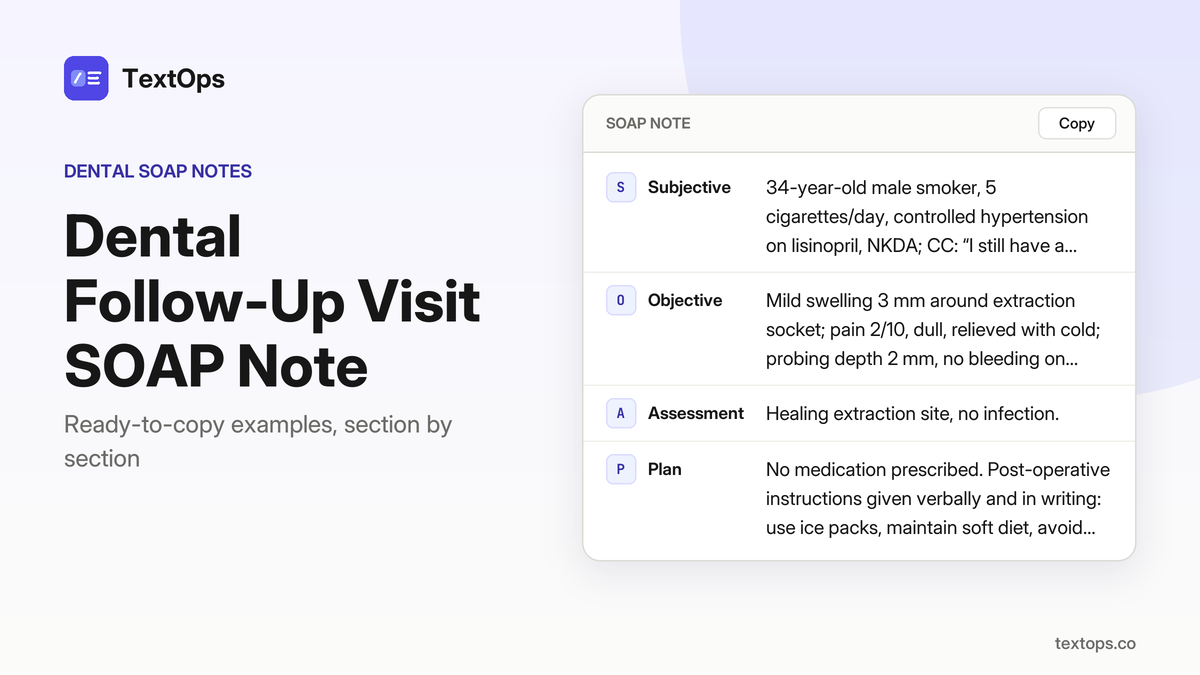
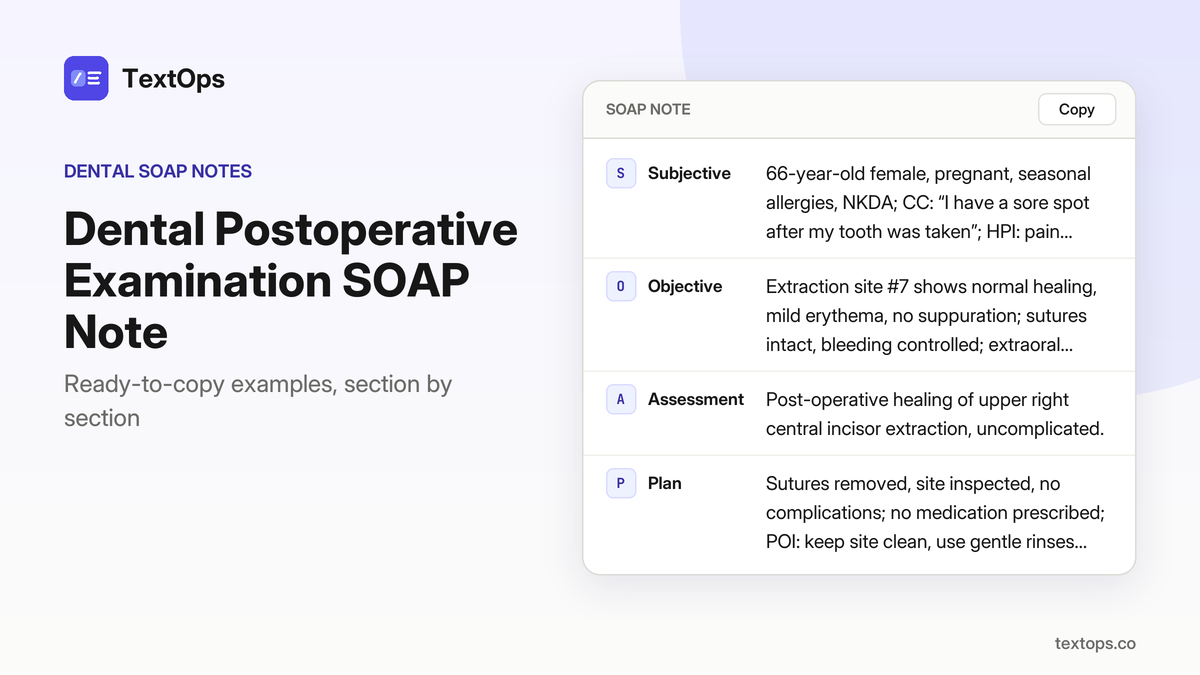
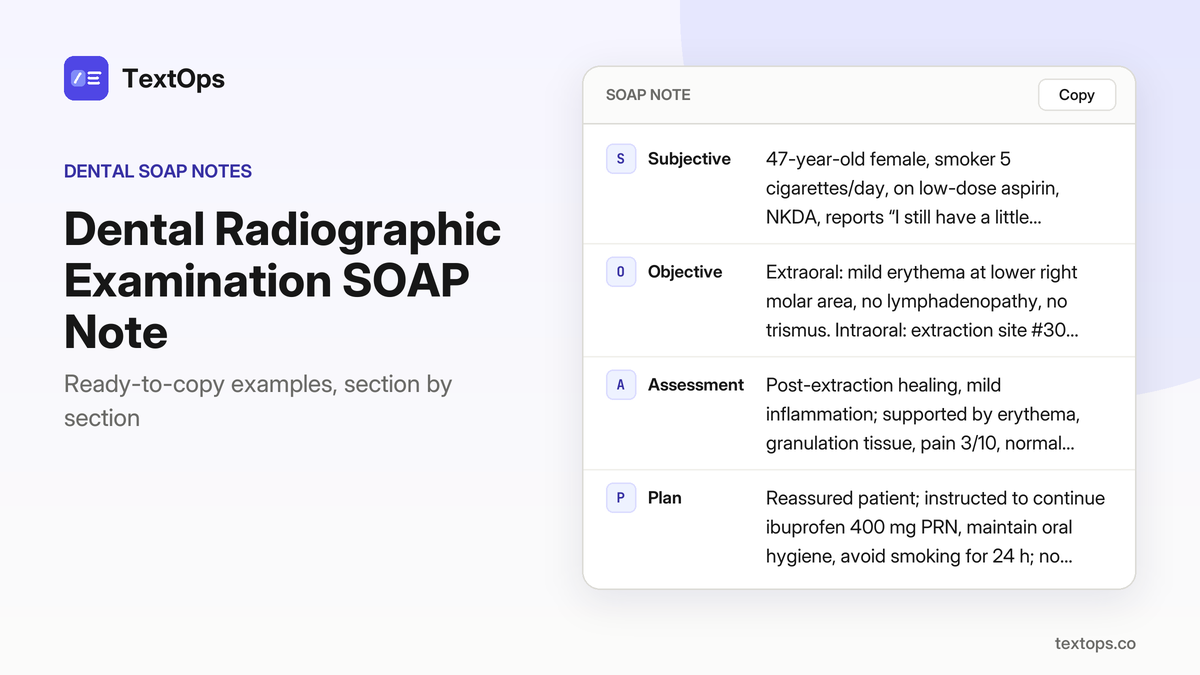
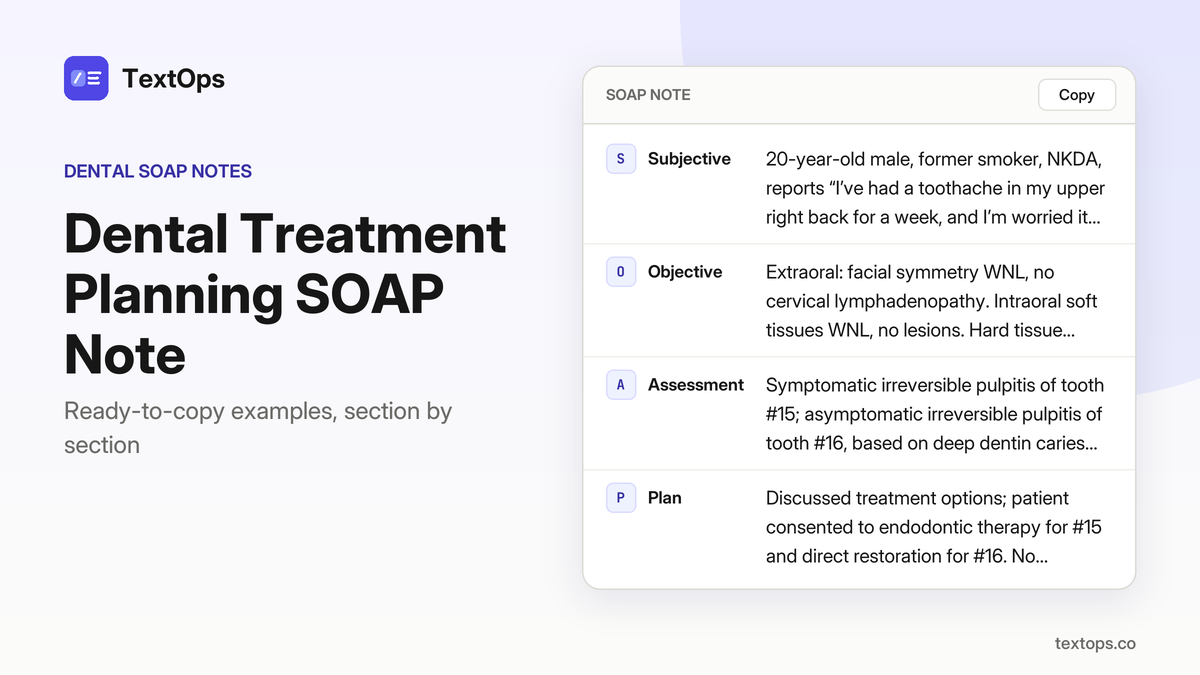
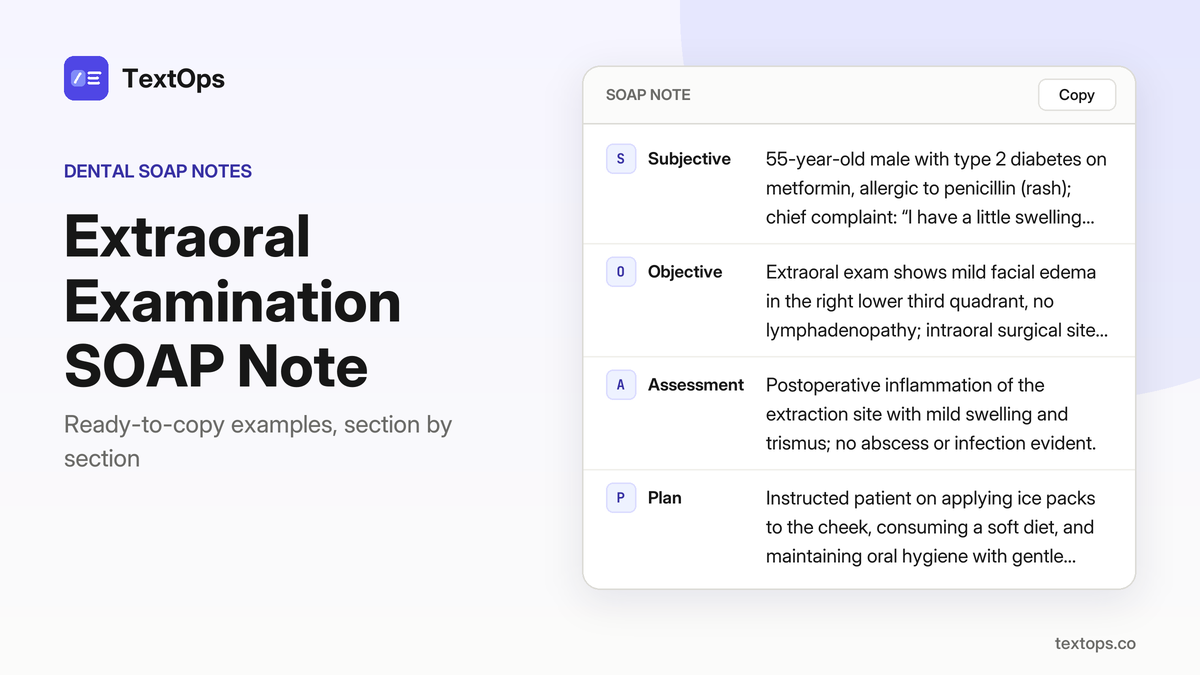
A copy-ready Dental Postoperative Examination SOAP Note follows, ready for immediate paste into the chart. Each field is defined in a concise, mobile-friendly guide: S for chief complaint and pain details, O for wound inspection and vital signs, A for healing assessment and complication flags, P for tailored medication, instructions, and next visit. The guide also highlights common documentation pitfalls—missing pain scales, vague wound descriptions, or unverified prescriptions—ensuring the note is accurate, compliant, and clinically useful.
Immediate Post-operative (Day 1) Visits
Pregnant, Day 1 After Upper Incisor Extraction
SOAP note
SSubjective
66-year-old female, pregnant, seasonal allergies, NKDA; CC: “I have a sore spot after my tooth was taken”; HPI: pain mild, no swelling, no trismus; PMH: pregnancy, seasonal allergies; meds: none.
OObjective
Extraction site #7 shows normal healing, mild erythema, no suppuration; sutures intact, bleeding controlled; extraoral exam: no facial swelling, no lymphadenopathy; temperature 36.8 °C; intraoral: no trismus.
AAssessment
Post-operative healing of upper right central incisor extraction, uncomplicated.
PPlan
Sutures removed, site inspected, no complications; no medication prescribed; POI: keep site clean, use gentle rinses, avoid hot foods, report increased pain or swelling; next visit: Day 3 for suture removal check and routine follow-up.
Non-Smoker, Day 1 After Upper Premolar Extraction
SOAP note
SSubjective
47-year-old male, chief complaint: “My tooth hurts a bit after the extraction.” History: extraction of tooth #12 performed the day before; patient reports mild discomfort, no fever, no trismus. Medical history: smoker, 5 cigarettes/day; NKDA.
OObjective
Extraction site shows mild swelling, no suppuration; bleeding controlled, sutures intact; no facial swelling, no lymphadenopathy; temperature 36.9 °C; mouth opening normal; sutures in place, wound edges approximated.
AAssessment
Post-operative healing of upper left first premolar extraction, uncomplicated.
PPlan
Sutures removed with 2% lidocaine with 1:100,000 epinephrine, 1.8 mL infiltration; site inspected, no complications. Patient instructed to keep the area clean, avoid smoking for 24 h, apply ice packs as needed, and report any increased pain, swelling, or bleeding. No prescription medication. Next visit: Day 3 for suture removal confirmation and healing assessment.
Non-Smoker, Day 7 After Periodontal Flap Surgery
SOAP note
SSubjective
41-year-old male, non-smoker, chief complaint: “My gums still feel a bit sore”; history: periodontal flap surgery on tooth #16 one week ago, hypothyroidism on levothyroxine, allergic to penicillin (rash), no other systemic signs.
OObjective
Extraoral: facial symmetry, no swelling, no lymphadenopathy; intraoral: flap site healing, mild erythema, no suppuration, sutures intact, no bleeding, no trismus; periodontal: no recession or mobility noted; vital signs: temperature 36.7 °C, heart rate and BP not abnormal.
AAssessment
Post-operative healing of periodontal flap surgery on tooth #16, supported by intact sutures, mild erythema, absence of suppuration or swelling.
PPlan
Sutures removed with no complications; patient given verbal and written postoperative instructions for oral hygiene and advised to return in 1 week for suture removal if not already done.
Non-Smoker, Day 2 After Placement of a Resin-Bonded Bridge
SOAP note
SSubjective
30-year-old male, former smoker, NKDA, reports “Everything feels fine after the bridge”; no pain, swelling, or discomfort.
OObjective
Temperature 36.8 °C, no lymphadenopathy; extraoral exam WNL; intraoral exam shows bridge seated correctly on tooth #11 (upper left canine), no occlusal interference, no bleeding, no trismus; periodontal tissues appear healthy.
AAssessment
Post-operative healing after resin-bonded bridge placement on upper left canine, supported by absence of pain, swelling, or bleeding and correct occlusion.
PPlan
No medication prescribed; instructed to maintain oral hygiene, avoid hard foods, and report any new symptoms. Next visit scheduled for suture removal and final occlusal adjustment on Day 5.
Pregnant, Day 1 After Extraction of a Carious Tooth
SOAP note
SSubjective
60-year-old pregnant female, controlled hypertension, NKDA, reports “My lower molar hurts after the extraction.” HPI: pain localized to extraction site, onset immediately post-procedure, mild aching, no radiation, no relief with rest.
OObjective
Extraction site #30 shows mild swelling, no suppuration, sutures intact, bleeding controlled, no trismus, no facial swelling, temp 36.9 °C, no lymphadenopathy.
AAssessment
Post-operative healing of lower right first molar extraction, supported by intact sutures, controlled bleeding, and absence of infection signs.
PPlan
Sutures removed, site inspected, no complications noted. No medications prescribed. Instructed patient to rinse with warm saline 30 s twice daily, avoid hot foods, maintain oral hygiene, and report fever, increased pain, or swelling. Next visit: Day 2 for suture removal confirmation and healing assessment.
Diabetic, Day 1 After Emergency Extraction of a Fractured Tooth
SOAP note
SSubjective
75-year-old male, type 2 diabetes on metformin, smoker 5 cigarettes/day, NKDA, reports “The tooth was broken and I had it removed.”
OObjective
Extraction site on #28 shows mild swelling, no suppuration, sutures intact, bleeding controlled; no trismus, no facial swelling, temp 36.8 °C, no lymphadenopathy.
AAssessment
Post-operative healing of lower right second premolar extraction, supported by intact sutures, controlled bleeding, and absence of infection or swelling.
PPlan
Sutures removed with 2% lidocaine + 1:100,000 epinephrine, 1.8 mL infiltration; no drugs prescribed. Instructed to maintain oral hygiene, avoid hot liquids, and report fever or increasing pain. Next visit scheduled for Day 7 for suture removal or healing assessment.
Pregnant, Day 1 After Extraction of a Carious Tooth with Dry Socket
SOAP note
SSubjective
29-year-old pregnant female with type 2 diabetes on metformin, no drug allergies, reports “My tooth hurts a lot and the socket looks empty” after extraction of tooth #19; dry socket noted.
OObjective
Extraoral: no facial swelling, no lymphadenopathy, temperature 36.7 °C. Intraoral: exposed bone in socket of #19, severe pain, no bleeding or suppuration, mild swelling, no trismus. Radiographs: none taken. Tests: none.
AAssessment
Dry socket (alveolar osteitis) of lower left first molar, supported by exposed bone, severe pain, absence of bleeding or suppuration.
PPlan
Removed sutures, applied saline rinse and 0.12 % chlorhexidine medicated dressing, advised soft diet and ibuprofen 400 mg PO q6 h PRN up to 3 days; instructed to monitor for fever or increased swelling and to return if symptoms worsen.
Early Post-operative (Day 2–3) – General Patients
Smoker, Day 3 After Lower Molar Extraction
SOAP note
SSubjective
32-year-old male, smoker, 5 cigarettes/day, allergic to penicillin (rash). Chief complaint: “I still feel a little sore and the swelling is a bit worse than yesterday.” No systemic signs, no medication listed.
OObjective
Extraoral: normal facial symmetry, no cervical lymphadenopathy. Intraoral: mild buccal mucosal edema around #30, no erythema or purulent drainage. Probing depth 2 mm at #30, no bleeding on probing; mobility Miller grade 0. Periapical radiograph shows expected healing, no fracture or foreign body.
AAssessment
Post-operative healing of lower right first molar extraction, supported by mild edema, stable probing depth, and radiographic evidence of expected healing.
PPlan
Re-appraisal of postoperative swelling; advised to continue ice packs and maintain oral hygiene. No intervention today. No drugs prescribed. RTC in 7 days for follow-up.
Elderly, Day 2 After Flap Surgery for Periodontitis
SOAP note
SSubjective
56-year-old male, asthma, NKDA, reports “My gums still feel tender and I have a little swelling on the left side.” HPI: 2 days post-flap surgery on tooth #16, mild discomfort, no fever.
OObjective
Extraoral: no cervical lymphadenopathy, normal TMJ. Intraoral: mild edema of flap, edges intact, no erythema. Periodontal: PD 4 mm at #16, BOP present, CAL 3 mm, Miller grade 0 mobility. Radiograph: periapical shows bone fill, no perforation.
AAssessment
Post-operative healing of periodontal flap surgery on upper left first molar, supported by intact flap, bone fill, and stable probing.
PPlan
No new medication prescribed. Instructed to continue chlorhexidine 0.12% rinse twice daily, avoid brushing the flap for 48 h, use a soft toothbrush, and monitor for increased swelling or pain; next visit in 7 days for healing assessment.
Pregnancy, Day 7 After Flap Surgery for Periodontitis
SOAP note
SSubjective
76-year-old pregnant female, chief complaint: “My gums are still a bit swollen but I can eat normally,” history of day-7 postoperative period after flap surgery on tooth #12, takes low-dose aspirin daily, NKDA.
OObjective
Soft tissue shows mild edema, flap edges healing, no erythema; probing depth 3 mm at #12, BOP minimal, CAL 2 mm; Miller grade 0 mobility; periapical radiograph reveals bone fill, no pathology; extraoral exam normal, no cervical lymphadenopathy, facial symmetry WNL.
AAssessment
Post-operative healing of periodontal flap surgery on upper left first premolar, supported by resolving edema, stable probing depths, and radiographic bone fill.
PPlan
Advised continuation of chlorhexidine 0.12% rinse, maintain oral hygiene, no medication prescribed; scheduled follow-up in 2 weeks for full healing assessment.
Pregnant, Day 3 After First-Stage Root Canal Therapy
SOAP note
SSubjective
40-year-old pregnant female reports “The tooth still hurts a little when I bite down.” She has seasonal allergies, NKDA, and no systemic symptoms.
OObjective
Extraoral: no cervical lymphadenopathy, TMJ normal. Intraoral: mild buccal mucosal edema, no erythema. Probing depth 2 mm at #11, no BOP, Miller grade 0 mobility. Radiograph: obturation present, no periapical radiolucency.
AAssessment
Post-operative healing after first-stage root canal therapy on upper left canine, supported by stable probing, absence of inflammation, and radiographic evidence of obturation.
PPlan
No medication prescribed. Instructed to use a soft toothbrush, avoid hard foods for 24 h, and apply a cold compress if swelling increases. Next visit scheduled for completion of root canal therapy.
Elderly, Day 1 After Coronally Advanced Flap for Recession
SOAP note
SSubjective
38-year-old female, NKDA, reports “My gums look a bit red and I feel a little sore.” She is Day 1 after a coronally advanced flap for recession on tooth #28 (lower right second premolar).
OObjective
Extraoral shows normal facial symmetry, no cervical lymphadenopathy. Soft tissue: mild erythema at flap margin, no edema, flap edges intact. Probing: PD 3 mm at #28, BOP present, CAL 2 mm. Mobility: Miller grade 0. Radiograph: periapical shows no pathology.
AAssessment
Post-operative healing of coronally advanced flap for recession on lower right second premolar, supported by mild erythema, intact flap margins, and stable probing depths.
PPlan
2% lidocaine with 1:100,000 epinephrine, 1.8 mL infiltration used during surgery. Patient instructed to use a soft toothbrush, avoid brushing the flap for 48 h, and rinse with chlorhexidine 0.12% twice daily. No medication prescribed. Next visit: Day 7 for healing assessment.
Allergic to Penicillin, Day 2 After Endodontic Retreatment
SOAP note
SSubjective
82-year-old male, allergic to penicillin, reports “the tooth still hurts when I chew and I feel some swelling on the cheek.” History: day-2 post-endodontic retreatment of tooth #3; PMH: hypothyroidism on levothyroxine; no other systemic signs.
OObjective
Extraoral: no cervical lymphadenopathy, TMJ function normal. Intraoral soft tissue: mild buccal mucosal edema, no erythema. Probing: PD 2 mm at #3, no BOP; mobility Miller grade 0. Radiograph: periapical view shows intact obturation, no radiolucency.
AAssessment
Post-operative healing after endodontic retreatment on upper right central incisor, supported by absence of periapical pathology, normal probing depth, and lack of inflammation.
PPlan
Anesthesia: 2% lidocaine with 1:100,000 epinephrine, 1.8 mL infiltration. No medication prescribed. Patient instructed to maintain oral hygiene, use a soft toothbrush, and apply a cold compress if swelling increases. Next visit: Day 5 for healing assessment.
Asthmatic, Day 1 After Extraction of a Supernumerary Tooth
SOAP note
SSubjective
43-year-old male, former smoker, NKDA, reports “I have a little pain and swelling around the upper right area”; pain is mild, localized, not radiating, no triggers noted.
OObjective
Socket at tooth #3 shows healthy granulation tissue, no exposed bone; mild erythema of surrounding mucosa; no trismus, no lymphadenopathy; intraoral exam shows no drainage or bleeding; vital signs BP 120/78 mmHg, pulse 72 bpm, temperature 98.6 °F.
AAssessment
Post-extraction healing of supernumerary tooth #3, evidenced by granulation tissue, absence of exposed bone, and stable vital signs.
PPlan
Sutures removed, patient instructed to keep the area clean, avoid hot foods, and monitor for increased pain or swelling; no medication prescribed; next visit scheduled for Day 5 to assess healing progress.
Pregnancy, Day 5 After Endodontic Therapy
SOAP note
SSubjective
49-year-old pregnant female, controlled hypertension on lisinopril, NKDA; CC: “The tooth still hurts a little when I bite”; HPI: pain localized to #9, mild, no swelling, normal BP 118/76, pulse 70, temp 98.4 °F.
OObjective
Root canal obturation intact, no perforation; socket shows normal healing, no swelling; mild percussion sensitivity; no trismus, no lymphadenopathy; BP 118/76 mmHg, pulse 70 bpm; temperature 98.4 °F.
AAssessment
Post-endodontic therapy healing of tooth #9, supported by intact obturation, normal socket healing, and absence of infection signs.
PPlan
2% lidocaine with 1:100,000 epinephrine, 1.8 mL infiltration, aspiration negative; patient advised soft diet, avoid chewing on that side; prescribed ibuprofen 400 mg PO q6h PRN up to 3 days and acetaminophen 500 mg PO q6h PRN up to 3 days; next visit in 7 days for final assessment.
Diabetic, Day 3 After Surgical Extraction of a Root Fracture
SOAP note
SSubjective
28-year-old male, type 2 diabetic on metformin, smoker 5 cigarettes/day, NKDA, reports “My lower right molar hurts a bit and I feel a bit sore” on Day 3 after surgical extraction of a root fracture.
OObjective
Extraction socket of tooth #30 shows healthy granulation tissue, no exposed bone; mild erythema of surrounding mucosa, no drainage, no swelling, no trismus, no lymphadenopathy; BP 122/80 mmHg, pulse 75 bpm, temperature 98.5 °F.
AAssessment
Post-extraction healing of tooth #30, with no signs of infection or complications.
PPlan
2% lidocaine with 1:100,000 epinephrine, 1.8 mL (1 cartridge), IANB, aspiration negative. Instructed to rinse with 0.12% chlorhexidine twice daily, avoid hot foods; prescribed ibuprofen 400 mg every 6 hours PRN, up to 3 days. Next visit: Day 7 for healing assessment.
Allergic to Penicillin, Day 3 After Surgical Extraction of a Periapical Abscess
SOAP note
SSubjective
33-year-old female, type 2 diabetic, allergic to penicillin (rash); CC: "The area feels sore but not swollen"; HPI: three days post-surgical extraction of periapical abscess at tooth #19; PMH: metformin; no smoking or alcohol noted.
OObjective
Extraction socket shows healthy granulation tissue, no exposed bone; mild erythema of surrounding mucosa; no drainage, swelling, trismus, or lymphadenopathy; BP 118/74 mmHg, pulse 68 bpm, temp 98.3 °F; IANB with 2% lidocaine + 1:100,000 epinephrine, 1.8 mL, aspiration negative.
AAssessment
Post-extraction healing of tooth #19, uncomplicated, with no signs of infection or systemic involvement.
PPlan
No medication prescribed; patient instructed to maintain oral hygiene, avoid hot foods, and monitor for swelling or fever; advised to return if symptoms worsen or at routine follow-up.
Non-Smoker, Day 3 After Placement of a Zirconia Crown
SOAP note
SSubjective
21-year-old male, smokes 5 cigarettes/day, allergic to penicillin (rash); chief complaint: “The crown feels a bit sensitive when I bite”; history: day-3 post-placement of a zirconia crown on tooth #8; medical history: none else; medications: none; allergies: penicillin rash.
OObjective
Zirconia crown seated, margins smooth, no overhangs; surrounding tissues non-tender, mild sensitivity to cold, no swelling, no trismus, no lymphadenopathy; BP 120/78 mmHg, pulse 70 bpm, temperature 98.4 °F; anesthesia: 2% lidocaine with 1:100,000 epinephrine, 1.8 mL infiltration, aspiration negative; no additional findings.
AAssessment
Post-crown placement healing of tooth #8, supported by smooth margins, absence of pain on palpation, and mild cold sensitivity only.
PPlan
No drugs prescribed; patient advised soft diet, avoid chewing on that side, maintain oral hygiene, use fluoride toothpaste twice daily, and return for a check-up in 7 days to assess sensitivity resolution.
Elderly, Day 3 After Endodontic Retreatment
SOAP note
SSubjective
27-year-old male with asthma, NKDA, reports “The tooth still hurts a little when I bite” on Day 3 after retreatment of tooth #3.
OObjective
Root canal retreatment completed, obturation intact; socket shows normal healing, no swelling; mild percussion sensitivity; no trismus, no lymphadenopathy; BP 117/75 mmHg, pulse 72 bpm, T 98.2 °F.
AAssessment
Post-endodontic retreatment healing of tooth #3, evidenced by intact obturation, normal socket healing, and absence of infection or systemic signs.
PPlan
2% lidocaine with 1:100,000 epinephrine, 1.8 mL infiltration, aspiration negative; patient advised soft diet and to avoid chewing on that side; prescribed ibuprofen 400 mg q6h PRN, up to 3 days; next visit in 1 week for final restoration.
Medical Condition Follow-ups (Day 2–3)
Diabetic, Day 5 After Mandibular Incision and Drainage
SOAP note
SSubjective
64-year-old female with type 2 diabetes on metformin and low-dose aspirin reports, “I’m still having some swelling and pain.” She denies trismus; temperature 99.5 °F. NKDA.
OObjective
Mild swelling and erythema over the lower right first molar region; probing depth 2 mm, no purulent drainage; IANB with 2% lidocaine 1:100,000, 1.8 mL, aspiration negative; no trismus.
AAssessment
Acute apical abscess of tooth #30 with drainage, supported by localized swelling, erythema, mild fever, and 2 mm probing depth.
PPlan
Suture removal performed. Prescribed ibuprofen 400 mg every 6 hours PRN up to 3 days and chlorhexidine gluconate 0.12 % rinse 15 mL for 30 seconds twice daily for 7 days. Instructed on pain control, oral hygiene, and to monitor for worsening swelling or fever; next visit in 2 days for reassessment.
Allergic to Penicillin, Day 4 After Third Molar Extraction
SOAP note
SSubjective
61-year-old male with seasonal allergies, penicillin allergy (rash); CC: “My mouth hurts and there's a little swelling.” HPI: pain and mild swelling after extraction of tooth #30, no drainage, temperature 98.6 °F. PMH: seasonal allergies, penicillin allergy. Meds: none.
OObjective
Extraoral: mild swelling over right mandibular region, no trismus. Intraoral: suture site closed, probing depth 2 mm, no bleeding on probing, mucosa intact. Periodontal: no pathology. Radiograph: not taken today. Tests: none.
AAssessment
Post-operative healing of third molar extraction, consistent with mild swelling and normal probing depth.
PPlan
Suture removal performed under 2% lidocaine with 1:100,000 epinephrine, 1.8 mL (1 cartridge), IANB, aspiration negative. Prescribed ibuprofen 400 mg PO q6h PRN up to 3 days; chlorhexidine gluconate 0.12 % rinse 15 mL for 30 s twice daily for 7 days. Instructed on pain control, oral hygiene, signs of infection; next visit in 7 days for healing assessment.
Asthmatic, Day 3 After Mandibular Incision and Drainage
SOAP note
SSubjective
19-year-old male, NKDA, reports “Pain is still there, and I’m wheezing a bit.” He had a mandibular incision and drainage on tooth #30 and is now on day 3 post-op.
OObjective
Extraoral swelling 3 mm, mild erythema, temperature 100.2 °F, mild dyspnea, no trismus. Intraoral: probing depth 2 mm, no purulent drainage, IANB anesthesia 2% lidocaine 1:100,000 1.8 mL, aspiration negative.
AAssessment
Acute apical abscess of tooth #30 with drainage, evidenced by localized swelling, mild erythema, probing depth 2 mm, fever, and dyspnea.
PPlan
Suture removed; prescribed ibuprofen 400 mg PO q6h PRN up to 3 days; advised use of asthma inhaler PRN. Next visit scheduled day 5 for suture check and assessment of pain and respiratory status.
Diabetic, Day 2 After Extraction of a Carious Tooth
SOAP note
SSubjective
78-year-old male, type 2 diabetes on metformin, hypothyroidism on levothyroxine, allergic to penicillin (rash); CC: “My mouth feels sore.” HPI: Day 2 post-extraction of #19, reports mild soreness, no bleeding. PMH: diabetes, hypothyroidism; allergy to penicillin noted.
OObjective
Extraoral: mild swelling, no drainage, temperature 98.4 °F, no trismus. Intraoral: extraction site healing, probing depth 2 mm, no BOP, suture removed. Periodontal: PD 2 mm, no mobility. Radiographic: not taken. Tests: none.
AAssessment
Post-operative healing of extraction of tooth #19, consistent with mild swelling and normal probing depth.
PPlan
Suture removal performed; prescribed ibuprofen 400 mg PO q6 h PRN, max 3 days. Advised strict glycemic control, maintain oral hygiene, monitor for increased pain or drainage. Follow-up in 7 days or sooner if symptoms worsen.
Pregnant, Day 2 After Endodontic Retreatment
SOAP note
SSubjective
46-year-old female patient, pregnant, former smoker, NKDA; CC: “My tooth still hurts a bit.” HPI: pain persists mild after retreatment of tooth #3; no other symptoms.
OObjective
Extraoral: mild swelling, no drainage; intraoral: probing depth 2 mm on #3, no trismus; vital: temperature 98.6 °F; anesthesia: 2% lidocaine with 1:100,000 epinephrine, 1.8 mL infiltration, aspiration negative.
AAssessment
Post-operative healing after endodontic retreatment of tooth #3, supported by mild swelling, normal probing depth, and absence of infection signs.
PPlan
Administered 2% lidocaine with 1:100,000 epinephrine, 1.8 mL infiltration; prescribed ibuprofen 400 mg PO q6h PRN up to 3 days; instructed chlorhexidine gluconate 0.12 % rinse 15 mL for 30 s twice daily for 7 days; advised to monitor for increased pain or drainage and return if symptoms worsen.
Allergic to Penicillin, Day 1 After Surgical Extraction of a Root Fracture
SOAP note
SSubjective
48-year-old female, controlled hypertension on lisinopril; CC: "My mouth hurts and I see some swelling"; HPI: pain and swelling noted the day after surgical extraction of a root fracture of tooth #30; PMH: lisinopril; no tobacco or alcohol use.
OObjective
Extraoral: mild facial swelling, no drainage, no trismus; intraoral: suture removal site intact, probing depth 2 mm, no bleeding; periodontal: healthy except extraction site; radiograph: not taken today; vital signs: temperature 98.6 °F, pulse 78 bpm; anesthesia: 2% lidocaine with 1:100,000 epinephrine, 1.8 mL, IANB, aspiration negative.
AAssessment
Post-operative healing of extraction of root fracture #30, with mild swelling and no systemic signs.
PPlan
Suture removal performed; prescribed ibuprofen 400 mg PO every 6 hours as needed, up to 3 days; instructed on pain control, oral hygiene, signs of infection; advised to avoid NSAID excess; scheduled follow-up in 7 days for healing assessment.
Asthmatic, Day 2 After Extraction of a Third Molar
SOAP note
SSubjective
55-year-old male patient, smoker 5 cigarettes per day, no known drug allergies, reports “Pain is still there, and I feel a bit sore” following the extraction of tooth #30; he notes that the discomfort has not subsided since yesterday and he is concerned about possible complications.
OObjective
Extraoral examination shows mild swelling around the left mandibular third-molar region with no erythema or drainage; intraoral probing depth is 2 mm, the socket appears clean with no purulent exudate, and there is no trismus. Vital signs are within normal limits, with a recorded temperature of 98.6 °F and no systemic signs of infection or distress.
AAssessment
Post-operative healing of extraction of tooth #30, with no evidence of infection, dry socket, or other acute complications.
PPlan
Suture removal was completed without resistance; the patient was instructed on gentle rinsing with saline, avoidance of vigorous rinsing or spitting, and to keep the mouth moist with a soft diet. Prescribed ibuprofen 400 mg PO every 6 hours as needed for pain, limited to a maximum of 3 days, and advised to monitor for increased swelling, drainage, or fever; instructed to return to the clinic if symptoms worsen or persist beyond the expected healing window.
Asthmatic, Day 2 After Surgical Extraction of a Supernumerary Tooth
SOAP note
SSubjective
24-year-old male, type 2 diabetes on metformin, NKDA, reports “My mouth hurts a bit.” HPI: Day 2 after surgical extraction of supernumerary tooth #3; pain mild, no swelling beyond mild, no drainage.
OObjective
Extraoral: mild swelling, no trismus; intraoral: suture removed, probing depth 2 mm, no bleeding, temperature 98.6 °F.
AAssessment
Post-operative healing of supernumerary extraction #3, uncomplicated, no infection or dry socket.
PPlan
Suture removal performed; 2% lidocaine with 1:100,000 epinephrine, 1.8 mL infiltration, aspiration negative. Prescribed ibuprofen 400 mg PO q6 h PRN, up to 3 days; advised to monitor for swelling, fever, or drainage and to return if symptoms worsen.
Allergic to Penicillin, Day 3 After Endodontic Retreatment of a Root Fracture
SOAP note
SSubjective
68-year-old male, allergic to penicillin (rash), reports “My tooth still hurts and there's some swelling.” HPI: pain persisted after endodontic retreatment of root fracture #30, a lower right molar; swelling noted. PMH: none significant. Meds: none.
OObjective
Extraoral: mild swelling in the lower right quadrant, no drainage, temperature 98.6 °F. Intraoral: probing depth 2 mm at #30, no trismus, no erythema beyond swelling. Periodontal: BOP absent, CAL normal. Radiograph: not taken today. Tests: none.
AAssessment
Post-operative healing after endodontic retreatment of root fracture #30, supported by mild swelling, normal probing depth, and absence of systemic signs.
PPlan
2% lidocaine with 1:100,000 epinephrine, 1.8 mL (1 cartridge), IANB, aspiration negative. Prescribed ibuprofen 400 mg PO q6h PRN up to 3 days. Instructed chlorhexidine gluconate 0.12 % rinse 15 mL for 30 seconds twice daily for 7 days. Advised to monitor swelling, report fever or drainage. Next visit: Day 7 for healing assessment.
Diabetic, Day 3 After Incision and Drainage of a Periapical Abscess
SOAP note
SSubjective
71-year-old male with type 2 diabetes on metformin and asthma using albuterol PRN reports “pain is still there, and I'm wheezing a bit.” PMH: type 2 diabetes, asthma, NKDA.
OObjective
Extraoral swelling 3 mm, mild erythema; intraoral probing depth 2 mm; no purulent drainage; temperature 100.1 °F; mild dyspnea; no trismus.
AAssessment
Acute apical abscess of tooth #30 with drainage, complicated by mild fever and mild dyspnea.
PPlan
Suture removal performed under 2% lidocaine with 1:100,000 epinephrine, 1.8 mL IANB, aspiration negative. Prescribed ibuprofen 400 mg every 6 hours PRN up to 3 days; advised use of albuterol inhaler as needed. Instructed to monitor temperature and swelling, report worsening pain or fever, and return for follow-up in 3 days for reassessment.
Intermediate Post-operative (Day 4–5) Visits
Elderly, Day 4 After Crown Lengthening for Implant Placement
SOAP note
SSubjective
37-year-old male, taking daily low-dose aspirin, NKDA, reports “I’m here for my follow-up after the crown lengthening.” He recalls the procedure was done on tooth #30 and that he has been following the postoperative care instructions without difficulty.
OObjective
The surgical socket demonstrates mild erythema but no drainage or purulent exudate. Probing depth measures 2 mm with no bleeding on probing; soft tissues appear well-healed, free of ulceration or exudate. There is no facial swelling, trismus, or other signs of inflammation. Vital signs are within normal limits, and the patient reports no systemic symptoms.
AAssessment
Post-operative healing of crown lengthening at the implant site is evident, with appropriate soft-tissue closure and absence of complications.
PPlan
Reviewed the healing status, reinforced meticulous oral hygiene techniques, and advised the patient to avoid hard foods and maintain the prescribed rinsing regimen. No medications were prescribed. The next visit is scheduled for Day 7 to perform a final assessment and plan any additional surgical or restorative steps.
Diabetic, Day 4 After Surgical Extraction of a Supernumerary Tooth
SOAP note
SSubjective
26-year-old female, type 2 diabetes on metformin, seasonal allergies, NKDA; CC: “I just had the extra tooth removed and I'm here to check the socket.” HPI: Day 4 post-surgical extraction of supernumerary tooth #3, reporting mild discomfort but no pain.
OObjective
Socket shows healing, mild bleeding controlled, no swelling; probing depth 1 mm, BOP negative; no trismus; vital signs WNL.
AAssessment
Post-extraction healing of supernumerary tooth #3, uncomplicated, with adequate soft tissue closure and no signs of infection.
PPlan
No local anesthesia used; patient advised strict glycemic control, reinforced oral hygiene with gentle brushing and interdental flossing. POI: avoid hard foods, maintain oral hygiene, monitor for signs of infection. Next visit scheduled Day 7 for final healing assessment.
Asthmatic, Day 5 After Coronally Advanced Flap for Recession
SOAP note
SSubjective
70-year-old male, NKDA, reports “I’m here for my follow-up after the flap surgery.” HPI: postoperative day 5, no pain or swelling, following a coronally advanced flap for Miller Class I recession on tooth #28.
OObjective
Extraoral: facial symmetry intact, no lymphadenopathy, TMJ normal, vitals WNL. Intraoral: flap healing complete, recession reduced, probing depth 1 mm, BOP negative, no inflammation, no trismus.
AAssessment
Post-operative healing of coronally advanced flap, Miller Class I recession.
PPlan
Reinforced oral hygiene instructions, soft diet advised, no medication prescribed. Next visit scheduled Day 7 for final assessment.
Allergic to Penicillin, Day 4 After Placement of a Resin-Bonded Bridge
SOAP note
SSubjective
80-year-old male, hypothyroid on levothyroxine, allergic to penicillin (rash); chief complaint: “I’m here to see how the bridge is doing.” He reports no pain, no swelling, no trismus, and states that he has been following the postoperative instructions. Vital signs are within normal limits, and he denies any systemic symptoms.
OObjective
The resin-bonded bridge on tooth #11 is seated correctly with no gaps or misfit. Gingival tissues surrounding the bridge are pink, healthy, and free of erythema or edema. Probing depth is 1 mm at all sites with no bleeding on probing. Extraoral examination shows no facial swelling, no trismus, and the patient’s face is symmetrical. No other intraoral pathology is noted, and the patient’s oral hygiene appears adequate.
AAssessment
Post-operative healing of the resin-bonded bridge with healthy gingival tissues and no complications.
PPlan
Reinforced oral hygiene instructions were reiterated, emphasizing gentle brushing with a soft-bristled brush and interdental cleaning around the bridge. The patient was advised to avoid hard, crunchy foods and to maintain a soft diet for the next few days. No medication was prescribed. The next visit is scheduled for Day 7 for final assessment and possible adjustment of the bridge.
Non-Smoker, Day 5 After Coronally Advanced Flap for Recession
SOAP note
SSubjective
50-year-old female, former smoker, NKDA, states “I’m here for my follow-up after the flap surgery.” She reports no pain, no swelling, and is satisfied with the appearance of the treated area.
OObjective
Extraoral examination shows no facial swelling or lymphadenopathy; intraoral assessment reveals a well-healed flap over tooth #12 with reduced Miller Class I recession. Probing depth is 1 mm, BOP negative, and the surgical site is free of inflammation, granulation tissue, or exudate. Vital signs are within normal limits, and the patient is alert and cooperative.
AAssessment
Post-operative healing of a coronally advanced flap for Miller Class I recession is confirmed; the clinical findings of a 1 mm probing depth and absence of bleeding on probing support this assessment.
PPlan
No medications were prescribed. The patient was instructed to maintain reinforced oral hygiene, continue a soft diet, and avoid smoking. A follow-up appointment is scheduled for Day 7 to perform final assessment and discuss any remaining concerns.
Pregnant, Day 4 After Root Canal Therapy for a Periapical Abscess
SOAP note
SSubjective
20-year-old pregnant female with controlled hypertension on lisinopril, NKDA; chief complaint: “I’m here to check on the tooth after the root canal.” HPI: reports mild postoperative pain that has improved since the procedure, denies swelling or trismus, and is otherwise comfortable.
OObjective
Examination of tooth #9 reveals a complete root canal obturation with no signs of extrusion or perforation; probing depth is 1 mm and bleeding on probing is negative. Extraoral inspection shows no facial swelling or lymphadenopathy; vital signs are within normal limits and the patient is afebrile.
No medications prescribed. Reinforced oral hygiene instructions were reiterated, emphasizing gentle brushing, interdental cleaning, and avoidance of hard foods for the next 48 hours. Patient was advised to monitor for any new pain, swelling, or difficulty swallowing and to contact the office if symptoms arise. Next visit scheduled Day 7 for final assessment and possible restoration placement.
Elderly, Day 5 After Surgical Extraction of a Lower Premolar
SOAP note
SSubjective
65-year-old female patient, smoker (5 cigarettes/day), NKDA, states “I’m here to see how the extraction site is healing.” O: Extraoral examination reveals no facial swelling, normal mouth opening, and no trismus; intraoral assessment shows socket at tooth #28 with mild erythema, no drainage, and healthy mucosa; probing depth 1 mm, bleeding on probing negative; vital signs within normal limits. A: Post-extraction healing of lower premolar #28, evidenced by complete socket healing, minimal erythema, and normal probing parameters, with no signs of infection or complications. P: Reinforced oral hygiene instructions with emphasis on gentle rinsing and interdental cleaning; advised patient to abstain from smoking during the healing period to promote optimal tissue repair; no medications prescribed; scheduled next visit Day 7 for final assessment and suture removal if applicable.
Asthmatic, Day 5 After Coronally Advanced Flap for Miller Class II Recession
SOAP note
SSubjective
72-year-old female, type 2 diabetic on metformin, NKDA, presents for Day 5 follow-up after coronally advanced flap on tooth #28, reports “I’m here for my follow-up after the flap surgery.” O: Extraoral exam shows facial symmetry, no swelling or trismus; intraoral inspection reveals the flap in good condition, recession markedly reduced, probing depth 2 mm, bleeding on probing negative, no erythema or exudate; vital signs within normal limits, heart rate 78 bpm, blood pressure 128/78 mm Hg. A: Post-operative healing of coronally advanced flap, Miller Class II recession, with satisfactory soft tissue response and no complications. P: Reinforced oral hygiene protocol with gentle brushing, interdental cleaning, and chlorhexidine 0.12 % rinse twice daily; advised soft diet, avoidance of smoking and alcohol; no medication prescribed; scheduled next visit Day 7 for final assessment and suture removal if applicable.
Late Post-operative (Day 6–7) Visits
Elderly, Day 6 After Incision and Drainage of a Periapical Abscess
SOAP note
SSubjective
22-year-old female, allergic to penicillin, presents for follow-up after incision and drainage of an acute apical abscess at tooth #30; reports “I’m here for my follow-up after the drainage”; medical history non-significant.
OObjective
Extraoral: mild residual swelling on right mandibular border, 5 mm, non-tender; Intraoral: flap closed, no drainage, mild erythema, no purulent exudate; Palpation: mild tenderness to light pressure over #30, no deep pain; Temperature 36.8 °C; Probing: 2 mm depth at #30, no bleeding on probing; Radiograph: periapical film shows reduced radiolucency compared with Day 1, no new pathology.
AAssessment
Acute apical abscess of tooth #30 – healing, evidenced by resolved drainage, reduced radiolucency, minimal swelling, and absence of systemic signs.
PPlan
No anesthesia used; no sutures to remove; patient instructed to maintain oral hygiene, avoid hard foods, and report any new swelling or pain; next visit scheduled for definitive endodontic therapy in 2 weeks.
Diabetic, Day 7 After Endodontic Therapy
SOAP note
SSubjective
69-year-old female, type 2 diabetic on metformin, asthma on albuterol PRN, NKDA, presents for day 7 follow-up after root canal on tooth #9; states “I’m here for my follow-up after the root canal”; no new complaints.
OObjective
Extraoral shows no facial swelling, TMJ function normal; intraoral restoration intact, percussion non-sensitive; palpation mild tenderness over #9, no deep pain; temperature 36.7 °C; probing depth 2 mm at #9, bleeding on probing absent; periapical radiograph shows reduced radiolucency, no new pathology.
AAssessment
Symptomatic apical periodontitis of tooth #9 – resolved, post-endodontic healing, supported by 2 mm probing depth, absence of bleeding, and radiographic improvement.
PPlan
No anesthesia or medication administered; patient advised to continue regular brushing and flossing, avoid chewing on the operated side, and report any new pain; next visit scheduled for definitive restoration placement.
Non-Smoker, Day 7 After Periodontal Flap Surgery for Recurrent Gingivitis
SOAP note
SSubjective
23-year-old male, non-smoker, presents for follow-up after flap surgery on tooth #28; “I’m here for my follow-up after the flap surgery”; medical history: smokes 5 cigarettes/day, takes low-dose aspirin, NKDA.
OObjective
Extraoral: no facial swelling, normal TMJ function; Intraoral: flap healed, no erythema, no suppuration; Probing: 2 mm depth at #28, no bleeding on probing; Temperature 36.6 °C; Radiograph: bitewing shows no new bone loss, flap site appears healed.
AAssessment
Periodontal flap surgery – healing, no residual disease, supported by 2 mm probing depth, absence of erythema or suppuration, normal temperature, and radiographic stability.
PPlan
No anesthesia used. Patient instructed to maintain oral hygiene, use chlorhexidine gluconate 0.12 % rinse 15 mL for 30 seconds twice daily, avoid smoking for 24 h, and report any new bleeding or swelling; next visit scheduled for definitive periodontal maintenance.
Definition of a Post-operative Surgical Site Evaluation within SOAP
A postoperative surgical site evaluation is a SOAP note written at the time of care that records the patient’s postoperative complaints, objective wound findings, clinical assessment of healing or complications, and a plan that links treatment, medication, follow-up, and patient instructions. The subjective section captures the patient’s chief complaint, pain intensity, and any new symptoms. The objective section documents the wound appearance, swelling, drainage, vital signs, and any relevant radiographs. The assessment synthesizes these findings into a concise clinical impression of healing status or potential issues such as infection or poor clot stability. The plan specifies the next steps: prescribed medications, oral hygiene instructions, dietary restrictions, and the date and purpose of the next visit. This note serves as the primary record for postoperative monitoring and must be contemporaneous, signed, and free of errors.
Breaking Down the SOAP Fields for a Post-operative Note
Subjective (S) – What the Patient Reports
Record the chief complaint in the patient’s own words, followed by a brief HPI: onset, character, triggers, and relief. Include a numeric pain rating 0-10, noting any radiation or impact on sleep. Document current medication use, recent over-the-counter analgesics, and any new or worsening symptoms such as swelling, drainage, or numbness. Update the PMH with any recent changes, list allergies with reaction details, and confirm tobacco, alcohol, and pregnancy status. End with a concise statement of postoperative concerns, e.g., “Patient reports throbbing pain, 8/10, worsening with cold.”
Detailed Examination Checklist for the Surgical Site
Wound appearance: color (pink, erythematous, pallor), evidence of bleeding or oozing, presence of dehiscence or flap exposure.
Pain level: rate 0-10, note any aggravating or relieving factors, record if pain is constant or intermittent.
Swelling: assess facial edema, rate severity (mild, moderate, severe) or use a 0-3 scale (0 = none, 1 = minimal, 2 = moderate, 3 = severe).
Trismus: measure maximum interincisal opening in millimeters; compare to baseline or normal (~35 mm).
Lymphadenopathy: palpate submandibular and cervical nodes; note size, tenderness, consistency.
Signs of infection: erythema, warmth, purulent drainage, foul odor, or abscess formation.
Extraction sites: assess socket fill, clot stability, presence of dry socket, and any exposed bone.
Document findings in concise phrases; use abbreviations only if previously defined (e.g., “Erythema = red, mild” or “Swelling = moderate, 2/3”).
Assessment of Post-operative Healing and Complications
Assessment links objective findings directly to wound status and patient symptoms. A stable clot, pink mucosa, no drainage, and pain ≤3/10 indicate “Healing without complications.” Mild erythema, minimal oozing, pain 4–6/10, and no systemic signs suggest “Early infection” and warrant a culture or antibiotic review. Presence of exposed bone, persistent pain >6/10, foul odor, or purulent drainage defines “Dry socket risk,” especially after molar extractions, and requires analgesia, chlorhexidine rinse, and possible local therapy. Document each assessment with the specific criteria observed—color, bleeding, pain score, temperature, lymphadenopathy—so the plan follows logically from the clinical picture. This structured linkage ensures clarity, facilitates continuity of care, and meets documentation standards.
Plan for Post-operative Care
NSAID therapy is first line; prescribe ibuprofen 400 mg PO q6 h PRN for 5 days, or acetaminophen 500 mg PO q6 h if NSAID contraindicated. If infection signs appear, add amoxicillin 500 mg PO TID for 7 days; for penicillin allergy, prescribe clindamycin 300 mg PO QID for 7 days. Pain control: advise topical 4 % lidocaine gel as needed for breakthrough pain. Oral hygiene: instruct patient to rinse with 0.12 % chlorhexidine gluconate, 15 mL, 30 seconds twice daily, and to avoid vigorous brushing over the surgical site for 48 h. Dietary advice: recommend soft foods, avoid hot liquids, alcohol, and smoking for 24 h. Follow-up: schedule a review visit on day 3 to assess clot stability and pain; if healing is delayed or infection suspected, adjust antibiotics or refer. Specific education: explain that dry socket risk increases after molar extraction; monitor for persistent pain > 6/10, foul odor, or exposed bone, and return immediately if noted. Tip: To customize the plan, simply replace the generic medication line with the patient’s actual prescription and adjust the follow-up date.
Common Pitfalls in Post-operative Documentation
Common pitfalls in postoperative documentation include: vague pain descriptions—replace “patient reports pain” with a 0-10 numeric rating and trigger words; missing wound measurements—record size, color, and clot stability in centimeters or millimeters; failing to document patient instructions—write a concise POI line for rinsing, diet, and activity; overlooking allergy checks—include an allergy line and verify medication suitability; and not linking assessment to plan—ensure the A sentence states the clinical impression and the P line directly addresses it, such as “infection suspected—start amoxicillin 500 mg TID for 7 days.” Each corrective action turns an incomplete note into a complete, actionable record.
These examples show structure and wording only. Record what you actually found and did, and follow your practice’s documentation requirements.
Dr. Rahul Joshi is a Specialist Orthodontist with extensive clinical experience in orthodontics, dentofacial orthopaedics, and dental aesthetics. Holding a Master of Dental Surgery (MDS) in Orthodontics and Dentofacial Orthopaedics and a Bachelor of Dental Surgery (BDS) from Manipal Academy of Higher Education, he brings expertise in orthodontic treatment planning, teeth alignment, and Invisalign treatment. With professional experience across India and the Netherlands, Dr. Joshi combines clinical knowledge with practical experience in orthodontic care, dental aesthetics, and improving patients' oral health.
Master of Dental Surgery (MDS) in Orthodontics and Dentofacial Orthopaedics — Manipal Academy of Higher Education
Bachelor of Dental Surgery (BDS) — Manipal Academy of Higher Education
Stop retyping your templates
Save any template to TextOps once, then insert it anywhere on the web without retyping. Share it with your team so everyone uses the same wording.