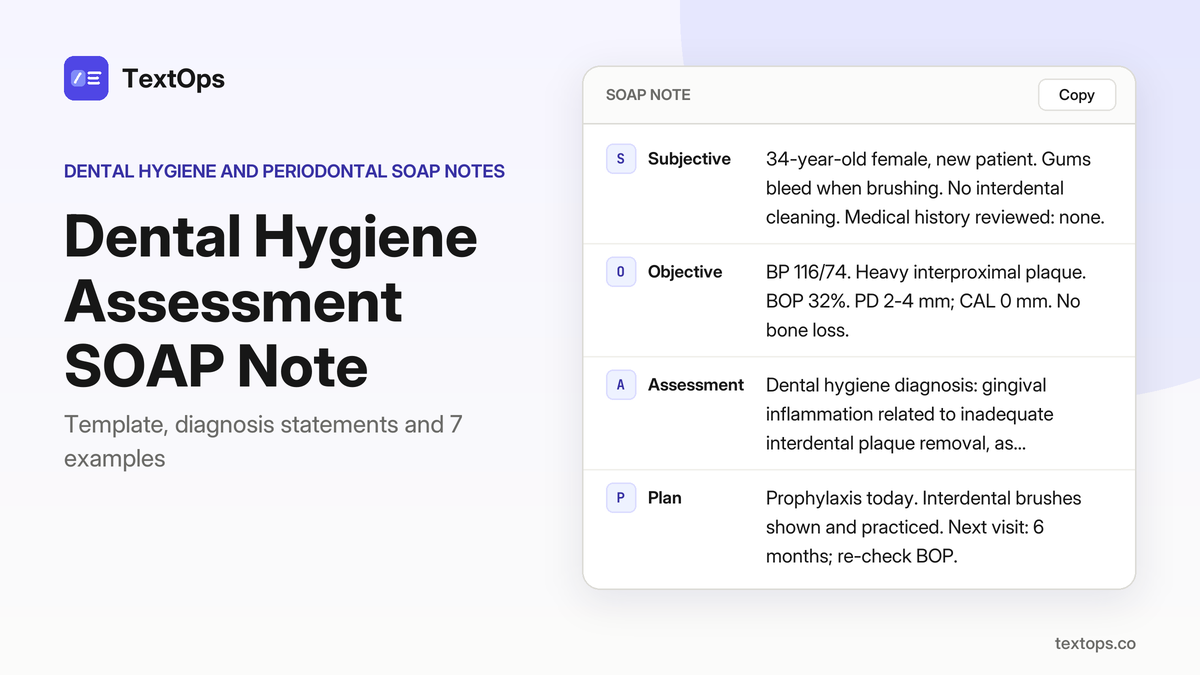
A dental hygiene assessment note records everything the hygienist gathers before treatment, turns it into a dental hygiene diagnosis, and sets the care plan. This page gives you a copy-ready template, how to write a dental hygiene diagnosis, and seven examples, including two where the right plan was to stop and refer.
Teeth use Universal numbering (#1–32). Periodontal terms follow the 2017 AAP/EFP classification. The patients are fictional: replace every finding with what you actually saw and did.
Dental Hygiene Assessment SOAP Note Template
Copy the template and fill in the fields in braces.
- Subjective
- {age}-year-old {sex}, {new patient / recall}. CC: "{patient's words}". Medical history reviewed and updated: {conditions}. Medications: {list; note those causing dry mouth or bleeding}. Allergies: {list or NKDA}. Tobacco: {type, amount or none}. Home care: {brushing, interdental cleaning, fluoride}. Diet: {sugar frequency}.
- Objective
- BP {value}, pulse {value}. Extraoral and intraoral exam: {findings or WNL}. Plaque: {score or description}. Calculus: {light / moderate / heavy; supra / subgingival}. Gingiva: {color, contour, consistency}. BOP {%}. PD {range}; CAL {range}; recession {sites}; mobility {teeth}; furcation {teeth}. Radiographs ({type, date}): {bone levels, suspected caries}. Caries risk: {low / moderate / high} ({reasons}).
- Assessment
- Dental hygiene diagnosis: {problem} related to {cause} as evidenced by {findings}. Periodontal status: {for the dentist's confirmation}. Findings referred to the dentist: {suspected caries, lesions, other}.
- Plan
- Findings and dental hygiene diagnosis explained to the patient. Care plan: {procedures, number of visits}. Education: {topics}. Referrals: {dentist / physician / other}. Patient agreed to the plan. Next visit: {date and purpose}.
How to Write a Dental Hygiene Diagnosis
A dental hygiene diagnosis names the problem the hygienist will help the patient manage. A common format has three parts:
- Problem: what is wrong, such as gingival inflammation or high caries risk.
- Cause (“related to”): what is driving it, such as plaque at the gumline or frequent sugary drinks.
- Evidence (“as evidenced by”): the findings that support it, such as BOP 32% or two new white spot lesions.
For example: “Gingival inflammation related to inadequate interdental plaque removal, as evidenced by BOP 32% and heavy interproximal plaque.”
Dental Hygiene Diagnosis vs Dental Diagnosis
The dental hygiene diagnosis describes problems within the hygienist’s care, such as inflammation, plaque control and risk. The dentist makes the dental diagnosis, such as caries needing a restoration, pulp disease, or the final periodontal classification. What a hygienist may record and diagnose varies by state, so follow your state’s practice act and your office protocol. In the examples below, periodontal staging is written as confirmed by the dentist.
What to Write in Each Section
Subjective
- Medical history, updated at every assessment: conditions, medications (especially those causing dry mouth or bleeding) and allergies.
- Risk factors: tobacco, diabetes, pregnancy, and dry mouth.
- Home care and diet: how and how often the patient cleans, and how often they have sugar.
Objective
- Vital signs: blood pressure and pulse before treatment.
- Extraoral and intraoral exam, including an oral cancer screening.
- Periodontal assessment: plaque, calculus, BOP %, probing depths, CAL, recession, mobility and furcations.
- Radiographs, and the caries risk level with the reasons.
Assessment
Write the dental hygiene diagnosis in problem, cause and evidence format. Record the periodontal status for the dentist’s confirmation, and list anything referred to the dentist.
Plan
- The care plan: procedures and number of visits.
- Education, tailored to the cause in the diagnosis.
- Referrals, and the patient’s agreement.
- The next visit, and the recall interval based on risk.
Dental Hygiene Assessment SOAP Note Examples
| # | Example | Dental hygiene diagnosis |
|---|---|---|
| 1 | New adult patient | Gingival inflammation from interdental plaque |
| 2 | Bone loss found at assessment | Periodontal infection; smoking as a risk factor |
| 3 | Dry mouth from medications | High caries risk |
| 4 | Child’s assessment | Caries risk from frequent sugary drinks |
| 5 | Pregnant patient | Gingival inflammation linked to pregnancy and plaque |
| 6 | Implant assessment | Inflammation around implant #30 |
| 7 | Blood pressure too high to treat | Treatment deferred; physician referral |
1. New Adult Patient
A full baseline assessment for a new patient with gingivitis.
- Subjective
- 34-year-old female, new patient. CC: "My gums bleed when I brush." Medical history reviewed: none. Medications: none. Allergies: NKDA. Tobacco: none. Home care: manual toothbrush twice a day; no interdental cleaning. Diet: sugar with meals only.
- Objective
- BP 116/74, pulse 70. Extraoral and intraoral exam WNL; oral cancer screening negative. Plaque: heavy interproximal. Calculus: light supragingival on lower anterior lingual. Gingiva: red, rolled margins interproximally. BOP 32%. PD 2–4 mm; CAL 0 mm; no recession or mobility. Bitewings and PAs: no bone loss; no suspected caries. Caries risk: low.
- Assessment
- Dental hygiene diagnosis: gingival inflammation related to inadequate interdental plaque removal, as evidenced by BOP 32% and heavy interproximal plaque. Periodontal status: gingivitis on an intact periodontium (confirmed by the dentist at exam).
- Plan
- Findings explained, including that the bleeding can reverse. Care plan: prophylaxis today. Education: interdental brushes, shown and practiced. Next visit: 6 months; re-check BOP.
More examples: Gingivitis SOAP Note.
2. Bone Loss Found at Assessment
When the assessment finds attachment loss, record the full periodontal findings and that the dentist confirmed the classification before deep cleaning.
- Subjective
- 51-year-old male, recall after 3 years away. CC: "Some of my teeth feel loose." Medical history reviewed: none. Allergies: NKDA. Tobacco: 15 cigarettes/day for 30 years. Home care: brushes once a day.
- Objective
- BP 132/84, pulse 78. Extraoral and intraoral exam: no lesions. Plaque: moderate generalized. Calculus: heavy subgingival. BOP 41%. PD 4–7 mm, deepest #2, #3, #14, #15, #18, #31; CAL 3–6 mm; mobility grade I #24, #25; class I furcation #3, #14. FMX: horizontal bone loss to the middle third.
- Assessment
- Dental hygiene diagnosis: periodontal infection related to subgingival biofilm and smoking, as evidenced by PD up to 7 mm, CAL up to 6 mm and BOP 41%. Periodontal status: generalized periodontitis, stage III, grade C (confirmed by the dentist at exam).
- Plan
- Findings and the role of smoking explained. Care plan: scaling and root planing, 4 quadrants over 2 visits, with local anesthesia; re-evaluation 6 weeks after. Education: interdental cleaning; smoking cessation advised and quitline information given. Next visit: SRP upper right and lower right.
More examples: Scaling and Root Planing SOAP Note, Periodontal Charting SOAP Note.
3. Dry Mouth from Medications
Record the medications behind the dry mouth, the caries risk, and what you referred to the dentist.
- Subjective
- 68-year-old female, recall. CC: "My mouth is always dry." Medical history reviewed: hypertension, depression, overactive bladder. Medications: hydrochlorothiazide, sertraline, oxybutynin. Allergies: NKDA. Sips sweetened tea through the day.
- Objective
- BP 128/80. Mucosa dry; little pooling of saliva. Plaque: moderate at the gumline. BOP 12%. PD 2–3 mm. Recession 2–3 mm on lower premolars. Soft, dark root surface on the facial of #21 and #28. Bitewings: possible root caries #21, #28.
- Assessment
- Dental hygiene diagnosis: high caries risk related to medication-induced dry mouth and frequent sugar, as evidenced by exposed roots, a dry mucosa and possible root caries. Referred to the dentist: #21 and #28.
- Plan
- Findings explained. 5% sodium fluoride varnish applied. Dentist examined #21 and #28 and recommended a 5,000 ppm fluoride toothpaste. Education: sip water instead of sweetened tea, sugar-free gum, saliva substitutes. Suggested she ask her physician whether any medication can be changed. Next visit: 3 months.
More examples: Fluoride Treatment SOAP Note.
4. Child’s Assessment
For a child, record who gave the history, the caries risk and its cause, and what was taught to the parent.
- Subjective
- 8-year-old male, with father. Recall. Medical history reviewed: none. Allergies: NKDA. Brushes once a day, unsupervised; fluoride toothpaste. Drinks juice 3–4 times a day.
- Objective
- Plaque: heavy on the lower first molars. Gingiva slightly red at the lower anterior. BOP 15%. White spot lesions on the facial of #19 and #30. First permanent molars #3, #14, #19, #30 erupted, deep grooves, no sealants. Bitewings: no cavitated caries.
- Assessment
- Dental hygiene diagnosis: high caries risk related to frequent juice and unsupervised brushing, as evidenced by white spot lesions on #19 and #30 and heavy plaque.
- Plan
- Findings explained to father. 5% sodium fluoride varnish applied. Sealants recommended for #3, #14, #19, #30; dentist agreed; booked. Education: juice with meals only, water between meals, parent to help with brushing twice a day. Next visit: sealants in 2 weeks; recall in 3 months.
More examples: Dental Sealant SOAP Note.
5. Pregnant Patient
Record the stage of pregnancy, and reassure the patient that dental hygiene care is safe.
- Subjective
- 29-year-old female, 20 weeks pregnant. CC: "My gums are puffy and bleed a lot." Medical history reviewed: uncomplicated pregnancy. Medications: prenatal vitamins. Allergies: NKDA. Nausea in the first trimester made brushing hard; now improved.
- Objective
- BP 112/70. Gingiva: red, enlarged papillae, generalized. Plaque: moderate. BOP 45%. PD 2–4 mm (pseudopockets); CAL 0 mm. No radiographs needed today.
- Assessment
- Dental hygiene diagnosis: gingival inflammation related to plaque, made worse by pregnancy hormones, as evidenced by BOP 45% and enlarged papillae. Periodontal status: gingivitis (confirmed by the dentist at exam).
- Plan
- Explained that treatment during pregnancy is safe and recommended. Prophylaxis today; patient positioned on her left side to avoid lying flat. Education: soft brush, interdental cleaning, rinse with water after vomiting and wait before brushing. Next visit: 3 months, then after the baby is born.
6. Implant Assessment
Around implants, compare with the baseline. Peri-implant conditions are not staged like periodontitis.
- Subjective
- 59-year-old male, recall. Implant crown #30 placed 2 years ago. No pain. Medical history reviewed: none. Allergies: NKDA. Non-smoker. Does not clean under the implant crown.
- Objective
- #30 implant: plaque at the margin; mucosa red; bleeding on gentle probing; PD 4 mm (baseline at crown delivery 4 mm); no suppuration. PA #30: bone level unchanged from the baseline radiograph.
- Assessment
- Dental hygiene diagnosis: inflammation around implant #30 related to plaque at the implant margin, as evidenced by bleeding on probing with no bone loss from baseline. Periodontal status: peri-implant mucositis #30 (confirmed by the dentist at exam).
- Plan
- Findings explained, including that it can reverse with better cleaning. Implant debrided with implant-safe instruments. Education: water flosser and implant floss, shown and practiced. Next visit: 3 months; re-check bleeding.
More examples: Periodontal Maintenance SOAP Note.
7. Blood Pressure Too High to Treat
The assessment can end in a decision not to treat. Record the readings and the referral.
- Subjective
- 63-year-old male, recall. No symptoms. Medical history reviewed: hypertension. Medications: lisinopril; says he ran out 2 weeks ago. Allergies: NKDA.
- Objective
- BP 186/112, pulse 88; repeated after 5 minutes: 184/110. No headache, chest pain or vision changes.
- Assessment
- Blood pressure too high for elective dental hygiene treatment.
- Plan
- Readings explained; elective treatment deferred, as agreed with the dentist. Advised to contact his physician today about restarting his medication; told to go to the emergency department if he develops headache, chest pain or vision changes. Visit rebooked for 2 weeks, with a blood pressure check before treatment.
Mistakes to Avoid
- No dental hygiene diagnosis. “Prophy done” isn’t an assessment. Write the problem, its cause and the evidence.
- Diagnosing beyond scope. Refer suspected caries, pulp problems and lesions to the dentist, and record the referral.
- Medical history not updated. Record that you reviewed it at every assessment.
- No measurements. Record BOP %, probing depths and CAL, so the next visit can be compared.
- Education not linked to the cause. Teach what addresses the cause you named in the diagnosis.
Frequently Asked Questions
What is a dental hygiene assessment?
The hygienist’s collection of information before treatment: medical history, vital signs, extraoral and intraoral exam, periodontal and caries risk assessment, and radiographs. It leads to the dental hygiene diagnosis and care plan.
How do I write a dental hygiene diagnosis?
Name the problem, its cause (“related to”) and the evidence (“as evidenced by”). For example: “High caries risk related to frequent sugary drinks, as evidenced by two new white spot lesions.”
Can a dental hygienist diagnose periodontitis?
It depends on your state’s practice act. Many offices have the hygienist record the findings and the dentist confirm the periodontal diagnosis and stage.
Where does the dental hygiene diagnosis go in a SOAP note?
In the Assessment (A) section, along with the periodontal status and any findings referred to the dentist.
How is this different from a dental hygiene SOAP note for a cleaning?
A cleaning note records the treatment visit. An assessment note records the full data collection and diagnosis that the treatment plan is built on. See dental hygiene SOAP note examples and dental cleaning SOAP note for treatment notes.
These examples show structure and wording only. The patients are fictional. Record what you actually found and did, and follow your state’s practice act, your practice’s documentation requirements and the rules where you work.