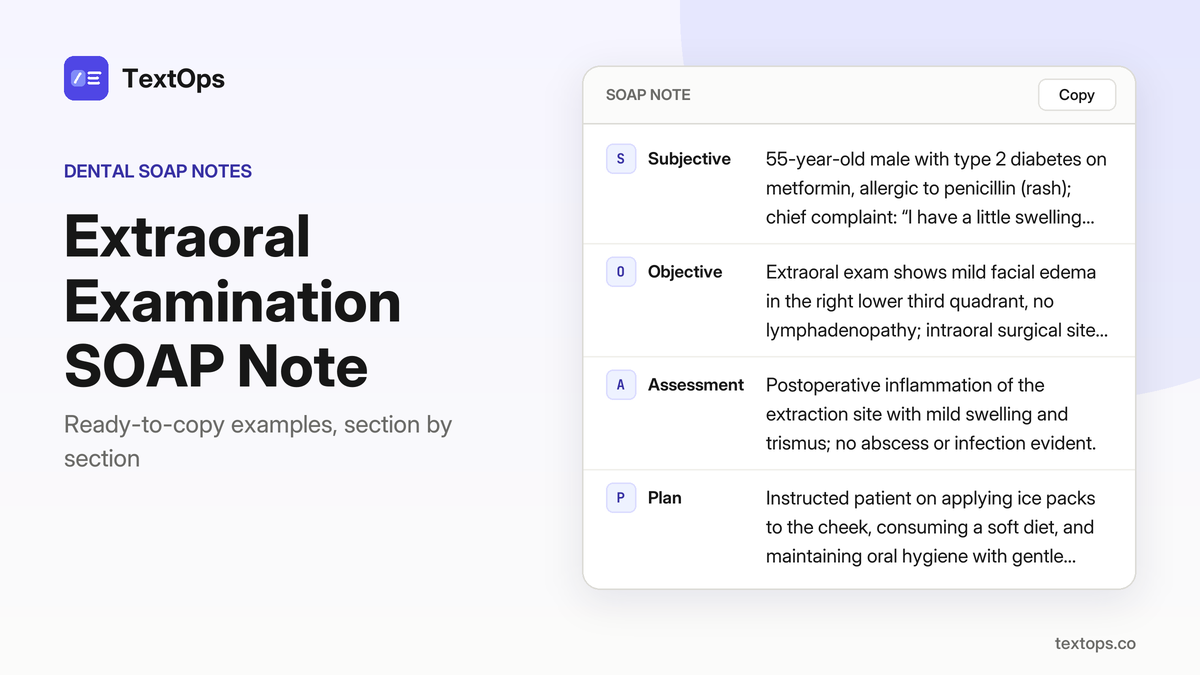
A dental follow-up visit evaluates healing after a procedure, monitors pain, infection, and functional status, and plans next steps. A SOAP note captures this succinctly: Subjective complaints, Objective findings, Assessment of healing, and Plan for care. The examples below provide 30+ ready-to-copy notes, each fully populated with S:, O:, A:, and P: sections, ready for immediate insertion into your charting system. The first example follows.
Extraction Follow-Up Visits
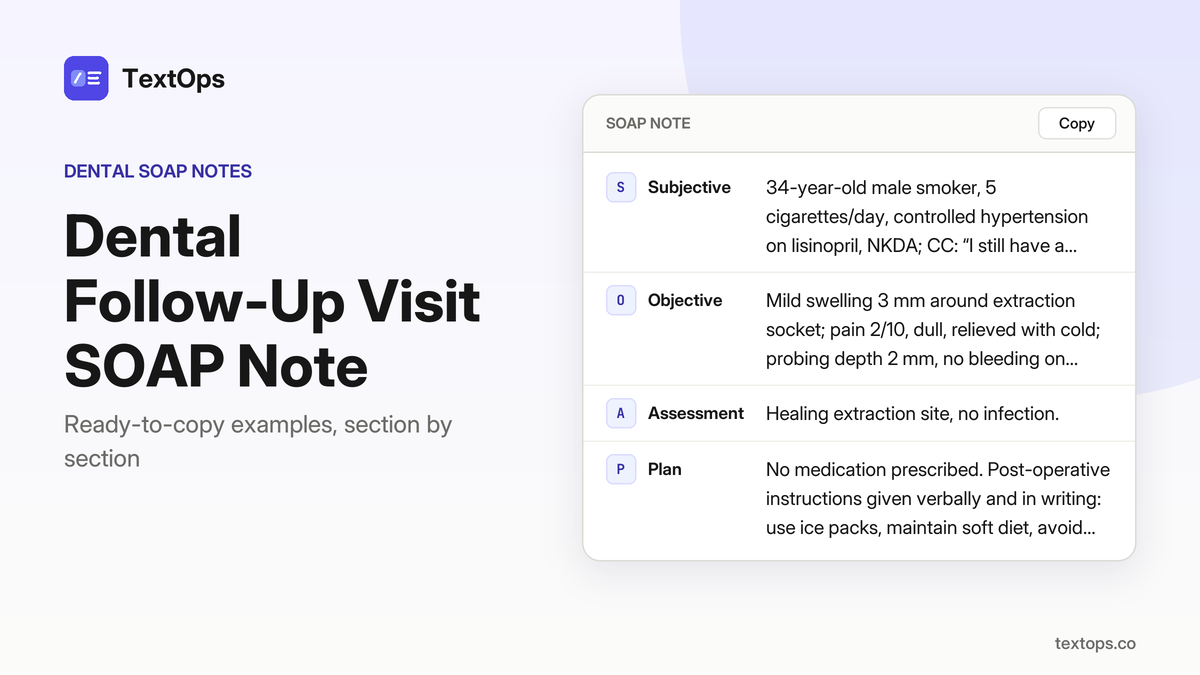
Smoker, Day 3 After Lower Molar Extraction
SOAP note
SSubjective
34-year-old male smoker, 5 cigarettes/day, controlled hypertension on lisinopril, NKDA; CC: “I still have a sore spot after the extraction.” HPI: mild soreness, pain 2/10, dull, relieved with cold, no drainage or erythema beyond socket.
OObjective
Mild swelling 3 mm around extraction socket; pain 2/10, dull, relieved with cold; probing depth 2 mm, no bleeding on probing; gingiva pink, no ulceration; extraoral and intraoral otherwise WNL.
AAssessment
Healing extraction site, no infection.
PPlan
No medication prescribed. Post-operative instructions given verbally and in writing: use ice packs, maintain soft diet, avoid smoking. Next review scheduled in 7 days.
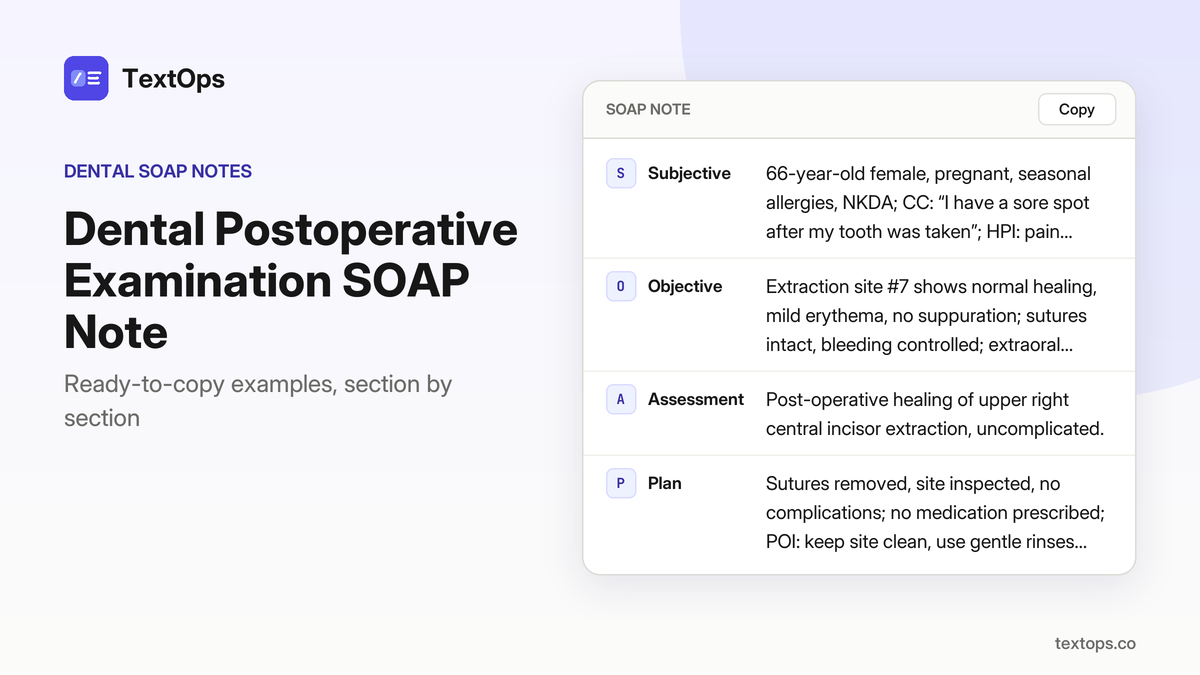
Pregnant, Day 7 After Upper Incisor Extraction
SOAP note
SSubjective
64-year-old pregnant female, hypothyroid on levothyroxine, allergic to penicillin (rash). Chief complaint: “I’m still a bit sore and the area feels tender.” HPI: pain 3/10, sharp, worsens with hot liquids; no swelling or drainage.
OObjective
Extraoral: no swelling. Intraoral: slight erythema 5 mm around socket of #7; probing depth 2 mm, no bleeding on probing; gingiva pink, no ulceration. Pain 3/10, sharp, hot-liquid trigger. No systemic signs.
AAssessment
Healing extraction site, no infection.
PPlan
Anesthesia used: 2% lidocaine with 1:100,000 epinephrine, 1.8 mL (1 cartridge), infiltration, aspiration negative. Post-operative instructions: avoid hot foods, continue chlorhexidine 0.12% rinse twice daily. No medications prescribed. Next visit scheduled in 7 days.
Non-smoker, Day 10 After Extraction of Third Molar
SOAP note
SSubjective
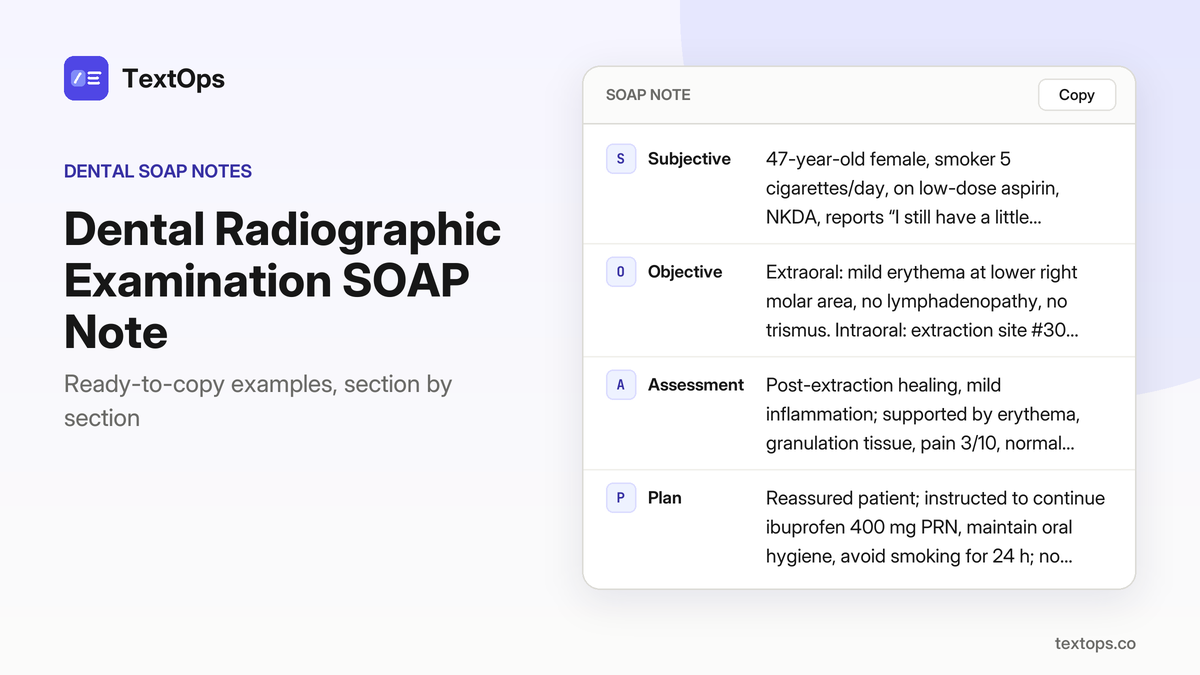
67-year-old female, smokes five cigarettes daily, NKDA, presents for day-10 follow-up after extraction of tooth #30. She reports that the molar area still hurts a bit; pain is 4/10, dull in character, relieved with cold, and she denies any drainage or worsening swelling. There is no systemic illness or new symptoms since the procedure.
OObjective
Extraoral examination shows no facial asymmetry, no cervical lymphadenopathy, and normal mouth opening. Intraorally, the socket of #30 shows mild swelling of approximately 4 mm around the extraction site; the mucosa is pink with no ulceration or erythema beyond the socket. Probing depth is 2 mm, with no bleeding on probing, and the surrounding gingiva appears healthy.
AAssessment
Healing extraction site with no evidence of infection or delayed healing.
PPlan
Local anesthesia was administered during the extraction: 2% lidocaine with 1:100,000 epinephrine, 1.8 mL (1 cartridge), IANB, aspiration negative. Post-operative instructions were reiterated, emphasizing avoidance of smoking, maintaining oral hygiene, and monitoring for any new pain, swelling, or drainage. No medications were prescribed at this visit. A follow-up review is scheduled for day 14 to assess continued healing.
Geriatric, Day 1 After Crown & Bridge Placement
SOAP note
SSubjective
79-year-old female, no significant medical history, allergic to penicillin (rash); chief complaint: “I just had a crown placed and I'm wondering how it feels.” O: crown seated, margins intact; gingiva pink, mild 2-mm inflammation, no bleeding on probing; probing depth 1 mm, no pocketing; no ulceration; systemic signs none. A: post-operative healing of crown placement, evidenced by intact margins, absence of pain, and shallow probing depths. P: 2% lidocaine with 1:100,000 epinephrine, 1.8 mL infiltration, aspiration negative; no medications prescribed; postoperative instructions: avoid hard foods for 24 h, maintain oral hygiene, report swelling or pain; next visit in 7 days for bridge cementation.
Smoker, Day 1 After Extraction of Impacted Tooth
SOAP note
SSubjective
23-year-old female, smoker (5 cigs/day), NKDA, reports “I still feel pain after the extraction.” HPI: pain 5/10, sharp, worsens with pressure, no drainage or erythema beyond socket.
OObjective
Mild swelling 5 mm around socket; probing depth 2 mm, no bleeding on probing; gingiva pink, no ulceration; pain 5/10, sharp; no systemic signs.
AAssessment
Healing extraction site, no infection.
PPlan
2% lidocaine with 1:100,000 epinephrine, 1.8 mL buccal infiltration, aspiration negative was used; no drugs prescribed. Post-operative instructions: use ice packs, soft diet, avoid smoking. Next review scheduled in 7 days.
Diabetic, Day 7 After Extraction of Tooth 18
SOAP note
SSubjective
66-year-old female with type 2 diabetes on metformin, seasonal allergies, NKDA, reports “My lower right molar area still hurts a bit.” HPI: pain 4/10, dull, relieved with cold, no drainage, no erythema beyond socket, mild swelling 4 mm around socket.
OObjective
Extraoral: mild swelling 4 mm around socket; intraoral: probing depth 2 mm, no bleeding on probing, gingiva pink, no ulceration; radiograph not taken; pain 4/10; anesthesia: 2% lidocaine with 1:100,000 epinephrine, 1.8 mL, IANB, aspiration negative.
AAssessment
Healing extraction site of tooth #30, no infection.
PPlan
Post-operative instructions reiterated; advised strict glycemic control, avoid smoking; no medication prescribed; next review scheduled in 7 days (day 14).
Elderly, Day 3 After Extraction of a Mandibular Incisor with Anticoagulant Therapy
SOAP note
SSubjective
44-year-old male, type 2 diabetic on metformin, NKDA, reports “I still have a bit of bleeding and soreness.” He is on anticoagulant therapy and has not interrupted it.
OObjective
Mild bleeding controlled with gauze, no active oozing; 3 mm swelling around socket; pain 3/10 dull, relieved with cold; no drainage or erythema beyond socket; probing depth 2 mm, no bleeding on probing; gingiva pink, no ulceration.
AAssessment
Healing extraction site, no infection.
PPlan
2% lidocaine with 1:100,000 epinephrine, 1.8 mL (1 cartridge), IANB, aspiration negative; postoperative instructions: continue anticoagulants, ice packs, soft diet; next review in 4 days (day 7).
Smoker, Day 1 After Molar Extraction with Graft
SOAP note
SSubjective
56-year-old female smoker, 5 cigarettes/day, asthma on albuterol PRN, NKDA; CC: “I still feel some soreness after the extraction.” HPI: pain 3/10, dull, relieved with cold, no drainage, mild swelling 4 mm around socket.
OObjective
Graft in place, stable; mild swelling 4 mm; pain 3/10; probing depth 2 mm, no bleeding on probing; gingiva pink, no ulceration; no erythema beyond socket; systemic signs none.
AAssessment
Healing extraction site with graft, no infection.
PPlan
2% lidocaine with 1:100,000 epinephrine, 1.8 mL (1 cartridge), IANB, aspiration negative; no drugs prescribed. POI: ice packs, soft diet, avoid smoking; next review in 7 days.
Non-smoker, Day 1 After Extraction of an Impacted Third Molar With Graft
SOAP note
SSubjective
21-year-old male, former smoker, NKDA, presents Day 1 after extraction of impacted third molar #30 with graft. He reports persistent pain, stating “I still have some pain after the extraction.” Pain is 4/10, dull in character, and is relieved by applying cold. No drainage, no erythema beyond the socket, and he denies fever or systemic symptoms.
OObjective
Clinical findings reveal a stable graft in place and mild swelling measuring 5 mm around the socket. Probing depth is 2 mm with no bleeding on probing. The gingiva is pink, intact, and shows no ulceration. Anesthesia administered was 2% lidocaine with 1:100,000 epinephrine, 1.8 mL (1 cartridge), IANB, with negative aspiration.
AAssessment
Healing extraction site with graft, no infection.
PPlan
Post-operative instructions reiterated; patient advised to use ice packs, maintain a soft diet, and avoid smoking. No medications prescribed. Next review scheduled in 7 days.
Pregnancy, Day 14 After Wisdom Tooth Extraction
SOAP note
SSubjective
63-year-old pregnant female, on low-dose aspirin, NKDA, reports “I still have a bit of soreness after the extraction.” She has no systemic symptoms.
OObjective
Mild swelling 4 mm around socket of tooth #30; pain 3/10, dull, relieved with cold; no drainage, no erythema beyond socket; probing depth 2 mm, no bleeding on probing; gingiva pink, no ulceration.
AAssessment
Healing extraction site, no infection, supported by minimal swelling, low pain score, and healthy gingival tissues.
PPlan
2 % lidocaine with 1:100 000 epinephrine, 1.8 mL IANB, aspiration negative. Post-operative instructions reiterated: ice packs, soft diet, avoid smoking. No medication prescribed. Next review scheduled in 7 days (day 21).
Root Canal & Endodontic Follow-Up
Diabetic, Day 5 After Root Canal Therapy
SOAP note
SSubjective
29-year-old male, type 2 diabetes on metformin, controlled hypertension on lisinopril, NKDA; CC: “I’m here for my follow-up after the root canal on my upper first molar.” HPI: returns 5 days post-RCT, reports mild discomfort.
OObjective
Extraoral: no facial swelling, lymph nodes not enlarged. Intraoral: gingiva around #14 pink, no erythema; mild tenderness to percussion, no swelling, no sinus tract. Radiograph: periapical film shows complete obturation, no periapical radiolucency.
AAssessment
Previously treated tooth #14, normal apical tissues.
PPlan
Reviewed healing, reinforced oral hygiene instructions, no medication prescribed. Scheduled next visit in 6 months for restoration placement.
Non-smoker, Day 6 After Root Canal Therapy
SOAP note
SSubjective
70-year-old female patient, smoker 5 cigarettes daily, NKDA, reports “I’m here for my follow-up after the root canal on my lower left molar.” She denies pain or swelling.
OObjective
Tooth #18 shows no percussion tenderness, gingiva pink, no erythema. Extraoral exam: no facial swelling, lymph nodes not enlarged. Radiograph: periapical radiograph shows complete obturation, no periapical radiolucency.
AAssessment
Previously treated tooth, normal apical tissues, supported by lack of tenderness, normal gingiva, and radiographic absence of pathology.
PPlan
Reinforced oral hygiene instructions; no medication prescribed. Advised to return in 6 months for final restoration placement.
Diabetic, Day 2 After Endodontic Surgery
SOAP note
SSubjective
48-year-old female, type 2 diabetic on metformin, smoker 5 cigarettes/day, NKDA, reports “I’m here for my follow-up after the surgery on my upper left premolar.”
OObjective
Tooth #12 shows mild buccal vestibular swelling, mild pain on biting; extraoral exam normal, no facial swelling or lymphadenopathy; intraoral surgical site healing with mild erythema; PA radiograph shows healing, no new radiolucency.
AAssessment
Acute apical abscess, evidenced by localized swelling, pain on biting, and radiographic healing without new pathology.
PPlan
Reassured patient, reinforced oral hygiene, advised to avoid hard foods, no medication prescribed; scheduled next visit in 7 days.
Pregnancy, Day 10 After Root Canal Therapy
SOAP note
SSubjective
55-year-old female, pregnant, allergic to penicillin (rash); CC: “I’m here for my follow-up after the root canal on my lower first molar.” HPI: 10 days post-RC; reports no pain or swelling. PMH: pregnancy; no other medications.
OObjective
Tooth #30: no percussion tenderness, no swelling; extraoral: no facial swelling, lymph nodes not enlarged; intraoral: gingiva around #30 pink, no erythema; PA radiograph shows complete obturation, no periapical radiolucency.
AAssessment
Previously treated tooth, normal apical tissues; findings support a healed periapical area with no pathology.
PPlan
Reinforced oral hygiene instructions; no medications prescribed. Scheduled next visit in 6 months for restoration placement.
Non-smoker, Day 3 After Root Canal of a Mandibular Premolar
SOAP note
SSubjective
71-year-old male, smoker (5 cigarettes daily), reports “I’m here for my follow-up after the root canal on my lower left premolar.” He denies pain, swelling or other symptoms, and has no known drug allergies.
OObjective
Tooth #27: no percussion tenderness, gingiva pink and healthy, no erythema. Extraoral: no facial swelling, submandibular and cervical lymph nodes not enlarged. Intraoral: mucosa intact, no lesions. Radiograph: periapical view shows complete obturation of the canal, no periapical radiolucency, and the surrounding bone appears normal.
AAssessment
Previously treated tooth, normal apical tissues – no pathology or complications identified.
PPlan
Reinforced oral hygiene instructions given, advised to continue regular brushing and flossing. No medication prescribed. Next visit scheduled in 6 months for definitive restoration placement.
Pregnant, Day 5 After Endodontic Surgery of a Maxillary Incisor
SOAP note
SSubjective
20-year-old pregnant female; chief complaint: "I'm here for my follow-up after the surgery on my upper right central incisor." History: postoperative day 5, no systemic symptoms, NKDA, seasonal allergies.
OObjective
Extraoral: no facial swelling, lymph nodes not enlarged. Intraoral: surgical site healing, mild erythema, mild swelling in vestibule, mild pain on biting. Tooth #8: mild swelling, no mobility. Radiograph: periapical shows healing, no new radiolucency.
AAssessment
Acute apical abscess of tooth #8, supported by mild vestibular swelling, pain on biting, and periapical radiograph showing healing without new lesions.
PPlan
Reassure patient, reinforce oral hygiene instructions, no medication prescribed. Schedule next visit in 7 days for restoration placement.
Non-smoker, Day 2 After Endodontic Surgery for a Maxillary Canine
SOAP note
SSubjective
82-year-old male, smoker, type 2 diabetic on metformin, NKDA; chief complaint: “I’m here for my follow-up after the surgery on my upper right canine.” History: day-2 post-endodontic surgery, no systemic symptoms.
OObjective
extraoral: no facial swelling, lymph nodes not enlarged; intraoral: surgical site healing, mild erythema, mild swelling in vestibule, mild pain on biting; radiograph: periapical shows healing, no new radiolucency.
AAssessment
acute apical abscess – supported by mild vestibular swelling, pain on biting, and periapical radiograph showing healing without new radiolucency.
PPlan
reassure patient, reinforce oral hygiene, no medication prescribed; next visit scheduled in 7 days.
Allergic to Penicillin, Day 3 After Endodontic Surgery
SOAP note
SSubjective
60-year-old female, asthma controlled with albuterol PRN, allergic to penicillin (rash). Chief complaint: “I’m here for my follow-up after the surgery on my upper left canine.” History: day-3 post-endodontic surgery, no systemic symptoms. PMH: asthma; medications: albuterol inhaler PRN.
OObjective
Extraoral: no facial swelling, lymph nodes not enlarged. Intraoral: surgical site #11 shows mild erythema, mild swelling in vestibule, mild pain on biting. Radiograph: periapical shows healing, no new radiolucency.
AAssessment
Acute apical abscess of tooth #11, supported by mild swelling, erythema, and pain on biting with radiographic healing.
PPlan
Reassured patient, reinforced oral hygiene instructions, advised to avoid hard foods and maintain gentle rinsing. No medication prescribed. Scheduled next visit in 7 days for restoration placement.
Implant Placement Follow-Up
Smoker, Day 7 After Sinus Lift and Implant Placement
SOAP note
SSubjective
47-year-old male, former smoker, NKDA, presents for Day 7 follow-up after sinus lift and implant placement in the maxillary right first molar (#14). He reports “I feel fine, just a little soreness in the upper back”; he denies pain, trismus, or bleeding, and notes only mild discomfort that has not worsened since the procedure.
OObjective
Extraoral examination shows no facial swelling or lymphadenopathy. Intraoral inspection reveals a healing implant site with mild mucosal edema and no erythema, ulceration, or suppuration. The implant is stable on percussion and palpation. Periapical radiograph demonstrates well-integrated graft material in the sinus floor and proper implant positioning without radiolucency or perforation.
AAssessment
Implant placement with graft integration, healing, no infection.
PPlan
No medications prescribed; postoperative instructions regarding oral hygiene, diet, and activity were reiterated verbally and given in writing. The patient was advised to avoid smoking and to report any new pain, swelling, or bleeding immediately. Next visit scheduled for Day 30 for final prosthesis placement.
Smoker, Day 4 After Implant Placement
SOAP note
SSubjective
76-year-old female smoker, 5 cigarettes/day, on low-dose aspirin, NKDA, reports “my lower molar feels a bit sore but nothing serious” since implant placement; no systemic symptoms.
OObjective
Implant site in tooth #17 shows slight swelling, no pain or drainage; percussion stable; periapical radiograph confirms implant in place, no radiolucency; overall healing within expected limits.
AAssessment
Implant placement, healing, no infection; stable implant with normal postoperative findings.
PPlan
No medication prescribed; postoperative instructions reviewed (avoid hard foods, maintain oral hygiene, monitor for swelling or pain); next visit scheduled for Day 14 to reassess healing.
Pregnancy, Day 8 After Implant Placement in the Maxillary Anterior Region
SOAP note
SSubjective
28-year-old pregnant female, controlled hypertension on lisinopril, NKDA; chief complaint: “I have a little soreness in the upper canine area”; no systemic symptoms, no pain reported.
OObjective
Implant site #6 shows mild mucosal erythema, no pain; implant stable on percussion; periapical radiograph confirms implant placement with no radiolucency; extraoral and intraoral findings otherwise within normal limits.
AAssessment
Implant placement, healing, no infection; findings of stable implant and absence of radiolucency support this assessment.
PPlan
2% lidocaine with 1:100,000 epinephrine, 1.8 mL infiltration administered; post-operative instructions given regarding oral hygiene, diet, and activity restrictions; no medications prescribed; next visit scheduled for Day 30 for final prosthesis placement.
Non-smoker, Day 7 After Implant Placement with Immediate Loading
SOAP note
SSubjective
52-year-old female, 5 cigarettes/day, hypothyroidism on levothyroxine, allergic to penicillin (rash); CC: “The new crown feels a bit tight but no pain”; HPI: day-7 post-implant placement with immediate loading, reports tight fit, no pain; PMH: hypothyroidism, no other meds.
OObjective
Extraoral: slight swelling at #30 site, no erythema; Intraoral: prosthesis seated, implant stable on percussion; Periodontal: no BOP; Radiograph: implant and crown in place, no radiolucency; Periapical view WNL.
AAssessment
Implant placement with immediate loading, healing, no infection; supported by stable percussion, absence of pain, normal radiograph.
PPlan
No drugs prescribed; postoperative instructions given: avoid hard foods, maintain oral hygiene, report swelling or pain; next visit scheduled for Day 30 for final prosthesis adjustment.
Pregnancy, Day 3 After Implant Placement in the Maxillary Posterior
SOAP note
SSubjective
42-year-old pregnant female, smoker, NKDA, reports “I feel a little sore in the back of my upper jaw”; history: implant placed in tooth #3, 3 days ago, no pain or drainage.
OObjective
Extraoral: mild edema at implant site, no erythema; Intraoral: closed mucosa, no ulceration; Periodontal: implant stable on percussion, no mobility; Radiograph: periapical shows implant in place, no radiolucency; Vital signs WNL.
AAssessment
Implant placement, healing, no infection.
PPlan
2% lidocaine with 1:100,000 epinephrine, 1.8 mL infiltration administered; postoperative instructions given (avoid smoking, maintain oral hygiene, soft diet); next visit Day 14 for healing assessment.
Pediatric, Day 7 After Sealant Placement
SOAP note
SSubjective
8-year-old male, no significant medical history; allergic to penicillin (rash). Chief complaint: “I don’t have any pain, just a little sore spot.” HPI: reports mild soreness at the sealant site, no swelling or erythema. PMH: none.
OObjective
Intraoral exam shows sealant intact on buccal surface of tooth #5, no caries, no sensitivity. No swelling, erythema, or other abnormalities noted. Extraoral exam WNL.
AAssessment
Sealant placement with normal healing; no complications.
PPlan
No medication prescribed. Post-operative instructions given verbally: keep the area clean, avoid hard foods for 24 h, use gentle brushing. Next visit scheduled for Day 30 for routine check.
Prosthetic & Restorative Follow-Up
Elderly, Day 2 After Implant Placement
SOAP note
SSubjective
54-year-old female, NKDA, comes for day-2 implant follow-up; says “I’m here for my follow-up after the implant placement.” HPI: no pain, no swelling, normal healing.
OObjective
Implant site shows slight pink mucosa, 2 mm probing depth, no bleeding on probing. Periapical radiograph confirms implant in place, no radiolucency.
AAssessment
Implant placement, healing; findings of normal soft tissue, shallow probing, and radiographic stability support this.
PPlan
No drug administered. Post-operative instructions given verbally and in writing: keep site clean, avoid hard foods, resume normal diet gradually. Patient advised to return in 7 days for next visit.
Pediatric, Day 4 After Stainless-Steel Crown Placement
SOAP note
SSubjective
6-year-old male, NKDA, reports “little sore after the crown was put on”; no significant medical history; parent notes mild discomfort during chewing.
OObjective
Crown on tooth K seated properly, no leakage; mild gingival inflammation at margin, probing depth 1 mm, no bleeding on probing; periapical radiograph shows no radiolucency; child reports no pain; extraoral exam shows no facial swelling or lymphadenopathy; intraoral soft tissues appear healthy; adjacent teeth exhibit normal enamel surfaces.
AAssessment
Stainless-steel crown placement with normal healing; mild gingival inflammation around margin likely post-operative irritation.
PPlan
2% lidocaine with 1:100,000 epinephrine, 1.8 mL infiltration used for the procedure; fluoride varnish applied to adjacent teeth #K-1 and #K-2; parent instructed on gentle brushing with a soft-bristle brush, use of fluoride toothpaste, and avoidance of hard foods for 48 h; advised to rinse with 0.12% chlorhexidine for 30 s twice daily; no medication prescribed; next visit scheduled in 7 days for a check-up and to assess gingival healing.
Elderly, Day 4 After Crown Removal
SOAP note
SSubjective
70-year-old female, type 2 diabetic on metformin, NKDA; CC: “The tooth feels a bit sensitive after the crown was taken off”; HPI: sensitivity to air, no pain on palpation; PMH: diabetes, no systemic signs; no medications besides metformin.
OObjective
Extraoral: no swelling or erythema; Intraoral: root surface of tooth #30 exposed, mild air sensitivity; Periodontal: PD 3 mm, no BOP; Radiograph: periapical radiograph shows no pathology; Tests: none.
AAssessment
Crown removal with exposed root, healing without pathology; root planing performed, fluoride varnish applied.
PPlan
2% lidocaine with 1:100,000 epinephrine, 1.8 mL (1 cartridge), IANB administered; root planing and fluoride varnish applied; POI: use desensitizing toothpaste, avoid hot foods; next visit in 7 days to evaluate sensitivity.
Pregnancy, Day 3 After Dental Implant Surgery
SOAP note
SSubjective
32-year-old pregnant female reports “I’m here to check on the implant after the surgery.” She has asthma, uses albuterol PRN, NKDA, and is on no other medications. HPI: mild soreness at implant site, no fever, no pain or swelling.
OObjective
Extraoral: mild edema, pink mucosa. Intraoral: implant site with 2 mm probing depth, no bleeding on probing. Radiograph: implant in place, no radiolucency. No systemic signs noted.
AAssessment
Implant placement, healing; findings of mild edema, 2 mm probing depth, and radiographic stability support this.
PPlan
No drugs prescribed. Post-operative instructions: soft diet, chlorhexidine 0.12% rinse 15 mL for 30 s twice daily, avoid smoking. Patient advised to return in 7 days for follow-up.
Elderly, Day 14 After Crown & Bridge Placement
SOAP note
SSubjective
80-year-old male, former smoker, NKDA, reports “I’m here for the follow-up after the bridge was placed.” No pain or sensitivity; history of crown & bridge placement on tooth #14.
OObjective
Bridge seated correctly, no leakage. Mild gingival recession at margin; probing depth 2 mm, no bleeding on probing. Periapical radiograph shows restoration in place, no periapical pathology. Extraoral and intraoral findings otherwise WNL.
Occlusal adjustment performed to relieve mild overbite; fluoride varnish applied to tooth #14 and adjacent teeth. Patient instructed to maintain oral hygiene, avoid hard foods for 24 h. Next visit scheduled in 30 days for final check.
Elderly, Day 7 After Crown & Bridge Placement on the Maxillary Arch
SOAP note
SSubjective
45-year-old female patient, daily low-dose aspirin, NKDA, presents for her routine Day 7 follow-up after a crown-and-bridge was placed on the maxillary arch; she reports “I’m here for my follow-up after the bridge was placed” and notes mild sensitivity to cold but no pain.
OObjective
Extraoral exam shows no swelling or lymphadenopathy. Intraoral findings reveal the bridge seated properly with no evidence of leakage or marginal discrepancy. Probing depth at the abutment tooth #6 is 2 mm, with no bleeding on probing. Periapical radiograph demonstrates the restoration in place, with no periapical pathology or radiolucency. The patient reports mild sensitivity to cold stimuli but denies any discomfort or pain.
AAssessment
Crown-and-bridge placement, healing; the abutment tooth exhibits normal periodontal status and no signs of postoperative complications.
PPlan
A desensitizing agent was applied to tooth #6; the patient was instructed to avoid very hot foods and drinks, to maintain meticulous oral hygiene, and to rinse with 0.12% chlorhexidine twice daily. No medications were prescribed. The next visit is scheduled in 14 days for a final adjustment and to reassess sensitivity.
Pediatric, Day 6 After Composite Restoration of a Primary Tooth
SOAP note
SSubjective
6-year-old male, no significant medical history, NKDA, reports “Just here for my check-up after the filling.” He has no pain, no sensitivity to cold or biting, and no other complaints.
OObjective
The composite restoration on the buccal surface of tooth K appears intact with no marginal discoloration. The gingiva surrounding tooth K is pink, healthy, and shows no bleeding on probing. Probing depths are 1–2 mm and there are no periodontal pockets. A periapical radiograph demonstrates no caries, no restoration overhang, and no periapical pathology.
AAssessment
Composite restoration, no complications.
PPlan
Reviewed the restoration with the patient and caregiver, confirming that the restoration is stable and that the patient understands the importance of maintaining good oral hygiene. Reinforced instructions to brush twice daily with fluoride toothpaste, floss around the tooth, and avoid hard foods for 24 h to protect the new restoration. No medication was prescribed. The next visit is scheduled for a routine check-up in 4 weeks to monitor the restoration and overall oral health.
Elderly, Day 5 After Crown Placement on a Single Tooth
SOAP note
SSubjective
62-year-old female, hypothyroidism on levothyroxine, allergic to penicillin (rash); CC: "I'm here to see how the crown is doing"; HPI: no pain, no sensitivity, no swelling; PMH: hypothyroidism; allergy: penicillin rash.
OObjective
Full-coverage crown on #30 seated, margins smooth, no overhangs; Pericervical gingiva pink, no recession, no bleeding on probing; Probing depths 1–2 mm, no periodontal pockets; Radiograph shows no crown or root fracture, no periapical radiolucency; no systemic signs.
AAssessment
Crown placement on #30, no complications.
PPlan
Reinforced oral hygiene instructions, advised to avoid chewing hard foods for 24 h; no medications prescribed; next recall scheduled in 6 months.
Pediatric, Day 3 After Composite Restoration of a Permanent First Molar
SOAP note
SSubjective
9-year-old female, no significant medical history, NKDA. Chief complaint: “Just checking on my filling.” The patient reports no pain, no sensitivity to cold or biting, and no recent trauma. No systemic signs noted.
OObjective
Composite on the mesio-occlusal surface of tooth #14 is intact with no marginal breakdown. Gingiva around #14 is pink and healthy; probing reveals 1–2 mm depths with no bleeding on probing. No periodontal pockets are present. Bite-wing radiograph shows no caries extension, no periapical radiolucency, and the restoration margins are well-contoured. Extraoral examination is unremarkable.
AAssessment
Composite restoration, no complications.
PPlan
Reviewed the restoration with the patient, reinforced proper brushing technique and fluoride use, and advised avoidance of sticky foods for 24 h to protect the new composite. No medications were prescribed. The patient was instructed to maintain regular oral hygiene and to report any new symptoms immediately. A routine recall is scheduled in 6 months to reassess restoration integrity and oral health.
Elderly, Day 2 After Placement of a Partial Denture
SOAP note
SSubjective
68-year-old male, NKDA, presents on Day 2 after placement of a partial denture for a routine check-in. He reports “I’m here to see how the denture feels.” He denies pain, swelling, or any discomfort while chewing or speaking, and reports no systemic symptoms or medication changes since the procedure.
OObjective
Clinical exam shows the partial denture seated correctly on abutments #15 and #18 with no sore spots or mucosal ulceration. The gingiva surrounding the abutment teeth is pink, healthy, and exhibits no bleeding on probing. Probing depths around the abutments are 1–2 mm, with no periodontal pockets or signs of inflammation. Intraoral radiograph demonstrates intact roots, no root resorption, and no periapical pathology. Extraoral findings are unremarkable.
AAssessment
Partial denture, no complications.
PPlan
Confirmed proper fit and occlusion of the partial denture. Instructed the patient on daily denture cleaning techniques and oral hygiene around the abutment sites, emphasizing the importance of maintaining plaque control to prevent future periodontal issues. No medications were prescribed. Scheduled next adjustment visit in 4 weeks for routine follow-up and fit reassessment.
Pediatric, Day 4 After Stainless-Steel Crown
SOAP note
SSubjective
4-year-old female, NKDA, “Just here to see how the crown is doing”; the child reports no pain, no sensitivity to cold or biting, and no discomfort while chewing.
OObjective
Stainless-steel crown on tooth K is seated properly, with smooth margins and no overhangs. Gingiva surrounding the crown is pink, healthy, and exhibits no bleeding on probing. Probing depths around the tooth are 1–2 mm, indicating no periodontal pockets. Periapical radiograph shows the crown intact, no fracture of the crown or root, and no periapical radiolucency.
AAssessment
Stainless-steel crown, no complications.
PPlan
Reinforced oral hygiene instructions were given, emphasizing brushing with a soft-bristle brush and flossing around the crown twice daily. The child was advised to avoid hard foods for 24 hours to allow the crown to settle. No medication was prescribed. A follow-up recall is scheduled in 6 months to reassess fit, occlusion, and oral hygiene status.
Pediatric, Day 2 After Composite Restoration
SOAP note
SSubjective
8-year-old male, seasonal allergies, NKDA; CC: “I’m here to check my filling”; HPI: no pain, no sensitivity to cold or biting; PMH: none.
OObjective
Composite on buccal surface of tooth #19 intact, no marginal discoloration; gingiva pink, healthy, no bleeding on probing; probing depths 1–2 mm, no periodontal pockets; radiograph shows no caries or periapical pathology; no systemic signs.
AAssessment
Composite restoration, no complications.
PPlan
Reviewed restoration, reinforced brushing technique, advised to avoid sticky foods for 24 h; no medication prescribed; next visit in 6 months for routine check.
Periodontal Surgery Follow-Up
Diabetic, Day 30 After Periodontal Surgery
SOAP note
SSubjective
24-year-old male, type 2 diabetic on metformin, NKDA, reports “I’m here for my 30-day follow-up after the flap surgery. I feel fine, just a little sore around the flap.”
OObjective
Flap healed with minimal erythema, no exudate; probing depth at tooth #30 is 3 mm, BOP negative; gingival recession 1 mm; no suppuration or swelling; radiograph shows bone fill at the surgical site, no radiolucency.
AAssessment
Stage I, Grade A periodontal disease – post-operative healing, supported by shallow probing depth, absence of bleeding, and radiographic bone fill.
PPlan
Reviewed postoperative instructions, reinforced oral hygiene, advised avoidance of hot foods for 48 h; no medications prescribed. Next visit: routine recall in 6 months.
Non-smoker, Day 4 After Periodontal Flap Surgery for Recession on the Mandible
SOAP note
SSubjective
69-year-old female, non-smoker, presents on day 4 after periodontal flap surgery for recession on tooth #27; reports “area feels a bit tender but it’s healing.” Medical history: asthma, albuterol PRN, NKDA.
OObjective
Flap margins intact, slight erythema; probing depth at #27 is 4 mm with BOP positive; gingival recession 2 mm; no swelling or suppuration; radiograph shows bone remodeling, no pathology.
AAssessment
Stage I, Grade A periodontal disease – early post-operative healing with mild inflammation.
PPlan
No medication prescribed; patient counseled on smoking cessation impact on healing, reinforced chlorhexidine 0.12 % rinse 15 mL for 30 s twice daily, and scheduled next visit in 2 weeks for reassessment.
Diabetic, Day 1 After Periodontal Flap Surgery for a Mandibular Molar
SOAP note
SSubjective
31-year-old male, type 2 diabetes on metformin, former smoker, NKDA; chief complaint: “I’m here the day after the flap surgery. The flap is a bit sore but I can still eat.”
OObjective
Flap edges neat with slight pinkness; probing depth #31 5 mm, BOP negative; gingival recession 1.5 mm; no swelling or drainage; panoramic radiograph shows bone fill at the surgical site, no radiolucency.
AAssessment
Stage I, Grade A periodontal disease – immediate post-operative healing, supported by stable probing depth, absence of BOP, and radiographic bone fill.
PPlan
Reviewed postoperative care instructions, advised soft toothbrush use, no medications prescribed; scheduled next visit in 7 days for healing assessment.
Diabetic, Day 3 After Periodontal Flap Surgery for Gingival Recession
SOAP note
SSubjective
57-year-old male, type 2 diabetes on metformin, daily low-dose aspirin, NKDA; CC: “I’m back for my 3-day check-up after the flap. The flap is a bit red but I don’t have any pain.”; HPI: no pain, mild erythema, normal healing; PMH: diabetes, aspirin.
OObjective
Flap margins intact, mild erythema; Probing depth at tooth #28 4 mm, BOP positive; Gingival recession 2 mm; No swelling or drainage; Radiograph shows bone remodeling, no pathology; systemic signs none.
AAssessment
Stage I, Grade A periodontal disease – early post-operative healing with mild inflammation.
PPlan
Advised on aspirin use and wound care; reinforced chlorhexidine 0.12% rinse twice daily; no drugs prescribed; next visit scheduled in 2 weeks.
What Is a Dental Follow-Up Visit?
A dental follow-up visit is scheduled after a specific procedure to monitor healing, assess pain, and evaluate treatment progress. The visit differs from a routine exam, which reviews overall oral health without a recent intervention, and from an emergency follow-up, which addresses acute complications or unexpected events. The goal is to document how the site is healing, whether pain or swelling is resolving, and whether the patient is complying with postoperative instructions. The SOAP structure is adapted to these objectives: Subjective captures the patient’s pain level and functional status; Objective records clinical findings such as swelling, wound appearance, and vital signs; Assessment summarizes healing status and any concerns; Plan outlines next steps, medications, and the date of the next visit.
SOAP Structure & Key Follow-Up Data Points
Subjective (S)
Chief complaint (CC) in the patient’s own words, including pain location, onset, and character.
Numeric pain rating 0–10, triggers, relief, and effect on sleep or function.
Medical history updates: current medications, anticoagulants, antiplatelets, bisphosphonates, denosumab, and allergies.
Medication adherence and any new prescriptions taken since the last visit.
Review of postoperative instructions followed, signs of infection (redness, swelling, drainage), and any adverse events.
Objective (O)
Vital signs when indicated: blood pressure, pulse; temperature if infection suspected.
Intraoral examination: wound appearance, drainage, bleeding, swelling, edema, palpation of the surgical site.
Probing of adjacent teeth: BOP, PD, CAL if relevant.
Radiographic findings: PA or BWX taken for the postoperative site, noting healing status or complications.
Local anesthetic details: agent, concentration, vasoconstrictor, volume, technique, and aspiration result.
Assessment (A)
Healing status relative to expected timeline (e.g., “wound healing within normal limits, no infection”).
Pain level and control adequacy.
Any complications: infection, delayed healing, bleeding, adverse medication reaction.
Summary diagnosis or clinical impression that guides the next step.
Plan (P)
Medications prescribed or reinforced (e.g., NSAID, antibiotic if indicated).
Postoperative instructions reiterated verbally and in writing.
Follow-up appointment date and purpose (e.g., suture removal, implant integration check).
Referrals or additional diagnostics if complications noted.
Differentiating Follow-Up from Routine and Emergency Notes & Customizing for Patient Populations
Follow-up SOAP notes focus on healing status, pain resolution, and compliance with postoperative instructions, unlike routine exam notes that assess baseline oral health without recent intervention, or emergency follow-ups that document acute complications and immediate management. In a follow-up, the Subjective section records pain level and functional impact, the Objective section documents wound appearance, swelling, and vital signs, the Assessment summarizes healing progress or concerns, and the Plan outlines next steps such as medication adjustments or next appointment. When tailoring the template, use a child-friendly pain scale (e.g., “0–10” with pictorial anchors) and keep language simple. For pregnant patients, avoid bisphosphonates and note fetal safety in the medication list. Diabetic patients require glucose monitoring prompts and a note on infection risk. Anticoagulated patients need explicit documentation of bleeding control measures, INR checks, and a plan for continuation or adjustment of therapy. Adjust the wording of instructions and the frequency of follow-up visits to reflect these population-specific considerations.
Copying, Pasting, and Inserting Notes into Charting Systems
Copying the Note
Select the entire SOAP block with a tap-and-hold, drag the handles to include all lines, then tap Copy. Open the charting system, navigate to the follow-up visit section, tap the text field, and choose Paste. Use the system’s “Keep line breaks” option or paste as plain text to preserve the S:, O:, A:, P: layout. Verify that the note lands in the correct encounter tab and that the line breaks align with the system’s formatting rules. Adjust spacing if needed, but avoid re-typing the content.
Emergency Follow-Up SOAP Note Examples
Emergency follow-up SOAP notes capture acute complications that arise after a dental procedure. The examples below cover the most common scenarios: post-trauma assessment, post-surgical infection evaluation, and medication reaction documentation. Each note is fully populated with S:, O:, A:, and P: sections and is ready to copy into any charting system. Use the template that matches the patient’s presentation—trauma, infection, or drug reaction—and paste it directly into the encounter. The ready-to-copy format saves time and ensures consistent, compliant documentation for every emergency follow-up visit.
These examples show structure and wording only. Record what you actually found and did, and follow your practice’s documentation requirements.
Dr. Rahul Joshi is a Specialist Orthodontist with extensive clinical experience in orthodontics, dentofacial orthopaedics, and dental aesthetics. Holding a Master of Dental Surgery (MDS) in Orthodontics and Dentofacial Orthopaedics and a Bachelor of Dental Surgery (BDS) from Manipal Academy of Higher Education, he brings expertise in orthodontic treatment planning, teeth alignment, and Invisalign treatment. With professional experience across India and the Netherlands, Dr. Joshi combines clinical knowledge with practical experience in orthodontic care, dental aesthetics, and improving patients' oral health.
Master of Dental Surgery (MDS) in Orthodontics and Dentofacial Orthopaedics — Manipal Academy of Higher Education
Bachelor of Dental Surgery (BDS) — Manipal Academy of Higher Education
Stop retyping your templates
Save any template to TextOps once, then insert it anywhere on the web without retyping. Share it with your team so everyone uses the same wording.