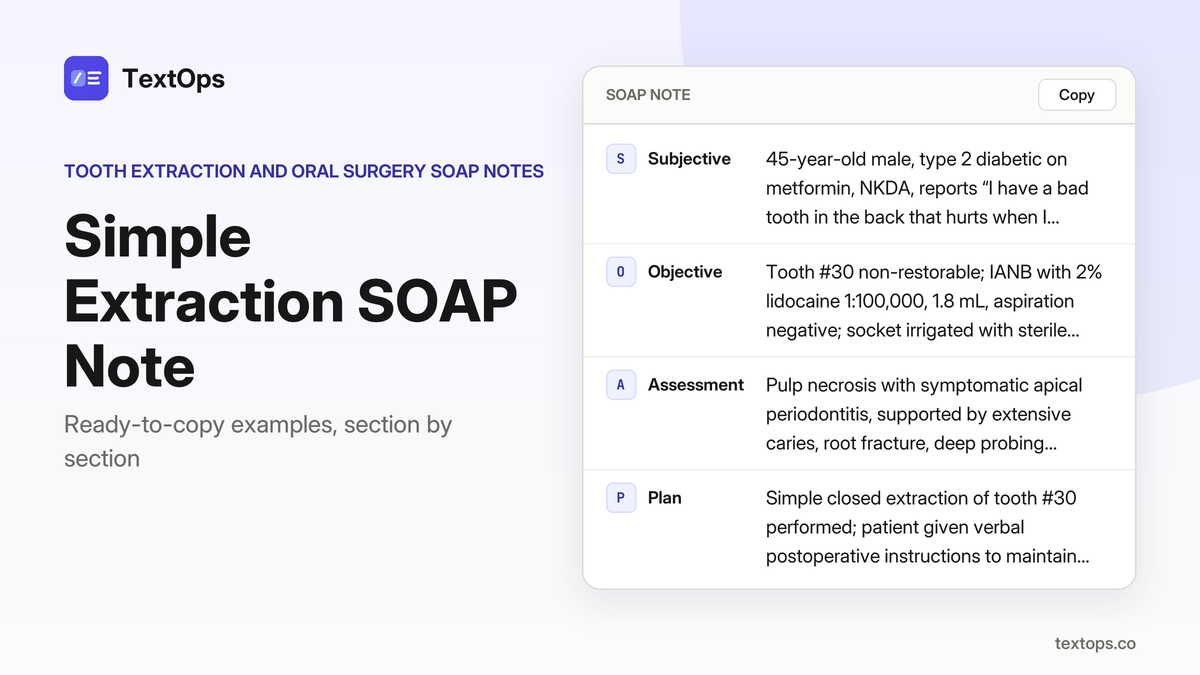
Dental Extraction Consultation SOAP Note templates are ready for immediate use. The first example appears at the top, fully formatted and copy-paste ready. Each note includes all required elements: patient ID, procedure, findings, anesthesia, plan, and follow-up. Clinicians can drop the template into their chart, adjust patient details, and sign. The content covers every essential data point, ensuring compliance with documentation standards and streamlining the extraction workflow.
Routine Extractions
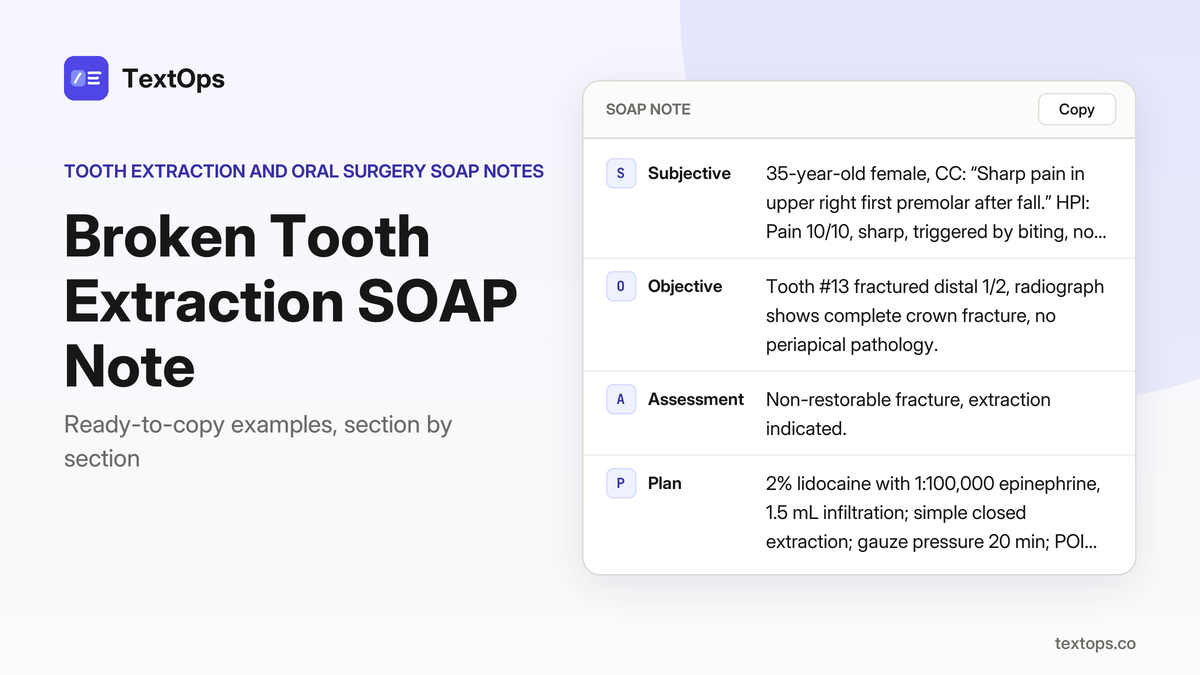
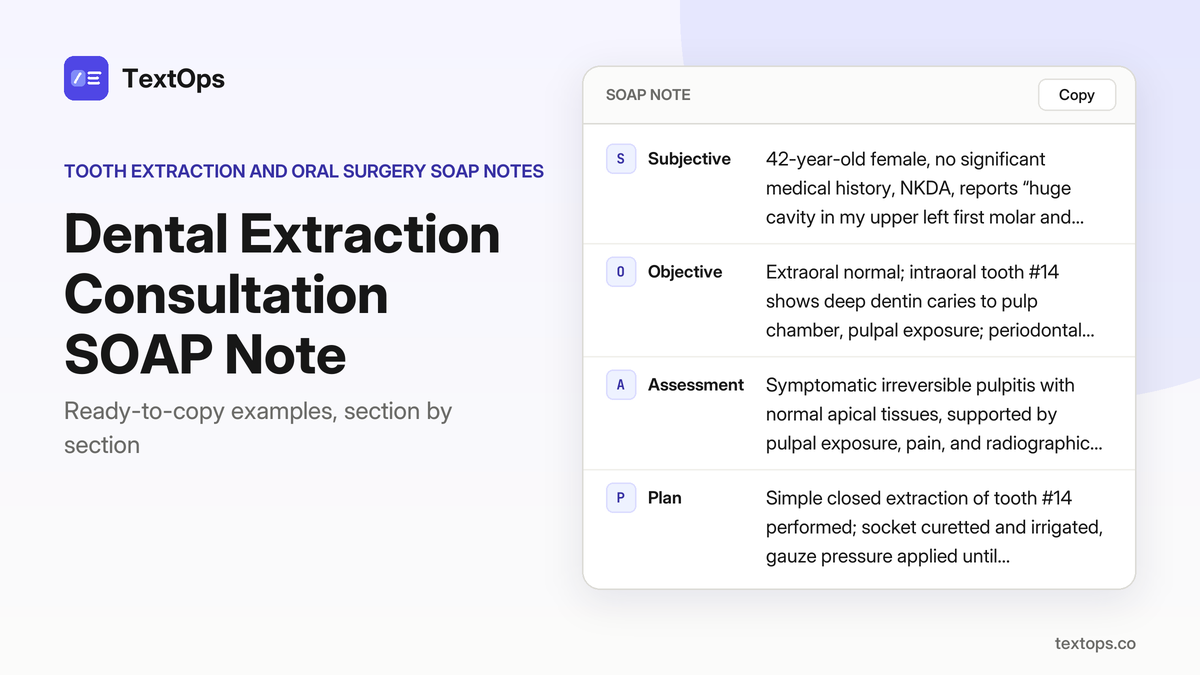
Non-Restorable Caries – Upper First Molar Extraction
SOAP note
SSubjective
42-year-old female, no significant medical history, NKDA, reports “huge cavity in my upper left first molar and it’s hurting”; history of deep dentin caries with pulpal exposure, mobile grade 0, no periodontal pockets, no swelling or trismus.
OObjective
Extraoral normal; intraoral tooth #14 shows deep dentin caries to pulp chamber, pulpal exposure; periodontal probing shows no pockets; PA radiograph shows extensive caries, no radiolucency; periapical tissues normal; anesthesia: 2% lidocaine with 1:100,000 epinephrine, 1.8 mL buccal infiltration, aspiration negative.
AAssessment
Symptomatic irreversible pulpitis with normal apical tissues, supported by pulpal exposure, pain, and radiographic lack of periapical pathology.
PPlan
Simple closed extraction of tooth #14 performed; socket curetted and irrigated, gauze pressure applied until hemostasis; ibuprofen 400 mg PO q6 h PRN for 3 days; instructed to avoid hard foods, use ice packs, and return if pain worsens or bleeding recurs.
Fractured Lower Second Molar – Emergency Extraction
SOAP note
SSubjective
21-year-old male, former smoker, NKDA, reports “My lower right second molar broke when I was chewing.” HPI: fractured crown with root fracture line to tip; no swelling, trismus, or systemic signs. PMH: none relevant.
OObjective
Extraoral: normal. Intraoral: tooth #30 fractured, mobility grade 1. Periodontal: no pockets. Radiograph: fracture line extending to root tip, no periapical radiolucency. Tests: none.
AAssessment
Fractured tooth with normal pulp and apical tissues; indicated for simple closed extraction.
PPlan
2% lidocaine with 1:100,000 epinephrine, 1.8 mL IANB, aspiration negative. Simple closed extraction of #30 performed; socket curetted, irrigated, gauze pressure until hemostasis. POI: ibuprofen 400 mg PO q6h PRN, max 3 days; avoid hard foods, maintain oral hygiene, report bleeding or pain. Next visit: follow-up in 7 days for healing assessment.
Impact-Related Pericoronitis – Third Molar Removal
SOAP note
SSubjective
78-year-old male, seasonal allergies, NKDA, reports “my wisdom tooth hurts and there's swelling.” HPI: pain started 3 days ago, swelling 1 cm, no fever, no trismus.
OObjective
Extraoral: 1 cm swelling over the right mandibular angle, no facial asymmetry. Intraoral: mesioangular impacted #30, inflamed pericoronium, no periodontal pockets. Radiograph: impacted third molar, no root proximity to inferior alveolar canal. Tests: none.
AAssessment
Pericoronitis of impacted #30, confirmed by clinical swelling and radiographic impaction, with no nerve involvement.
PPlan
Surgical extraction performed under 4% articaine with 1:100,000 epinephrine, 1.8 mL buccal infiltration; full-thickness flap, bone removal, tooth sectioning, curette, socket irrigation, gauze pressure until hemostasis. POI: ibuprofen 400 mg q6h PRN up to 3 days; chlorhexidine 0.12% 15 mL rinse 30 s twice daily; avoid hard foods, maintain oral hygiene. RTC in 7 days for suture removal and healing assessment.
Multiple Third Molar Extractions – Bilateral Lower Molars
SOAP note
SSubjective
41-year-old female, NKDA, smokes 5 cigarettes/day, CC: “I need all my wisdom teeth removed.” O: panoramic radiograph shows all four lower third molars impacted; #31 horizontal, #30 mesioangular, #32 vertical; no root proximity to the inferior alveolar canal, no periapical radiolucency, no periodontal pockets, no swelling or trismus. A: impacted third molars, confirmed by radiographic findings of complete impaction and absence of adjacent pathology. P: surgical extractions with 4% articaine 1:100,000, 1.8 mL buccal infiltration per quadrant; full-thickness flaps, bone removal, sectioning as needed, curette, socket irrigation, 4-0 chromic gut sutures, gauze pressure until hemostasis; POI: ibuprofen 400 mg q6h PRN up to 3 days, chlorhexidine 0.12% rinse 15 mL 30 s twice daily; avoid hard foods, smoking, and straws for 24 h; next visit for suture removal in 7 days.
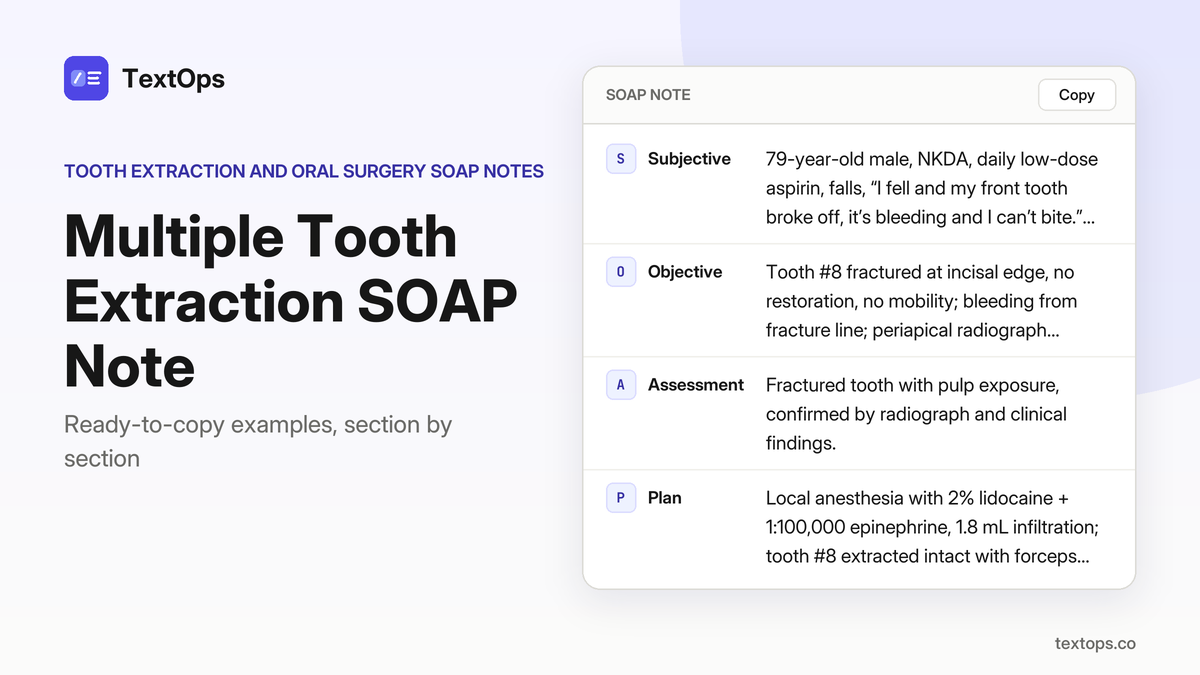
Extraction of a Fractured Upper Incisor – Single Tooth
SOAP note
SSubjective
38-year-old female; CC: “My front tooth broke and I can’t bite.” HPI: crown fracture with root exposure, mobility grade 1, no swelling, no trismus. PMH: no significant history; allergic to penicillin (rash).
OObjective
Extraoral: no facial asymmetry, intraoral: fractured tooth #8, mobility grade 1, no periodontal pockets, no swelling; PA: fracture line, no periapical radiolucency; tests: none.
AAssessment
Fractured tooth with normal pulp and apical tissues; findings: crown fracture, root exposure, mobility grade 1, PA shows no periapical pathology.
PPlan
2% lidocaine with 1:100,000 epinephrine, 1.8 mL buccal infiltration, aspiration negative; simple closed extraction of #8, socket curetted and irrigated, gauze pressure until hemostasis; POI: ibuprofen 400 mg PO q6h PRN for 3 days, avoid hard foods, apply ice, follow up if pain worsens.
Extraction of a Root-Tip in a Periodontally Compromised Tooth
SOAP note
SSubjective
36-year-old female, hypothyroidism on levothyroxine, allergic to penicillin (rash); chief complaint: “My lower left first molar has a root tip stuck after root canal.” History: no swelling, trismus, or systemic symptoms.
OObjective
Extraoral: normal. Intraoral: tooth #19 with 6 mm periodontal pockets, bone loss on PA radiograph; periapical radiograph shows retained root tip; no mobility, no sinus tract. Periodontal: BOP present, CAL consistent with stage III grade B. Radiographic: retained root tip, bone loss evident.
AAssessment
Root tip retained in socket with periodontal disease stage III grade B, supported by 6 mm pockets, radiographic bone loss and retained root tip.
PPlan
Surgical removal of root tip performed under 2% lidocaine with 1:100,000 epinephrine, 1.8 mL IANB; full-thickness flap, curette, selective bone removal, socket irrigation, gauze pressure until hemostasis. POI: ibuprofen 400 mg q6 h PRN for 3 days, avoid hard foods, keep gauze for 30 min, no smoking or straws. Next visit: follow-up in 7 days to assess healing.
Extraction of a Tooth with a Large Periapical Abscess
SOAP note
SSubjective
50-year-old female, asthma on albuterol PRN, NKDA, reports “My upper left canine hurts and there's a swelling.” HPI: pain, swelling, mild fever 99.5°F, submandibular lymphadenopathy, no trismus.
OObjective
Extraoral: 2 cm swelling, mild erythema. Intraoral: tooth #11 with large periapical radiolucency 6 mm, no periodontal pockets. Radiograph: acute apical abscess. Vital signs: temperature 99.5 °F.
AAssessment
Acute apical abscess of tooth #11, supported by 6 mm periapical radiolucency, swelling, fever, and lymphadenopathy.
PPlan
Simple closed extraction of tooth #11 under 2% lidocaine with 1:100,000 epinephrine, 1.8 mL buccal infiltration, aspiration negative. Socket curetted and irrigated; gauze pressure until hemostasis. Prescribed amoxicillin 500 mg q8h for 7 days and ibuprofen 400 mg q6h PRN up to 3 days. POI: avoid hard foods, apply ice, take meds, report worsening pain or bleeding. RTC in 7 days for healing assessment.
Emergency Extraction of Tooth with Large Caries and Swelling
SOAP note
SSubjective
65-year-old male, type 2 diabetes on metformin, NKDA, reports “my upper right first molar is huge and swollen”; pain described as throbbing, worsens with chewing, rating 8/10.
OObjective
Extraoral: 3 cm swelling, fever 100.4 °F, trismus; intraoral: extensive caries with pulpal exposure, tooth #3 tender, no periodontal pockets, no lymphadenopathy; radiograph: 8 mm periapical radiolucency, no bone loss elsewhere; tests: none.
AAssessment
Acute apical abscess of tooth #3, supported by extensive caries, pulpal exposure, swelling, fever, trismus, and 8 mm radiolucency.
PPlan
2% lidocaine with 1:100,000 epinephrine, 1.8 mL buccal infiltration, aspiration negative; simple closed extraction of tooth #3, socket curetted, irrigated, gauze pressure until hemostasis; prescribed amoxicillin 500 mg q8h for 7 days, ibuprofen 400 mg q6h PRN up to 3 days; instructed to avoid hard foods, maintain oral hygiene, use ice packs, report increased pain or swelling; next visit in 7 days for review.
Extraction of Tooth with Periodontal Abscess
SOAP note
SSubjective
68-year-old female, NKDA, takes low-dose aspirin. Chief complaint: “My lower right first molar hurts and there's a pocket.” History: periodontal pocket 8 mm, abscess pocket noted; no swelling, trismus, fever, or lymphadenopathy.
OObjective
Extraoral: normal. Intraoral: tooth #32 with 8 mm periodontal pocket, purulent exudate; no periapical radiolucency on PA. Periodontal: BOP present, PD 8 mm. Radiographic: PA shows no periapical lesion. Tests: none.
AAssessment
Periodontal abscess of tooth #32, supported by deep periodontal pocket, purulent exudate, and absence of periapical involvement.
PPlan
2% lidocaine with 1:100,000 epinephrine, 1.8 mL (1 cartridge), IANB, aspiration negative. Simple closed extraction of tooth #32; socket curetted, irrigated, and gauze pressure applied until hemostasis. POI: ibuprofen 400 mg q6h PRN, up to 3 days; keep gauze on for 30 min, avoid hard foods, maintain oral hygiene, report increased pain or swelling. Next visit: RTC in 7 days for healing assessment.
Orthodontic & Implant-Related Extractions
Extraction of a Failed Implant and Adjacent Tooth
SOAP note
SSubjective
26-year-old female, NKDA, controlled hypertension on lisinopril, reports “my implant is loose and the tooth next to it is painful.” HPI: implant in #15 shows thread loosening, adjacent tooth #15 has deep outer-dentin caries with exposed dentin; no periapical radiolucency, probing depths ≤4 mm, no mobility of adjacent teeth.
OObjective
Maxillary infiltration with 2% lidocaine + 1:100,000 epinephrine, 1.8 mL (1 cartridge); extraction of failed implant and tooth #15 performed; socket curetted, irrigated with sterile saline; 4-0 chromic gut sutures placed; postoperative instructions given.
AAssessment
Failed implant; symptomatic irreversible pulpitis of tooth #15; normal apical tissues.
PPlan
Extraction completed under local anesthesia; sutures secured; patient instructed to take ibuprofen 400 mg PO q6h PRN for 5 days, maintain soft diet, avoid chewing on the side, and return if swelling or uncontrolled pain develops.
Extraction of a Tooth for Orthodontic Retraction
SOAP note
SSubjective
52-year-old male, NKDA, reports “I need to move my teeth back and this tooth is blocking the movement.” He has no significant medical history and denies pain or swelling.
OObjective
Tooth #12 shows mild attrition, 2 mm probing depth, no BOP, grade I mobility; adjacent teeth stable. Radiograph reveals no periapical pathology. Maxillary infiltration with 2% lidocaine + 1:100,000 epinephrine, 1.8 mL, was administered.
AAssessment
Grade I mobility of tooth #12 with normal pulpal and apical tissues; no pathology, extraction indicated to facilitate orthodontic retraction.
PPlan
Tooth #12 was extracted, socket curetted and irrigated with sterile saline; no sutures placed. Post-operative instructions included avoiding hard foods, using ice packs, and maintaining oral hygiene. Ibuprofen 400 mg PO q6h PRN for 5 days prescribed. Next visit: orthodontic retraction assessment.
Medical Extractions – High Bleeding & Medication Risk
Extraction of a Tooth in a Patient on Anticoagulants
SOAP note
SSubjective
32-year-old male, former smoker, NKDA, reports “I have a bad tooth that hurts all the time”; history of non-restorable caries on tooth #30 with symptomatic irreversible pulpitis and normal apical tissues; INR 2.5, no active bleeding on palpation.
OObjective
Extraoral exam WNL; intraoral shows carious #30, tender to percussion; periodontal probing shows no BOP, PD <4 mm; radiograph PA of #30 shows extensive caries, no periapical pathology; INR 2.5 noted; no other systemic findings.
AAssessment
Symptomatic irreversible pulpitis, normal apical tissues, confirmed by pain history, percussion, and PA radiograph.
PPlan
Administered 2% lidocaine with 1:100,000 epinephrine, 1.8 mL (1 cartridge), IANB, aspiration negative; performed simple extraction of #30, curetted socket, applied oxidized cellulose for hemostasis, placed gauze for 30 min with pressure; instructed to avoid spitting, rinsing, smoking, and to return in 2 days for suture removal and healing assessment.
Extraction of a Tooth in a Pregnant Patient – Second Trimester
SOAP note
SSubjective
54-year-old female, pregnant, seasonal allergies, NKDA; CC: “My molar keeps hurting and I can’t eat”; HPI: persistent pain with mild swelling, no fever or systemic symptoms; PMH: pregnancy, no other comorbidities; medications: none; allergies: NKDA.
OObjective
Extraoral: mild facial swelling; Intraoral: tooth #14 with pericoronitis, ulcerated sulcus, no abscess; Periodontal: BOP present, PD 4 mm, CAL 1 mm; Radiograph: periapical PA shows mild bone loss, no radiolucency; Tests: aspiration negative, no paresthesia.
AAssessment
Diagnosis: pericoronitis of tooth #14, no abscess; findings: ulcerated sulcus, mild swelling, negative aspiration, no systemic signs.
PPlan
Local anesthesia: 2% lidocaine with 1:100,000 epinephrine, 1.8 mL infiltration, aspiration negative; simple extraction performed, socket irrigated with saline, gauze pressure for 20 min; POI: soft diet, chlorhexidine 0.12% rinse 15 mL for 30 s twice daily; no medications prescribed; next visit: follow-up in 7 days to assess healing.
Extraction of a Tooth in a Patient with Bisphosphonate Therapy
SOAP note
SSubjective
44-year-old female, smokes 5 cigarettes/day, NKDA, reports “my molar is loose and painful”; history: periodontal disease stage III grade B, Miller grade 2 mobility, no root fracture, on oral bisphosphonate for 2 years, no active bleeding.
OObjective
Extraoral: normal. Intraoral: tooth #19 with Miller 2 mobility, periodontal probing depths 6–8 mm, no swelling. Periodontal: stage III grade B. Radiograph: bone loss around #19, no root fracture. Tests: none.
AAssessment
Periodontal disease stage III grade B with Miller 2 mobility; findings support surgical extraction.
PPlan
4% articaine with 1:100,000 epinephrine, 1.8 mL, IANB, aspiration negative; surgical extraction of #19 with flap, bone removal, root sectioning, socket irrigation; hemostasis achieved with gelatin sponge; sutures 4-0 chromic gut; no medications prescribed; POI: apply gauze, avoid hard food, no smoking for 24 h, follow-up in 7 days for suture removal and healing assessment.
Extraction of a Tooth in a Patient with CKD
SOAP note
SSubjective
20-year-old male, CKD stage 3, creatinine 1.8 mg/dL, allergic to penicillin (rash); chief complaint: “My tooth is decayed and hurts when I bite”; history: deep dentin caries, symptomatic irreversible pulpitis, normal apical tissues; no significant medical history beyond CKD.
OObjective
extraoral: no swelling, extraoral lymphadenopathy, or facial asymmetry; intraoral: tooth #30 with deep dentin caries, tender to percussion, no mobility; periodontal: healthy probing, no BOP; radiograph: periapical radiolucency absent, root structure intact; tests: normal bite force, no signs of infection.
AAssessment
symptomatic irreversible pulpitis with normal apical tissues, confirmed by deep caries, pain on biting, and absence of periapical pathology.
PPlan
simple extraction of tooth #30 under 2% lidocaine with 1:100,000 epinephrine, 1.8 mL (1 cartridge) IANB, aspiration negative; socket curetted, oxidized cellulose applied, gauze pressure for 25 min; postoperative instructions: avoid chewing hard foods, maintain oral hygiene, use cold packs as needed; no medications prescribed; next visit for suture removal and healing assessment.
Extraction of a Tooth in a Patient with MRONJ History
SOAP note
SSubjective
34-year-old female, hypothyroidism on levothyroxine, penicillin allergy rash, reports “my molar is loose and I can’t chew”; history of MRONJ after bisphosphonate therapy now resolved, no exposed bone, no active bleeding.
OObjective
Extraoral: no swelling, intraoral: tooth #3 non-restorable caries, periodontal disease stage II, Miller grade 1 mobility; radiograph: moderate bone loss around #3, no peri-apical radiolucency; tests: aspiration negative.
AAssessment
Periodontal disease stage II with Miller grade 1 mobility, findings support simple extraction of tooth #3.
PPlan
Administered 4% articaine with 1:100,000 epinephrine, 1.8 mL buccal infiltration, simple extraction performed; socket irrigated, gelatin sponge placed, 4-0 chromic gut sutures applied; gauze pressure for 30 min; no medications prescribed; instructed to avoid trauma, maintain soft diet, keep gauze for 30 min, return in 2 weeks for socket healing assessment.
Extraction in MRONJ History
SOAP note
SSubjective
73-year-old female, asthma (albuterol PRN), NKDA, reports “my lower molar hurts and feels loose”; history of MRONJ after bisphosphonate therapy, now healed, no exposed bone or active bleeding.
OObjective
Tooth #17 shows periodontal disease stage II, Miller grade 1 mobility, no root fracture; extraoral and intraoral exam otherwise normal; IANB with 2% lidocaine + 1:100,000 epinephrine, 1.8 mL, aspiration negative.
AAssessment
Periodontal disease stage II, Miller grade 1 mobility – the sole diagnosis supported by mobility grade and periodontal attachment loss.
PPlan
Performed simple extraction of tooth #17; socket irrigated, gauze pressure for 25 min, hemostasis achieved with oxidized cellulose, sutured with 4-0 chromic gut; no medications prescribed; instructed to keep gauze in place 30-60 min, avoid spitting or rinsing for 24 h, maintain soft diet, use ice packs as needed, and return in 7 days for suture removal and healing assessment.
Extraction in CKD on Dialysis
SOAP note
SSubjective
35-year-old female, type 2 diabetes on metformin, NKDA, reports “my molar is swollen and painful”; history shows pericoronitis of tooth #32 with mild swelling, no abscess, on hemodialysis twice weekly.
OObjective
Extraoral: mild facial swelling; Intraoral: inflamed pericoronal tissues around #32, no purulent drainage; Periodontal: BOP present, PD 4 mm; Radiograph: pericoronitis changes, no abscess; Tests: none.
AAssessment
Pericoronitis of tooth #32 without abscess, confirmed by clinical and radiographic findings.
PPlan
Performed simple extraction of #32 with 2% lidocaine + 1:100,000 epinephrine, 1.8 mL IANB; socket irrigated, gauze pressure 30 min, hemostasis achieved with gelatin sponge and 4-0 chromic gut sutures; no medication prescribed; instructed to maintain oral hygiene, avoid hard foods, and report any bleeding; next visit in 7 days for suture removal and healing assessment.
Extraction in Bisphosphonate Therapy
SOAP note
SSubjective
58-year-old female, NKDA, on 81 mg aspirin daily, reports “my front tooth is decayed and hurts when I bite”; history of deep dentin caries, symptomatic irreversible pulpitis, normal apical tissues.
OObjective
Extraoral: normal. Intraoral: tooth #7 with deep dentin caries, pain on biting, no swelling. Periodontal: healthy. Radiograph: deep caries, intact periapical area. Tests: none.
AAssessment
Symptomatic irreversible pulpitis, normal apical tissues; findings include deep dentin caries, pain on biting, normal periapical radiograph.
PPlan
Simple extraction of tooth #7 performed under 2% lidocaine with 1:100,000 epinephrine, 1.8 mL infiltration, aspiration negative. Socket irrigated, gauze pressure for 20 min, oxidized cellulose applied, 4-0 chromic gut sutures placed. No medications prescribed. POI: maintain gauze for 30 min, avoid chewing hard foods. RTC: 7 days for suture removal and healing assessment.
Extraction of a Tooth in a Recent COVID-19 Patient
SOAP note
SSubjective
82-year-old male, no known drug allergies, controlled hypertension on lisinopril, reports “my molar is swollen and painful”; history of COVID-19 resolved 2 weeks ago, no current bleeding or infection.
OObjective
Extraoral: mild swelling on buccal aspect of upper right quadrant; intraoral: tooth #3 shows pericoronitis, no abscess, periodontal probing within normal limits; radiograph (PA) confirms pericoronitis, no root pathology; tests: aspiration negative, vital signs stable.
AAssessment
Pericoronitis of tooth #3 without abscess, supported by clinical swelling, erythema, and radiographic evidence of inflamed periodontal tissues.
PPlan
Simple extraction of tooth #3 performed under 2% lidocaine with 1:100,000 epinephrine, 1.8 mL infiltration; socket irrigated, gelatin sponge placed, 4-0 chromic gut sutures applied; gauze pressure maintained 25 min; postoperative instructions given for pain control, soft diet, and no smoking; next visit scheduled for postoperative review in 7 days.
Medical Extractions – Systemic Disease & Anesthesia
Extraction of a Root-Tip in a Patient with Diabetes
SOAP note
SSubjective
37-year-old male, type 2 diabetes on metformin, NKDA, reports “sore tooth that hurts when I bite down”; history of painful chewing; no systemic symptoms.
OObjective
Extraoral: mild facial swelling, 98.6 °F; intraoral: tooth #30 extracted intact, root tip retained and removed; periapical radiolucency 3 mm; no trismus; periodontal findings WNL; radiograph shows 3 mm radiolucency.
AAssessment
Symptomatic irreversible pulpitis with retained root tip; findings of periapical radiolucency and pain on biting support the diagnosis.
PPlan
2% lidocaine with 1:100,000 epinephrine, 1.8 mL IANB; extraction of tooth #30, removal of root tip, socket curettage, 4-0 chromic gut sutures; POI: ibuprofen 400 mg q6h PRN, acetaminophen 500 mg q6h PRN, up to 3 days; advise soft diet, avoid biting hard foods, apply ice, return if swelling worsens or pain increases.
Extraction of a Tooth with Local Anesthetic Allergy
SOAP note
SSubjective
72-year-old male, former smoker, reports “my molar is painful and I can’t eat.” He has an allergy to local anesthetic (rash). PMH: no systemic disease. Meds: none.
OObjective
Extraoral: facial symmetry, no swelling, temperature 98.4 °F. Intraoral: tooth #19 extracted, socket clean, no bleeding, no root fragments. Periodontal: healthy tissues, no BOP. Radiograph: not taken; clinical findings sufficient.
AAssessment
Symptomatic irreversible pulpitis, normal apical tissues – supported by pain history, extraction outcome, and absence of apical pathology.
PPlan
4% articaine with 1:200,000 epinephrine, 1.8 mL infiltration used; simple extraction, curettage, 4-0 chromic gut sutures placed. POI: ibuprofen 400 mg PO q6h PRN, max 3 days; advise soft diet, avoid hard foods, keep sutures clean. RTC in 7 days for suture removal and healing assessment.
Extraction of a Tooth in a Substance Abuse Patient
SOAP note
SSubjective
46-year-old male, seasonal allergies, NKDA, reports “My front tooth is loose and hurts when I bite”; tooth #8 is painful and mobile.
OObjective
Tooth #8 extracted; probing depth 6 mm, clinical attachment loss 4 mm, Miller grade 2 mobility; no periapical radiolucency, no swelling; 2% lidocaine with 1:100,000 epinephrine, 1.8 mL infiltration used.
AAssessment
Periodontal disease stage III grade B with Miller grade 2 mobility, supporting extraction and curettage.
PPlan
Extracted tooth #8, curetted socket, sutured with 4-0 chromic gut; prescribed ibuprofen 400 mg PO q6h PRN up to 3 days; instructed to avoid hard foods, maintain oral hygiene, and return if pain worsens or swelling develops.
Extraction of a Tooth in an Anxious Patient
SOAP note
SSubjective
77-year-old female, smoker 5 cigarettes/day, NKDA, reports “I’m scared but my tooth hurts a lot”; pain localized to tooth #3, onset recent, described as sharp, no swelling, temperature 98.7 °F.
OObjective
Tooth #3 extracted; symptomatic irreversible pulpitis, normal apical tissues; extraoral normal, intraoral extraction site with curettage, 4-0 chromic gut sutures placed; patient anxious but cooperative; no systemic signs.
AAssessment
Symptomatic irreversible pulpitis with normal apical tissues, supported by pain history, lack of swelling, and post-extraction findings.
PPlan
Anesthesia: 2% lidocaine with 1:100,000 epinephrine, 1.8 mL infiltration. Extraction of tooth #3, curettage, suturing with 4-0 chromic gut. Prescribed ibuprofen 400 mg PO q6h PRN, max 3 days. Instructed to avoid hard foods, maintain oral hygiene, report excessive bleeding or pain. RTC in 7 days for suture removal and healing assessment.
Extraction of a Tooth in a Post-Cancer Patient
SOAP note
SSubjective
19-year-old male, no significant medical history; allergic to penicillin (rash); CC: “My molar is painful and I can’t chew”; HPI: pain localized to #15, no swelling, no trismus; PMH: none; medications: none.
OObjective
Extraoral: normal; Intraoral: tooth #15 extracted, no swelling; periodontal: normal; radiograph: previously treated root canal, symptomatic irreversible pulpitis, normal apical tissues; vital signs: T 98.5 °F; anesthesia: 2% lidocaine with 1:100,000 epinephrine, 1.8 mL infiltration.
AAssessment
Diagnosis: previously treated, symptomatic irreversible pulpitis, normal apical tissues; supported by history of pain, radiographic evidence of root canal treatment, absence of periapical pathology.
PPlan
Extraction of tooth #15 performed with 2% lidocaine 1:100,000, 1.8 mL infiltration; curettage of socket; 4-0 chromic gut sutures placed; POI: ibuprofen 400 mg PO q6h PRN, up to 3 days; instructed to avoid hard foods, maintain oral hygiene, report bleeding or severe pain; next visit: review healing in 7 days.
Root-Tip Extraction in CKD Patient
SOAP note
SSubjective
56-year-old male, hypothyroidism on levothyroxine, penicillin allergy (rash), complains “my molar hurts and I can’t bite”; no systemic symptoms, temperature 98.4 °F.
OObjective
Extraoral: mild facial swelling, no trismus; intraoral: extraction site of tooth #30 with retained root tip removed, socket curetted; periodontal: periapical radiolucency 4 mm; radiographic: PA shows 4 mm radiolucency at #30; tests: none abnormal.
AAssessment
Symptomatic irreversible pulpitis with retained root tip, supported by pain on biting, radiolucency, and extraction findings.
PPlan
IANB with 2% lidocaine + 1:100,000 epinephrine, 1.8 mL; tooth #30 and root tip extracted, socket curetted, 4-0 chromic gut sutures placed; ibuprofen 400 mg PO q6h PRN for 3 days; instructed to avoid hard foods, maintain oral hygiene, report excessive bleeding or fever; next visit in 7 days for suture review.
Non-Restorable Tooth Extraction in Smoker
SOAP note
SSubjective
69-year-old male, smoker 5 cigarettes/day, asthma controlled with albuterol, NKDA; CC: “I have a bad tooth that keeps hurting when I bite”; HPI: extensive caries and distal fracture of tooth #30, no mobility, no periodontal pockets, periapical radiograph shows no radiolucency.
OObjective
Extraoral: normal; Intraoral: tooth #30 non-restorable, intact surrounding tissues; Periodontal: no pockets, no BOP; Radiograph: PA of #30, no periapical pathology; Tests: none.
AAssessment
Diagnosis: non-restorable caries, normal apical tissues, supported by extensive caries, distal fracture, intact periodontal status, and clear PA.
PPlan
2% lidocaine with 1:100,000 epinephrine, 1.8 mL (1 cartridge), IANB, aspiration negative; tooth #30 extracted with closed technique, socket irrigated with sterile saline, gauze pressure for 30 min; POI: bite on gauze, avoid spitting, rinsing, straws, smoking, and hard foods for 24 h; next visit in 7 days for suture check (none placed).
Extraction in Recent Stroke Survivor
SOAP note
SSubjective
75-year-old female, type 2 diabetes on metformin, NKDA; CC: “My lower left first molar is swollen and I can’t eat”; HPI: swelling of lower left buccal mucosa, pain on chewing; PMH: controlled diabetes, HbA1c 6.8%; no systemic signs.
OObjective
Extraoral: no lymphadenopathy, afebrile; Intraoral: tooth #17 shows deep caries to pulp, 6 mm buccal periodontal pocket; Radiograph: 3 mm periapical radiolucency; Tests: IANB with 2% lidocaine + 1:100,000 epinephrine, 1.8 mL, aspiration negative.
AAssessment
Pulp necrosis with acute apical abscess, supported by deep caries, radiolucency, and periodontal pocket.
PPlan
Extracted tooth #17 with closed technique; socket curetted, irrigated, hemostasis with gauze pressure; advised oral hygiene, soft diet, avoid hard foods; no medications prescribed.
Allergy to Lidocaine – Articaine Extraction
SOAP note
SSubjective
67-year-old male, on low-dose aspirin, reports “My lower right second molar is loose and hurts when I chew.” He has a history of allergic rash to both lidocaine and articaine. No systemic signs of infection or swelling.
OObjective
Extraoral exam normal. Intraoral: tooth #31 shows extensive caries with mesial fracture, Miller grade 1 mobility, no periodontal pockets. Periapical radiograph: no periapical pathology.
AAssessment
Non-restorable caries of tooth #31 with normal apical tissues.
PPlan
Administered 4% prilocaine plain, 1.8 mL (1 cartridge) IANB, aspiration negative. Extracted tooth #31 with closed technique; socket irrigated, gauze pressure applied. Post-operative instructions: bite on gauze 30 min, avoid spitting, rinsing, or smoking for 24 h, soft diet, apply ice packs. No medication prescribed. Next visit: review healing in 7 days.
Extraction after Recent Stroke
SOAP note
SSubjective
60-year-old male, controlled hypertension on lisinopril, NKDA, reports “My lower right third molar is causing pain after a recent stroke.” History: ischemic stroke 2 weeks ago, on aspirin 81 mg daily; no infection or swelling noted.
OObjective
Extraoral: facial symmetry, no swelling. Intraoral: #31 mesioangular impacted, no caries, no mobility. Periodontal: BOP none, PD ≤3 mm. Radiographic: PA of #31 shows no periapical pathology, root in close proximity to IAN, no root resorption. Tests: IANB with 2% lidocaine + 1:100,000 epinephrine, 1.8 mL, aspiration negative.
AAssessment
Impacted third molar (#31) with normal apical tissues, no pathology.
PPlan
Surgical extraction performed: flap reflected, bone removed, buccal sectioning, socket irrigated. Hemostasis with gauze and oxidized cellulose; sutures placed 4-0 chromic gut. No medications prescribed. Post-op instructions: bite on gauze 30 min, no spitting or rinsing 24 h, soft diet, ice packs, monitor for bleeding or numbness. Return to clinic in 7 days for suture removal and healing assessment.
Extraction in Late-Trimester Pregnancy
SOAP note
SSubjective
59-year-old female patient, pregnant, NKDA, reports “My upper left canine is loose and hurts when I bite”; history shows deep caries to pulp, 4 mm periapical radiolucency, Miller grade 1 mobility, buccal mucosa swelling, no systemic infection signs, BP 118/76 mmHg.
OObjective
Extraoral: no facial asymmetry, intraoral: tooth #11 loose, deep caries, swelling of buccal mucosa; periodontal: Miller 1 mobility; radiographic: PA shows 4 mm radiolucency at apex; tests: aspiration negative.
AAssessment
Pulp necrosis with acute apical abscess, supported by deep caries, radiolucency, mobility, and swelling.
PPlan
Infiltration with 2% lidocaine + 1:100,000 epinephrine, 1.8 mL, aspiration negative; extracted tooth #11 using closed technique, socket irrigated, gauze pressure applied, no sutures; no medications prescribed; instructed to avoid hard foods, use soft diet, apply ice packs, monitor for bleeding or pain, return if swelling increases or pain worsens.
Follow-up & Re-examination
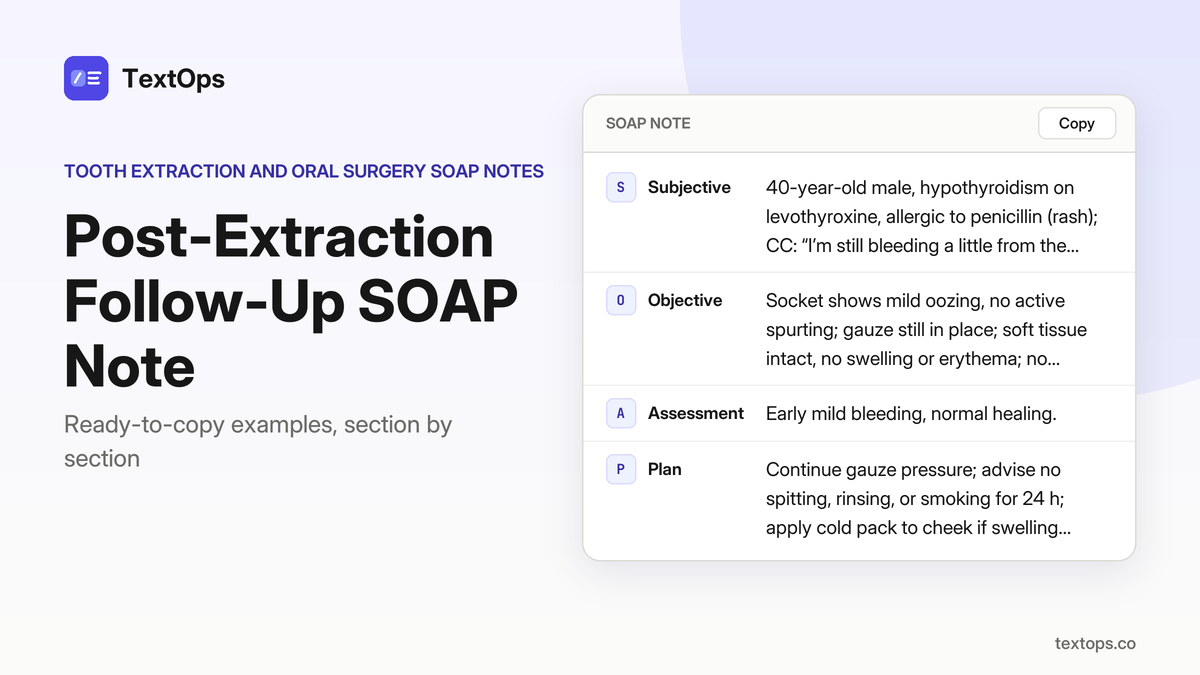
Follow-up Extraction of Tooth with Large Caries and Swelling
SOAP note
SSubjective
66-year-old male, former smoker, NKDA, states “I’m here for my follow-up after the extraction; I still have some swelling.” HPI: mild swelling persists, reports 2/10 discomfort improving over time. PMH: none noted.
OObjective
Extraction site of tooth #30 shows mild erythema, slight edema of surrounding mucosa; socket closed, no exposed bone, no purulent drainage. No pain on palpation, no tenderness to percussion. Oral hygiene adequate; no other intraoral pathology.
AAssessment
Post-extraction healing, no infection.
PPlan
Reviewed healing status; instructed patient to continue gentle rinsing with 0.12% chlorhexidine twice daily, maintain soft diet, avoid smoking for 48 h. Advised return if pain worsens, swelling increases, or drainage appears. No medications prescribed.
Severe Periodontal Bone Loss
Extraction of Tooth with Severe Periodontal Bone Loss
SOAP note
SSubjective
55-year-old female, seasonal allergies, NKDA, reports “my lower right molar has been hurting and I can’t bite down.” HPI: pain started 3 weeks ago, worsening with chewing, no swelling or fever.
OObjective
Probing depths 8–10 mm around #30, BOP present, Miller grade 2 mobility; PA shows horizontal bone loss, no periapical radiolucency, no root fracture or resorption.
AAssessment
Periodontal disease stage III grade B with Miller grade 2 mobility, supporting extraction of #30.
PPlan
2% lidocaine with 1:100,000 epinephrine, 1.8 mL IANB; simple closed extraction, socket curetted, gauze pressure hemostasis; POI: bite on gauze 30-60 min, no chewing, soft diet, cold packs, ibuprofen 400 mg q6h PRN up to 3 days; next visit: socket preservation evaluation and implant planning.
How to Use These Notes
Each note is a full SOAP entry, ready to paste into any charting system. Replace the placeholder text—patient name, date, tooth number, and any other specific identifiers—with your own data before saving. The template already contains the required S, O, A, and P lines, so no additional formatting is needed. Copy the block directly into the electronic health record, update the fields, and sign. This approach eliminates retyping and ensures every entry meets documentation standards.
Common Variations Covered
Routine extractions cover non-restorable caries, fractures, and periapical abscesses. Orthodontic and implant-related notes address failed implants and teeth removed for retraction. Medical high-bleeding templates include anticoagulant use, pregnancy, bisphosphonate therapy, CKD, MRONJ history, and recent COVID-19. Systemic disease notes cover diabetes, anesthetic allergies, substance abuse, anxiety, post-cancer status, stroke survivors, smokers, and late-trimester pregnancy. Follow-up entries document post-extraction reviews for large caries and swelling. Severe periodontal bone loss notes handle extractions where bone loss precludes retention. Each scenario has a dedicated example note in the examples section.
Key Documentation Elements
Record the patient ID in the S section, followed by the chief complaint and a 0-10 pain rating quoted verbatim. Include a concise medical history summary, noting anticoagulants, bisphosphonates, or other relevant meds. In the O section, note anesthesia details: agent, concentration, vasoconstrictor, volume, technique, and aspiration result. Specify the extraction technique (simple or surgical) and document findings: tooth removal status, root tip retention, socket condition, and any complications. In A, list hemostasis measures used (gauze pressure, hemostatic agents, sutures). The P section must give postoperative instructions—bites, diet, analgesics, mouthwash—and a scheduled follow-up date. Each element belongs in its designated SOAP line, and the note must be written contemporaneously, dated, and signed.
Quick Reference for Consent and Post-Op Instructions
Consent must state the extraction, risks (pain, swelling, bleeding, infection, dry socket, nerve injury, sinus communication, fracture), alternatives (no treatment, restorative options), and record any patient questions. Post-op instructions verbatim: bite on gauze 30-60 min, no spitting, rinsing, straws or smoking first 24 h, soft diet, cold packs, take prescribed NSAIDs as directed, and call if bleeding persists, severe pain, or signs of infection. Include these items in the P line of every SOAP note.
These examples show structure and wording only. Record what you actually found and did, and follow your practice’s documentation requirements.
Dr. Rahul Joshi is a Specialist Orthodontist with extensive clinical experience in orthodontics, dentofacial orthopaedics, and dental aesthetics. Holding a Master of Dental Surgery (MDS) in Orthodontics and Dentofacial Orthopaedics and a Bachelor of Dental Surgery (BDS) from Manipal Academy of Higher Education, he brings expertise in orthodontic treatment planning, teeth alignment, and Invisalign treatment. With professional experience across India and the Netherlands, Dr. Joshi combines clinical knowledge with practical experience in orthodontic care, dental aesthetics, and improving patients' oral health.
Master of Dental Surgery (MDS) in Orthodontics and Dentofacial Orthopaedics — Manipal Academy of Higher Education
Bachelor of Dental Surgery (BDS) — Manipal Academy of Higher Education
Stop retyping your templates
Save any template to TextOps once, then insert it anywhere on the web without retyping. Share it with your team so everyone uses the same wording.