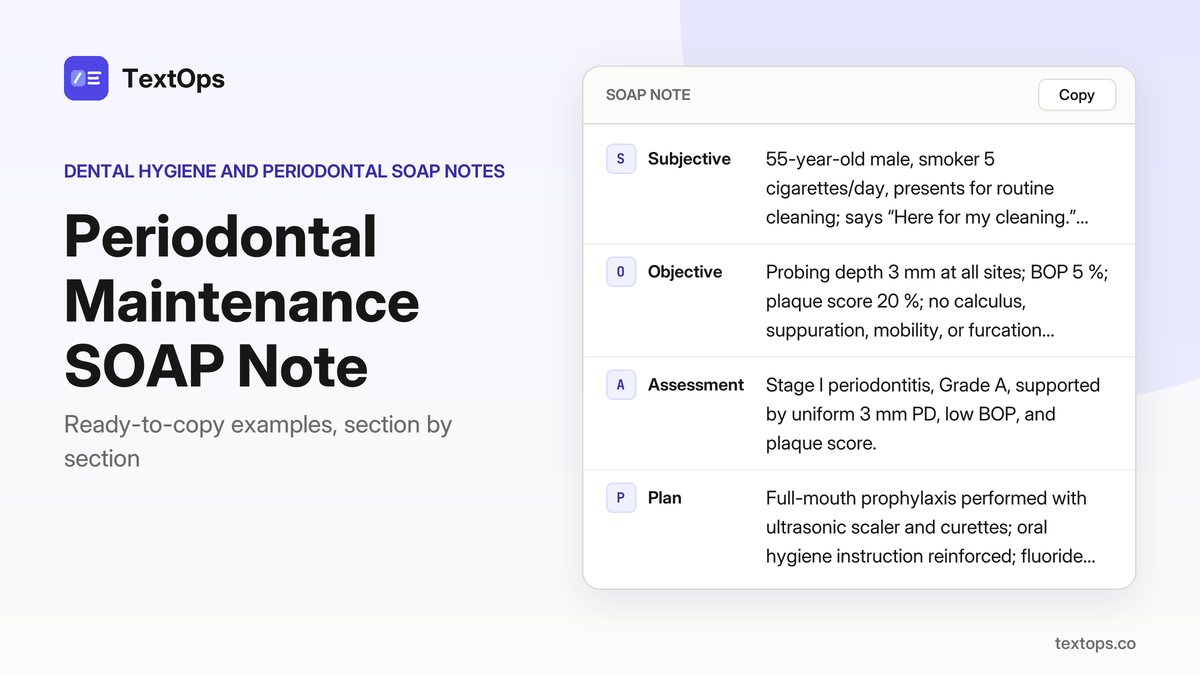
Dental Cleaning SOAP Note captures every detail of a prophylaxis visit. The template library contains fully populated adult prophylaxis notes, variants for air polishing and ultrasonic scaling, and customizations for special-needs patients. Each note records subjective findings, objective plaque and calculus assessment, and a concise plan that includes education and follow-up instructions tailored to the patient’s medical history.
First-Time Cleanings
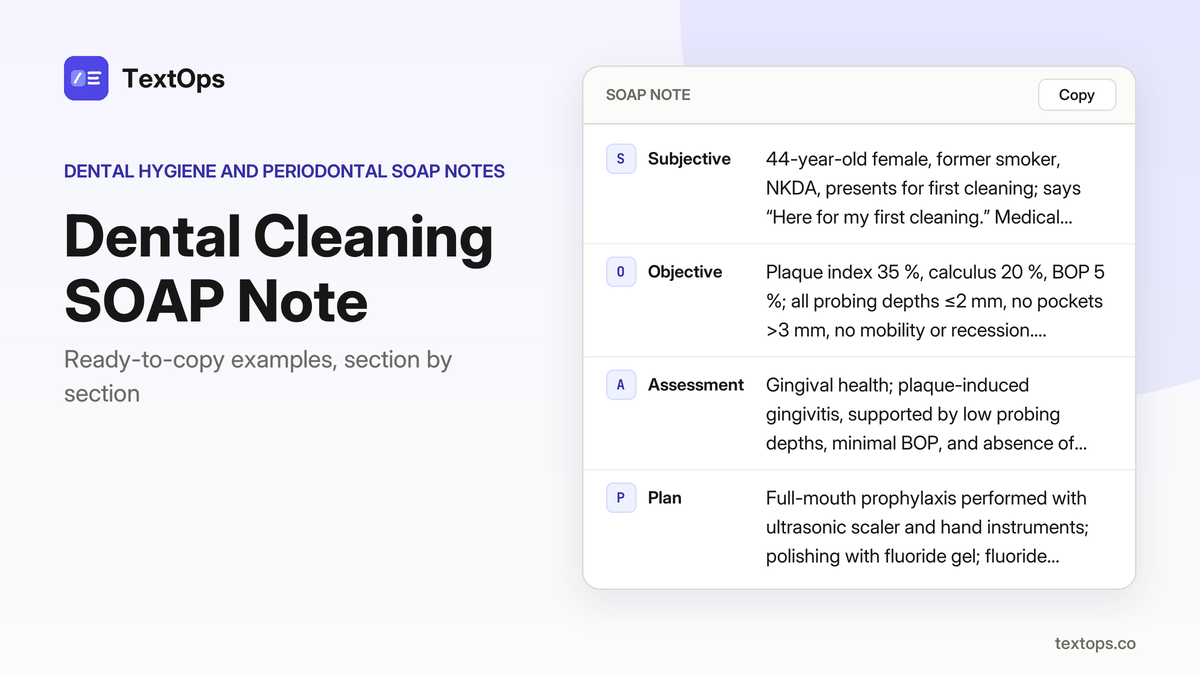
First-Time Adult Prophylaxis – Non-Smoker
SOAP note
SSubjective
44-year-old female, former smoker, NKDA, presents for first cleaning; says “Here for my first cleaning.” Medical history: former smoker, no systemic signs.
OObjective
Plaque index 35 %, calculus 20 %, BOP 5 %; all probing depths ≤2 mm, no pockets >3 mm, no mobility or recession. Panoramic radiograph shows no bone loss or caries.
AAssessment
Gingival health; plaque-induced gingivitis, supported by low probing depths, minimal BOP, and absence of periodontal pockets or bone loss.
PPlan
Full-mouth prophylaxis performed with ultrasonic scaler and hand instruments; polishing with fluoride gel; fluoride varnish 5 % applied to all occlusal surfaces. Oral hygiene instruction given; patient advised to brush twice daily with fluoride toothpaste and use interdental brushes. Next visit: 6-month recall.
First-Time Pediatric Cleaning with Fluoride Varnish and Sealant Placement
SOAP note
SSubjective
26-year-old female, NKDA, reports “I need my first cleaning and sealants.” HPI: first visit, no medical issues.
OObjective
Plaque index 40 %, calculus 15 %; BOP 8 %; probing depths 2 mm on all teeth; no caries; panoramic radiograph shows no bone loss; pit-and-fissure sealant indicated on teeth #3-#8 and #13-#16.
AAssessment
Gingival health; plaque-induced gingivitis, supported by BOP 8 % and probing depths ≤2 mm.
PPlan
Full-mouth prophylaxis performed; fluoride varnish 5 % applied to all occlusal surfaces; pit-and-fissure sealants placed on #3-#8 and #13-#16; oral hygiene instruction given; patient advised to avoid sugary snacks and brush twice daily; no medications prescribed.
First-Time Adult Cleaning with Tobacco Cessation Counseling
SOAP note
SSubjective
27-year-old male patient presents for his first dental cleaning, stating “First cleaning, and I want to quit smoking.” He reports daily low-dose aspirin use and has no known drug allergies. O: Plaque index 30 %, calculus 10 %; bleeding on probing 4 %; probing depths 2 mm or less across all teeth; no caries or pockets >3 mm; panoramic radiograph shows no bone loss or other pathology. A: Gingival health; plaque-induced gingivitis, evidenced by BOP 4 % and uniformly shallow PDs with no periodontal pockets. P: Full-mouth prophylaxis completed with ultrasonic scaling and hand curettage; fluoride varnish 5 % applied to all occlusal surfaces; comprehensive oral hygiene instruction given; brief tobacco cessation counseling delivered and patient referred to the local quitline; no medications prescribed.
First-Time Adult Cleaning with Fluoride Varnish and Oral Hygiene Counseling
SOAP note
SSubjective
54-year-old female patient, smoker 5 cigarettes/day, NKDA, presents for her first dental cleaning and fluoride varnish application; she reports no pain and wants routine preventive care. O: Plaque index 45 %, calculus 25 %; bleeding on probing 10 %; probing depths 2 mm on all teeth; no caries; panoramic radiograph shows no bone loss or other pathology; extraoral exam within normal limits; no systemic signs of infection or inflammation. A: Gingival health; plaque-induced gingivitis, evidenced by BOP 10 % and uniform PD 2 mm, with no periodontal pockets >3 mm and no radiographic bone loss. P: Full-mouth prophylaxis performed with hand instruments and ultrasonic scaler; fluoride varnish 5 % applied to all occlusal surfaces; comprehensive oral hygiene instruction provided, including brushing technique, interdental cleaning, and use of fluoride toothpaste; brief tobacco cessation counseling delivered and referral to a quitline offered; no medications prescribed; next visit scheduled in 6 months for routine maintenance.
First-Time Adult Cleaning with Dental Sealant Placement
SOAP note
SSubjective
72-year-old female, type 2 diabetes on metformin, NKDA, reports “First cleaning, I have diabetes.” She has no periodontal pockets >3 mm, BOP 6 %, plaque 35 %, calculus 20 %.
OObjective
Panoramic radiograph shows no bone loss. Extraoral exam WNL. Intraoral: plaque index 35 %, calculus 20 %, BOP 6 %, all probing depths ≤2 mm.
AAssessment
Gingival health; plaque-induced gingivitis, supported by BOP 6 % and PD ≤2 mm.
PPlan
Full-mouth prophylaxis performed; fluoride varnish 5 % applied to all occlusal surfaces. Oral hygiene instruction and nutritional counseling on sugar intake provided. Patient advised to maintain glycemic control. Next visit: 6-month recall.
Routine Recall Cleanings
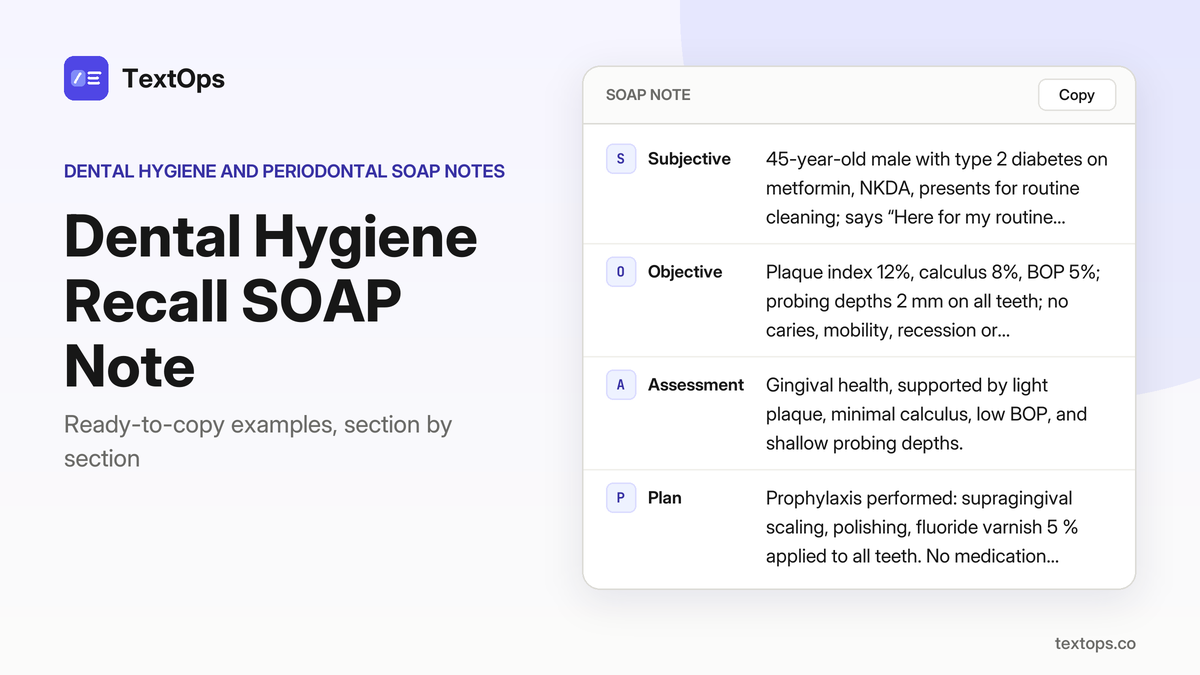
Repeat Cleaning – 6-Month Recall
SOAP note
SSubjective
36-year-old female patient, hypothyroidism on levothyroxine, allergic to penicillin (rash); CC: “Here for my routine cleaning”; HPI: routine maintenance visit, no pain or discomfort; PMH: hypothyroidism; Allergy: penicillin (rash).
OObjective
Extraoral: normal; Intraoral: plaque and calculus on all surfaces, no caries; Periodontal: BOP 8% of sites, PD 2–3 mm, no pockets >4 mm, no mobility; Radiographs: none taken; Tests: none.
AAssessment
Gingival health; plaque-induced gingivitis – supported by BOP 8% and PD 2–3 mm with no pockets.
PPlan
Prophylaxis performed: supragingival scaling, polishing with pumice and fluoride gel; OHI reinforced – brush twice daily with fluoride toothpaste, use interdental brushes; no drugs; next visit: 6-month recall.
Smoker – 1-Year Recall
SOAP note
SSubjective
76-year-old female, smoker (5 cigarettes/day), asthma (albuterol PRN), NKDA, “I’m here for my yearly cleaning.”
OObjective
Plaque accumulation on all teeth; supragingival calculus on molars and premolars; BOP 12% of sites; PD 2–3 mm, no pockets >4 mm; no mobility; no restorations needing repair; no systemic signs.
AAssessment
Gingival health; plaque-induced gingivitis, supported by BOP 12% and PD 2–3 mm with no deep pockets.
PPlan
Prophylaxis performed: removal of supragingival calculus, polishing, fluoride varnish 5% sodium fluoride on all teeth; tobacco cessation counseling given, patient advised to quit smoking and consider nicotine patch; no drugs prescribed; next visit scheduled for 1-year recall.
Post-Fluoride Varnish – 3-Month Recall
SOAP note
SSubjective
37-year-old male, controlled hypertension on lisinopril, NKDA, reports “I’m back for my follow-up cleaning after the varnish.”
OObjective
plaque and calculus present; gingival bleeding on probing 9 % of sites; probing depths 2–3 mm, no pockets >4 mm; no mobility; no restorations needing repair.
AAssessment
gingival health; plaque-induced gingivitis, supported by 9 % BOP and shallow PDs.
PPlan
prophylaxis performed: supragingival scaling, polishing; fluoride varnish 5 % sodium fluoride applied to all teeth; oral hygiene instruction reinforced; advised to avoid hard foods for 2 h post-varnish; next visit in 3 months for routine recall.
Post-Periodontal Maintenance – 3-Month Recall
SOAP note
SSubjective
80-year-old male, seasonal allergies, NKDA, reports “I’m here for my maintenance cleaning” and has no pain or swelling.
OObjective
Extraoral exam shows no facial asymmetry or swelling. Intraoral findings reveal plaque and calculus on all teeth; BOP 7 % of sites, probing depths 2–3 mm throughout, no pockets >4 mm, no mobility, and no restorations requiring repair. Periodontal charting confirms gingival health with plaque-induced gingivitis.
AAssessment
Gingival health; plaque-induced gingivitis, evidenced by 7 % BOP and uniform 2–3 mm PD without deep pockets.
PPlan
Performed prophylaxis with supragingival scaling and polishing, removed subgingival calculus on molars and premolars, applied 5 % fluoride varnish to all tooth surfaces, and reinforced oral hygiene instruction emphasizing twice-daily brushing and interdental cleaning. No drugs were prescribed. Patient advised to maintain current oral hygiene routine and return in 3 months for the next periodontal maintenance visit.
Post-Fluorosis – 4-Month Recall Cleaning
SOAP note
SSubjective
61-year-old male, no significant medical history, allergic to penicillin (rash). Chief complaint: “I’m back for my cleaning after the fluorosis treatment.” History of present illness: routine recall, no systemic signs. Allergies: penicillin rash.
OObjective
Plaque and calculus present on all teeth; gingival bleeding on probing 10 % of sites; probing depths 2–3 mm; no pockets >4 mm; no mobility; no restorations needing repair. Extraoral normal. Intraoral: full-mouth plaque and calculus. Radiographs not taken.
AAssessment
Gingival health; plaque-induced gingivitis, supported by 10 % BOP and shallow PDs.
PPlan
Prophylaxis performed: supragingival scaling, polishing; fluoride varnish 5 % sodium fluoride applied to all teeth; patient instructed to avoid hard foods for 2 h post-varnish; oral hygiene instruction reinforced; next visit in 6 months for routine recall.
Post-Sealant – 1-Year Recall Cleaning
SOAP note
SSubjective
63-year-old male, former smoker, NKDA, presents for his yearly cleaning after sealants. He reports no pain and states, “I’m here for my yearly cleaning after the sealants.” PMH is limited to former smoking; no systemic signs noted.
OObjective
Extraoral exam WNL. Intraoral findings: plaque and calculus on all teeth; gingival bleeding on probing 8 % of sites; probing depths 2–3 mm; no pockets >4 mm; no mobility. Sealants intact on all first molars.
AAssessment
Gingival health; plaque-induced gingivitis, supported by 8 % BOP, shallow PDs, and presence of plaque/calculus.
PPlan
Prophylaxis performed: supragingival scaling, polishing; fluoride varnish 5 % sodium fluoride applied to all teeth. Oral hygiene instruction reinforced; patient advised to brush twice daily and use interdental cleaning. No medications prescribed. Return to clinic in 6 months for routine recall.
Post-Fluoride Varnish – 6-Month Recall Cleaning
SOAP note
SSubjective
66-year-old female, no significant medical history, NKDA, presents with “I’m back for my cleaning after the varnish.”
OObjective
Plaque and calculus present on all teeth; gingival bleeding on probing 9 % of sites; probing depths 2–3 mm, no pockets >4 mm; no mobility; no restorations needing repair.
AAssessment
Gingival health; plaque-induced gingivitis, supported by 9 % BOP and shallow PDs.
PPlan
Prophylaxis performed—scaling of supragingival calculus, polishing; fluoride varnish 5 % sodium fluoride applied to all teeth; oral hygiene instruction reinforced; advised to avoid hard foods for 2 hours post-varnish; next visit scheduled in 6 months for routine recall.
Cleaning of Teeth with Fixed Orthodontic Appliances – 3-Month Recall
SOAP note
SSubjective
78-year-old male, NKDA, takes low-dose aspirin. CC: “I’m here for my cleaning with the braces still in place.” HPI: routine 3-month recall; no pain or swelling. PMH: aspirin, no systemic signs.
OObjective
Extraoral: normal. Intraoral: brackets and wires on teeth #16-#32. Plaque and calculus around brackets; gingival bleeding on probing 15% of sites; probing depths 2–3 mm; no pockets >4 mm; no mobility; no restorations needing repair.
AAssessment
Gingival health; plaque-induced gingivitis supported by 15% BOP, 2–3 mm PD, and calculus accumulation around brackets.
PPlan
Prophylaxis performed: supragingival calculus removed around brackets and wires with hand instruments and ultrasonic scaler; polishing completed. OHI focused on bracket-friendly brushing and interdental cleaning; patient instructed to use 0.12% fluoride rinse twice daily. No anesthesia or drugs used. Next visit: 6-month recall.
Post-Orthodontic – 6-Month Retainer Cleaning
SOAP note
SSubjective
28-year-old female, smoker 5 cigarettes/day, NKDA, CC: “I’m here for my cleaning after getting my retainers.” HPI: post-orthodontic retainer cleaning, no systemic signs.
OObjective
plaque and calculus around retainer clasps; BOP 10% of sites; PD 2–3 mm; no pockets >4 mm; no mobility; no restorations needing repair.
AAssessment
Gingival health; plaque-induced gingivitis, evidenced by BOP 10% and PD 2–3 mm with calculus accumulation around clasps.
PPlan
Prophylaxis: removed supragingival calculus around clasps with hand instruments and ultrasonic scaler, polished surfaces, applied 5% sodium fluoride varnish to all teeth; reinforced oral hygiene instruction, advised twice-daily brushing and interdental cleaning; next visit 6 months for retainer check.
Post-Extraction & Emergency Cleanings
Post-Extraction Day 3 – Cleaning of Remaining Teeth
SOAP note
SSubjective
52-year-old male with type 2 diabetes on metformin, NKDA, presents for cleaning after a recent extraction. “I’m here for my cleaning after the extraction.” No systemic signs, no pain, no bleeding from the extraction site.
OObjective
Plaque and calculus present on all remaining teeth; mild gingival inflammation, BOP 15 % of sites; extraction site healed, no bleeding; PD 2–3 mm on all teeth.
AAssessment
Plaque-induced gingivitis, supported by BOP 15 % and PD 2–3 mm with mild inflammation.
PPlan
Scaling and polishing of all remaining teeth performed; oral hygiene instruction given, advised to avoid hard foods for 24 hrs; no drugs prescribed. Next visit: routine recall in 6 months.
Post-Surgery – 1-Week Cleaning of Adjacent Teeth
SOAP note
SSubjective
73-year-old male, hypothyroid on levothyroxine, penicillin allergy (rash); CC: “I’m back for a cleaning after my tooth was pulled last week.” HPI: extraction of #30 last week, no swelling, healing site; no systemic signs.
OObjective
Extraction site at #30 healed, no swelling. Adjacent teeth #29 and #31 show plaque and calculus; BOP 10% of sites; PD 2–3 mm.
AAssessment
Plaque-induced gingivitis, supported by BOP 10% and shallow PDs on #29 and #31.
PPlan
Scaling and polishing of #29 and #31, removal of plaque from adjacent surfaces; no drugs prescribed. Informed OHI given; advised chlorhexidine 0.12% rinse twice daily. Next visit: 3-month recall for maintenance.
Emergency Cleaning After Acute Gingival Abscess
SOAP note
SSubjective
60-year-old female with asthma, NKDA, reports “painful swelling on my upper left canine.” History: swelling started 2 days ago, pain worsens with pressure, no trauma. PMH: asthma, albuterol PRN.
OObjective
Extraoral: buccal mucosa swelling, temperature 99.5 °F. Intraoral: tooth #11 shows a 6 mm pocket, BOP 100 % with purulent exudate. Periodontal charting: PD 6 mm on #11, BOP 100 %. Radiographs not taken.
AAssessment
Periodontal abscess on tooth #11, supported by 6 mm pocket, purulent exudate, BOP 100 % and low-grade fever.
PPlan
Debridement of pocket #11, irrigation with sterile saline, chlorhexidine 0.12 % rinse 15 mL for 30 s. Oral hygiene instruction given; advised to avoid hard foods. Prescribed amoxicillin 500 mg q8h for 7 days and ibuprofen 400 mg q6h PRN up to 3 days. Next visit: 7-day follow-up to assess resolution.
Cleaning After Emergency Dental Extraction – 2-Week Follow-Up
SOAP note
SSubjective
33-year-old female, controlled hypertension on lisinopril, NKDA; CC: “I’m here for a follow-up cleaning after my tooth was extracted.” O: extraction site at #24 healed, no bleeding or swelling; plaque and calculus on remaining teeth; BOP 12 % of sites; PD 2–3 mm on all teeth. A: plaque-induced gingivitis, supported by BOP 12 % and PD 2–3 mm. P: full-mouth scaling and polishing performed; plaque removed from all teeth; oral hygiene instruction given; advised chlorhexidine 0.12 % rinse twice daily; no drugs prescribed; next visit scheduled for routine maintenance in 6 months.
Post-Crown Placement – 2-Week Follow-Up Cleaning
SOAP note
SSubjective
47-year-old male, seasonal allergies, NKDA, chief complaint: “I’m here for a cleaning after my crown was placed.” History: post-crown placement, no pain, no systemic symptoms.
OObjective
Crown on tooth #11 with smooth margins, no bleeding on probing (BOP) at the margin; plaque accumulation on crown surface; probing depth 2 mm on adjacent teeth; BOP 5 % of sites overall.
AAssessment
Plaque-induced gingivitis, supported by plaque on crown, 2 mm PDs, and 5 % BOP.
PPlan
Polished crown on #11, cleaned around margins, provided oral hygiene instruction, advised avoidance of hard foods for 24 hrs; next visit scheduled for routine 6-month recall.
Post-Restorative Cleanings
Post-Crown Placement – 1-Month Follow-Up Cleaning
SOAP note
SSubjective
51-year-old male, no significant medical history, allergic to penicillin (rash). Chief complaint: “Here for my cleaning after the crown.” History: recent crown on tooth #11, no pain, no systemic symptoms.
OObjective
Extraoral: normal. Intraoral: tooth #11 with a well-contoured crown, surrounding mucosa pink, no swelling. Periodontal: plaque-induced gingivitis, BOP 10 % of sites, probing depths 2 mm, no calculus, no caries.
AAssessment
Plaque-induced gingivitis, supported by BOP 10 % and PD 2 mm.
PPlan
Prophylaxis performed; gentle scaling around crown margins, polishing with rubber cup and prophylaxis paste. No anesthesia or medication used. Oral hygiene instruction given, emphasizing interdental cleaning and proper brushing technique. Next visit scheduled for 3-month maintenance cleaning.
70-year-old male, former smoker, NKDA, presents for a routine cleaning and reports no pain or swelling, stating “just a routine cleaning.”
OObjective
Extraoral exam shows no facial asymmetry or swelling. Intraoral findings are normal except for implant #30, which exhibits a probing depth of 3 mm, bleeding on probing at 5 % of sites, and no suppuration. Panoramic radiograph demonstrates stable bone levels around the implant with no peri-implant calculus or radiolucency.
AAssessment
Implant maintenance with gingival health; the probing depth, low BOP percentage, and radiographic stability confirm healthy peri-implant tissues.
PPlan
Performed implant prophylaxis with gentle scaling of the implant surface and surrounding gingiva; applied polishing to adjacent tooth surfaces. Provided detailed oral hygiene instruction focusing on interdental brushes and flossing technique for implant care. No medications prescribed. Scheduled next maintenance visit in 12 months.
Post-Root Canal – 2-Month Follow-Up Cleaning
SOAP note
SSubjective
64-year-old female, no significant medical history, NKDA, reports “cleaning after root canal.” HPI: no pain, no swelling, routine follow-up.
OObjective
Extraoral: normal. Intraoral: tooth #3 restored with post-root canal crown, no caries, no tenderness. Periodontal: plaque-induced gingivitis, BOP 8 % of sites, PD 2 mm. Radiographs: periapical radiograph shows periapical healing, no radiolucency.
AAssessment
Plaque-induced gingivitis, supported by BOP 8 % and PD 2 mm around #3, with healthy restoration margins.
PPlan
Prophylaxis performed with hand instruments and ultrasonic scaler; polishing of crown margins; oral hygiene instruction on interdental cleaning and brushing technique. No drugs prescribed. Next visit scheduled in 6 months for routine maintenance.
Post-Dental Bonding – 6-Month Recall Cleaning
SOAP note
SSubjective
59-year-old female, chief complaint: “Cleaning after bonding.” Medical history: low-dose aspirin daily, NKDA. HPI: no pain, routine 6-month recall after bonding of tooth #12.
OObjective
Extraoral: normal. Intraoral: plaque-induced gingivitis, BOP 12 % of sites, PD 2 mm, no calculus, no pain. Periodontal chart: PD 2 mm, BOP 12 %, CAL stable. Radiographs: none taken this visit.
AAssessment
Plaque-induced gingivitis, supported by BOP 12 % and PD 2 mm, with no calculus or pain.
PPlan
Prophylaxis performed: scaling of tooth #12, polishing of bonded surface, oral hygiene instruction emphasizing interdental brushing and fluoride toothpaste. No drugs prescribed. Patient advised to return in 6 months for routine maintenance.
Cleaning of Teeth with a Recent Dental Crown – 2-Week Follow-Up
SOAP note
SSubjective
62-year-old male smoker, 5 cigarettes/day, NKDA, reports “Cleaning after crown.” History of plaque-induced gingivitis, no pain, no systemic signs.
OObjective
Extraoral normal. Intraoral: mild supragingival calculus, BOP 15 % of sites, PD 3 mm around #15, no pain. Periodontal charting confirms plaque-induced gingivitis. No radiographs taken.
AAssessment
Plaque-induced gingivitis supported by BOP 15 %, PD 3 mm, and mild supragingival calculus around the recent crown.
PPlan
Prophylaxis performed with hand scaling and polishing of the crown margin. Oral hygiene instruction emphasized interdental cleaning and proper brushing technique. No drugs administered. Next visit scheduled in 4 weeks for maintenance.
Cleaning of Teeth with a Recent Dental Crown – 1-Month Recall
SOAP note
SSubjective
65-year-old male, type 2 diabetes on metformin, NKDA, presents for a 1-month recall after placement of a crown on tooth #16, stating “cleaning after crown.” He reports no pain or sensitivity and denies any recent swelling or bleeding.
OObjective
Extraoral examination shows no facial asymmetry or lymphadenopathy. Intraoral assessment reveals plaque-induced gingivitis around the crowned tooth with bleeding on probing at 10 % of sites, probing depths of 2 mm, and moderate supragingival calculus accumulation; the crown margin appears intact with no visible caries or restoration failure.
AAssessment
Plaque-induced gingivitis, evidenced by BOP 10 %, PD 2 mm, and moderate supragingival calculus, is the primary diagnosis.
PPlan
Prophylaxis was completed with thorough scaling of supragingival calculus, polishing of the crown surface, and meticulous plaque removal around the restoration. Oral hygiene instruction emphasized interdental cleaning with a water flosser and twice-daily brushing with a soft-bristle brush; no anesthesia or medications were required. The patient was advised to maintain regular brushing and to return for a 3-month maintenance visit.
Post-Dental Implant Maintenance – 3-Month Recall
SOAP note
SSubjective
55-year-old male, hypothyroidism on levothyroxine, allergic to penicillin (rash); chief complaint: “Maintenance cleaning.” No systemic signs.
OObjective
Implant #28: probing depth 2 mm, BOP 4 % of sites, no suppuration; panoramic radiograph shows stable bone level, no peri-implant calculus. Extraoral and intraoral findings within normal limits.
AAssessment
Implant maintenance with gingival health, supported by 2 mm PD, minimal BOP, stable bone, and absence of calculus or suppuration.
PPlan
Implant prophylaxis performed with gentle scaling; oral hygiene instruction given on interdental brushes; no drugs prescribed; next visit scheduled in 3 months for routine maintenance.
Post-Root Canal Cleaning with Adjunctive Antibiotic Therapy
SOAP note
SSubjective
71-year-old female, asthma, NKDA, CC: “Cleaning after root canal, feeling some discomfort.” HPI: mild swelling of adjacent gingiva, no pain at tooth #19.
Symptomatic apical periodontitis, previously treated, supported by chronic apical periodontitis on PAN, BOP 20 %, PD 4 mm and mild gingival swelling.
PPlan
Prophylaxis performed with scaling; no anesthesia used; prescribed amoxicillin 500 mg TID for 7 days; instructed to take full course, maintain oral hygiene, report worsening pain or swelling; next visit in 2 weeks for postoperative assessment.
Post-Surgical/Orthodontic/Periodontal Follow-Ups
Post-Cleft Lip Repair – 1-Year Recall Cleaning
SOAP note
SSubjective
43-year-old female, controlled hypertension on lisinopril, NKDA, presents for annual cleaning after cleft repair; says “Here for my annual cleaning after the cleft repair.”
OObjective
Plaque 25% O’Leary index; light supragingival calculus; BOP 8% of sites; PD 2–3 mm all sites; no recession, no mobility; radiographs show no pathology.
AAssessment
Gingival health; plaque-induced gingivitis, supported by 25% plaque, 8% BOP, and shallow PDs.
PPlan
Prophylaxis performed: pumice polishing, ultrasonic scaling of supragingival calculus, fluoride varnish 5% applied to all teeth; no drugs administered; patient instructed to maintain daily brushing and flossing; next visit scheduled for 1-year recall.
Post-Tonsillectomy – 2-Month Cleaning
SOAP note
SSubjective
50-year-old male, seasonal allergies, NKDA, reports “Just a routine cleaning after my tonsillectomy.” HPI: no pain, no swelling, no systemic symptoms. PMH: seasonal allergies, no medications.
OObjective
Extraoral: normal. Intraoral: plaque 30% O’Leary, moderate subgingival calculus on #12, #13. Periodontal: BOP 12% of sites, probing depths 3–4 mm on #12, #13, no suppuration. Radiographic: no changes.
AAssessment
Plaque-induced gingivitis, supported by 30% plaque score, moderate subgingival calculus, BOP 12%, PD 3–4 mm, and absence of attachment loss.
PPlan
Prophylaxis performed with ultrasonic scaling of subgingival deposits and hand curette on #12, #13; fluoride varnish 5% applied to all tooth surfaces. No drugs prescribed. Instructed patient on brushing twice daily, interdental cleaning, and to return for routine cleaning in 6 months.
Post-Gum Graft – 3-Month Follow-Up Cleaning
SOAP note
SSubjective
57-year-old male, allergic to penicillin, reports “Cleaning after my gum graft.” He has no significant medical history and no systemic signs.
OObjective
Extraoral normal. Intraoral: recipient site #30 shows 1 mm recession, 2 mm PD, no BOP; donor site palatal mild erythema, no ulceration. Plaque score 20 % O’Leary, calculus light, no suppuration. Panoramic radiograph: graft site intact, no bone loss.
AAssessment
Gingival health; plaque-induced gingivitis, supported by 2 mm PD, 1 mm recession, 20 % plaque, and absence of BOP or suppuration.
PPlan
Gentle ultrasonic scaling around #30, hand curette on donor site, fluoride varnish 5 % on all teeth. No anesthesia or drugs used. Patient instructed to maintain oral hygiene, avoid hard foods for 24 h, and return for routine maintenance in 3 months.
Post-Oral-Surgery Cleaning with Anticoagulant Management
SOAP note
SSubjective
40-year-old female, former smoker, NKDA, CC: “Cleaning after my wisdom tooth extraction.” HPI: extraction of #15 completed; healing site, no bleeding, mild erythema. PMH: former smoker, no systemic disease.
OObjective
Extraction site #15: healing, no bleeding, mild erythema; Plaque 28% O’Leary; Calculus moderate on #14 and #16; BOP 10% of sites; PD 3 mm on #14 and #16; no suppuration; PAN: no pathology; extraoral and intraoral otherwise WNL.
AAssessment
Gingival health; plaque-induced gingivitis, supported by BOP 10%, PD 3 mm, moderate calculus, and 28% plaque score.
PPlan
Prophylaxis performed: ultrasonic scaling of #14 and #16, hand curette on #15 extraction site; fluoride varnish 5% applied to all surfaces. No medication prescribed. Instructed patient to maintain oral hygiene, avoid vigorous rinsing for 24 h, and return for routine cleaning in 6 months.
Repeat Cleaning After Periodontal Surgery – 4-Week Follow-Up
SOAP note
SSubjective
79-year-old male, NKDA, reports “Cleaning after my periodontal flap surgery”; no pain, no swelling.
OObjective
Extraoral normal; intraoral: flap site #22 sutures removed, no erythema or edema; BOP 5% of sites, PD 2–3 mm all around, recession 1 mm on #22; no suppuration; panoramic radiograph shows stable bone level; plaque score 18% O’Leary.
AAssessment
Gingival health; plaque-induced gingivitis, supported by low BOP, shallow PDs, and stable bone on radiograph.
PPlan
Prophylaxis performed with ultrasonic scaling and hand curette on #22; fluoride varnish 5% applied; no medications prescribed; instructed to maintain oral hygiene, avoid smoking, and return for maintenance in 3 months.
Post-Root Canal Cleaning with Adjunctive Chlorhexidine Rinse
SOAP note
SSubjective
82-year-old female, takes low-dose aspirin; CC: “Cleaning after my root canal”; HPI: no pain, no swelling; PMH: aspirin; no systemic signs.
OObjective
Root-treated #3, PD 3 mm, BOP 6 % of sites, no suppuration; panoramic radiograph shows no periapical radiolucency; plaque score 22 % O’Leary; extraoral and intraoral otherwise normal.
AAssessment
Gingival health; plaque-induced gingivitis, supported by BOP 6 % and PD 3 mm on #3 with no radiographic pathology.
PPlan
Prophylaxis performed with ultrasonic scaling and hand curette on #3, fluoride varnish 5 % applied; instructed to rinse with 0.12 % chlorhexidine 15 mL for 30 sec twice daily; no medications prescribed; next visit in 6 months for maintenance.
Repeat Cleaning After Periodontal Surgery – 6-Month Follow-Up
SOAP note
SSubjective
75-year-old female, smoker 5 cigarettes/day, NKDA, CC: “Cleaning after my periodontal surgery.” HPI: reports routine post-surgical care; no pain or swelling. Medical history: smoking; no systemic signs.
OObjective
Extraoral: no facial asymmetry, no swelling. Intraoral: mild gingival inflammation, no suppuration. Periodontal: Site #28 – 1 mm recession, 2 mm PD, no BOP; Sites #30–#31 – 3–4 mm PD, BOP present on 8 % of sites overall. Plaque score 30 % O’Leary; calculus moderate. Radiographic: Panoramic shows stable bone level.
AAssessment
Gingival health; plaque-induced gingivitis – supported by BOP <10 %, PD ≤4 mm, stable bone.
PPlan
Prophylaxis performed: ultrasonic scaling of all teeth, hand curette on #28, fluoride varnish 5 % applied to all root surfaces. No anesthesia or medications used. Advised to maintain oral hygiene, avoid smoking, and return in 6 months for maintenance.
Repeat Cleaning After Periodontal Surgery – 6-Month Re-Evaluation
SOAP note
SSubjective
69-year-old female, type 2 diabetes on metformin, NKDA; CC: “Cleaning after my periodontal surgery”; HPI: no pain, no swelling, no systemic symptoms.
OObjective
Site #19: 2 mm recession, 4 mm PD, BOP 20 % of sites; #18 and #20: PD 4–5 mm, recession 2 mm; plaque 35 % O’Leary, heavy subgingival calculus; PAN: 1.5 mm bone loss on #18, #20; no suppuration; anesthesia none.
AAssessment
Stage II, Grade B localized periodontitis, supported by PD 4–5 mm, recession, BOP, bone loss, and heavy calculus.
PPlan
Prophylaxis with ultrasonic scaling and hand curette on #18, #20; periodontal maintenance re-probe of #18, #19, #20; instructed to maintain oral hygiene and return in 3 months.
Medical Condition-Specific Cleanings
Pregnancy – 2nd Trimester Cleaning
SOAP note
SSubjective
30-year-old female, pregnant, hypothyroidism on levothyroxine, allergic to penicillin (rash); chief complaint: “Here for my routine cleaning, but I’m in my second trimester.” Past medical history: pregnancy, hypothyroidism; medications: levothyroxine; allergies: penicillin rash.
OObjective
Plaque index 18%; calculus on buccal surfaces of #15-#17; BOP 12% of sites; probing depths 2–3 mm on all teeth; no caries; no pockets >4 mm; extraoral and intraoral otherwise within normal limits; no systemic signs noted.
AAssessment
Gingival health; plaque-induced gingivitis, supported by BOP 12%, PD 2–3 mm, and calculus presence.
PPlan
Prophylaxis performed: supragingival scaling of #15-#17, polishing of all tooth surfaces, fluoride varnish 5% sodium fluoride applied to all teeth; no anesthesia or medications used; patient advised to maintain oral hygiene, avoid tobacco, and return for next routine cleaning in 6 months.
Diabetic – HbA1c 7.2% – Routine Cleaning
SOAP note
SSubjective
58-year-old male, type 2 diabetes on metformin, asthma with albuterol PRN, NKDA, chief complaint: “I’m here for my regular cleaning, I’ve been feeling fine.”
OObjective
Plaque index 22%; calculus on lingual surfaces of #30, #31; BOP 15% of sites; PD 2–3 mm; no caries; no pockets >4 mm; no systemic signs.
AAssessment
Gingival health; plaque-induced gingivitis, supported by BOP 15%, PD 2–3 mm, and calculus presence.
PPlan
Prophylaxis performed: supragingival scaling, polishing, fluoride varnish 5% sodium fluoride applied to all teeth; no anesthesia, no drugs; patient advised to maintain oral hygiene, limit sugary foods, and monitor blood glucose; next visit in 6 months for routine cleaning.
Allergy to Penicillin – Routine Cleaning
SOAP note
SSubjective
68-year-old male, controlled hypertension on lisinopril, allergic to penicillin (rash); CC: “Just a routine cleaning, nothing else.” HPI: no pain, no systemic symptoms. PMH: hypertension, allergy to penicillin.
OObjective
Plaque index 20%; calculus on buccal surfaces of #12-#13; BOP 10% of sites; PD 2–3 mm; no caries; no pockets >4 mm; extraoral and intraoral otherwise WNL.
AAssessment
Gingival health; plaque-induced gingivitis, supported by BOP 10%, PD 2–3 mm, and calculus presence.
PPlan
Supragingival scaling and polishing performed; fluoride varnish 5% sodium fluoride applied to all teeth; no anesthesia or medications used; instructed to maintain brushing twice daily and floss; next routine cleaning in 6 months.
Cardiac History – AHA-Approved Cleaning
SOAP note
SSubjective
41-year-old female patient, seasonal allergies, NKDA, presents for a prophylaxis – AHA-approved cleaning; she states, “I’m here for my cleaning, I have a history of heart issues.”
OObjective
Plaque index 17%; calculus on lingual surfaces of #24, #25; BOP 8% of sites; probing depths 2–3 mm; no caries; no pockets >4 mm; extraoral and intraoral findings within normal limits; no systemic signs.
AAssessment
Gingival health; plaque-induced gingivitis, supported by 17% plaque, 8% BOP, 2–3 mm PD and absence of deeper pockets.
PPlan
Supragingival scaling and polishing performed on all teeth; fluoride varnish 5 % sodium fluoride applied to all teeth; no local anesthesia or drugs used; patient advised to maintain twice-daily brushing, interdental cleaning, and to return in 6 months for routine prophylaxis.
How to Document a Dental Cleaning Visit
Start the note with patient identification and the visit date. Record the patient’s full name, date of birth, and a unique chart number. Immediately follow with the chief complaint in the patient’s own words, then a concise history of present illness that notes any pain, its location, onset, character, and any relieving or aggravating factors. Use a numeric rating scale for pain intensity and document the last time pain was experienced.
Document objective findings in a single paragraph: note plaque and calculus scores, describe the distribution of staining, and record any gingival inflammation or bleeding on probing. Include a brief risk factor review: tobacco use, alcohol consumption, pregnancy status, diabetes control (e.g., HbA1c), and any medication that may affect healing or bleeding. Specify the cleaning technique performed—“ultrasonic scaling, hand instrumentation, and air polishing” or “air polishing only”—and note the use of any adjuncts such as fluoride varnish or chlorhexidine rinse.
The assessment should summarize the periodontal status, classifying it as healthy, plaque-induced gingivitis, or mild gingivitis, and state the plan: removal of plaque and calculus, application of fluoride varnish, and oral hygiene instruction. The plan should also record any referrals, prescriptions, or follow-up appointments.
End the note with a brief statement of postoperative instructions, the provider’s signature, the date, and a comparison to the previous visit—e.g., “plaque score decreased from 35% to 20%.” Ensure the note is dated, signed, and that any late entries are labeled appropriately.
Adapting the SOAP Template for Special-Needs and Medical Conditions
When a patient presents for a cleaning with a pregnancy, diabetes, cardiac disease, anticoagulant therapy, or drug allergy, the SOAP note must capture additional risk factors that influence both the procedure and postoperative care. In the S section, ask whether the patient is pregnant and, if so, which trimester; document gestational age and any obstetric complications. For diabetes, record the most recent HbA1c value, current medications, and any signs of poor glycemic control (e.g., frequent thirst, polyuria). Cardiac history requires a concise review of the diagnosis, current medications (especially antiplatelets or anticoagulants), and whether the patient has a history of thromboembolic events. For anticoagulant therapy, note the agent, dose, and last dose timing; for drug allergies, record the specific agent, reaction type, and severity. These questions ensure that the clinician has a complete picture before proceeding.
In the O section, vital signs become mandatory for high-risk patients. Measure blood pressure and heart rate; for pregnant patients, add a fetal heart rate check if indicated. For diabetic patients, check capillary glucose if the HbA1c is >7.5% or if the patient reports symptoms of hypo- or hyperglycemia. For cardiac patients, document pulse rhythm and any chest discomfort. If the patient is on anticoagulants, record the INR or PTT if known, and note any recent changes in medication or dosing. Include a brief periodontal assessment, but emphasize that bleeding on probing should be interpreted cautiously in anticoagulated patients; record any spontaneous bleeding or bruising.
The A section should summarize the periodontal status while integrating the medical risks. For pregnant patients, classify the periodontium as healthy or plaque-induced gingivitis, noting that pregnancy gingivitis may be more severe. For diabetics, add a grade modifier (C) if HbA1c ≥7.0%, and note any increased probing depths or attachment loss. For cardiac patients on anticoagulants, state the risk category (e.g., high risk for infective endocarditis) and the need for prophylaxis if indicated. For anticoagulants, mention the risk of excessive bleeding and the plan to monitor hemostasis. For drug allergies, confirm that no contraindicated agents will be used during the visit.
In the P section, list specific interventions tailored to each condition. For pregnancy, advise limiting the use of ionizing radiation; schedule radiographs only if clinically necessary and with shielding. For diabetes, recommend a follow-up in 3 months or sooner if HbA1c rises, and consider a referral to the primary care provider. For cardiac patients on anticoagulants, schedule the cleaning at a time when the INR is within therapeutic range and consider prophylactic antibiotics if the patient meets AHA criteria. For patients on anticoagulants, document the use of a hemostatic agent (e.g., chlorhexidine gel) and the plan to monitor for bleeding. For drug allergies, note that no contraindicated antibiotics will be used and that alternative medications are available if needed. End the plan with clear postoperative instructions: avoid vigorous rinsing, use a soft-bristled brush, and report any unusual bleeding or pain.
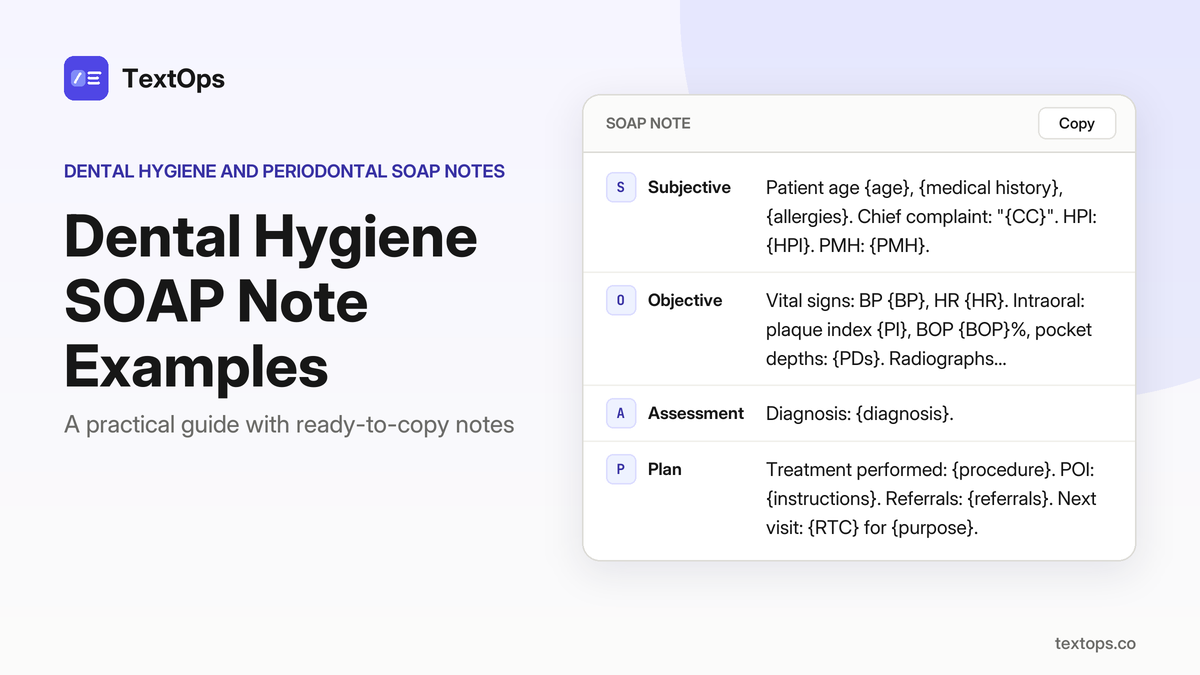
SOAP note
SSubjective
34-year-old female, pregnant, 2nd trimester, no known drug allergies. PMH: type 2 diabetes, HbA1c 7.2%. Meds: metformin 500 mg BID. Cardiac history: none. Anticoagulant: none.
OObjective
BP 118/76 mmHg, HR 78 bpm, FHR 145 bpm. Capillary glucose 110 mg/dL. Periodontal chart: plaque 20%, BOP 5%, PD 3 mm max. No spontaneous bleeding.
AAssessment
Healthy periodontium, plaque-induced gingivitis. Diabetes controlled (HbA1c <7.5%). Pregnancy: moderate gingival inflammation. No anticoagulant or cardiac risk.
PPlan
Perform scaling and polishing with chlorhexidine gel. Limit radiographs to bitewing if needed. Advise soft brushing, avoid vigorous rinsing. Follow-up in 6 weeks. No antibiotics needed.
Checklist for each condition
Pregnancy: trimester, obstetric complications, limit radiographs, record fetal heart rate if applicable.
Diabetes: recent HbA1c, current meds, glucose check if symptomatic, note grade modifier C if HbA1c ≥7.0%.
Cardiac disease: diagnosis, current meds, INR/PTT, infective endocarditis prophylaxis decision.
Drug allergies: specific agent, reaction type, severity, alternative medication plan.
Documenting Patient Education and Follow-Up Instructions
Record the exact content of the education session in the P section, listing risks, benefits, oral hygiene techniques, dietary recommendations, and any referrals. Use concise, objective language: “Patient was informed of the risk of plaque accumulation leading to gingivitis, the benefit of regular brushing and interdental cleaning, the need to limit sugary snacks, and the referral to a pediatric dentist for sealant placement.” Capture the patient’s reaction and agreement in quotation marks or a brief note: “Patient acknowledged understanding, agreed to use a soft-bristled brush twice daily, and consented to the referral.” This ensures the note reflects both the provider’s instruction and the patient’s acceptance.
Document the patient’s response to each instruction, noting comprehension or concerns. For example, “Patient expressed difficulty with flossing and requested a demonstration of interdental brush use.” Record any verbal or written instructions given, such as “Patient received a hand-out on proper brushing technique and a video link to flossing.” If the patient declines or refuses a recommendation, note the reason and obtain a signature if required by policy. Level of detail protects the provider and provides a clear audit trail for quality review.
SOAP note
PPlan
Educated patient on risks of plaque buildup and benefits of daily brushing and flossing. Advised dietary limits on sugary snacks and suggested a low-sugar diet. Referred to pediatric dentist for sealant placement. Patient acknowledged understanding, agreed to use a soft-bristled brush twice daily, and consented to referral. Patient expressed difficulty flossing; demonstrated interdental brush technique and provided hand-out. POI: Brush twice daily, floss once daily, limit sugary snacks, follow up in 6 weeks.
Routine Cleaning vs. Recall and Standardized Terminology
First-time prophylaxis visits begin with a comprehensive medical and dental history, including tobacco use, systemic disease, and recent medication changes, because the patient may be encountering the clinic for the first time. Objective findings are recorded with a full plaque and calculus score, gingival bleeding percentage, and a periodontal chart that establishes a baseline. The assessment categorizes the periodontium as healthy or plaque-induced gingivitis, and the plan includes complete removal of plaque and calculus, application of fluoride varnish, and detailed oral-hygiene instruction tailored to the patient’s risk profile.
A 6-month recall visit assumes the patient has a documented baseline and a history of regular care. The subjective section notes any new complaints or changes in oral health, while the objective section focuses on changes in plaque index, bleeding on probing, and probing depths compared to the last visit. The assessment evaluates whether the periodontal status has remained stable, improved, or worsened, and the plan emphasizes maintenance cleaning, reinforcement of home care, and scheduling of the next recall.
Periodontal maintenance visits are distinct from routine recalls in that the patient has completed active periodontal therapy and is now in a maintenance phase. The history includes details of prior scaling and root planing, any surgical interventions, and current systemic conditions that may affect healing. Objective findings are limited to probing depths, BOP, and plaque scores, often with a focus on sites that previously required treatment. The assessment classifies the periodontium as stable or in need of additional intervention, and the plan specifies targeted debridement of specific sites, use of adjunctive antimicrobials if indicated, and a schedule for the next maintenance appointment.
Glossary of common cleaning procedure terms
Adult Prophylaxis – Full plaque and calculus removal from all tooth surfaces using ultrasonic scalers and hand instruments. Plan: “Perform Adult Prophylaxis with ultrasonic scaling and polishing.”
Air Polishing – Use of a powder-air mixture to remove supragingival plaque and stains. Plan: “Apply Air Polishing with sodium bicarbonate powder.”
Ultrasonic Scaling – High-frequency vibration to dislodge calculus from tooth surfaces. Plan: “Conduct Ultrasonic Scaling of all quadrants.”
Plaque & Calculus Removal – The core objective of any prophylaxis, documenting the extent of removal. Plan: “Plaque and calculus removed from all teeth; surfaces polished.”
Flossing & OHI – Instruction and demonstration of interdental cleaning techniques and oral hygiene practices. Plan: “Provide Flossing & OHI; patient to floss daily and brush twice.”
Fluoride Varnish Application – 5 % sodium fluoride applied to enamel surfaces post-cleaning. Plan: “Apply fluoride varnish to all teeth.”
Periodontal Maintenance – Targeted cleaning of sites with a history of periodontal disease, often with adjunctive care. Plan: “Perform Periodontal Maintenance on sites 17, 27, 37; apply chlorhexidine gel.”
These examples show structure and wording only. Record what you actually found and did, and follow your practice’s documentation requirements.
Dr. Rahul Joshi is a Specialist Orthodontist with extensive clinical experience in orthodontics, dentofacial orthopaedics, and dental aesthetics. Holding a Master of Dental Surgery (MDS) in Orthodontics and Dentofacial Orthopaedics and a Bachelor of Dental Surgery (BDS) from Manipal Academy of Higher Education, he brings expertise in orthodontic treatment planning, teeth alignment, and Invisalign treatment. With professional experience across India and the Netherlands, Dr. Joshi combines clinical knowledge with practical experience in orthodontic care, dental aesthetics, and improving patients' oral health.
Master of Dental Surgery (MDS) in Orthodontics and Dentofacial Orthopaedics — Manipal Academy of Higher Education
Bachelor of Dental Surgery (BDS) — Manipal Academy of Higher Education
Stop retyping your templates
Save any template to TextOps once, then insert it anywhere on the web without retyping. Share it with your team so everyone uses the same wording.