Broken Tooth Extraction SOAP Note is a ready-to-copy, mobile-friendly template that clinicians can paste and adapt instantly.SOAP note
SSubjective
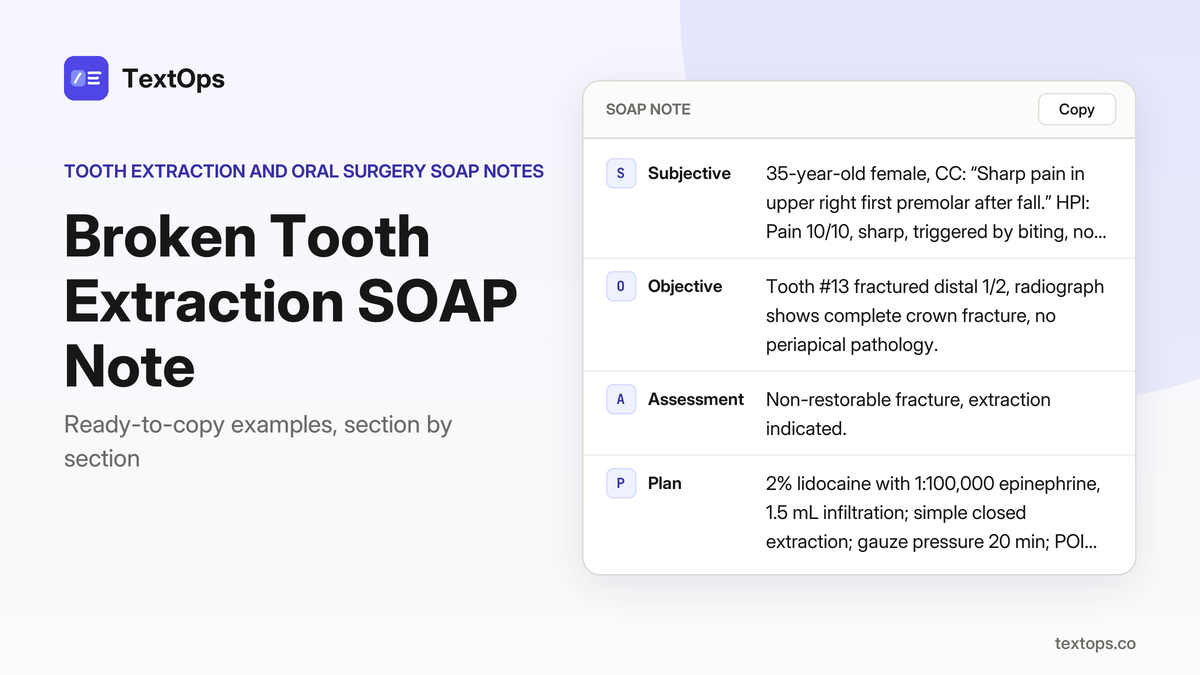
35-year-old female, CC: “Sharp pain in upper right first premolar after fall.” HPI: Pain 10/10, sharp, triggered by biting, no swelling. PMH: {medical history}. NKDA.
2% lidocaine with 1:100,000 epinephrine, 1.5 mL infiltration; simple closed extraction; gauze pressure 20 min; POI: soft diet, ice, ibuprofen 400 mg PRN. Follow-up in 7 days.
Additional grouped examples follow.
Emergency Sports-Related Extractions
Emergency Visit for Fractured Upper Incisor
SOAP note
SSubjective
67-year-old female, asthma, NKDA, CC: “I hit my front tooth while playing basketball and it’s broken and bleeding”; HPI: fractured incisor with no pulpal exposure, 2 mm intraoral swelling, afebrile, pulse 78, BP 128/76.
OObjective
Extraoral: no swelling, intraoral: tooth #7 fractured into two pieces, no erythema, 2 mm swelling; periodontal: intact BOP; radiograph: fracture line extends to pulp chamber, no sinus tract; vital signs: pulse 78, BP 128/76.
AAssessment
Fractured tooth #7, pulpal exposure absent, consistent with radiographic fracture line extending to pulp chamber.
PPlan
Infiltration with 2% lidocaine + 1:100,000 epinephrine, 1.8 mL; extracted #7 via closed technique, socket irrigated with saline, gauze pressure for 20 min; verbal POI given; no medications prescribed; next visit: follow-up in 7 days for healing assessment.
Emergency Extraction After Sports Injury
SOAP note
SSubjective
69-year-old female, no significant medical history, allergic to penicillin (rash). Chief complaint: “I fell and my lower right canine popped out, it’s painful and I can’t bite.” History: acute sports injury, pain localized to tooth #27, no systemic symptoms. PMH: none.
OObjective
Extraoral: mild pericoronal swelling, no lymphadenopathy. Intraoral: tooth #27 completely luxated, root exposed. Periodontal: BOP present, PD 3 mm. Radiographic: PA shows root fracture at middle third, no sinus tract. Vital signs: temperature 37.0 °C.
AAssessment
Luxated tooth with root fracture, symptomatic apical periodontitis. Findings: complete luxation, root exposure, periapical fracture, mild swelling, normal temperature.
PPlan
Administered 2% lidocaine with 1:100,000 epinephrine, 1.8 mL infiltration. Extracted tooth #27, curetted socket, achieved hemostasis with gauze pressure. Instructed patient to avoid chewing on that side, keep soft diet, apply ice packs, and return if pain worsens or swelling increases. No medications prescribed.
Emergency Extraction for Sports-Related Fracture
SOAP note
SSubjective
48-year-old female, smoker, NKDA, reports “I broke my lower right first molar while playing soccer, it’s shattered and bleeding.” HPI: acute fracture with pulp exposure, no systemic symptoms. PMH: smoking 5 cigarettes/day. O: tooth #30 fractured into multiple pieces, pulp exposed; PA shows fracture line to apex; moderate swelling 5 mm, no erythema; afebrile, pulse 82, no trismus. A: fractured tooth with pulpal exposure, acute apical abscess not present. P: extracted tooth #30 with surgical technique; 4 % articaine 1:100 000, 1.8 mL infiltration; socket irrigated, hemostasis achieved with gauze; POI given (bite on gauze 30-60 min, no spitting/rinsing/straws for 24 h, soft diet, cold packs, analgesic if needed); next visit in 7-10 days for healing assessment.
Emergency Extraction for Sports-Related Fracture in a Teenager
SOAP note
SSubjective
40-year-old male, hypothyroidism on levothyroxine, allergic to penicillin (rash); CC: “I broke my upper right canine in a bike crash, it’s broken and I can’t bite”; HPI: fractured #6 into two fragments, pulp exposed, moderate swelling 3 mm, no erythema, T 36.8 °C, no lymphadenopathy; PMH: hypothyroidism.
OObjective
Extraoral: mild 3 mm swelling, no erythema, no lymphadenopathy; Intraoral: #6 fractured into two fragments, pulp exposed; Radiographic: PA shows fracture to middle third; Tests: none.
AAssessment
Fractured tooth with pulpal exposure, symptomatic apical periodontitis, supported by exposed pulp, radiographic fracture, and clinical pain.
PPlan
Extracted tooth #6 under 2% lidocaine with 1:100,000 epinephrine, 1.8 mL infiltration; socket curetted, hemostasis achieved; advised to avoid chewing on that side, no medications prescribed; next visit for healing assessment.
Extraction After Failed Root Canal Therapy
SOAP note
SSubjective
80-year-old male, NKDA, reports “My root canal didn’t fix the pain, the tooth is still hurting and I can’t eat.” He has no significant medical history, is afebrile, pulse 76, no trismus, and moderate swelling 4 mm without erythema.
OObjective
Tooth #11 previously endodontically treated, crown missing, fractured at the cervical third. Periapical radiograph shows a 6 mm periapical radiolucency. Extraoral exam reveals no facial asymmetry; intraoral exam shows the fractured crown fragment and surrounding mucosa intact.
AAssessment
Pulp necrosis, previously treated, acute apical abscess—supported by the periapical radiolucency, persistent pain after RCT, and localized swelling.
PPlan
2% lidocaine with 1:100,000 epinephrine, 1.8 mL infiltration administered; tooth #11 extracted, socket irrigated, hemostasis achieved with gauze pressure. POI: bite on gauze for 30 min, avoid chewing hard foods, keep the area clean, return to clinic in 2 days for healing assessment.
Extraction After Failed Root Canal Therapy in a Middle-Aged Female
SOAP note
SSubjective
61-year-old female, seasonal allergies, NKDA, reports “The root canal didn’t help, the tooth keeps hurting after my tennis match.” She has a history of endodontic treatment on tooth #28 with a missing crown and a middle-third fracture.
OObjective
Extraoral: moderate swelling 3 mm, no erythema, temperature 36.9 °C, no lymphadenopathy. Intraoral: fractured tooth #28, crown missing, periapical radiograph shows 5 mm radiolucency. No other findings.
AAssessment
Pulp necrosis, previously treated, acute apical abscess – supported by fractured tooth, periapical radiolucency, and pain after trauma.
PPlan
2% lidocaine with 1:100,000 epinephrine, 1.8 mL infiltration administered; tooth #28 extracted, socket irrigated, hemostasis achieved. Patient instructed to avoid chewing on that side and to monitor for swelling or pain; next visit scheduled for follow-up in 7 days.
Post-Operative Follow-Up & Complications
Smoker, Day 3 After Lower Molar Extraction
SOAP note
SSubjective
45-year-old male, former smoker, NKDA, presents for a post-operative follow-up after extraction of tooth #30; in his own words, “I’m here to check on the extraction site.” He reports no pain, no discomfort, and no bleeding or swelling since the procedure. He has no systemic complaints and denies any medication use.
OObjective
Extraoral examination shows no facial edema or asymmetry; intraoral inspection reveals the socket at tooth #30 exhibiting normal healing with intact mucosa, no exposed bone, no purulent drainage, and no tenderness on palpation. Periodontal probing around the adjacent teeth is within normal limits; radiographic assessment was not performed as the clinical findings are reassuring. No additional tests were required.
AAssessment
The patient is experiencing uncomplicated post-extraction healing with no signs of infection, dry socket, or other complications.
PPlan
Reviewed the healing status, reinforced postoperative instructions: continue gentle rinsing with 0.12% chlorhexidine twice daily, maintain a soft diet, avoid smoking for at least 48 hours, and monitor for any sudden pain or swelling. No medication was prescribed. Scheduled a follow-up visit in 7 days to confirm complete resolution and to discuss any future restorative options.
Smoker, Day 1 After Extraction, Broken Lower Molar
SOAP note
SSubjective
30-year-old male, smoker 5 cigarettes/day, on low-dose aspirin, NKDA; CC: “I have a lot of pain and some swelling”; HPI: pain 4/10 throbbing, relieved by ibuprofen, swelling 1 cm around #30 extraction site, mild controlled bleeding, no exposed bone, no trismus, no systemic signs.
OObjective
Socket shows mild bleeding, controlled; swelling 1 cm; pain 4/10 throbbing; no exposed bone; no trismus; no systemic signs; anesthesia not required.
AAssessment
Post-extraction pain with early dry socket risk, supported by mild bleeding, swelling, throbbing pain, and patient’s smoking status.
PPlan
Prescribed ibuprofen 400 mg PO q6 h PRN up to 3 days; advised avoid smoking, continue POI, monitor for worsening pain or exposed bone; next visit in 3 days for reassessment.
Non-smoker, Day 2 After Extraction, Broken Upper Molar
SOAP note
SSubjective
64-year-old female, smoker 5 cigarettes/day, controlled hypertension on lisinopril, NKDA, reports “The pain is still there and there's some swelling” after extraction of tooth #18.
OObjective
Socket demonstrates normal healing; swelling measures 1.5 cm; pain intensity 6/10, dull, relieved by ibuprofen; no active bleeding; no exposed bone; extraoral exam shows no trismus; vital signs stable.
AAssessment
Post-extraction pain without dry socket, evidenced by intact socket, absence of exposed bone, and lack of purulent discharge.
PPlan
Prescribed ibuprofen 400 mg PO every 6 h PRN for up to 3 days; continue postoperative instructions (avoid smoking, maintain soft diet, apply cold packs as needed); advise to return if swelling exceeds 2 cm, pain escalates above 7/10, or signs of infection appear.
Extraction With Post-operative Dry Socket Monitoring
SOAP note
SSubjective
58-year-old female, type 2 diabetes on metformin, NKDA, reports “the socket hurts a lot and I taste something bad” after extraction of tooth #30.
OObjective
Socket shows exposed bone 2 cm in diameter; pain 8/10 radiating to the ear; bad taste and foul odor; no swelling or bleeding; systemic signs absent.
AAssessment
Alveolar osteitis (dry socket) supported by exposed bone, severe pain, and halitosis.
PPlan
Gentle saline irrigation performed; medicated dressing applied; prescribe ibuprofen 400 mg every 6 h PRN, max 3 days; advise oral hygiene, avoid smoking, and return in 5 days for reassessment.
Extraction With Post-operative Dry Socket Monitoring in a Smoker
SOAP note
SSubjective
50-year-old male, smoker (5 cigarettes/day), asthma on albuterol PRN, NKDA, reports “the socket hurts a lot and I taste something bad.”
OObjective
Tooth #30 socket shows 2 cm exposed bone; pain 8/10 radiating, bad taste, foul odor; no swelling or bleeding; systemic signs absent.
AAssessment
Alveolar osteitis (dry socket) supported by exposed bone, severe pain, and characteristic taste/odor.
PPlan
Gentle saline irrigation performed; medicated dressing placed in socket; prescribed ibuprofen 400 mg PO every 6 h PRN for up to 3 days; advised to avoid smoking, maintain oral hygiene, and return in 5 days for reassessment.
Re-evaluation After Failed Splint
SOAP note
SSubjective
55-year-old male, allergic to penicillin (rash), reports “The tooth still hurts and the splint is broken.” He has no significant medical history and no systemic signs.
OObjective
Tooth #30 shows mobility grade 2, pain 5/10; splint fractured; no swelling, no bleeding, no exposed bone.
AAssessment
Failed orthodontic splint with symptomatic irreversible pulpitis of tooth #30, supported by mobility, pain, and splint failure.
PPlan
Splint removed, pulp status evaluated; extraction of tooth #30 planned if pulpal necrosis confirmed. No anesthesia or medication administered today. Patient instructed to maintain oral hygiene, avoid chewing on the area, and report any increase in pain or swelling. Next visit scheduled in 3 days for reassessment and possible extraction.
Re-evaluation After Failed Splint in a Diabetic
SOAP note
SSubjective
47-year-old female, type 2 diabetes on metformin, smoker 5 cigarettes/day, NKDA. Chief complaint: “The tooth still hurts and the splint is broken.” History: splint placed on teeth #30 and #31; now fractured, pain persists.
OObjective
Tooth #30 shows mobility grade 2, pain 5/10; splint fractured; no swelling, no bleeding, no exposed bone. No systemic signs.
AAssessment
Failed orthodontic splint with symptomatic irreversible pulpitis of tooth #30, supported by mobility, pain, and splint failure.
PPlan
Remove fractured splint, evaluate pulp status of #30; if pulpal inflammation persists, plan extraction. No anesthesia or medications administered. Instruct patient to maintain oral hygiene, avoid chewing on that side, and report any increase in pain or swelling. Schedule next visit in 7 days for reassessment and to discuss definitive treatment.
Re-evaluation After Failed Splint in a Hypertensive Patient
SOAP note
SSubjective
56-year-old female, hypothyroid on levothyroxine, allergic to penicillin (rash), reports “The tooth still hurts and the splint is broken.” HPI: pain 5/10, ongoing after splint placement. PMH: hypothyroidism, no other systemic disease.
OObjective
Tooth #30 shows mobility grade 2, pain 5/10, splint fractured; no swelling, no bleeding, no exposed bone. Tooth #31 stable, no pain. Extraoral exam WNL.
AAssessment
Failed orthodontic splint; symptomatic irreversible pulpitis of tooth #30, supported by mobility, pain, and splint failure.
PPlan
Remove fractured splint; evaluate pulpal response; if pulpal inflammation persists, plan extraction of #30. No medication prescribed. Instruct patient to maintain oral hygiene, avoid chewing on the area, use soft diet, and report increased pain, swelling, or bleeding. Schedule follow-up in 3 days to reassess pain and healing.
Re-evaluation After Failed Splint in a Post-Op Patient on Anticoagulants
SOAP note
SSubjective
46-year-old male, NKDA, presents with “the tooth still hurts and the splint is broken”; reports 5/10 pain in tooth #30, splint fractured, no swelling.
Failed orthodontic splint with symptomatic irreversible pulpitis of tooth #30, supported by mobility, pain, and splint failure.
PPlan
Removed fractured splint, inspected pulp chamber, noted no pulpal exposure; advised to avoid anticoagulants if possible, scheduled follow-up in 3 days to reassess pain and consider extraction if pulpal inflammation persists.
Immediate Implant Placement
Extraction With Immediate Implant Placement
SOAP note
SSubjective
24-year-old female, seasonal allergies, NKDA, reports “I need my tooth removed and a new one placed right away.” She has no systemic signs, no swelling or trismus, and no periodontal pockets >3 mm.
OObjective
Radiograph shows extensive caries into outer dentin with a root fracture; tooth #30 is non-restorable. Extraoral exam is unremarkable; intraoral exam shows no mobility, no bleeding on probing, and no periapical radiolucency beyond the fracture line.
AAssessment
Pulp necrosis with symptomatic apical periodontitis, confirmed by radiographic fracture and clinical pain.
PPlan
An IANB with 2% lidocaine + 1:100,000 epinephrine (1.8 mL) was administered. Tooth #30 was extracted, socket irrigated, clot stabilized, and a 4.0 mm × 10 mm implant with provisional healing abutment was immediately placed. Ibuprofen 400 mg PO q6h PRN for 5 days prescribed; patient advised on postoperative care and to return for implant integration check.
Extraction With Immediate Implant Placement in a Young Adult
SOAP note
SSubjective
28-year-old male, hypertension, NKDA, CC: “My tooth broke and I want a new one right away.” HPI: fractured #30, patient reports pain after break, no swelling or trismus. PMH: hypertension, no other systemic signs.
OObjective
Extraoral: no facial asymmetry, no swelling. Intraoral: #30 non-restorable, root fracture, extensive outer dentin caries, no mobility, periodontal pockets ≤3 mm. Radiograph: periapical shows root fracture, symptomatic apical periodontitis. No other findings.
AAssessment
Pulp necrosis with symptomatic apical periodontitis, confirmed by radiograph and clinical exam.
PPlan
Extraction of #30 under 2% lidocaine with 1:100,000 epinephrine, 1.8 mL IANB; immediate placement of a 4.0 mm × 10 mm implant with provisional healing abutment; socket irrigated, clot stabilized. Ibuprofen 400 mg PO q6h PRN for 5 days. POI: soft diet, avoid chewing on site, use ice packs, keep head elevated. Next visit: implant review in 2 weeks.
Medical Condition-Specific Extractions
Pregnant, First Trimester, Broken Upper Central Incisor
SOAP note
SSubjective
81-year-old female, pregnant, first trimester, on low-dose aspirin, NKDA; CC: “My front tooth is broken and hurts when I bite.” HPI: fractured upper central incisor #8, no pulpal exposure, no swelling, erythema, trismus, or lymphadenopathy; afebrile.
Fractured tooth #8, pulpal exposure absent, based on clinical and radiographic findings.
PPlan
Simple extraction of #8 with 2% lidocaine + 1:100,000 epinephrine, 1.8 mL infiltration, aspiration negative. Elevation and forceps extraction, socket curetted and irrigated, gauze pressure 30 min. POI: bite on gauze, no spitting or rinsing for 24 h, soft diet, cold packs as needed, monitor for bleeding or pain. No medications prescribed. RTC in 7 days for healing assessment.
Diabetic, Controlled, Broken Lower Second Molar
SOAP note
SSubjective
53-year-old female, type 2 diabetes on metformin, controlled hypertension on lisinopril, NKDA; CC: “My back molar is broken and it’s painful when I chew”; HPI: fractured #19 with pulpal exposure, pain on chewing, no swelling or trismus; PMH: T2DM, HTN, no other meds; allergies: NKDA.
OObjective
Extraoral: no facial swelling, no trismus; Intraoral: fractured #19 with exposed pulp, soft tissue intact; Periodontal: healthy; Radiographic: PA shows acute apical periodontitis around #19; Tests: afebrile, no lymphadenopathy.
AAssessment
Fractured tooth #19 with pulpal exposure and symptomatic apical periodontitis, confirmed by PA radiograph and clinical findings.
PPlan
2% lidocaine with 1:100,000 epinephrine, 1.8 mL (1 cartridge), IANB, aspiration negative; simple extraction with elevation and forceps, socket curetted and irrigated, gauze pressure for 30 min; prescribed ibuprofen 400 mg PO q6h PRN for pain; POI: soft diet, avoid hard foods for 24 h, keep gauze for 30 min, rinse with warm saline after 24 h; next visit: follow-up in 7 days for healing assessment.
NSAID Allergy, Broken Upper Lateral Incisor
SOAP note
SSubjective
23-year-old female, type 2 diabetes on metformin, reports “My upper lateral tooth is broken and it hurts when I bite.” No swelling, erythema, trismus or lymphadenopathy; afebrile. No known drug allergies except NSAID rash.
OObjective
Tooth #9 fractured, no pulpal exposure. Periapical radiograph shows intact periapical tissues. Extraoral and intraoral exam WNL.
AAssessment
Fractured tooth #9, pulpal exposure absent.
PPlan
Simple extraction of tooth #9 performed with 2% lidocaine 1:100,000 epinephrine, 1.8 mL maxillary infiltration; aspiration negative. Elevation and forceps extraction, socket curetted and irrigated, gauze pressure for 30 min. Post-op: acetaminophen 500 mg PO q6h PRN; advise soft diet, avoid NSAIDs, monitor for infection; next visit for healing assessment.
Elderly, Osteoporosis, Broken Lower Third Molar
SOAP note
SSubjective
62-year-old male, asthma, NKDA, reports “My lower wisdom tooth is broken and it’s painful when I chew.” HPI: fractured #32 with pulpal exposure, no swelling, no trismus, afebrile, no lymphadenopathy.
OObjective
Extraoral normal; intraoral shows fractured #32 with exposed pulp; periodontal probing within normal limits; PA radiograph shows symptomatic apical periodontitis; aspiration negative.
AAssessment
Fractured tooth #32 with pulpal exposure and symptomatic apical periodontitis.
PPlan
2% lidocaine with 1:100,000 epinephrine, 1.8 mL (1 cartridge), IANB administered; simple extraction performed with elevation and forceps; socket curetted, irrigated, gauze pressure for 30 min; ibuprofen 400 mg PO q6h PRN; advised soft diet, avoid hard foods for 48 h, report excessive pain or swelling; next visit in 7 days for healing assessment.
Pregnancy, Second Trimester, Broken Upper Canine
SOAP note
SSubjective
75-year-old pregnant female presents with “My upper canine is broken and it hurts when I bite.” HPI: fractured #11, no pulpal exposure, afebrile, no swelling, erythema, trismus, or lymphadenopathy. PMH: pregnancy; allergy to penicillin (rash). O: extraoral normal; intraoral shows fractured #11, intact periapical tissues on PA radiograph; no swelling or erythema; vital signs WNL. A: fractured tooth #11, pulpal exposure absent. P: simple extraction of #11 performed with 2% lidocaine 1:100,000 epinephrine, 1.8 mL maxillary infiltration, aspiration negative; elevation, forceps, socket curettage and irrigation; gauze pressure for 30 min; prescribed acetaminophen 500 mg PO q6h PRN; instructed to avoid hot foods, maintain a soft diet, use cold packs, and report severe pain or bleeding; next visit in 7 days for healing assessment.
Hypertensive, Broken Lower Premolar
SOAP note
SSubjective
66-year-old male, smoker, NKDA, reports “My lower premolar is broken and it’s painful when I chew.” History: fractured tooth #20, no pulpal exposure, afebrile, no swelling, erythema, trismus, or lymphadenopathy.
OObjective
Extraoral: normal. Intraoral: fractured #20, intact periapical tissues on PA radiograph. Periodontal: no BOP. Radiographic: PA shows intact periapical tissues. Tests: none.
AAssessment
Fractured tooth #20, pulpal exposure absent; supported by absence of pulpal signs, intact periapical tissues, and normal PA findings.
PPlan
Simple extraction of #20 with 2% lidocaine 1:100,000, 1.8 mL (IANB, aspiration negative). Elevation, forceps, socket curetted and irrigated, gauze pressure 30 min. POI: ibuprofen 400 mg PO q6h PRN for pain; avoid hard foods, maintain oral hygiene. Next visit: review healing in 7 days.
Allergic to Penicillin, Broken Upper Molar
SOAP note
SSubjective
51-year-old male, hypothyroidism on levothyroxine, allergic to penicillin (rash); chief complaint: “My upper molar is broken and it hurts when I bite.” History: fractured tooth #16, no pulpal exposure, afebrile, no swelling, erythema, trismus, or lymphadenopathy.
OObjective
Extraoral: no swelling, erythema, or lymphadenopathy. Intraoral: fractured tooth #16, intact periapical tissues on PA radiograph, no pulpal exposure, no trismus. Radiographic: PA shows intact periapical tissues. Vital signs: afebrile.
AAssessment
Fractured tooth #16 with no pulpal exposure, confirmed by clinical and radiographic findings.
PPlan
Simple extraction of #16 performed with 2% lidocaine with 1:100,000 epinephrine, 1.8 mL maxillary infiltration; elevation, forceps, socket curetted and irrigated; gauze pressure for 30 min. Post-op: acetaminophen 500 mg PO q6 h PRN for pain; advise soft diet, avoid hard foods, and return if pain worsens or signs of infection develop.
Pregnant, Third Trimester, Broken Lower Molar
SOAP note
SSubjective
77-year-old pregnant female, NKDA, reports “My lower molar is broken and it hurts when I chew.” She has no swelling, erythema, fever, trismus or lymphadenopathy; HPI: fractured tooth #30 with no pulpal exposure. O: Extraoral normal; intraoral shows fractured #30, no pulpal exposure, no swelling; Periodontal: BOP absent, PD 2 mm; Radiograph: periapical PA shows intact periapical tissues, no pathology; patient afebrile, no trismus. A: Fractured tooth #30, pulpal exposure absent, indicating simple extraction. P: Administered 2% lidocaine with 1:100,000 epinephrine, 1.8 mL (1 cartridge) via IANB, aspiration negative; performed simple extraction with elevation and forceps, socket curetted and irrigated, gauze pressure for 30 min; prescribed ibuprofen 400 mg PO q6h PRN; instructed soft diet, avoid hard foods, maintain oral hygiene, and return if pain worsens or bleeding persists.
Elderly, Arthritis, Broken Lower Molar
SOAP note
SSubjective
29-year-old female, seasonal allergies, NKDA, CC: “My lower right molar broke after a fall and it’s painful”; HPI: vertical split of tooth #30, no pulpal exposure, no swelling, no mobility, no BOP.
OObjective
Extraoral: mouth closed, no swelling. Intraoral: tooth #30 fractured, intact root, no periapical radiolucency on PA radiograph. Periodontal: no BOP, no mobility. Radiographic: PA shows intact root structure, no periapical pathology.
AAssessment
Symptomatic apical periodontitis with pulp necrosis, previously untreated, supported by vertical fracture, intact root, and clinical pain.
PPlan
Simple extraction of tooth #30 under 2% lidocaine with 1:100,000 epinephrine, 1.8 mL IANB, aspiration negative. Socket curetted, irrigated with saline; gauze pressure for 30 min. POI: soft diet, no hard foods for 24 h, no smoking, keep gauze in place. Return to clinic in 7 days for healing assessment.
Diabetic, Uncontrolled, Broken Lower Molar
SOAP note
SSubjective
59-year-old female, type 2 diabetes on metformin, former smoker, NKDA, reports “My lower left molar snapped and I can’t chew”; history shows mild trismus, 98.6 °F, swelling in left mandibular vestibule, no BOP.
OObjective
Extraoral: mild swelling left mandibular vestibule. Intraoral: tooth #19 fractured with horizontal split, pulpal exposure, periapical radiolucency 3 mm, no root resorption. Periodontal: no BOP. Radiographic: PA shows 3 mm periapical radiolucency. Vital signs: temperature 98.6 °F.
AAssessment
Pulp necrosis, previously untreated, acute apical abscess, supported by pulpal exposure, periapical radiolucency, and clinical swelling.
PPlan
Simple extraction of tooth #19 under 2% lidocaine with 1:100,000 epinephrine, 1.8 mL IANB, aspiration negative. Socket irrigated with saline, gauze pressure for 45 min. POI: ibuprofen 400 mg q6h PRN up to 3 days, acetaminophen 500 mg q6h PRN up to 3 days, soft diet, avoid chewing on site, keep gauze for 30 min, return if pain >4/10, swelling increases, or fever develops.
Pregnancy, First Trimester, Broken Upper Molar
SOAP note
SSubjective
35-year-old female, pregnant, on low-dose aspirin, NKDA; CC: “My upper left molar broke and I’m in pain”; HPI: vertical split of tooth #16, no pulpal exposure, pain localized to the tooth, no swelling or mobility; PMH: pregnancy, aspirin; medications: low-dose aspirin; allergies: NKDA.
OObjective
Extraoral: no swelling, no BOP; Intraoral: tooth #16 fractured with vertical split, intact root, no periapical radiolucency on PA; Periodontal: no mobility, BOP WNL; Radiographic: PA shows intact root, no periapical radiolucency; Tests: none.
AAssessment
Pulp necrosis, previously untreated, symptomatic apical periodontitis, supported by vertical fracture, intact root, periapical radiolucency absent but pain present.
PPlan
Simple extraction of tooth #16 under 2% lidocaine with 1:100,000 epinephrine, 1.8 mL buccal infiltration, aspiration negative; socket curetted, irrigated with saline; gauze pressure for 30 min; POI: avoid hard foods, use ice packs, follow postoperative instructions; next visit: follow-up in 7 days for healing assessment.
Allergic to Aspirin, Broken Lower Molar
SOAP note
SSubjective
68-year-old male, controlled hypertension on lisinopril, allergic to aspirin (rash); chief complaint: “My lower right molar broke and it hurts when I bite”; history: tooth #30 fractured with horizontal split, pulpal exposure, periapical radiolucency 2 mm, no swelling, no mobility, no BOP; PMH: hypertension; allergy: aspirin; no other meds.
OObjective
extraoral normal; intraoral: tooth #30 horizontal fracture, exposed pulp, 2 mm periapical radiolucency on PA, no root resorption, no swelling, no mobility, BOP negative; periodontal: healthy; radiograph: periapical radiolucency 2 mm; tests: none.
AAssessment
symptomatic apical periodontitis, pulp necrosis, previously untreated, supported by exposed pulp, radiolucency, pain on biting.
PPlan
simple extraction of tooth #30 under 2% lidocaine with 1:100,000 epinephrine, 1.8 mL (1 cartridge), IANB, aspiration negative; socket irrigated with saline; gauze pressure for 30 min; POI given: avoid hard foods, use ice packs, take acetaminophen 500 mg q6h PRN for pain; schedule follow-up in 7 days for healing assessment.
Diabetic, Controlled, Broken Upper Molar
SOAP note
SSubjective
79-year-old male, type 2 diabetes on metformin, NKDA, reports “My upper left molar snapped and I can’t chew”; fractured vertical split with pulpal exposure.
OObjective
Tooth #16 fractured, pulpal exposure, periapical radiolucency 3 mm, no root resorption, no swelling, no mobility, no BOP; 2% lidocaine with 1:100,000 epinephrine, 1.8 mL buccal infiltration, aspiration negative.
AAssessment
Symptomatic apical periodontitis with pulp necrosis, previously untreated, diagnosed from fracture, exposure, and radiolucency.
PPlan
Simple extraction of tooth #16 performed; socket irrigated with saline, gauze pressure applied for 45 min; patient received POI, advised soft diet, avoid chewing on side, use ice packs; next visit in 7 days for healing check.
Extraction With Anticoagulant Management
SOAP note
SSubjective
21-year-old female, asthma, NKDA, reports “My lower right molar broke and I’m in pain”; fractured #30 with horizontal split, pulpal exposure, 2 mm periapical radiolucency, no swelling, no mobility, no BOP.
OObjective
Extraoral normal; intraoral tooth #30 fractured, exposed pulp; periodontal BOP negative; radiograph PA shows 2 mm periapical radiolucency, no root resorption; aspiration negative.
AAssessment
Pulp necrosis, previously untreated, symptomatic apical periodontitis, supported by pulpal exposure, radiolucency, and pain.
PPlan
2% lidocaine with 1:100,000 epinephrine, 1.8 mL IANB; simple extraction of #30; socket irrigated with saline; gauze pressure 30 min; POI given: avoid hard food, use ice packs, return if bleeding >24 h or pain worsens.
Extraction in a Patient With Bisphosphonate Therapy
SOAP note
SSubjective
31-year-old female, allergic to penicillin (rash), reports “My lower right molar broke and it’s painful”; history of a vertical split with no pulpal exposure; PMH non-significant.
OObjective
Extraoral WNL; intraoral tooth #30 fractured, no mobility, no BOP; periodontal probing normal; PA radiograph shows intact root, no periapical radiolucency; no swelling; IANB anesthesia 2% lidocaine 1:100,000, 1.8 mL, aspiration negative.
AAssessment
Pulp necrosis, previously untreated, symptomatic apical periodontitis—supported by vertical fracture, pain, and radiographic lack of periapical pathology.
PPlan
Simple extraction of tooth #30 performed; socket curetted and irrigated with saline; gauze pressure for 30 min; POI given—avoid hard foods, use ice packs; next visit in 7 days for healing assessment.
Extraction of a Fractured Tooth in a Pregnant Patient (Second Trimester)
SOAP note
SSubjective
34-year-old female, pregnant, smoker 5 cigarettes/day, NKDA, presents with “My upper left molar broke and I’m in pain”; history shows a horizontal split of tooth #16 with pulpal exposure, periapical radiolucency 3 mm, no swelling, no mobility, no BOP; PMH: pregnancy, smoking.
OObjective
Extraoral: no swelling, extraoral symmetry normal. Intraoral: tooth #16 fractured with horizontal split, pulpal exposure, no mobility, no BOP. Periodontal: probing depths within normal limits, no recession. Radiographic: PA shows 3 mm periapical radiolucency, no root resorption, no sinus tract. Tests: none performed.
AAssessment
Pulp necrosis, previously untreated, symptomatic apical periodontitis of tooth #16, supported by pulpal exposure, radiolucency, and pain.
PPlan
Simple extraction of tooth #16 performed under 2% lidocaine with 1:100,000 epinephrine, 1.8 mL buccal infiltration; aspiration negative. Socket irrigated with saline; gauze pressure applied for 45 min. POI: avoid hard foods, maintain soft diet, use cold packs, rinse with warm water after 24 h, report bleeding or severe pain. Next visit: follow-up in 7 days for healing assessment.
Extraction With Antibiotic Prophylaxis for Cardiac Condition
SOAP note
SSubjective
32-year-old male, hypothyroidism on levothyroxine, penicillin allergy (rash), chief complaint: “I have a broken tooth that’s painful and I’m worried about my heart.” HPI: fractured tooth, no pulpal exposure, no swelling or trismus, INR 2.4 stable, no systemic signs. PMH: hypothyroidism, cardiac condition requiring antibiotic prophylaxis.
OObjective
Extraoral: no swelling, trismus WNL. Intraoral: fractured tooth #30, intact soft tissues, no periapical radiolucency on PA. Periodontal: healthy gingiva, no BOP. Radiographic: PA shows no periapical pathology. Tests: INR 2.4, no other abnormal labs.
AAssessment
Non-restorable caries of tooth #30, supported by fracture, absence of pulpal exposure, and clear radiograph.
PPlan
2% lidocaine with 1:100,000 epinephrine, 1.8 mL (1 cartridge), IANB, aspiration negative. Extraction of tooth #30, socket curetted, hemostasis with gauze pressure. Antibiotic prophylaxis: amoxicillin 2 g orally 30 min pre-procedure, single dose. Chlorhexidine gluconate 0.12% 15 mL rinse 30 sec twice daily POI. Next visit: follow-up in 7 days for healing assessment.
Extraction in a Patient With Aspirin Allergy
SOAP note
SSubjective
33-year-old male, no significant medical history, aspirin allergy (rash); CC: “My molar is broken and it hurts when I bite”; HPI: fractured tooth with pulpal exposure, pain on biting, no swelling or trismus; PMH: none; aspirin allergy noted.
OObjective
Extraoral: no swelling, trismus, or facial asymmetry; Intraoral: fractured #30 with exposed pulp, moderate caries; Periodontal: healthy gingiva, no BOP; Radiograph: periapical radiolucency around #30, no root resorption; Tests: none.
AAssessment
Symptomatic apical periodontitis of tooth #30, supported by pulpal exposure, pain on biting, and periapical radiolucency.
PPlan
4% articaine with 1:100,000 epinephrine, 1.8 mL infiltration buccal, aspiration negative; extraction of #30 performed, socket curetted, hemostasis achieved with gauze pressure; POI: bite on gauze for 30-60 min, no spitting, rinsing, or smoking for 24 h, soft diet, cold packs as needed; schedule follow-up in 7 days for healing assessment.
Extraction of a Fractured Tooth in a Child
SOAP note
SSubjective
8-year-old male, seasonal allergies, NKDA, reports “My front tooth is broken and it hurts when I eat”; history shows no pulpal exposure and no swelling or trismus.
OObjective
Extraoral normal; intraoral shows fractured tooth #8 with intact surrounding tissues; periodontal probing WNL; PA radiograph shows no periapical radiolucency; no abnormal findings on other teeth.
AAssessment
Non-restorable caries of tooth #8, supported by fracture, lack of pulpal exposure, and clear periapical radiograph.
PPlan
2% lidocaine with 1:100,000 epinephrine, 1.8 mL infiltration buccal, aspiration negative; extracted tooth #8, socket curetted, hemostasis achieved with gauze pressure; instructed to bite gauze 30-60 min, avoid hard foods, use soft diet, apply cold packs, and return if pain worsens or bleeding persists.
Extraction of a Fractured Tooth in a Child with Anemia
SOAP note
SSubjective
67-year-old female, asthma on albuterol PRN, NKDA, CC: “My molar is broken and it’s painful,” HPI: fractured tooth with pulpal exposure, no swelling or trismus, PMH: asthma, medications: albuterol, no known drug allergies.
OObjective
Extraoral: no facial swelling, intraoral: fractured #19 with exposed pulp, periodontal: BOP present, radiograph: periapical radiolucency around #19, no sinus tract, tests: normal bite, no paresthesia, vital signs: BP 128/78, pulse 76.
AAssessment
Symptomatic apical periodontitis of tooth #19, supported by pulpal exposure, periapical radiolucency, pain on biting, and absence of systemic signs.
PPlan
2% lidocaine with 1:100,000 epinephrine, 1.8 mL IANB buccal, aspiration negative; extraction of #19 performed, socket curetted, hemostasis achieved with gauze pressure, postoperative instructions given (bite gauze 30-60 min, no spitting or rinsing for 24 h, soft diet, cold packs, NSAID as needed, return to clinic in 7 days for healing assessment).
Extraction With Dental Anxiety Management in a Young Adult
SOAP note
SSubjective
26-year-old female, takes low-dose aspirin, NKDA, chief complaint: “I’m nervous about the extraction and it’s painful”; fractured #30, pulpal exposure absent, periapical radiograph shows no radiolucency, no swelling, no trismus, systemic signs none.
OObjective
extraoral: no asymmetry, intraoral: fractured #30, periodontal: healthy, radiograph: PA of #30 shows intact periapical area, no swelling, no trismus; tests: none.
AAssessment
non-restorable caries of #30, supported by fracture, lack of pulpal exposure, and periapical radiograph showing no pathology.
PPlan
2% lidocaine with 1:100,000 epinephrine, 1.8 mL (1 cartridge), IANB, aspiration negative; extraction of #30 performed, socket curetted, hemostasis with gauze pressure; anxiety managed with verbal reassurance and nitrous oxide 50%; no drugs prescribed; POI: bite on gauze 30-60 min, no spitting, rinsing, or smoking for 24 h, soft diet, cold packs, return to clinic in 7 days for healing assessment.
Extraction With Dental Anxiety Management
SOAP note
SSubjective
78-year-old female, controlled hypertension on lisinopril, NKDA, reports “My molar is broken and I’m scared of the pain.” Fractured #32 with exposed pulp absent; periapical radiograph shows no radiolucency; no swelling or trismus.
OObjective
Extraoral: normal; Intraoral: fractured #32, no swelling, no trismus. Periodontal: healthy. Radiographic: PA of #32 shows intact periapical tissues, no radiolucency. Tests: none.
AAssessment
Non-restorable caries of tooth #32, supported by fracture, lack of pulpal exposure, and radiographic absence of periapical pathology.
PPlan
2% lidocaine with 1:100,000 epinephrine, 1.8 mL IANB buccal, aspiration negative. Extraction of #32 performed; socket curetted, hemostasis achieved with gauze pressure. Anxiety managed with 50% nitrous oxide. Post-operative instructions: bite on gauze 30-60 min, avoid spitting, rinsing, straws, smoking for 24 h, soft diet, cold packs. Schedule follow-up in 7 days for healing assessment.
Extraction With Anticoagulant Management in a Warfarin User
SOAP note
SSubjective
67-year-old female, asthma, NKDA, reports fractured molar and concerns about bleeding.
OObjective
Extraoral: no swelling, no trismus. Intraoral: fractured #30, no pulpal exposure. Radiograph: periapical radiolucency absent. No other findings.
AAssessment
Non-restorable caries of #30, supported by fracture, absence of periapical pathology, and patient’s complaint.
PPlan
2% lidocaine with 1:100,000 epinephrine, 1.8 mL IANB, aspiration negative; extracted #30, socket curetted; hemostasis with gauze pressure and oxidized cellulose; patient instructed to keep warfarin regimen unchanged, avoid strenuous activity, use ice packs, and return if bleeding exceeds 24 h.
When to Use a Broken Tooth Extraction Note vs. a Retained Root Extraction Note
Broken tooth extraction notes apply when a tooth is removed intact or in pieces, with no root fragment left in the socket. Use a retained-root extraction note only if a root tip or fragment remains after the fractured tooth is removed. Splinting is required for mobile fractured teeth that are extracted as a unit; it is not indicated when the tooth is extracted intact or when a root tip is left behind. Presence of a root fragment is the decisive factor: if the radiograph shows a remaining root stump, document a retained-root extraction. If the radiograph shows complete removal of crown and root, document a broken tooth extraction.
Checklist / decision tree
Step 1: Radiograph reviewed.
Root fragment present → Retained-Root Extraction.
No fragment → proceed to Step 2.
Step 2: Tooth removed intact or in fragments?
Intact or fragments removed → Broken Tooth Extraction.
Fragment remains in socket → Retained-Root Extraction.
Step 3: Mobility and splinting?
Mobile tooth extracted as a unit → note splinting in plan.
Tooth not mobile → splinting not required.
The retained-root note records the root tip left in the socket, the decision to avoid removal, and any follow-up for potential root resorption or infection.
Key Elements of a Broken Tooth Extraction SOAP Note
Subjective (S) – Pain & Swelling Assessment
Record CC in patient words and HPI.
Note pain intensity 0-10, character, triggers, and relief.
Document swelling: location, size, progression.
Include PMH, allergies, tobacco use, pregnancy status.
Objective (O) – Fracture Type & Tooth Identification
Identify tooth number and surfaces involved.
Classify fracture: crown, root, or combined; note completeness.
Report radiographic findings: PA or PAN, fracture line, periapical status.
Note mobility (Miller grade) and adjacent tooth condition.
Assessment (A) – Severity & Splinting Decision
State fracture severity and extraction indication.
Decide on splinting: mobile fractured tooth → splint; intact extraction → none.
Record root fragment status: retained or removed.
Plan (P) – Anesthesia, Splinting/Restoration, Follow-Up
Outline splinting: type, material, duration if applicable.
Detail restoration plan: extraction, immediate placement, or referral.
Provide POI: diet, ice, analgesic, bleeding control.
Schedule follow-up: day 7 for healing, earlier if complications.
Pain & Swelling Documentation
Pain Assessment
Record the patient’s exact words for the chief complaint, then detail pain location, onset, duration, character (sharp, dull, throbbing), triggers (cold, biting, sweet), relief, and numeric rating 0-10.
Example: “I feel a sharp 8/10 pain in the left upper canine when I bite.”
Include whether the pain is spontaneous or provoked, any radiation, and effect on sleep. Note if the tooth was removed intact or in pieces: “Tooth #13 removed in two fragments; pain now 5/10, dull.”
Swelling Assessment
Document swelling size (e.g., “moderate, 1 cm × 1 cm on buccal gingiva”), location, progression, and associated symptoms (trismus, erythema, warmth).
Example: “Swelling 2 cm buccally, progressing over 4 h; patient reports mild tenderness and difficulty opening mouth.”
Indicate whether swelling is localized to the extraction site or diffuse, and note any associated signs such as facial edema or lymphadenopathy.
Fracture Documentation
Fracture Type
Record the fracture as crown-only, root-crown, root-only, vertical, or horizontal. Use a concise phrase: “crown-only fracture, oblique, involving the labial surface of tooth #19” or “vertical root fracture, apical third of tooth #30”. When the fracture is incomplete, note the extent: “partial crown fracture, 2 mm labial extension”. If the tooth was removed in pieces, write “tooth #13 extracted in two fragments, crown and root separated”. If removed intact, write “tooth #13 extracted intact, no fragments left”.
Tooth Identification
Identify the tooth with the Universal numbering system and include the surface(s) involved. Example: “tooth #13, mesio-distal fracture of the incisal edge” or “tooth #30, vertical root fracture, palatal surface”. When the tooth was removed intact, note the intact status: “tooth #13 removed intact, no residual fragments”. When extracted in pieces, note the pieces: “tooth #13 extracted in crown and root fragments, both removed”. Use the same format for primary teeth, e.g., “tooth K, crown fracture, occlusal surface”.
Splinting, Anesthesia, and Follow-Up Planning
Splinting Indication & Type
Splint when the fractured tooth is mobile (Miller ≥ 1) and extracted as a unit.
Rigid splint: stainless-steel wire with composite or acrylic, fixed for 2–4 weeks.
Flexible splint: fiber-reinforced composite or elastic band, used when adjacent teeth are healthy and mobility is mild.
Document: “Splint: rigid, stainless-steel wire + composite; duration 4 weeks; applied to tooth #13 and adjacent #12.”
Anesthesia Details
Topical: 20 % benzocaine, 30 s application.
Agent: 2 % lidocaine with 1:100,000 epinephrine.
Volume: 1.8 mL (1 cartridge).
Technique: infiltration at buccal and lingual sites.
Dr. Rahul Joshi is a Specialist Orthodontist with extensive clinical experience in orthodontics, dentofacial orthopaedics, and dental aesthetics. Holding a Master of Dental Surgery (MDS) in Orthodontics and Dentofacial Orthopaedics and a Bachelor of Dental Surgery (BDS) from Manipal Academy of Higher Education, he brings expertise in orthodontic treatment planning, teeth alignment, and Invisalign treatment. With professional experience across India and the Netherlands, Dr. Joshi combines clinical knowledge with practical experience in orthodontic care, dental aesthetics, and improving patients' oral health.
Master of Dental Surgery (MDS) in Orthodontics and Dentofacial Orthopaedics — Manipal Academy of Higher Education
Bachelor of Dental Surgery (BDS) — Manipal Academy of Higher Education
Stop retyping your templates
Save any template to TextOps once, then insert it anywhere on the web without retyping. Share it with your team so everyone uses the same wording.