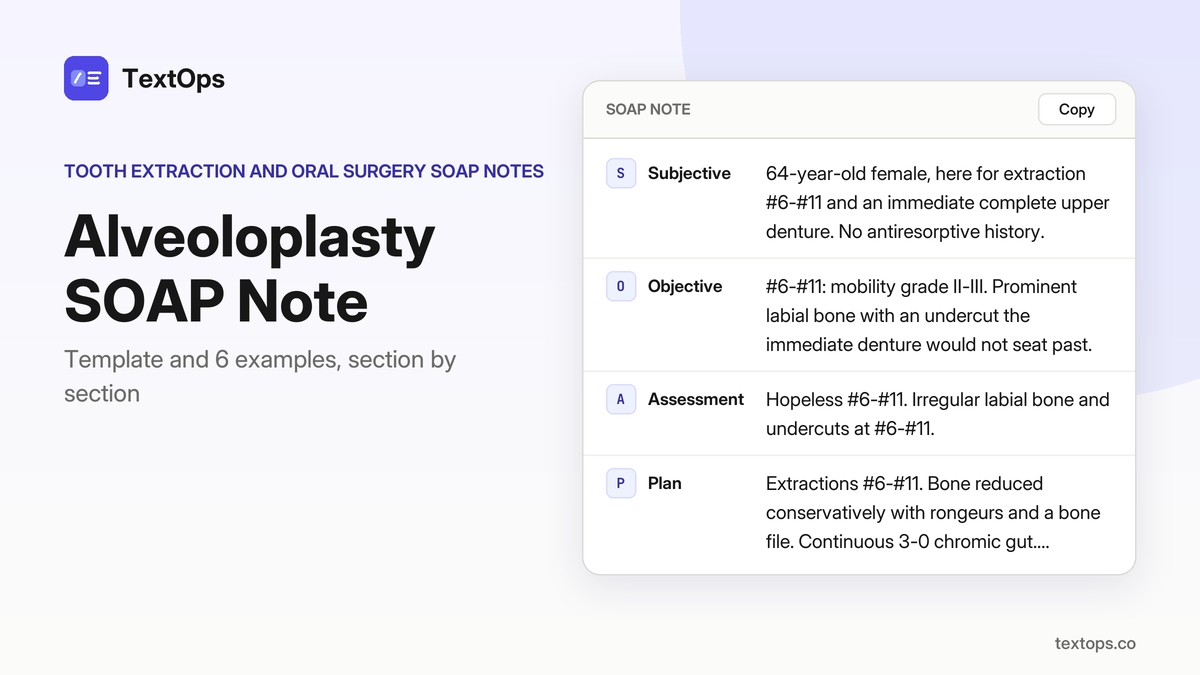
An alveoloplasty note records why the bone needed reshaping, usually to fit a denture, which sites you treated, how much bone you removed, and how the prosthesis will be managed. This page gives you a copy-ready template, what to record in each section, and six examples, with and without extractions.
Teeth use Universal numbering (#1–32). The patients are fictional: replace every finding with what you actually saw and did.
Alveoloplasty SOAP Note Template
Copy the template and fill in the fields in braces.
- Subjective
- {age}-year-old {sex}. Reason: {extractions before a denture / sore spots under a denture / sharp bone after extraction}. Prosthesis plan: {immediate denture / partial denture / new complete denture / implants}. Medical history: {conditions; antiresorptive drugs; radiation}. Medications: {list}. Allergies: {list or NKDA}.
- Objective
- {Teeth to extract and why} / {edentulous ridge}: {sharp crest, bony spicules, undercuts, knife-edge ridge}, at {sites}. Radiograph: {findings}. {Denture sore spots at …}.
- Assessment
- {Irregular alveolar bone / undercuts / knife-edge ridge} at {sites}, {interfering with / risk to} {denture fit}.
- Plan
- Options and risks discussed. Consent signed. Anesthesia: {technique, agent, mL}. {Extractions #…}. Alveoloplasty at {sites, quadrant}: {flap}, {bone file / rongeurs / bur under irrigation}, {conservative removal of …}. Irrigated; closed with {suture type and number}. {Immediate denture placed / existing denture relieved and relined}. Post-op instructions given. Next visit: {date and purpose}.
What to Write in Each Section
Subjective
- Why the bone needs reshaping: extractions before a denture, sore spots under an existing denture, or a sharp edge the patient can feel.
- The prosthesis plan, since alveoloplasty is almost always done to support one.
- Healing risks: antiresorptive drugs, head and neck radiation, diabetes control and smoking.
Objective
- The bone problem: sharp crests, bony spicules, undercuts, a knife-edge ridge, and where they are.
- Teeth being extracted, if any, and why.
- Denture findings: sore spots, ulcers, and where the denture rocks or catches.
Assessment
Name the bone irregularity, the sites, and how it affects the prosthesis, for example “sharp interseptal bone and buccal undercut at #6–#11 sites, would prevent an immediate denture from seating”.
Plan
- Sites and extent, by tooth or tooth space and quadrant, since that determines the code.
- Technique: flap, instruments, and that bone removal was conservative.
- Closure.
- The prosthesis: an immediate denture placed, or an existing one relieved or relined.
- Follow-up, usually within a day for an immediate denture.
Alveoloplasty SOAP Note Examples
| # | Example | Assessment |
|---|---|---|
| 1 | With extractions, before an immediate denture | Irregular bone and undercuts, #6–#11 |
| 2 | With two extractions, before a partial denture | Sharp interseptal bone, #29–#30 |
| 3 | Without extractions, healed ridge | Knife-edge mandibular ridge, #22–#27 sites |
| 4 | Bony spicule after an extraction | Sharp bone at the #19 site |
| 5 | Patient on a bisphosphonate | Alveoloplasty kept minimal, #3–#5 |
| 6 | Next-day immediate denture check | Normal healing; denture adjusted |
1. With Extractions, Before an Immediate Denture
Record every tooth, both quadrants, and that the immediate denture was seated.
- Subjective
- 64-year-old female, here for extraction of her remaining upper teeth, #6–#11, and an immediate complete upper denture. Medical history: hypertension. Medications: losartan. No anticoagulants; no antiresorptive history. Allergies: NKDA.
- Objective
- BP 138/84. #6–#11: mobility grade II–III, PD 6–9 mm. Pan: bone loss to the apical third. Prominent labial bone over #6–#11 with an undercut that the immediate denture would not seat past.
- Assessment
- Hopeless #6–#11 from periodontitis. Irregular labial bone and undercuts at #6–#11 that would prevent the immediate denture from seating.
- Plan
- Options discussed, including extraction with a delayed denture. Consent signed. Labial and palatal infiltration, 2% lidocaine with 1:100,000 epinephrine, 3 cartridges (5.1 mL). Extractions #6–#11 with elevators and forceps; roots intact. Small labial flap; interseptal and labial bone reduced conservatively with rongeurs and a bone file, checked against a clear surgical template. Irrigated; closed with a continuous 3-0 chromic gut suture. Immediate denture seated and adjusted; occlusion checked. Told to keep the denture in for 24 hours. Post-op instructions given. Next visit: tomorrow for denture check.
More examples: Multiple Tooth Extraction SOAP Note.
2. With Two Extractions, Before a Partial Denture
For one to three teeth in a quadrant, record the sites, since the code differs from a full-quadrant alveoloplasty.
- Subjective
- 57-year-old male, here for extraction #29 and #30; lower partial denture planned. Medical history: type 2 diabetes, last HbA1c 7.1%. Medications: metformin. No antiresorptive history. Allergies: NKDA.
- Objective
- #29: fractured to the gingival margin. #30: caries into the furcation. PA: sharp interseptal crest between the two roots of #30 and between #29 and #30.
- Assessment
- Non-restorable #29 and #30. Sharp interseptal bone at #29–#30 that would cause sore spots under the partial denture.
- Plan
- Options discussed, including extraction without bone smoothing. Consent signed. IANB and long buccal, 2% lidocaine with 1:100,000 epinephrine, 2 cartridges (3.4 mL). Extractions #29 and #30; #30 sectioned; roots intact. Interseptal bone smoothed with a bone file; crest checked by palpation through the mucosa. Irrigated; 2 interrupted 4-0 chromic gut sutures. Post-op instructions given. Next visit: 1 week; partial denture impressions after healing, about 8 weeks.
3. Without Extractions, Healed Ridge
On a healed ridge, the note should connect the bone to the denture problem it causes.
- Subjective
- 74-year-old male, edentulous lower jaw for 10 years. CC: "My lower denture hurts every time I chew." Two relines in the past year without lasting relief. Medical history: hypertension. Medications: amlodipine. No antiresorptive history. Allergies: NKDA.
- Objective
- Mandibular ridge at the #22–#27 sites: thin, knife-edge crest; tender to palpation; ulcer 3 mm under the denture at the #24 site. Pan: thin crest; mental foramina at the top of the ridge on both sides.
- Assessment
- Knife-edge mandibular ridge at the #22–#27 sites causing denture pain.
- Plan
- Options discussed: alveoloplasty with a new denture, a soft liner, or implant-supported denture. Patient chose alveoloplasty. Consent signed, including the risk of lip numbness from nearby mental nerves. Bilateral mental nerve blocks and labial infiltration, 2% lidocaine with 1:100,000 epinephrine, 2 cartridges (3.4 mL). Crestal incision; flap raised, mental nerves identified and protected. Sharp crest reduced conservatively with a bone file. Irrigated; closed with 4 interrupted 4-0 chromic gut sutures. Denture relieved and soft-lined. Post-op instructions given. Next visit: 1 week; new denture after healing.
4. Bony Spicule After an Extraction
A small spicule can often be removed with minimal surgery. Record that you ruled out a retained root.
- Subjective
- 33-year-old female, 3 weeks after extraction #19. CC: "Something sharp is poking my tongue." No pain otherwise; no swelling or bad taste. Medical history: none. Allergies: NKDA.
- Objective
- #19 site: healing well; 2 mm sharp bony spicule through the mucosa on the lingual crest. No swelling or purulence. PA: no retained root.
- Assessment
- Bony spicule at the #19 extraction site.
- Plan
- Explained that this is common after extractions. Consent obtained. Lingual infiltration, 2% lidocaine with 1:100,000 epinephrine, 0.5 cartridge (0.9 mL). Spicule removed with a small rongeur; edge smoothed with a bone file. No sutures needed. Post-op instructions given. Next visit: as needed.
More examples: Post-Extraction Follow-Up SOAP Note.
5. Patient on a Bisphosphonate
For a patient on an antiresorptive drug, record the drug, the risk discussion and how you kept bone removal to a minimum.
- Subjective
- 69-year-old female, here for extraction #3–#5 before an upper partial denture. Medical history: osteoporosis. Medications: oral alendronate weekly for 5 years. No cancer history. Allergies: NKDA.
- Objective
- #3–#5: hopeless from periodontitis; mobility grade III. No exposed bone anywhere in the mouth. PA: bone loss to the apical third; sharp interseptal crests.
- Assessment
- Hopeless #3–#5. Sharp interseptal bone at #3–#5. Risk of medication-related osteonecrosis of the jaw (MRONJ) from long-term oral alendronate.
- Plan
- MRONJ risk explained; patient told not to stop alendronate without her physician's advice; letter sent to her physician. Consent signed. Buccal and palatal infiltration, 2% lidocaine with 1:100,000 epinephrine, 2 cartridges (3.4 mL). Extractions #3–#5 with minimal trauma. Only the sharpest interseptal edges smoothed with a bone file; no flap; no bone removal beyond that. Primary closure with 3 interrupted 4-0 chromic gut sutures. Post-op instructions given. Next visit: 1 week, then 8 weeks to check for exposed bone before denture impressions.
6. Next-Day Immediate Denture Check
The day after an immediate denture, record the first removal, the tissues and any adjustments.
- Subjective
- 64-year-old female, 1 day after extractions #6–#11, alveoloplasty and immediate upper denture. Sore but manageable; mild oozing last night, stopped. Kept the denture in as told.
- Objective
- Denture removed: sockets #6–#11 with clots in place; suture intact; mild swelling of the upper lip. Sore spot on the labial mucosa at the #7 site from the denture flange.
- Assessment
- Normal healing after alveoloplasty and extractions #6–#11. Denture sore spot at the #7 site.
- Plan
- Flange relieved at the #7 site; occlusion rechecked. Shown how to remove, clean and reinsert the denture. Next visit: 1 week for suture removal check; reline expected in 3–6 months as the ridge heals.
Codes
Check the current CDT manual for exact descriptors.
- D7310: alveoloplasty in conjunction with extractions, four or more teeth or tooth spaces, per quadrant.
- D7311: alveoloplasty in conjunction with extractions, one to three teeth or tooth spaces, per quadrant.
- D7320: alveoloplasty not in conjunction with extractions, four or more teeth or tooth spaces, per quadrant.
- D7321: alveoloplasty not in conjunction with extractions, one to three teeth or tooth spaces, per quadrant.
Examples 1 and 3 each span two quadrants, three teeth or tooth spaces in each (#6–#8 and #9–#11; #22–#24 and #25–#27).
Mistakes to Avoid
- No prosthesis plan. Alveoloplasty is done to support a prosthesis; record which one.
- No sites or quadrants. The code depends on the number of teeth or tooth spaces per quadrant.
- Not saying bone removal was conservative. Ridge bone doesn’t grow back; record that you kept it to what was needed.
- Missing antiresorptive history. Record the drug or its absence.
- Calling every post-extraction visit an alveoloplasty. A dry socket or a normal healing socket is not an alveoloplasty.
Frequently Asked Questions
What should an alveoloplasty SOAP note include?
The reason and prosthesis plan, and healing risks (S); the bone irregularities and their sites, and any teeth to extract (O); the irregularity and its effect on the prosthesis (A); and consent, anesthesia, extractions, sites and technique, closure, the prosthesis and follow-up (P).
When is alveoloplasty done?
Most often at the time of extractions, to smooth sharp bone and remove undercuts before a denture, or later on a healed ridge when sharp or irregular bone makes a denture painful.
Is a bony spicule after an extraction an alveoloplasty?
Removing a small spicule is a minor procedure. Some practices code it as an alveoloplasty for one to three tooth spaces; record what you removed and how, and check with your payer.
Can you do alveoloplasty for a patient on bisphosphonates?
It needs extra care. Keep bone removal to a minimum, aim for primary closure, record the MRONJ risk discussion, and contact the prescribing physician. For patients on high-dose IV antiresorptives for cancer, elective bone surgery is usually avoided.
For the general structure of a dental note, see the dental SOAP note template.
These examples show structure and wording only. The patients are fictional. Record what you actually found and did, and follow your practice’s documentation requirements and the rules where you work.